Richard created his foundation with artists like you in mind: to share his knowledge, educate and inspire generations of painters, and continue the spirit of learning that meant so much to him.
This October 2 to 4, his foundation and the historic Palette & Chisel come together for Celebrating Richard Schmid’s Legacy, and I invite you, artists from around the world, to join us for a global weekend devoted to painting and learning.
 Richard Schmid, Study of Diana, 1986, oil on canvas, 22 x 19” (55 x 48 cm)
Scott Burdick, Rose Frantzen, Daniel Gerhartz, Clayton J. Beck III, Susan Lyon, Romel De La Torre and myself—all deeply connected to Richard and his teaching—will paint, demonstrate and share what we learned from him and carry into our own work.
On Saturday, October 3, the seven of us will paint together in a collaborative day of painting and teaching, sharing how Richard influenced the way we see, think and paint. On Sunday, individual portrait demonstrations will give you a rare opportunity to see how each artist thinks, makes decisions and brings a painting to life.
This exhibition will bring together 36 portraits Richard painted from life at the P&C, along with 14 additional works—50 original works in all. Together, they offer a rare opportunity to study Richard’s drawing, values, color, edges, brushwork and the beautiful choices behind his paintings. The entire event will also be available online.
The paintings I have written about for you in the following pages are part of this special exhibition. It is my privilege to share with you what Richard so generously shared with us—and, in my own way, to carry forward his spirit of teaching.
Study of Diana
I sat next to Richard, along with other members of the P&C, while he painted Diana. What I remember most is the color. It was amazing! I had never seen color like this before. I was watching Richard work in a high key, although at the time I don’t think I fully understood just how carefully he was controlling the values to create that effect.
Richard later explained that painting in a high key was really quite simple: hold back the dark values and paint the light values as they are. In Study of Diana, he made a very deliberate decision not to go darker than a 5 on the value scale. Any value in the subject that was darker than 5, he raised to 5 in the painting. Think about that: he wasn’t simply copying the values he saw in front of him. He was controlling them. By keeping most of the painting within the lighter values, Richard created that beautiful high-key effect, and all that wonderful color had a chance to sing.
He taught us that values could be manipulated this way to create different feelings of atmosphere and emotion. A high-key painting uses primarily the lighter portion of the value scale; a low-key painting does just the opposite, relying mostly on the darker values.
Sitting beside him and watching Diana unfold was a lesson I have never forgotten. He showed us that high key wasn’t simply about making a painting lighter. It was about controlling the values so that light, color and atmosphere could become the painting.
Portrait Sketch
Imagine having the privilege of sitting beside this master three times a week, witnessing firsthand the unfolding of his craft, from the very first wash and block-in to the final, decisive stroke. Here are rare sequences from the Palette & Chisel in 1987 of Richard painting Portrait Sketch. We did not have cell phones at the time, so having these photographs today is especially meaningful as we document his years at the P&C.
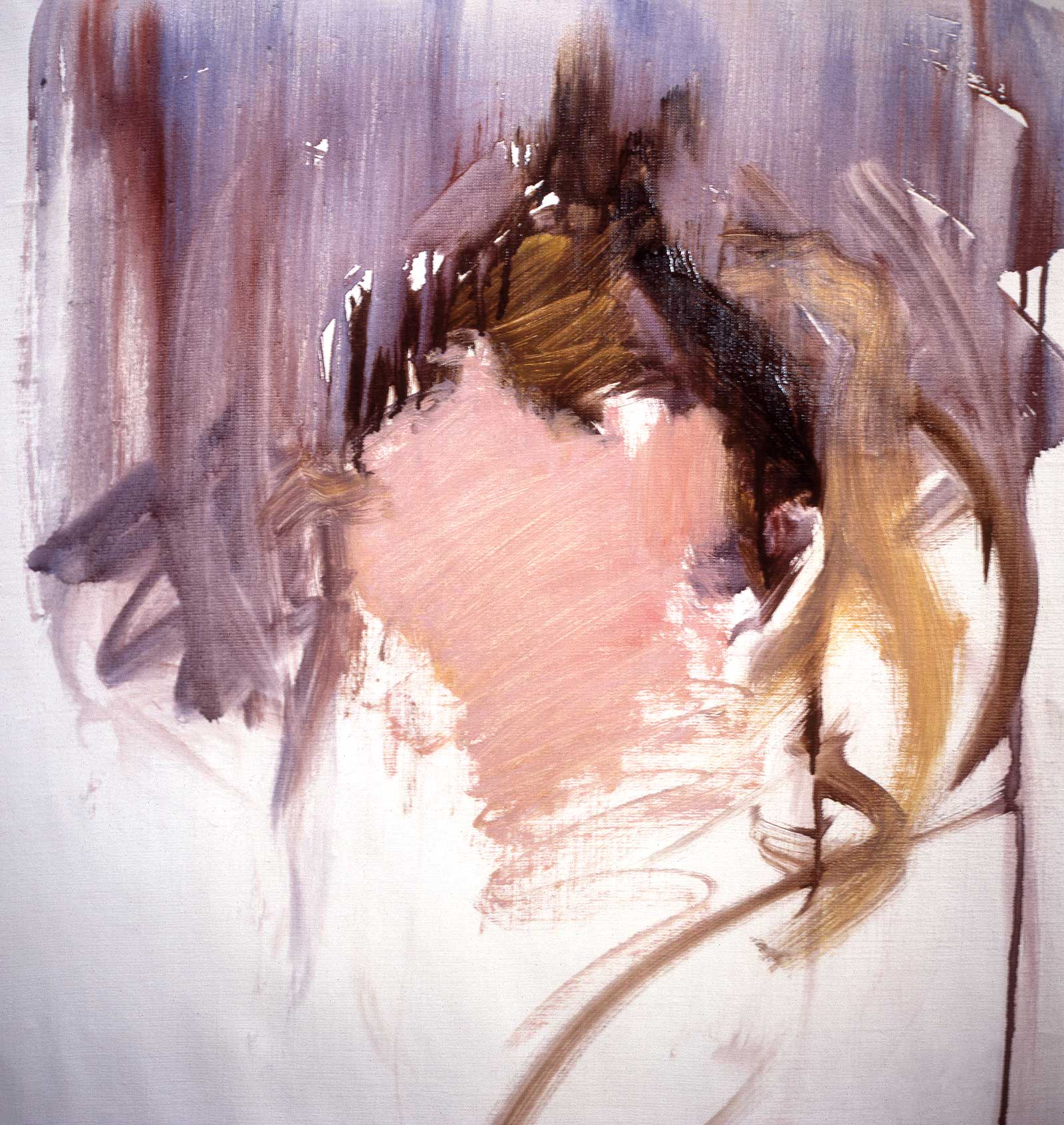
Stage 1
Stage 1
In the first stage, Richard began with a cool wash; however, in places you can still see the white of the canvas showing through. He establishes his skin color and the darkest dark in the black headband. Look at all the beautiful color and harmony already there from the very beginning.
Notice the background as well. Richard establishes the correct value early. He later changes the color, introducing warmer tones, but the value remains essentially the same. For Richard, getting a strong and accurate start was so important. As he would often say to us, a beginning like this gives you confidence and a clear direction for everything that follows.
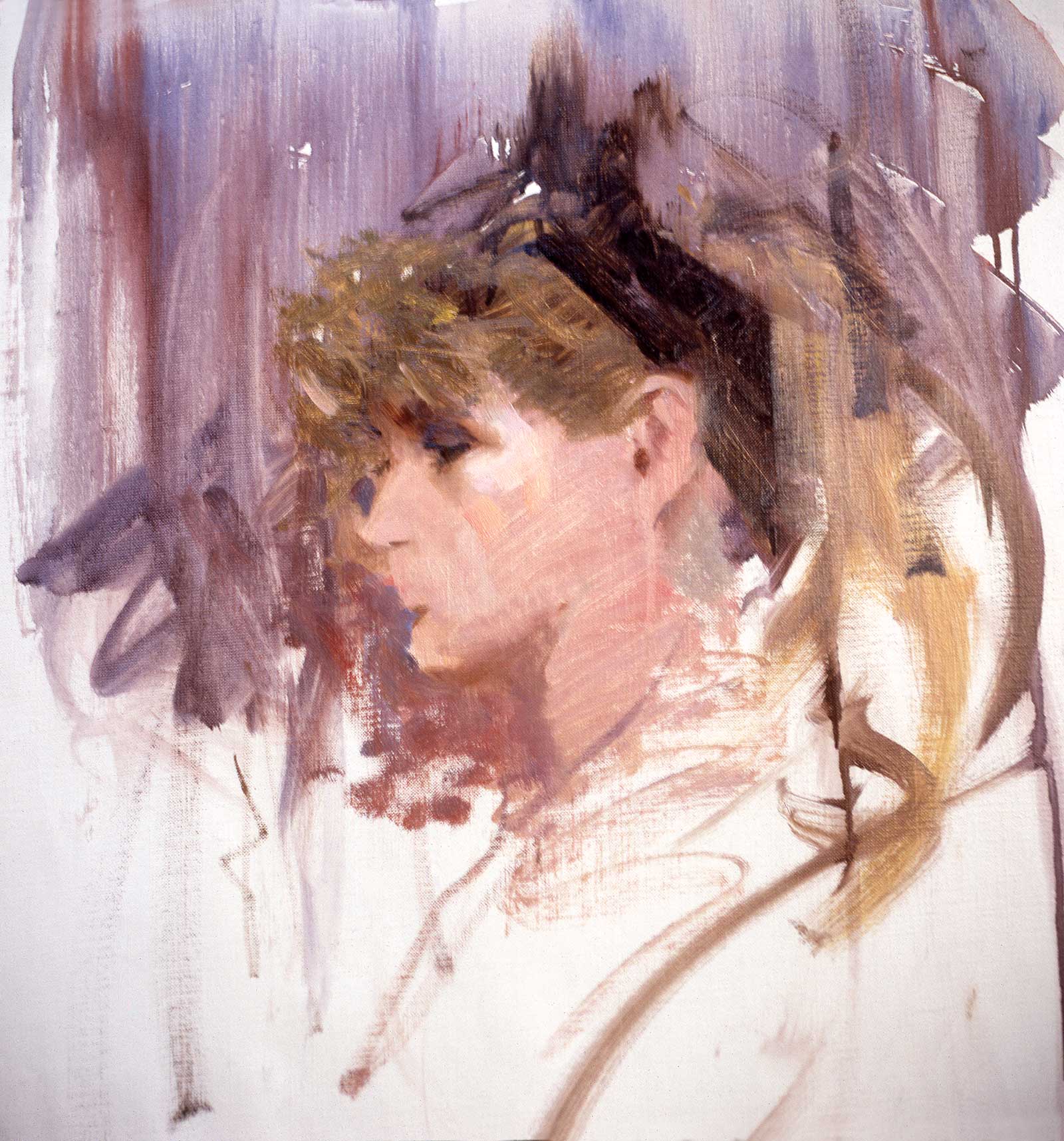
Stage 2
Stage 2
Richard once shared with me that he had three sure ways he loved to paint. He developed approaches he knew would lead him toward a good painting. When you have only three hours, he explained, you need a plan that works. This sequence shows one of the ways he liked to paint a head: begin with a great block-in, establish the flesh tones, and then slow down and get the shapes of the drawing correct.
Drawing: The eye and eye socket are complete! Then he carefully establishes the correct shapes of the nose, mouth, chin, ear, and neck. He makes it look simple and beautiful. He would often say, “Portrait painting is about taking complexity and making it simple.”
And look at the drawing of her headband. What a powerful shape!
Values: Look at her thick bangs and how their value merges into the eye socket. Another beautiful example is the shadow of her neck merging with the background, the same value creating one continuous shape.
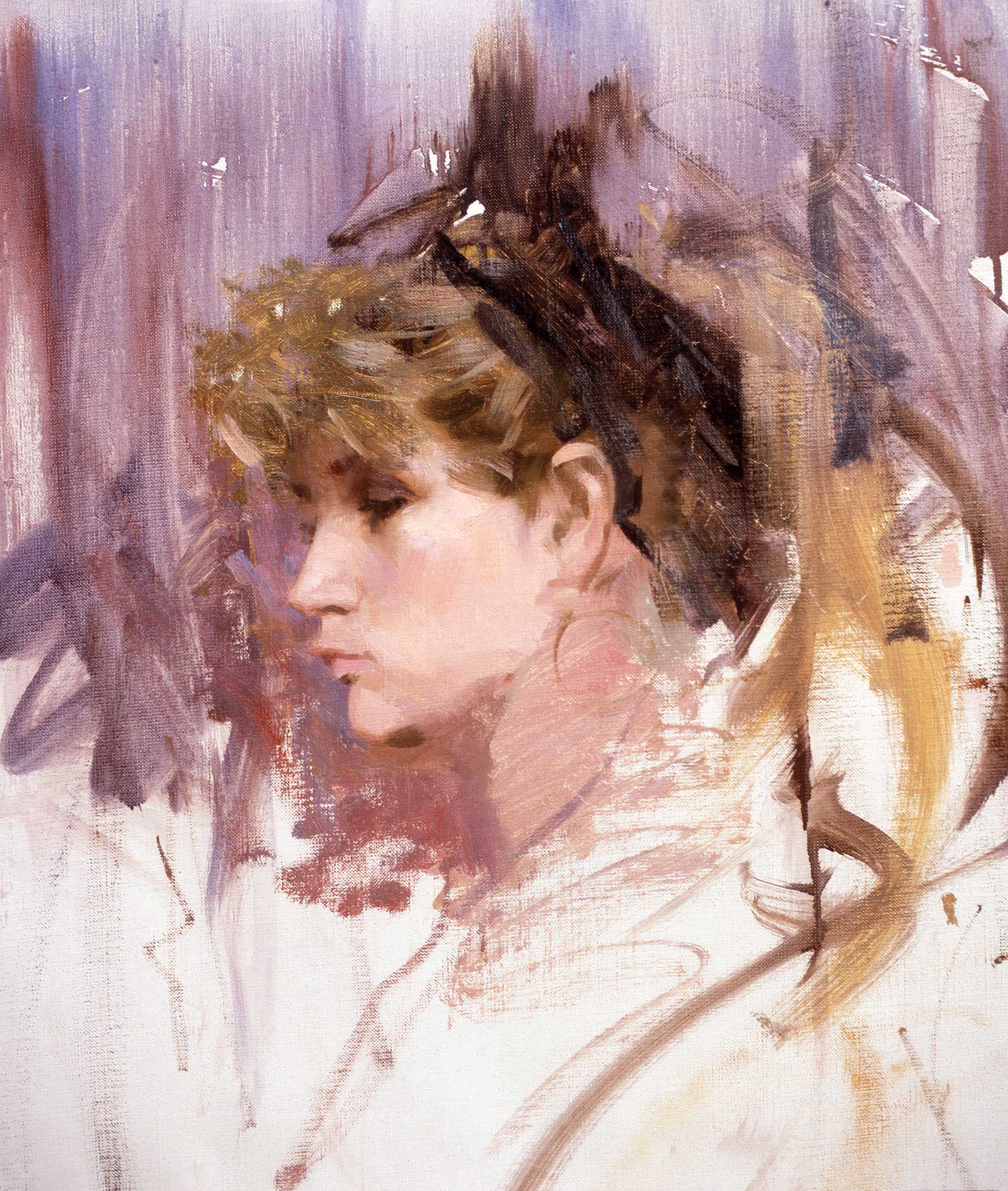
Stage 3
Stage 3
I watched him do this many times. After his stage one block-in, he would move into a great lesson of his teaching: completing each area correctly as he went. Here you see Richard finishing the features before moving on to the hair, neck and background. And remember, it was that incredible stage one block-in that gave him the foundation to do this with confidence. This stage also reminds me of something he would say to us ladies with a laugh about painting skin: “It should be easy for you—it’s like putting on makeup. Some of you do that every day.” He also indicates the darker shadow browns of the hair in front of the diagonal headband and toward the ear, arranging them into interesting shapes. Then he paints in a few lighter hairs in front of the shadow, and suddenly the hair looks so real.
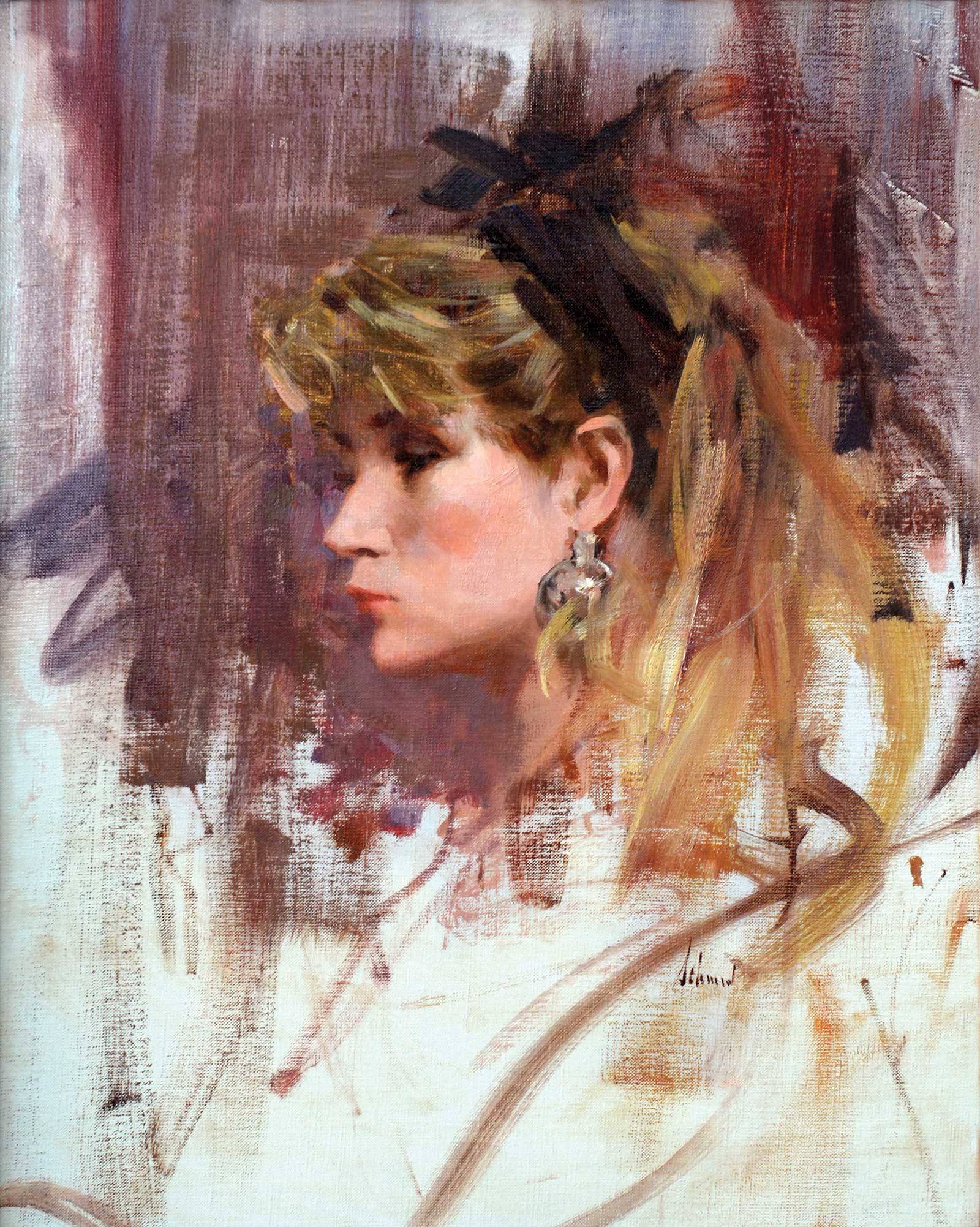
Stage 4: Richard Schmid, Portrait Sketch, 1987, oil on canvas, 20 x 16” (50 x 40 cm)
Stage 4
The earring: This was one of Richard’s favorite things to paint. Just a few strokes of silver, made up of a beautiful variety of grays, and then he adds a highlight or two.
Edges: Look closely in the light areas of her face, from the nose and chin to the ear—almost no visible edges. The drawing remains strong and precise, yet the edges within the light areas are beautifully soft. Richard paints the hair with mostly soft edges using dry brush techniques, giving the hair its soft, natural appearance. Around the hair and where the hair meets the face, the edges remain soft. The ear itself becomes a little adventure of hard and soft edges, each appearing in just the right place.
Design: Richard would say, “I want the viewer to see my painting first, not my design.” And he does exactly that. Yet look again. Do you see the beautiful design he created? Even when painting something as intimate as a head, Richard reminds us: think design.
Paul Mullally
I was there in 1989 when Richard painted his friend and fellow artist Paul Mullally during a demonstration at the Palette & Chisel. What an amazing portrait demonstration to witness! Richard later used this painting to introduce his teaching on drawing, and when you look closely, you can see why.
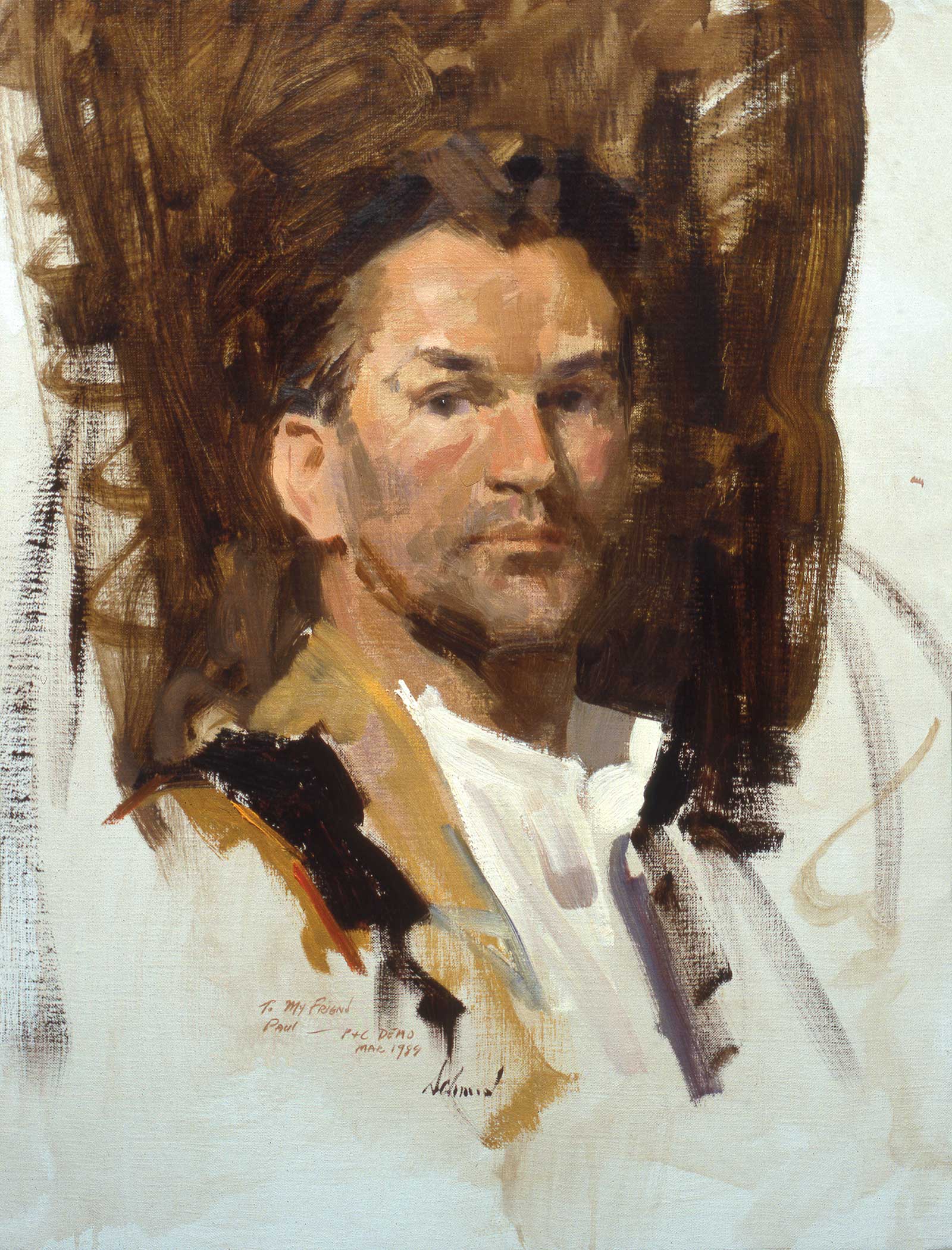
Richard Schmid, Paul Mullally, 1989, oil on canvas, 24 x 18” (60 x 45 cm)
Drawing: Richard taught us that drawing in painting was not simply about lines or outlines. It was about seeing shapes correctly. Look closely at Paul’s face and shirt. They are made up of distinct shapes of color, almost like a mosaic of light falling across him. Many of those shapes are so clearly defined that you could actually draw an outline around them. Richard did love to count, so of course he counted these shapes too. There are approximately 115 individual shapes of color in Paul’s face, while the shirt and vest were painted with only 15 to 18 brushstrokes. Think about that. So much information and yet such economy.
Block-in: The beginning was even simpler. Richard explained that he needed only a few main value shapes to establish Paul. One large, connected dark shape brought together the hair, background, shadows of the facial features, part of the shirt and the right eye. The light side of the face, neck and collar became another largely connected middle value shape. The shirt formed the lightest painted value, while the next light value was the actual canvas Richard allowed to show through in other places.
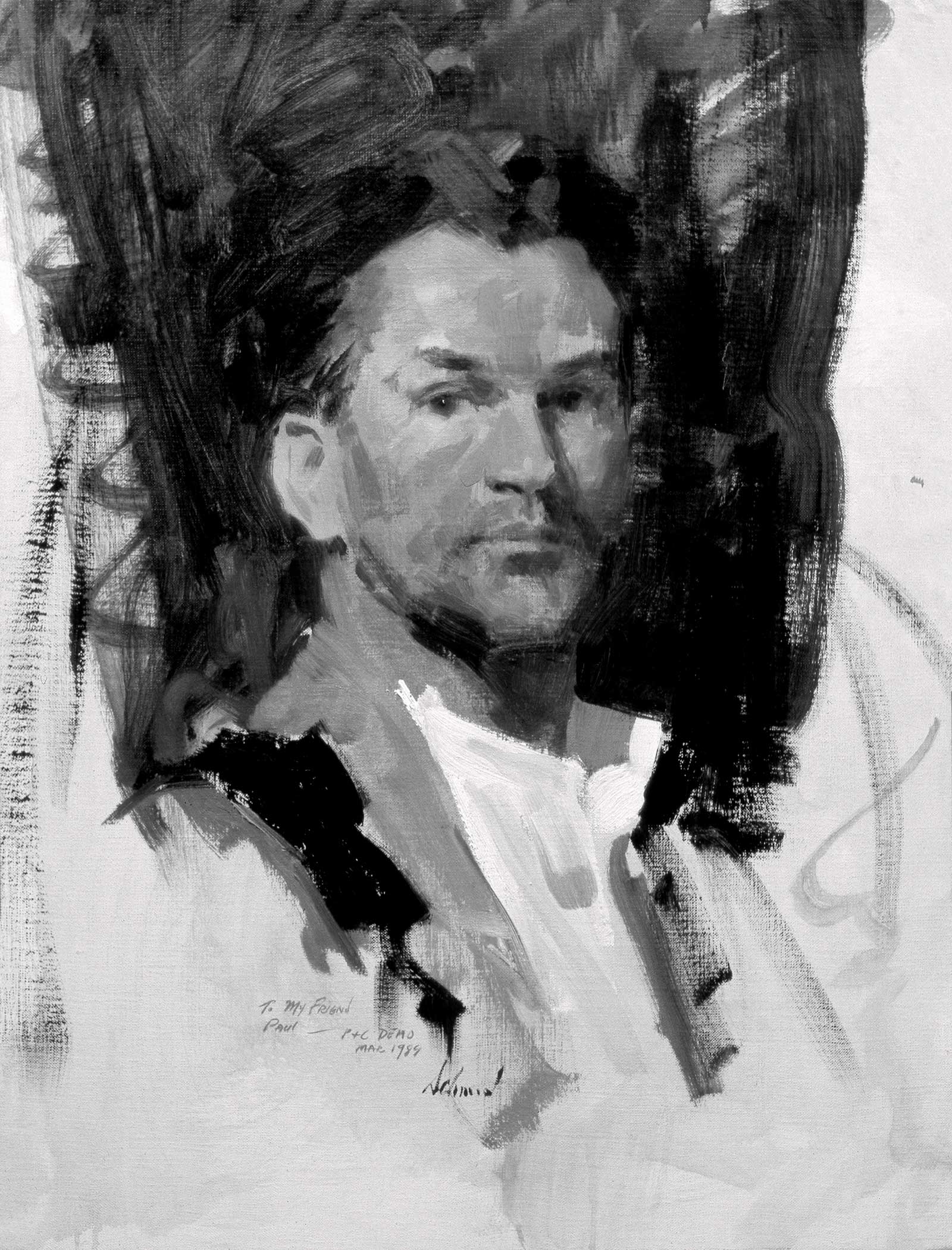
Paul Mullally in black-and-white
Only a handful of large value shapes, and Paul was already there. Richard taught us that you don’t need every detail to make a person appear. You need the right shapes, the right values and the right relationships. That was part of the magic of watching Richard paint. With surprisingly little information on the canvas, suddenly there was Paul looking back at us! The details could come later. The likeness was already there because Richard had found what was essential.
Erin – Susan Lyon’s Niece
Artist Susan Lyon arranged for her 8-year-old niece, Erin, to pose for all of us at the Palette & Chisel. It was there, in 1990, that Richard painted this timeless portrait of young Erin. When painting children, Richard understood that two things were especially important. First, take good care of your model. A child must be comfortable, happy and safe. The pose should be easy to hold, with plenty of creative and fun breaks. Good music, stories and books on tape can help make the experience enjoyable.
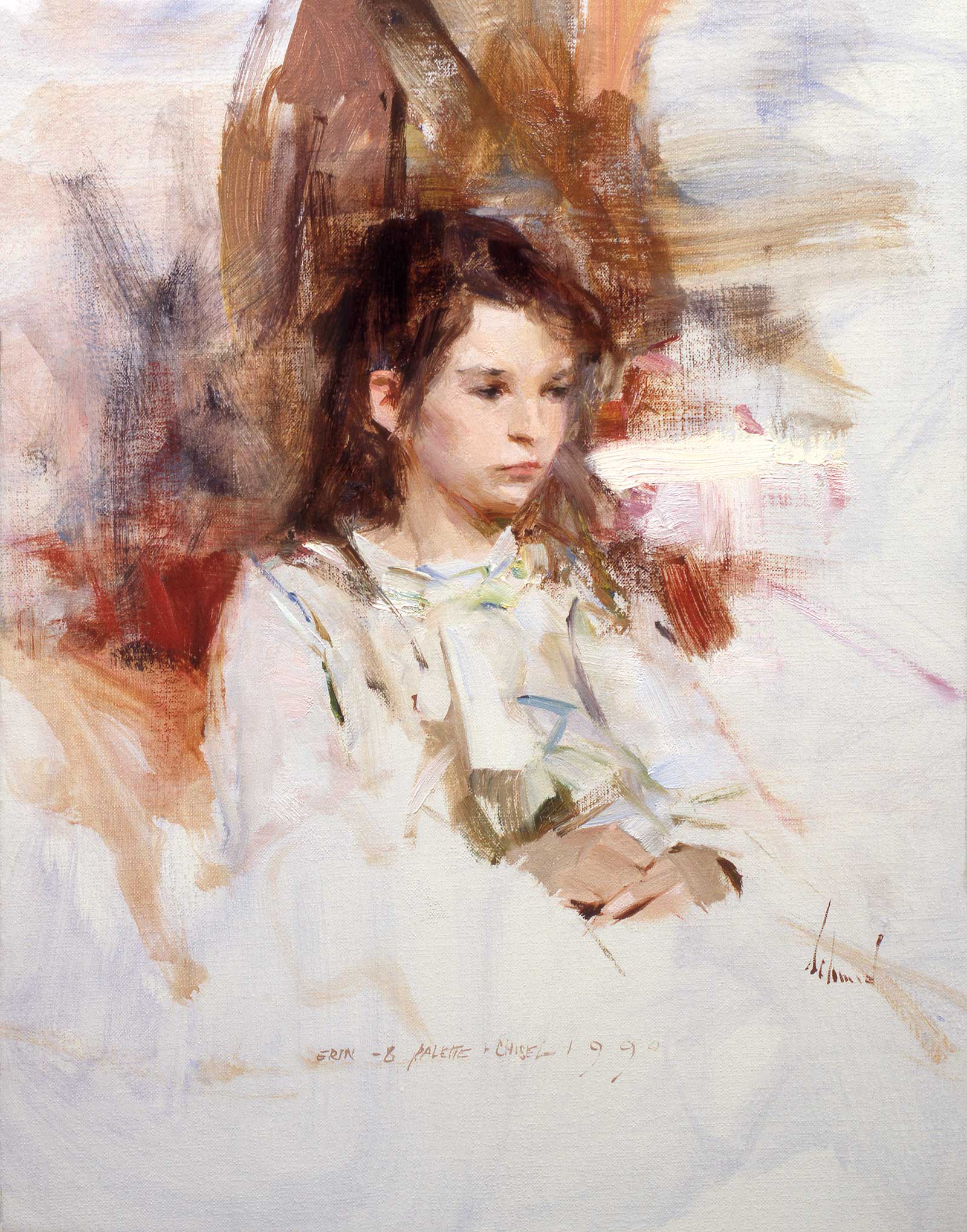
Richard Schmid, Erin – Susan Lyon’s Niece, 1990, oil on canvas, 20 x 16” (50 x 40 cm)
The second responsibility belongs to the artist: be ready. Everything should be ready before the child ever sits down. The easel should be set, the palette prepared with fresh colors, and the brushes clean and ready. With a young model, there is no time to waste struggling with equipment or searching for supplies. You want to be able to give your full attention to the painting and to the child.
Richard began Erin with a beautiful bluish-purple wash. What fascinates me is that he allowed so much of that initial wash to remain visible in the finished painting, especially along the bottom and right side, and even within her blouse. It became part of the color harmony rather than something that needed to be completely covered.
He established the flesh color and value of the face before describing the shapes of the individual features. Look how simple he makes it look. I also learned so much from watching Richard simplify Erin’s hands. He was painting a child from life, so every stroke had to count. Rather than describe every finger and every little turn of form, he found the larger shape, the gesture and just enough information to make the hands feel completely natural.
That was one of Richard’s great lessons: simplicity does not mean leaving something unfinished. It means knowing what is essential. As we discuss Richard’s painting of Erin, a quotation from his book, Alla Prima II, comes to mind: “The most important thing in art is to know what is important.”
When I look at Erin, I see that philosophy everywhere, in the quiet edges of her face, the beautifully understated hands, the untouched passages of the original wash, the dark background with its broad, creative brushstrokes and the blouse, which is a little masterpiece of painting all on its own. In this painting, we see Richard’s extraordinary ability to say so much with so little.
Bandeau
During one of our three-hour evening painting sessions at the P&C, Richard created Bandeau as we all painted alongside him. I remember Richard sharing with me that he found men easier to paint than women and children. He especially loved painting beards and angular facial bone structures, like those of this model. I laughed when he joked that a beard and bandeau like this conveniently took care of some of the hard parts! For him, the eyes, nose and ears were no problem. He found the jawline, chin and mouth to be the most demanding features.
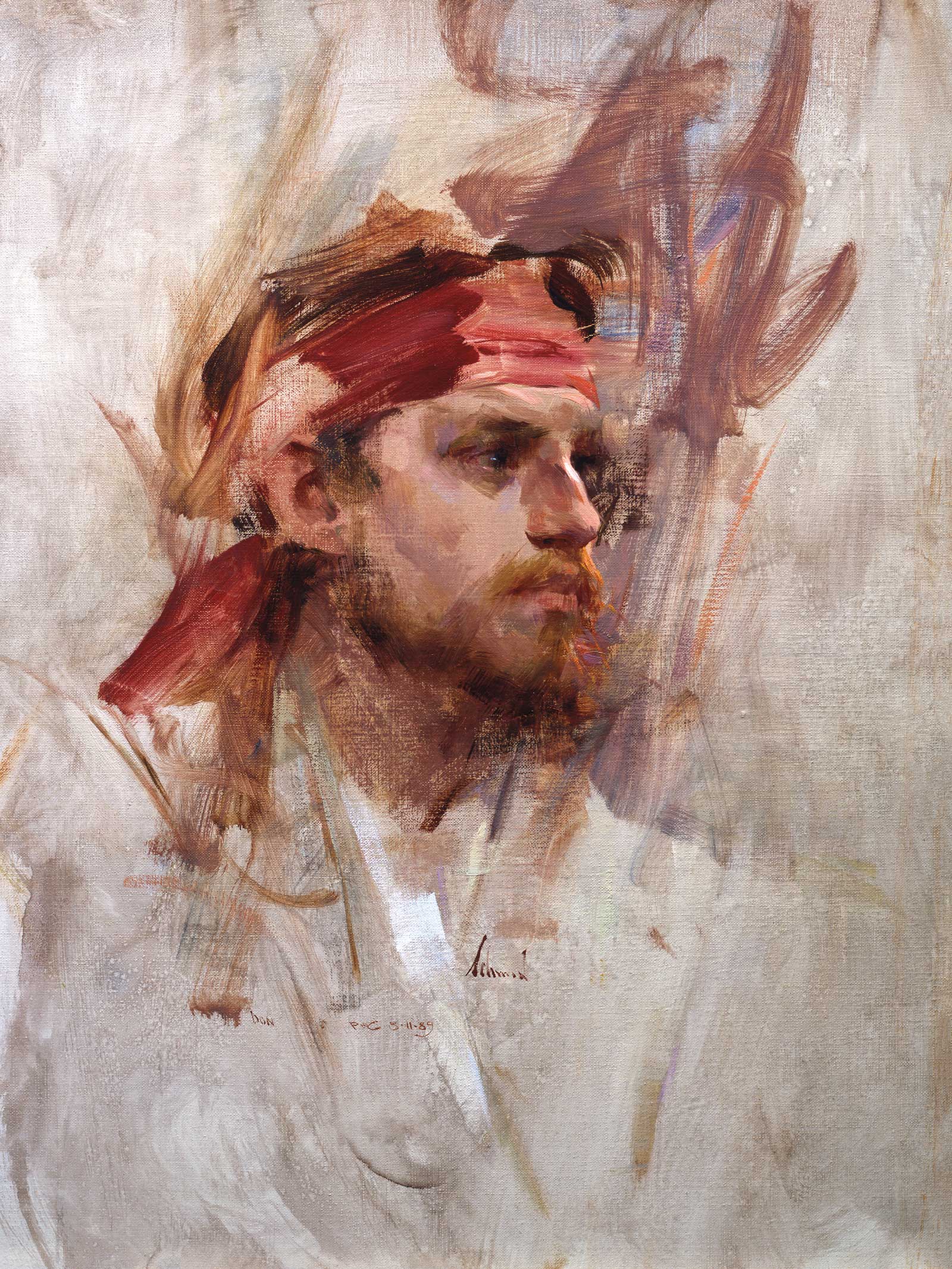
Richard Schmid, Bandeau, 1989, oil on canvas, 24 x 18” (60 x 45 cm)
Edges: Look closely around the beard and mustache. Notice how Richard varies the edges—medium-soft where the beard meets the skin, soft throughout, and in most places completely lost. Then follow the red bandeau and watch its edges change from crisp and clearly defined to completely lost where it merges into the same value as the hair and where it meets the top of the ear. Who knew edges could be this beautiful?
Richard would describe edges not as mechanical borders but as subtle, poetic and musical elements of expression, allowing the paint to whisper or shout. Richard himself regarded Bandeau as one of the most rewarding portraits he had ever painted.
The entire two-day weekend for Celebrating Richard Schmid’s Legacy is recorded and will be available for up to six months, giving attendees the chance to return, study and learn from the demonstrations again and again. To learn more, visit richardschmidfoundation.org and paletteandchisel.org.