In the summer of 1926, Rockwell Kent came to Ireland to paint. Seeking isolation, he stayed in the remote valley of Glenlough, a sparsely populated area on the West coast of Donegal. An influential American artist of the 20th century, Kent is celebrated for his repeated portrayal of secluded landscapes and isolated locations. While much attention has been given to his paintings of Alaska and Greenland, in the broader narrative of Kent’s career his time spent in Ireland has received comparatively less recognition.
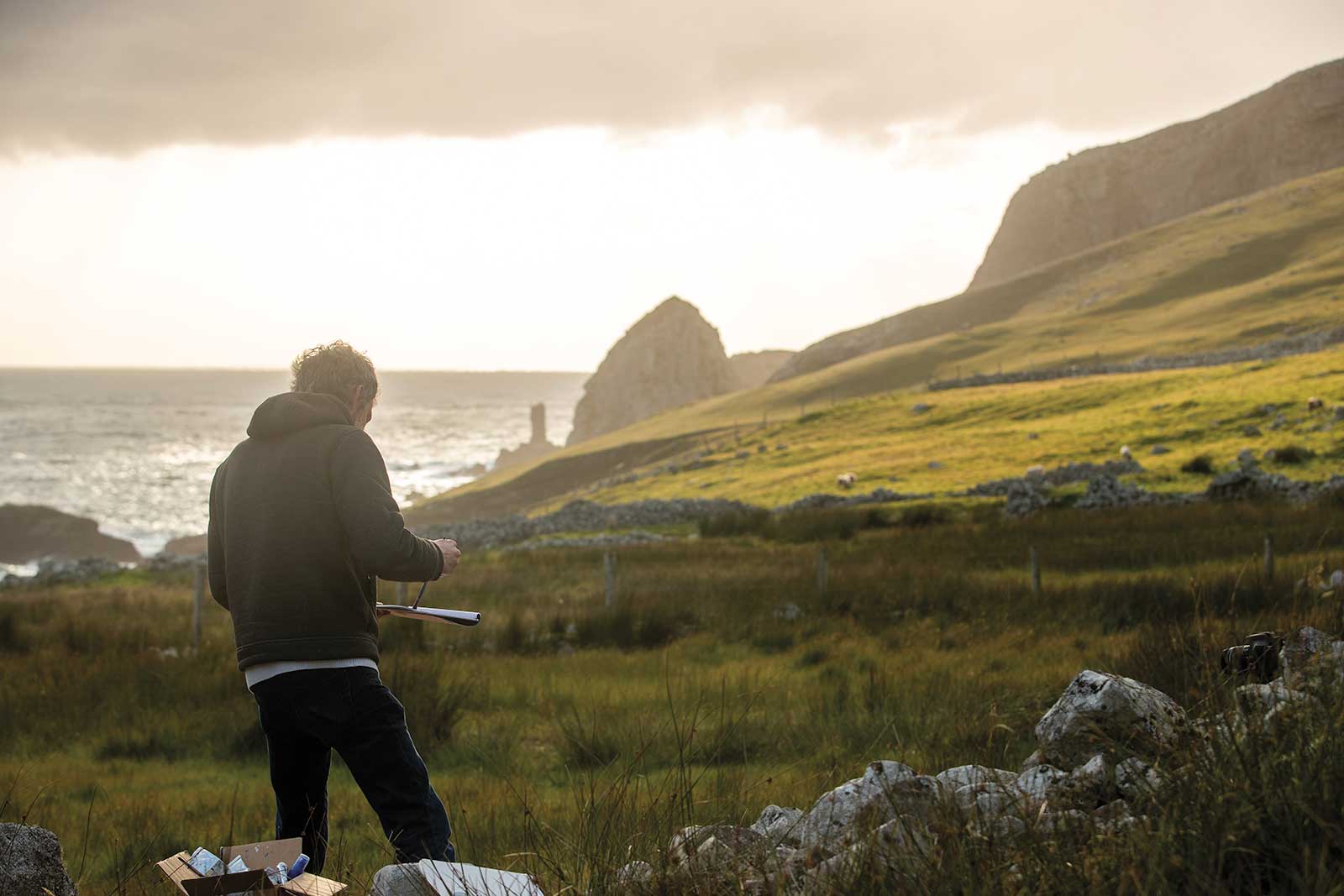
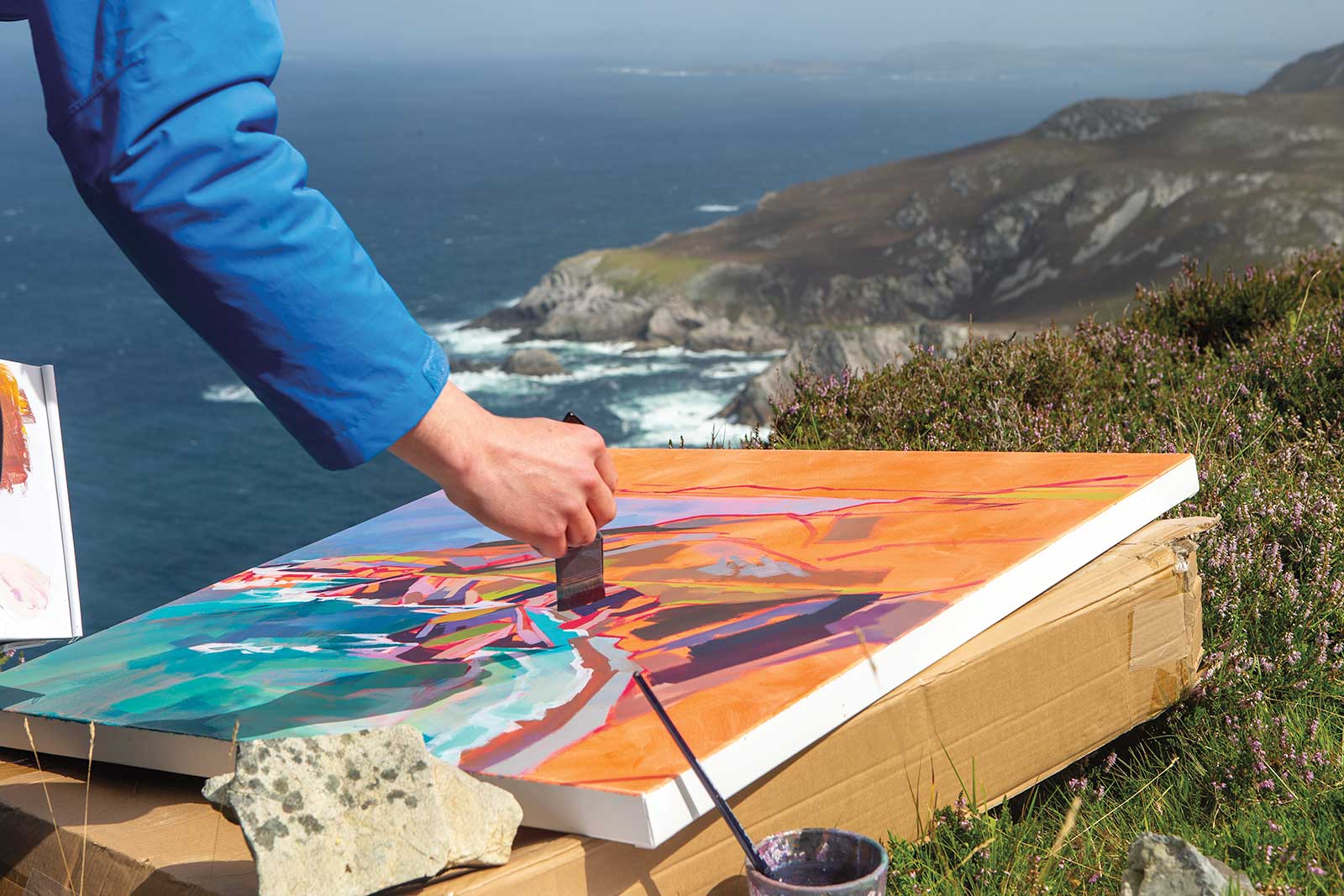
Painting Irish Sun on location. Photo by Darragh Gorman.
One hundred years later, inspired by his lingering legacy in Donegal, I revisit the scenes of his Irish work. They convey a strong sense of place and tell the story of this distinctive landscape. In an exploration of this period in his work, I set out to see what he saw, embarking on a journey to the locations of some of his key works, exploring and painting the Atlantic coastline that never rests. From a distance, the landscape seemed familiar: steep valley walls, sea stacks, exposed Atlantic coastline and the particular sense of isolation that runs through Kent’s Donegal work. But paintings and photographs can only take you so far. They can suggest a place, but they cannot fully convey its scale, the effort required to reach it or the way the weather can alter everything within minutes.
That was what I wanted to understand.
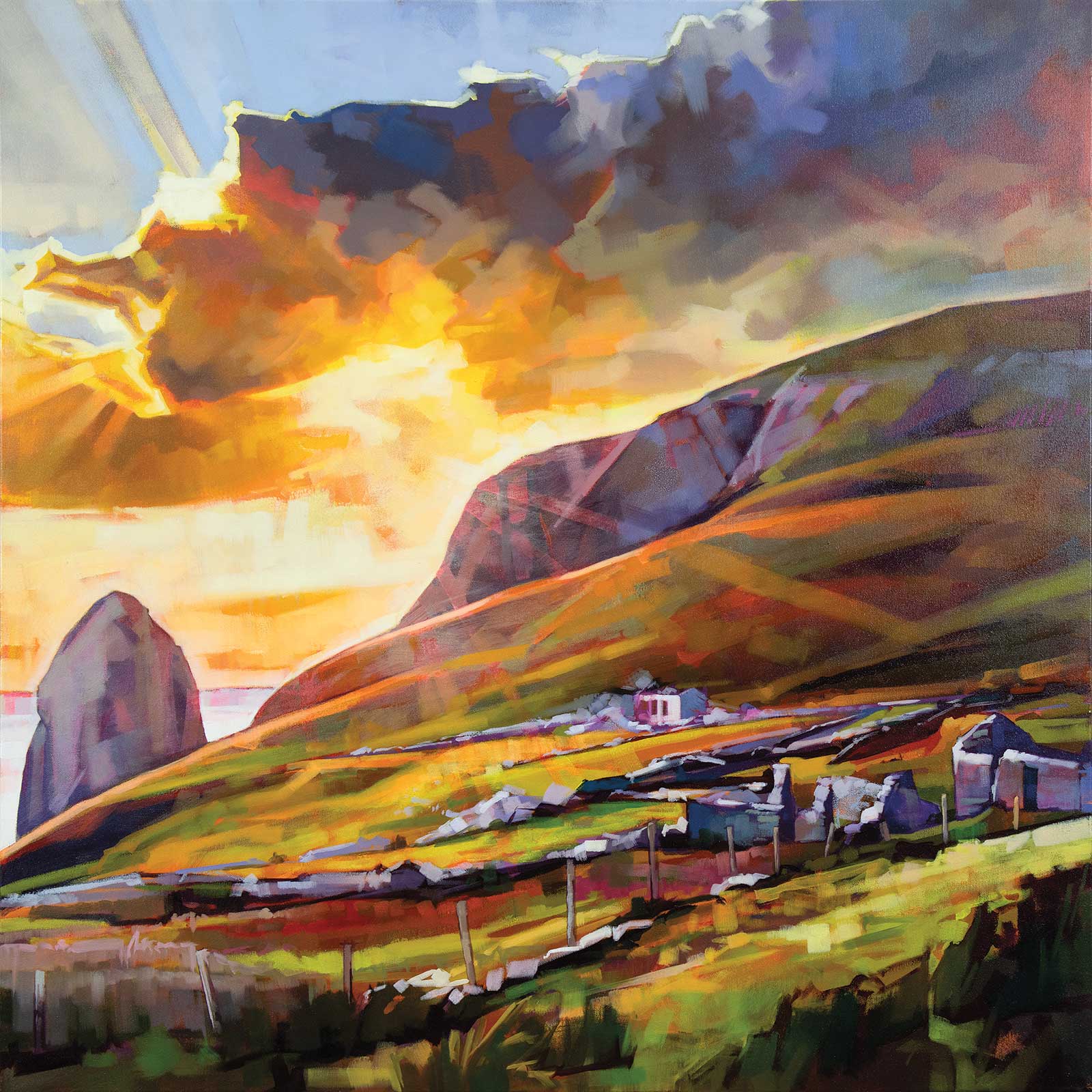
Irish Sun, oil and acrylic on canvas, 39½ x 39½” (100 x 100 cm)
I began by selecting a group of Kent’s Donegal paintings and trying to identify the locations from which they had been made, a task made much easier with the help of local historian Christy Gillespie’s research, particularly his book The Road to Glenlough. The plan was to compare cliff profiles, horizons and the relationships between land and sea to those in Kent’s paintings.
At first, I thought the task would be largely visual. In reality, finding the viewpoints often depended just as much on understanding the practical decisions of a painter working outdoors.
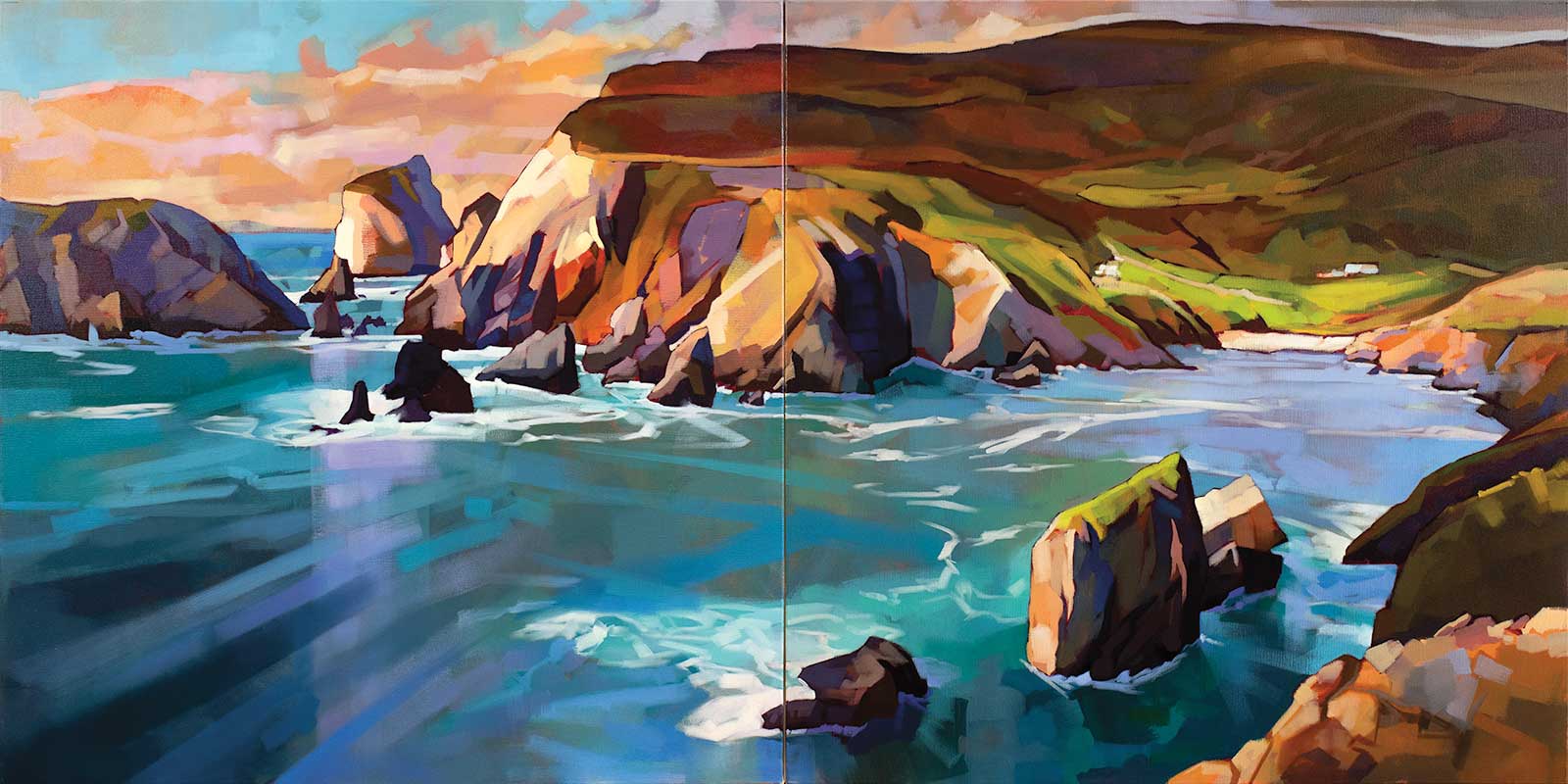
Skelpoonagh Bay (diptych), oil and acrylic on canvas, 31½ x 63” (80 x 160 cm)
One of the first Kent paintings we searched for was Irish Coast. Photographer Darragh Gorman and I traveled to Port (an abandoned village and the closest road to Glenlough valley) the previous evening and slept in our vans. The next morning, we climbed Port Hill carrying canvases, paint, water, waterproofs and camera equipment.
The wind was strong, so after crossing the higher ground we moved a little way down the Glenlough side of the hill in search of shelter. When I put down the canvases and looked out again, the landscape suddenly aligned with Kent’s painting. It was the place we had been looking for.
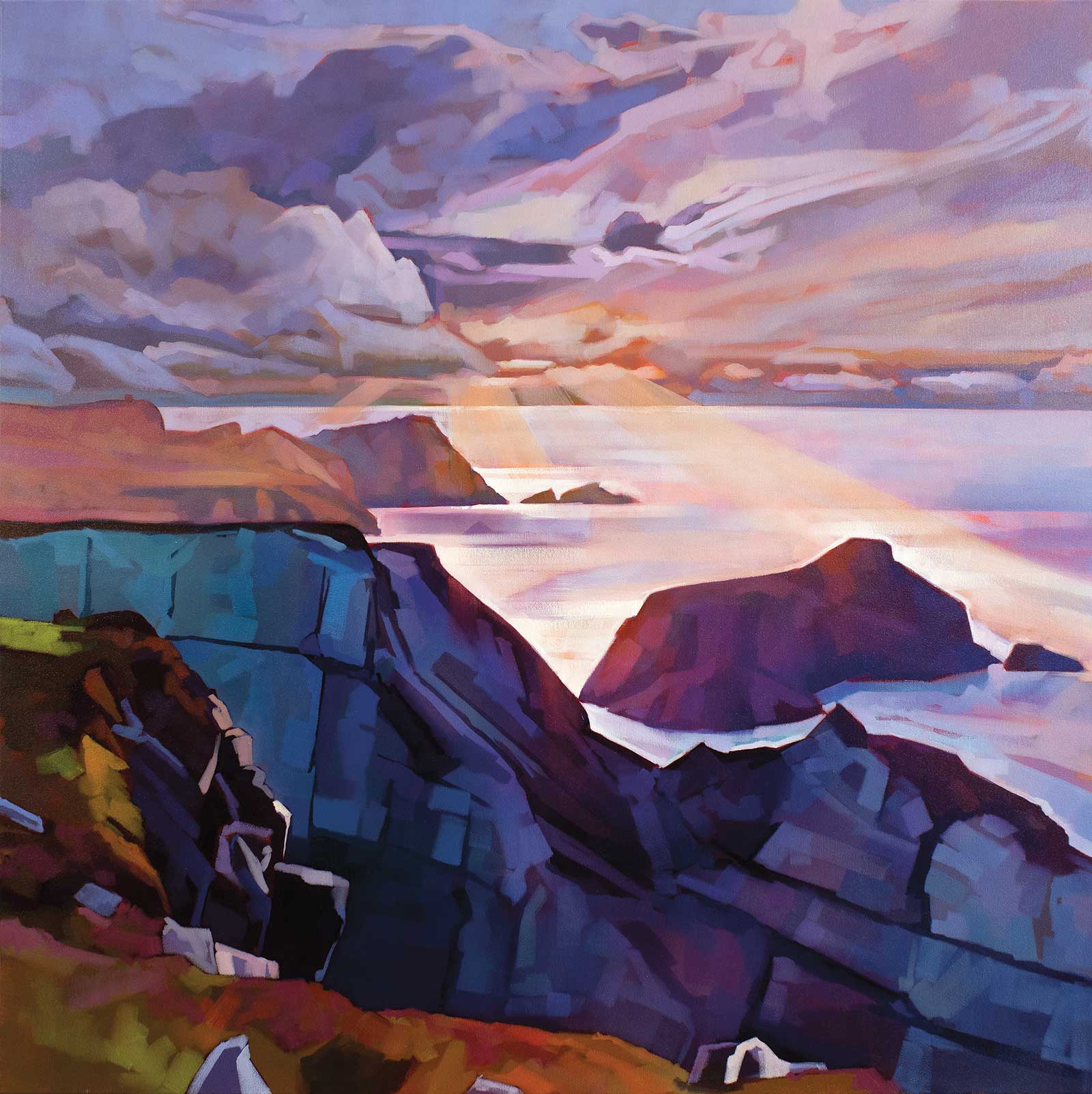
The Sturrall, oil and acrylic on canvas, 39½ x 39½” (100 x 100 cm)
What interested me was not simply that the cliffs and coastline matched. The sheltered hollow explained why Kent might have chosen that exact position. It was one of the few places where a painter could realistically remain and work without being completely exposed to the wind.
Finding the viewpoint changed my understanding of the painting. It was no longer an image I had studied in reproduction, it became the result of a physical decision made in difficult conditions. For a moment, it felt almost like stepping into another person’s memory. That connection was important, but it was only the starting point. Once I began to work, the landscape started to lead me in its own direction.
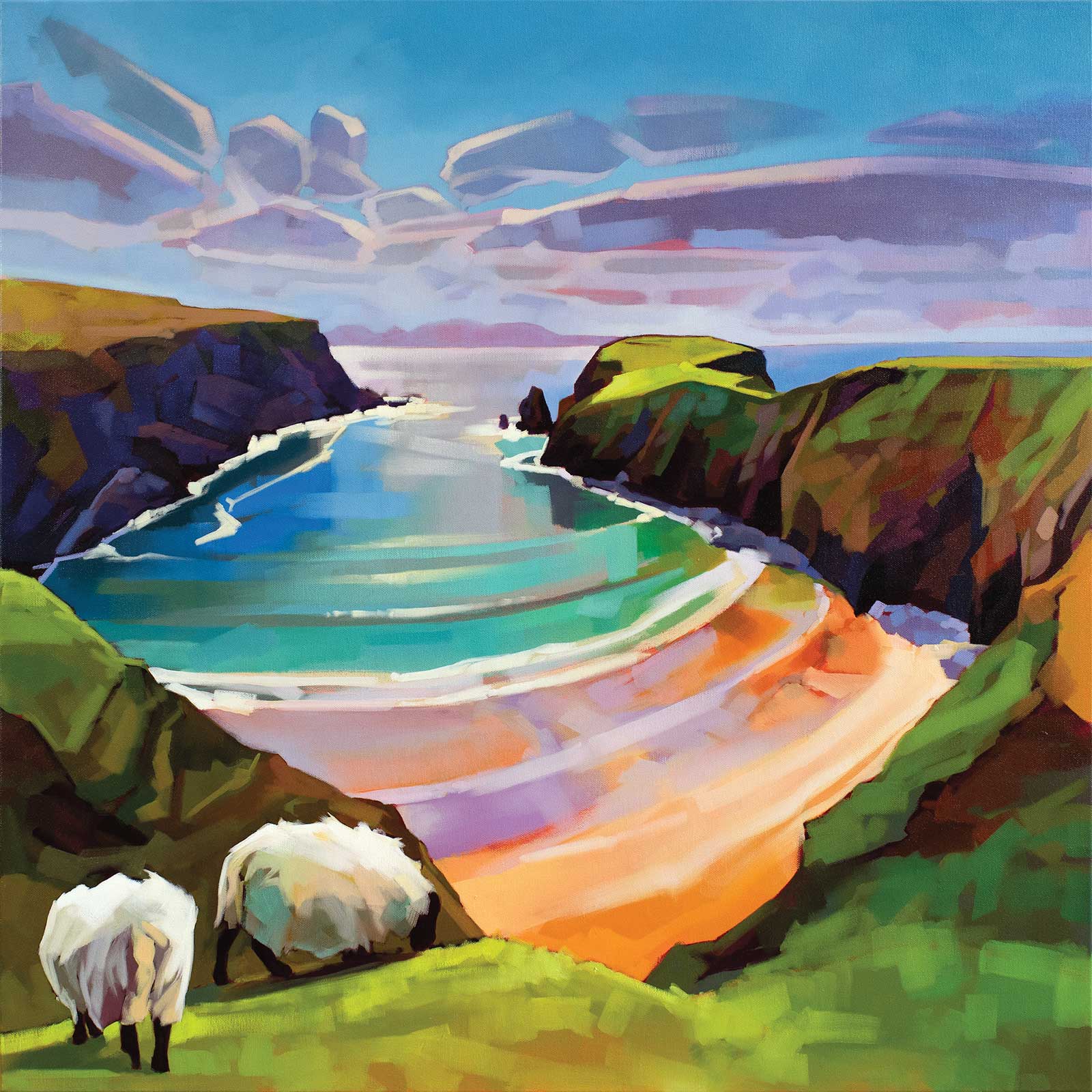
Landscape With Sheep, oil and acrylic on canvas, 31½ x 31½ (80 x 80 cm)
Kent’s paintings often rely on a strong, monumental structure. The landforms feel weighty and symbolic, and the composition can have an almost carved quality. What interested me was how that sense of structure could become a starting point rather than something to follow too closely. In my own work, I tend to build the landscape through color, layering and repeated adjustments across the surface. I also tend to work in a square format, which opens up different compositional possibilities but can be challenging when dealing with the natural horizontal pull of a landscape.
For practical reasons, I began all of the paintings in acrylic on location, working quickly to establish the composition and capture as much information as possible.
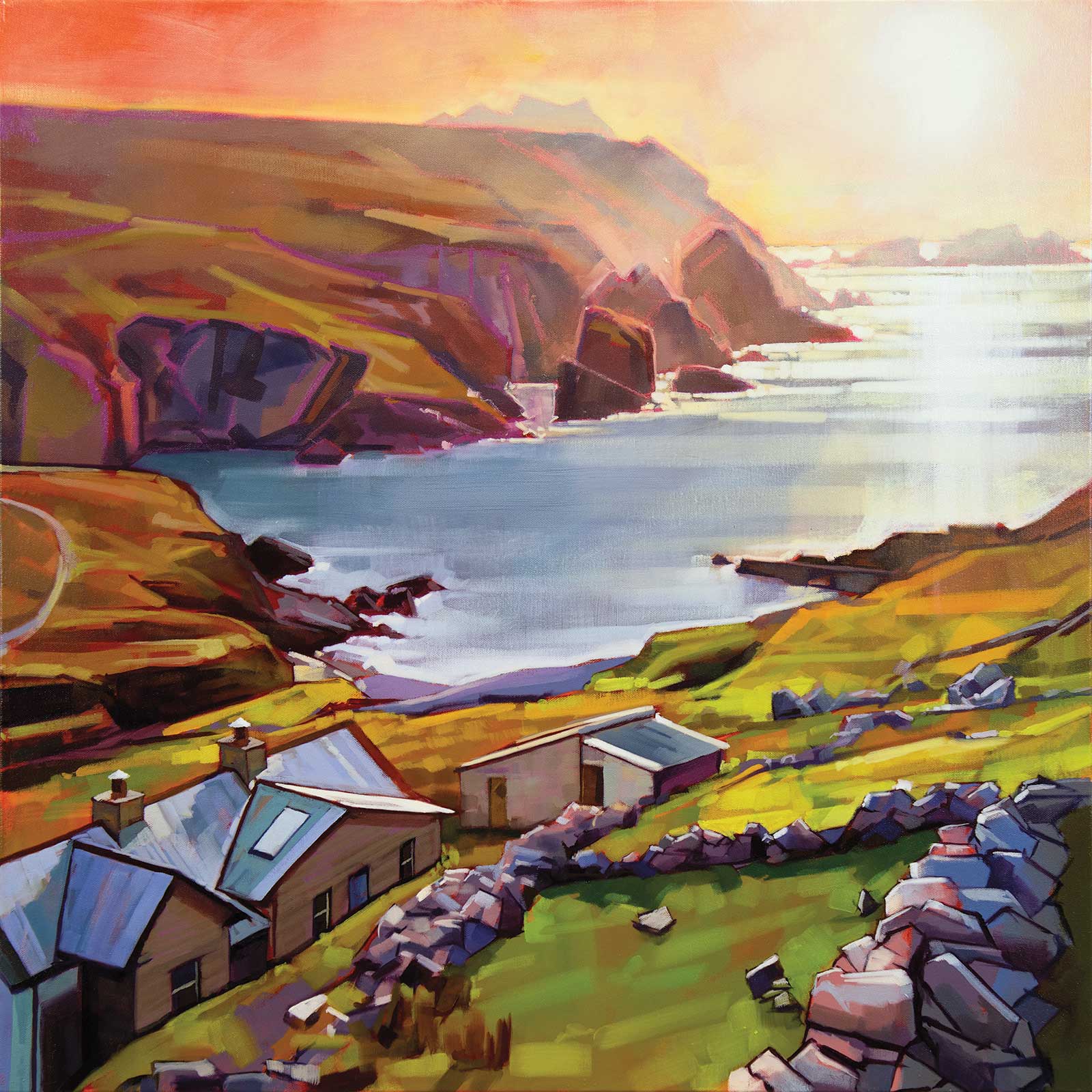
McGinley’s Cottage, oil and acrylic on canvas, 31½ x 31½ (80 x 80 cm)
Back in the studio, I switched to oils to develop and refine the work while the experience of the place was still fresh in my memory. It was important that the marks made outdoors remained visible in the finished paintings; I did not want to overwork them and lose the immediacy of where they had begun. That method means the painting is never simply a record of the view. The surface develops through a series of decisions, corrections and rediscoveries. I may begin with a clear idea of what I want to accomplish, but each layer changes what follows. The painting gradually begins to suggest its own direction.
In Glenlough, the conditions intensified that process. The paintings became maps, although not always reliable ones. A sea stack might appear in the correct position while the horizon was too high. A cliff profile would match, but the valley behind it would not. Moving only a short distance could completely alter the relationship between the forms. The first time this became apparent was while searching for Irish Sun. After moving around a small area for hours, trying to align the sea stack, Port Hill and a narrow strip of visible water, I realized that the exact view did not exist: Kent had altered and combined parts of the landscape.
As a painter, I regularly simplify, compress or move forms, but I had initially treated his paintings almost as geographical records. Discovering his compositional freedom came as a relief. It reminded me that his work was not a transcription of the place, but an interpretation.
That gave me permission to push my own paintings further.
Plein air painting in Glenlough Bay, Ireland. Photo by Darragh Gorman.
In Skelpoonagh Bay, I moved furthest from Kent’s view, choosing instead the relationships that felt most convincing while I was standing there. With Lobster Cove, I allowed the painting to become more graphic, using stronger outlines, flatter color and more direct marks. In Landscape with Sheep, I closed in the bay and exaggerated the sense of enclosure. The difference was not simply stylistic. Kent’s painting had brought me to the location, but my own work had to carry the experience of reaching it.
One subject proved more elusive than the others: I had been searching for a way into Kent’s paintings of the lobstermen, but the landscape alone was not enough. Then, during a spell of poor weather, I came across a sketch in Christy Gillespie’s book showing preparations for a lobster-fishing trip. I took a short walk around the harbor, where a working boat was framed by stacks of brightly colored lobster pots, and the composition appeared almost immediately. It connected Kent’s time in Port with the present, without asking me to recreate a scene that no longer existed.
I began the painting from that encounter and later drew on earlier photographs of the fishermen working further out. It became one of the few paintings in the series to include figures, because the lobstermen represented a living continuity with the place rather than a reconstruction of its past.
I also had the privilege of staying in McGinley’s cottage for a number of weeks while working on the project. It’s a place Kent would have visited regularly and the home of two of the subjects of his paintings, Dennis and Annie McGinley. Staying there changed that experience further. There was no electricity, the water came from the mountain and evenings centered on the turf fire. Every morning began with coffee at the door, looking across Port Bay and trying to read the weather.
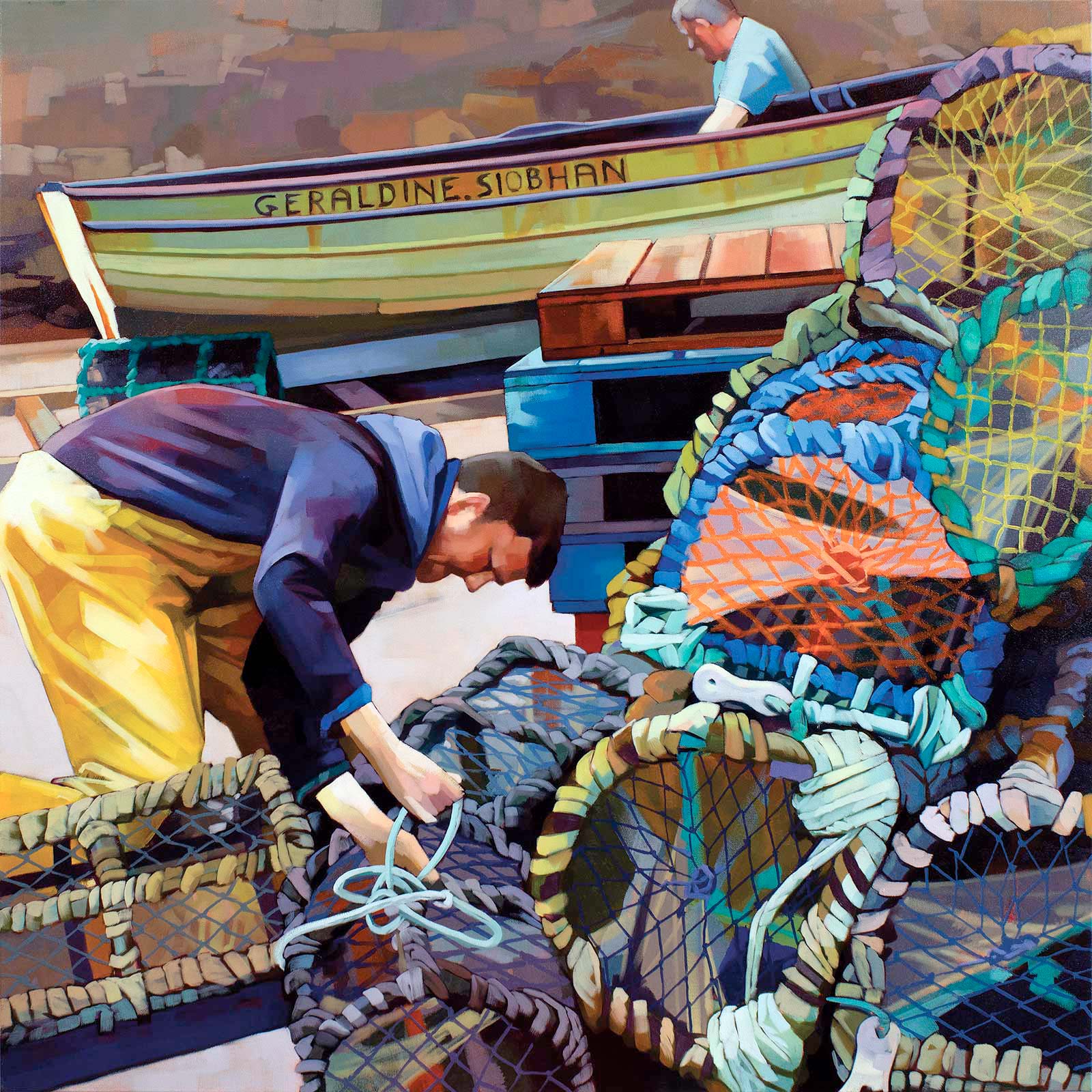
Making Ready For A Lobster Fishing Trip, oil and acrylic on canvas, 39½ x 39½” (100 x 100 cm)
We packed paint, brushes, palettes, food, waterproofs, water and usually two canvases before crossing Port Hill. Darragh carried cameras, lenses and drone equipment. By evening, we returned physically tired but mentally focused. The first task was to light the fire, heat water and dry equipment. Later, by candlelight, we reviewed the work and considered the following day.
Repeated journeys taught me what a single visit could not—I learned where the prevailing wind offered shelter, which route out of the valley was shorter but steeper, and how Tormore’s (Ireland’s highest sea stack) scale only became clear from within the valley.
The physical effort entered the paintings too. After carrying large canvases over Port Hill, I noticed that the hill appeared steeper in my work than it did in photographs. Part of that came from adapting the view to a square format, but part came from memory. That was how steep it felt. Painting there required constant adjustment. If clouds obscured the cliffs, I worked on the underlying structure. If the tide shifted, I moved to the sky. A shaft of light might appear for only seconds, and I had to stop immediately to record it. Rain marked the surface. Vegetation attached itself to the paint. Midges became embedded in several canvases. I did not remove every trace. The landscape had entered the work physically, and I wanted some evidence of that to remain.
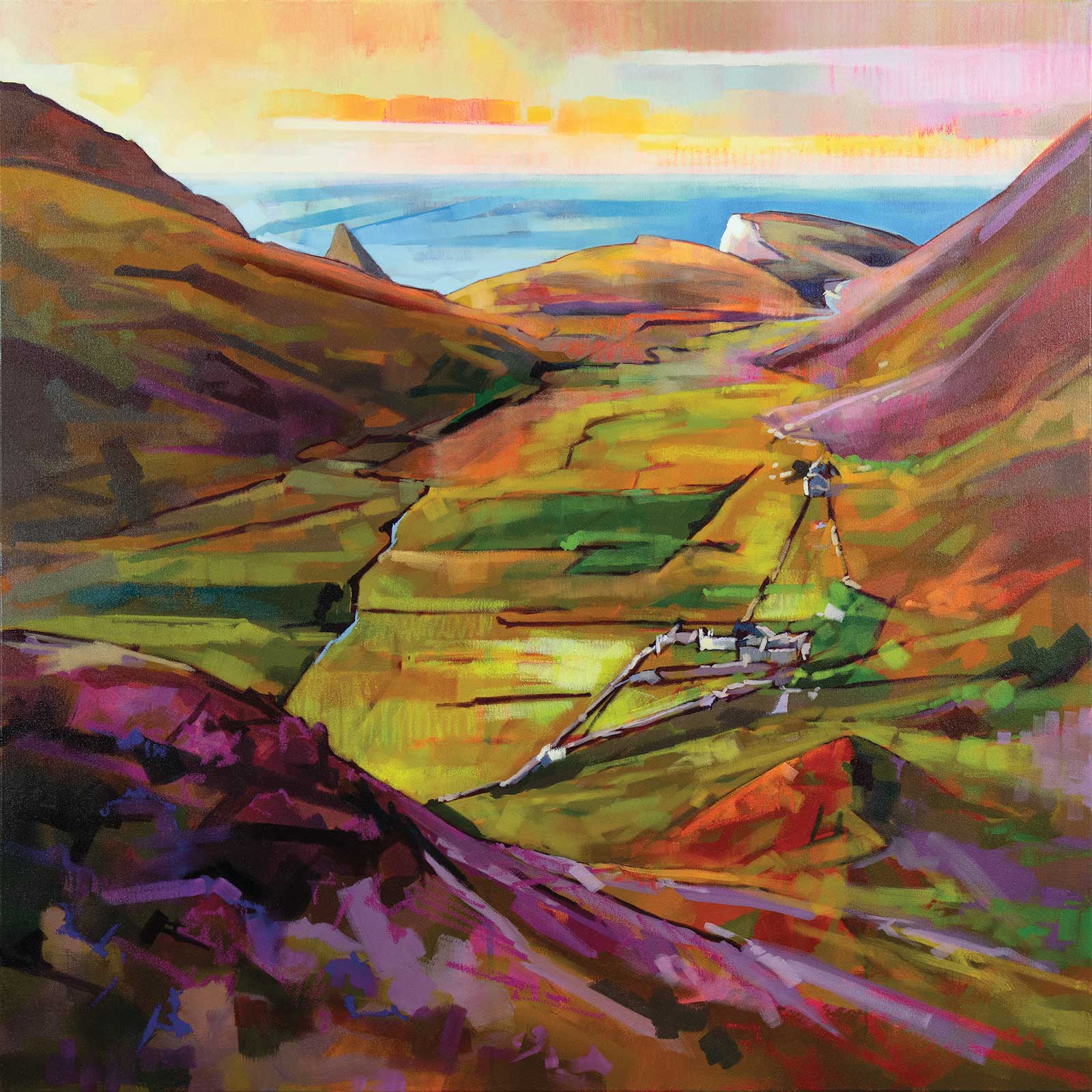
Glen Lough, oil and acrylic on canvas, 39½ x 39½” (100 x 100 cm)
Back in the studio, photographs helped with detail, but memory often decided scale, color and emphasis. When a painting became too descriptive, I returned to the first outdoor marks, and when it became too loose, I redrew key forms. The final image emerged through a tension between observation and invention. That balance between what I observed and what I remembered became central to the paintings. The finished works grew out of the color, scale and physical sensations I carried back with me, while still retaining the marks made directly in the landscape.
As my journey continued, Kent became less present in the act of painting. His work had brought me into Glenlough, but the landscape gradually began to create its own questions.
The finished paintings carry the effort of the journey, the weather, the time spent with Darragh, the slower rhythm of the cottage and the family waiting at home. They also carry my own way of working: building, redrawing, exaggerating and allowing memory to alter what observation began.
I started the project wanting to stand where Kent stood. What I discovered was that two artists can occupy the same ground and still encounter entirely different landscapes. Each time I return, I understand the landscape a little better and Kent a little more. The place may appear unchanged, but I am not and neither are the paintings I bring back from it.
Land’s End - An Artist’s Journey to Glenlough 100 Years After Rockwell Kent runs at the Regional Cultural Centre in Letterkenny, Donegal, Ireland, from October 3 to November 14. —
About the artist
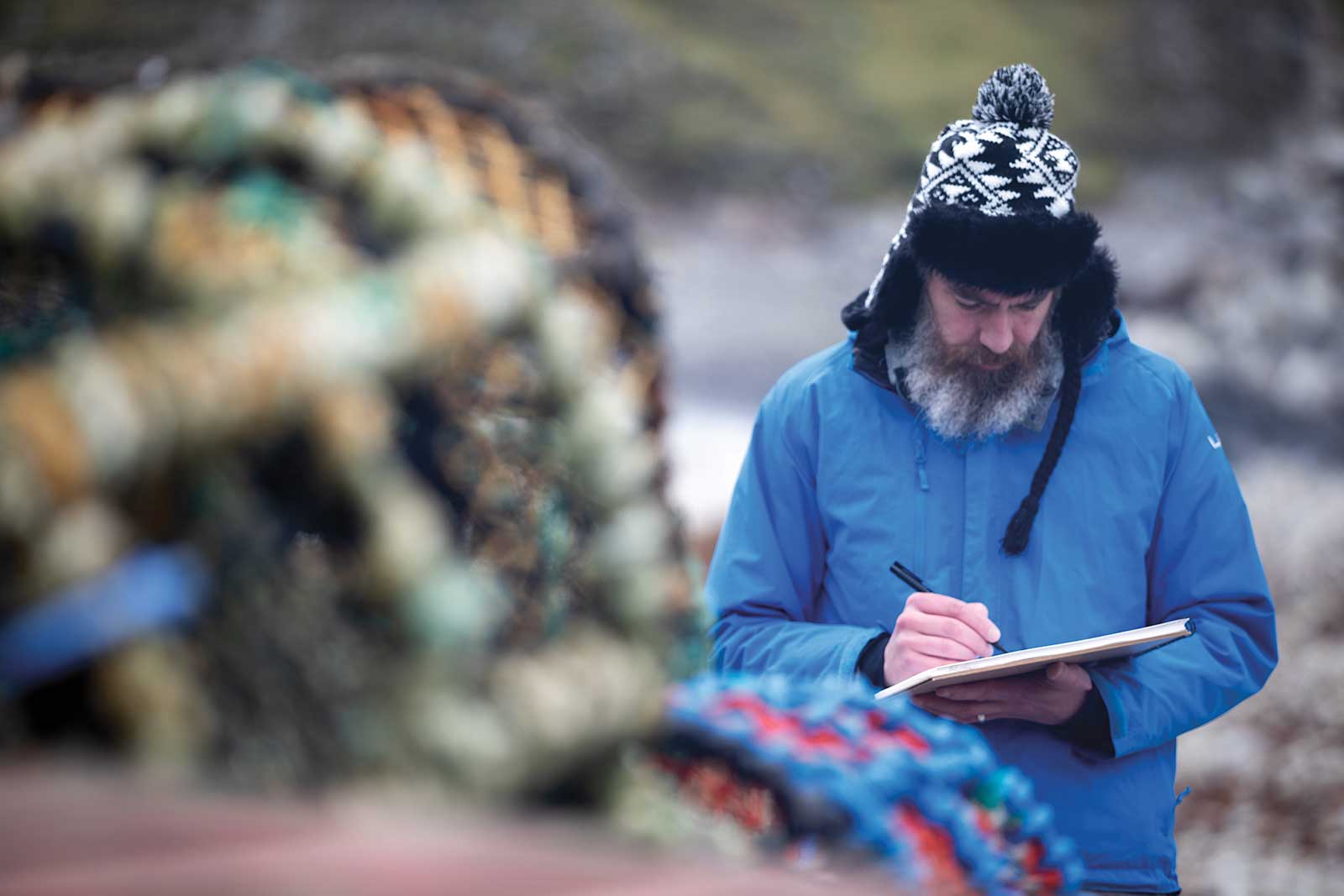 Kevin Lowery
Kevin Lowery’s work is shaped by the landscape of Northwest Ireland. His paintings have been included in shows hosted by the Royal Ulster Academy and the Royal Society of Marine Artists and are held in both Irish and international collections. In May 2024, he opened his own studio and gallery in Bundoran, Donegal.
Lowery is represented by Whitethorn Gallery in Galway, Ireland; Russell Gallery in Clare, Ireland; Gallery One in Belfast, Northern Ireland; Irish Art Plus in Antrim, Northern Ireland; Harbour Gallery in Cornwall, England; and Corte Real Gallery in Algarve, Portugal.
Contact at
kevinlowery.ie