The greatest discoveries in an artist’s career are often found not in moments of certainty, but in the questions that continue to unfold. After 40 years of painting, Rose Frantzen remains deeply engaged in that pursuit, exploring what it means to truly see, to interpret, and to create work that resonates with the viewer.
From portraits that celebrate individual lives to large-scale projects that bring communities together, Frantzen has built a body of work rooted in connection. The recent recognition of the Rorick Grand Prize at The Art of the Portrait conference served as both a celebration of past achievements and encouragement for the artistic journey still ahead.
Frantzen recently shared with me her reflections on artistic growth, the challenges that shaped a career, and the enduring belief that art is, at its core, an affirmation of life.
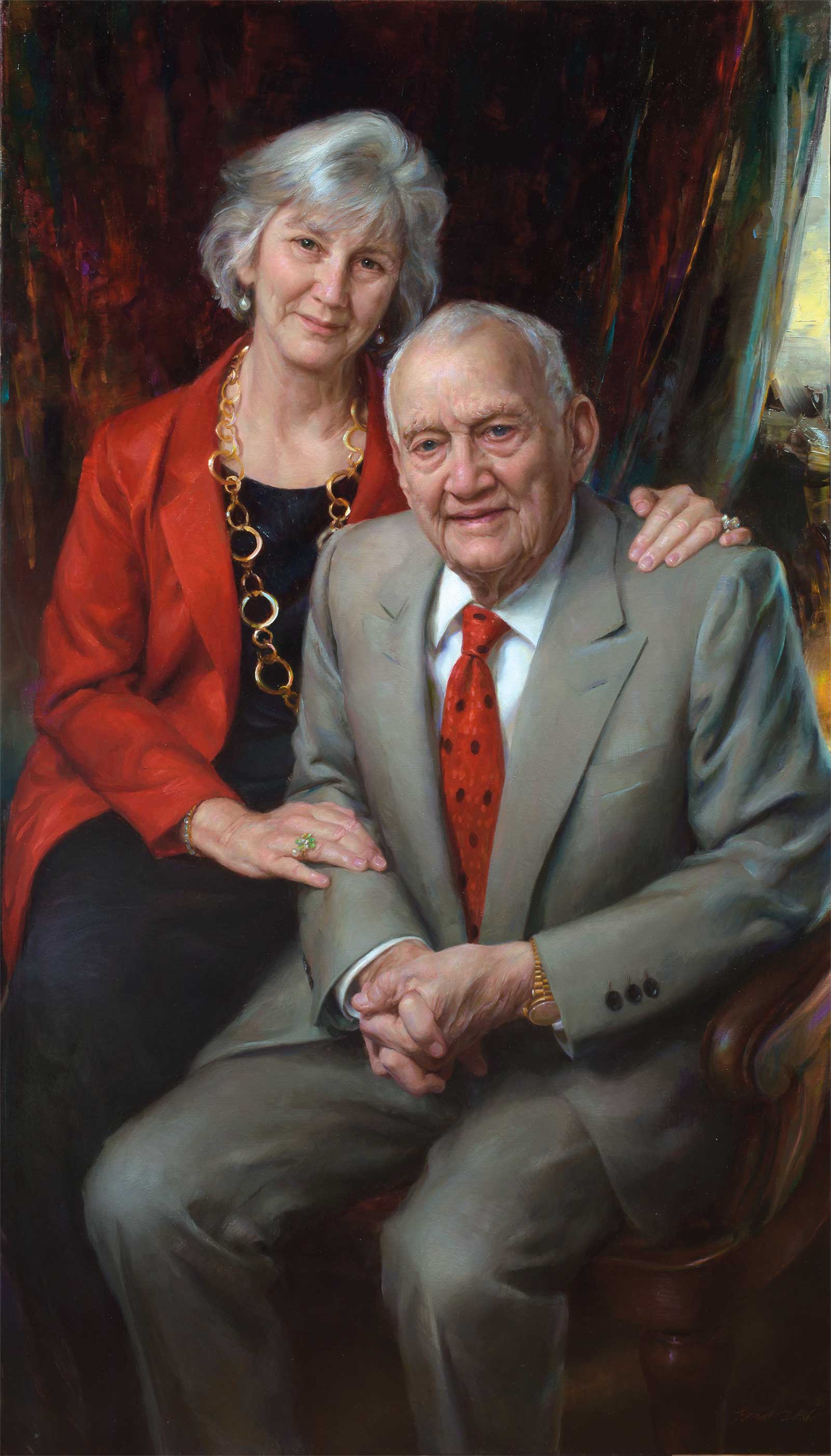
Jerry and Debby Ivy, oil on canvas, 56 x 32” (143 x 82 cm). Collection of the Ivy College of Business, Iowa State University.
Congratulations on receiving the Grand Prize at The Art of the Portrait conference. What did this recognition mean to you at this stage in your career, and how has it impacted your artistic journey?
At the conference this year, more than any other year, I had engagement with artists from every generation. It has long been the case that my elders have shown me support, and they are probably why I am often on the faculty. I am continuously grateful for them. Markedly, this year I also had numerous younger attendees, women and men, take the time to speak with me. My male peers also reached out and spoke to me about my painting in ways I have not really experienced before at the conference. This means a lot to me.
Many artists speak about finding their artistic voice. How has your career evolved over the past 40 years, and how would you best describe it?
I am beginning to believe that finding your artistic voice is both incredibly elusive and ever-present. It is akin to Dorothy in The Wizard of Oz, being taken on a wild adventure while trying all the while to get home, only to learn that it was always possible with a click of her heels. Finding that voice may be as simple as making an honest discernment between thinking, “What should I paint?” and “What do I really want to paint?” Inside both the “I” and the “really” are layers of self-discovery. That is where the friction lies.
Earlier in my career, a larger percentage of my work looked outward, marveling at the visible world and trying to paint it. Now, I am trying to marry that with questions that are more interior. I often want to paint everything at least twice: once for the experience of capturing it, followed by other versions of interpreting it.
This is an odd impulse. In the very effort of capturing, I am already interpreting, yet I feel there is still more uncovering and discovery available. So, I guess I just want to follow the yellow brick road, enjoy the journey, and let others decipher if I have made it home.
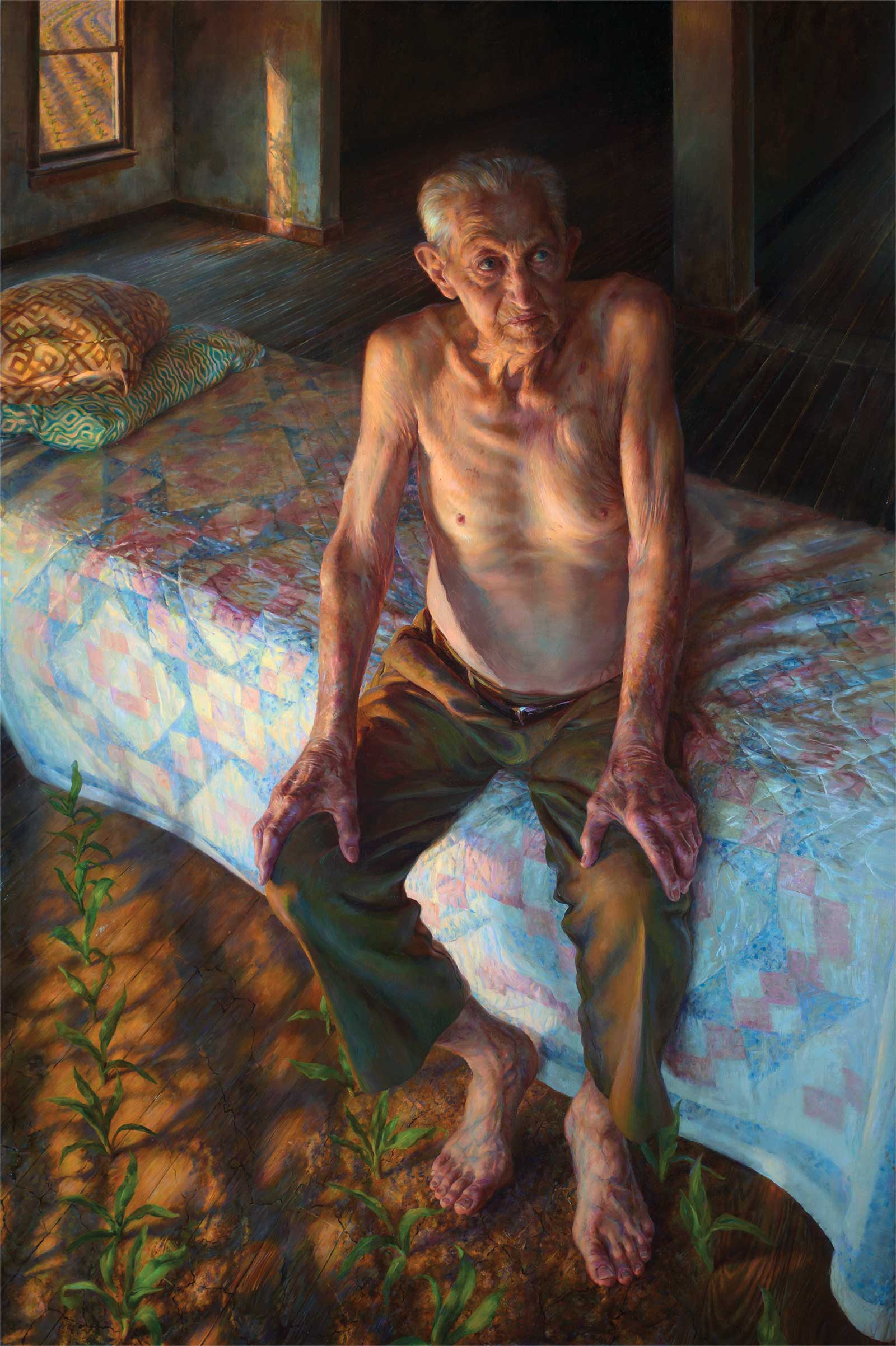
Spring Corn, oil on canvas, 72 x 48” (183 x 122 cm). Collection of the Figge Art Museum.
You have painted people from all walks of life and created ambitious community-centered projects such as Portrait of Maquoketa, Dormancy Series and Faces of Illusion. What have these experiences taught you about the role of art in bringing people together?
I think it is fair to say that these projects have helped foster community, allowed people to resonate and share their feelings and experiences, and created openings for dialogue.
I have learned that making art is creating value. We can take our focus and say to another person, “I see you. You are meaningful, you exist, and I am grateful for the chance to share you.” This creates community because it creates belonging, and belonging creates care, engagement and empathy.
You do both figurative work and commissioned portraits. In your experience, are there specific challenges for each genre?
Studio work requires deep introspection and considerable lead time for its creation. When I finish a consecutive run of commissions, I have to reground myself. I need to gather seeds from my last harvest. This harvest might include finished or unfinished work, questions, sketches, studies, notes, museum and gallery visits, or finding a great model. I have learned that I must work on something, anything, just to get the ground fertilized and ready for planting.
In turn, my studio practice informs my commissioned experience. Commissions require openness, flexibility, and a deep desire to collaborate. I enjoy this work largely because we get to be with genuinely interesting people. We pop into other people’s worlds or environs, sometimes worlds you read about in the newspaper, or other times, simply witnessing a family’s daily life.
Both are equally fascinating. I can feel anxious or self-critical in both the studio and commission settings. To counter this, preparation is key. We want our subjects to thoroughly enjoy the experience, so we handle the technical and logistical hurdles before they arrive. We try to give them options, scenarios and necessary information. You will notice I say “we.” I approach these projects alongside my husband, Chuck, who is also an artist. He joins me for most commissions, and his presence is essential to the ease, success and joy of the overall experience.
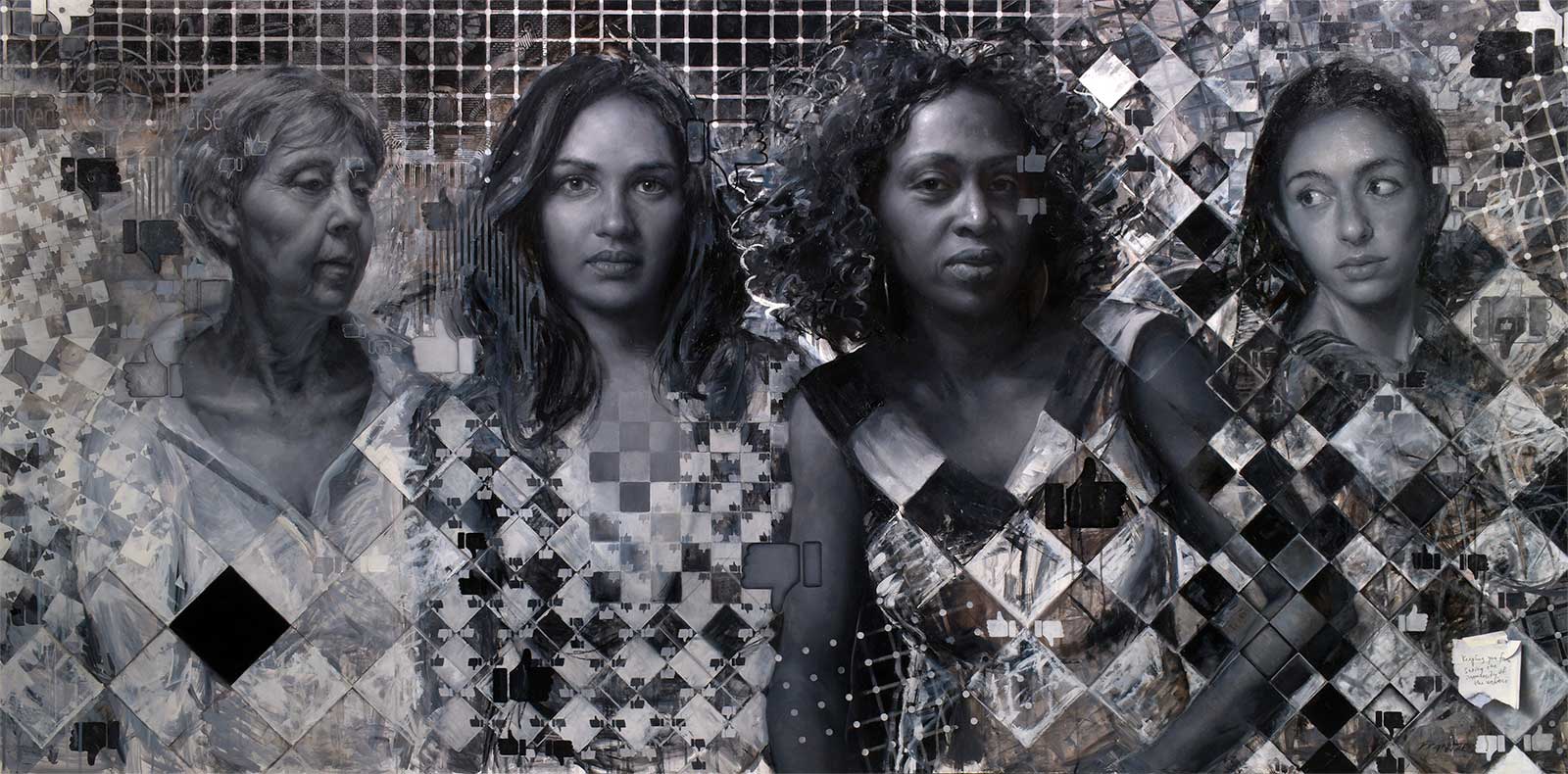
Values in Evaluation, oil on panel, 48 x 96” (122 x 244 cm)
Artists at every level face challenges and periods of uncertainty. Looking back on your career, what obstacles proved most formative, and what lessons emerged from them?
I continually learn that I have, without awareness, adopted rules, standards, opinions and practices within and about painting. I first need to become conscious of these habits and patterns of thinking; once recognized, I can then examine and challenge them.
For example, I used to hold an attitude of extreme resistance toward using photographs as support for my work. For the first 25 years of my painting practice, it was verboten. I have dozens of good paintings anywhere from beginning to three-quarters finished, left in that state because I refused to take a reference picture. If I did use a photo, I would paint from it with a constant itch and a sense that I was cheating. I disliked using them, and I judged other artists who did as compromised. But after Portrait of Maquoketa, I began taking commissions. This is a completely different genre, and you have to adapt to the conditions.
Through this, I learned the benefits of photography as a backup. It became important to understand the photograph, its differences from direct observation, and what each practice gives and takes. This shift has changed my finish rate quite significantly.
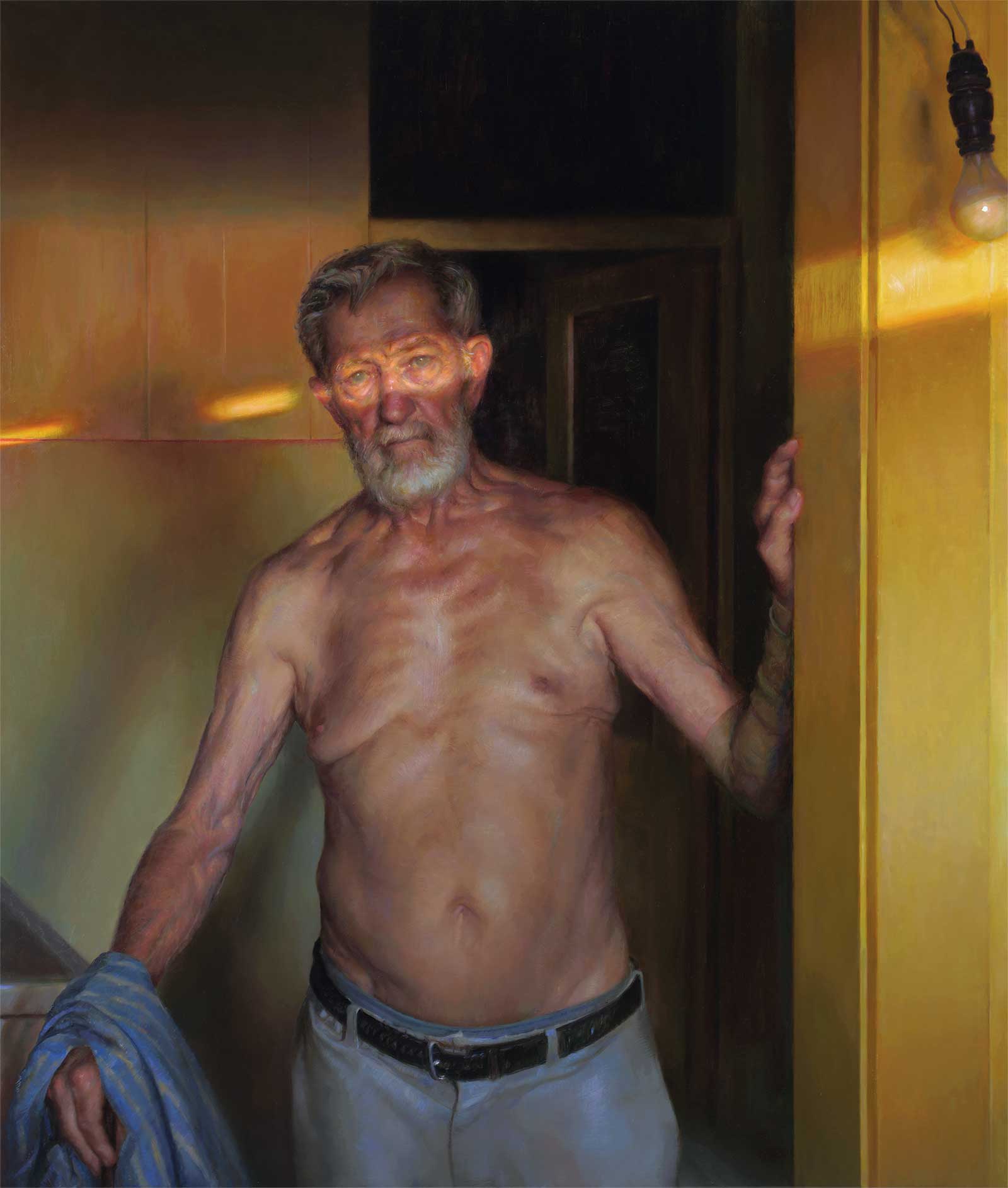
Last Light, oil on linen, 52 x 44” (133 x 112 cm)
What advice would you give to emerging artists trying to find their voice in the world of contemporary portraiture?
This is going to sound funny if you read my last answer, but paint more from life and direct observation. Fail marvelously. By that, I mean marvel at your success and your failed attempts; let them both teach you. Ask what am I seeing, what am I communicating? The crux is that you can’t really fail at being yourself; you just might not be great at being someone else.
Looking ahead, what projects are currently exciting you, and where do you hope your work will lead in the coming years?
I have a few good compositions for the In the Face of Illusion series waiting to become, and I am working on over a dozen life studies as preparation for a stand-alone concept. This large piece might have a connection to my Spectrum series; I am still musing.
Currently, a large canvas of mine is showing in the Dubuque Museum of Art. It went up at about 80 percent finished, so I am looking forward to getting that back on the easel. (Yes, I am showing an unfinished work!) I am also poised to compose a rather complex commission that has an early 2027 deadline.
More than anything, I hope that in the coming years I can continue to make work that resonates, has value for people and for the community, and work that contributes to and honors our miraculous existence.
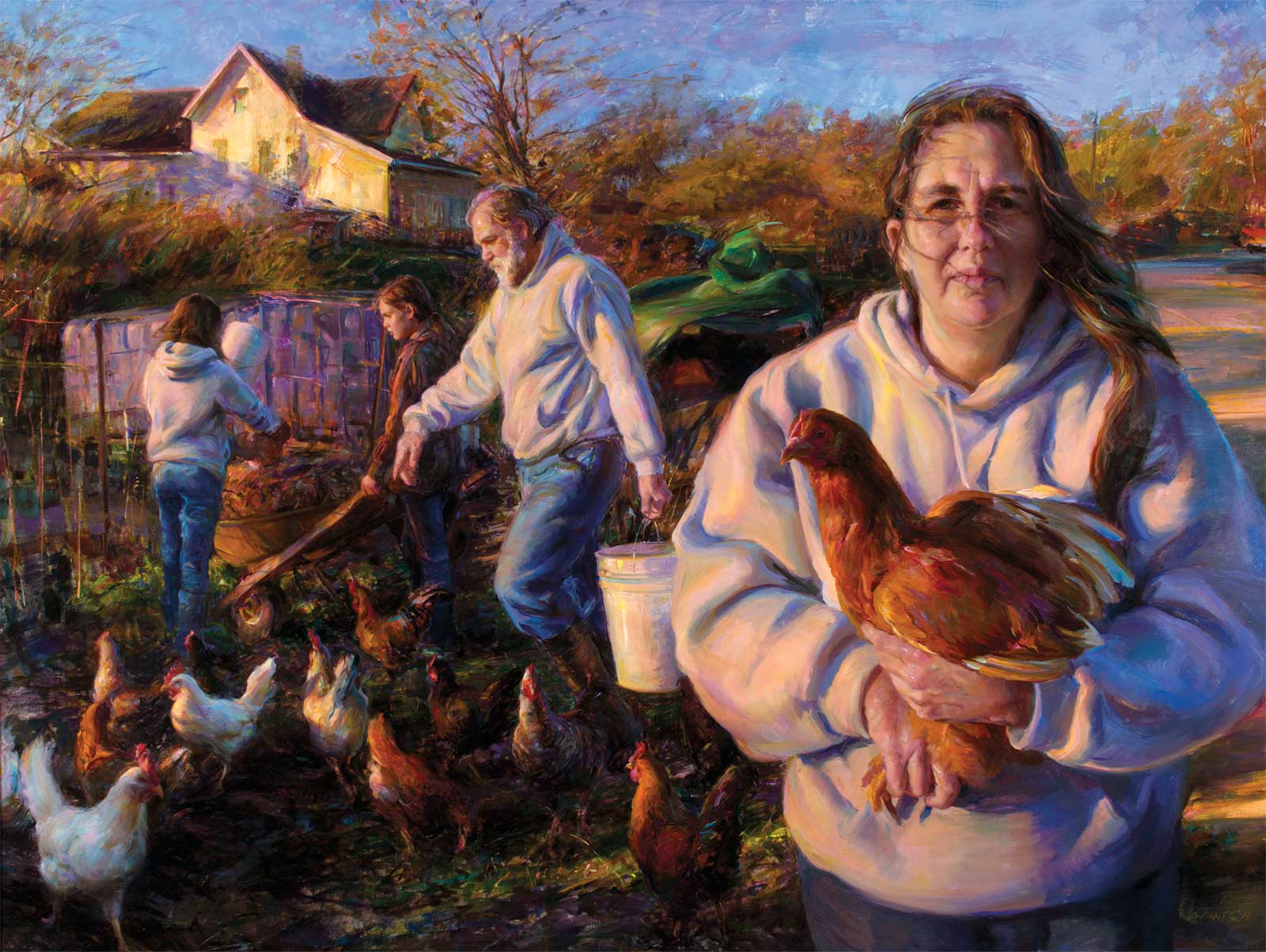
Jane’s Brood, oil on linen, 36 x 48” (92 x 122 cm)
Kimberly Azzarito, director of programs for the Portrait Society of America, has spent the past 25 years connecting with artists and exploring the stories behind their work. She has interviewed renowned masters and emerging voices alike, exploring the inspirations, struggles, and discoveries that shape a life devoted to art. Through these conversations, she continues to illuminate the personal journeys behind their work and celebrate the artists who keep the tradition of portraiture alive and well. —