I paint in oil using a limited color palette. My subjects are often ordinary, everyday objects, but my goal is to elevate them—transforming the familiar into something compelling through the careful use of dramatic lighting, reflections and shadows.
My style of painting is realism but not photorealism, in that I try to place little patches of color next to one another, leaving visible brushstrokes rather than blending. I love the way it looks messy close up, but all comes together when viewed from a distance. I am fascinated by the way the brain can fill in the missing pieces when an edge is lost, or when an object can appear to be painted with great detail, but is really made up of only a few strokes of paint placed in just the right way. In painting, we are really just creating illusions with the limited value scale of paint.
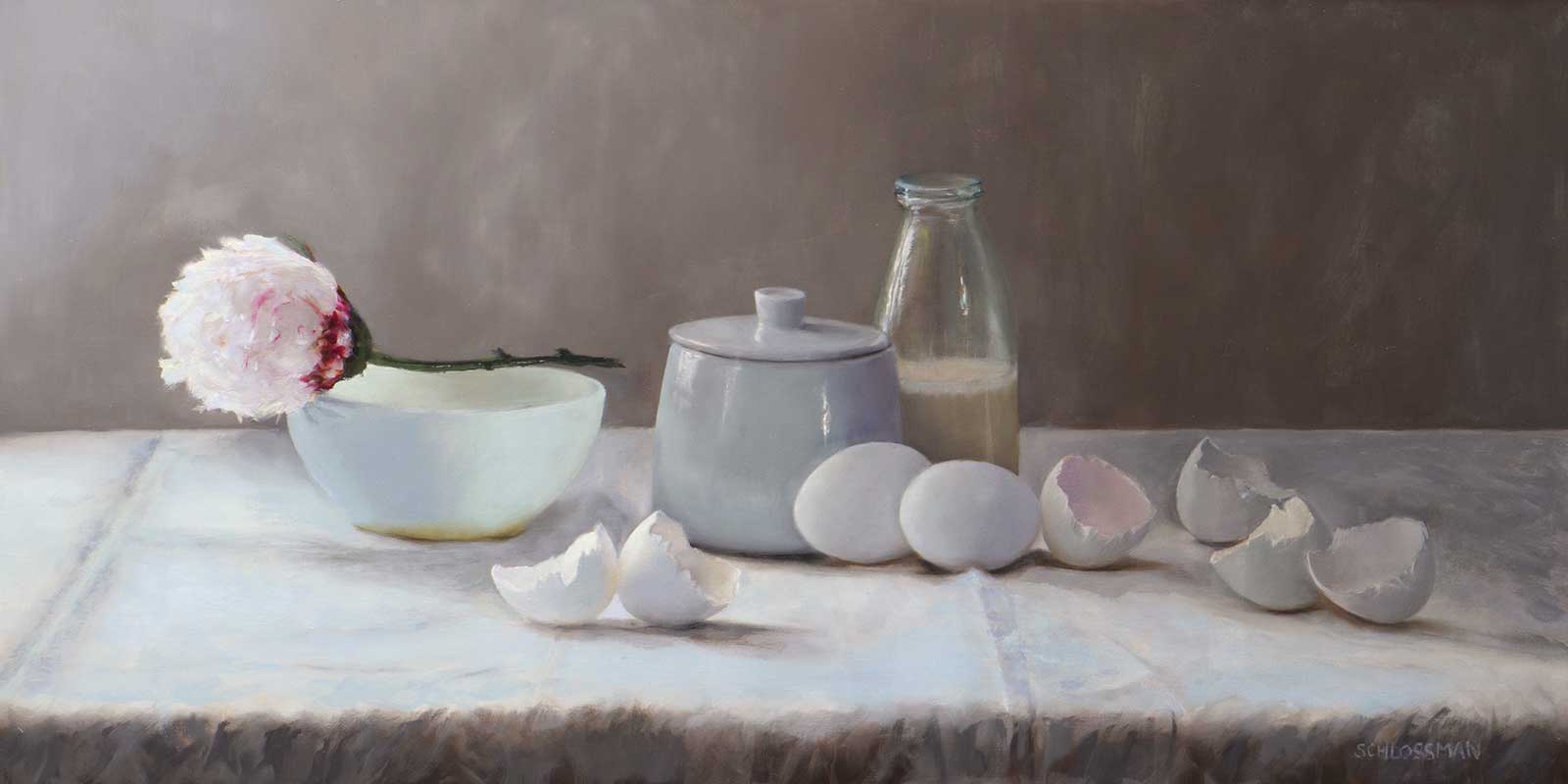
A study of whites, oil on panel, 12 x 24" (30 x 60 cm)
Because I often paint after work and cannot rely on natural light, my studio is a darkened space lit by a diffuse 5,000K ceiling light. I compose my still life setups inside a shadowbox, which I light separately to create strong contrasts, defined edges and the dramatic shadows I’m drawn to. I prefer to work alla prima, painting wet into wet, rather than in layers. This direct approach keeps the work fresh and spontaneous. The most challenging and important part of my process is the composition itself. I spend a lot of time arranging objects, experimenting with light angles and taking reference photos in RAW format, which I later edit in Lightroom to preserve tonal integrity and color accuracy.
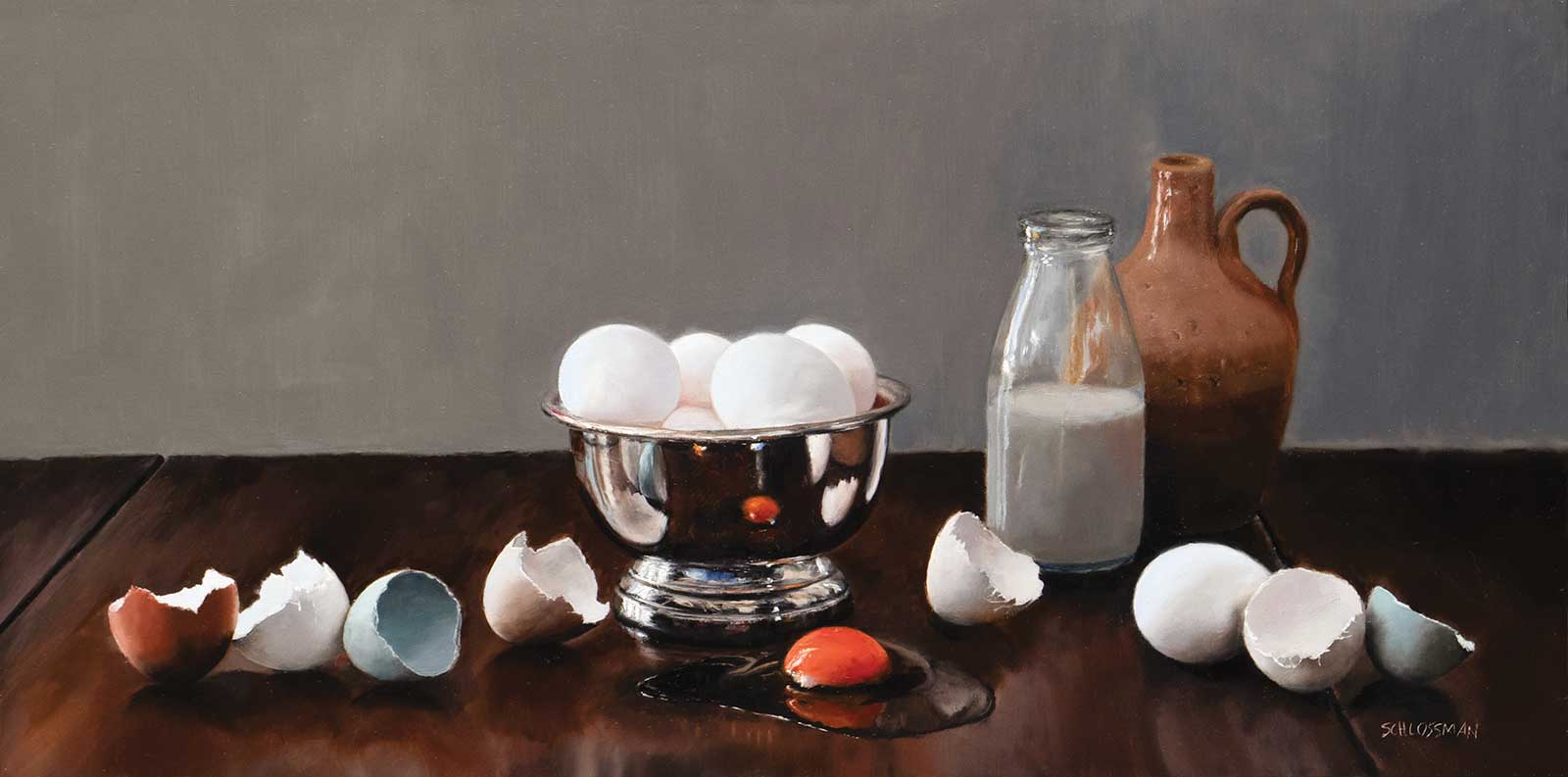
Eggs, oil on panel, 12 x 24" (30 x 60 cm)
Painting from life is my preferred approach whenever possible. For more complex compositions—or when working with subjects that are perishable, such as food, flowers or people—the process often begins from life and continues with the help of photo references. In these more intricate pieces, the work typically starts with a sketch of the basic shapes to establish the composition. In contrast, smaller alla prima works done from life usually bypass the preliminary drawing, with the sketching done directly in paint.
While my main focus is still life painting, I also work with figurative and portrait subjects. Eggs, peonies and reflective objects are some of the recurring themes in my work. I’m continually exploring the balance between looseness and control in my work, often questioning how much to refine. As part of my process, I regularly undertake timed alla prima studies, usually completed in 30 to 60 minutes without a preliminary sketch. This approach encourages a focus on structure and overall composition, helping to maintain a sense of spontaneity and freshness in my work.
My Art in the Making Spring Peonies
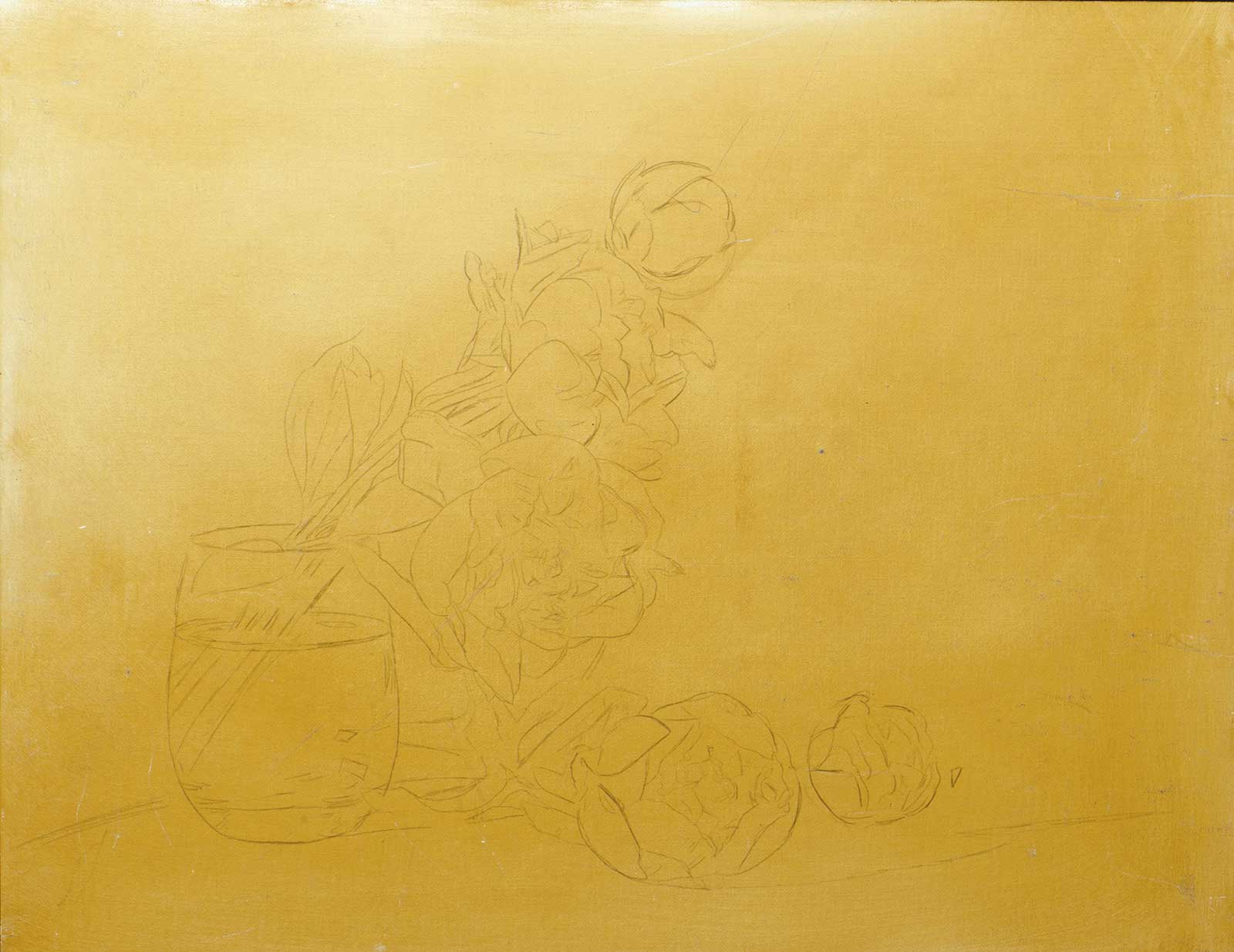
Stage 1 Loose Sketch
On a linen panel stained with Gamsol and burnt umber, I draw a very simple sketch of my composition.
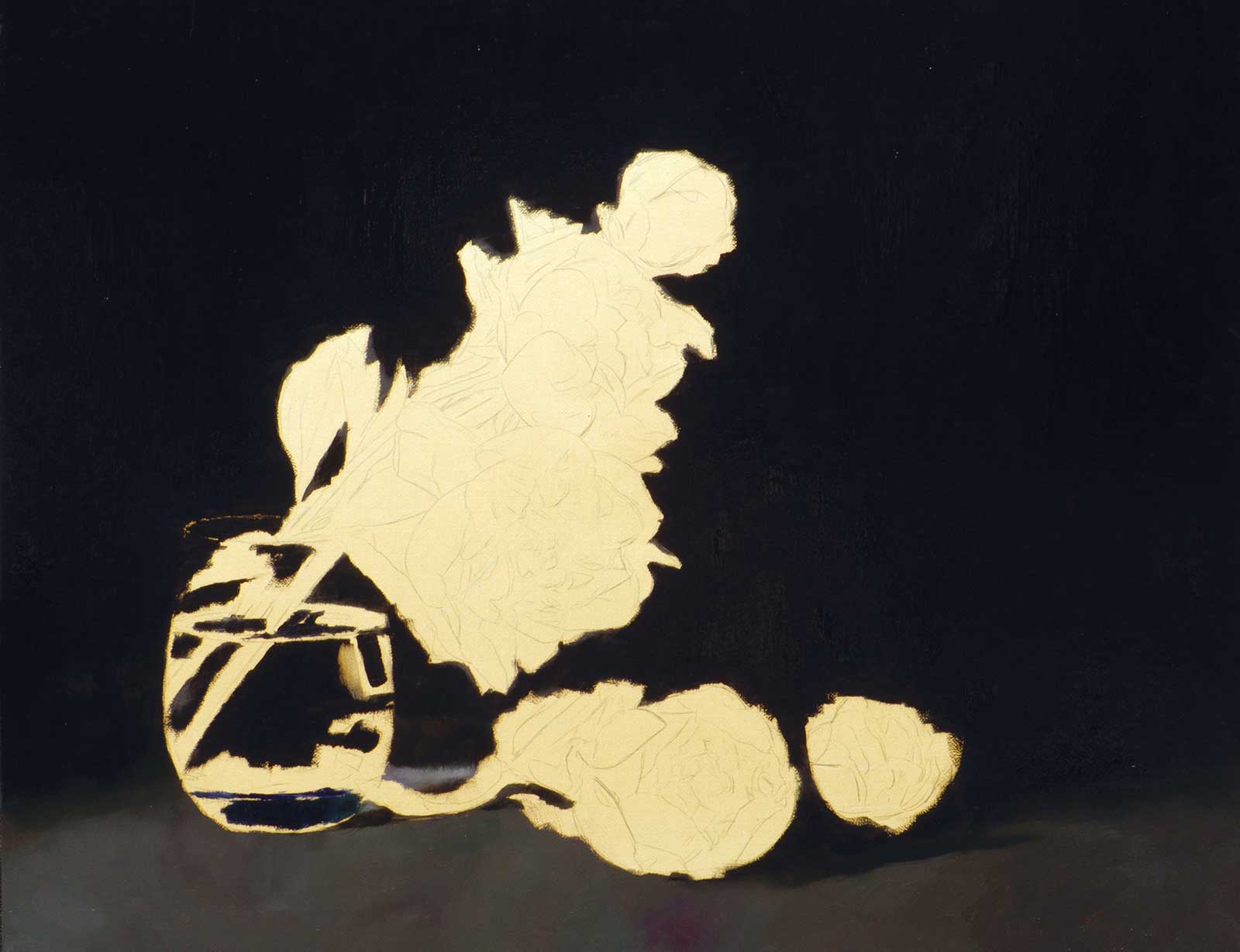
Stage 2 Blocking in Background
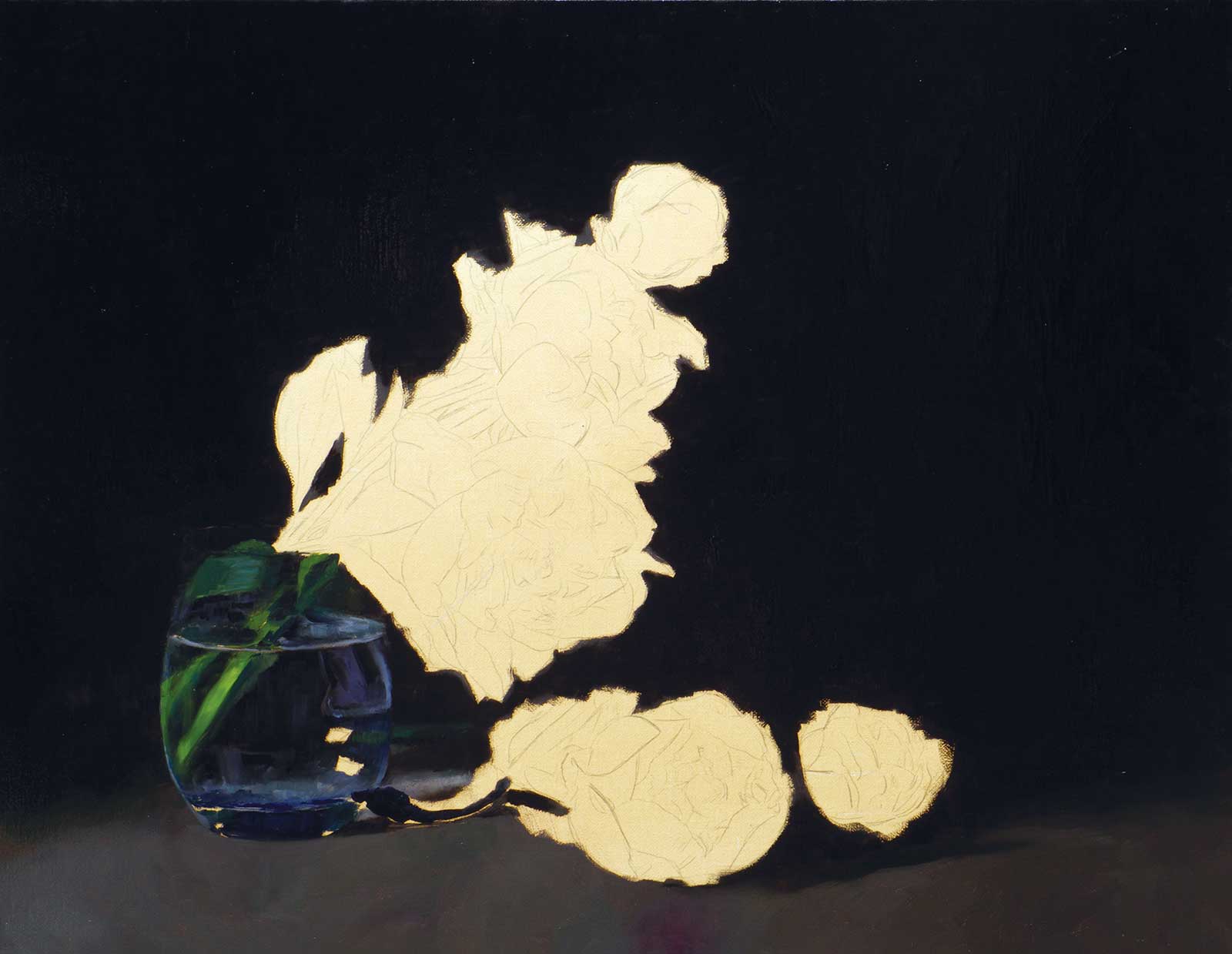
I always work from the outside in, starting with the background. Here I have blocked in the background in ivory black. Next I blocked in the table surface, along with the cast shadows and reflections, and began establishing the basic form of the vase.
Stage 3 Refining the Vase
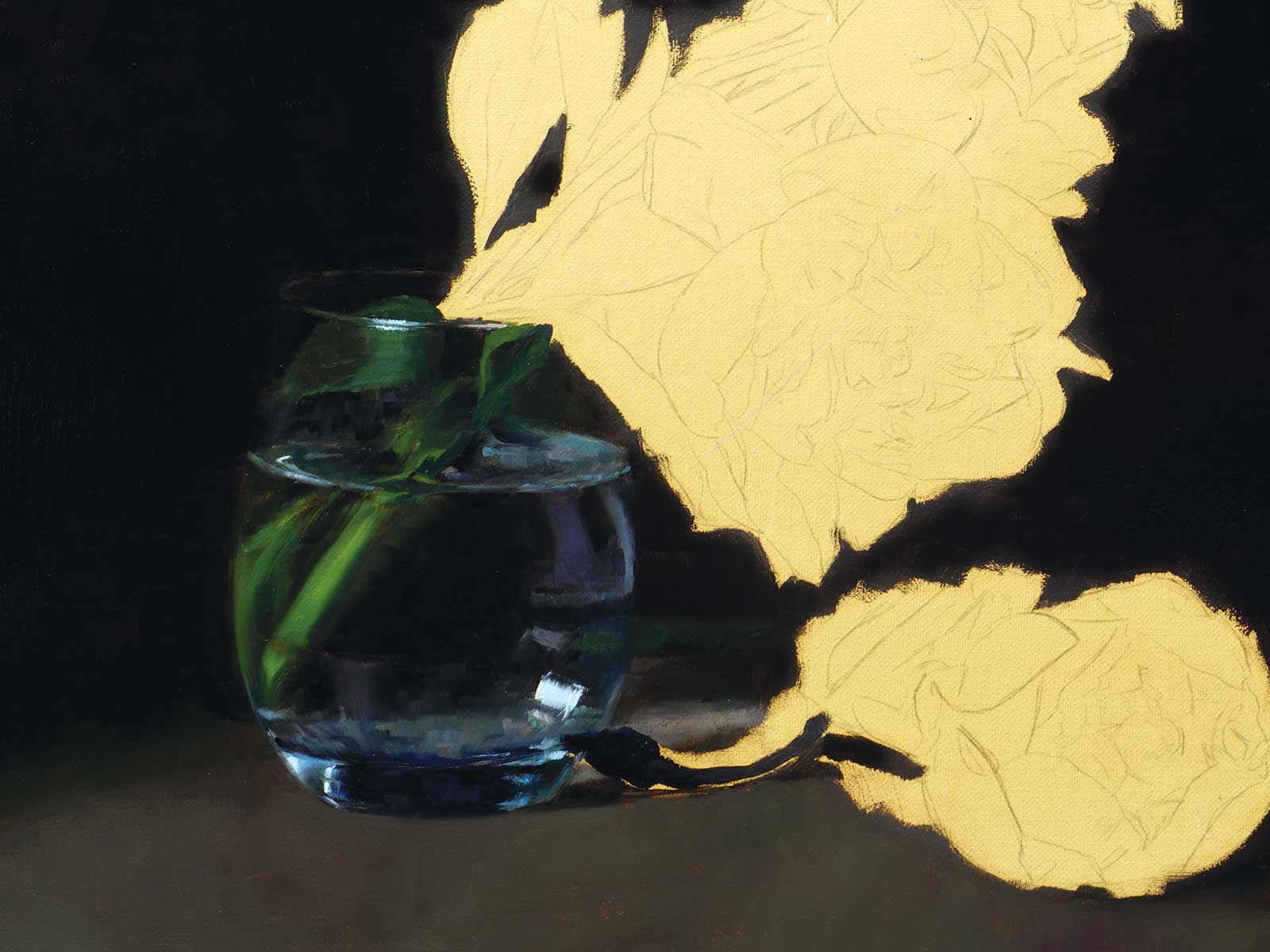
At this stage, the vase is refined by adding more detailed elements to its form and surface. In the close-up photo, you can see that the vase is intentionally rendered with a loose approach, reflecting my aim to suggest form through gestural brushwork rather than precise detail. The smallest brush I use is a size 3 flat.
Stage 4 Shadows of White Peonies
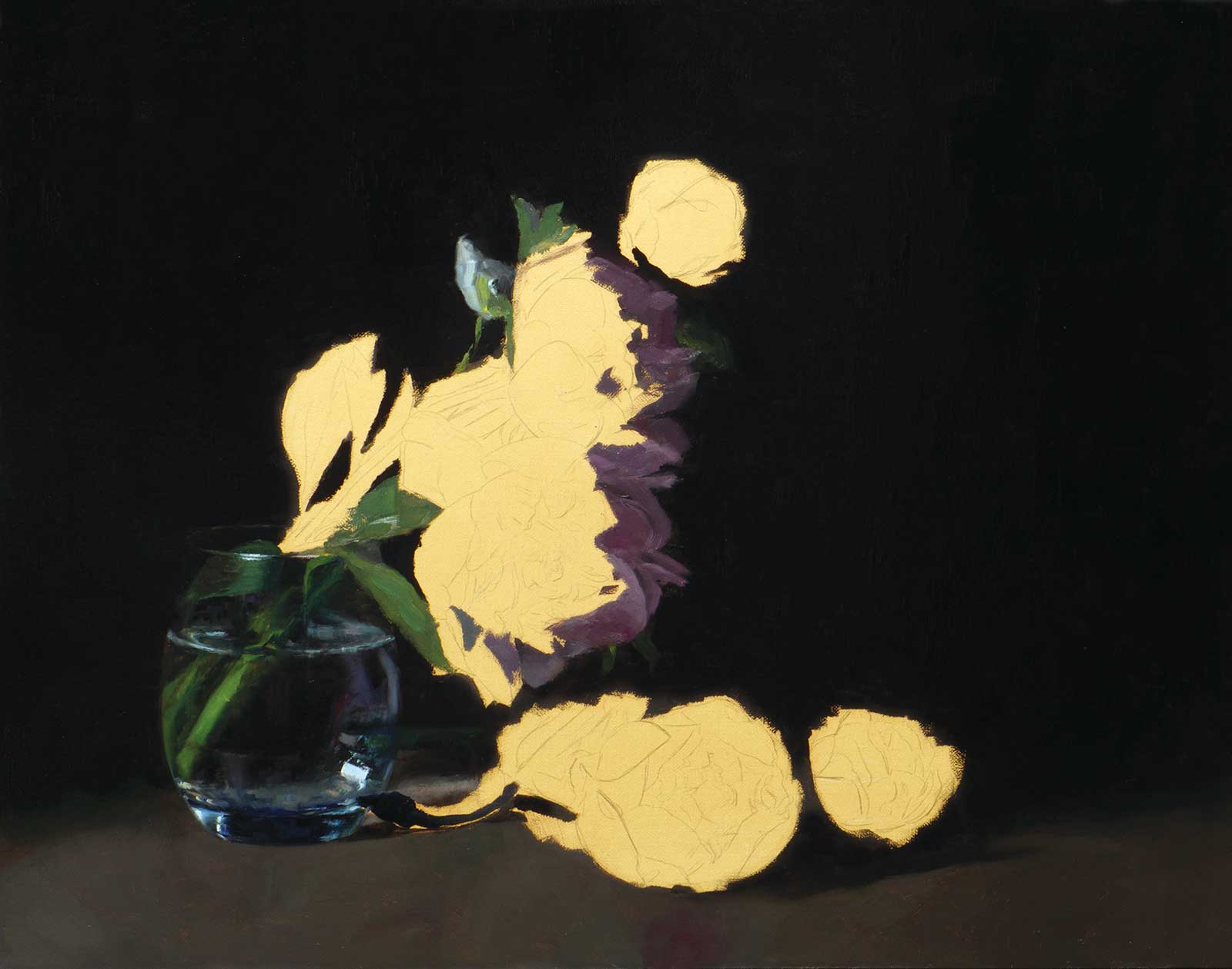
Working from dark to light, I have begun developing the shadow side of the white peonies to establish depth and structure.
Stage 5 Mid-Tones
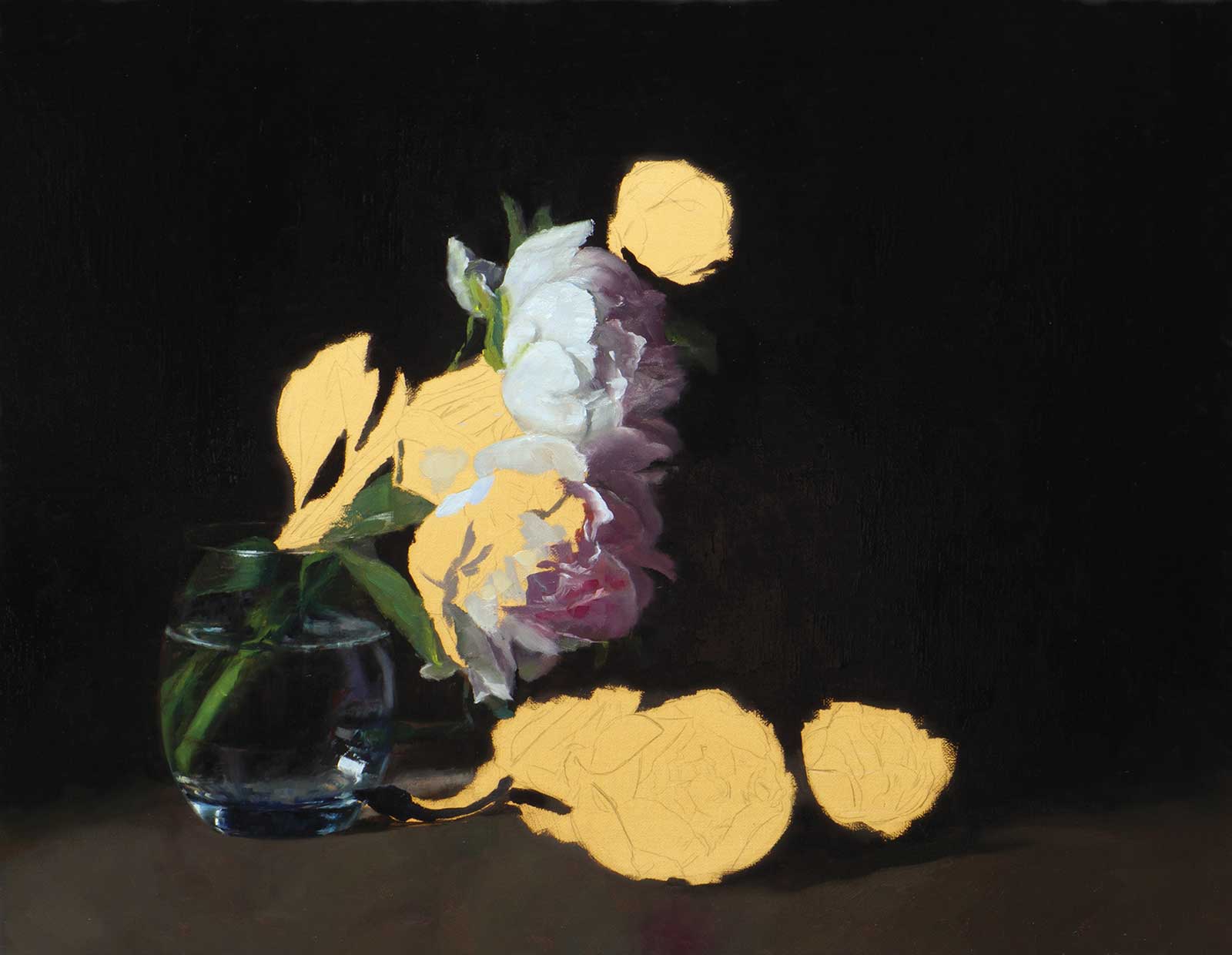
I have now introduced the mid-tones of the white peonies, aiming to maintain a sense of looseness in the petals while incorporating selective details to clarify the form.
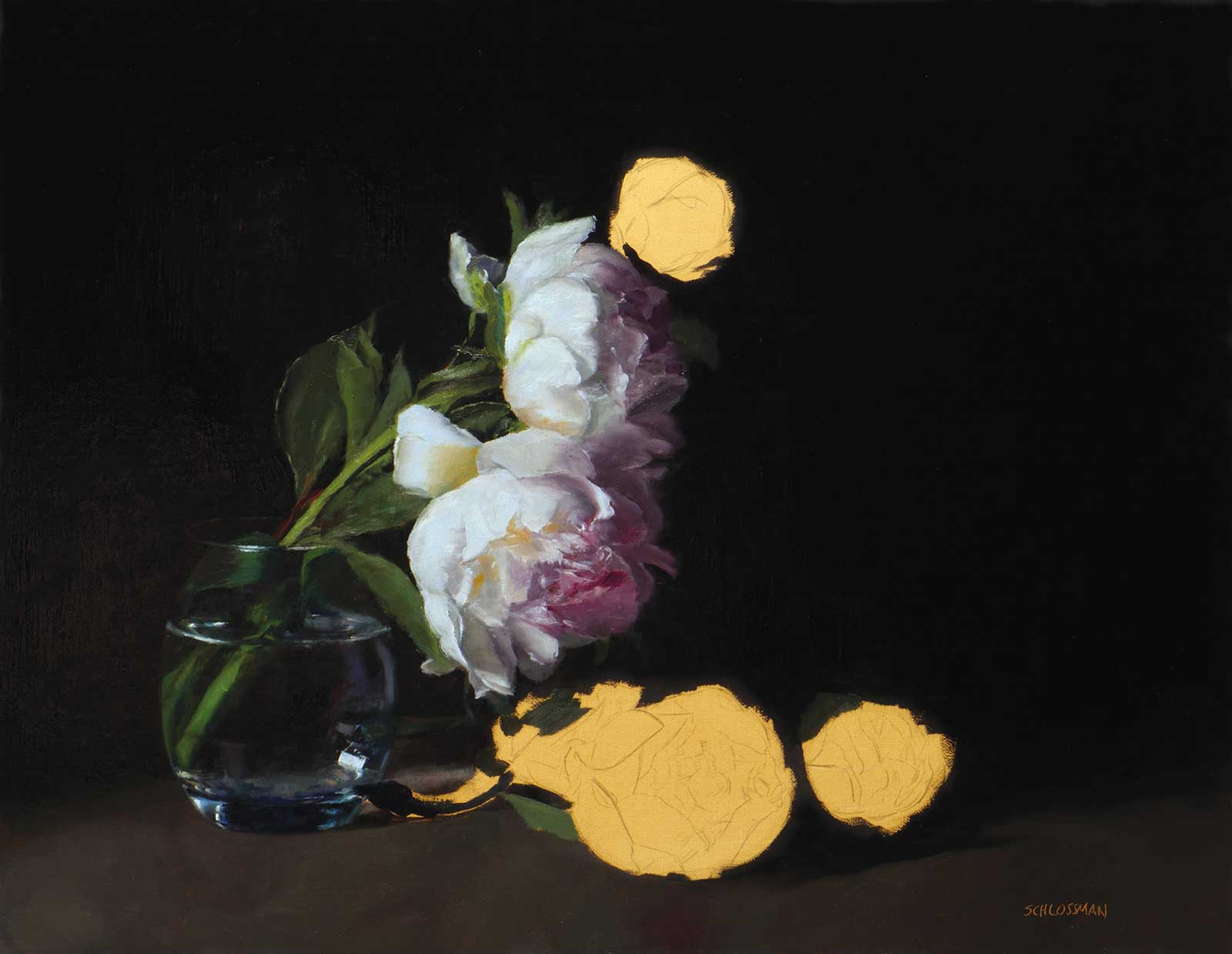
Stage 6 Developing Contrast
I have now developed the light side of the white peonies, enhancing the contrast and bringing dimensionality to the flowers. The leaves have been added, further defining the composition and providing additional structure and contrast. I typically sign my paintings when still wet by scratching my name into the paint with a stylus.
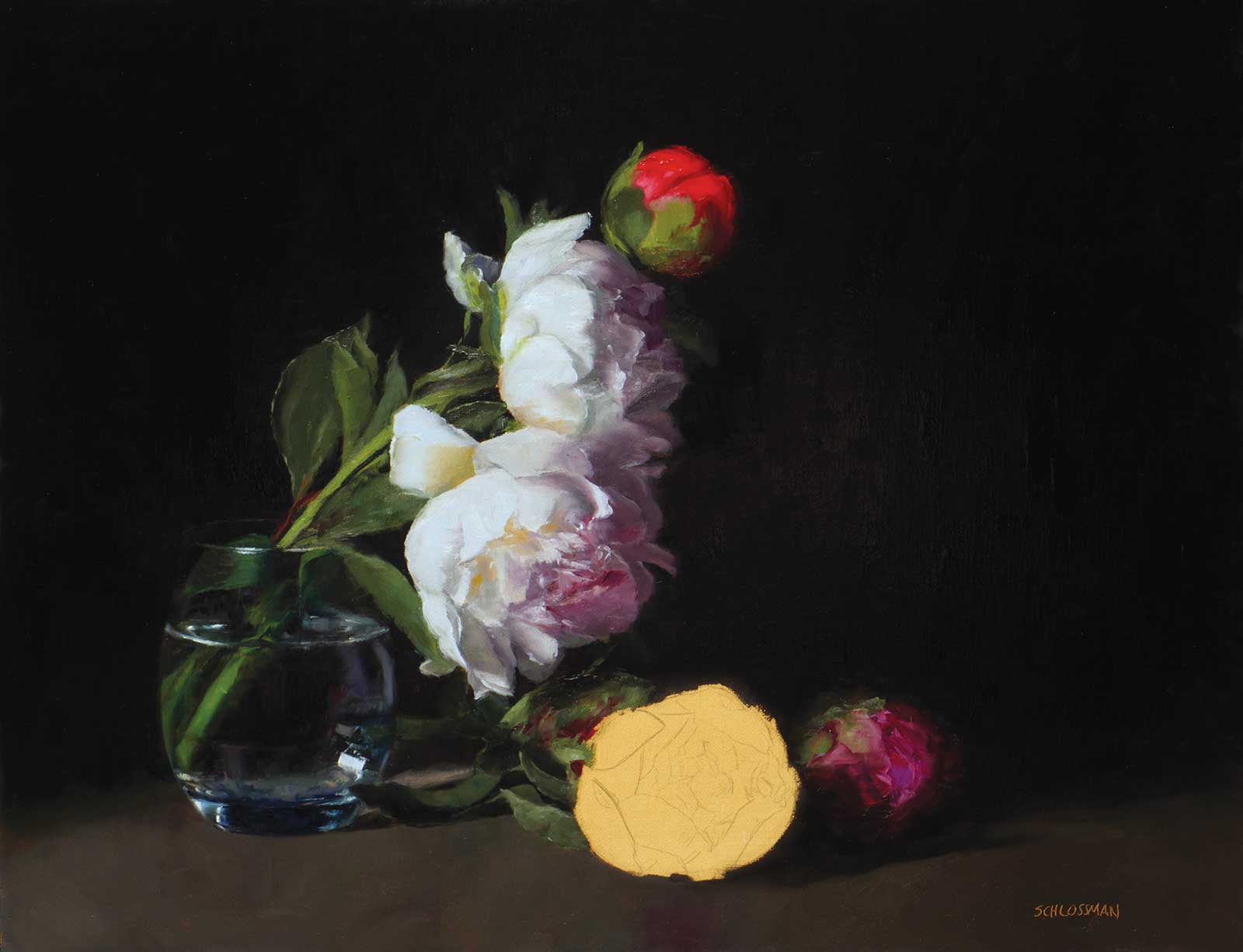
Stage 7 Bursts of Color
Next, I painted a few of the unopened, bright peony buds, adding pops of color that enhance the composition’s depth and visual interest.
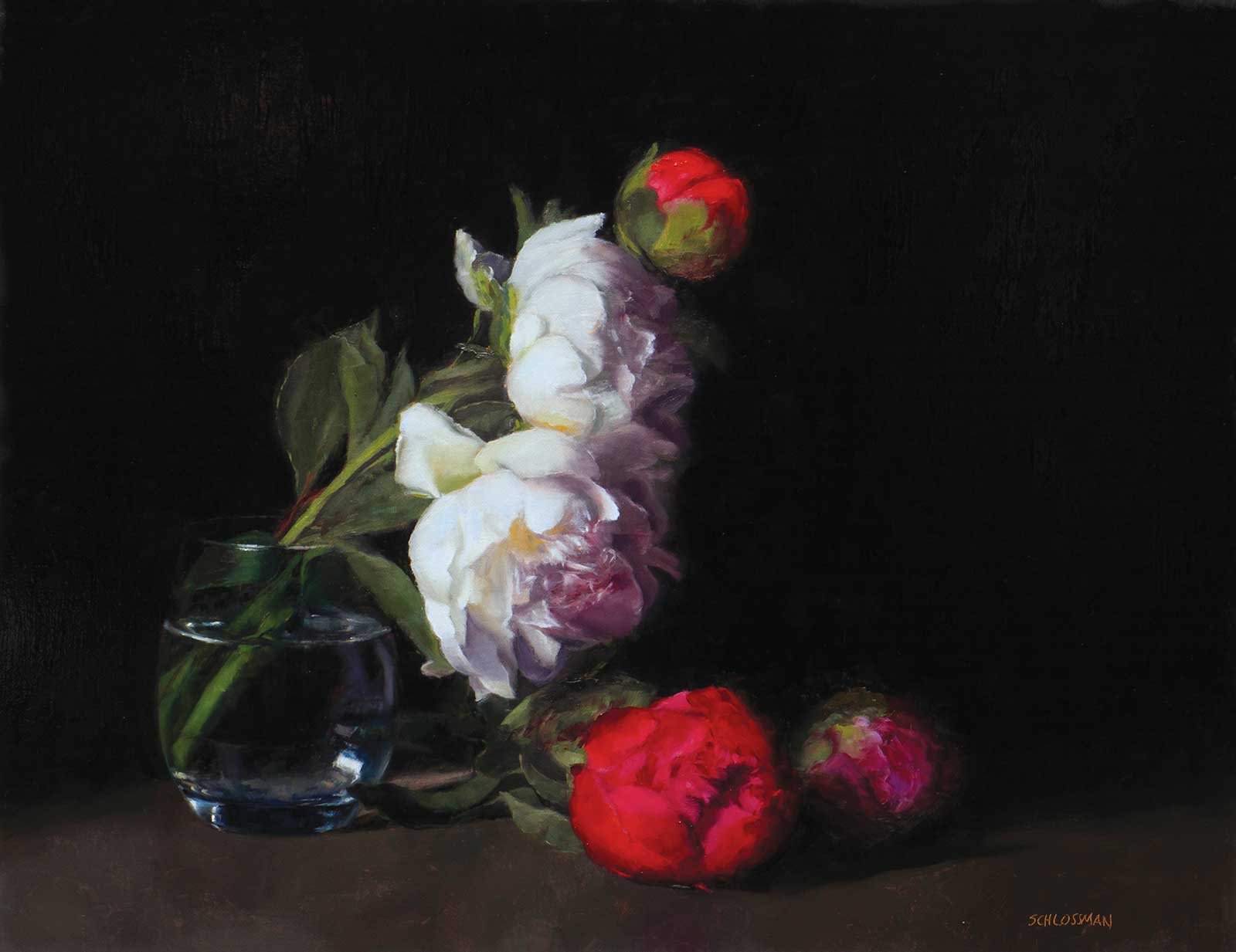
Stage 8 Finished Artwork
Spring Peonies, oil on linen panel, 14 x 18” (35 x 45 cm)
I have now added the final bright red peony in the foreground, serving as a vibrant focal point that anchors the composition. After the painting was dry to the touch, I reviewed the values and made subtle adjustments, selectively defining a few of the petals with small details. I aim to keep the overall feel loose and avoid overworking it. The painting is now complete, following a few final refinements and the application of Gamvar gloss varnish to enhance surface depth and provide archival protection.
About the artist
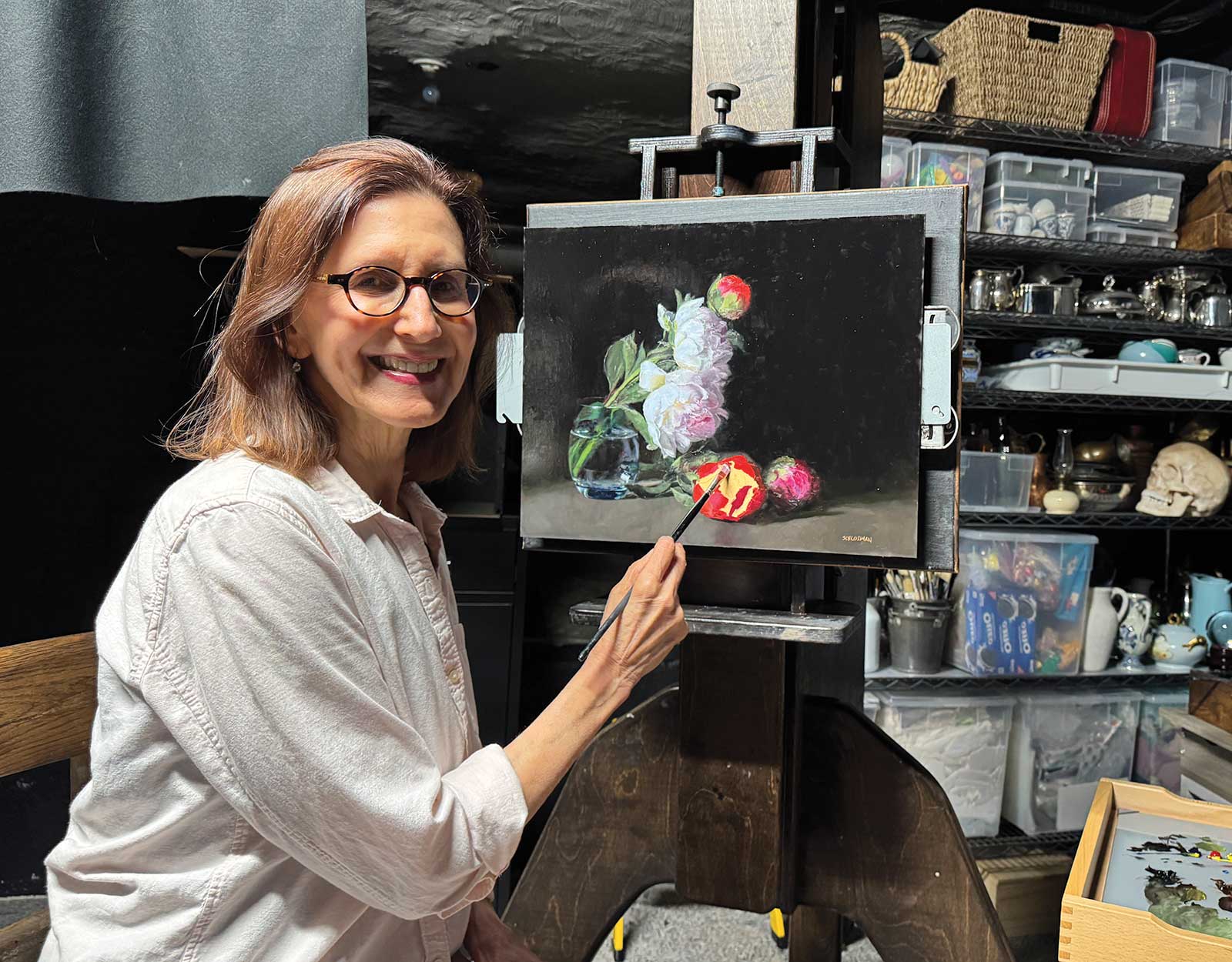 Deborah Schlossman
Deborah Schlossman grew up in the New York suburbs and has been living in the Boston area for most of her adult life. Although she works full time as an ophthalmologist and cataract surgeon, painting has remained a vital and evolving part of her life.
Schlossman is a member of the Copley Society of Art in Boston and the Salmagundi Club in New York City. Her work has been included in numerous juried exhibitions, including the prestigious Guild of Boston Artists. She has received recognition from national and international organizations, with awards from the Art Renewal Center Salon, Portrait Society of America, Hudson Valley Art Association and the Northeast Fine Arts Exhibition.
Contact at
deborahschlossman.com