I’m a self-taught artist based in Cheshire, England, where I’ve been working professionally for the past four years. All of my work is painted directly from life, the subjects being either still lifes or plein air landscapes. My early work was almost photorealistic, but as it’s evolved I’ve found that I’ve become increasingly interested in creating looser paintings with more expressive brushwork. Recently, I developed an interest in daily painting, the aim of which is, as suggested, to finish a painting each day. Having time limitations has forced me to be more economical with my brushwork, avoiding unnecessary detail. Therefore, I tend to choose simple subjects such as fruit, vegetables, ceramics and silver with the intention of capturing form and texture. I want my paintings to have a sense of vitality, through the use of color, mark-making and control of edges.
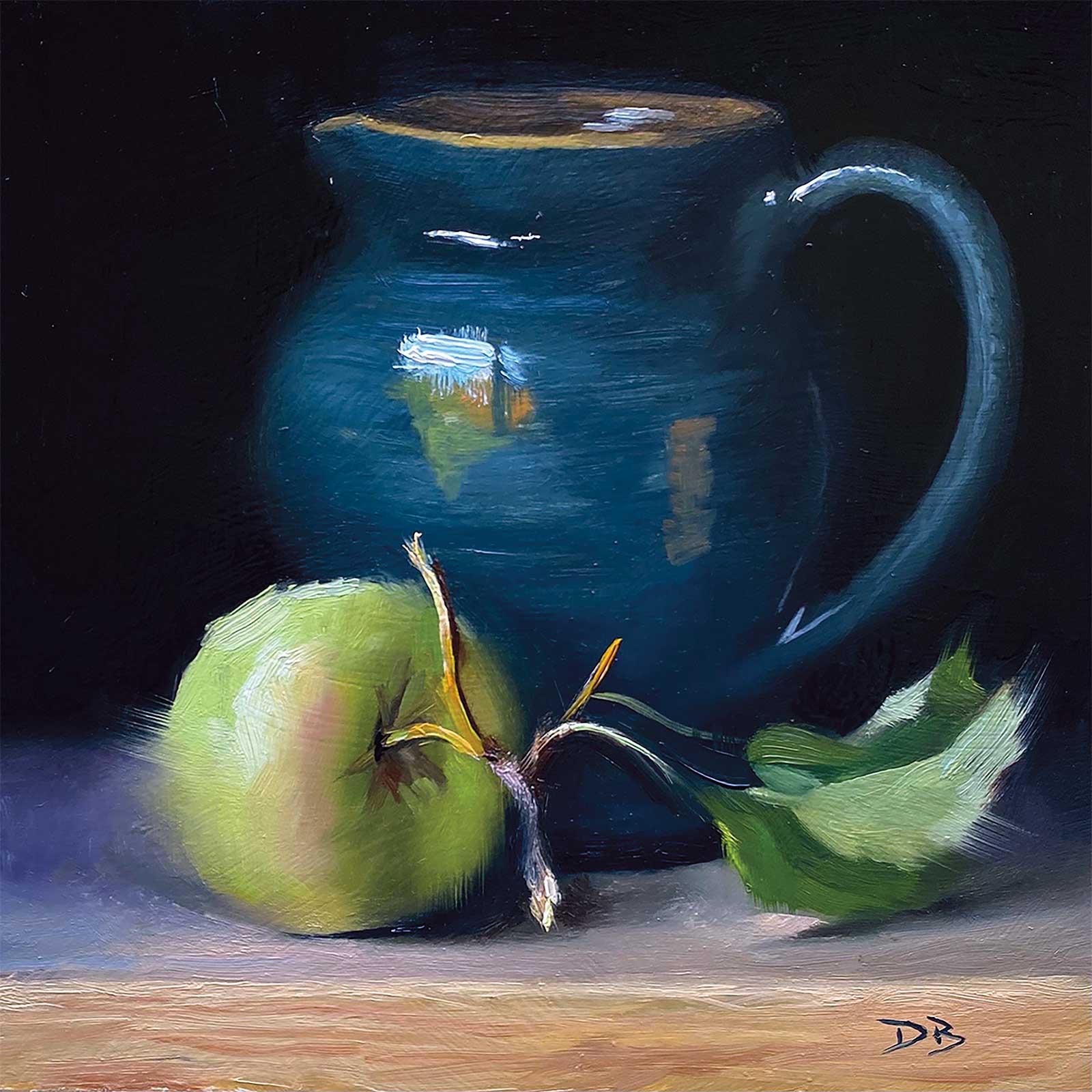 Apple & Jug, oil on panel, 8 x 8” (20 x 20 cm)
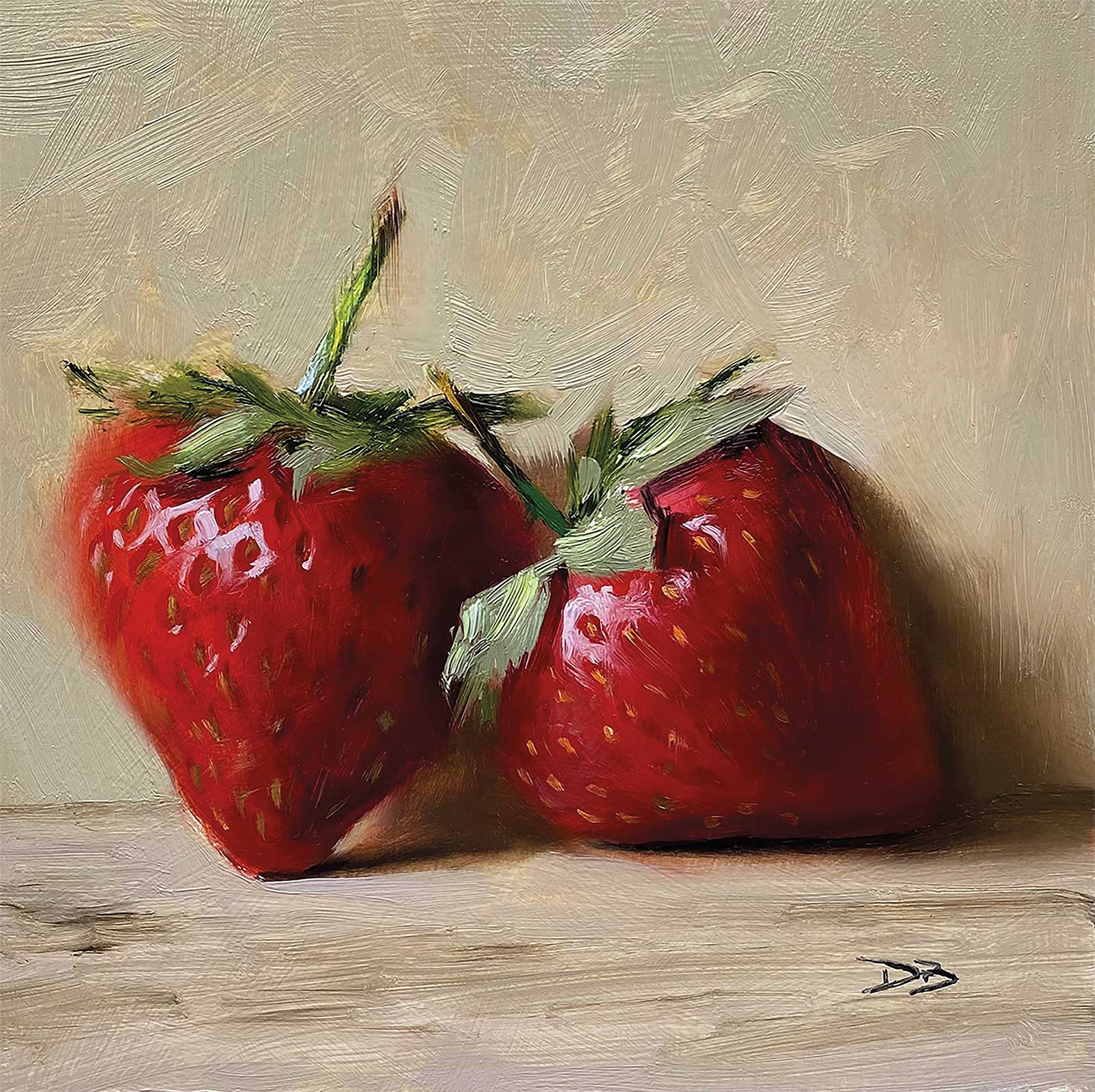
Strawberries, oil on panel, 8 x 8" (20 x 20 cm)
Over the years I’ve been influenced by a number of artists, but most notably Dutch still life artist Henk Helmantel along with American artist Richard Schmid have influenced my choice of subject and my approach to painting.
I’ve enjoyed each stage of my painting journey; it’s the learning and evolving that continues to motivate me.
My Art in the Making Damsons & Lemon
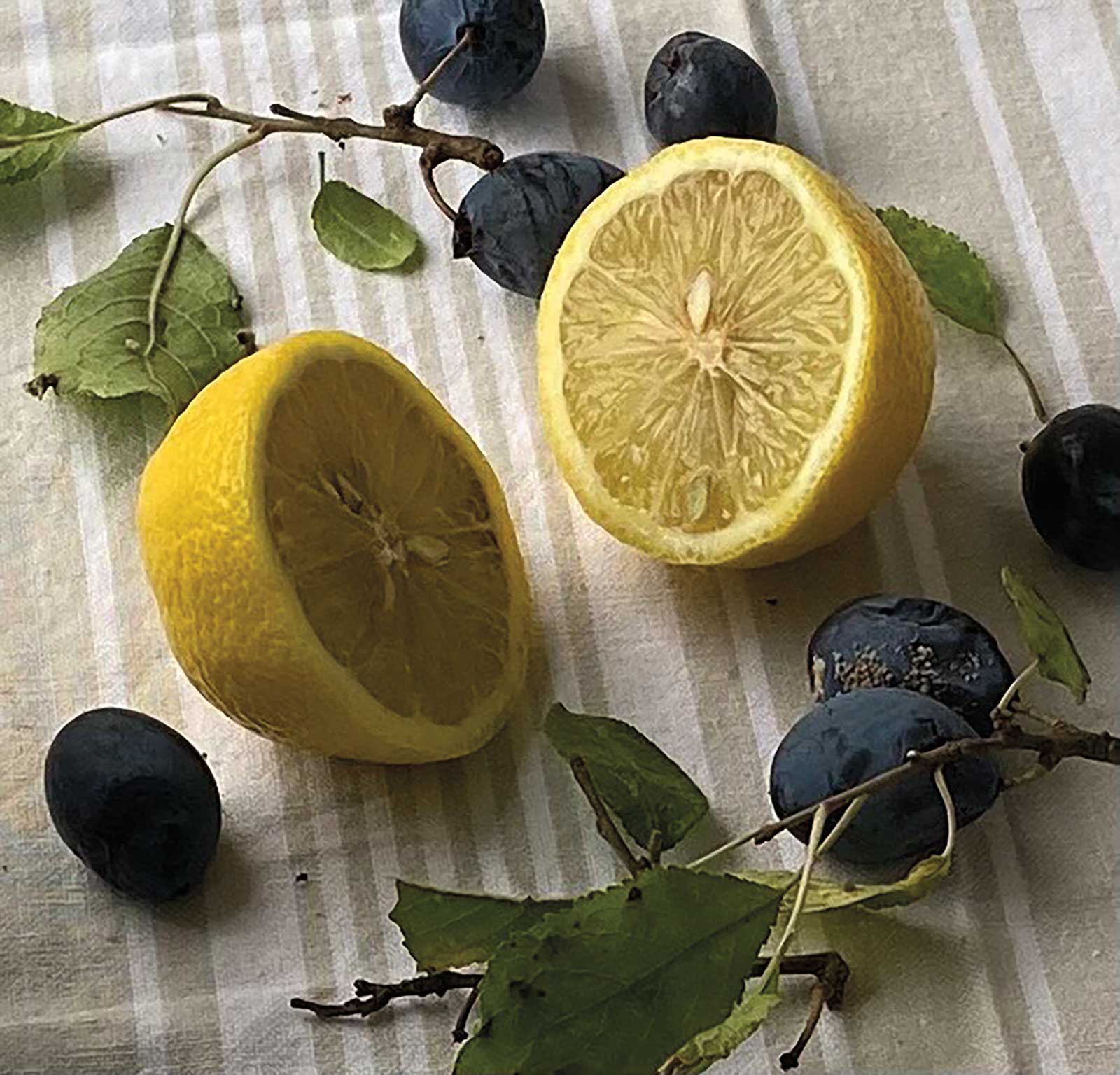
Stage 1 Set-up and Composition
Once I’ve selected the objects that I’m going to paint, I spend time arranging them in a variety of ways until I find a composition I’m happy with. I then use a viewfinder with the same aspect ratio as the panel that I’m working on and squint down in an attempt to visualize how the finished painting may look.
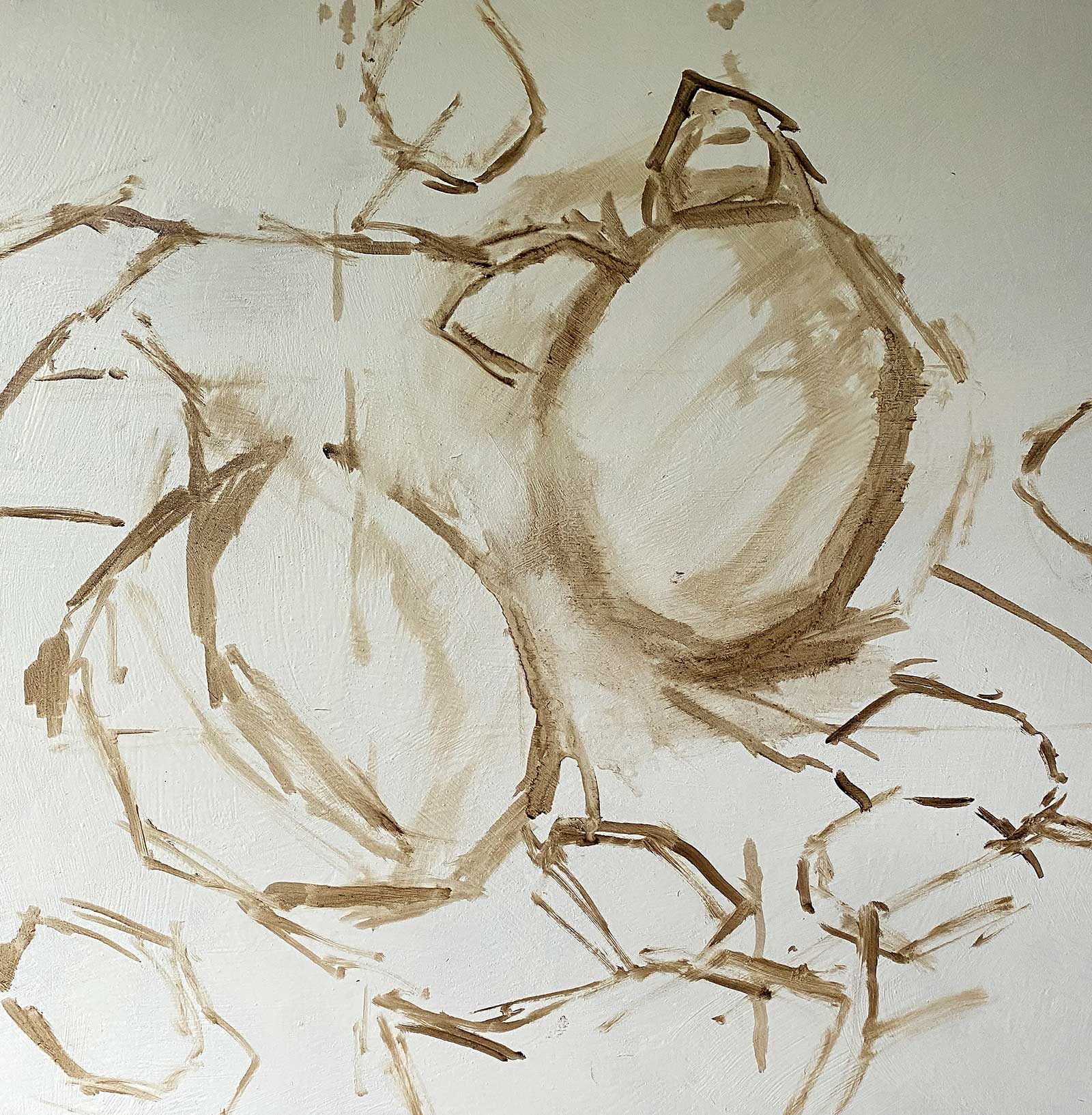
Stage 2 Loose Paint Sketch
Once I am happy with the composition, I loosely draw this out using a size 1 round bristle brush. I use raw umber, diluted with turpentine for the drawing. The purpose of the drawing is to roughly position all of the elements on the panel, not to create a detailed image. I’ll frequently use a paper towel to erase shapes if I feel they’re not working in the composition. I’ll also use this stage to tweak the elements in the still life set up.
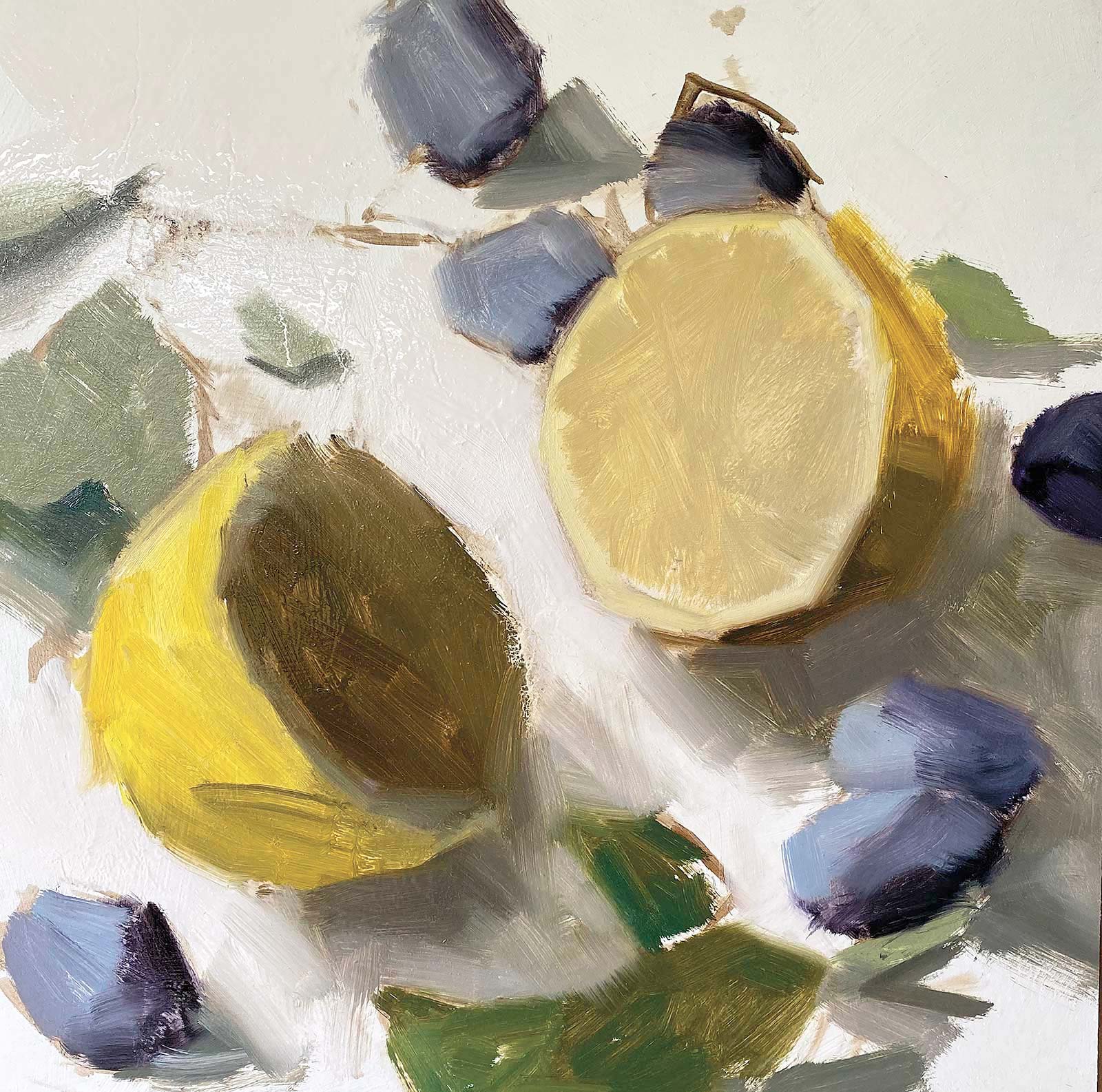
Stage 3 Blocking in Main Colors
The next stage is to loosely block in the large masses of color. My focus at this stage is to ensure that all of the value relationships are correct. I use a large, flat bristle brush (size 8), which helps me to avoid any detailed painting. At this stage I use genuine turpentine to dilute the paint into an inky consistency. In this painting I spent quite a bit of time mixing a string of colors for the lemons on the palette. I find it easier to see the color relationships next to each other on the palette before committing them to the panel.
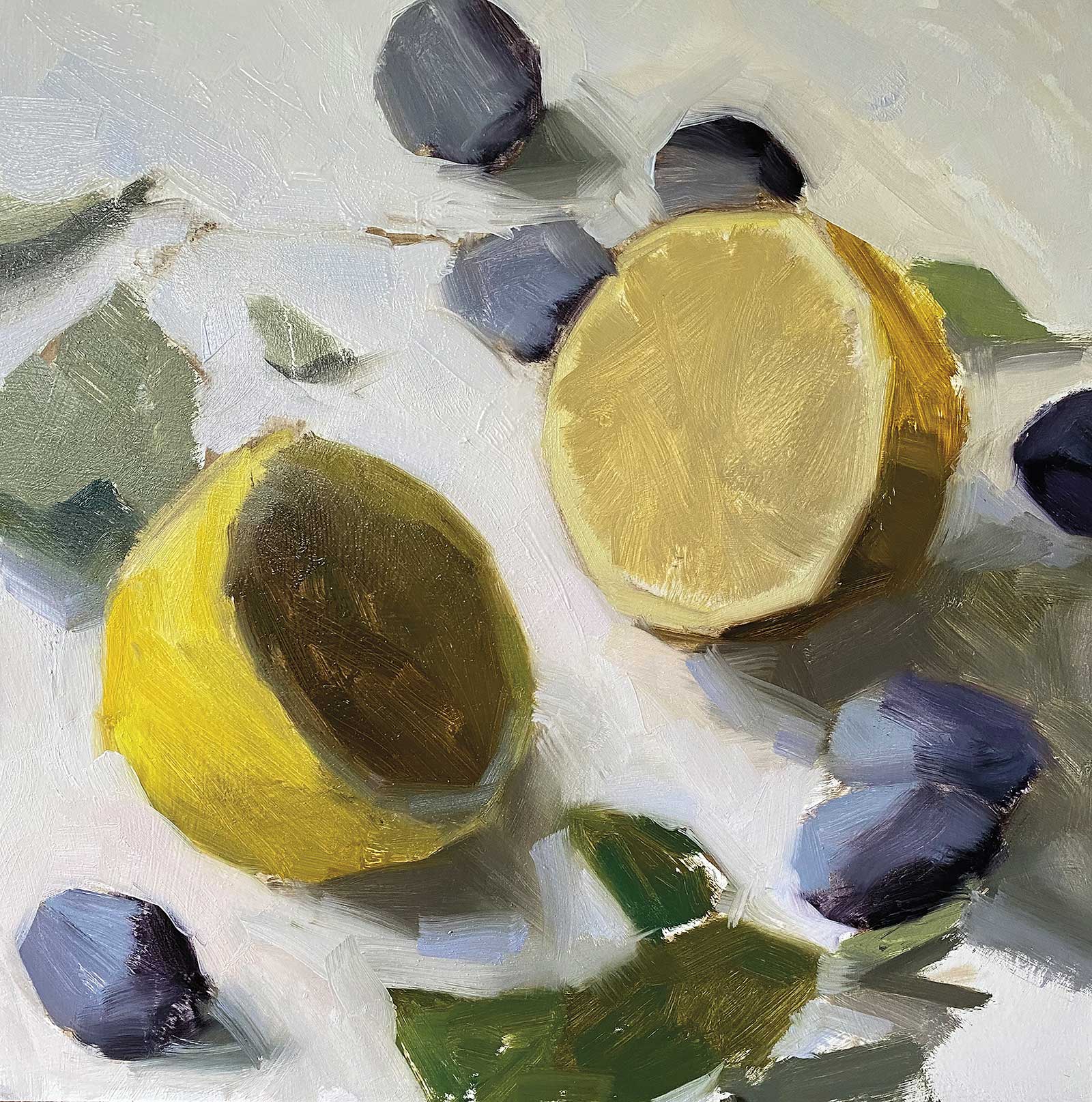
Stage 4 Shadows
Once the block-in is complete and I’m happy with the value relationships, I evaluate the image as a whole and make decisions on which colors need adjusting. In this next image you will see that I’ve begun to introduce violets and blues into the edges of the shadows. My aim in this painting was to exploit the complementary color relationship between the damsons and the lemon. Using the violets and blues in the shadows reinforces this relationship. Using a size 6 synthetic long flat brush, I focus on making very deliberate strokes, which once placed are left alone, as any fiddling at this stage will mix the paint with the thin layer below and muddy the paint. I use a small amount of linseed oil to keep the paint thin and allow it to flow.
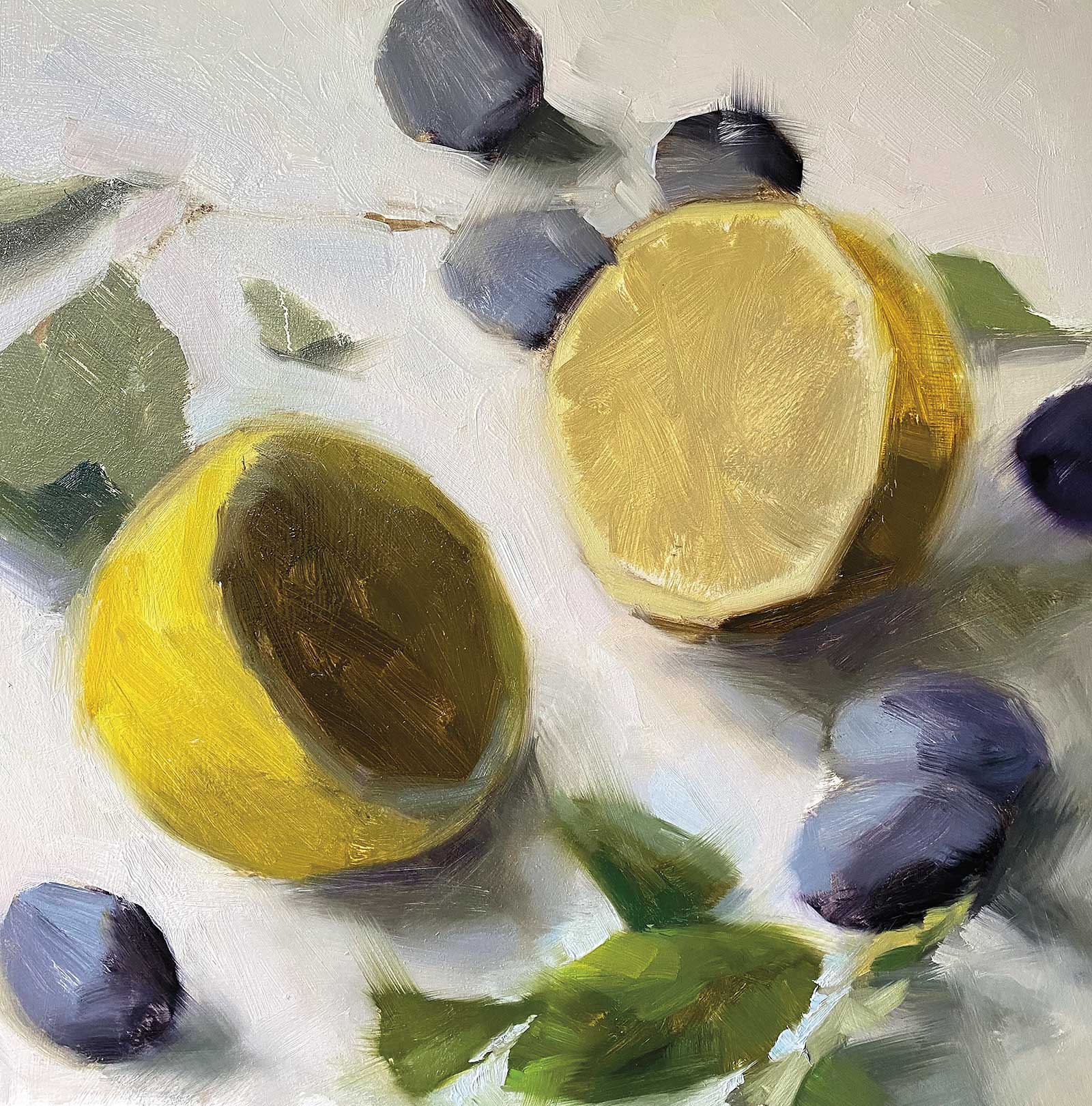
Stage 5 Refining Color
At this point I begin to add subtler whites to the tablecloth. I wanted to vary the whites across the painting, so I tinted the titanium white with either alizarin crimson or cobalt blue in varying degrees. I then used a 1” hakeme brush to gently blend the edges of the shadows. I continued refining the colors, varying the green with the leaves towards the bottom of the painting.
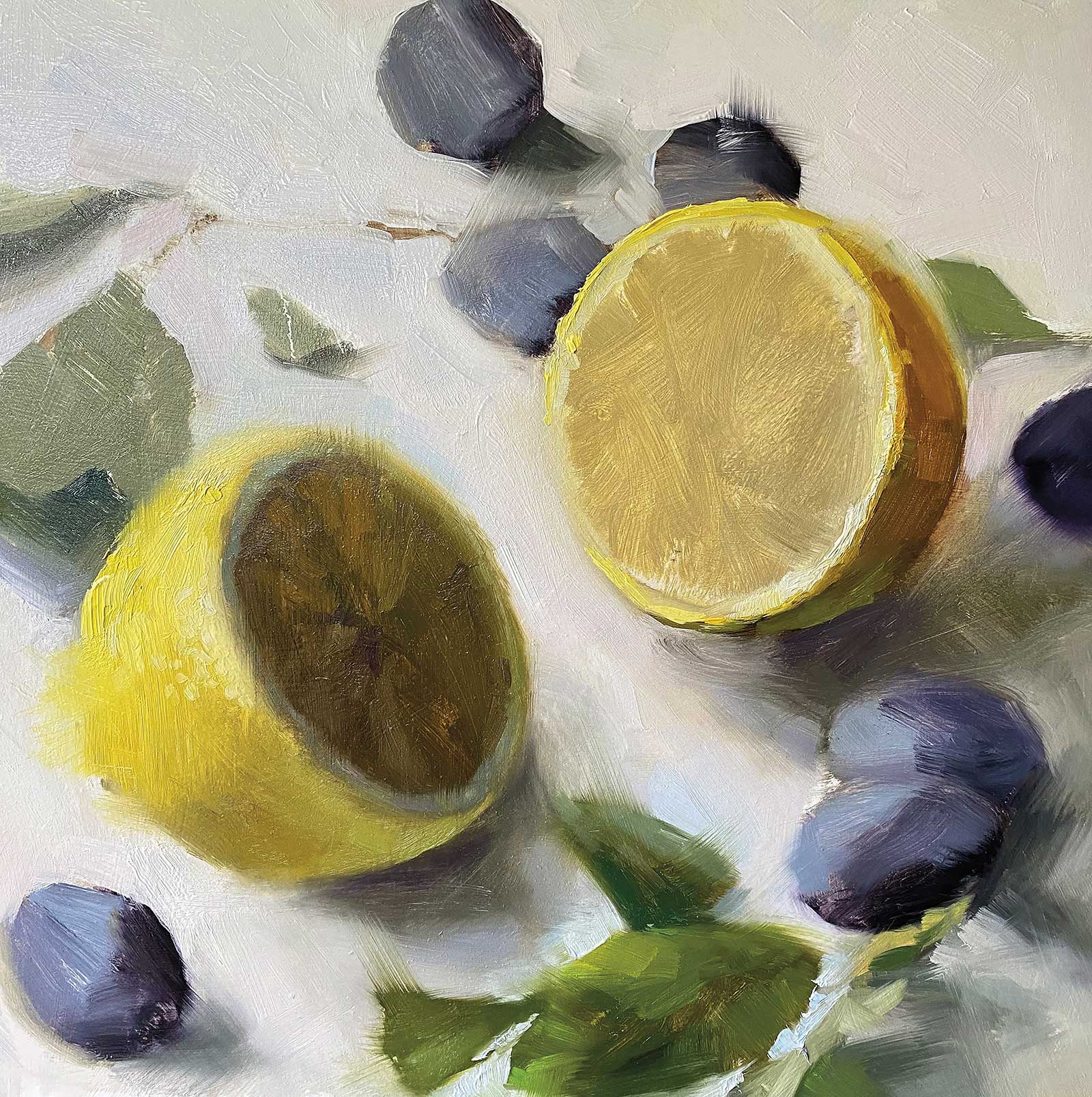
Stage 6 Adding Texture and Softening Edges
Using undiluted paint, I begin to add higher chroma paint in the light values of the lemons. These brushstrokes are much more textured and will help to brighten the highlights on the lemon. I also introduce some cooler blue details to the cut face of the lemon. At this point I’m also beginning to think about which edges in the painting are going to be hard and where I can lose some edges. I use a soft sable brush as well as a comber brush to break edges. The comber brush creates lined streaks in the paint, whereas the sable brush gives a smoother blend.
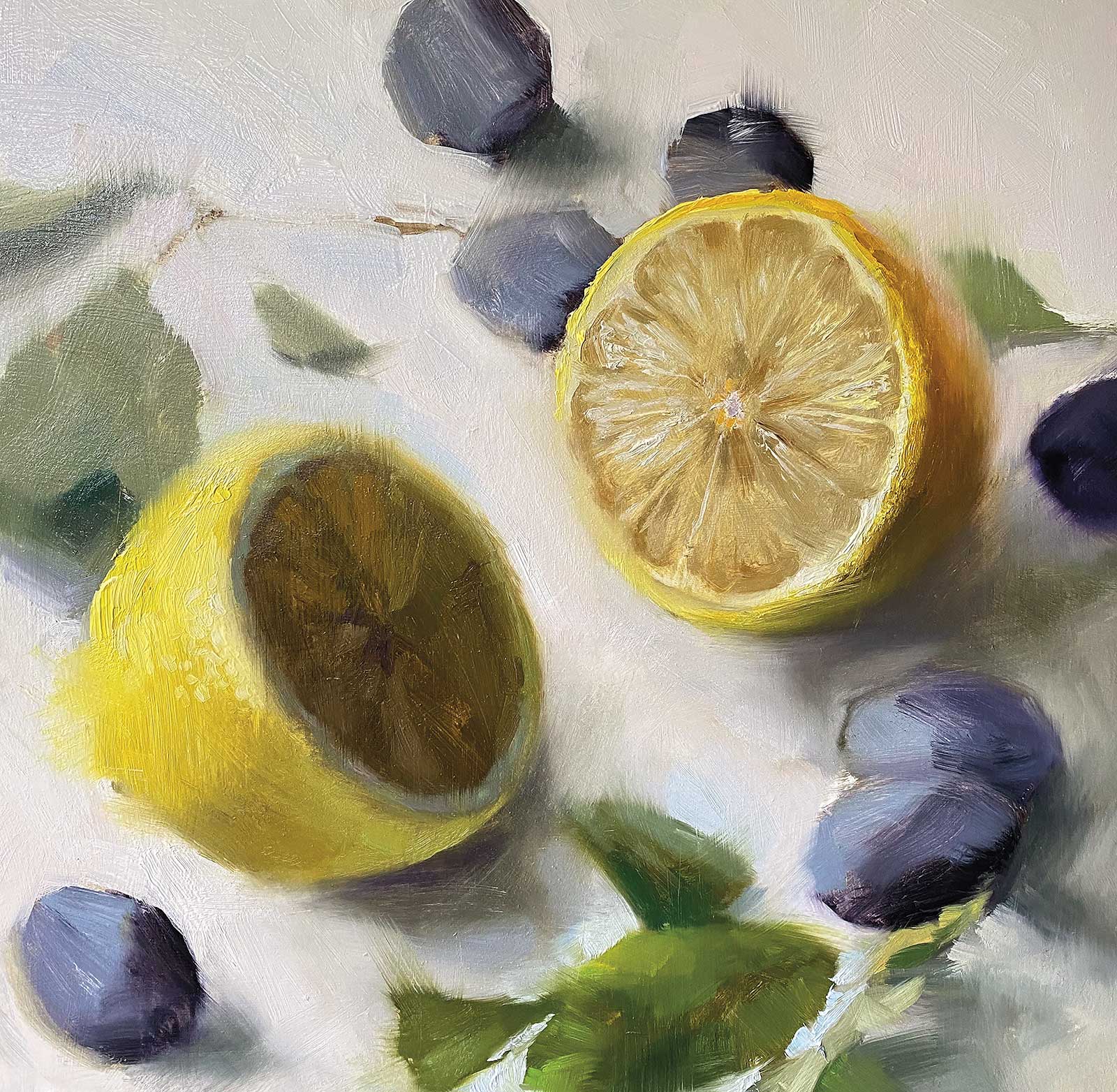
Stage 7 Impasto on Lemon Peel and Rind
Using thicker paint, I use a small round bristle brush to paint the rind around the edge of the lemon. I also begin to add the highlights to the cut face of the lemon slice with impasto paint.
Stage 8 Softening Edges of the Damsons
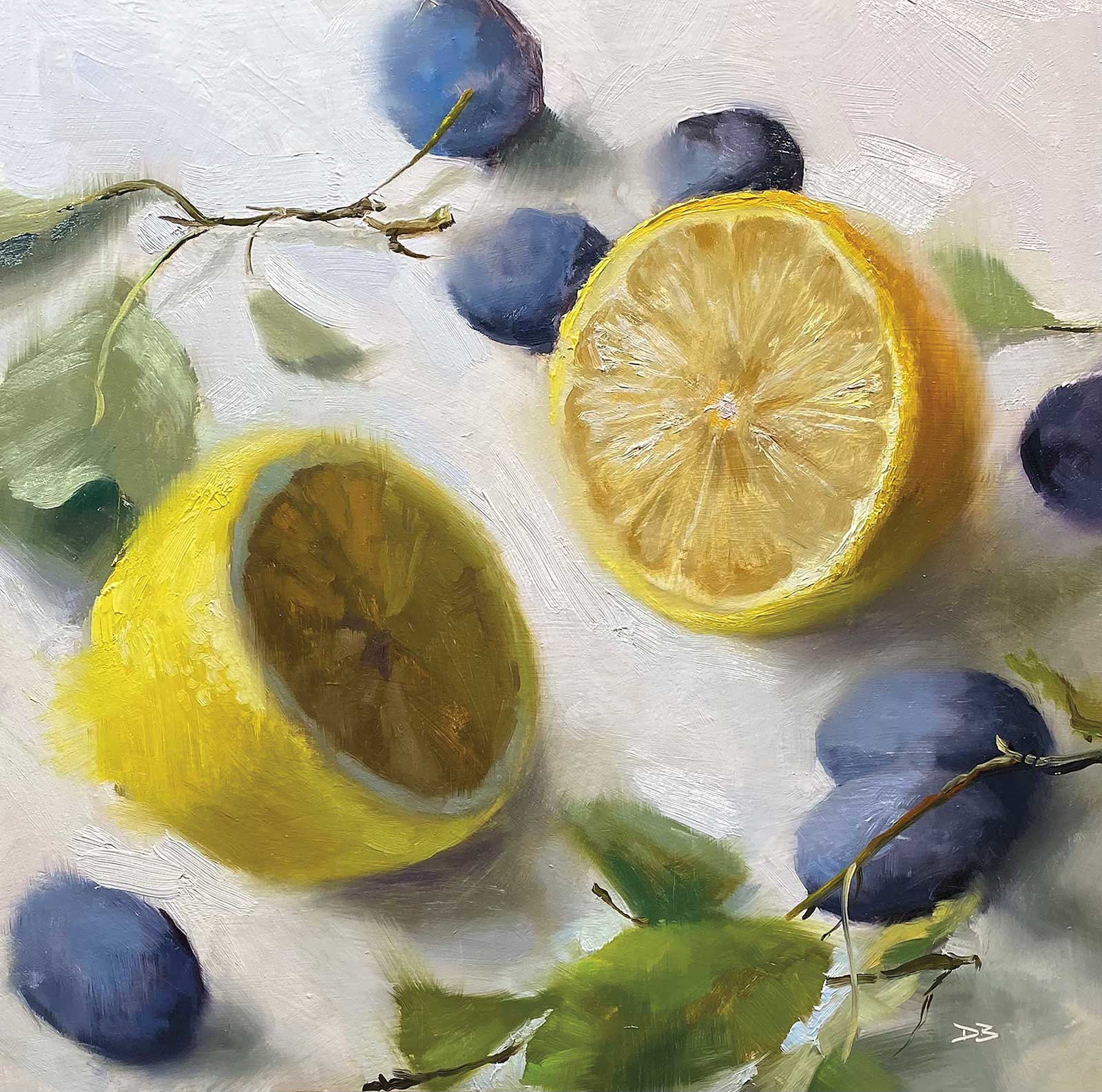
Damsons & Lemon, oil on panel, 12 x 12" (30 x 30 cm)
Finally, I begin to refine the edges of the damsons with a soft sable brush. Next, I add the stems and begin to imply details within the leaves using a rigger brush. I then evaluate the entire painting and decide which, if any, edges need adjusting. I either soften these with a sable brush or sharpen them with bold strokes of “neat” paint.
About the artist
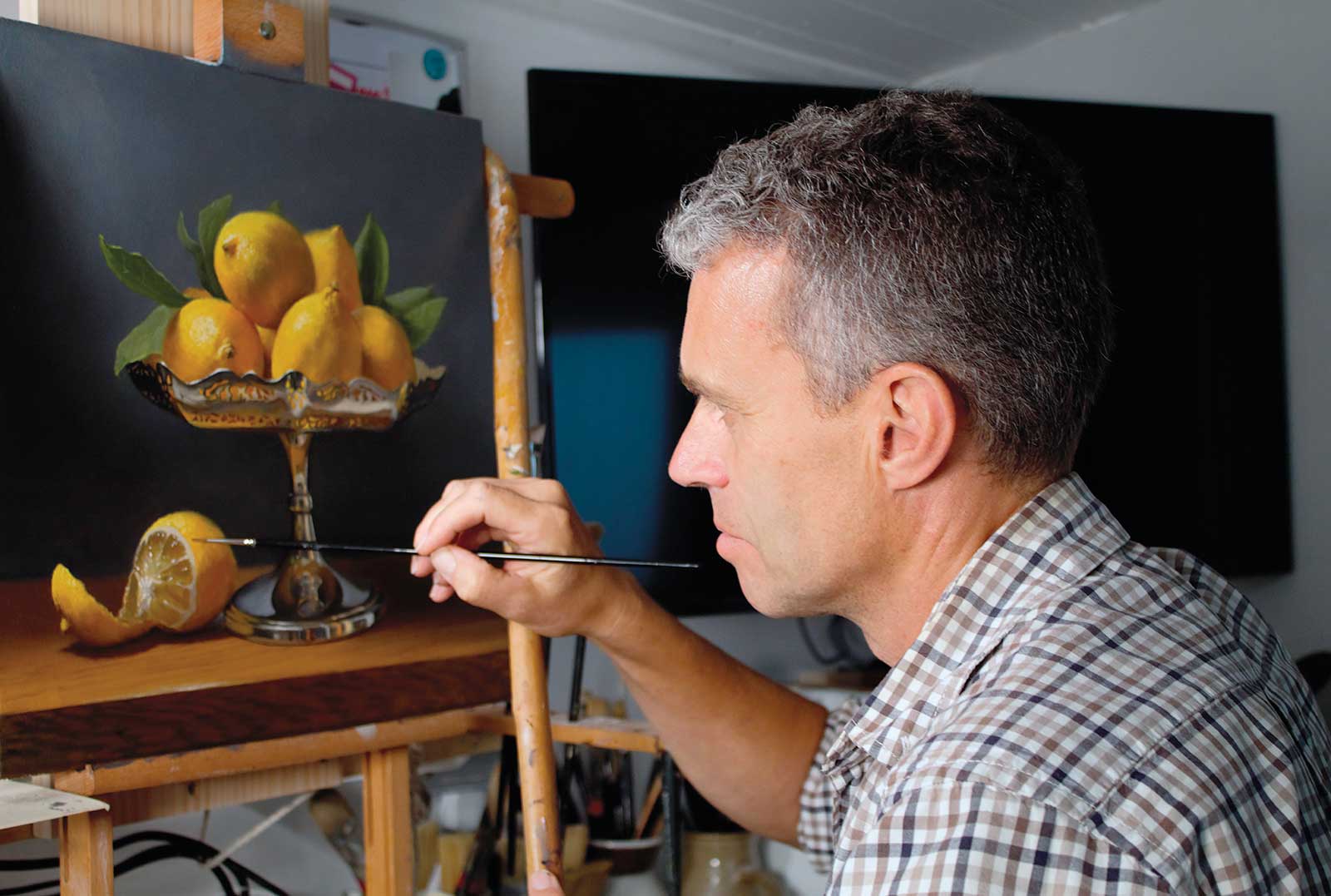 David Barber
David Barber was born in 1968, and is an English realist painter. His early career began in the art studios of Stoke-on-Trent’s potteries where he was involved in the production of artwork for the local ceramics industry. This was followed by a degree in fine art from Manchester Metropolitan University.
After university, the demands of having a young family meant that painting was relegated to a hobby, and he worked for many years as a school teacher. However, Barber always nurtured a longing to be able to paint for a living, and only in 2021 did he make the momentous decision to retire from teaching and start painting in earnest, making it his new career.
All of Barber’s work is painted directly from life. Through his work, he seeks to convey the beauty that surrounds us in everyday objects. He paints daily, always striving to create looser, more expressive work.
Contact at
davidbarberfineart.com