There is something unmistakably cinematic about the paintings of Bo Bartlett. His canvases often appear as still frames from a larger story: moments suspended in time, filled with quiet tension and unresolved narrative. A figure stands in contemplation, a group gathers without clear purpose, or a landscape stretches out beneath a sky that feels both familiar and unknowable. These are not grand historical scenes or overtly dramatic events. Instead, Bartlett returns again and again to the ordinary rhythms of American life, transforming fleeting observations into enduring meditations on memory, identity and existence.
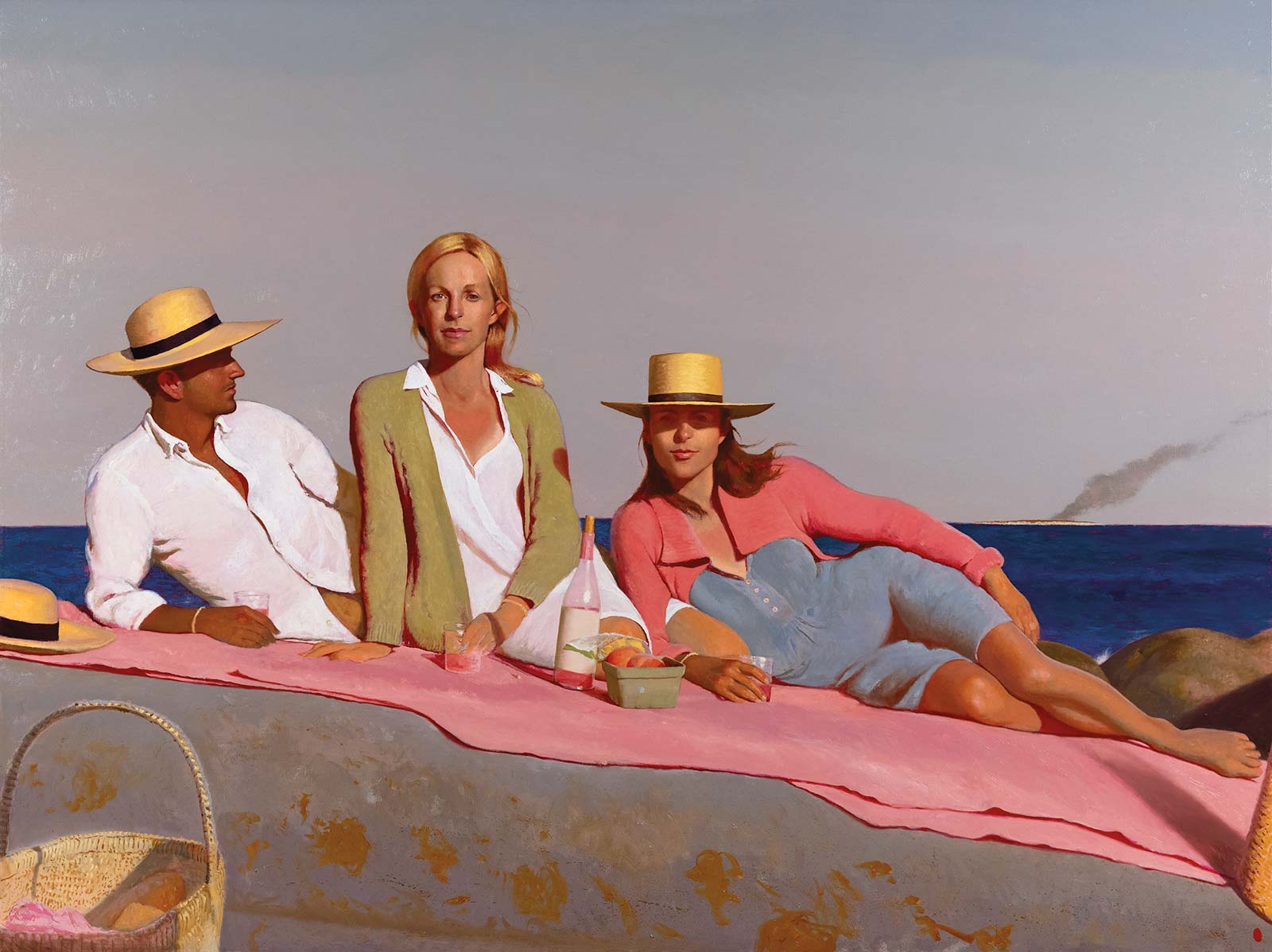
Ten Days in July, oil on linen, 60 x 80” (152 x 203 cm)
For Bartlett, the origin of a painting is rarely abstract. Most begin with something seen, an image encountered in passing that lingers long after the moment has gone. While some works emerge from dreams or reinterpretations of other artworks and films, the majority are rooted in lived experience. Travel plays an important role in this process. Moving through the world with attentive curiosity, he collects visual impressions that later resurface in his studio. A passing glance, a roadside scene, or an incidental interaction can spark an idea that becomes, in his words, “etched in memory.”
What distinguishes Bartlett’s approach is the way these fragments are transformed. The scenes he paints are not literal reproductions, but reinterpretations filtered through his own life. There is a duality at play, a macrocosm and microcosm existing simultaneously. A seemingly simple image might carry deep personal associations while also resonating with broader, collective experience. This layering gives his work its emotional depth; viewers sense that something meaningful is present, even if its full significance remains just out of reach.
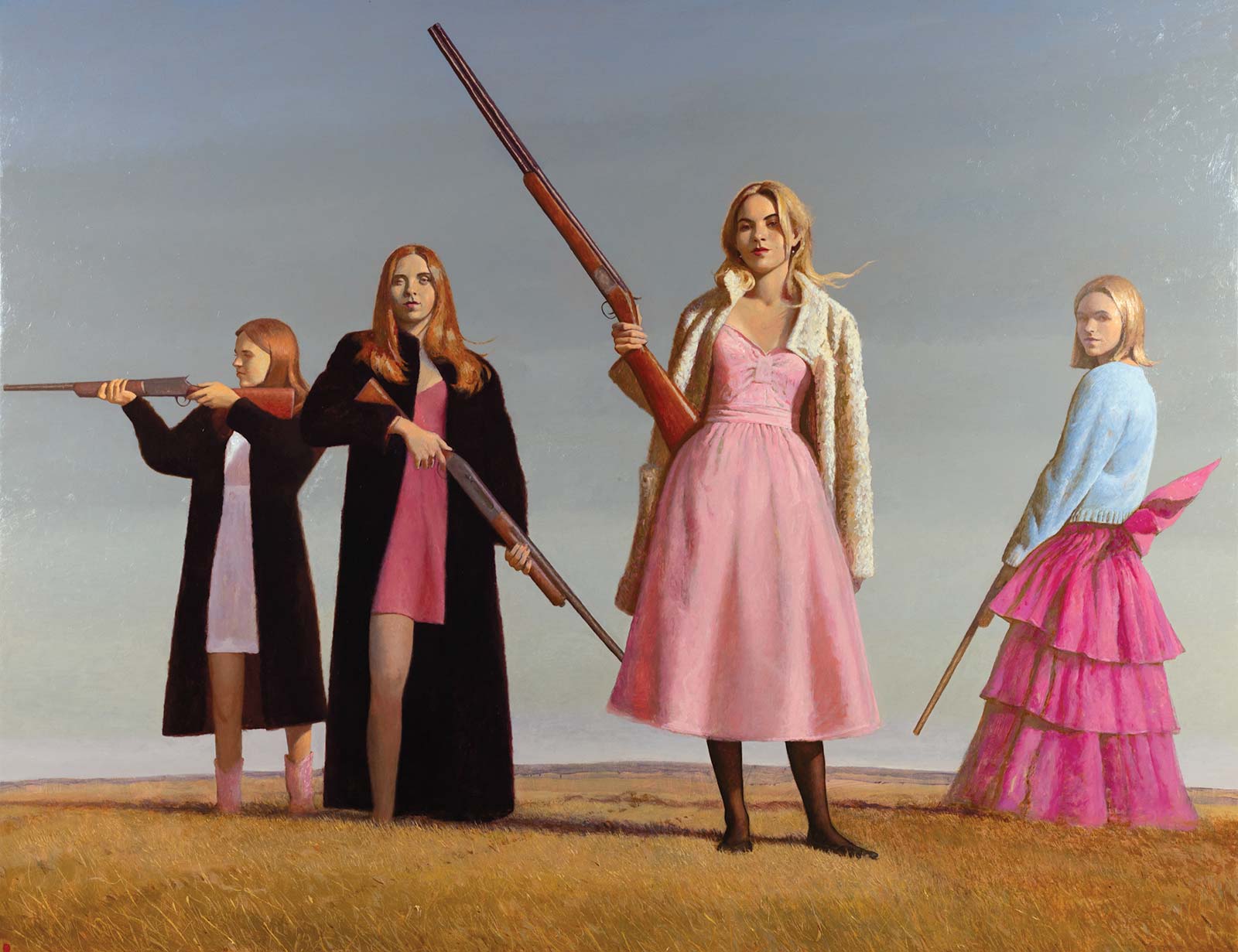
The Debutantes, oil on linen, 78 x 98” (198 x 248 cm)
Bartlett’s artistic foundation is firmly rooted in the traditions of American realism, yet his voice within that lineage is distinctly his own. His early training provided him with rigorous technical skills. He studied drawing in Florence under Ben Long IV and later refined his painting practice in New Hope, Pennsylvania, with Nelson Shanks. By the time he encountered Andrew Wyeth, whose influence looms large over American figurative art, Bartlett had already established his stylistic direction.
What Wyeth offered was not instruction in technique, but something more profound. From him, Bartlett absorbed a philosophy of painting centered on emotional truth. The act of painting, he came to understand, is not merely about representation but about conveying what it feels like to be alive in a particular moment. This shift, from focusing on how to paint to understanding why to paint, became a defining element of his practice. It is this emphasis on feeling that gives Bartlett’s work its quiet intensity.
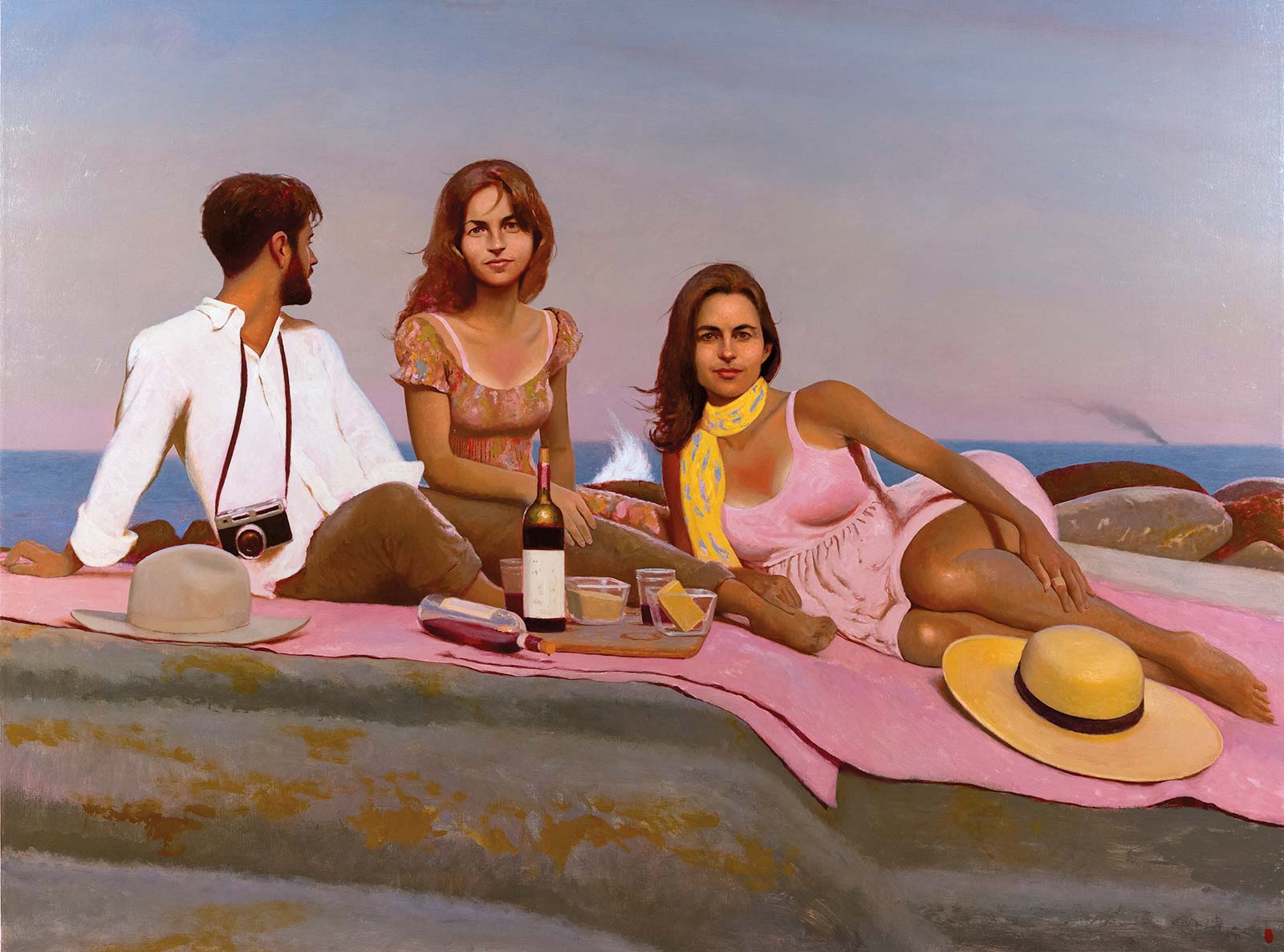
Wild Love, oil on linen, 60 x 80” (152 x 203 cm)
Narrative plays a central role in his paintings, though it is never didactic. Unlike artists who leave interpretation entirely open from the outset, Bartlett typically begins with a clear sense of the story he wants to tell. Ideas are developed over long periods, sometimes years, through sketches, studies, and sustained contemplation. By the time he begins a final painting, he has already explored its possible meanings and implications in depth.
Yet this clarity does not result in closure. Bartlett deliberately leaves space for ambiguity, allowing viewers to enter the work and form their own interpretations. The story is known to him, but it is not fixed. Each painting becomes a site of discovery, both for the artist and for those who encounter it. If a work fails to reveal something new, if it does not “wake him up” to an undiscovered aspect of himself, then, to him, it has not fulfilled its purpose.
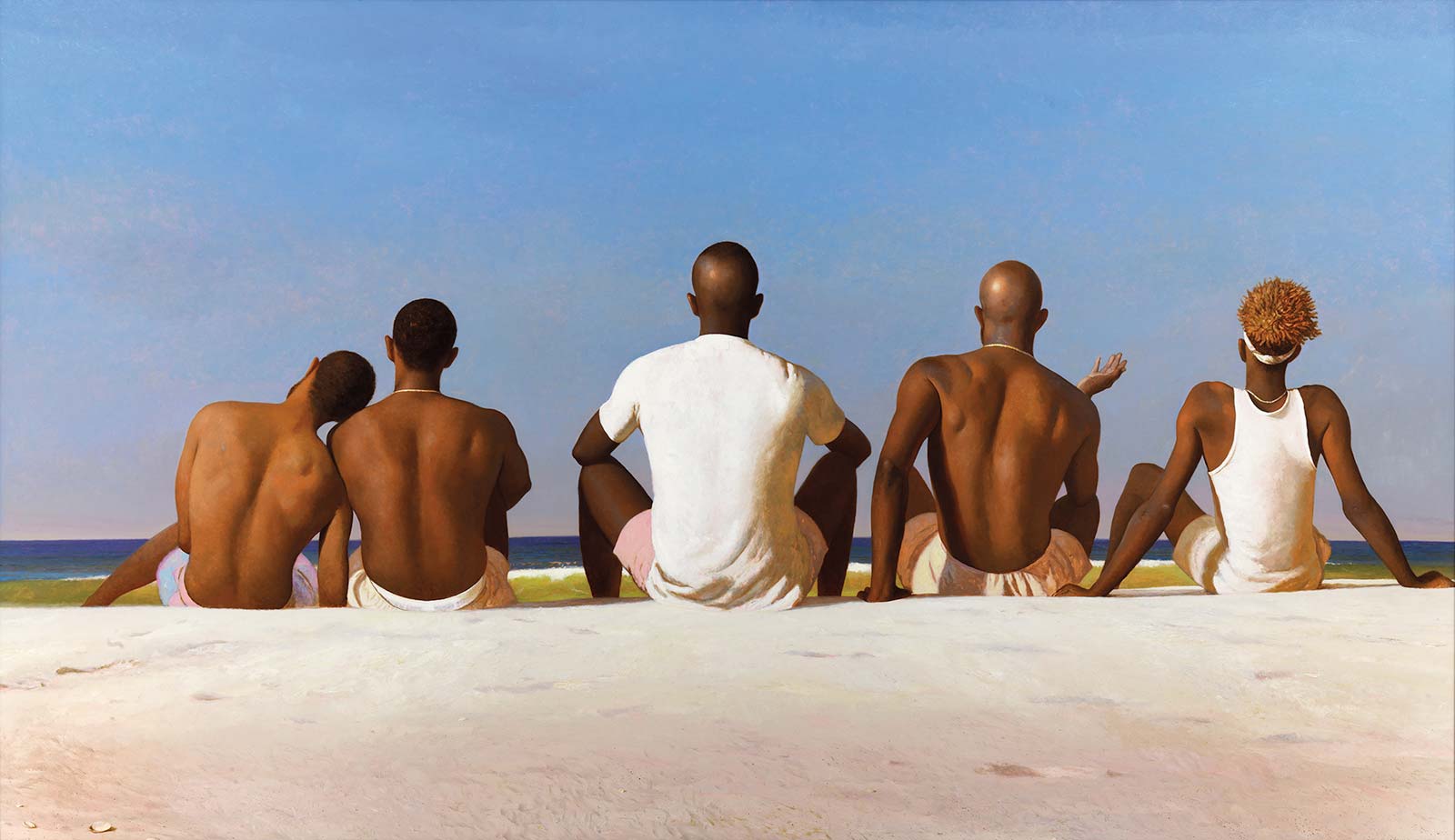
Hurtsboro, oil on linen, 70 x 120” (177 x 304 cm)
This balance between intention and openness is mirrored in Bartlett’s approach to style. His work combines classical technique with contemporary subject matter, creating a bridge between past and present. He believes that art should not alienate viewers but, rather, it should welcome them in and challenge them. It’s the artist’s job to make something quite unlike anything they’ve experienced before. Bartlett’s paintings embody this principle. Their technical precision and familiarity draw viewers closer, while their subtle distortions of narrative and mood encourage deeper engagement. Rather than replicating the past, he builds upon it, using traditional methods as a foundation for innovation.
Place is another essential element in Bartlett’s work. His life is divided between two distinct environments: his hometown in Columbus, Georgia, and an island in Maine where he spends summers with his wife, artist Betsy Eby. These locations are more than backdrops; they are active participants in his creative process.
In Georgia, Bartlett lives in his childhood home, surrounded by the physical remnant of his past. Everyday experiences, walking through familiar streets, and encountering ordinary scenes trigger memories that feed directly into his paintings. These memories are not static; they evolve and intertwine, allowing him to represent his life through time, past, present and even imagined future.
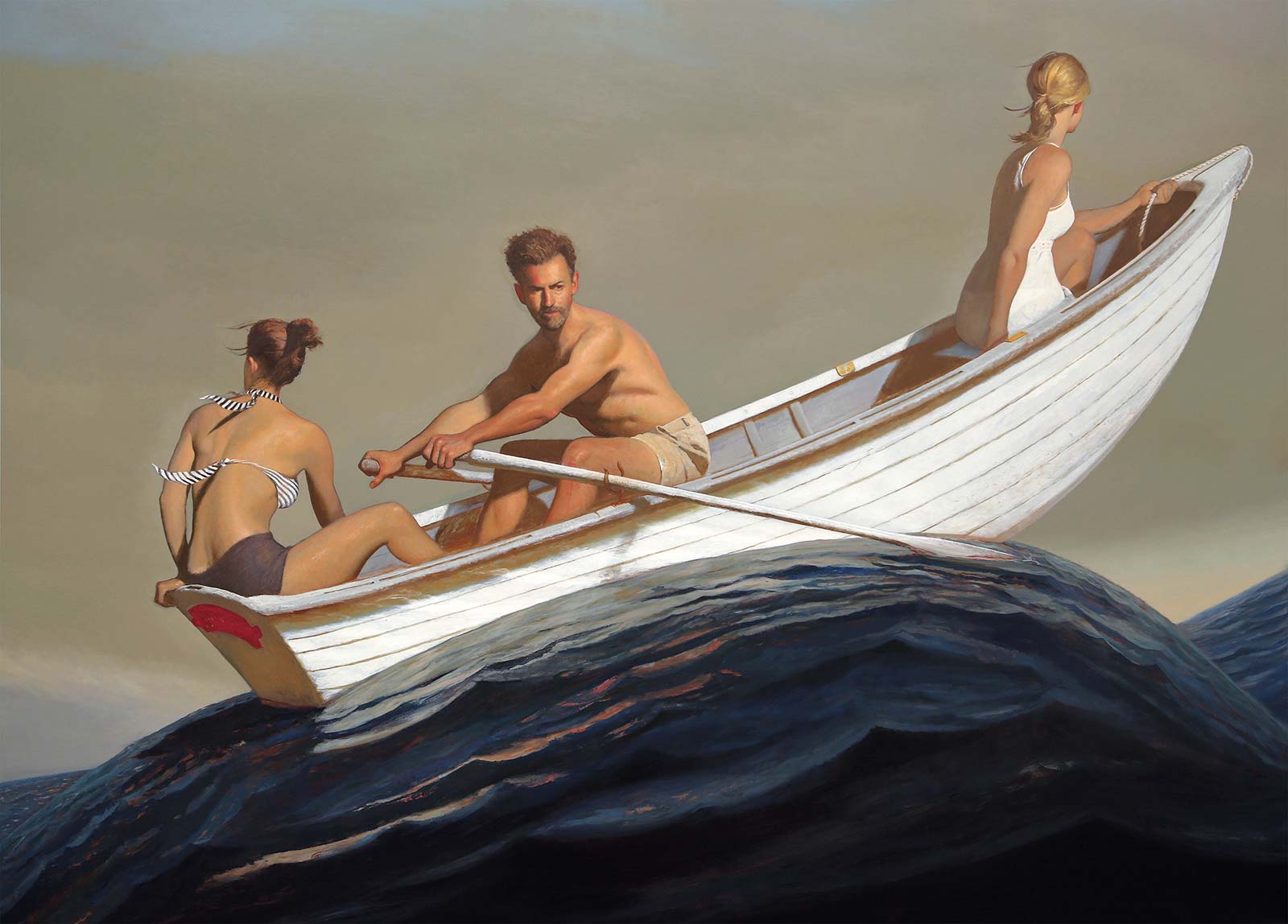
The Promised Land, oil on linen, 88 x 120” (223 x 304 cm)
This deep personal connection to place reinforces the autobiographical nature of his work. For Bartlett, every painting is, in some sense, a self-portrait. Even when depicting others, he is ultimately reflecting his own perceptions, emotions and experiences. Nothing within the composition is accidental. Every detail carries meaning, often rooted in personal history. However, these meanings are not intended as universal symbols. Bartlett resists overt didacticism, instead developing a private visual language. His paintings are conversations between himself, the divine, and what he describes as the “silent ghosts” that inhabit memory and space. Viewers are invited to listen in, but not necessarily to decode every element.
The process of creating these works is as meticulous as it is intuitive. A painting often begins with a quick sketch, on a napkin, an envelope or in a sketchbook, capturing the initial spark of inspiration. This idea is revisited repeatedly, gradually taking shape through more detailed compositional studies and drawings.
Bartlett frequently works with friends and family as models, grounding his figures in real human presence. He develops highly refined studies before beginning the final painting, solving many of the technical and compositional challenges in advance. This preparation allows him to approach the finished work with a different focus, not on problem-solving, but on expression.
In the final stages, the act of painting becomes an immersive experience. Each brushstroke is an attempt to capture a feeling, to translate the intangible into physical form. The completed painting, then, is not just an image but a record, a trace of the artist’s state of being during its creation.
Mood and atmosphere are central to this endeavor. In Bartlett’s work, they are not secondary elements but subjects in their own right. The emotional tone of a scene, its light, its stillness, its sense of anticipation or unease, often carries as much weight as the figures within it.
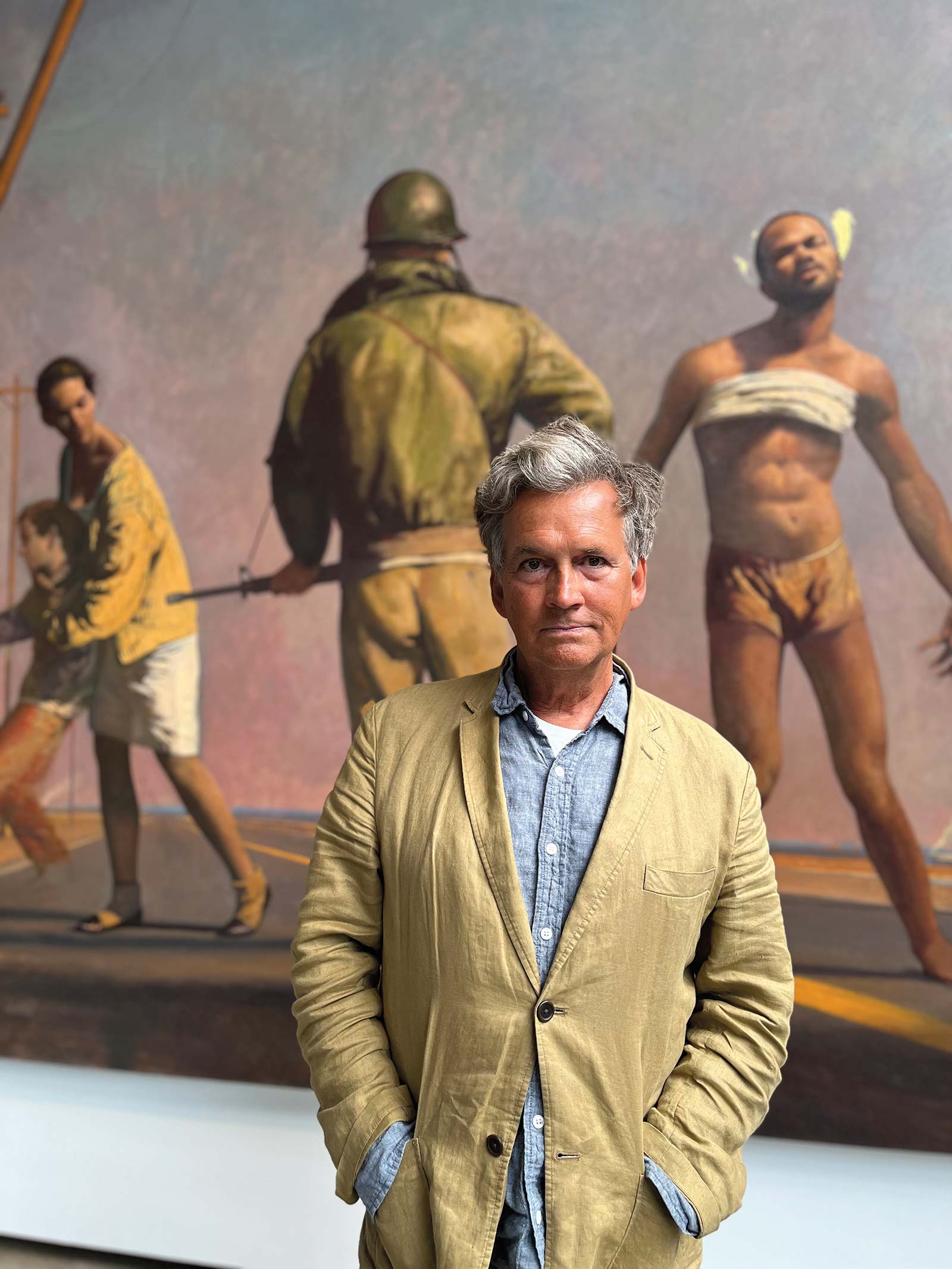
Bo Bartlett with his painting Damascus Road.
There is also a mystical dimension to these qualities. Bartlett speaks of a “numinous” presence that exists within the spaces of a painting, something that cannot be fully articulated but can be felt. It is this elusive quality that gives his work its enduring power. The viewer senses that the painting is not merely depicting reality but pointing toward something beyond it.
In this way, Bartlett’s art becomes a kind of map, an exploration of what it means to exist within a vast and complex universe. His paintings do not provide answers; instead, they invite reflection and introspection. They ask viewers to pause, to look more closely and to consider the deeper layers of meaning embedded within everyday life.
Ultimately, the strength of Bo Bartlett’s work lies in its ability to transform the ordinary into something profound. By grounding his paintings in personal experience while opening them to broader interpretation, he creates images that resonate on multiple levels. They are at once intimate and expansive, specific and universal. In a world that often prioritizes spectacle and immediacy, Bartlett’s quiet, contemplative scenes offer something different: a space for stillness, for mystery and for the slow unfolding of meaning. —