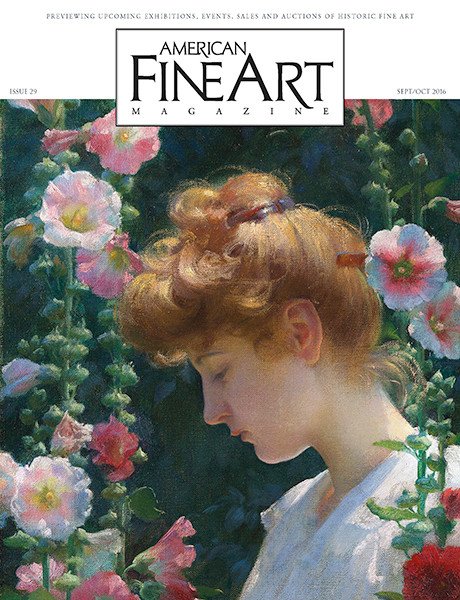
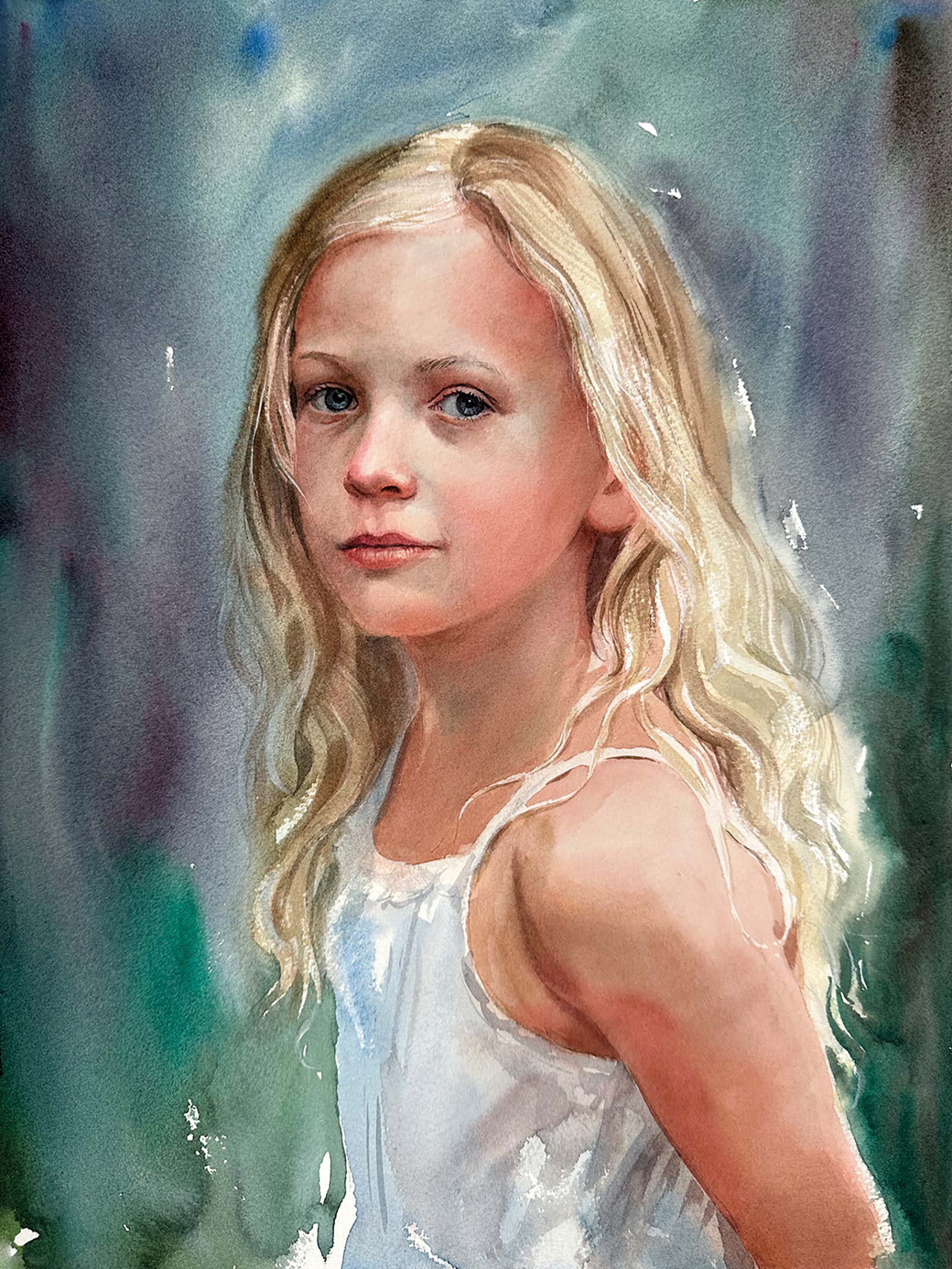
 Brave in Bloom, watercolor on paper, 16 x 12” (40 x 30 cm)
Emily Olson
Inspiration
Brave in Bloom is a watercolor portrait of my daughter Ansley at 9 years old. The inspiration for this work is deeply personal. Having struggled most of my life with feelings of inadequacy and not being “enough,” I remember praying before she was born that she would grow into a girl marked by irrepressible confidence. Ansley embodies that prayer. She is bold and fearless—a natural warrior for justice—yet she also possesses a tender heart and a remarkable emotional depth. In this painting, I wanted to capture that beautiful dichotomy: the innocence and sweetness of childhood intertwined with the quiet strength of a young girl stepping bravely into who she is becoming.
Process
The piece was influenced by the work of Mary Whyte and Joseph Zbukvich, both of whom I have had the privilege of studying with. Whyte’s palette of ultramarine, quinacridone rose and raw sienna created the luminous skin tones, while Zbukvich’s expressive approach to atmosphere and movement inspired the overall feeling of the composition. To create the ethereal sense of motion, I began with a loose, flowing background wash, intentionally preserving small flecks of white paper to suggest light and air. I gradually built form and contrast, concentrating the highest level of detail in Ansley’s face. Capturing her bold expression and subtle smile was essential; it is the emotional anchor of the painting and the place where her bravery and tenderness meet.
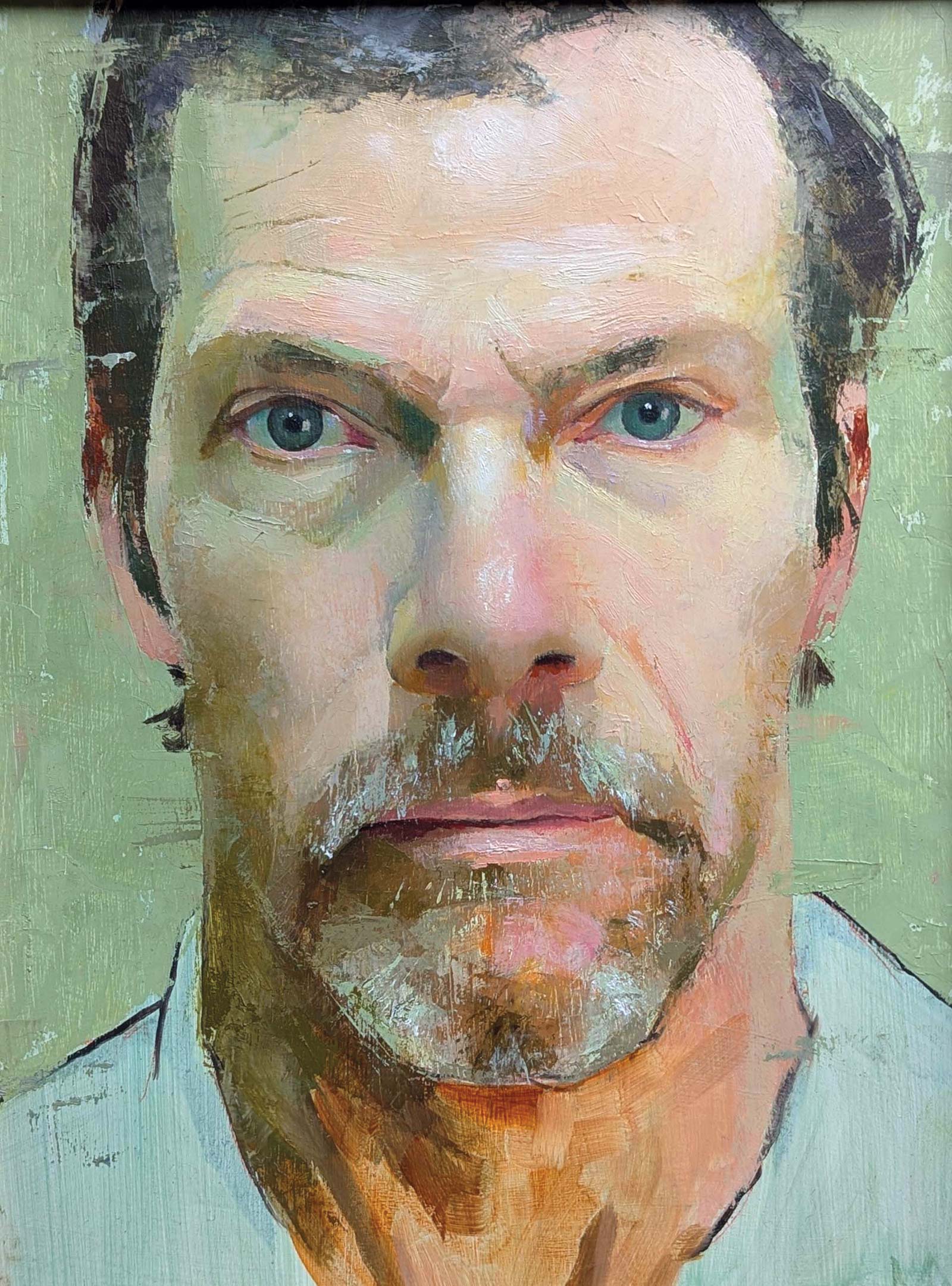 Portrait of Drew Bernard, oil on board, 11 x 9” (27 x 22 cm)
Marc Dubois
Inspiration
The portrait of Drew Bernard, a gifted artist in his own right, is one I have done in a series of local Ottawa artists. I find the human form, portraiture and especially the human face, the quintessential subject for an artist. I love the challenge of rendering a good likeness, of capturing the essence of the sitter, in an original, focused and unobstructed manner. At the same time, I want to explore new ways for me to express myself in the portrait by exploiting the versatility that oil paints provide. In the end, I consider a portrait a success when it not only reveals who the sitter is, but also reveals something about me, the artist. I draw inspiration from artists such as Chuck Close, Ray Turner and Colin Davidson, however, the scale of my portraits is much smaller, more life-size, which I feel creates a connection, a certain intimacy, between the viewer and the portrait.
Process
I typically start with a graphite drawing, which allows me to undertake an in-depth study of values, proportions and placement of features. I transfer the drawing (using tracing paper backed with charcoal, which acts like carbon paper) to a tinted gessoed board. I use the simple and versatile Zorn palette in this portrait augmented with terre-verte, alizarin red and burnt sienna. I use both palette knives and brushes, constantly checking my progress through a mirror behind me to ensure that I don’t stray from the colour and values from the subject.
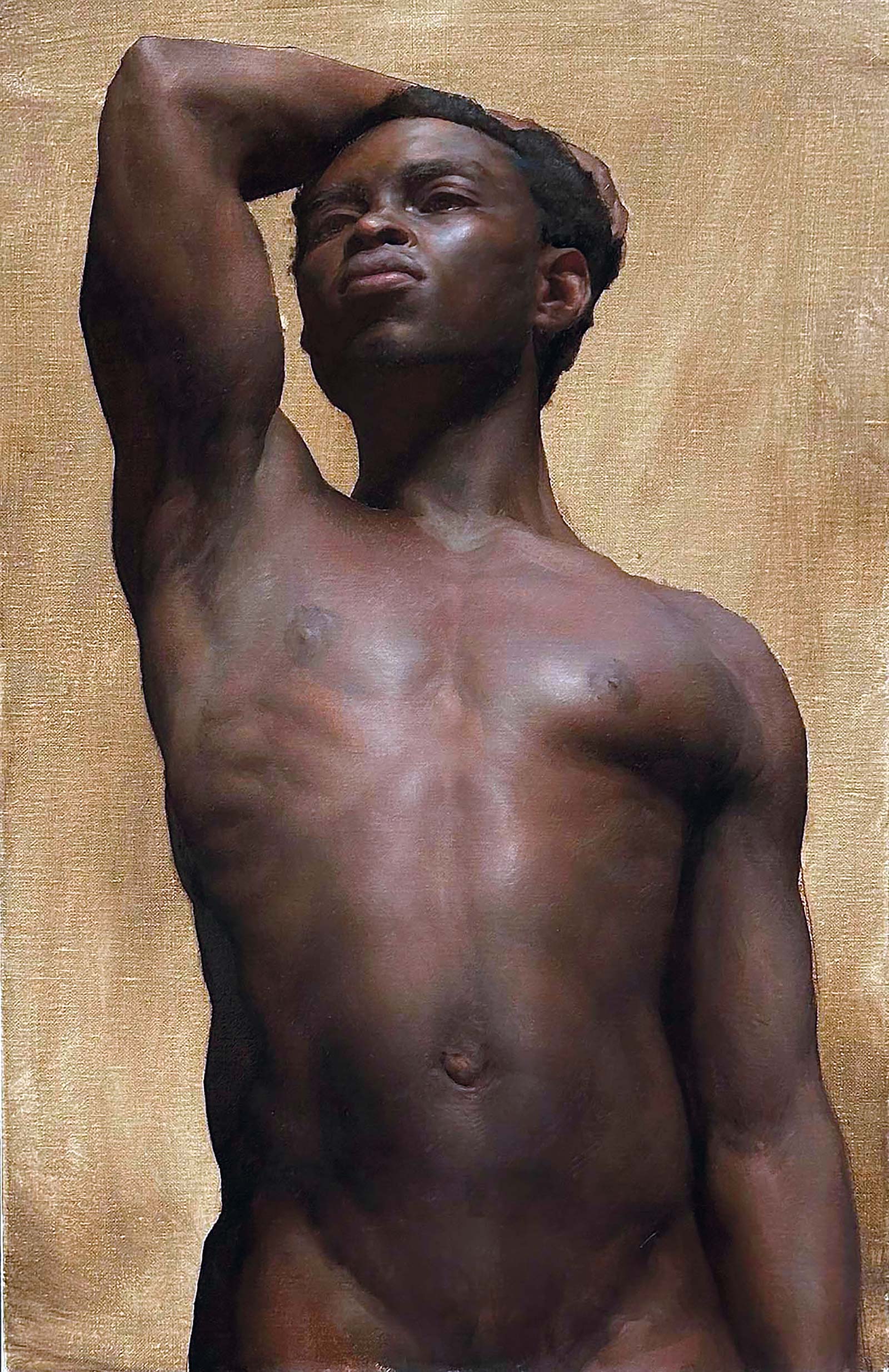 Josh, oil on linen, 17 x 11” (43 x 27 cm)
Kathryn Dennison
Inspiration
I’m deeply inspired by 19th-century figurative art and the atelier tradition, particularly the human form as an independent subject for study and narrative. That appreciation is best realized when working from life, where the artist can spend time observing the model honestly and translating a three-dimensional presence into two dimensions. With Josh, I wanted to reinforce the sense of monumentalism I felt when he stood on the model stand and push his statuesque presence further. Every session offers new challenges and discoveries, and in this painting my goal was to balance light and chroma while maintaining a faithful underlying drawing.
Process
Once he settled into the pose, I placed myself directly beneath him on the floor to emphasize that monumental perspective. From that angle the form became a series of dramatic tilts and shifting planes, requiring careful structural analysis. I began with a thorough block-in drawing mapping the muscles and measurements as he breathed and subtly shifted. After a loose color study to organize values and palette, I stretched the canvas and transferred the drawing in graphite. A quick wipeout with raw umber, 3-in-1 Gamblin medium, and some white underpainting established the first structure. From there I built the painting gradually, “tiling” the form day by day, moving across the torso, into the face and arm, and back toward the stomach. It’s a slow process, but one I’ve come to value for the chance to work deliberately and stay present with the painting.
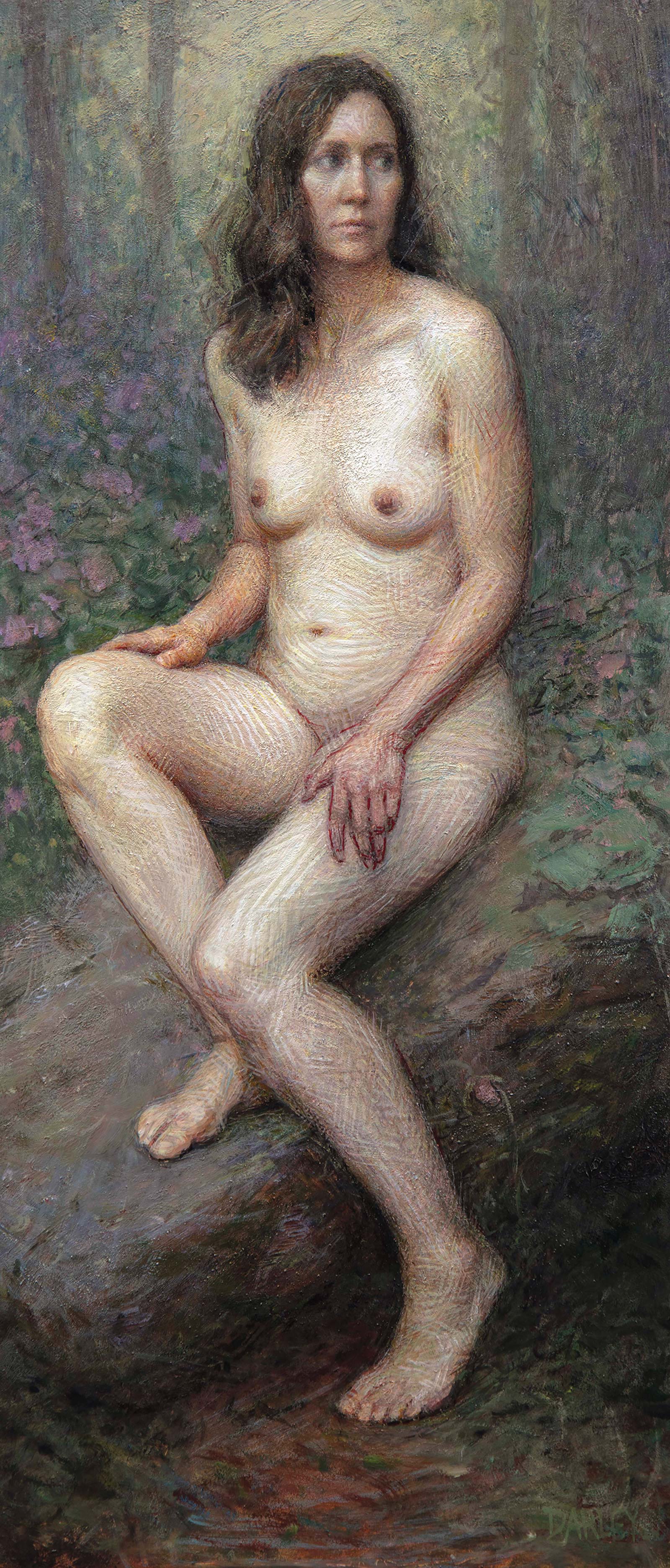 Before Surgery for Cancer, tempera, 9 x 20” (22 x 50 cm)
John Darley
Inspiration
My wife and I had returned home from the hospital with our newborn twin boys. Overnight our family had grown to four sons, and the house was filled with a mix of exhaustion, gratitude and overwhelm that comes with new life. In the middle of that haze, I received a call from a client for whom I had recently painted a portrait of her mother shortly before she passed away from breast cancer. Her voice was unsteady. She told me she had just been diagnosed with breast cancer. She explained that surgery was ahead of her, and before it happened, she and her husband wanted to commission a figure painting, something that would capture her as she was before the operation.
Process
She had never modeled nude before, so to make the experience more comfortable for her, and to avoid an awkward “Titanic” moment, my friend, the sculptor Ben Hammond, joined the sittings. While I painted, Ben sculpted. Those sessions became far more than technical exercises. The three of us spoke about health, sickness, courage, fear and the purpose of life. The conversations were heavy, thoughtful and human. They inevitably shaped the atmosphere of the work and influenced the way I approached the painting. The piece was created using Sennelier egg tempera with a limited palette of five colors. Tempera is an inherently linear medium, and I enjoy building a surface through layers of marks and the embroidery of lines that optically mix color while also describing the form of the figure.