This April, the Portrait Society of America will return to Atlanta, Georgia, for The Art of the Portrait annual conference. For me, one of the highlights of the weekend will be the awards banquet on Saturday evening. Each year we gather to celebrate not only the winners of The International, but a variety of other award recipients as well. This year, we will be presenting the Excellence in Fine Art Education Award to Studio Incamminati and the Gold Medal Award to Bo Bartlett.

Bo Bartlett, Lifeboat, oil, 80 x 100” (203 x 254 cm)
In an era when contemporary art often gravitates toward digital experimentation, conceptual frameworks and fast production, Studio Incamminati stands out as a leading center for classical realist training. Founded in 2002 by Nelson and Leona Shanks, the Philadelphia-based atelier was created with a simple mission: to restore rigorous craftsmanship, deep observation, and humanist values to the practice of painting.
The school’s name, Incamminati, which is Italian for “those who are progressing” or “those who have set out on the right path,” is a reference to the Carracci family’s Renaissance academy in Bologna. Much like its namesake, Studio Incamminati aims to reform artistic education by returning to the fundamentals: drawing from life, understanding anatomy, mastering color, and cultivating a disciplined eye. The school operates on the atelier model, providing small classes, direct mentorship, and a studio-based environment where the daily practice of drawing and painting is central. Students’ progress through a structured curriculum that begins with foundational drawing and gradually moves toward figure and portrait painting. Unlike many contemporary programs, the training emphasizes sustained observation over speed, craftsmanship over trend, and an integrated understanding of both technical skill and artistic intent. This appeals to students who want the kind of training once found in 19th-century academies but tailored for today’s art world.
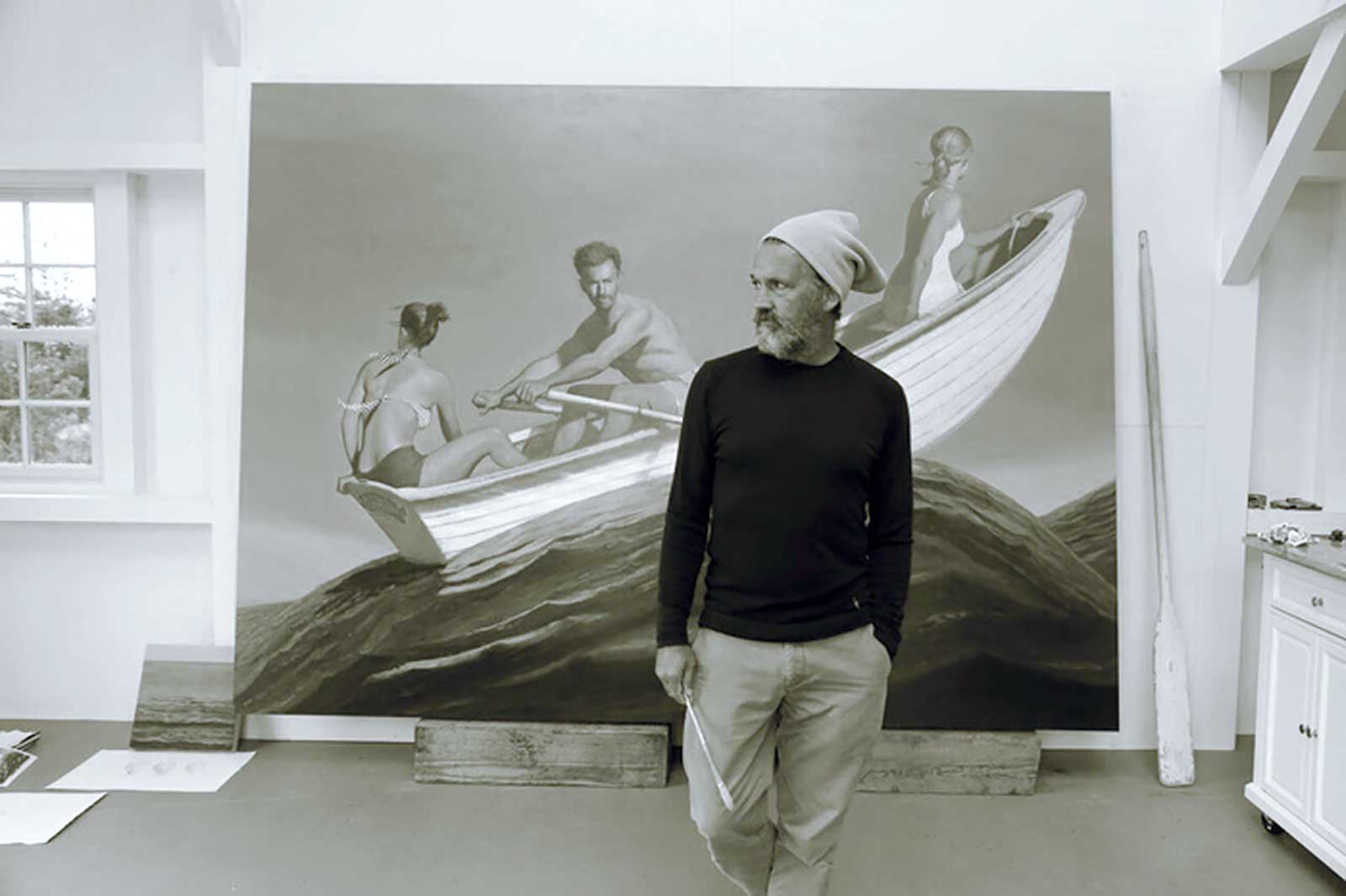
Bo Bartlett pictured in front of a painting that reflects his focus on story and composition.
Nelson Shanks, who painted figures such as Princess Diana and Pope John Paul II, believed realism was not mere replication; it was a process of truth-seeking. His approach combined a painter’s sensitivity with a scientist’s precision, and Studio Incamminati continues to teach from the methods he refined during his decades of studio practice. Though Shanks passed away in 2015, his influence remains at the school’s foundation. The faculty, many of whom studied under him, carry his commitment to high-level training and artistic integrity.
Studio Incamminati hosts a diverse student body from around the world. Its Advanced Fine Art Program, continuing education classes and public workshops foster a vibrant community that includes career-changing adults, emerging painters and professional artists. Graduates have gone on to careers as gallery painters, instructors, muralists, illustrators, and portraitists. Many teach in private studios or art centers, extending the school’s influence far beyond its Philadelphia home.
In a time when attention is fragmented and creation is accelerated, this school offers something rare: a space where slow, careful seeing is not only preserved but celebrated. We are proud to present the Excellence in Fine Art Education Award to Studio Incamminati, a school that stands as a testament to the enduring power of classical training and to the idea that progress in art sometimes means returning to the fundamentals that first made it profound.
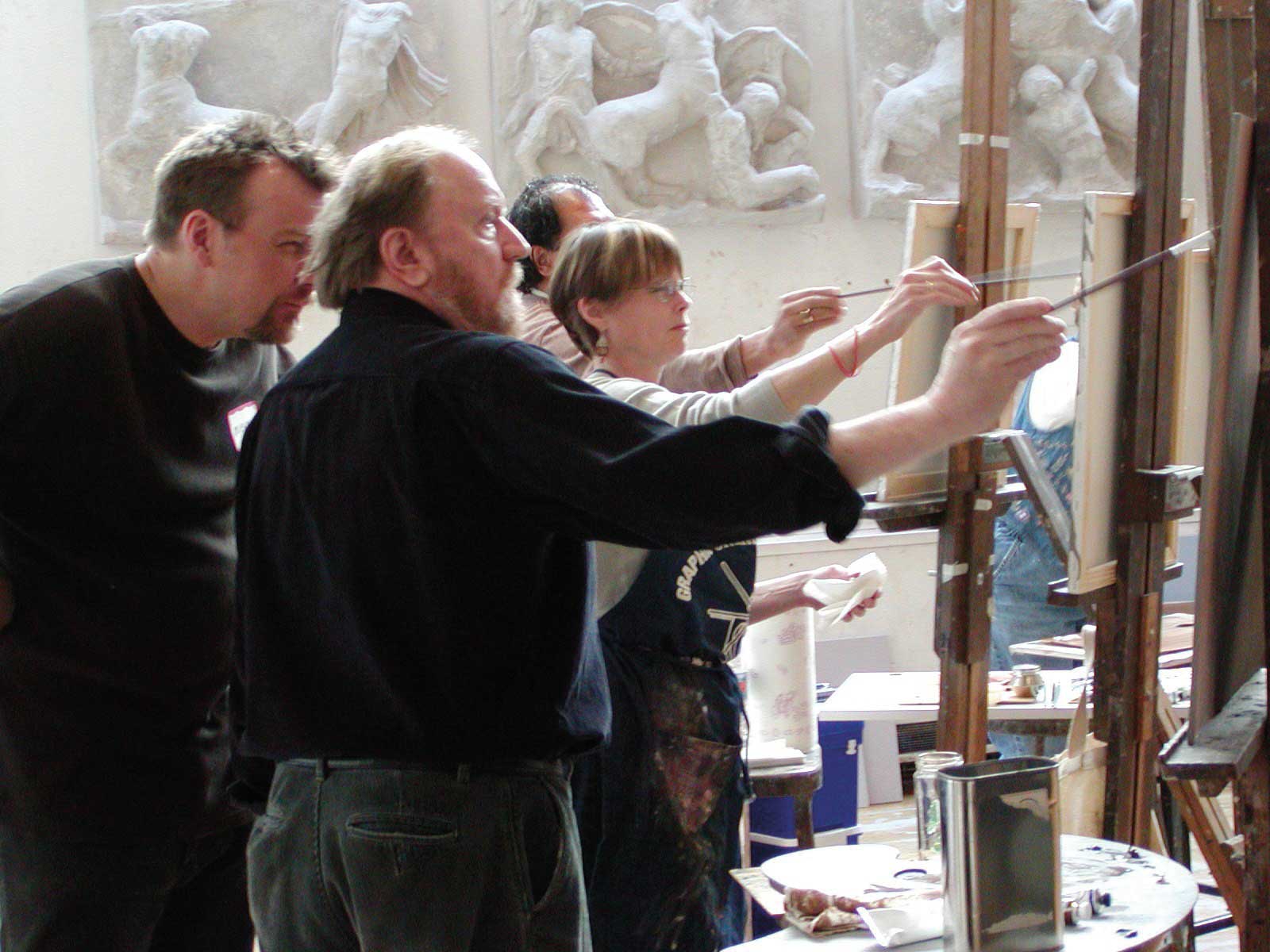
Master realist Nelson Shanks teaches by example, breaking down his process and sharing the classical techniques he’s known for.
In a similar manner, Bo Bartlett stands out among the most compelling voices in contemporary American painting as a realist whose work captures the poetry embedded in ordinary life. Born in 1955 in Columbus, Georgia, Bartlett has built a career rooted in observation and narrative depth. While his paintings echo the grand style of historical realism, they are firmly grounded in the present, blending the familiar with the quietly uncanny.
Bartlett’s journey into art began early. Growing up in the Deep South profoundly shaped his visual vocabulary: wide horizons, strong sunlight, the presence of family and community, and the complexities of regional identity. At 18, he left Georgia for Florence, Italy, where he studied under Ben Long at the Studio Cecil-Graves, part of the burgeoning realist revival. From there, Bartlett moved to Philadelphia to attend the Pennsylvania Academy of the Fine Arts, one of the nation’s oldest art institutions and a formative environment for his emerging style.
Bartlett’s work is often compared to that of Andrew Wyeth, which is not surprising, given his longstanding personal and professional relationship with the Wyeth family. But while Bartlett draws from the lineage of American realist painters, he also expands it. His canvases tend to be large, cinematic and symbolically charged, inviting viewers into spaces that feel both intimate and monumental. A figure pausing mid-gesture, a child standing in a field at dusk, a boat docked in quiet water—scenes that are rendered with clarity and precision, yet their meanings hover just beyond easy interpretation.
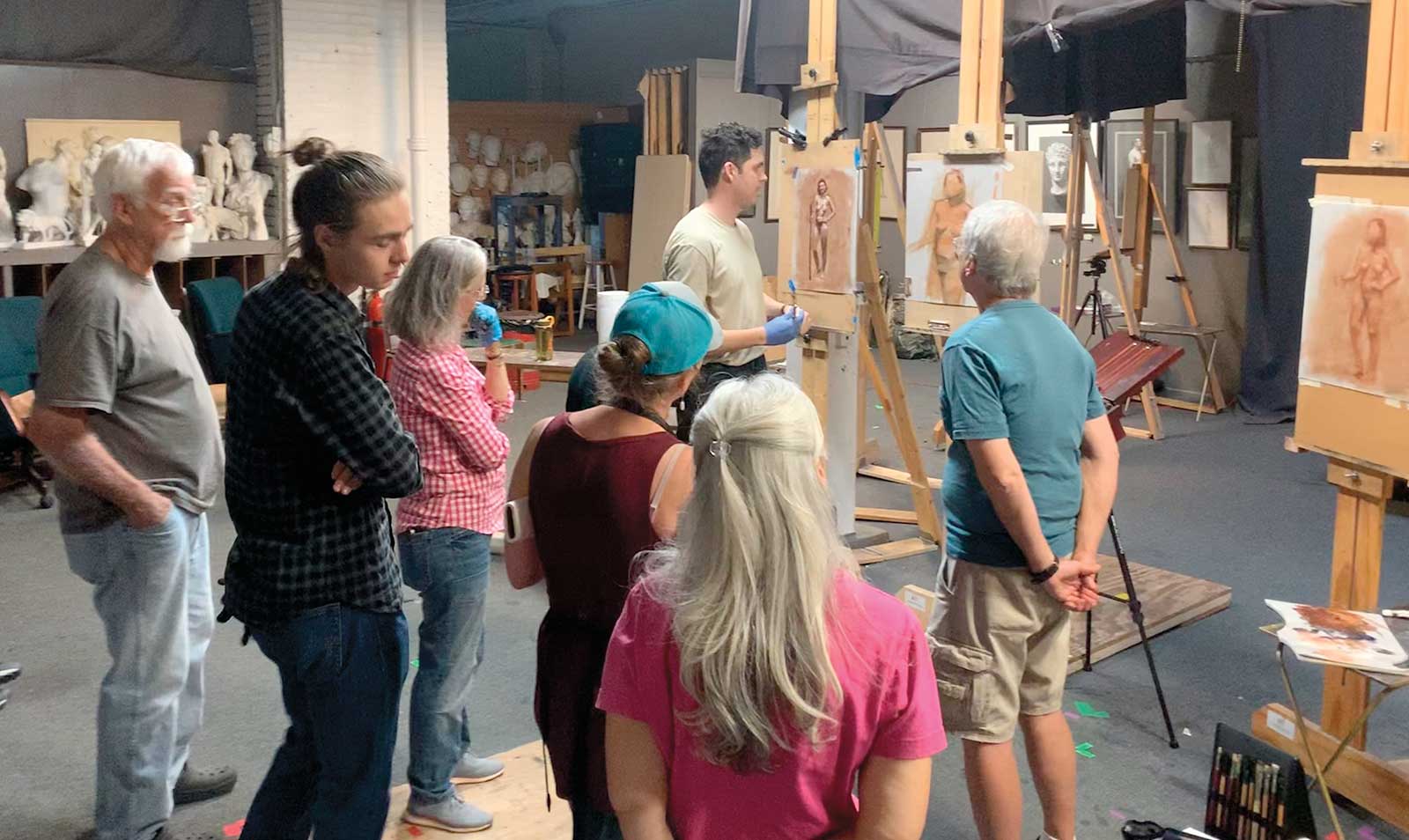
A teaching artist at Studio Incamminati shares his critiques during a figure painting workshop, offering an inside look at the school’s celebrated teaching method.
Throughout his career, Bartlett has traveled widely, painting in Italy, Maine, the Pacific Northwest, and his native Georgia. Each place contributes a distinct atmospheric quality to his canvases. His series painted on Wheaton Island, Maine, where he and his wife, artist Betsy Eby, maintain a studio, reveals a quieter, more contemplative side of his vision: foggy mornings, stark coastlines, and the rhythm of tide and weather. His works from Georgia, by contrast, are often full of sunlight, heat, and the rich complexities of Southern storytelling.
Today, Bartlett’s work is represented in major public and private collections, including the Crystal Bridges Museum of American Art, the Pennsylvania Academy of the Fine Arts, and the Columbus Museum in Georgia, which also houses the Bo Bartlett Center—a hybrid gallery, archive, and community arts space dedicated to his legacy and mission.
This year’s Gold Medal recipient, Bo Bartlett, remains a painter of honesty and imagination. Through his own work as well as the work of the Bo Bartlett Center, he embodies the mission of the Portrait Society of America. His canvases invite us to pause, to look more slowly, and to recognize the extraordinary within the everyday. Through realism infused with wonder, he continues to redefine what contemporary American painting can be.
I hope you will be there on Saturday, April 11, as we honor both Studio Incamminati and Bo Bartlett on stage at the awards banquet. As you can see, both are very deserving recipients. It’s going to be a night to remember, and we can’t wait to be with you all!
Sincerely,
Michael Shane Neal
Chairman