Jon Ching’s latest body of work does the same thing all of his paintings do—inspect, challenge and dissect the world around us. But as the world continues to change at a rapid pace, so do the themes that Ching examines. A recent solo exhibition at Haven Gallery in Northport, New York, focuses on the idea of escape, born from the desire to flee from the chaos and intensity of modern life.
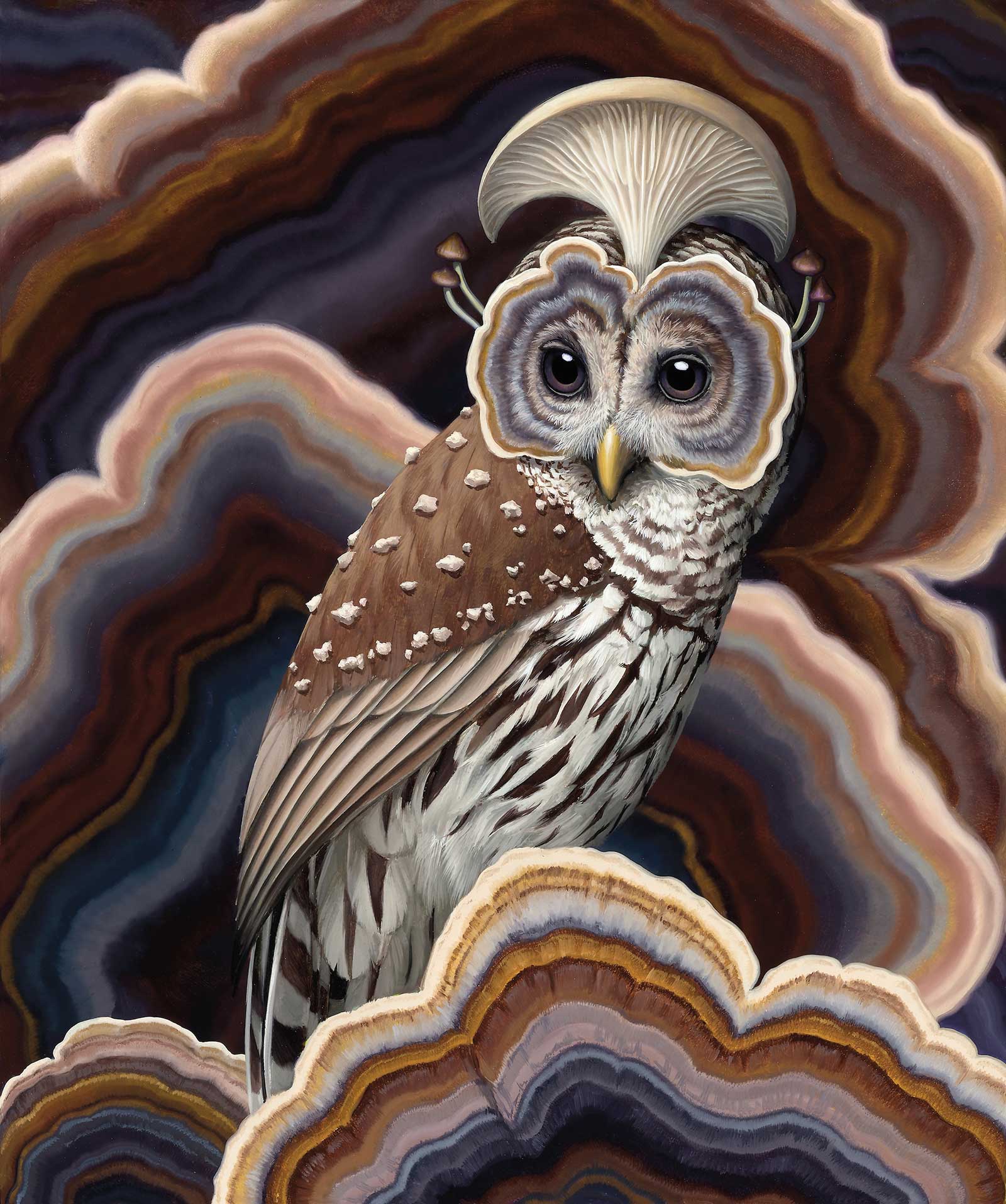
FAE, oil on wood, 24 x 20” (60 x 50 cm)
“What hasn’t been captivating me lately?” Ching says. “The news these days is so supercharged and the attention economy seems to have found new highs (or lows?). With all the chaos in this country from tariffs…the [government] shut down, attacks on the constitution, the weakening of environmental protections, and AI looming over everything—and then trying to figure out what’s the best elementary school to send my kid to next year, there’s been way too much captivating my mind lately. That’s why I named this show Escape,” he says.
“I tend to feel others’ problems inside myself, and while I value my sense of empathy and think it’s one of my strongest traits, it becomes exhausting when there’s so much pain and suffering we are bombarded with every time we go on social media or read the news,” the artist continues. “I found myself eager to turn it all off and make this show; an escape from it all.”

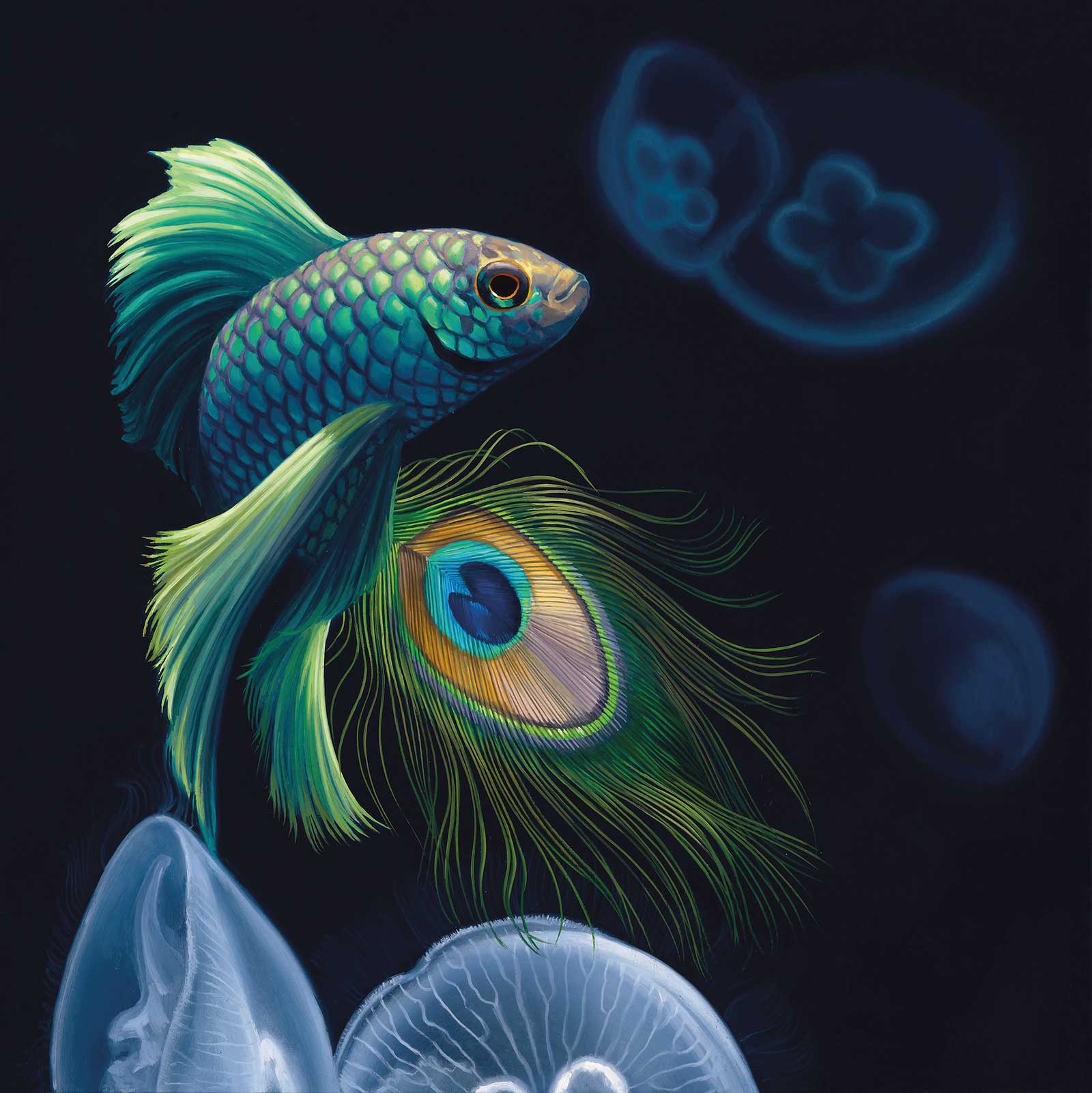
Arpeggi, oil on wood, 12 x 12” (30 x 30 cm)
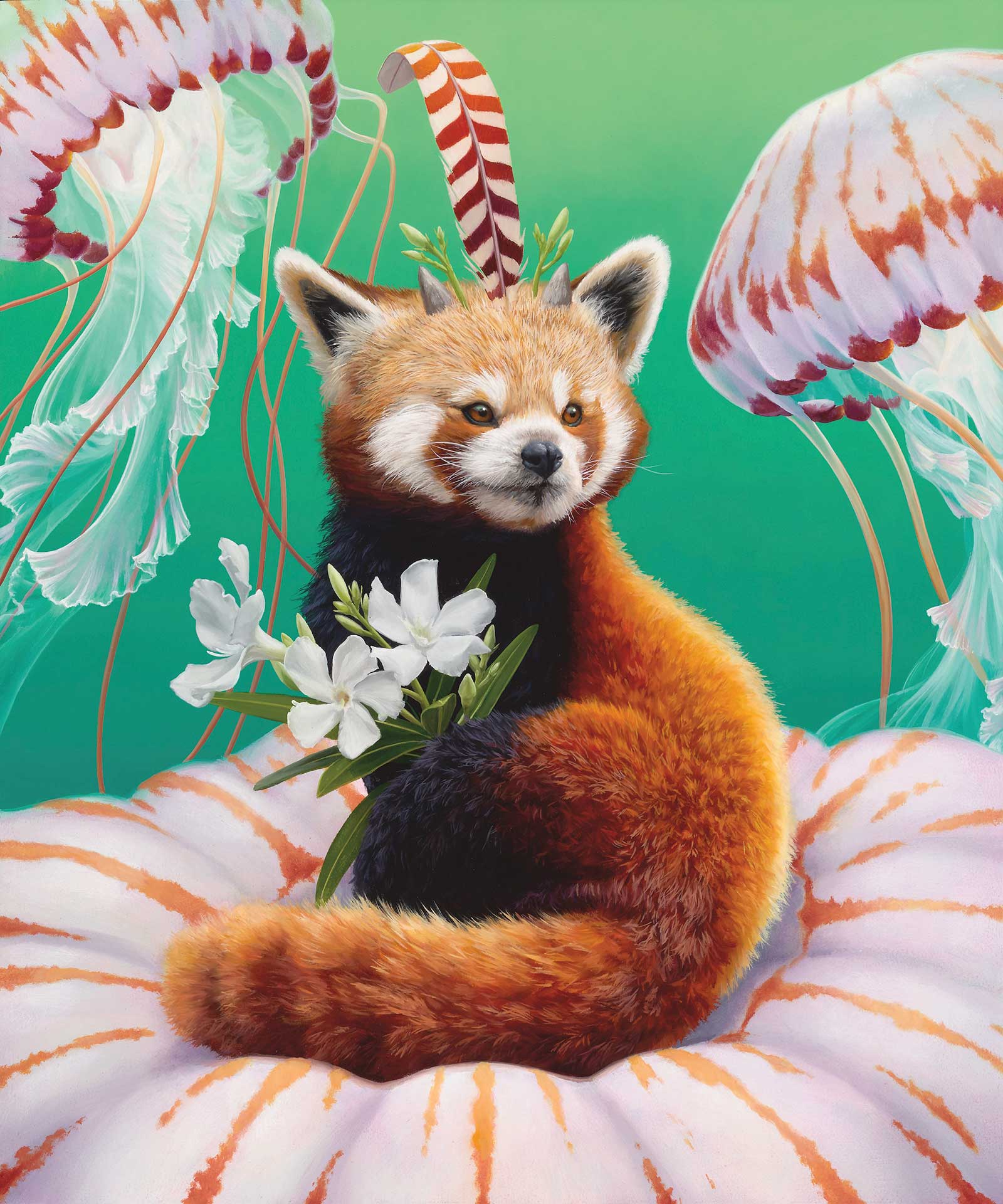
Passage, oil on wood, 24 x 20” (60 x 50 cm)
Ching says that while painting these new pieces, he’d listen to long-form fantasy novels while spending hundreds of hours focusing on nature. And that’s what he does best: take the ecology of the natural world and say something poignant with it.
“I suppose this is something I always do, but lately I found myself using my work as a way to avoid the real world,” he adds. “A lot of the work is about the idea of escape. Some pieces are meant to provide an escape to a wonderful, wonder-filled space, like Pura Vida. To give the viewer a place to go mentally and visually. In others, there’s an act of escaping, whether physical, like Passage, or mental, like Neo.”
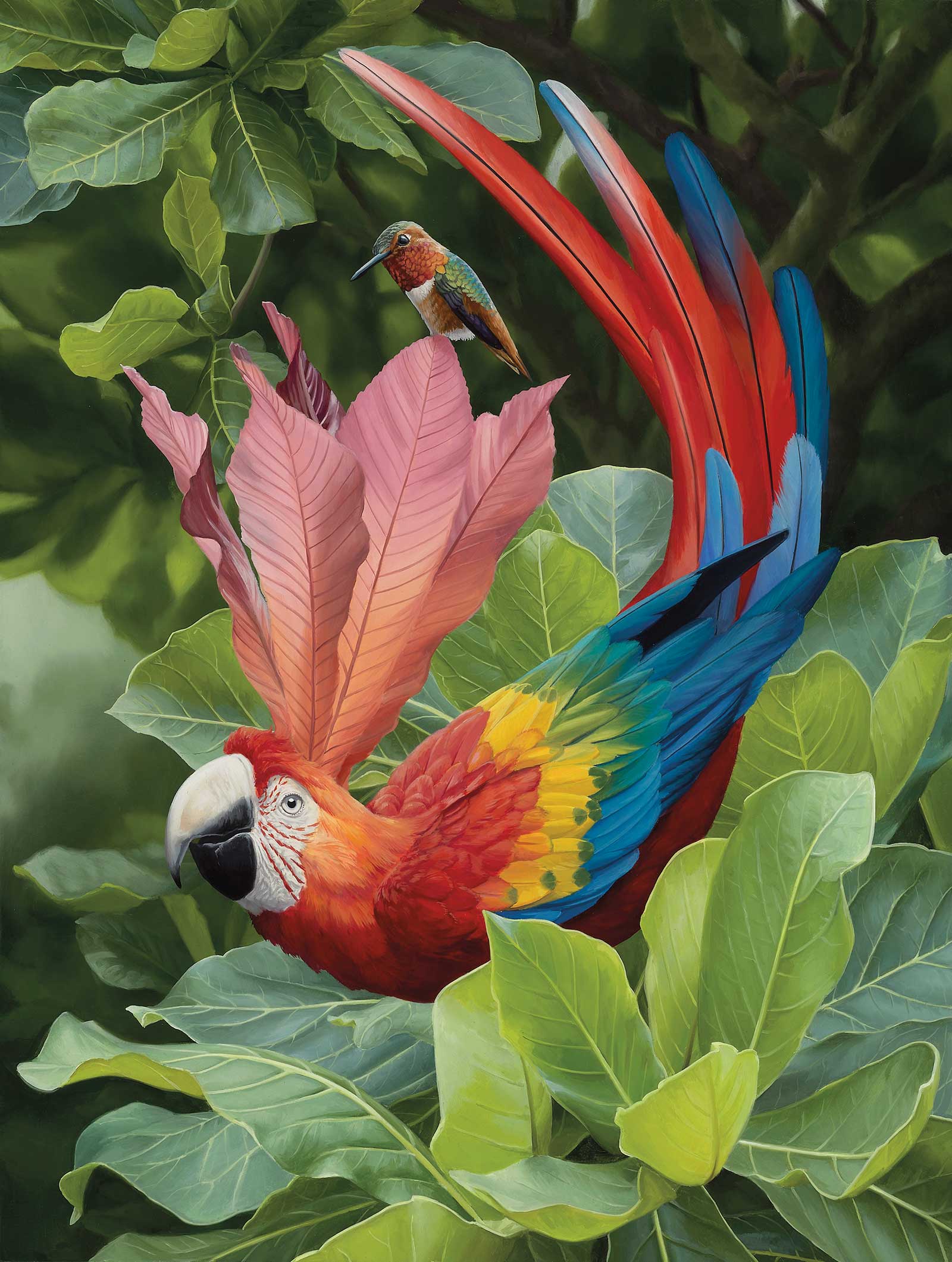
Pura Vida, oil on wood, 24 x 18” (60 x 45 cm)
In Pura Vida, a macaw and a hummingbird find respite together amongst lush foliage; in Passage, a red panda rests atop a jellyfish.
Commenting on Neo, depicting a red fox with a poison dart frog in its mouth, he says, “The fox is contemplating whether to consume it or not. I see the frog in a couple of ways. The red and blue represent American politics, and the piece reflects on our consumption of it and the resulting poison we ingest. I also see the frog like the red pill and the blue pill from the Matrix, hence the title Neo, the protagonist from the film. The red pill showing you reality, the blue pill showing you the simulation. Sometimes I think I would prefer to be plugged into the Matrix and escape the overwhelming world we live in. But then again, maybe we are in the Matrix. There’s also the Kudzu vines that surround the fox. These vines are known to be fast growing that cover and choke the things it grows on and represent the threats of the piece. [But] the fox is clever, so the outcome of this piece isn’t cut and dry.”
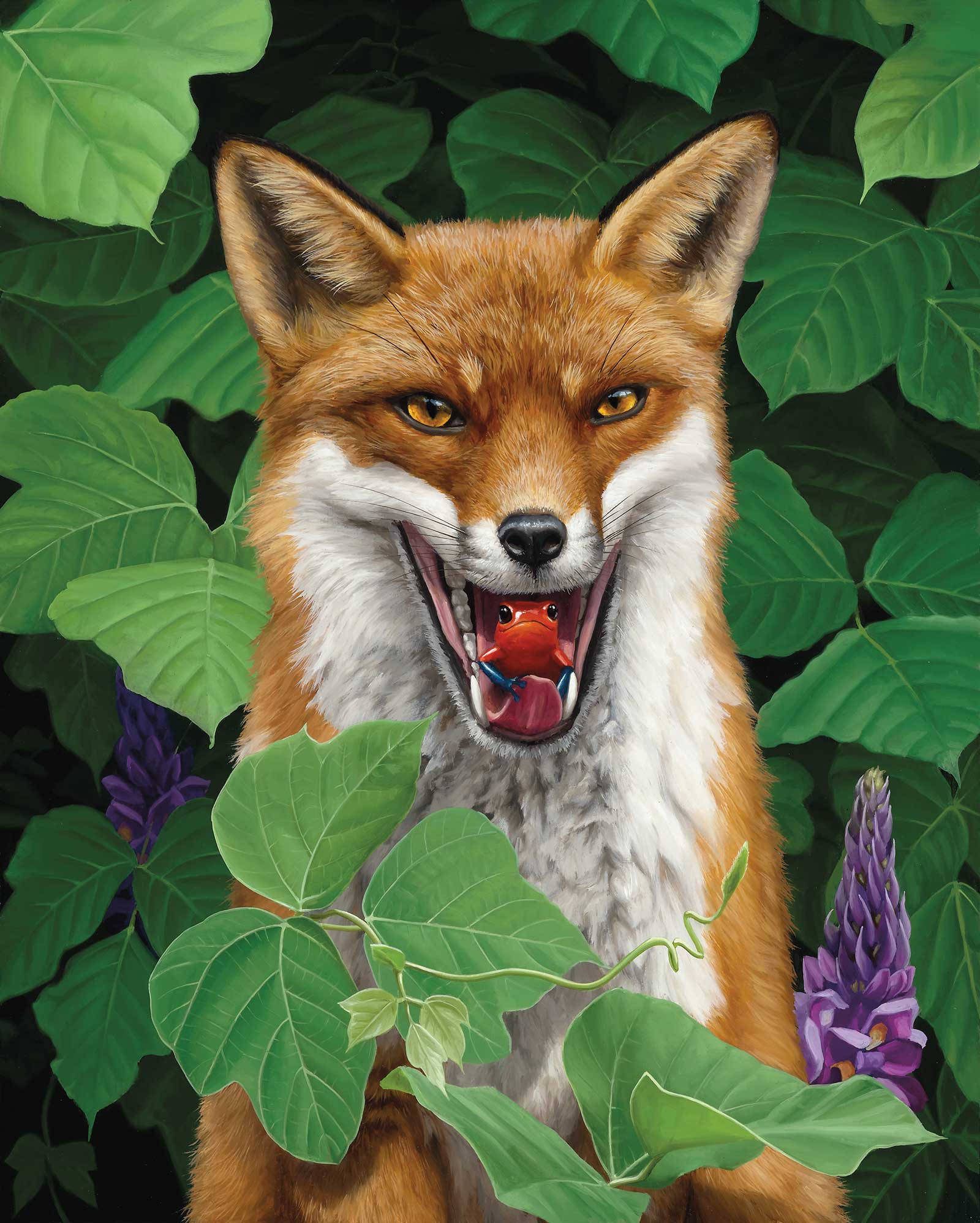
Neo, oil on wood, 20 x 16” (50 x 40 cm)
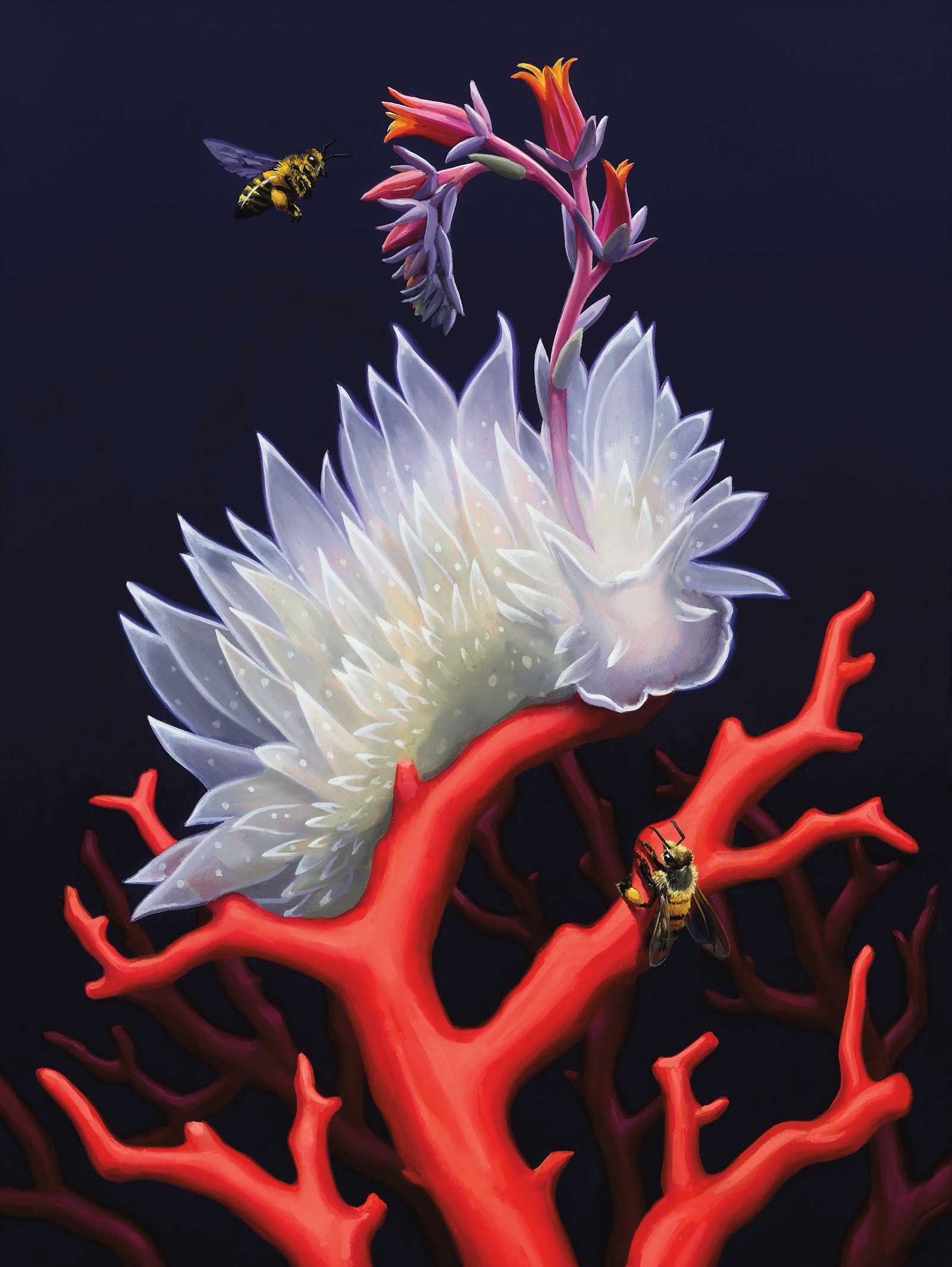
Burgeon, oil on wood, 16 x 12” (40 x 30 cm)
FAE is a portrait of a regal barred owl partially morphing into turkey tail mushrooms, those little polypores that grow in shelf-like bunches on dead hardwood logs. “This piece is kind of a follow up to my piece Mother Mycelium. I was sketching different owls one night and just playing around with things and thought that the concentric stripes of the barred owl looked like turkey tail mushrooms,” Ching says. “When I did a rough drawing of it, it worked, and so I kept embellishing, picturing it as a tiny little mushroom owl that goes from tree to tree, compelling the mushrooms to grow. The title FAE is kind of a double entendre. In the mushroom growing world, it stands for Fresh Air Exchange but also, in Western folklore, it’s a word that sums up a group of supernatural beings like fairies and nature spirits, which it most certainly is.”
Fish and feathers meet in the aquatic scene Arpeggio, dominated by deep, midnight blues. “The title comes from the musical term ‘arpeggio’ where a chord is played by the individual notes that make it up, like a harp,” says the artist. “The individual strings of the peacock feather tail of the fish reminded me of a harp…As far as the origins of the piece, it’s one of those ideas that just swam into my head—pun intended—and I went with it. Whenever I can see a creature clearly in my head, I know it’s something I need to make whether there’s a backstory or not.”
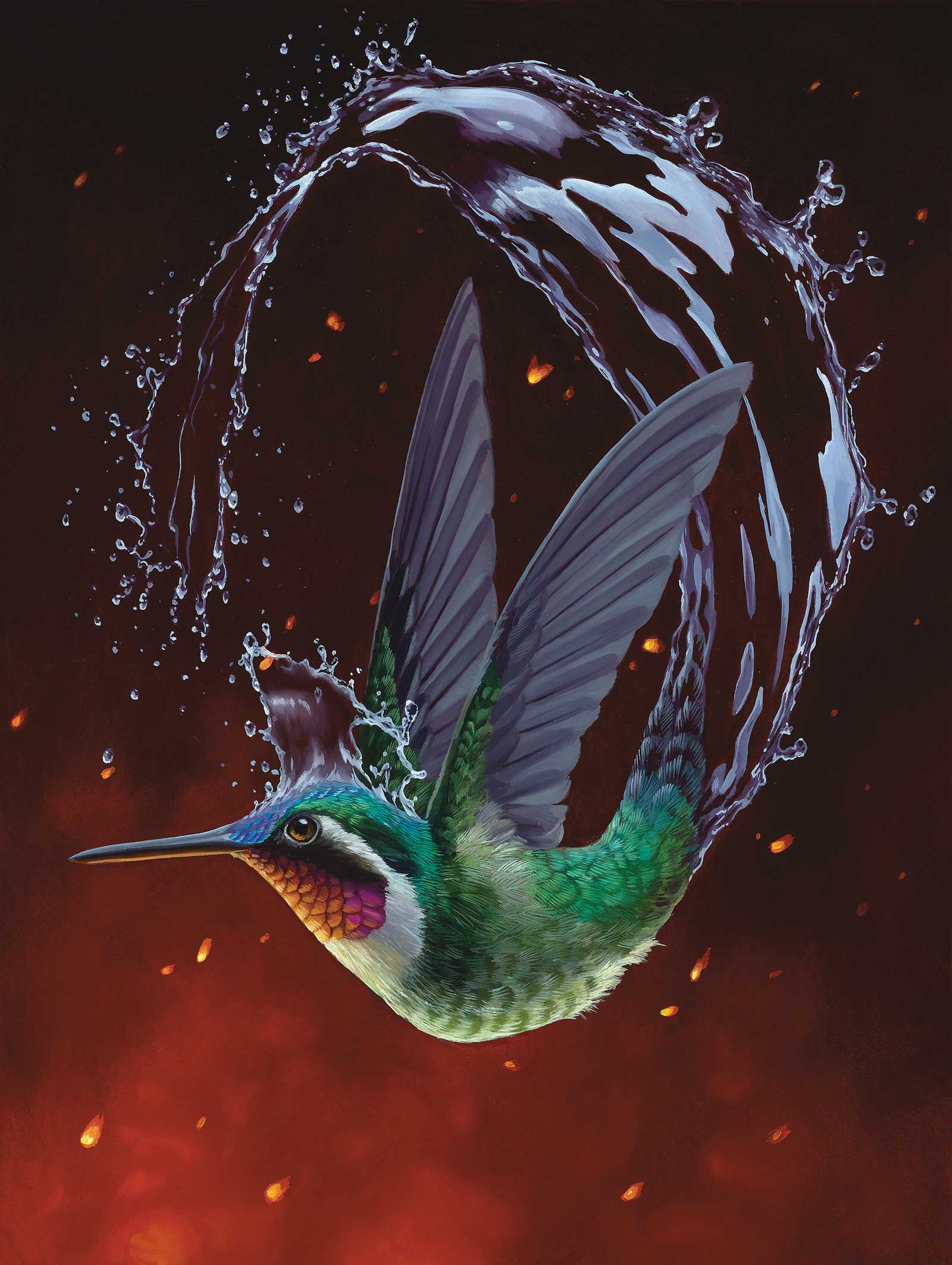
Smokejumper, oil on wood, 16 x 12” (40 x 30 cm)
Other new works by Ching include Smokejumper, in which a hummingbird’s tail feathers are transforming into water, and Faraday, in which a hawk controls a lightning storm. “I sometimes like to make creatures that are divine beings that oversee aspects of nature, and a lighting god, one who harnesses the power of storms, is just so rock and roll! I wanted to make a piece where I could play with light and form,” he says. All paintings are oil on wood.
“Jon Ching’s hyperrealistic paintings of animals and botany pulsate with life and harmony, reverberating their majesty and importance. Through Ching’s precise hand, each sitter is meticulously painted and transformed into higher beings, obtaining synchronicity with the elements and life around them,” says Erica Berkowitz, owner and curator at Haven Gallery. “An honorific to their beauty and worth, Ching paints with reverence, allowing his own love and appreciation to shine through and bewitch the viewer.”
To view more works from the artist, visit his website jonching.art or his Instagram @jonchingart. —