Words cannot express my joy when I was commissioned to paint this portrait of Anne Murray in the year 1971, those many years ago when I was at the beginning of my career. I was unknown and yet given the honor of creating this artwork for one of the greatest singers of our time.
I was there with Anne, presenting this portrait to her on stage with Lorne Ball of CFAC radio at the Jubilee Auditorium in Calgary, Canada. I feel totally blessed in having this portrait now on the cover of her new album Here You Are. Anne Murray’s music has touched so many people around the globe. Dear reader, I can tell you that listening to her songs on this record will have you bursting with even more love of what you are creating.
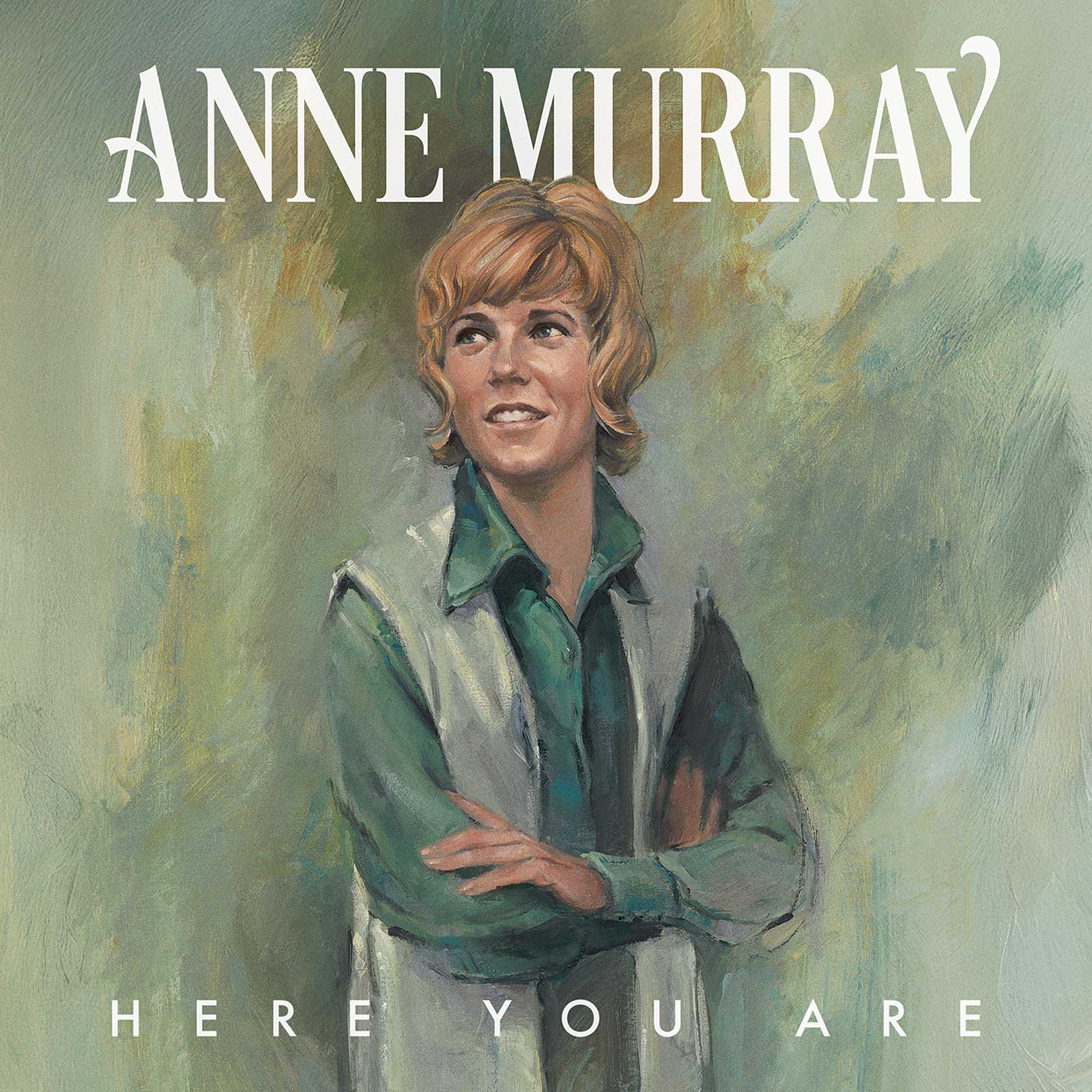 The cover of Anne Murray’s new album Here You Are.
 Doing Anne’s portrait started from the beginning with sketches working out the composition. We see the result in the portrait on the opposite page: she has the look of a caring, uplifted heart. Her arms are gently folded, relaxed and prepared for the next moment. She stands at an angle with her head slightly turned and with eyes slightly turned further. A classic with many portraits.
Smaller areas of color often dominate within a painting. Here, Anne’s warm face and hands are the remarkable centers of interest surrounded by the cool complementary color in the surrounding areas. Those areas also have more texture and more visual brushwork. Her face and hands are done with more delicate details.
I was somewhat nervous back then when working on Anne’s portrait. But I remember so well as I listened to her music while laying in those details, and I became more confident stroke by stroke. Her voice brought that to me; it really gave me the strength to do what I needed. Yes, I slowly witnessed her come alive on this canvas; she was there with me as I laid in the final touch.
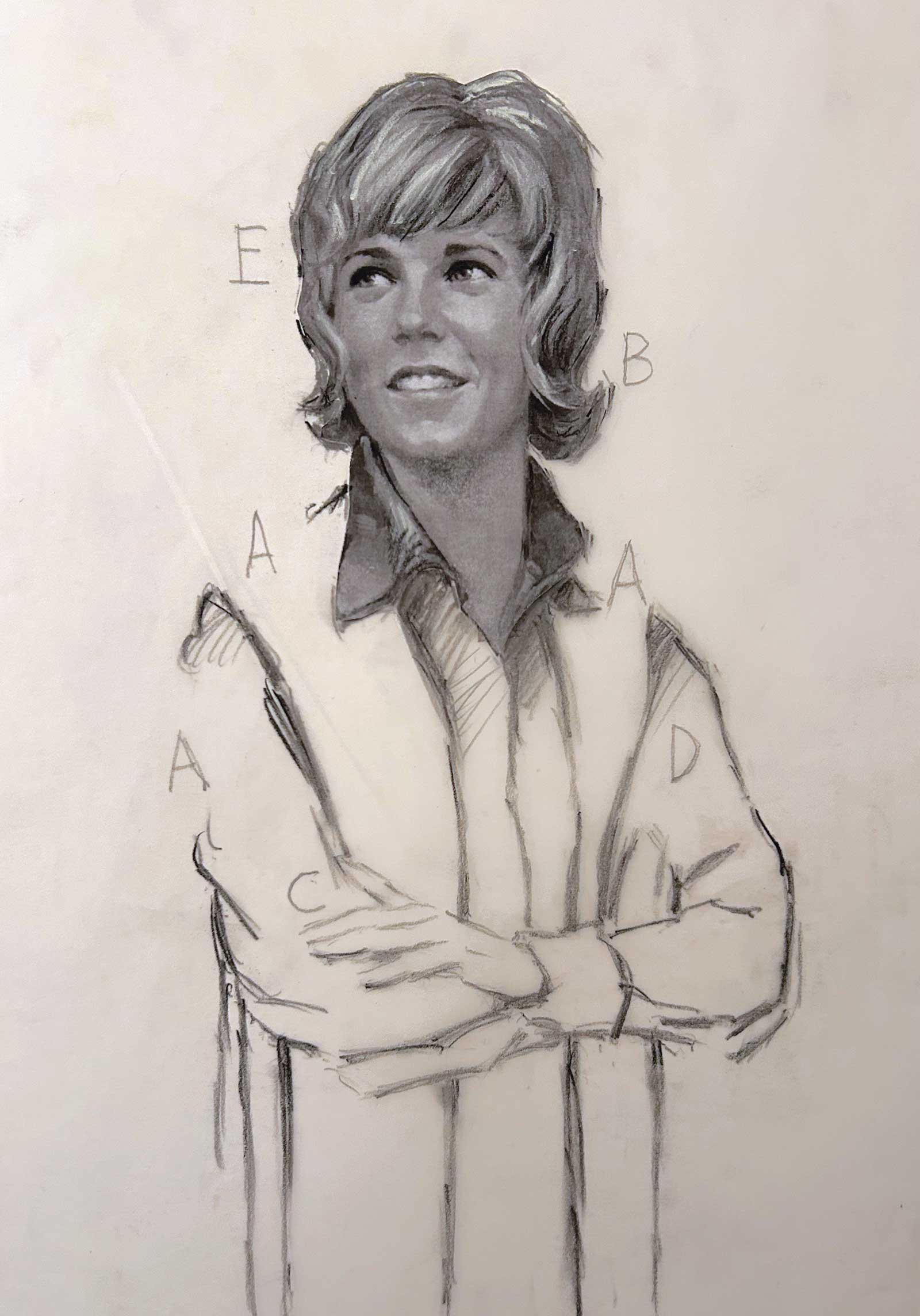
Portrait of Anne Murray in progress: A. Lost edges add to flow of the design.
B. The shapes of her collar and hair give visual movement within the center of interest. C. Open, relaxed fingers add a natural looseness to her presence.
D. Slight arm angle needed next to vertical areas. E. The turn of head and eyes have ease and charisma.
Anne Murray is Canadian and a major part of our musical history. Her inspiring journey is beyond belief, as you will realize when you explore her monumental years in music. Anne’s voice is loved throughout the world and will be in all the years ahead—continuing to bring smiles and tears. We live those moments with Anne, hearing her expressive voice in each song, knowing the song belongs to Anne as she offers it to us.
I’ll say here that this portrait of Anne Murray is a meaningful part of my life. First, in creating this painting for her in 1971, and with Anne having it on her new record album now, more than half a century later. Thank you, Anne.
And Now, A Few Art Thoughts
A painting near the beginning can have many dabs, strokes and colors appearing in an almost crazed manner. But as we continue, we begin to steadily take command, and those areas we work on happily “obey” our well-practiced approach.
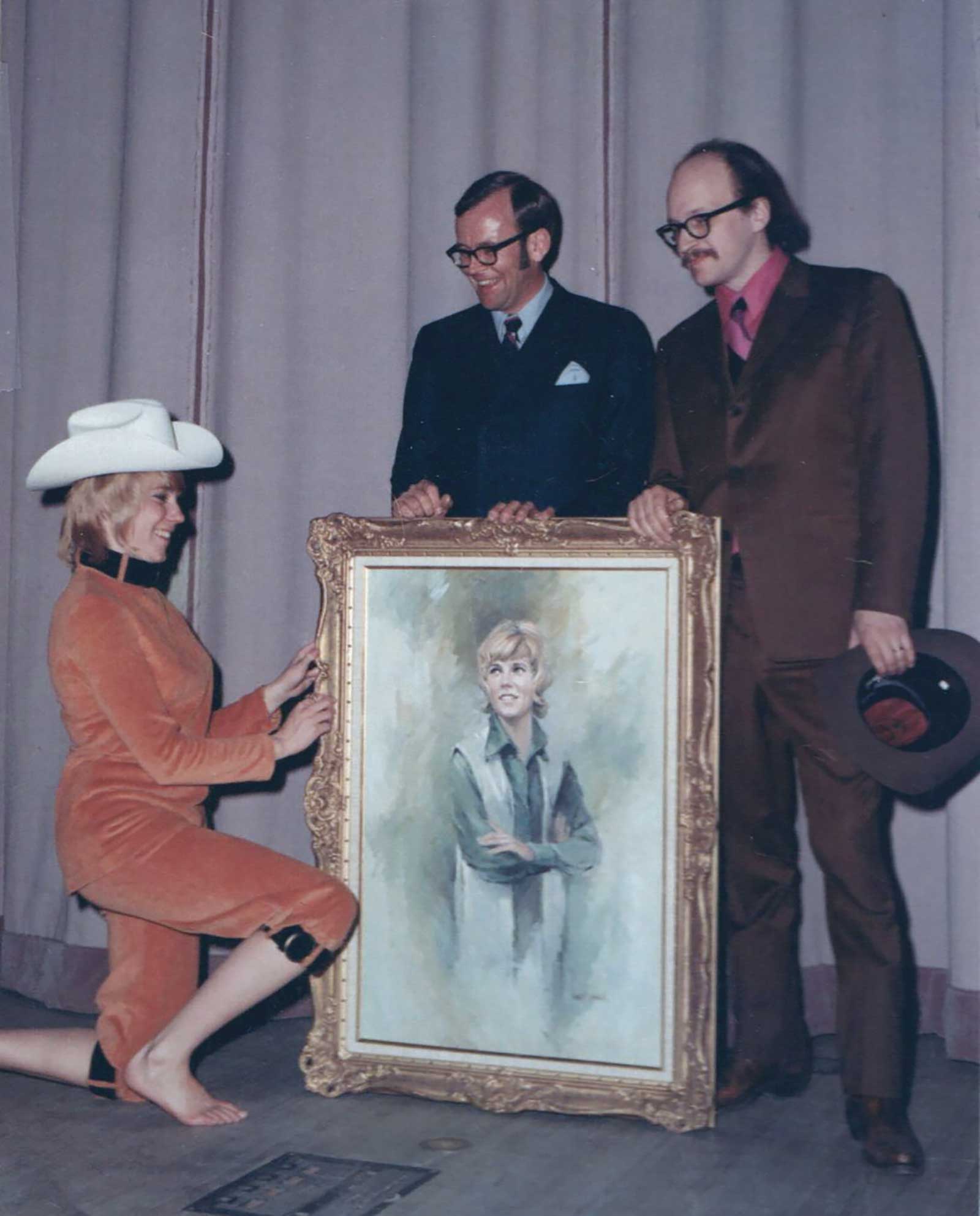
Presenting my painting to Anne Murray on stage with Lorne Ball of CFAC radio at the Jubilee Auditorium in Calgary, Canada. I am on the right.
Problem: If a major area in a painting doesn’t work and there is something within it that has to be removed. Solution: I have witnessed this with many artists. They said that area bothered them enough that they just couldn’t continue the work with any passion. So every time, as soon as they totally changed that area into a fresh part of the overall subject, they came through with heartfelt satisfaction. They got rid of that problem and happily charged onto a glorious finish.
When we learn and understand where we are going with our art, there comes a time that we trust our own self-expression. In my early years, my art helped me through many of life’s difficulties. I guess I can say that art has been one of my very best friends.
My favorite color is red. Don’t ask me why, but it’s the color I’ve liked since infancy. Could be that it seemed friendly and would always be there if I needed it. I like it also when it’s next to its complement blue/green (Munsell Color Wheel). How the eye can take these in and bring thoughts of pleasure to our mind might never really be known. Do you, dear reader, have a favorite color or maybe a combination? I’ve never heard anyone say they don’t like color.
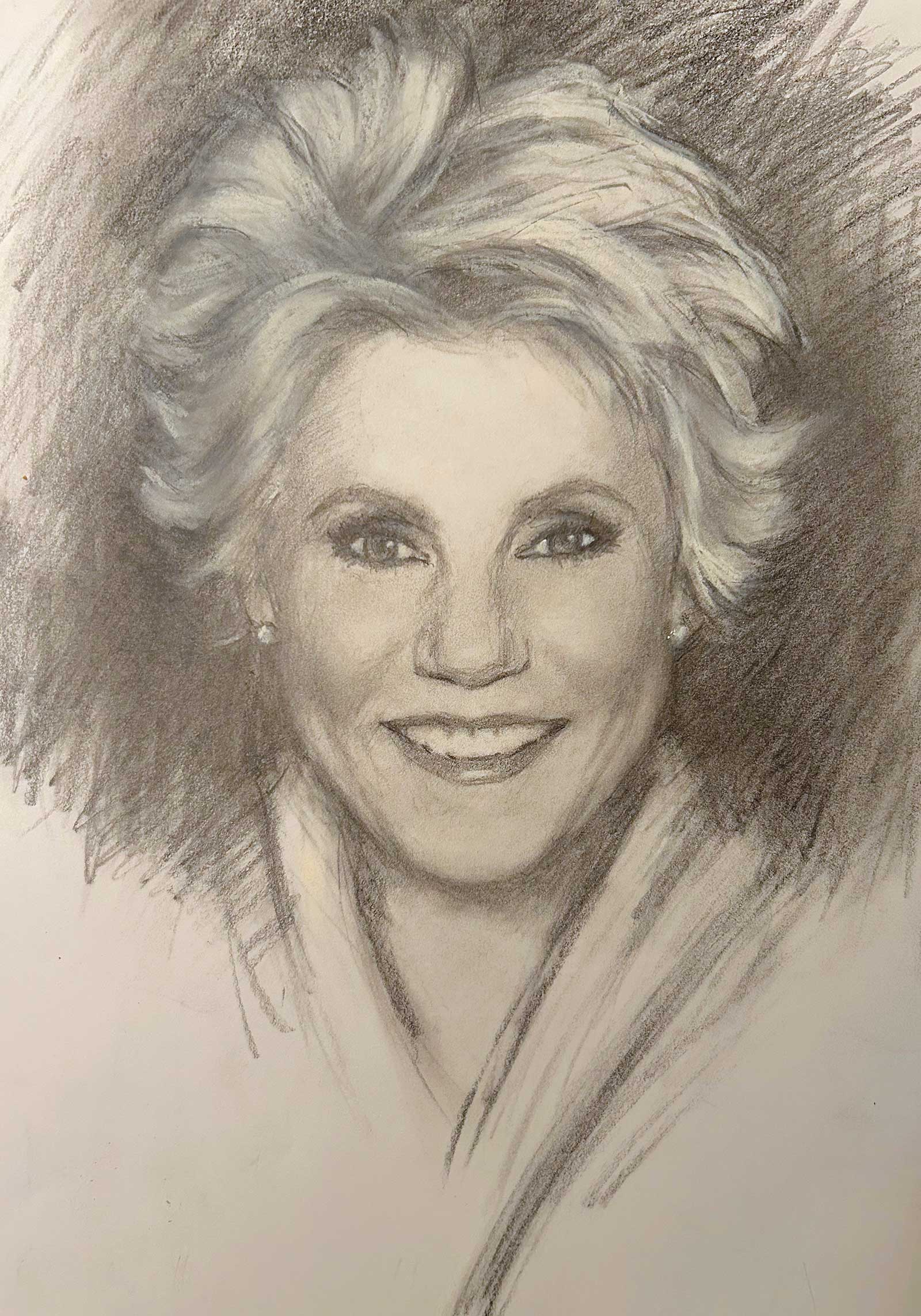
Sketch of Anne Murray: I remember once while listening to Anne singing, I grabbed a piece of paper, a 9B pencil and a kneaded eraser, and began doing this sketch of Anne. I enjoyed every minute. When I see these earlier works of mine, I leave them alone without any touch-ups. I respect and love my works of the past.
I’ve always felt with art pieces, that if there is something I really like, I actually like it even more each time I see it. When I was 10 years old, I was fascinated with Rembrandt’s The Night Watch. Since then, I’ve seen it often, and each time there are parts in it that continue to fascinate me.
A subject in an art-piece all by itself doesn’t necessarily capture our attention. For instance, the painting of a solitary apple or a solitary bowl with nothing else—but include that apple or bowl with other bits and background, and it can be part of a masterpiece. I’ll add here that a human head in a painting needs something it can connect with even if it is a well-worked out, composed background.
When I hear someone say, “I can’t even draw a stick figure!” I wonder if they say the same thing about their inability in directing a movie or writing a novel. Some people think that drawing comes quite naturally. Most of us learn a bit of drawing from our grade school days, and generally it ends there. Drawing a good stick figure isn’t easy, nor is surgically removing a gallbladder.
The world has a fascination with artists. Few look down on someone in the arts, and those who do look down don’t matter. —
BALINOFSKI
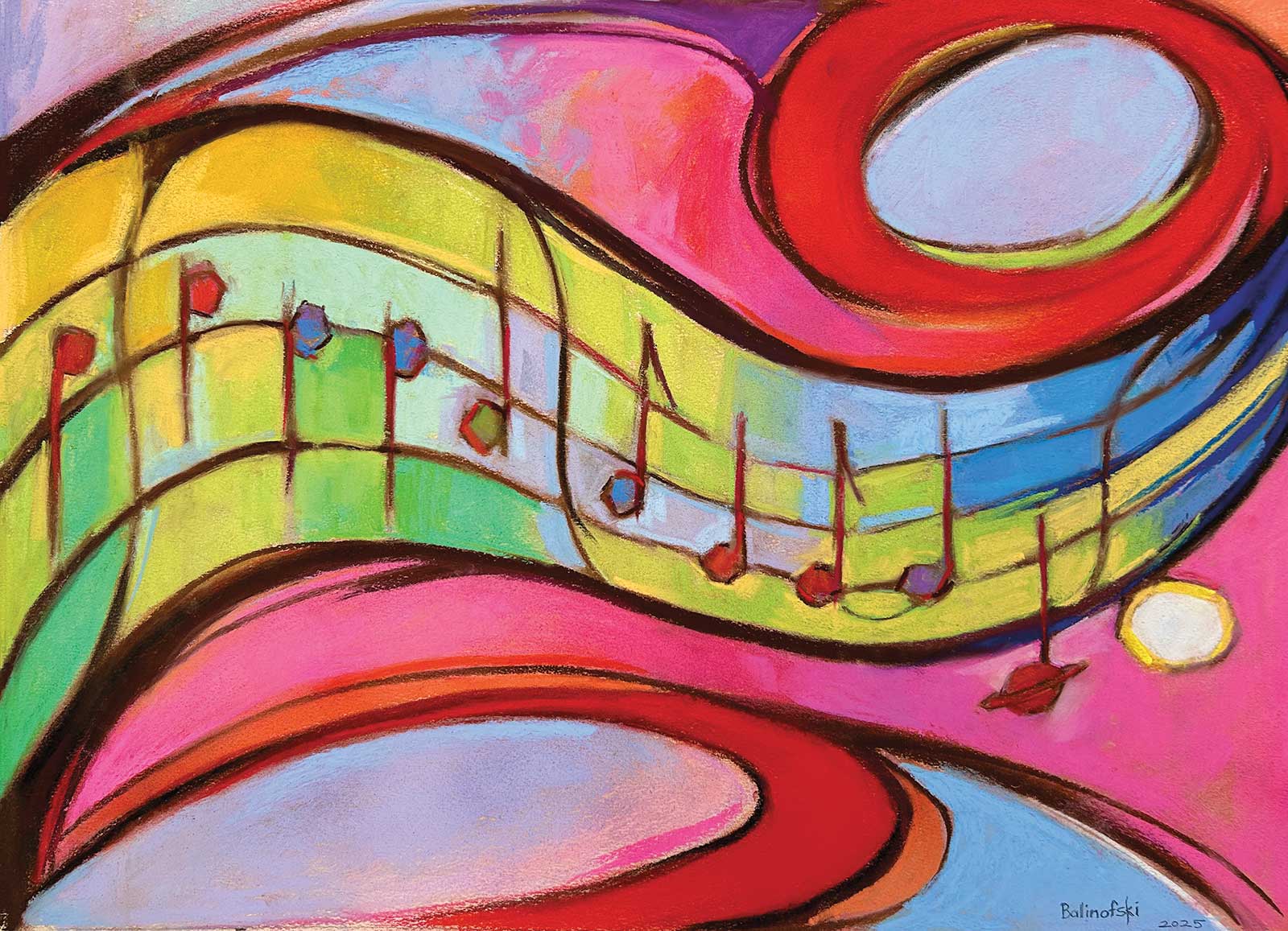
Years ago, Harley introduced me to Anne Murray’s voice, and I was totally swept away. And like with Harley, her songs carried me through this particular artwork of mine. My hand and arms started waving as if I was conducting. Those waves turned into the strokes of pastel we see here. Anne’s music guided me into colors and shapes, including very particular notes playing a melody. It’s so gratifying that what I’ve done here is a work of art that came about without wondering what I should do next.