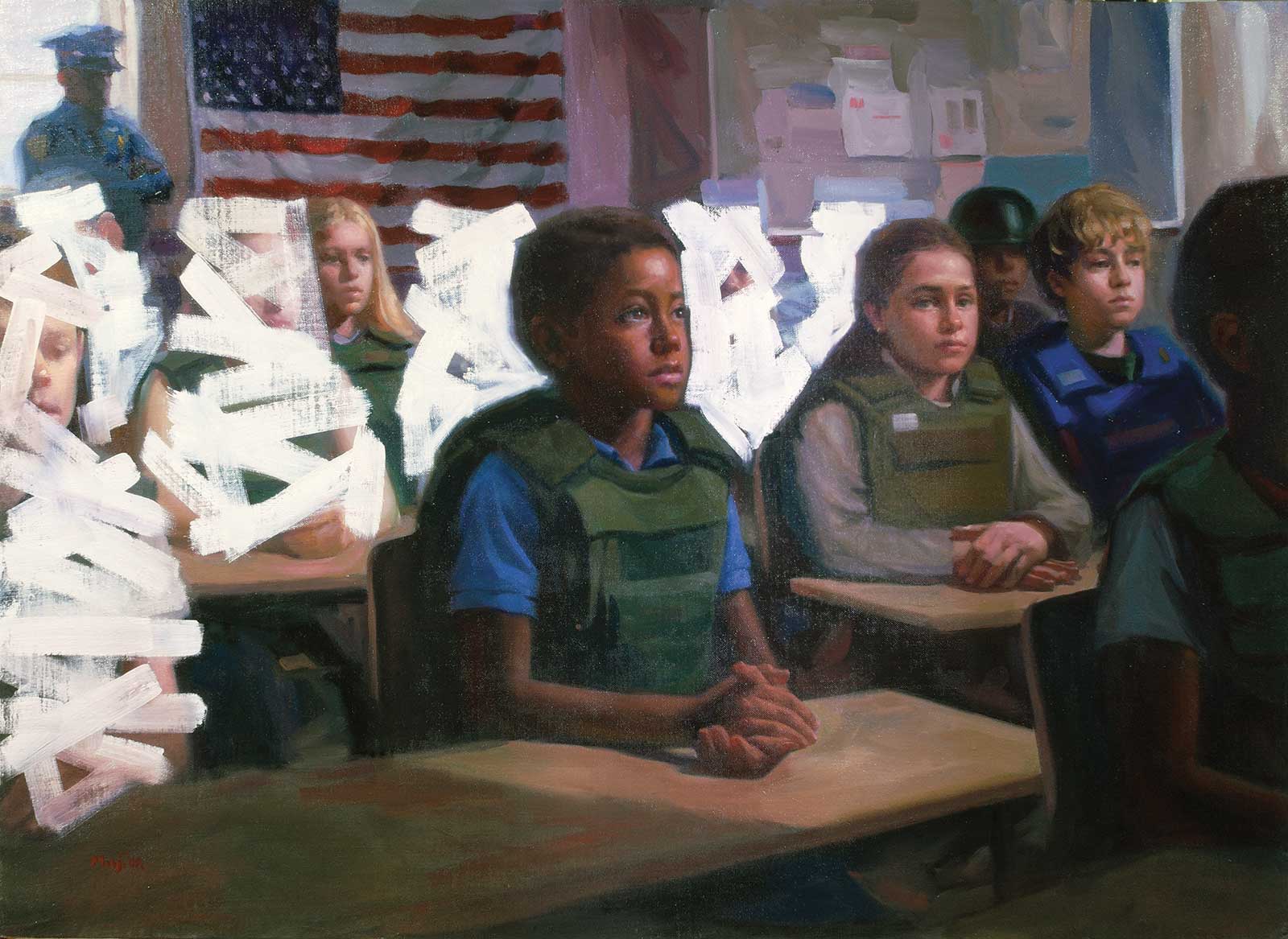
 Thoughts and Prayers, oil on linen, 35 x 48” (88 x 121 cm)
Ricky Mujica
Inspiration
This painting was born from heartbreak over the epidemic of school shootings, a crisis that has hit painfully close to home. My family has endured gun violence three times: once during a mall shooting when my wife and baby son had to flee and hide; again when my daughter’s high school was evacuated due to a student with a gun; and most recently, at her summer camp, when an armed murderer entered the grounds, forcing the children to barricade themselves inside the cafeteria. These experiences haunt me. Each new shooting report brings fresh grief. I’m especially disturbed by the kinds of solutions proposed, often made in earnest—arming teachers or dressing children in bulletproof vests. As an artist, I feel compelled to respond. This painting is both a cry of pain and a protest. I titled it Thoughts and Prayers, a common phrase that is too often used in place of meaningful action.
Process
The idea developed slowly through sketches and reflection. I drew inspiration from Norman Rockwell’s painting of a Soviet classroom but aimed for something more tense and unbalanced, hence the offset desks. My son and daughter posed for all the students. I was hesitant to involve other families in such a heavy subject, so I adapted my sketches to create unique characters. The classroom, vests and police officer are fictional. The painting evolved as I worked, with changes happening directly on the canvas. It is currently on display in the window of the Art Students League of New York.
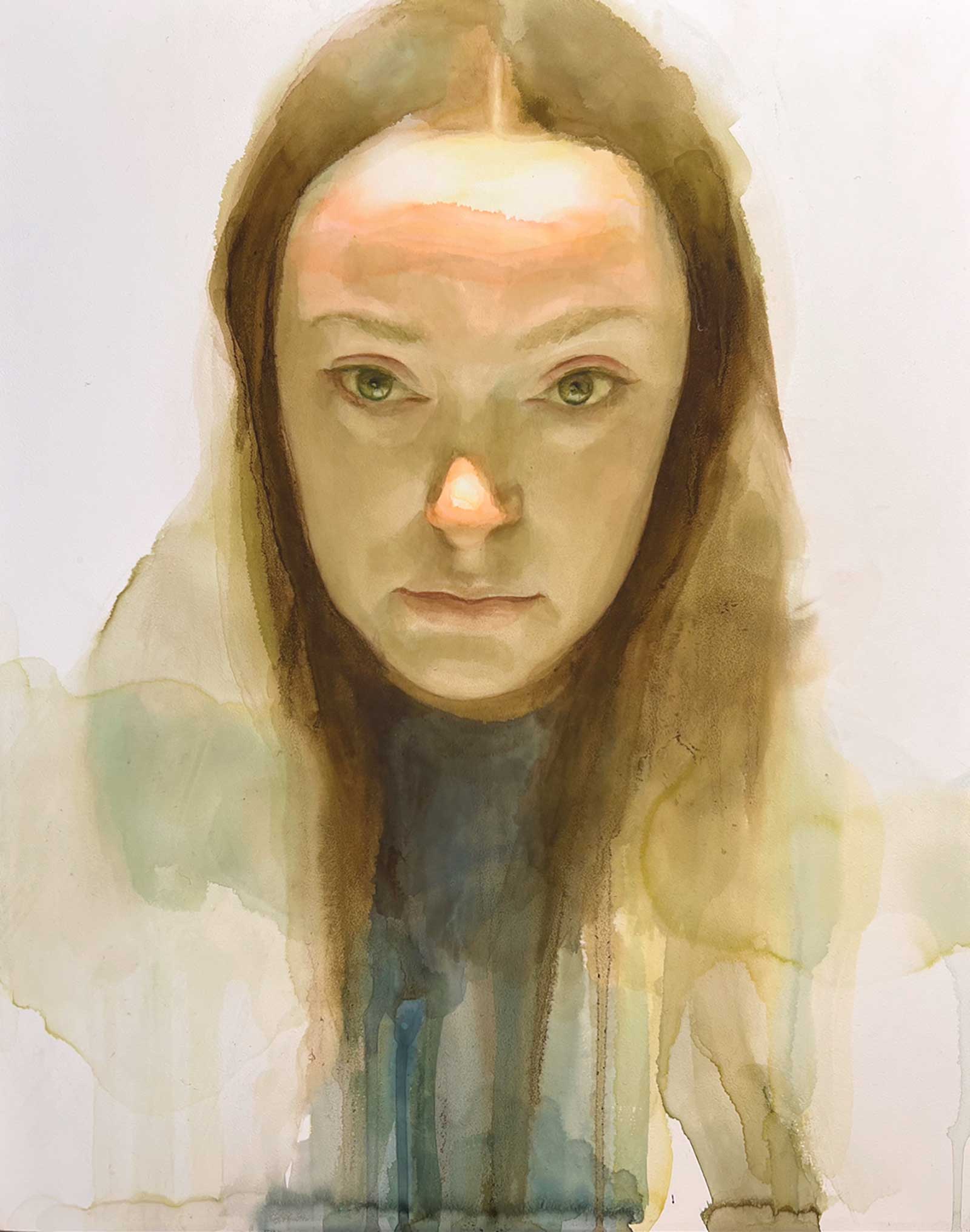 When No One is Looking, watercolor on panel, 14 x 11” (35 x 27 cm)
 Ali Cavanaugh
Inspiration
This self-portrait was created as part of an annual tradition in my watercolor community. I started the challenge several years ago and was originally inspired by the long-standing practice of artists like Van Gogh and Rembrandt. I’ve always thought that a yearly self-portrait is a wonderful way to document both personal growth and artistic evolution.
Process
This particular self-portrait was painted during my 50th year. Using my reflection in the mirror, I captured a quiet, unguarded moment right before stepping into the shower. I was lit by the warm glow of an overhead light. I wasn’t smiling or performing for anyone. This is simply how I look when I see myself—not sad, not happy—just being. I intentionally left out any environmental context to allow the portrait to exist as a fleeting, impressionistic moment, like a dream or a brief memory. Using my signature bloomy watercolor technique, I painted the portrait with my six-color portrait palette (Payne’s gray, sap green, ultramarine turquoise, perylene crimson, pyrrole orange, and nickel azo yellow) on a panel treated with watercolor ground. I began with an underpainting and then applied translucent layers, building up depth and luminosity. The minimal, spontaneous brushwork reflects simplicity and honesty in my approach to portraiture.
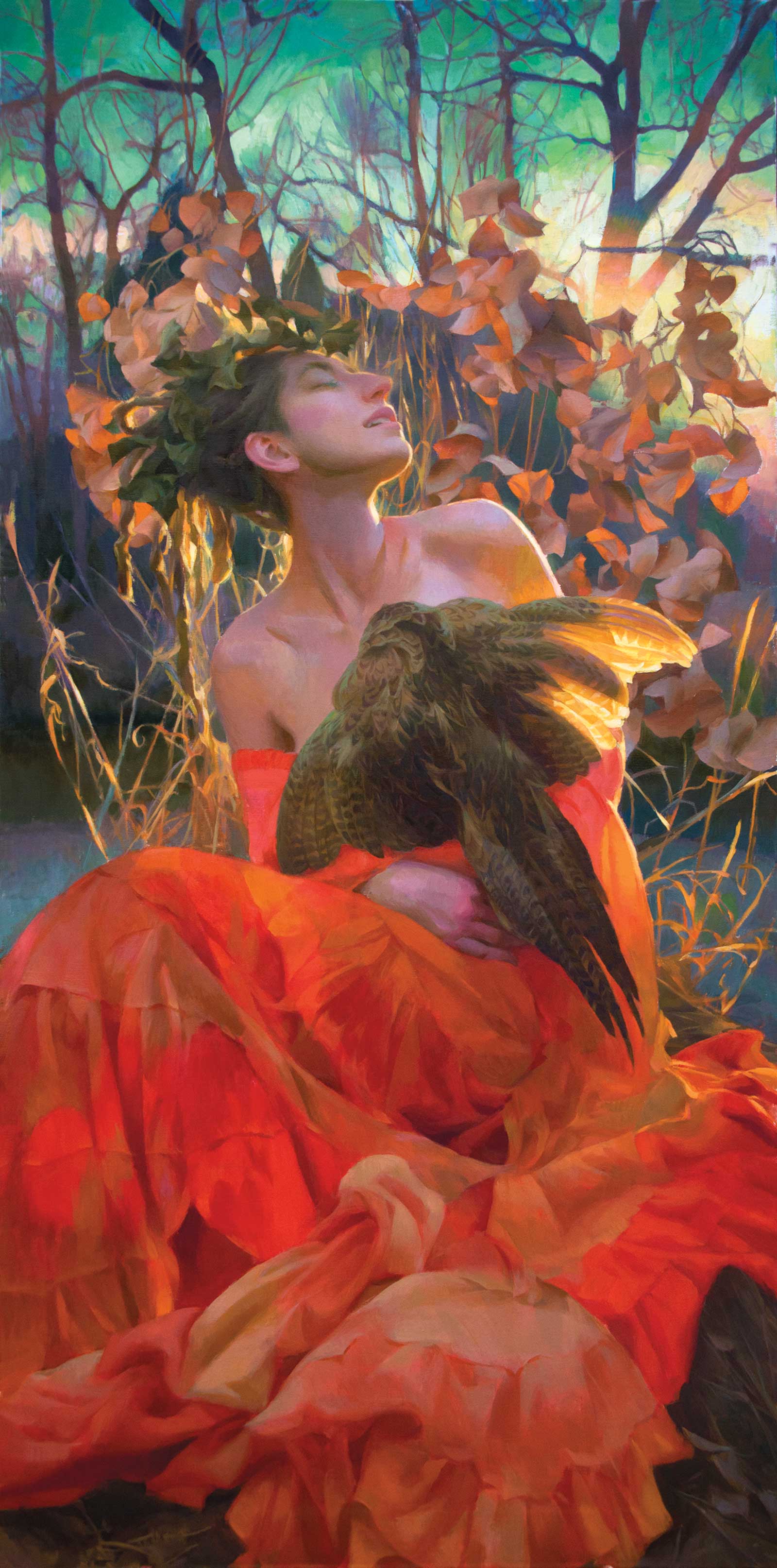 Riverbend, oil on linen, 60 x 30” (152 x 76 cm)
Adrienne Stein
Inspiration
I chose a vertical composition for Riverbend because I wanted the first impression to evoke the feeling of a soaring cathedral. The towering trees act as vaulted pillars, and the light filtering through the grass, hair, leaves and pheasant wing brings to mind the luminous beauty of stained glass. My model, Felissia, with her dreadlocks and earthy style, is imagined as a forest sprite or an earthbound angel, an embodiment of nature’s quiet magic. The setting is a specific creek tucked within a park in Denver, Colorado, which has always felt to me like a spiritual sanctuary amid the surrounding bustle of the city. This contrast between the sacred stillness of nature and the chaos of the modern world deeply inspired the mood and meaning of the piece. My hope is that, not only this painting, but all my work, offers a quiet, visual antidote to our noisy, industrialized and information-saturated lives.
Process
To bring this vision to life, I took Felissia to the park in the late afternoon to photograph her in the soft, dappled light. I borrowed a pheasant pelt from my husband Quang’s studio, which added a symbolic and textural element. As she posed along the creek and the sunlight danced through the trees, I could clearly envision the final composition in my mind’s eye. From there, I completed two small watercolor studies and a larger color study in oil to refine the mood and structure before beginning the final painting. Each stage helped anchor the emotion I wanted to convey.
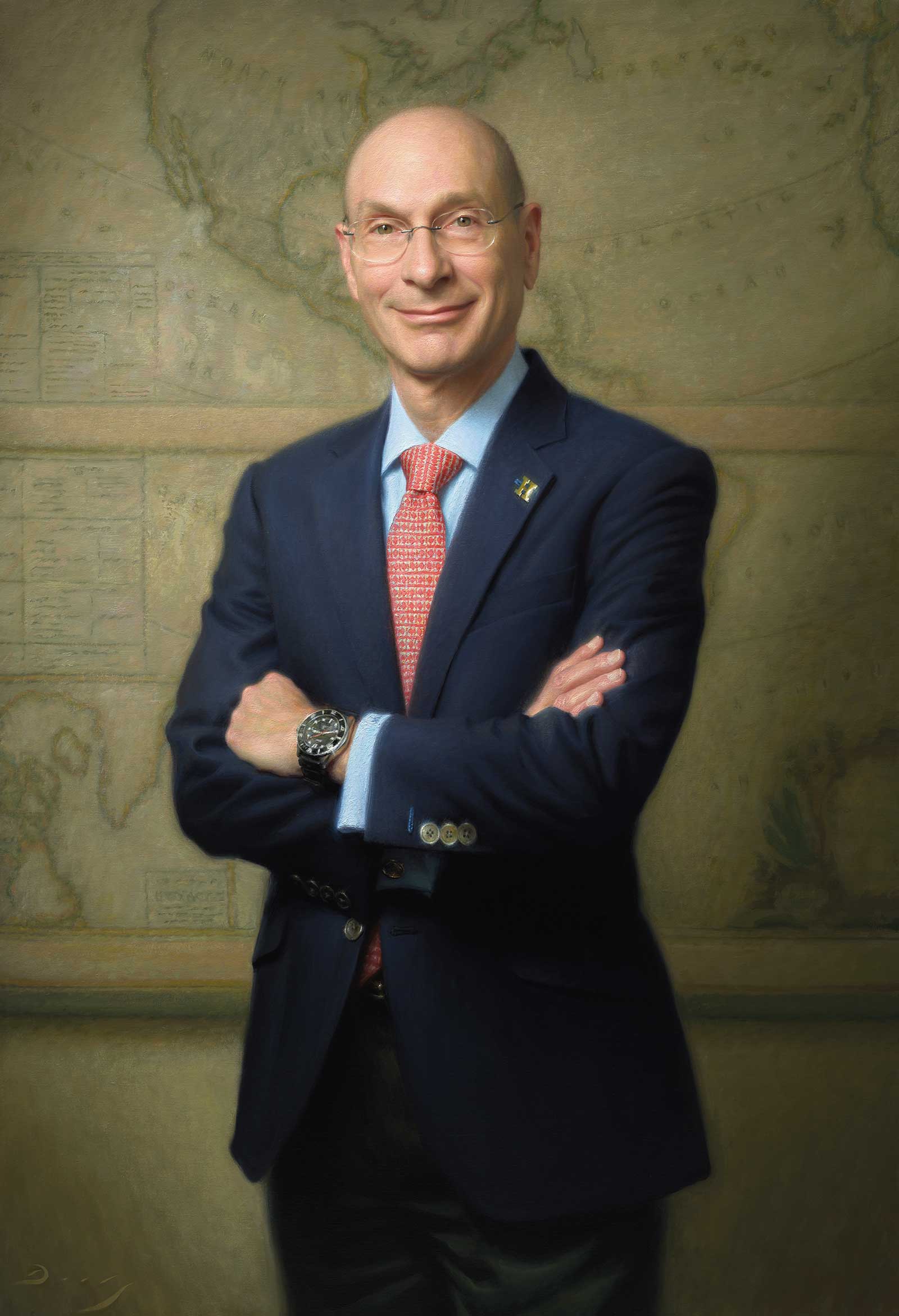 David Wippman, oil, 48 x 33” (121 x 83 cm)
Joseph Daily
Inspiration
This is a commissioned portrait of David Wippman, the 20th president of Hamilton College. In terms of inspiration, I usually find that portraying the subject’s character comes almost automatically, just from meeting them with an open mind and heart. The greater challenge for me is to arrive in the subject’s work environment and, in a very short window of time, to find a visually compelling way to represent them within it. In this case, President Wippman initially requested a plain background, but I asked him towards the end of our photo session if he felt that anything in his office might be suitable for inclusion. He was partial to this large world map, which I thought made for an interesting compositional element and added dynamic energy to his pose.
Process
I took hundreds of photos of President Wippman and painted a small 9-by-12” head study from life. Then I combined several photographs into one compositional mockup, digitally manipulating the shapes, colors, values and facial expression until I was happy with the image. After President Wippman approved the digital mockup, the painting itself was composed of five separate layers of paint over the top of a white canvas: monochromatic raw umber underpainting to establish the values, full color block-in, rendering and building texture, fine-tuning and building more texture, and finishing touches. Each layer takes me between three days and three weeks, with several days or weeks of drying time between layers.