Scottsdale Artists’ School: How did your journey with Scottsdale Artists’ School begin?
Jeff Hein: Many years ago, I was invited to teach a workshop at an institution near Scottsdale Artists’ School. Having already heard great things about the school, I decided to stop by and see it for myself. If I remember correctly, that visit led to my first invitation to teach there the following year. I’ve been fortunate to be invited back each year since, and it has become one of the true highlights of my year.
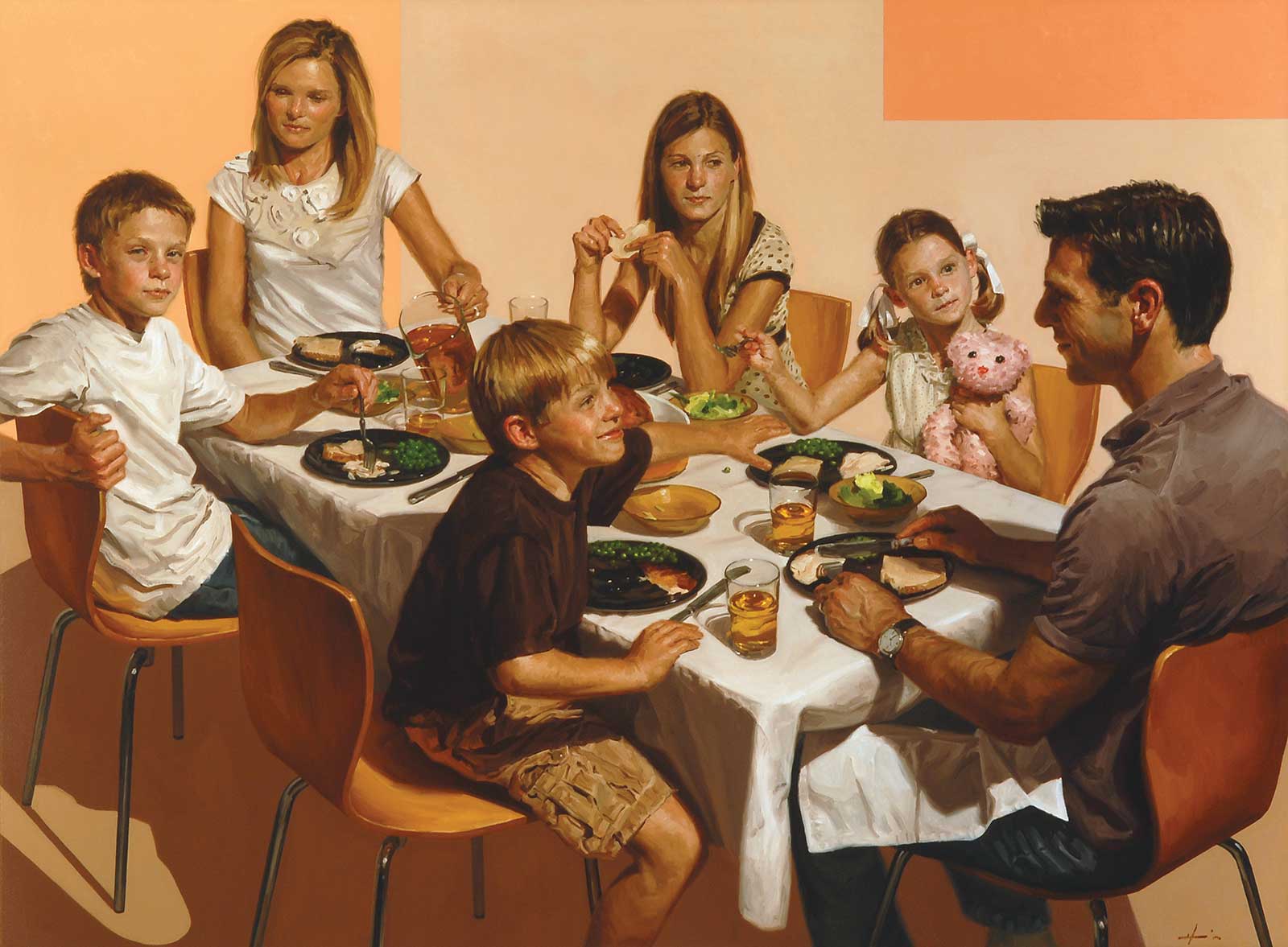
Burgeson Family, oil on canvas, 45 x 60" (114 x 152 cm)
SAS: Have you always known you wanted to be an artist?
JH: I’ve wanted to be an artist for as long as I can remember. I vividly recall a moment in second grade when I was drawing at my desk and a group of classmates gathered around to watch. One girl asked me, “Do you want to be an artist when you grow up?” I remember thinking deeply about it, really considering the question and deciding right then and there: yes, I did.
SAS: Your portraits beautifully balance cool and warm light. What inspired you to explore dual lighting in your work?
JH: While I was still in college, I happened to paint a portrait of a woman wearing yellow-lensed sunglasses. I became completely captivated by the way the colored light filtered through the lenses and cast warm tones across her cheeks. That moment sparked a fascination, and for a while, I painted several portraits featuring colored sunglasses and visors, experimenting with the interplay of light and color. Eventually, I realized I could recreate and even expand on that effect by using colored gels on a secondary light source. That discovery opened up a whole new world of possibilities, allowing me to sculpt form with contrasting temperatures and bring a unique atmosphere to each portrait.
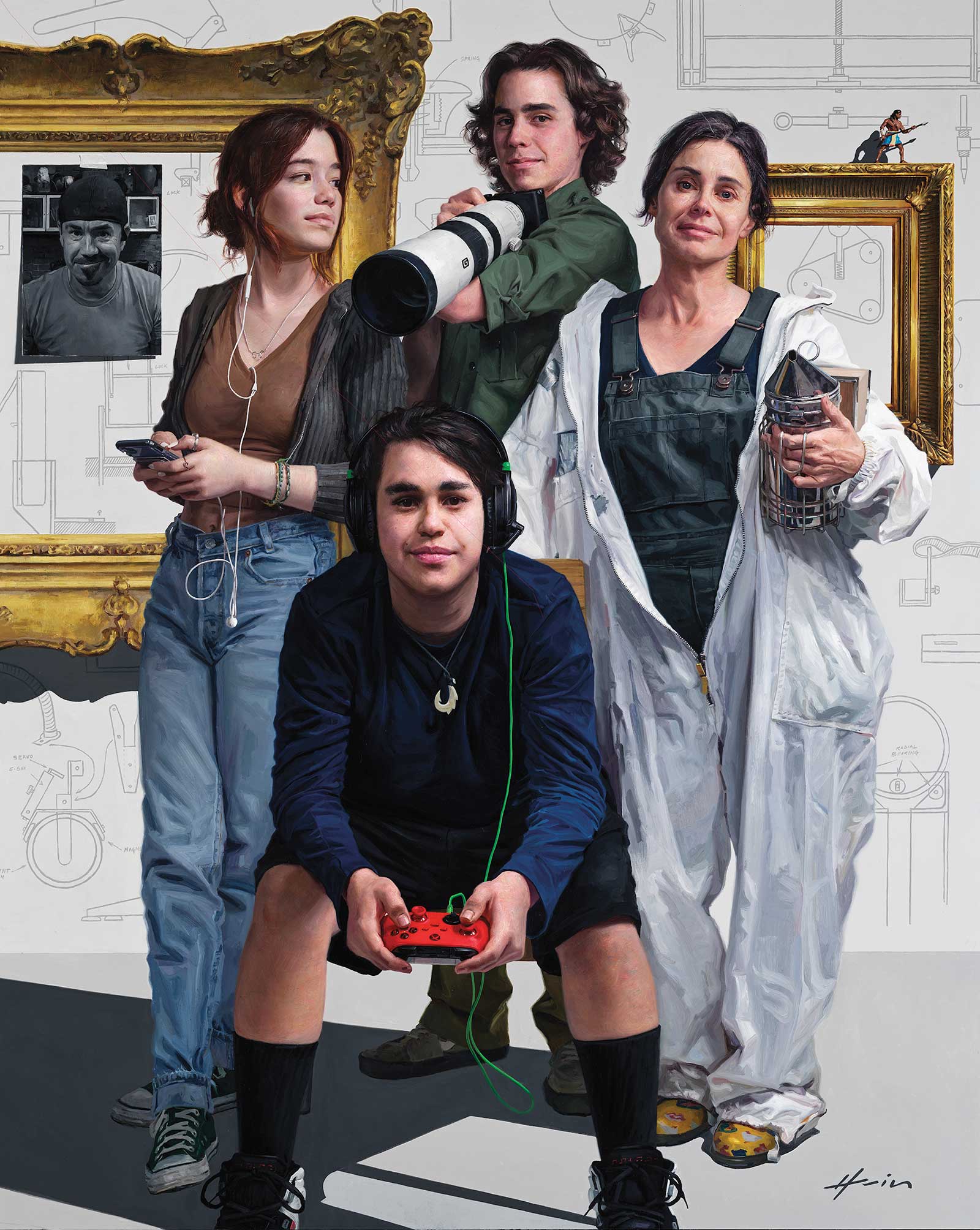
Hein Family, oil on panel, 60 x 48" (152 x 121 cm)
SAS: Can you share the story behind your very first commission?
JH: My first commission was one I took very reluctantly. At the time, my gallery work was selling well, and I had no interest in doing commissions. I’d also heard horror stories from other artists, how commissions were often miserable, how the client dictated everything, and how the artist ended up with little to no creative control. None of that sounded appealing. Still, one of my dealers kept calling, more than once, telling me that people were inquiring about family portraits. I kept saying no. Then one day, he hit me where he knew it would sting: “You’re crazy to turn down well-paying work when you’ve got a family to support.” Ouch.
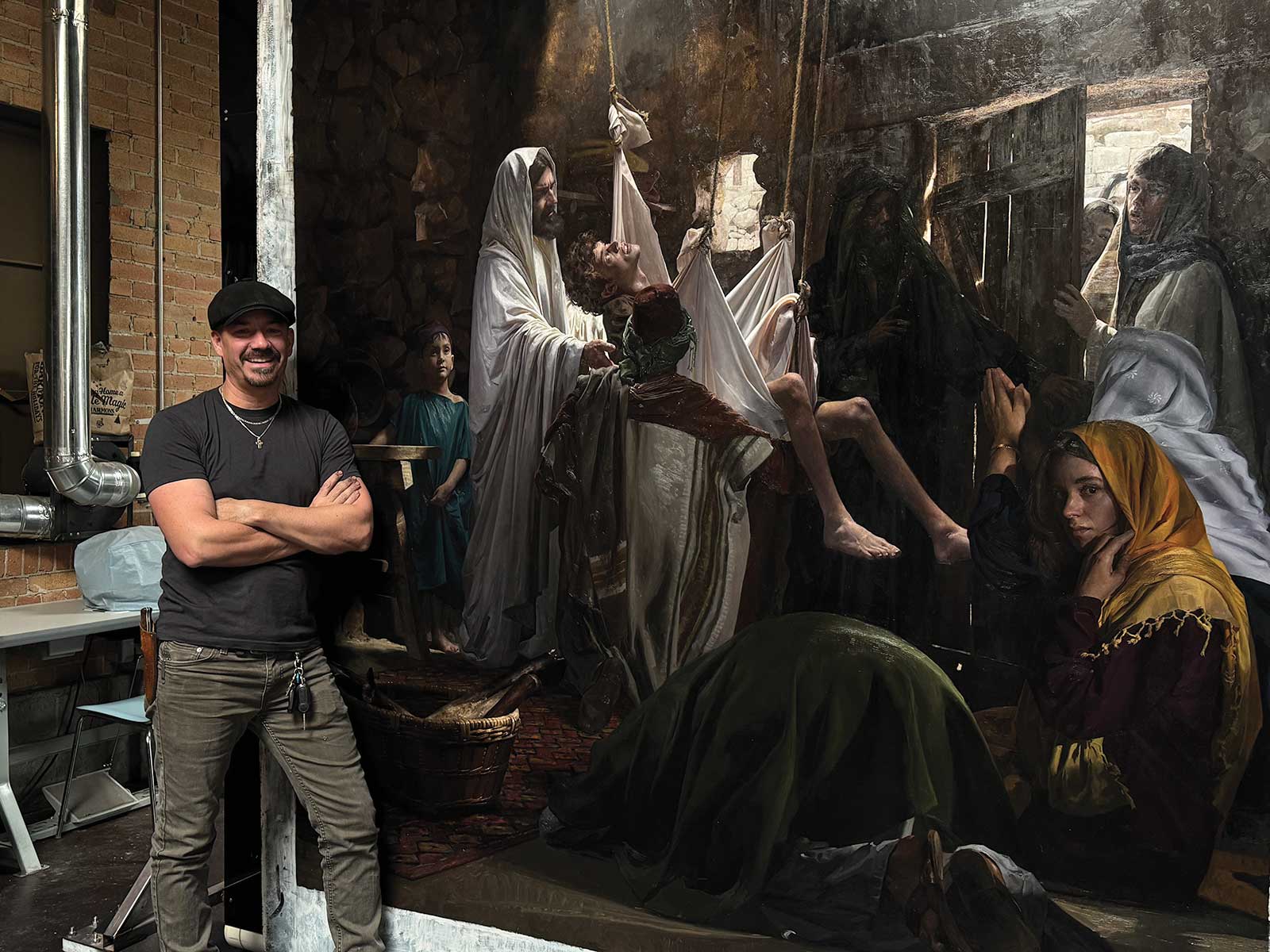
Artist and SAS instructor Jeff Hein.
So I finally said yes, just this once, to test it out. I walked into that first meeting with zero pressure on myself, thinking I didn’t want the job anyway. I told the clients flat-out: I’d only do the portrait if I had complete creative control. The only thing they’d get to choose was who they wanted me to paint. To my surprise, they didn’t walk away. They agreed. That commission turned out to be a rewarding experience, and it completely changed the way I thought about commissioned work. I realized that with the right boundaries and expectations, it could actually be a fulfilling part of my practice.
SAS: When someone views your work, what do you hope they experience or take away from it?
JH: Right now, my focus is entirely on painting the life of Christ through a series of 25 large-scale works. My hope is that I can paint well enough to honor the subject with the depth it deserves. If my craftsmanship is strong enough, I believe I can become invisible as the artist, so that the power of the subject can shine through without distraction. I often think of my role like that of a great lighting designer in film. When they’ve done their job beautifully, the audience doesn’t even notice the lighting; they’re immersed in the story. That’s what I hope for: that viewers walk away not necessarily thinking about how the painting was done, but instead feeling deeply moved and inspired by the story it tells.
SAS: Tell us about your upcoming workshop at Scottsdale Artists’ School.
JH: I feel that my approach to painting flesh is uniquely lifelike. I share the entire process I use to create this quality and allow the student to try for themselves.
SAS: What’s the most important takeaway you hope students leave with after your workshop?
JH: I hope my students leave my workshop questioning what they thought they knew about painting the portrait. I hope they ache to get back to their studios to explore painting with new information and a new outlook. —
Visit scottsdaleartschool.org for more information on the school and its upcoming workshops.