Children in the Field began as a color study, an experiment rooted in curiosity. After encountering E. Phillips Fox’s Moonrise at the National Gallery of Victoria, I found myself drawn to the subtle richness of its cool palette. Inspired, I began incorporating cerulean and ultramarine into my own work, pushing the overall tone toward cooler, duskier blues.
The subject itself, a quiet exchange between two girls dressed in crisp white, provided the perfect stage to explore a lighting effect that has long fascinated me: that brief, magical moment at dusk when opaque objects shimmer and glow. Technically, I aimed to make each brushstroke work as hard as possible, to say more with less, while still enjoying the physical act of painting.
As a father to a young daughter, what truly animated the work for me was the idea of children’s secret, shared worlds. They are mercurial beings, playful, mysterious, and endlessly absorbing to observe. That spirit guided every stage of this piece.
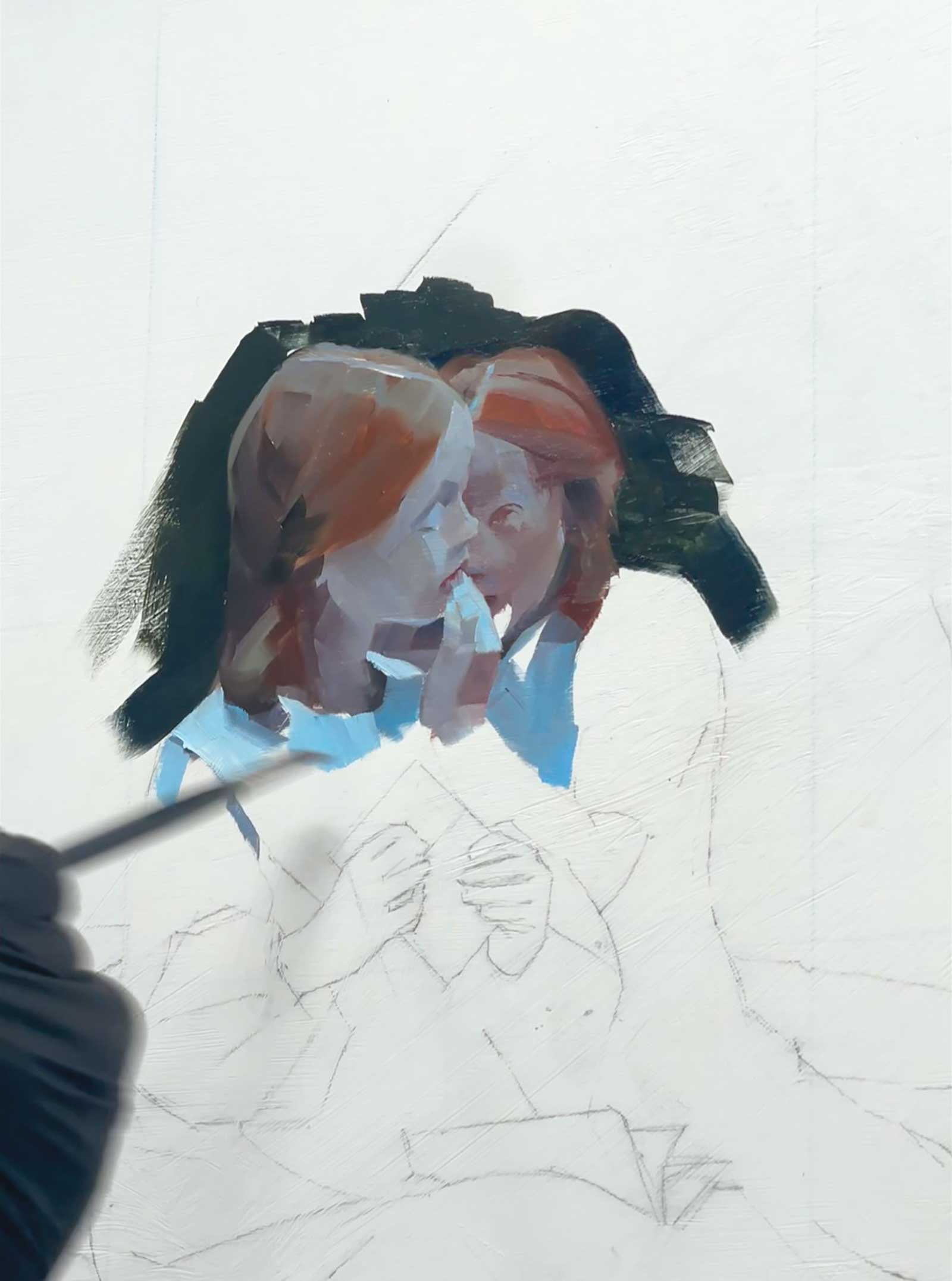 Stage 1
Stage 1 The Sketch: As with many of my paintings, the process began with a pencil sketch on paper. Once the gesture and balance of the two figures felt right, I transferred the drawing onto a primed Masonite board using charcoal. I then went straight into painting the focal point: the girls’ heads, one leaning, one whispering. At this early stage, my focus was purely on arranging color, value, shape and edge relationships, leaving details for later.
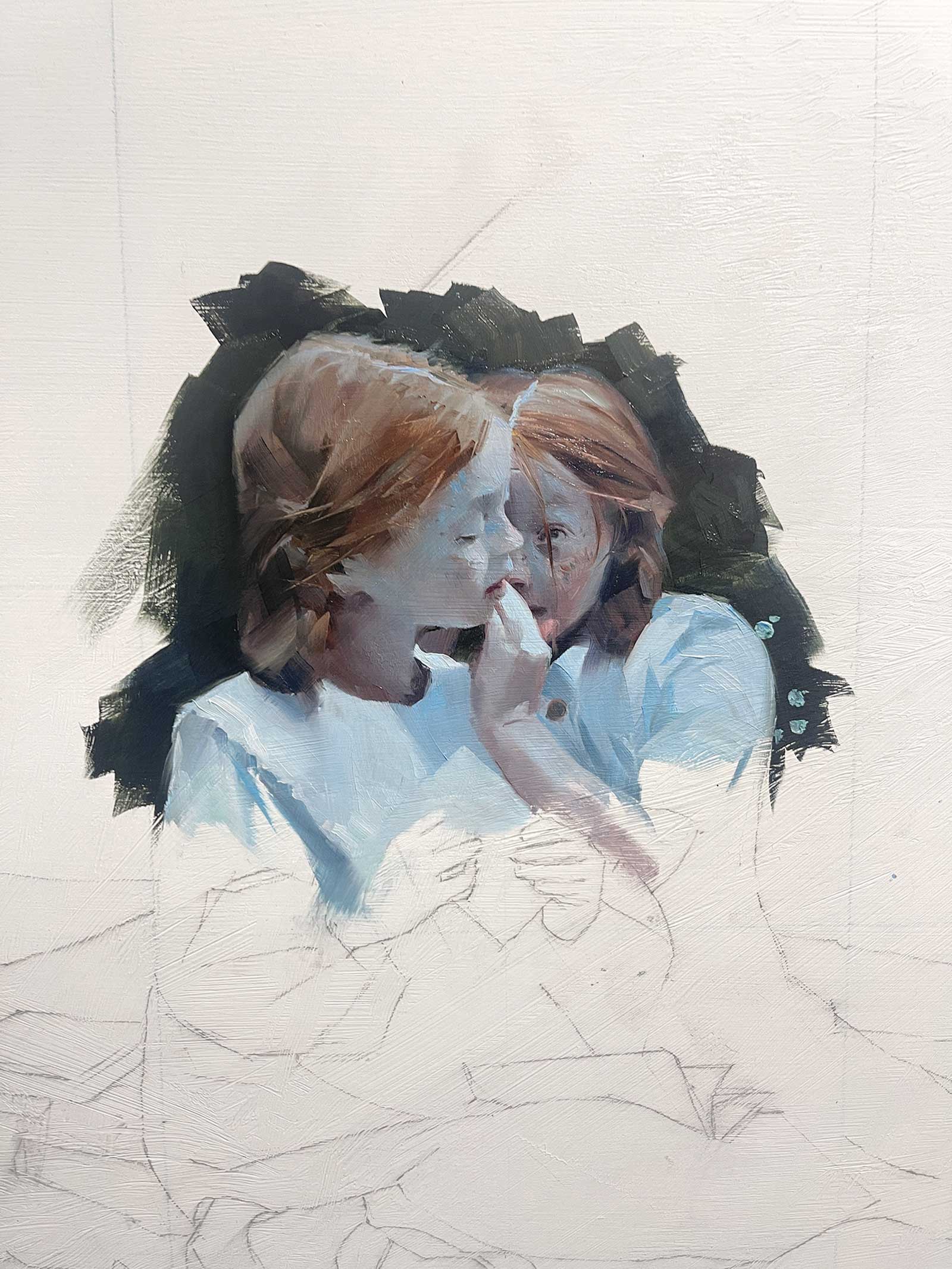 Stage 2
Stage 2 Establishing Values: I find it useful to work from dark to light. Beginning with the deepest darks, namely the dusky foliage, I progressed into the shadowed areas of the girls’ faces. This allowed me to establish the tonal relationships early, which made it easier to judge and refine color choices as I went. Once the foundational relationships were in place, I added select details wet-on-wet, bringing the area to near completion.
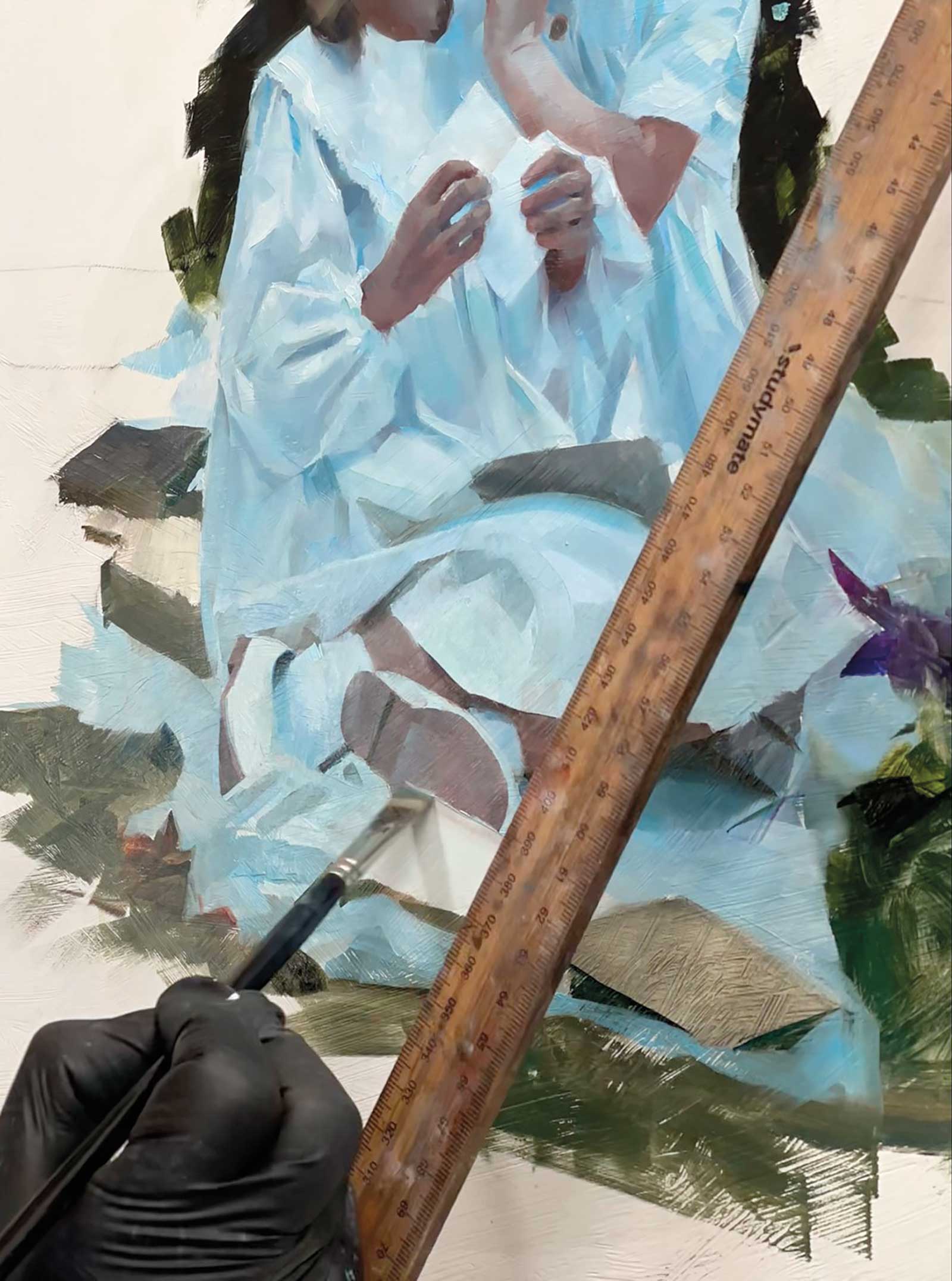 Stage 3
Stage 3 Painting the Tunics: With the focal area resolved, I turned to the girls’ bodies. Working with cerulean blue, a new territory for me, proved unexpectedly challenging. Its intensity became overwhelming in the larger expanses of their tunics. To restore balance, I reintroduced more familiar hues from my palette, like viridian and cobalt blue. This section, if anything, was the weak link in the process; my discomfort with the new palette affected my brushwork more than I anticipated.
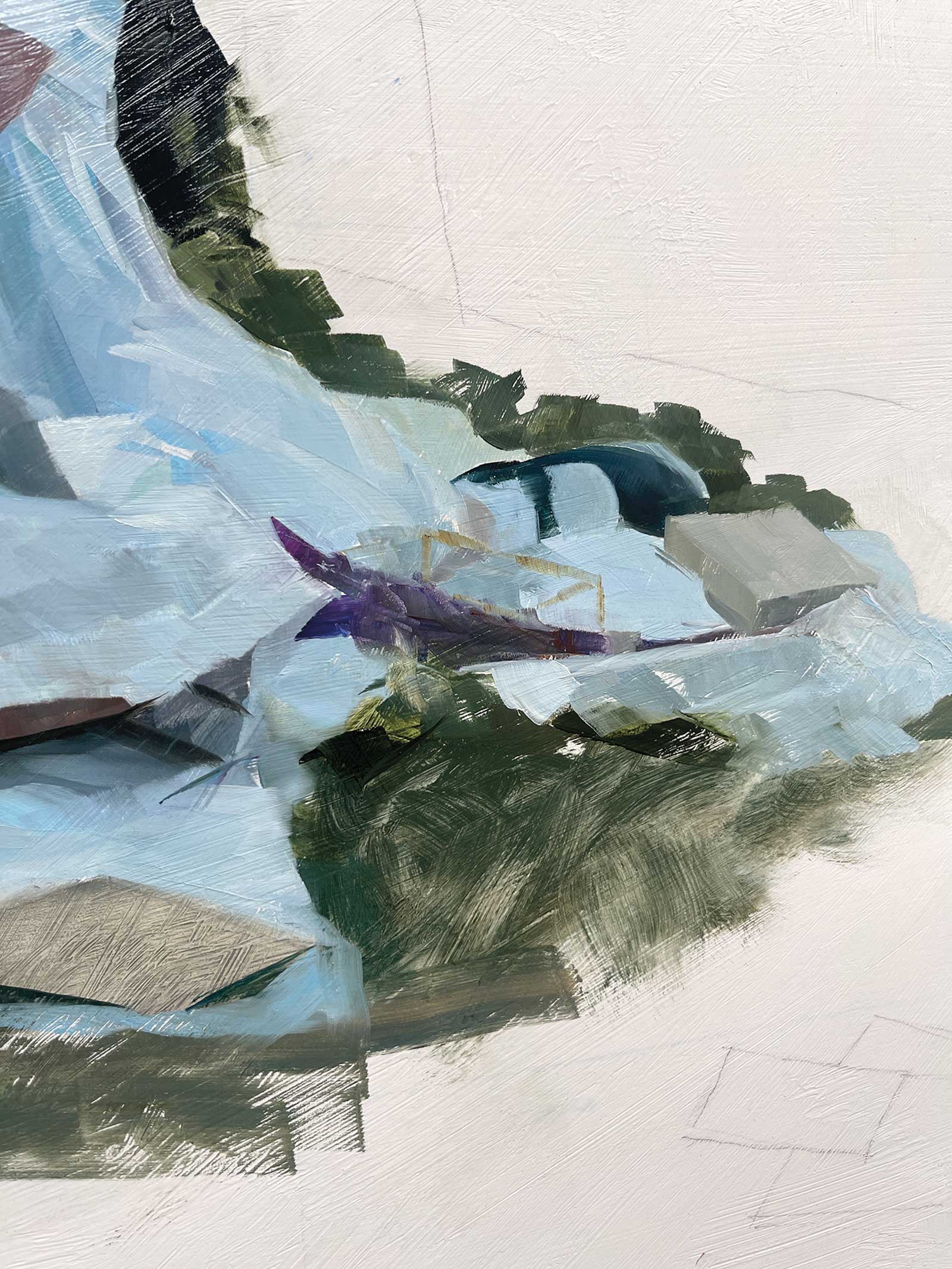 Stage 4
Stage 4 Integrating the Scene: Once the figures were largely complete, it was time to anchor them in their environment. Elements like the picnic blanket, a scattering of books, and a lavender sprig functioned as quiet extensions of the girls themselves, both in value and hue. I approached these objects quickly and loosely, careful not to let them distract from the faces. In places, I even left the primed Masonite bare to preserve the looseness and lightness of the composition.
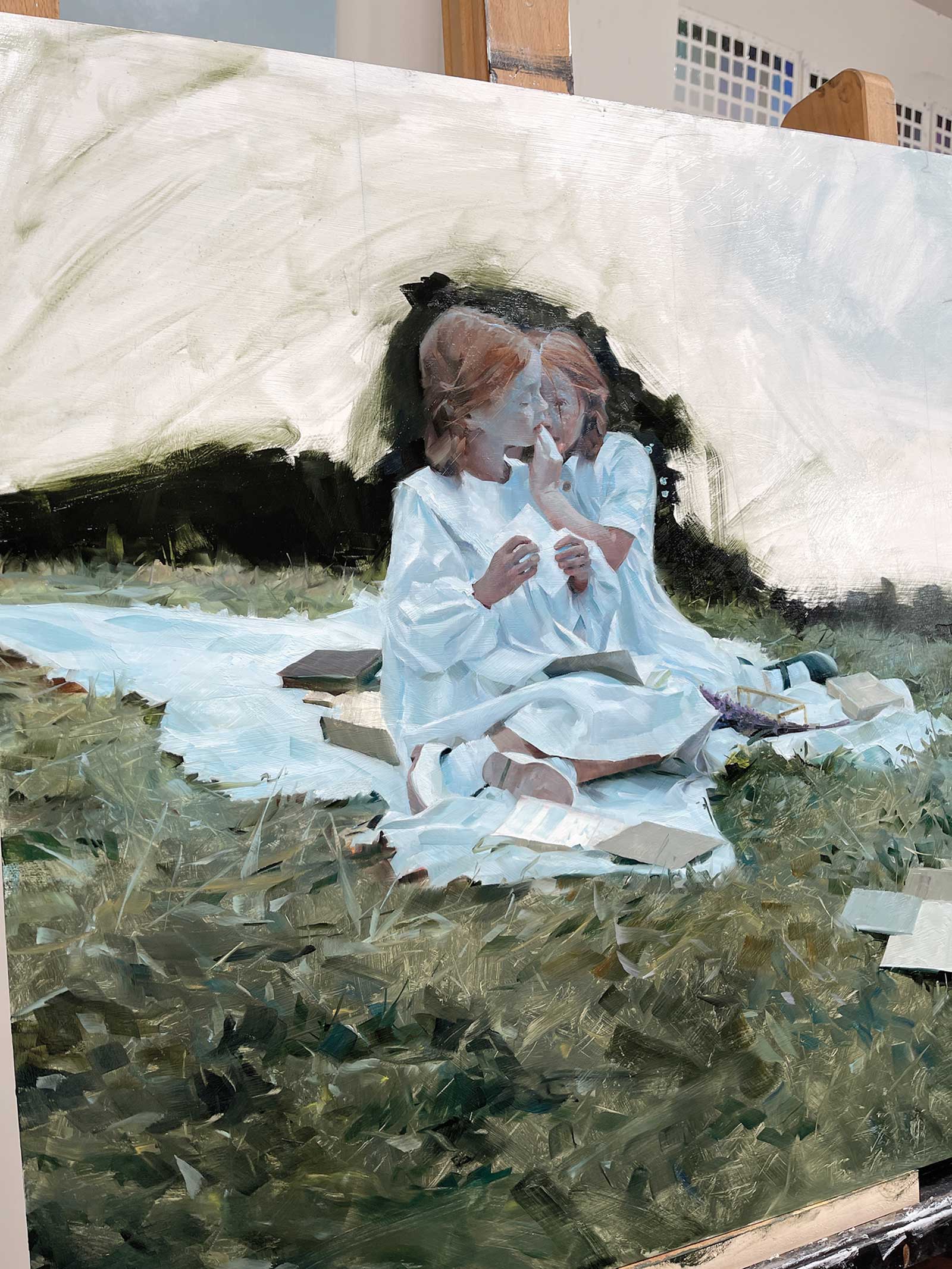 Stage 5
Stage 5 Repainting the Grass: I painted the grass twice. The first attempt, too cool and heavy, didn’t sit well and was wiped off. On the second go, I adjusted the temperature slightly warmer than I had initially planned, and it worked. The grassy texture was built up using a stiff short flat brush and palette knife over the marbled surface I had prepared, lending it a tactile, spontaneous quality.
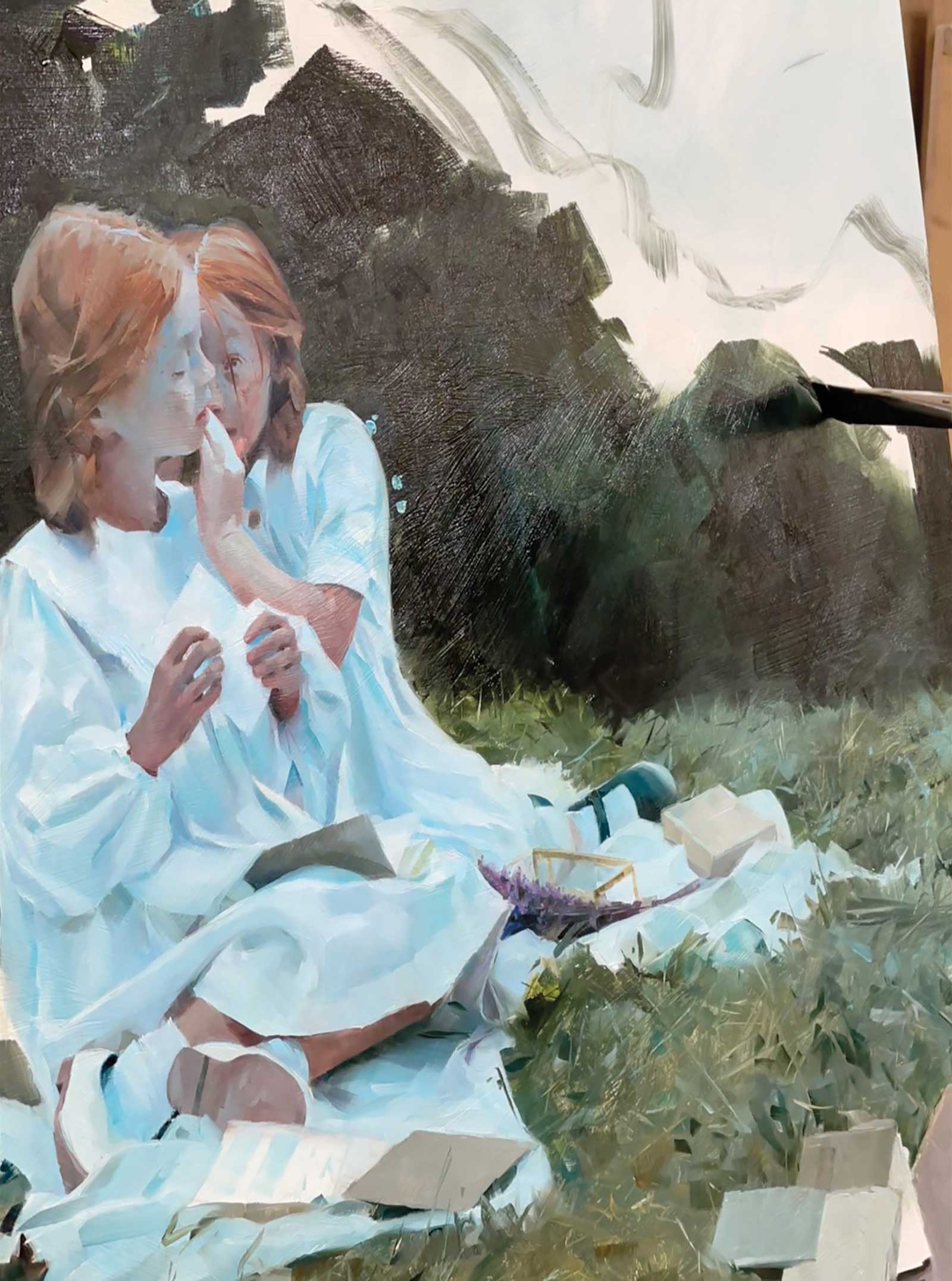 Stage 6
Stage 6 Foliage and Sky: The final, and most satisfying, step was the surrounding foliage. I painted this section rapidly, aiming to keep the brushstrokes fresh and unlabored. The sky, by contrast, remained simple: just the gessoed substrate with a translucent color wash applied early on. If you look closely at the finished piece, you’ll still see grid marks peeking through—small traces of the painting’s early construction.
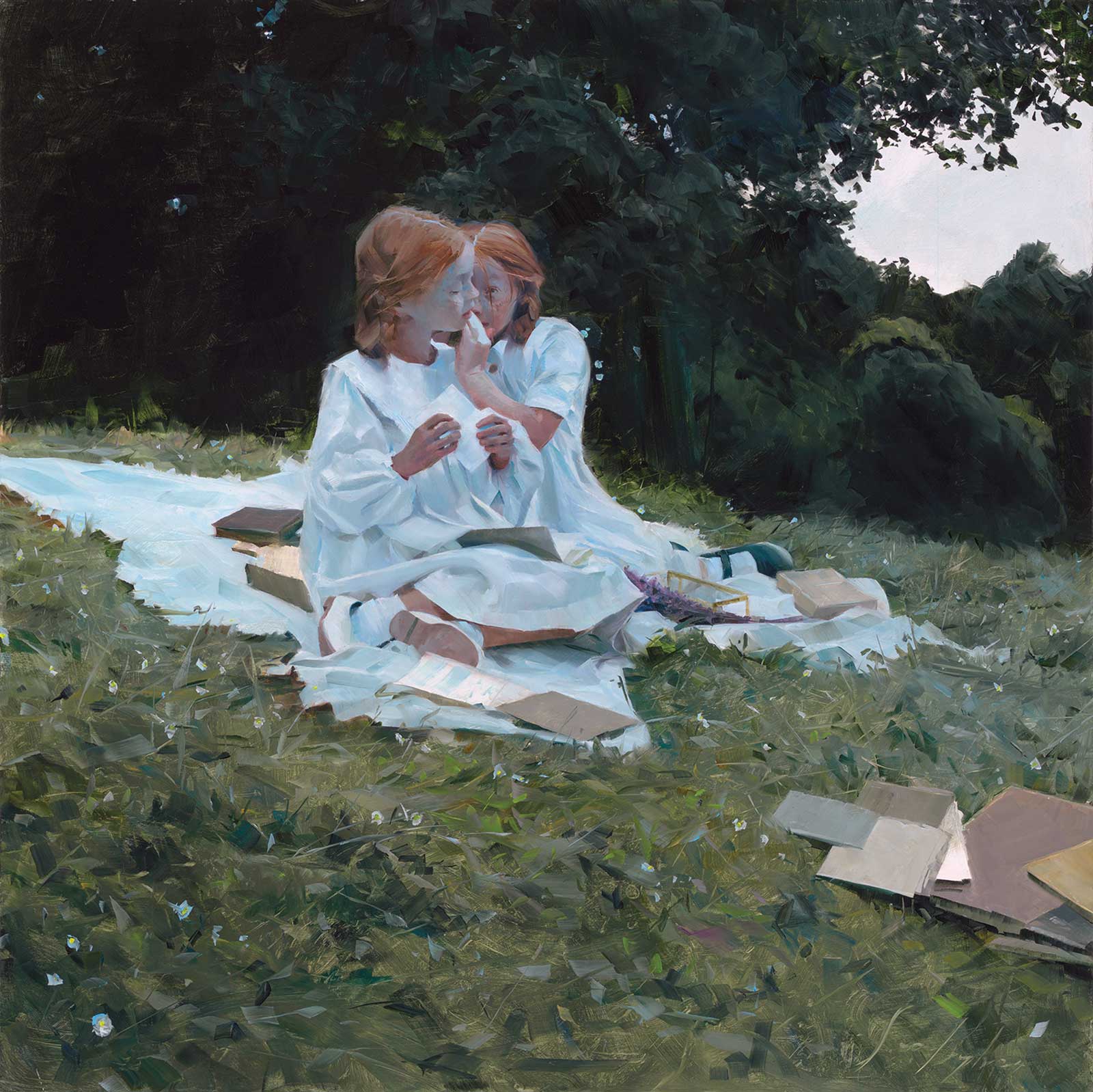 Stage 7
Stage 7 Letting It Be: With larger works, I often return for revisions, but in this case, I felt no need. The intention was always to explore new color territory and to maintain a fresh, responsive approach. That ethos stayed with me from start to finish. In the end, Children in the Field became more than a color study; it captured, for me, something essential and ephemeral about childhood itself.
Sean Layh is a Melbourne-based figurative artist known for his narrative-driven paintings that blend classical themes with contemporary technique. His work has been exhibited internationally, including at MEAM in Barcelona and Arcadia Contemporary in New York. From 2023 to 2025, Layh has won multiple awards in the Portrait Society of America’s The International Portrait Competition.