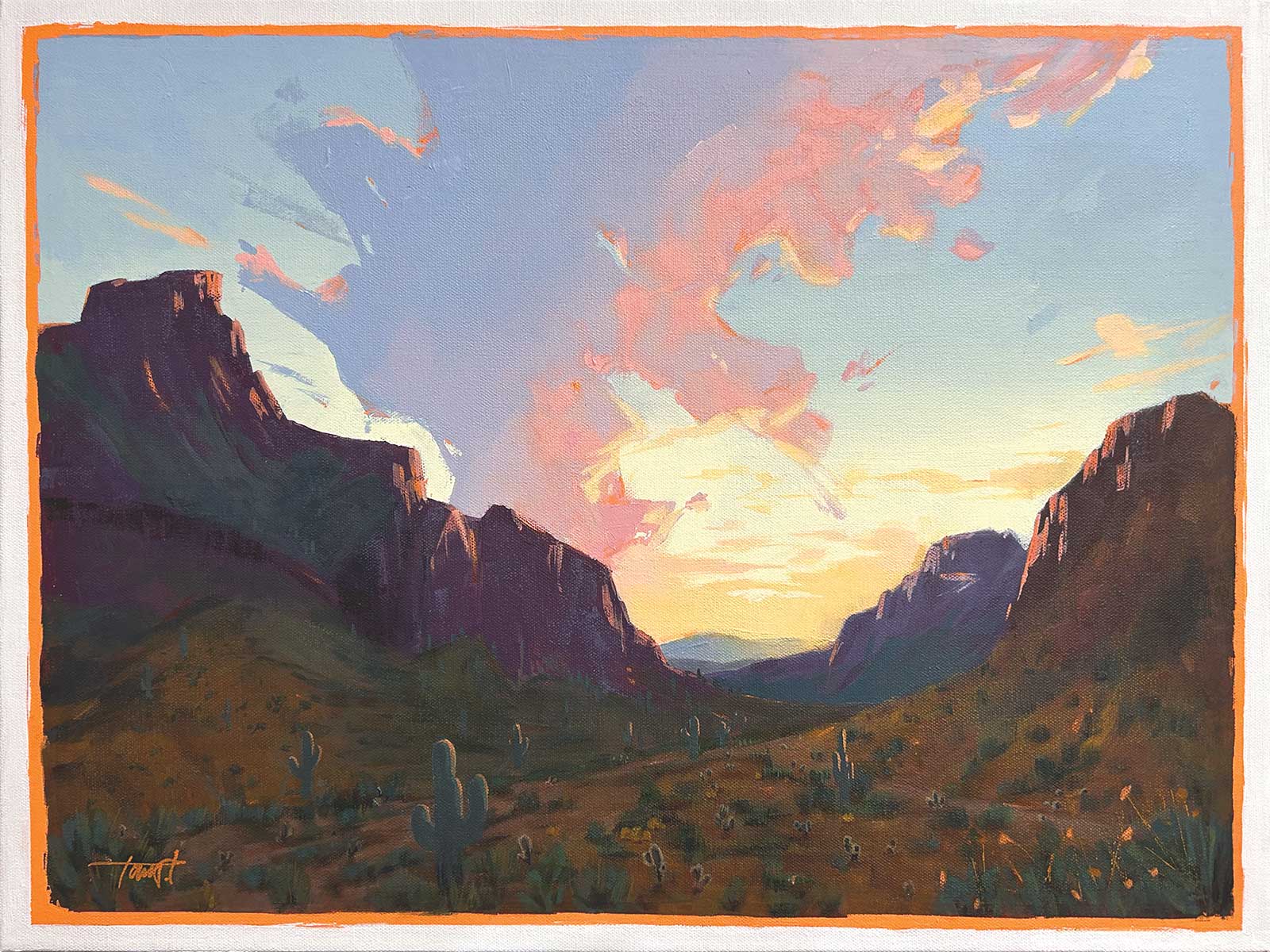
The painting Kofa in Purple was a commissioned gift based on a family camping trip to Kofa National Wildlife Refuge in Arizona. The reference for the painting was based on research and client photos. As we often see, the client reference photos were trying to capture the magnitude of the sunset over the mountains, but the camera is limited in capturing the true colors and detail that our eyes can see.
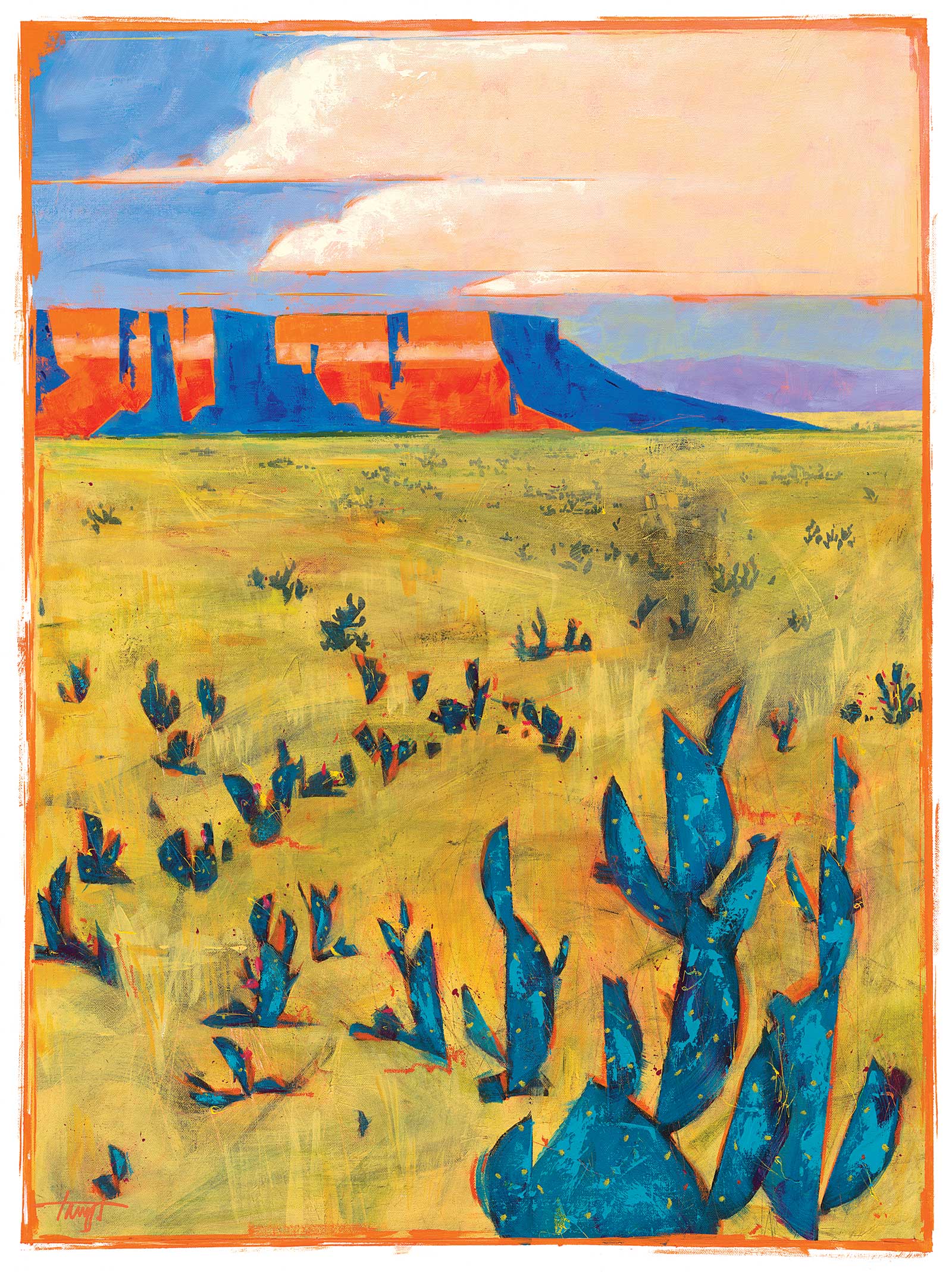
Mesa Country, mixed media on stretched canvas, 40 x 30" (101 x 76 cm)
I took this opportunity to capture that magic, and invent the sunset, sky and clouds. As someone who likes to merge representation, abstraction and expression, I find clouds to be the perfect subject for this. Going into this painting, my intent was to create a colorful sunset with an abstract cloud that could carry some of the warm hues from the setting sun, and to keep the foreground as the darker area of the composition where the light doesn’t reach as much.
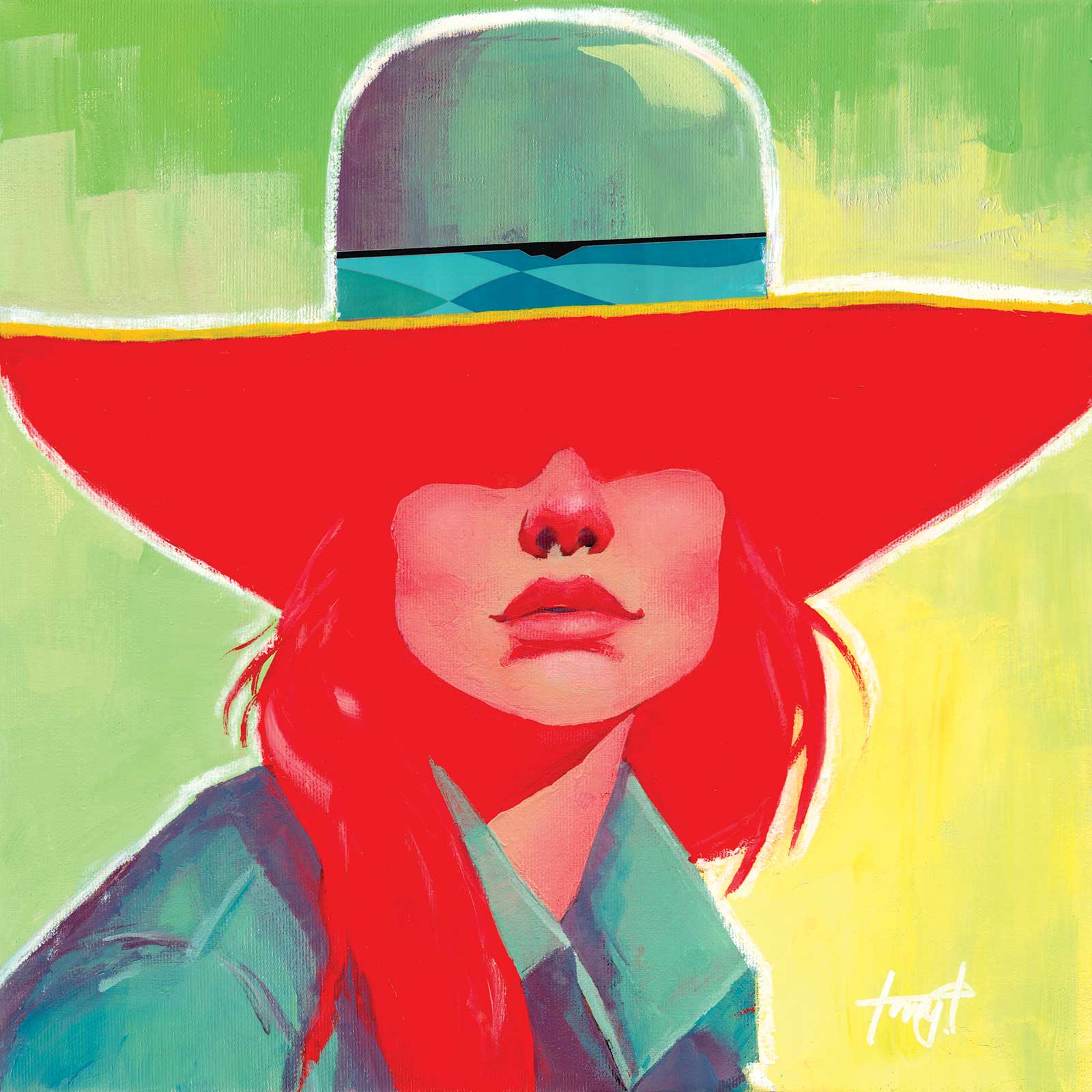
East of Arizona, mixed media on stretched canvas, 12 x 12" (30 x 30 cm)
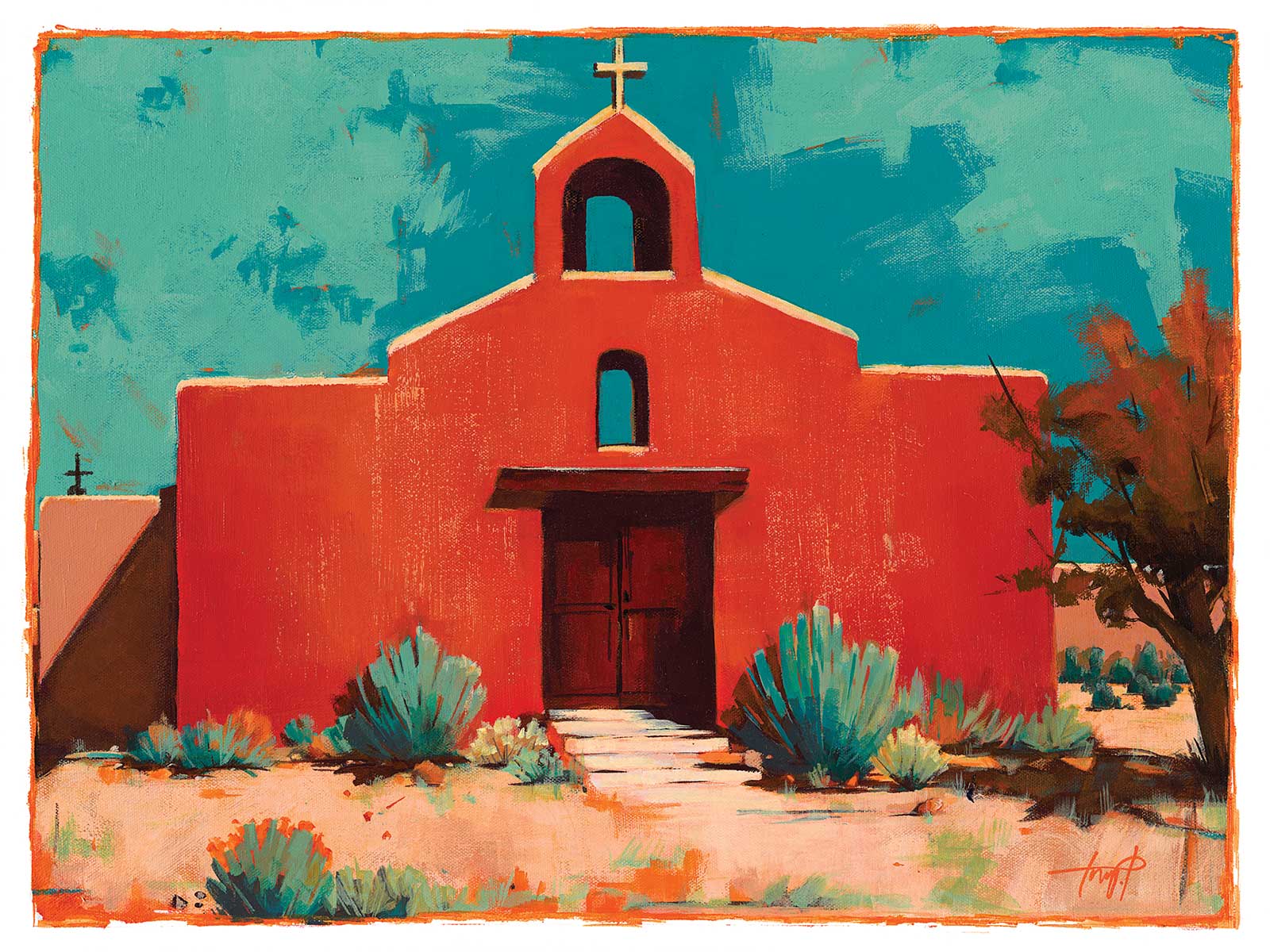
Sanctuary, acrylic on stretched canvas, 18 x 24" (45 x 60 cm)
I begin my process by quickly blocking in the big shapes, from the background to the foreground and slowly building up the detail. As you can see in my sketch, I intentionally do not create an idea that solves every part of the painting. I leave it open to allow the creative process to happen and for it not be too prescribed. I start placing the idea of elements, such as bushes, in the foreground to see what resonates. I then loosely dry brush over those layers to push those elements back. Dry brushing in landscapes is one of my favorite techniques because I can build up the depth and volume of the painting as elements of previous layers subtly come through. I also used glazes in this piece to capture atmospheric depth and perspective. As elements of the environment recede, they become cooler, lighter in value, less detailed and more blue.
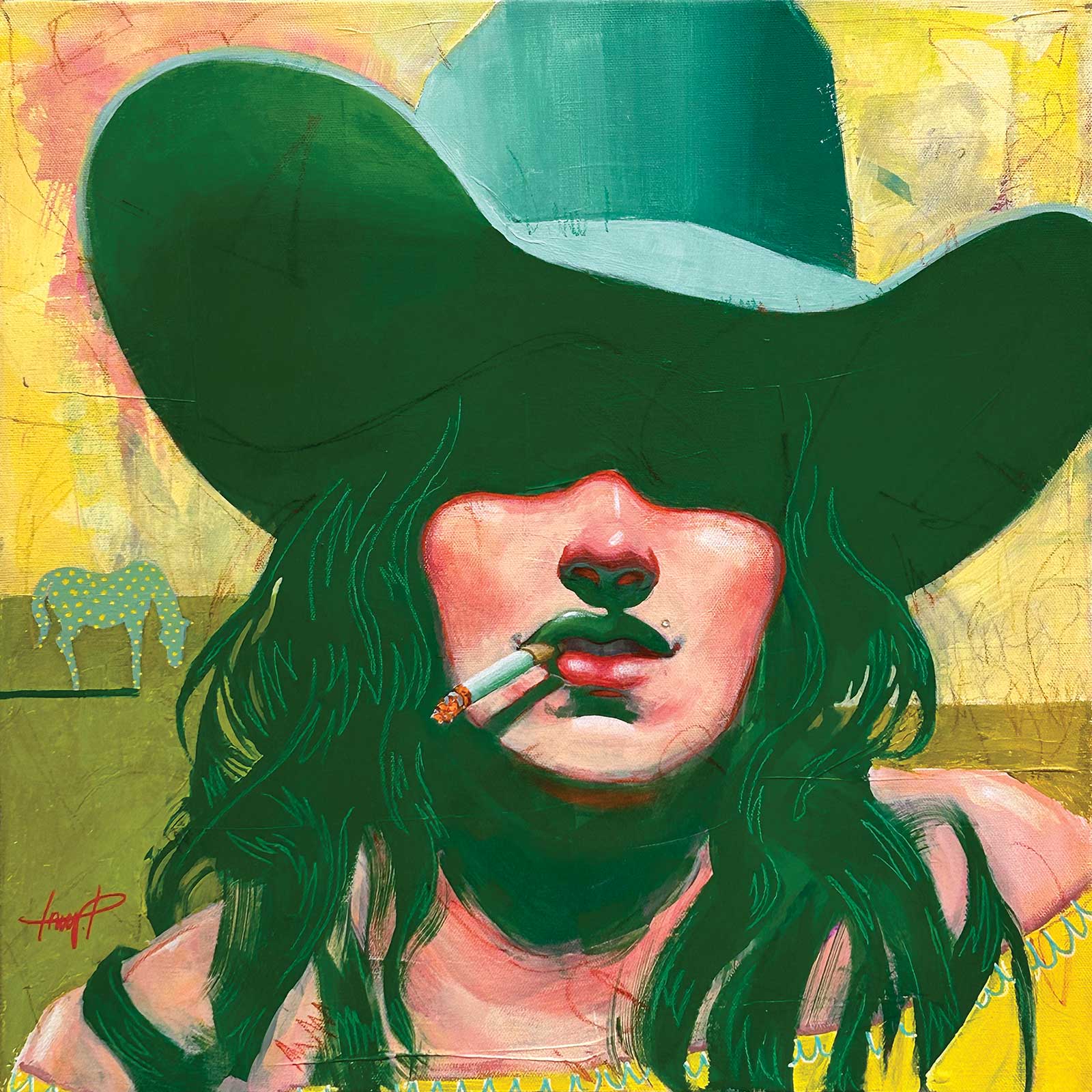
A Cowgirl and Her Horse, mixed media on stretched canvas, 20 x 20" (50 x 50 cm)
See these techniques and descriptions throughout my demonstration.
My Art in the Making Kofa in Purple
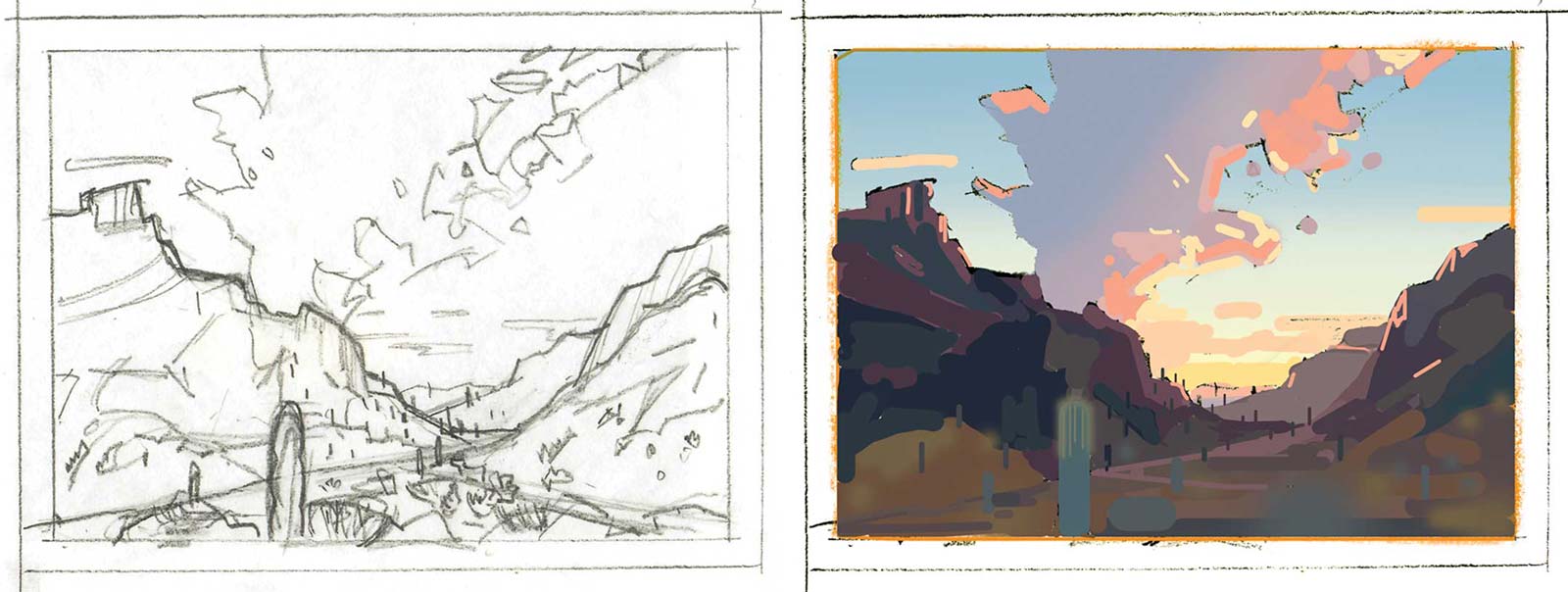 Stage 1
Stage 1 Initial Sketch
This is the initial pencil sketch scanned from my sketchbook and brought into Photoshop where I created the simplified color study. This sketch was based on the client’s image and research of KOFA National Wildlife Refuge.
WHAT THE ARTIST USED
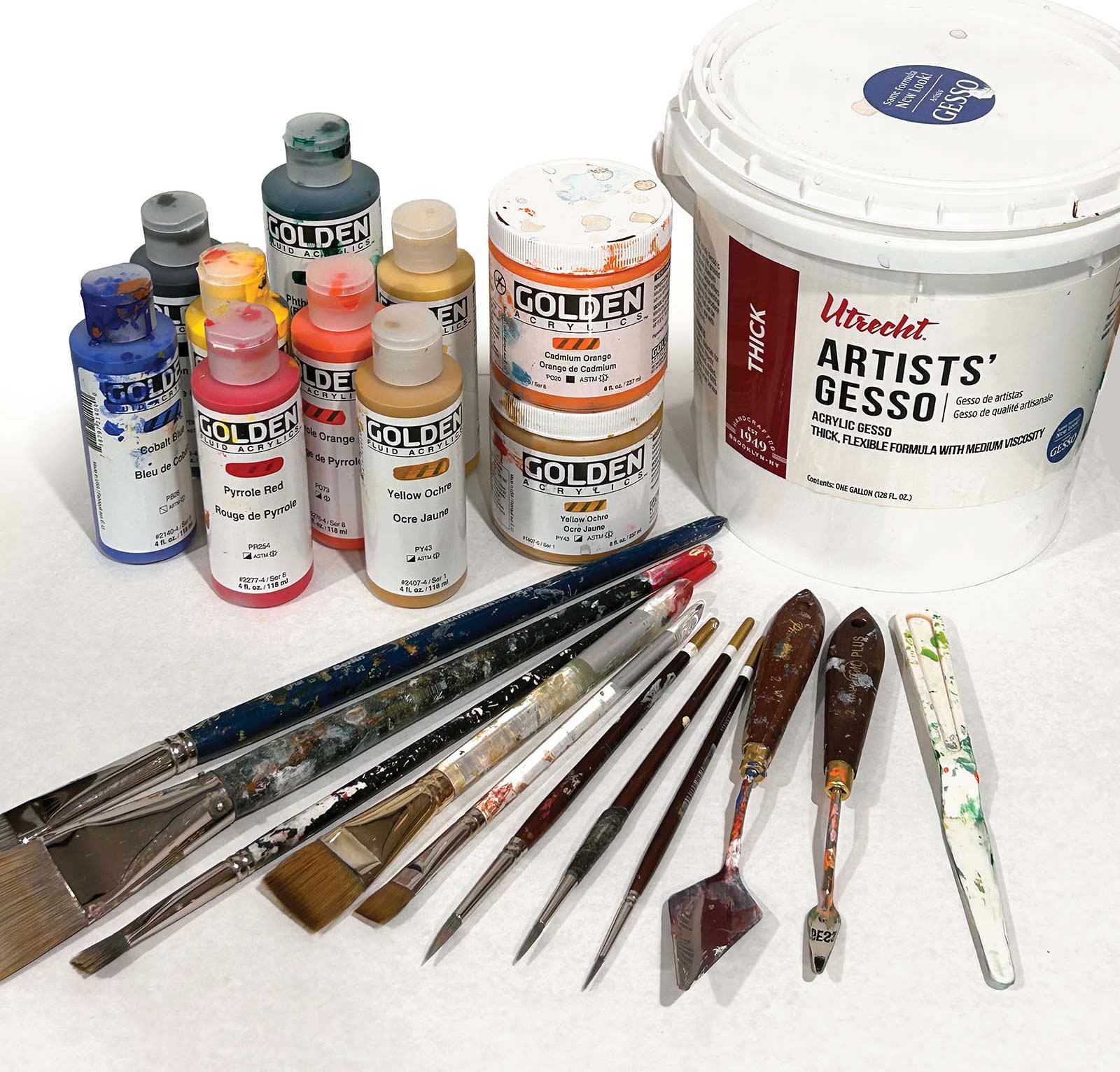
Golden Acrylics
Cobalt blue (Fluid), Pyrrole red (Fluid), Hansa yellow (Fluid), Pyrrole orange (Fluid), Carbon black (Fluid), Burnt umber (Fluid), Phthalo green (Fluid), Naples yellow hue (Fluid), Yellow ochre (Fluid/Heavy Body), Cadmium orange (Heavy Body), Utrecht Artist’s Gesso, thick (Used in place of titanium white)
Mediums
Golden satin glazing liquid, Golden soft gel gloss
Brushes
I use a variety of brushes from cheap to expensive. The majority of my brushes are flats, both soft synthetic and stiff bristle brushes. I use soft round synthetic brushes for the smaller details.
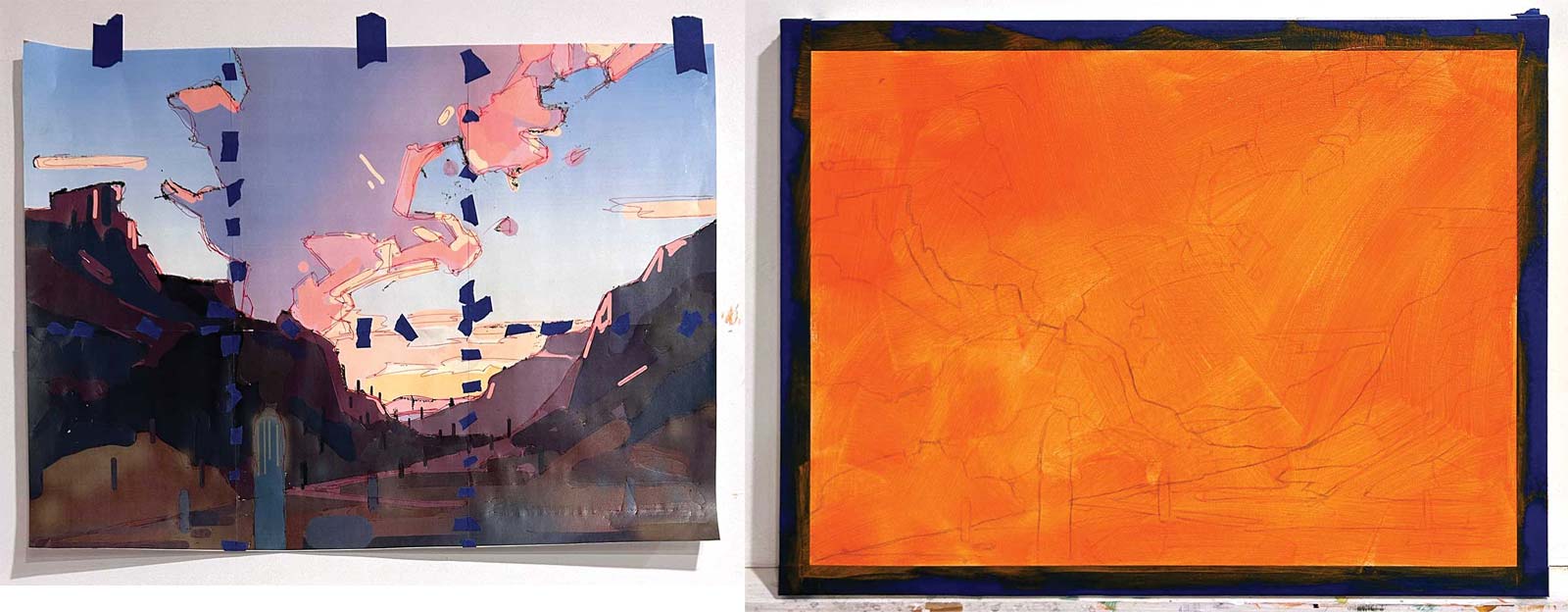 Stage 2
Stage 2 Canvas Prep and Image Transfer
Here you can see I enlarged the color sketch to use as an image transfer to the canvas. The canvas has been taped off on the edges because I plan to frame the painting with a deckled edge within the canvas. I also covered the canvas in a pyrrole orange ground.
Color Swatches
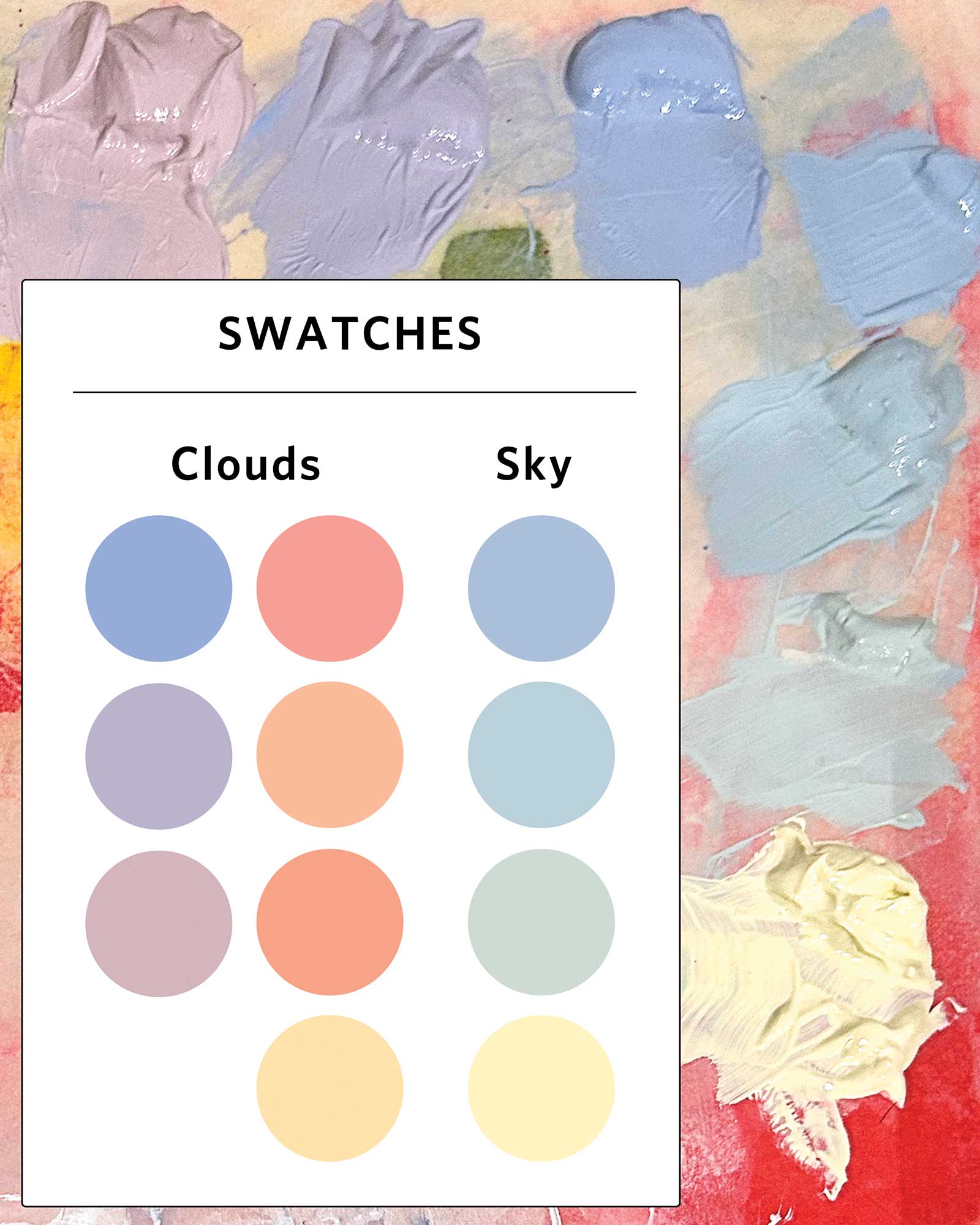
Using Photoshop and the digital color sketch, I select colors to use as swatches so that I can mix and match paints to it. Here you can see the sky colors, the cooler cloud colors on my palette, and the swatches from the digital color sketch.
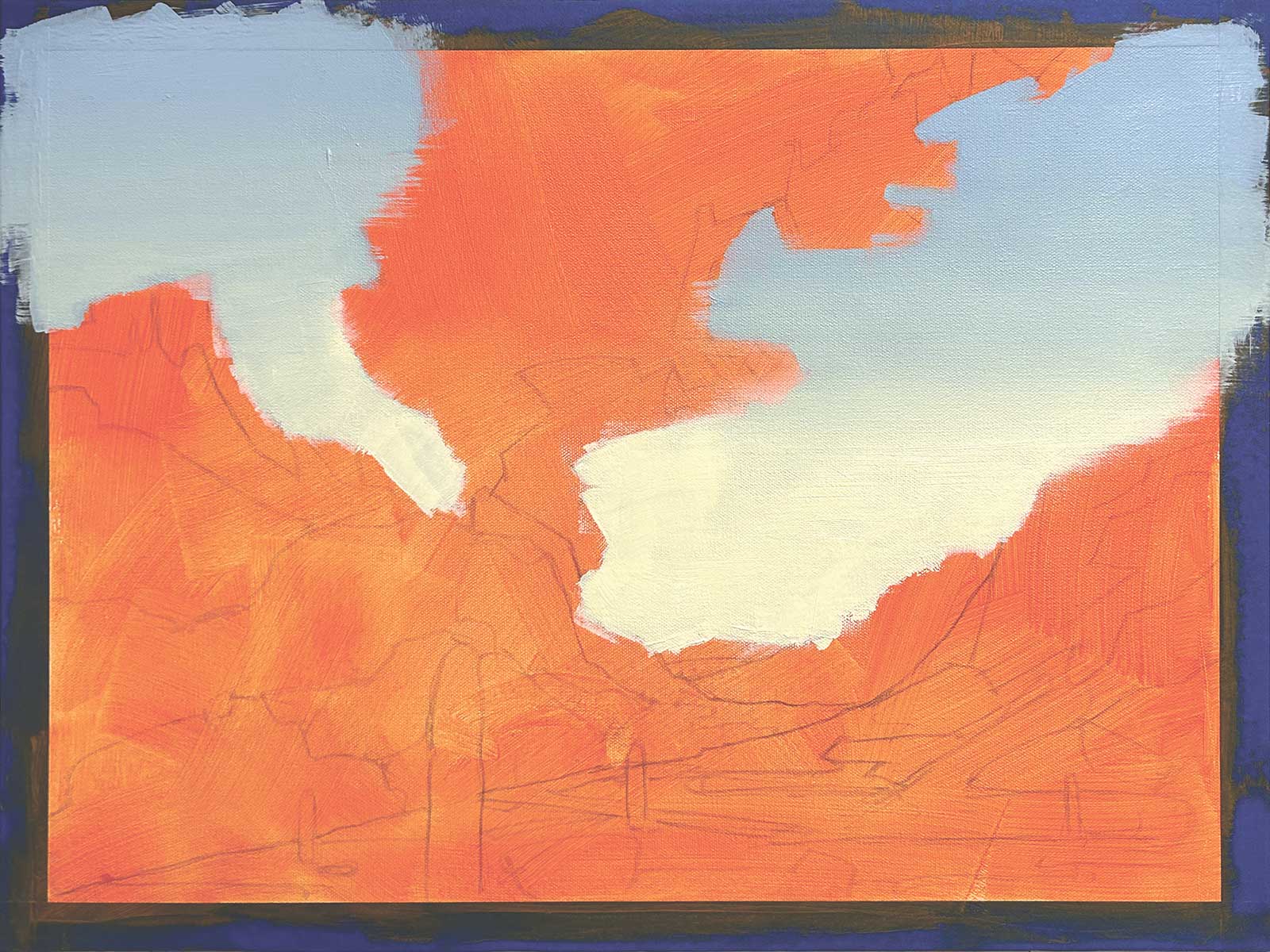 Stage 3
Stage 3 Blocking in the Sky
I block in my colors and shapes from the background to the foreground. In this image, I begin with the background gradient sky.
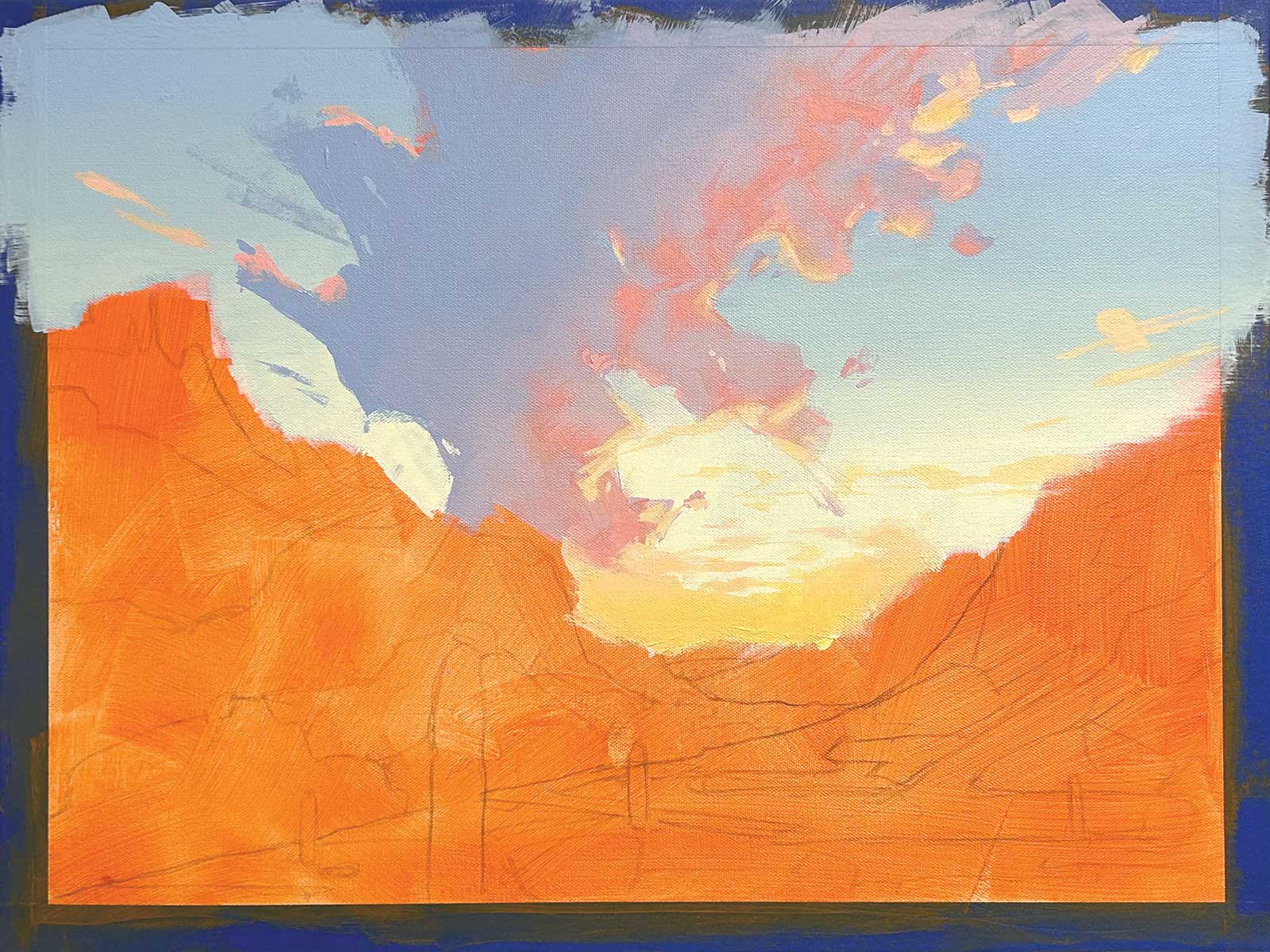 Stage 4
Stage 4 Blocking in Clouds
Here I am blocking in the clouds and painting in the yellows and oranges of the sunset colors that hit the clouds.
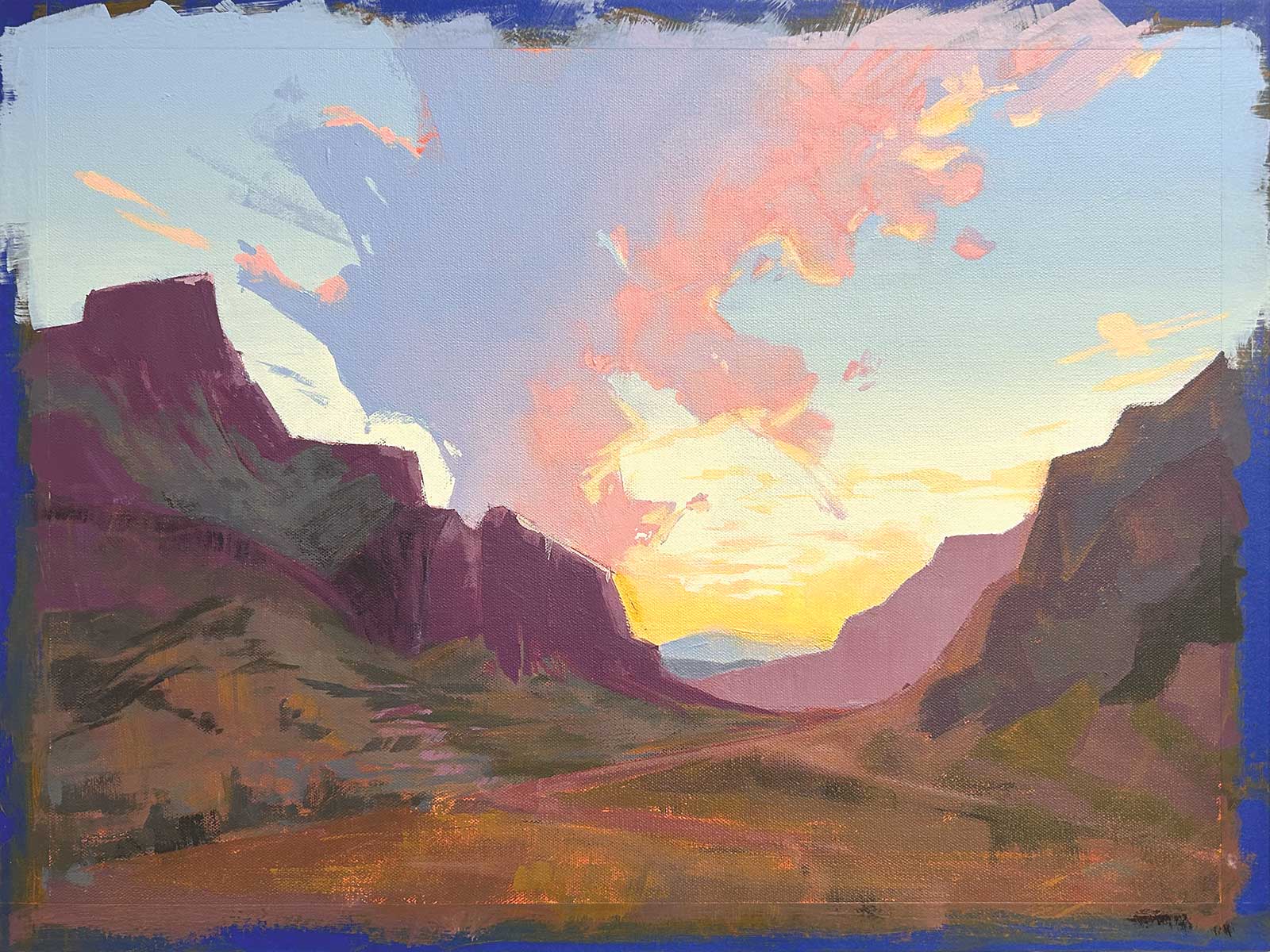 Stage 5
Stage 5 Foreground
Quickly using my color mixes, I block in the initial foreground colors and shapes.
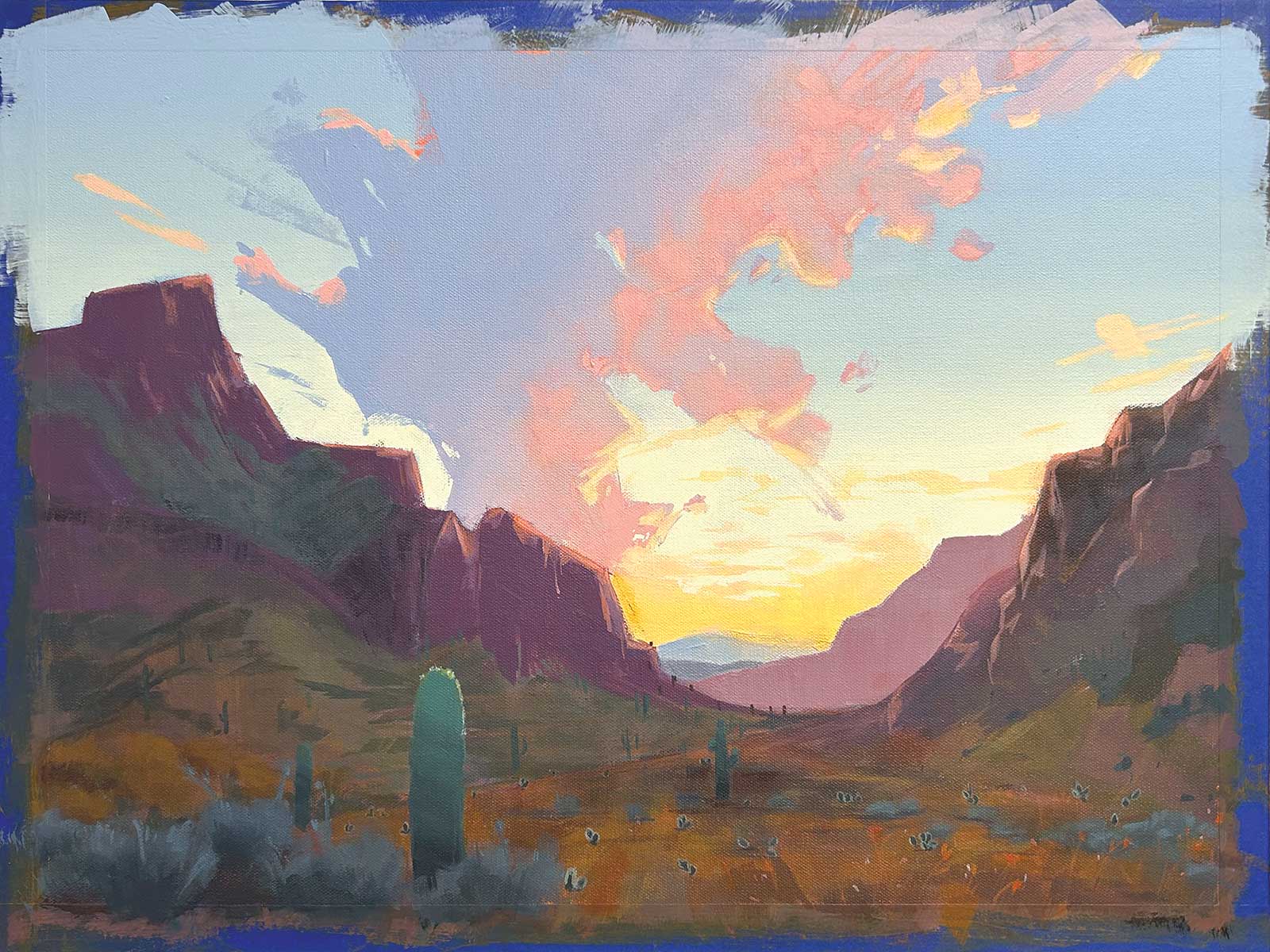 Stage 6
Stage 6 Adding Foliage and Details
I begin to play with foreground elements such as foliage and highlights. I also decided to add a glaze of blue to the mountain on the left to cool it down.
Glazes
Using Golden satin glazing liquid and an acrylic paint, usually fluid, I can build up layers and shift the values and temperature in areas in the painting. The ratio of glazing liquid to paint is a personal preference. The more paint you mix with the glazing liquid, the more opaque your glaze will become. For me it is about light glazes that I can slowly layer until I get it just right.
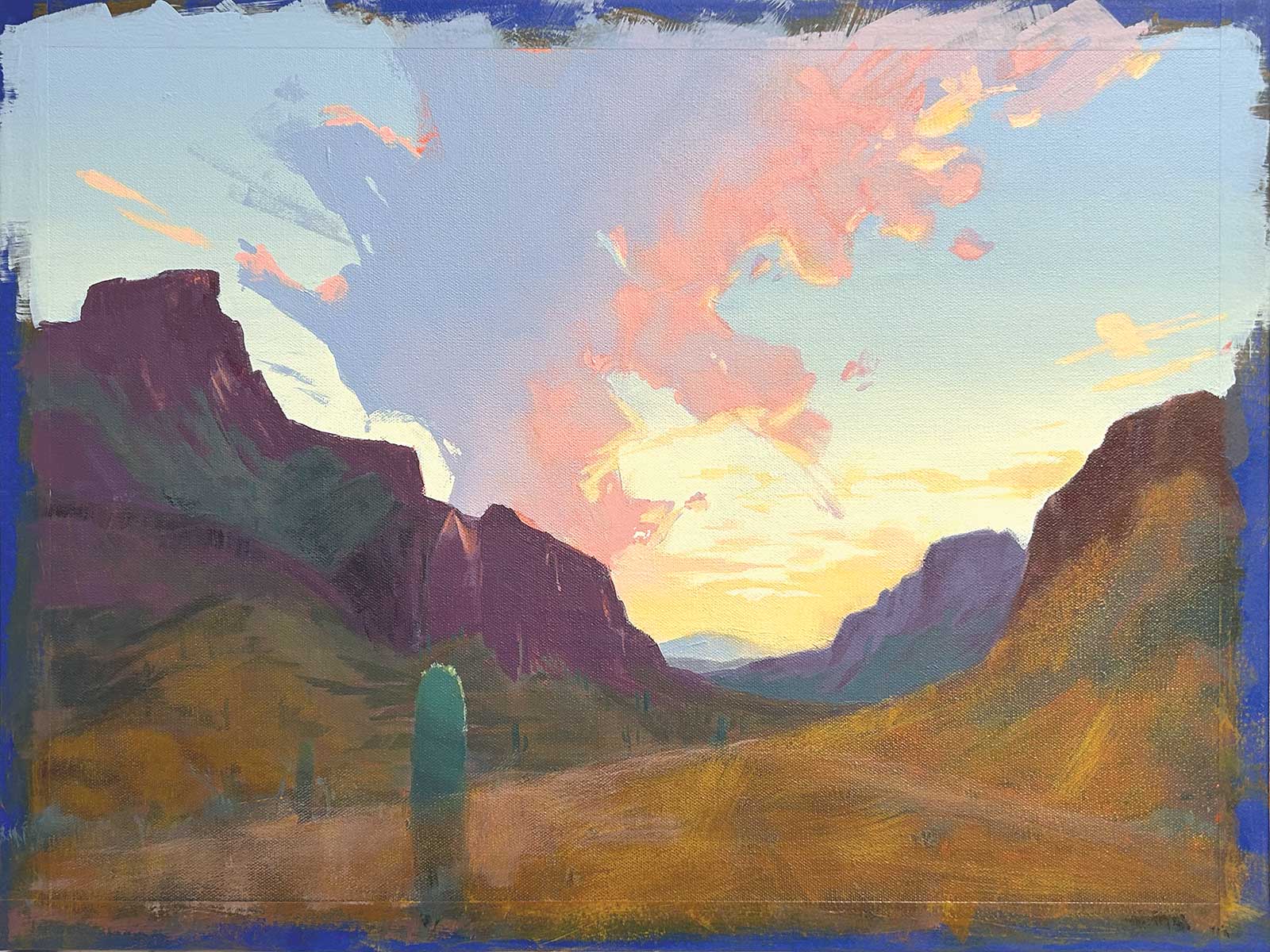 Stage 7
Stage 7 Additional Details/Layers
I start to reshape, cool down and add detail to the mountains. I desaturated the yellow sun-flooded clouds on the horizon. I also loosely dry brush in some warmer colors over the foreground. The dry brush adds texture to the ground and allows some of the previous foreground layer to show through and add depth.
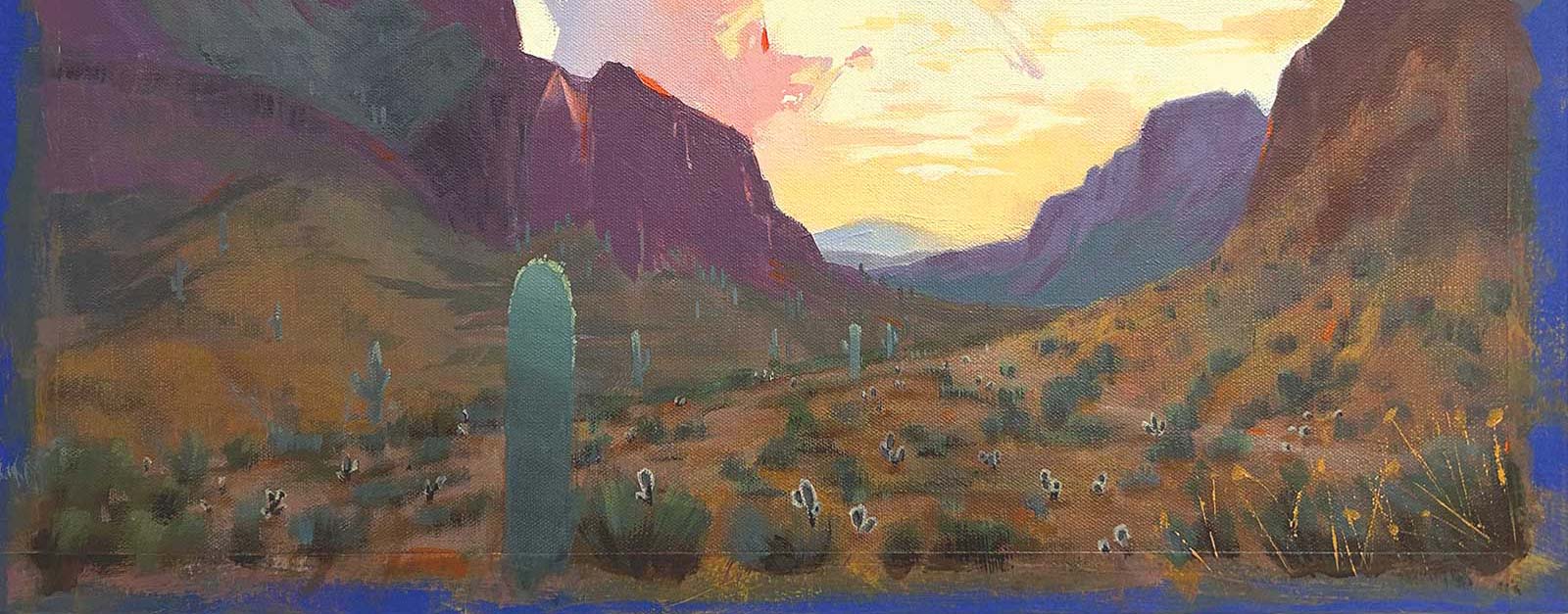 Stage 8
Stage 8 Adding Foliage
At this point, I am working on the entire painting. Adding the foliage and details, I also started playing with orange in random places knowing that I am going to deckle the edge with orange.
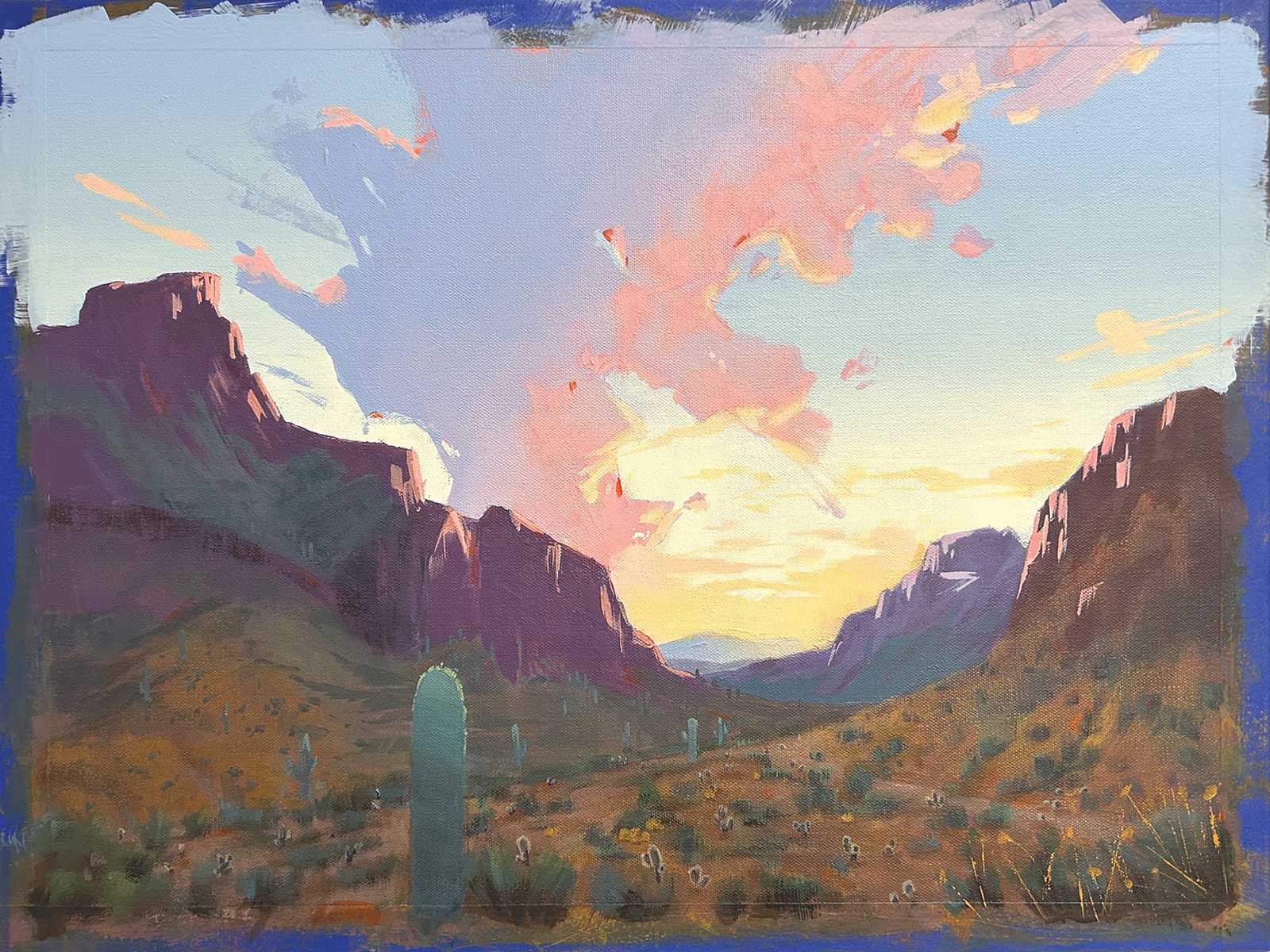 Stage 9
Stage 9 Highlights
More detailing at this point in the foreground, and adding sunset highlights back to the mountain tops to help describe the rocky tops of the mountains.
Isolation Coat
To protect the painting when it’s finished, I will put an isolation coat over the entire piece. The isolation coat protects the acrylics underneath it and allows me to use a removable UV varnish on top of the isolation coat. The varnish collects the dust, and over time can be replaced without damaging the acrylics because they are protected by the isolation coat. To create an isolation coat, I mix two thirds Golden soft gel gloss with one third water in a mason jar. Then I use a soft synthetic flat brush to coat the painting. I cover the painting to protect it from dust while the isolation coat dries. Let it dry for 24 hours to fully cure. I usually do two coats on my paintings.
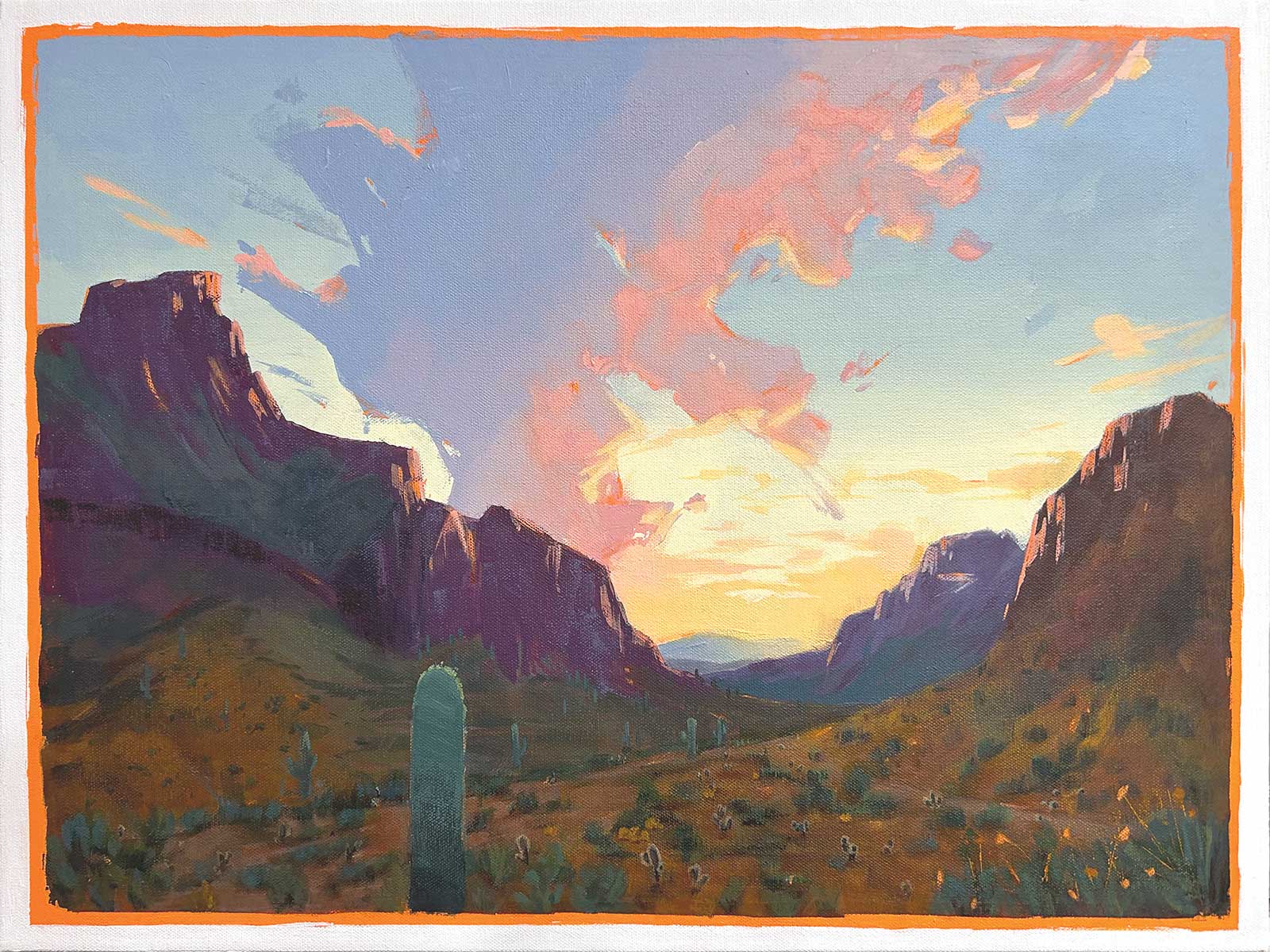 Stage 10
Stage 10 Removing the Tape
I remove the tape and paint a light orange around the painting. I try not to be too particular about how perfect the square is designed. In fact, I purposely break into the image and canvas. For my aesthetic, this deckled edge makes for a unique handmade look that also works as a frame to the image on the canvas. For consistency, I added that same orange in various areas of the painting, like the clouds and mountain highlights.
 Stage 11
Stage 11 Final Adjustments
Kofa in Purple, acrylic on gallery-wrapped stretch canvas, 18 x 24" (45 x 60 cm)
There were two things that weren’t working for this composition: the large Saguaro cactus in the foreground and the value of the foreground not being dark enough. I painted over the large cactus and redesigned it to fall further back with a little more form. I then added some highlights of the light orange to the cacti. Finally, I added several glazes to darken the foreground.
About the artist
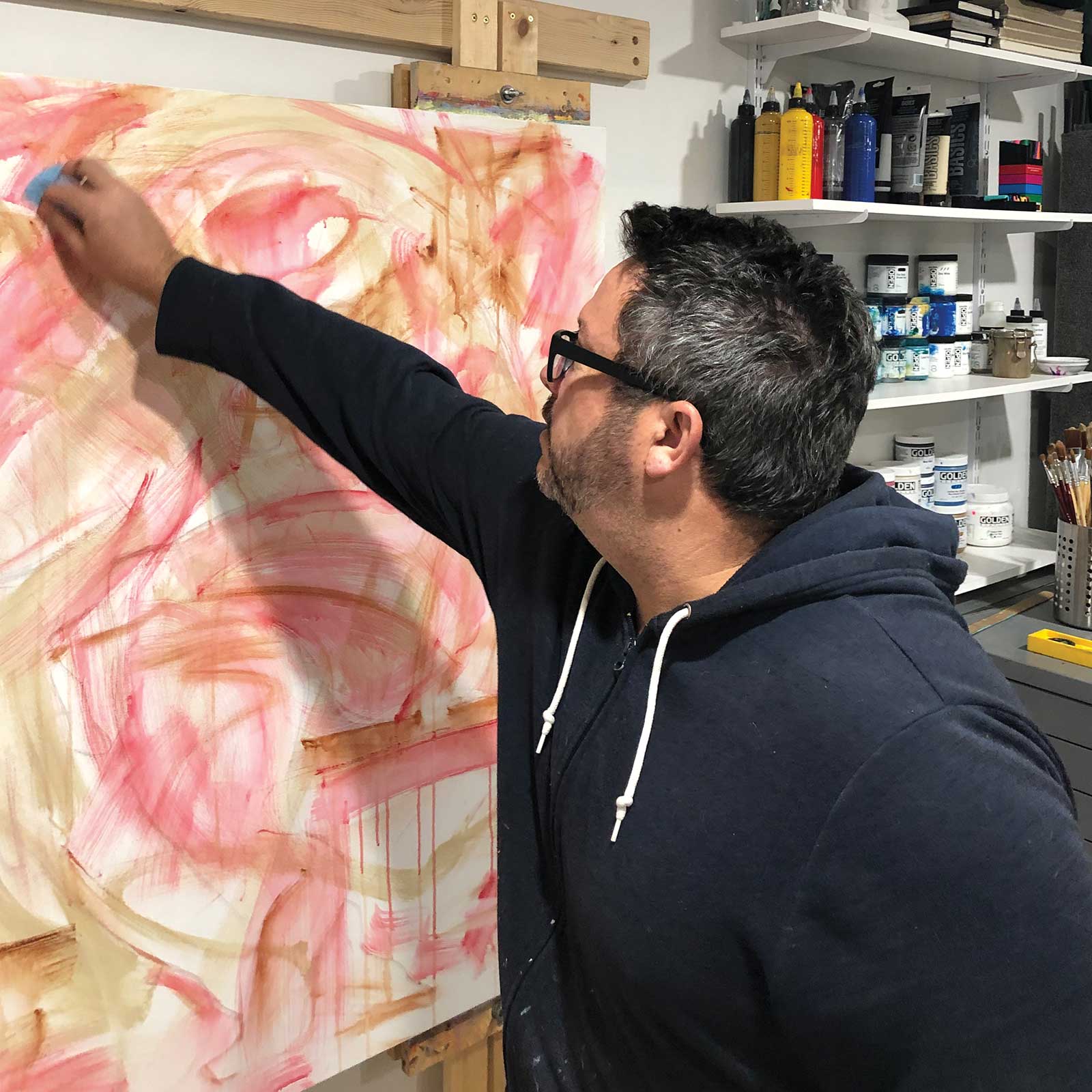 Tony Thielen
Born in 1973, Tony Thielen is a 14th generation New Mexican whose upbringing was anything but static. As a child of military parents, and later his own military service, Thielen lived a nomadic lifestyle. His experiences abroad, meeting different people and cultures, have been a big influence on who he is today. Before becoming a full-time artist, Thielen spent 20 years as an award-winning graphic designer. He studied at the Art Institute of Seattle, the San Francisco Academy of Art, and the Watts’ Atelier, as well as direct study with other professional artists and workshops.
Much of Thielen’s art is a blend of representation, abstraction and self-expression, striving to find a balance between the three. His approach is refreshingly individualistic. He emphasizes the importance of not being afraid to fail, embracing learning opportunities and constantly pushing creative boundaries. Residing in Santa Fe, New Mexico, with his wife Carrie and their beloved pets, Thielen’s art is deeply interwoven with his daily life, each piece a testament to his journey and a window into his soul. His work is not just a reflection of his diverse life experiences, it offers a refreshingly new perspective on the natural world viewed through the prism of contemporary art.
Represented by
Madaras Gallery, Arizona, USA, madaras.com
Mad Contemporary, New Mexico, USA, instagram.com/madcontemporary
Kuehl Fine Art Gallery at the A.R. Mitchell Museum, Colorado, USA, kuehlfineart.com
Contact at
tony@tonythielen.com
tonythielen.com