For centuries, artists have come together through academic institutions, teaching studios, art societies and exhibitions. These vibrant art communities forged through teacher-student relationships ensure the preservation of artistic excellence and time-honored techniques. With each new generation, artists carry forward this legacy, becoming the vital link between the past and the future.
This year in the Washington, D.C. area, at the 27th Annual Art of the Portrait conference, more than 750 artists from across the globe assembled with some of the leading portraiture and figurative artists of our day. They arrived hoping to catch a spark of inspiration, learn new techniques, receive feedback and perhaps learn how to make a living as an artist. Participants returned home with something more profound. They witnessed how to make a meaningful life in the arts, through teaching, learning, camaraderie, resonance and beauty.
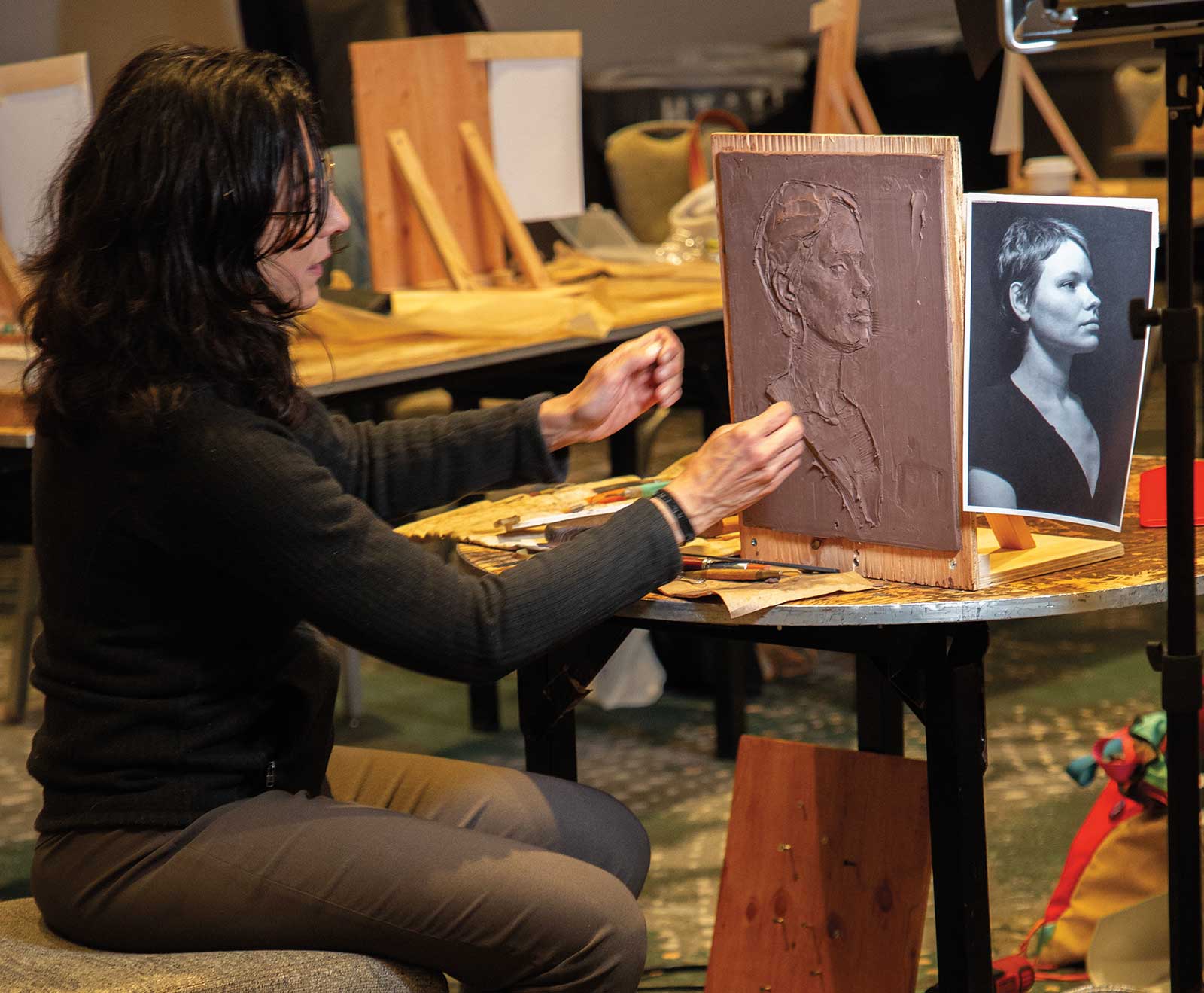
During her pre-conference workshop, Alicia Ponzio guided students using oil-based clay in learning the basic principles of relief sculpture, covering everything from how to prepare the materials to blocking in and turning the forms.
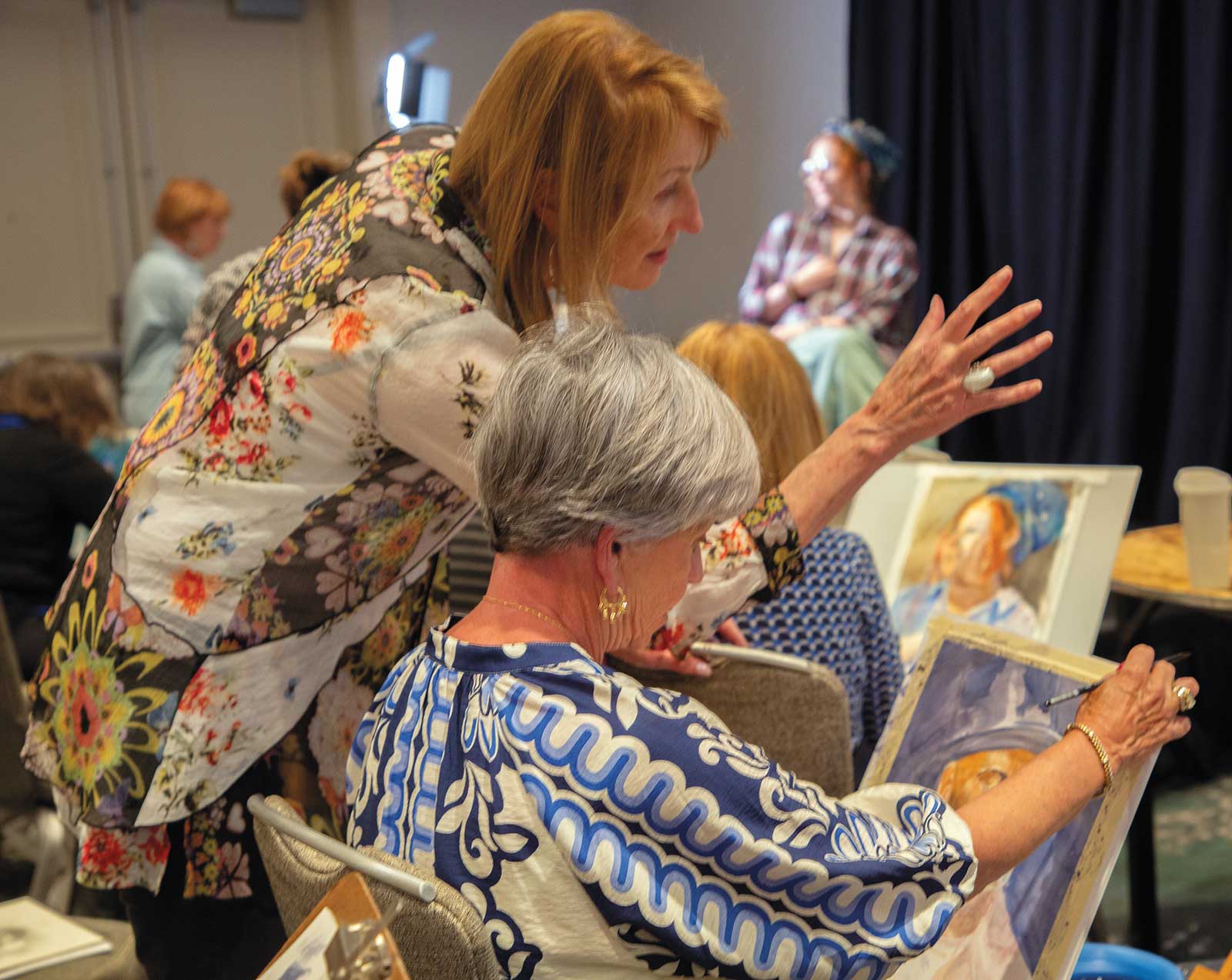
This annual gathering of artists is accomplished through the tireless efforts of staff, member volunteers and distinguished faculty who give freely of their time and expertise to provide meaningful content, and who strive to improve upon their efforts year after year. Participants had the opportunity to attend pre-conference workshops, mainstage demonstrations and breakout sessions that included panel discussions, hands-on sculpting, drawing instruction and painting demonstrations in oil, watercolor and egg tempera.
Portfolio critiques, book signings and open studio time with live models were also available to attendees. Throughout the weekend, there was an opportunity to get up close and personal with the work of the top finalists of The International Portrait Competition and openly converse with the artists.
Mary Whyte led a hands-on workshop, working directly from a live model, all while sharing valuable techniques for creating paintings that radiate luminosity and convey a sense of life and movement during one of three pre-conference workshops offered on Thursday.
During the dynamic opening Face-Off event, spectators watched with rapt attention as 18 distinguished faculty artists worked simultaneously, sketching, painting and sculpting from live models. The 6x9 Mystery Art Sale, featuring original works donated anonymously by top artists, was a flurry of lively competition as participants were given the opportunity to purchase and take home artwork at a reasonably set price. The sale was a resounding success, raising an impressive $32,175 to support the Portrait Society’s scholarship program. This event not only showcased incredible talent but also played a vital role in nurturing the next generation of portrait artists through education and opportunity.
On the evening of the gala banquet, artists celebrated one another’s accomplishments as the Future Generation, Signature Status, and The International Award winners were announced. This year’s winner of both the prestigious Draper Grand Prize and the People’s Choice award was UK artist Frances Bell. Her self-portrait Yellow Trainers was masterful, with her trademark palette, thoughtful design and admirable brushwork. While the room sensed the emotion of the moment, Bell received the awards with the poise and politeness of the English.
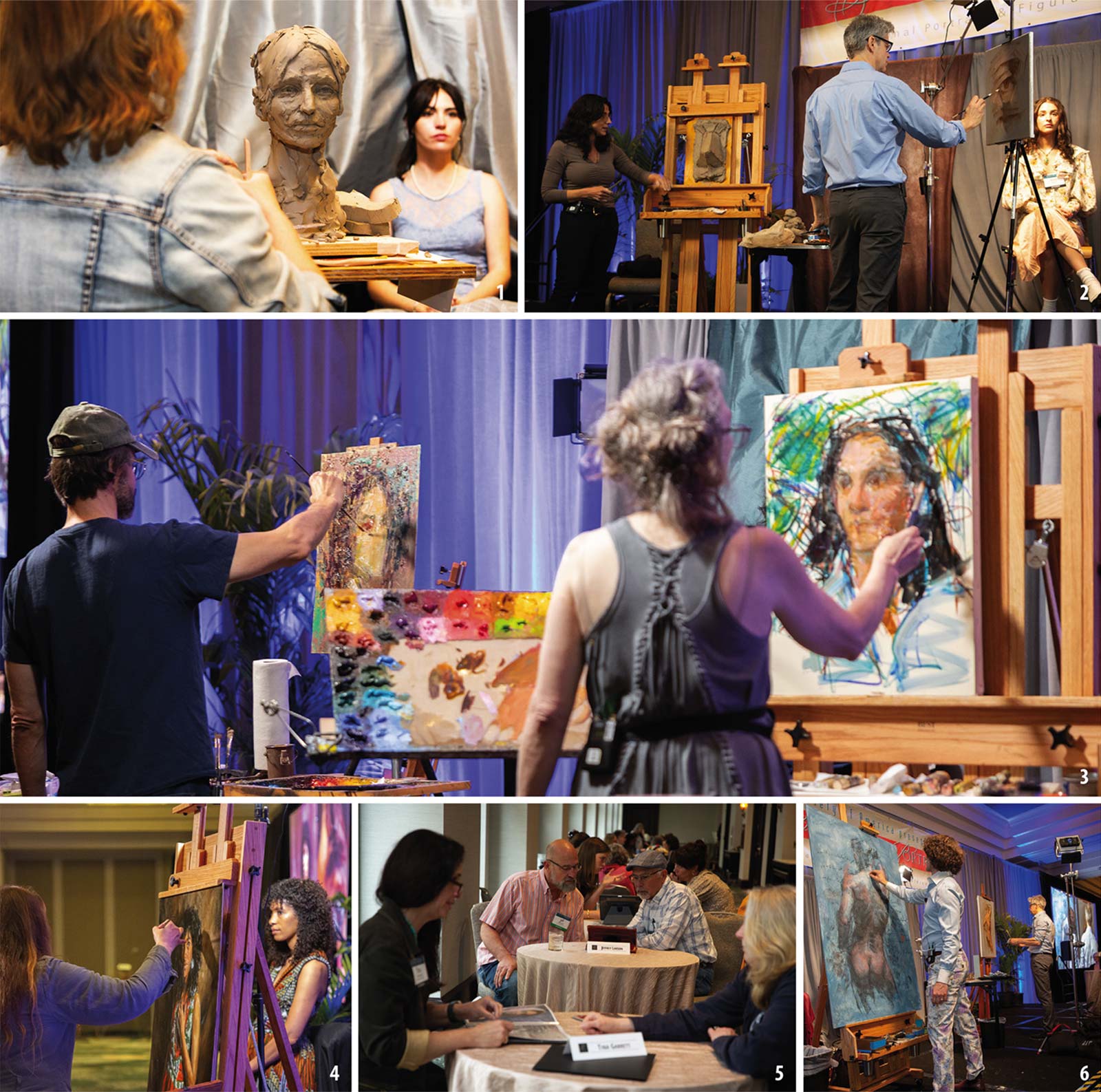
1. The Face-Off event highlighted a dynamic range of artistic mediums, including a captivating live sculpture demonstration by Louise Weir. Her contribution added a powerful 3D element to the experience amongst 2D artists. 2. The keys to understanding the mouth, nose and eyes were brought to life on the main stage during the opening event by Robert Liberace, Alicia Ponzio and Dan Thompson. All three shared their unique approaches to capturing a sense of mastery. 3. Rose Frantzen and Scott Burdick delivered concurrent yet stylistically different demonstrations, each showcasing their unique approach to portraiture which emphasized the critical role of structure and precision in creating a compelling and successful portrait. 4. Michelle Dunaway offered a unique twist on Friday morning by completing the final touches on a complex painting, while offering an overview of her process. 5. One of the most popular events, the Portfolio Critiques, provided attendees with an opportunity to receive one-on-one feedback from a faculty artist concerning their artwork. 6. Shane Wolf and Robert Liberace offered a unique artistic experience as they simultaneously portrayed the same nude figure. Each artist captured the form, light and emotion of the subject through their own distinctive style and interpretation.
James Gurney received the Excellence in Fine Art Education Award at this year’s banquet. Having spent 40 years as an acclaimed artist, illustrator and storyteller, Gurney has encouraged mastery and imagination in illustration and the arts through his books and online platforms. In his speech, Gurney identified himself as an art school dropout who never taught a class but did teach a workshop once that involved a classroom goat.
Few roles are more beloved than those of teachers. A good educator can influence generations of artists, and great artists who are also generous teachers are among the most revered. This year, one of the recipients of the 25 tuition scholarships granted by the Portrait Society was 12-year-old Eliot. A budding artist in his own right and a student of John Darley, Eliot’s presence embodied the mission of this organization: to foster the education and preservation of traditional fine art portraiture for posterity.
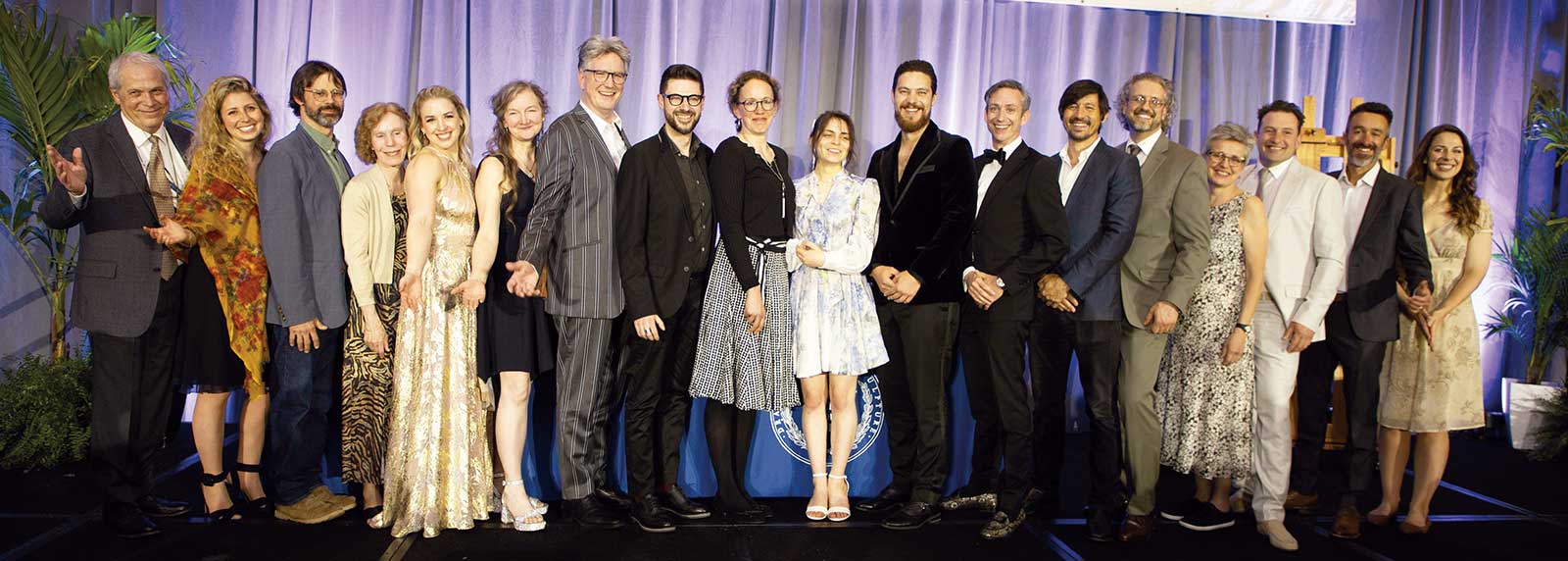
The Gala Awards and Banquet presentation concluded on a high note as all 19 finalists came together for a celebratory group photo. This powerful moment captured the spirit of camaraderie, artistic achievement and shared dedication, serving as a lasting tribute to the talent and hard work recognized throughout the evening.
In 1998 Richard Schmid dedicated his highly regarded book, Alla Prima, to his mentor Bill Mosby, whom he described as a truly gifted teacher. Mosby also influenced this year’s Gold Medal Award winner, George Carlson. The exceptional generosity of Mosby, Schmid and Carlson continues to impact artists today. During their presentations, faculty members Michelle Dunaway, Scott Burdick and Rose Frantzen all spoke of the influence of these mentors on their lives.
There is a quote by Yogi Bhajan, “If you want to learn something, read about it. If you want to understand something, write about it. If you want to master something, teach it.” There is a reciprocal relationship between student and mentor, where each benefits the other. Burdick summarized this by saying, “Everything I know, I learned from someone else.” He would go on to say that every painting is a collaboration of people who went before us, almost as light refracted through a lens of individual experience. Both Burdick and Frantzen spoke of their time at the Palette and Chisel Academy with Richard Schmid. In a poignant narrative on the mainstage, Frantzen recounted the moment she knew she must break from her mentor and make her own way. “Rosie,” Schmid would say, “I could never be that vulnerable on a canvas.” Frantzen would go on to use her vulnerability to freely explore her own limitations.
In his panel discussion on composition, Jeffrey Larson spoke of his teacher Richard Lack, a student of Ives Gammel who studied under Edmund Tarbell and Joseph DeCamp. In his workshop, Dan Thompson said he was deeply influenced by the work and writings of John Vanderpoel, an instructor at the Art Institute of Chicago who taught J.C. Leyendecker. As Thompson would relay, “If there wasn’t Leyendecker, we wouldn’t have Rockwell.”
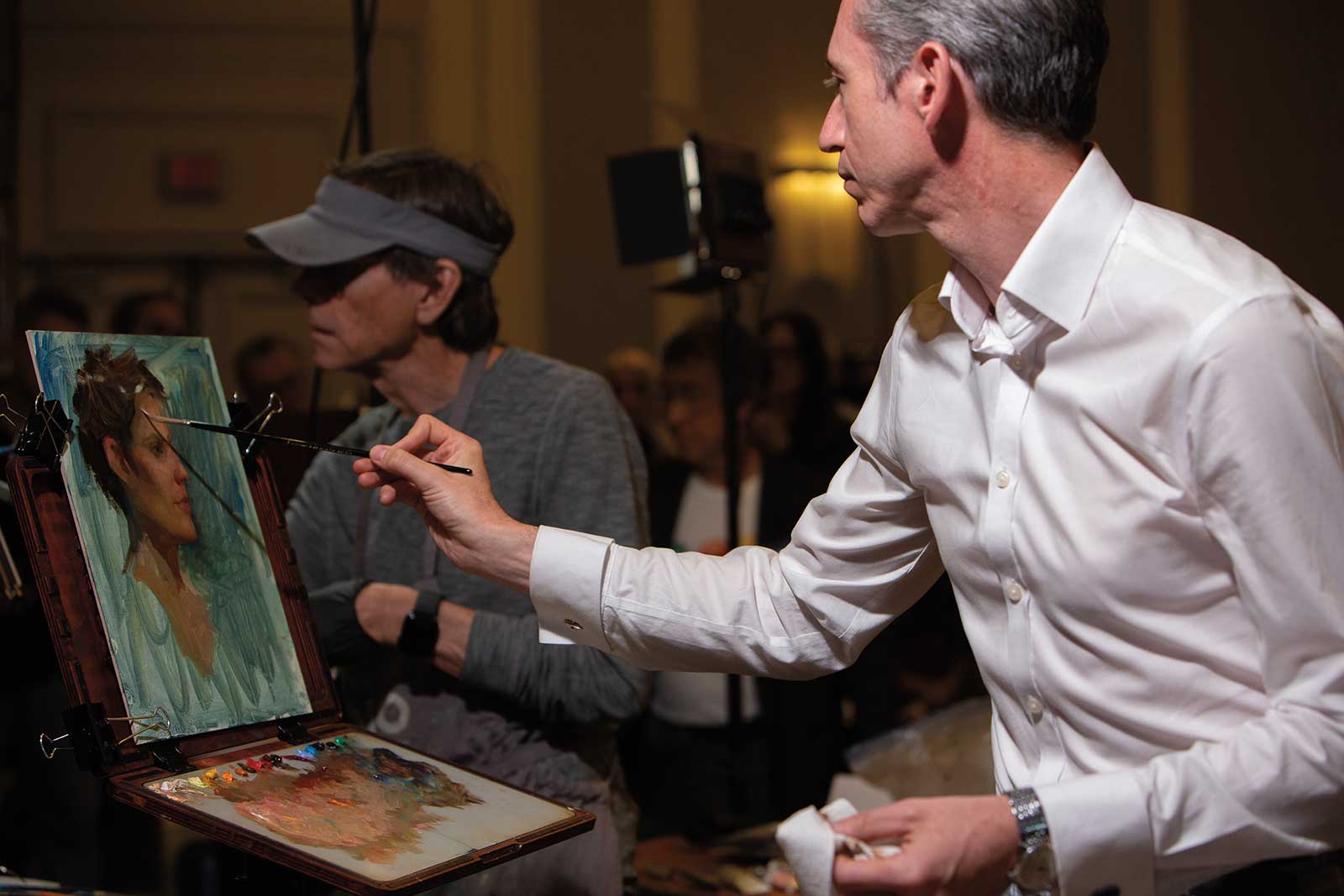
During the Thursday evening Face-Off event, Timothy Rees and Daniel Sprick captivated attendees as they painted fellow artist Robin Cole, offering a glimpse into their individual techniques and creative processes during the evening’s showcase of artistic talent. All photos by Robin Damore and Peggy Kinstler.
Through training and shared exhibitions, artists forged lasting relationships. They learned from one another, offered critique and looked for each other in the French Salons. It may seem like a bygone era when Sargent and Monet or Cassatt and Degas developed their friendships, but at The Art of the Portrait Conference, we continue this noble tradition of iron sharpening iron.
On the last day of the conference, buses of attendees arrived at the National Portrait Gallery to revel with the great masters and gather inspiration. Works by Gilded Age artists like Thayer, Zorn, Beaux and Sargent act as messengers from the next realm. Created with awakened hands, they are still warm with life from the artist who made them; luminescent with transferred touch, they continue to teach us as we engage with them through the silent language of observation. They join with us in communion, once again as teacher and student. Michelle Dunaway spoke of this when she conveyed that if we never have the opportunity to meet our art heroes, we can know who they were through their work and teaching.
The history of art is a rich tapestry, and at this very moment is the working thread weaving the story of who we were to who we will become, the bridge between the past and the future. The great masters of art faced the challenges of their present age, just as we are. They worked in their studio’s day after day, in the face of illness, war, anxiety, unstable economies, birth and death. Amidst it all, there they were, and here we are, still trying to make something beautiful that will resonate with the human soul. —