



There is no easy route for getting into a full-time art career, yet, it’s always a satisfying journey. I like to speak of my career beginnings: right after leaving art college, I started doing door-to-door portraits, as well as in saloons and fairgrounds. Some people in the art community frowned at what I was doing, but it didn’t stop me one bit—I was solidly on track. With good opportunities, some quite lucky, I was ready, willing and able. Even through the difficulties, things steadily got better, which made my mind swell with happiness. Put plainly, I was doing what I loved.
Eventually major art events and art galleries came along, all slowly but surely creating a healthy income. There I was, loving my life with family and friends and artists from everywhere. I constantly met with good, unexpected times, and that’s the way it has now been for many decades.
If you have people in your life who are uneasy and disapprove of your direction in art, don’t concern yourself. When there’s a confident path in front of you to move to the next level, go for it. We don’t hope—we do!
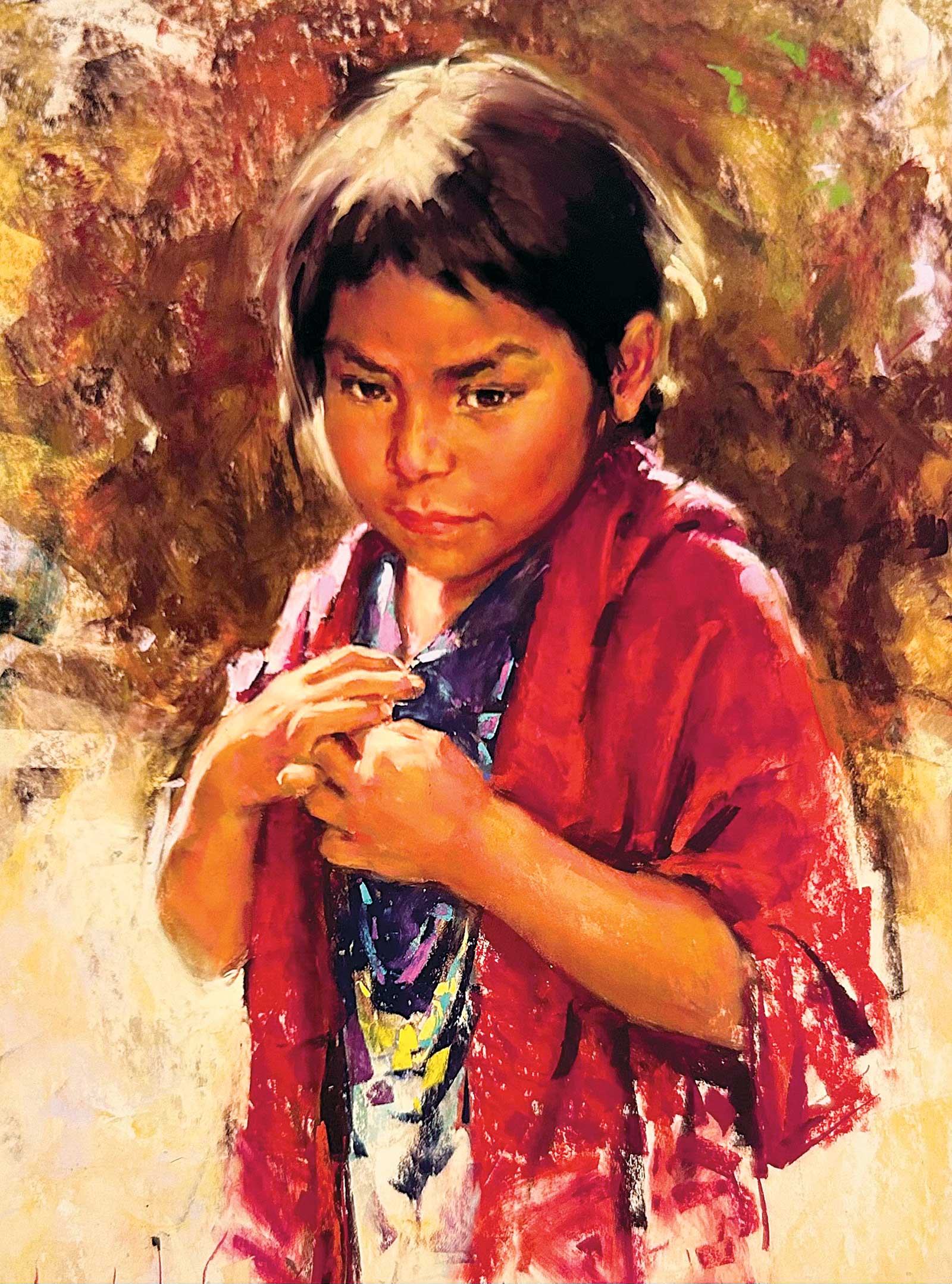
A Child’s World: Here we see a young girl who was with her family at a traditional gathering. There seems to be a hushed presence where she’s wondering things we’ll never know. A strong light glances the top of her head, shoulders and hands, leaving a soft, reflective light upon her delicate features. The background is a maze of busy strokes, giving contrast and even more substance within her quiet moment.
References
When photographing a person’s face, we shouldn’t get too close. Stand back slightly, zoom in a bit and hold the camera at the subject’s face level. When photographing the body, again move back a bit and zoom in with the camera at mid body level. Take all sorts of angles and lighting along with various expressions. We now have cameras that can take limitless, high-resolution shots. What could be better?
Various Musings
When at my easel I don’t work from memory, but at the same time, I’m creative in doing my artworks from photos or life. Doing art from memory too often uses a formulaic approach. Draw a shoe from life and draw one from memory and you’ll see the difference. Trust and interpret from your actual subject.
When you learn something worthwhile in art, you test it and work with it. Keep molding it into your own art. Finally one day, without you even noticing, that “worthwhile” something is yours. And it’s important to realize this. The time comes when we are comfortable with our own art; we slowly envelope it within our very souls. Each stroke is hard won, and we must sincerely celebrate that truth.
I express much through what I’m drawing and painting. You will know me as much from my artworks as you will in conversation with me. Our minds expand from each day’s experience; all going into brain cell storage and waiting to be released in our art as well as our thoughts, actions and words.
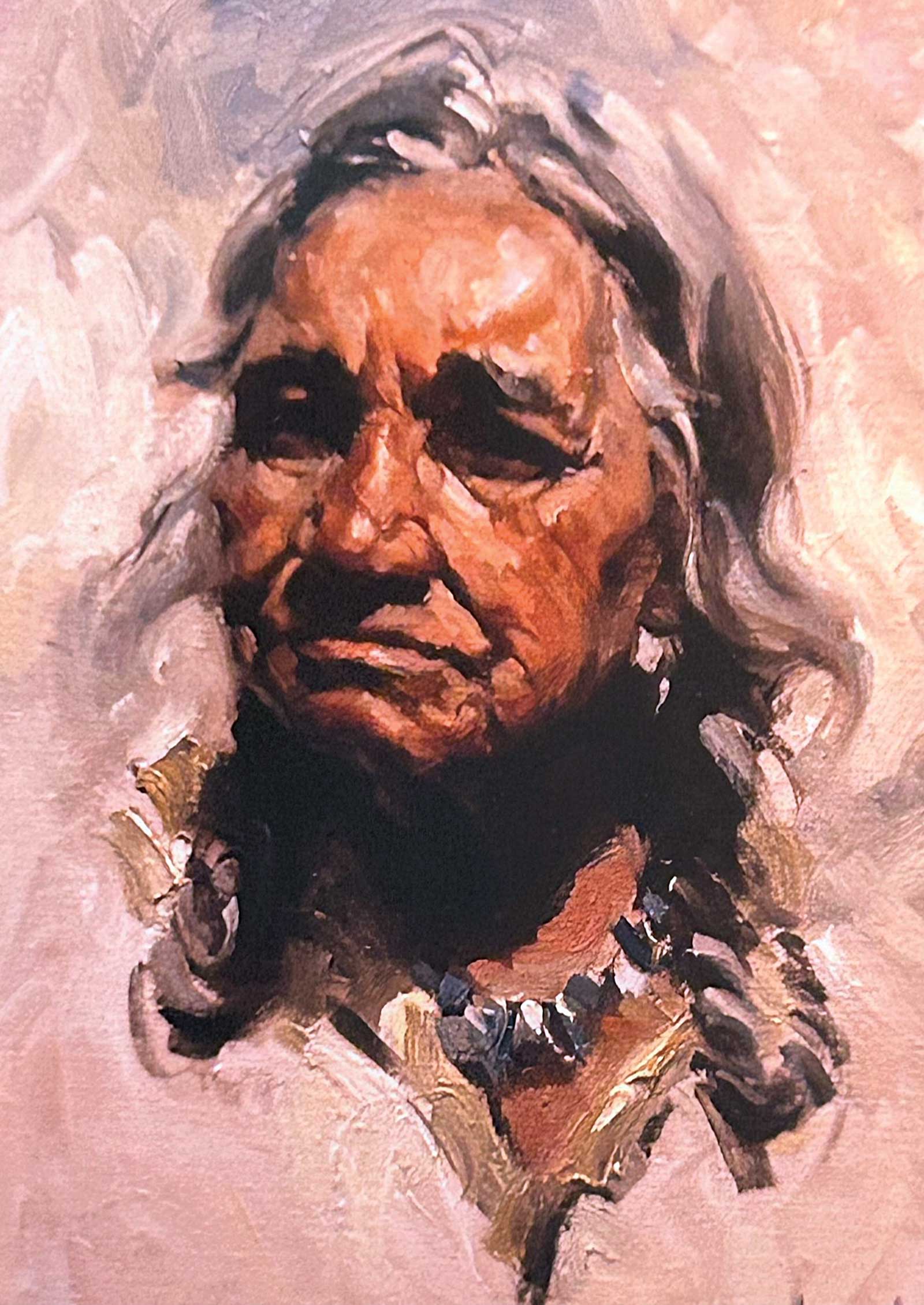
Lady Takes Care: This painting shows my total satisfaction of laying oil on canvas, stroke by stroke. I now do very few oils, but when I was into them, it was artistic ecstasy like my pastels are today. Also, I’ve designed the composition so that the background value is entirely light. The design elements are those dramatic shapes made with her face, hair and collar, as well as purposely darkened cast shadows throughout.
Starting as far back as I remember, I’ve fully appreciated masterworks of art, memorable films, music, ballet—all the arts inspiring me to soar with my own personal life.
You can take an ordinary subject and make it into a fine work of art. Let’s take a plain pot as your subject: the lighting counts and where you place it in your composition. How far you push the color, all with your individual approach. “It ain’t what you do, it’s the way that you do it.”
I don’t understand the musings of subway poets or the art pieces of today’s “serious artists.” Also, I don’t want to be invited to the Deep Thinker’s Club. My thinking is quite variable with a deepish thought popping up once in a while. I like to admire art pieces without long explanations of what is worthy, whether classic or contemporary. It would be like having people telling me what I should eat and who I should listen to and why. I rely on my years observing art and paying attention to the world around me.
Artists never really retire. Even if we don’t put on another stroke, our minds never stop. My art pals, some in their late 90s, are wonderfully inspired and energized with their days. Being with them has always contributed to my bright outlook on life.
Lost Edges
Something else I’ll keep saying: understand and use lost edges. We don’t have to see a particular jaw line in shadow or dark edges of areas of hair, people will know the subjects have those very shapes and edges. Babies start to understand lost edges as soon as their eyes begin to focus on things. Think of mommy coming towards the child’s crib in the dark; just her forehead and nose and cheeks are visible. The baby gets it. We artists get it. Also, generally in art, hair is not “hairs,” but large and small shapes, and maybe a few added strands.
You Have to Mean it
When drawing, each stroke, whether a sensitive line or “filling in” an area, must be meant. Many strokes are subconscious and others more consciously deliberate. All are going towards a conclusion that might change throughout the procedure. It’s like changing the tone of a conversation depending on subject, mood and response.
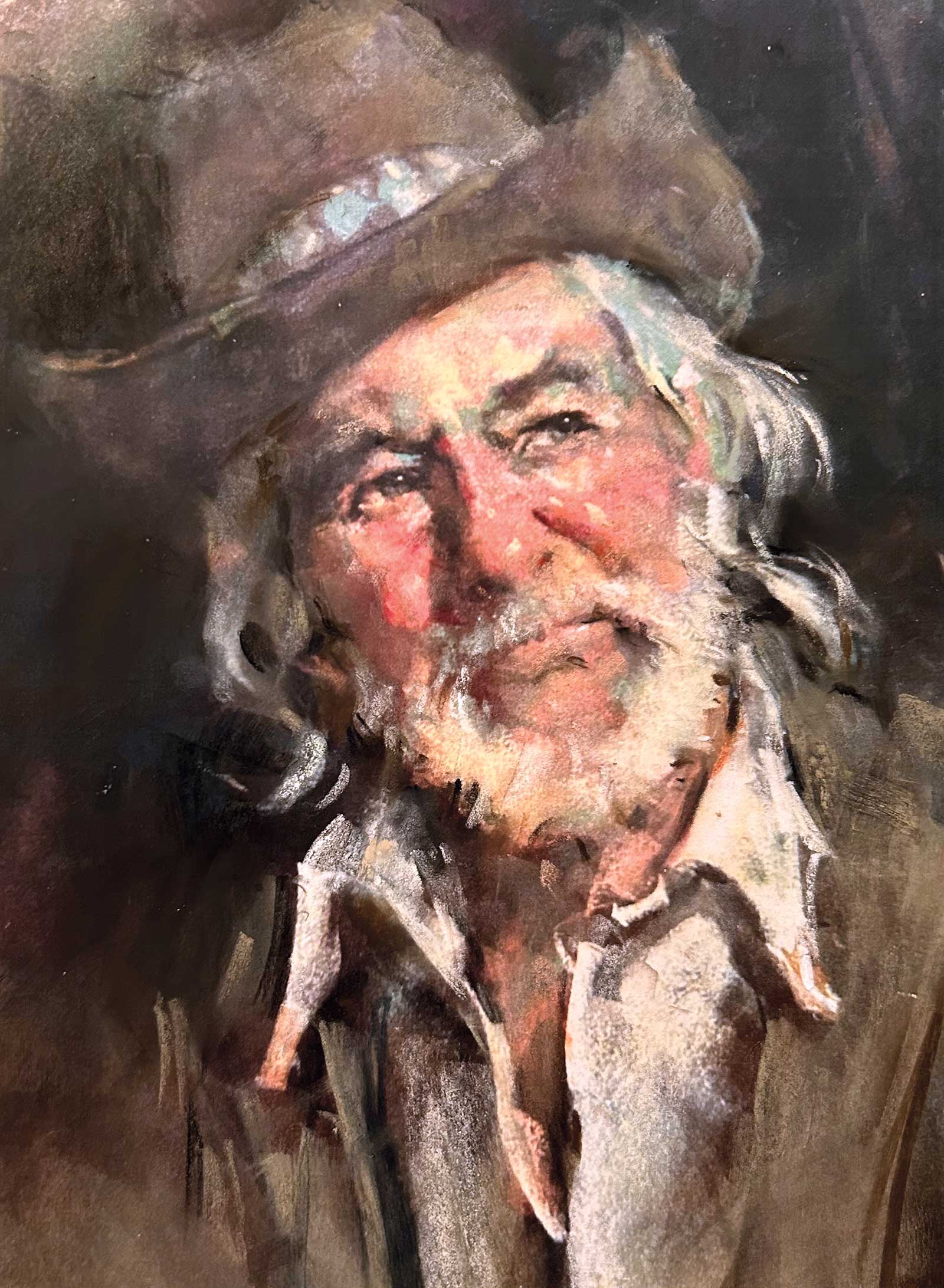
Cowboy Ben: Continuing last issue’s basic start of Ben’s portrait, here the piece is taken to completion. We observe Ben as he considers his next move. His eyes fixed on a thought with a determined mouth. Let me explain my approach here in a different way: I did these enthralled strokes like when I played jazz piano years ago. I started with the melody and then slowly did my own interpretation based on that melody. In music and art, our mind gets us to interpret the subject in full gear. There was no final fussing done with Ben’s portrayal. I stopped while I was ahead. I’m exhilarated even describing this for you.
Free Rein
What’s going through my mind? Actually I’m allowing myself free rein when those brain cells need to emerge. In other words, my subconscious would like me to put a stroke here or a color there. I’m myself, working exclusively, isolated from outside influences. Not much hesitation allowed—those kinds of pauses might mean worry, weariness or wondering how others might judge it. My mind likes “moving ahead” of such burdens. Painting at a steady pace keeps the strokes fluid and coming directly from the aesthetic mind. I’ve been thinking about these strange complexities for quite some time.
Yes, looking back at myself with all my years as an artist, my urge to create drove my frenzied spirit and energy to incredible levels. That capacity rarely allowed me to leave my studio. As I reflect back, there is little doubt I was a different person, someone I often find quite hard to figure. Yet, I observe “Harley’s” early artworks and am rather glad “he” exists to this day. It would be interesting if my early self would know you now, dear reader. —
BALINOFSKI : Lois
 Lois
Lois
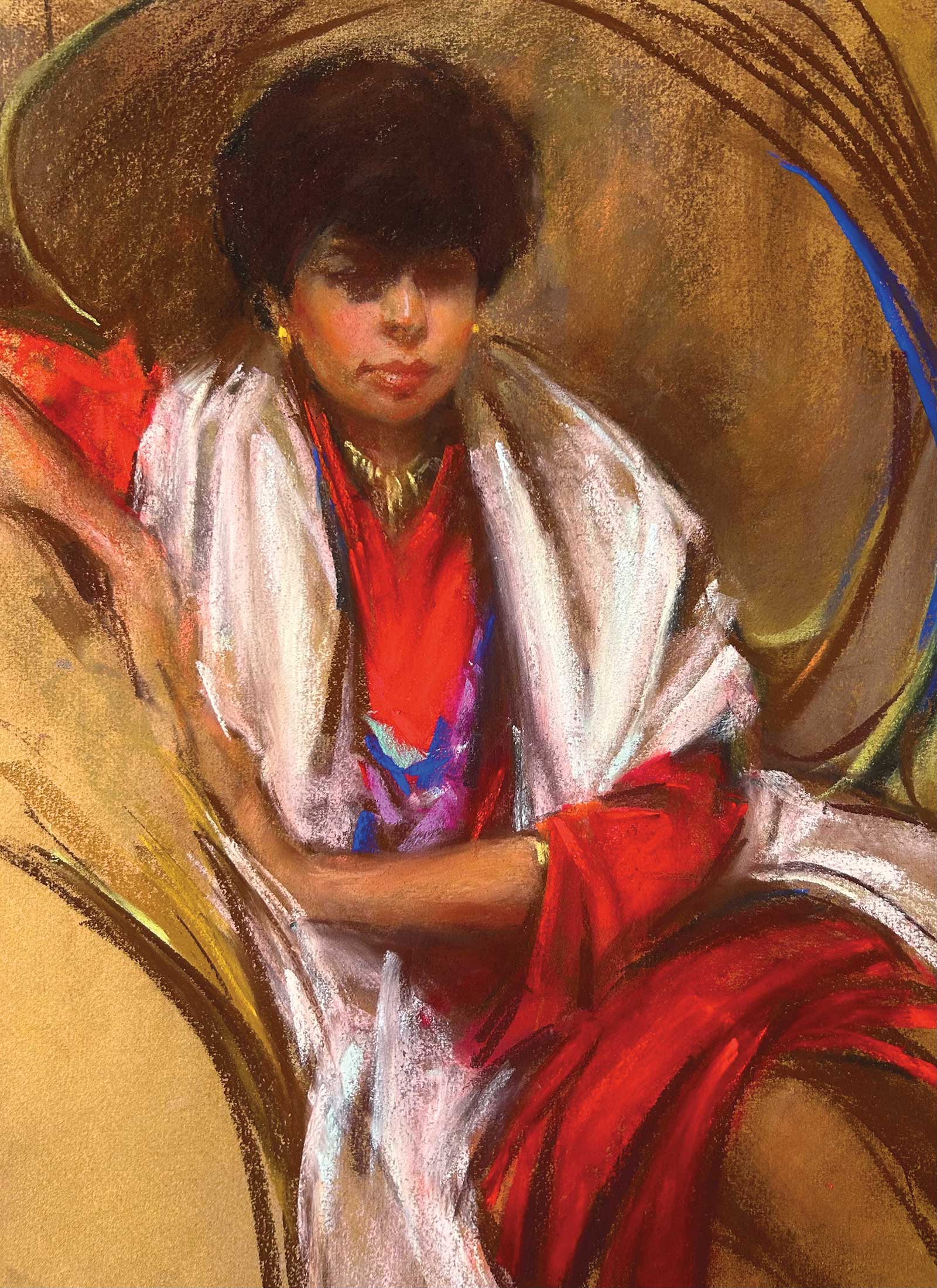
Lois came into my studio wearing this bright red dress and white shawl that fell gently from her neck. She went over and sat down on the chesterfield. This sudden appearance of her was breathtaking, and I asked her not to move. The aura of her presence flowed from pastel onto paper. Just a few basic strokes for her face showed a serene but rather determined spirit. As I laid down the white with the red, my strokes continued with inventive overall curves throughout. I put her earrings on, then off, then back on. A quick sweep of forearms and hands, a few more white and red strokes and I stepped away—done! Start, create, finish. The rapture of art.