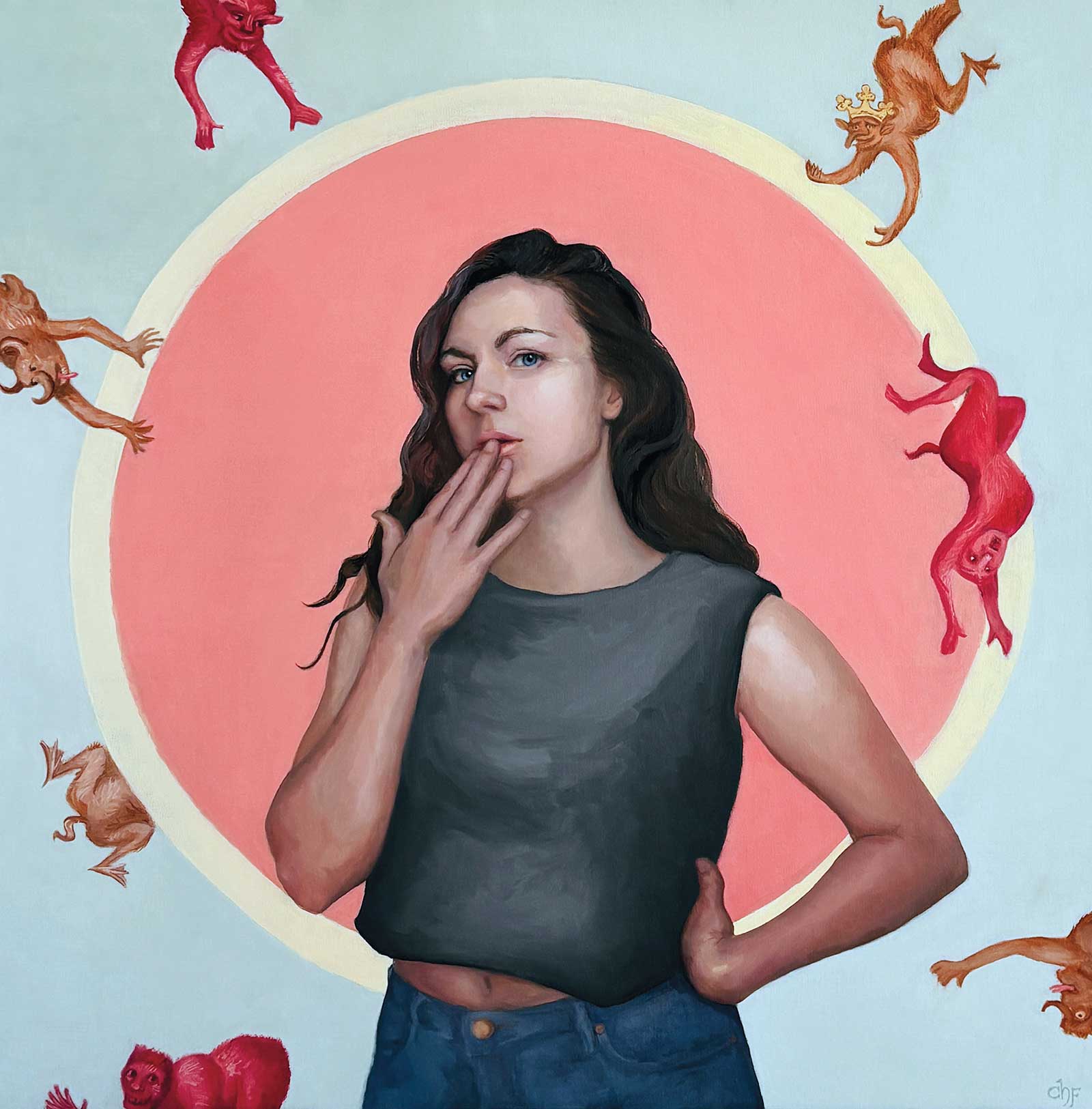
 Mary and Her Demons Are Totally Fine, oil on linen, 24 x 24” (60 x 60 cm)Casey Field
Inspiration
The idea of painting my personal 21st-century feminine perspective of Mary Magdalene came to me when I was looking through her portrayal throughout art history. This painting’s color and composition were inspired by a trip through the Medieval section of the National Gallery in Washington, D.C. last year, where I saw narrative art, sacred stories and bold color and composition choices coming together in subtle and strange ways. I directly cite the work of German artist, Master Bertram, whose International Gothic work Grabow Altarpiece, was the source for my demons. Look for them on the first panel of the altarpiece!
Process
I began this painting by hiring a model to play the role. I spent some time painting her from life, mostly to capture important color notes and a photo reference for the pose. I made small sketches and color studies to try to address some of the larger questions about placement, color, and value. Somewhere in the planning phase, I came across Master Bertram’s altarpiece and decided to use his demons—they are so cute and funny, and I love the idea of echoing the artistic hands of past masters. My painting process was fairly straightforward: first, I drew in charcoal on the canvas; second, I created a limited palette underpainting; finally, I did a single pass—as much as possible—with my full-color palette for the final painting.
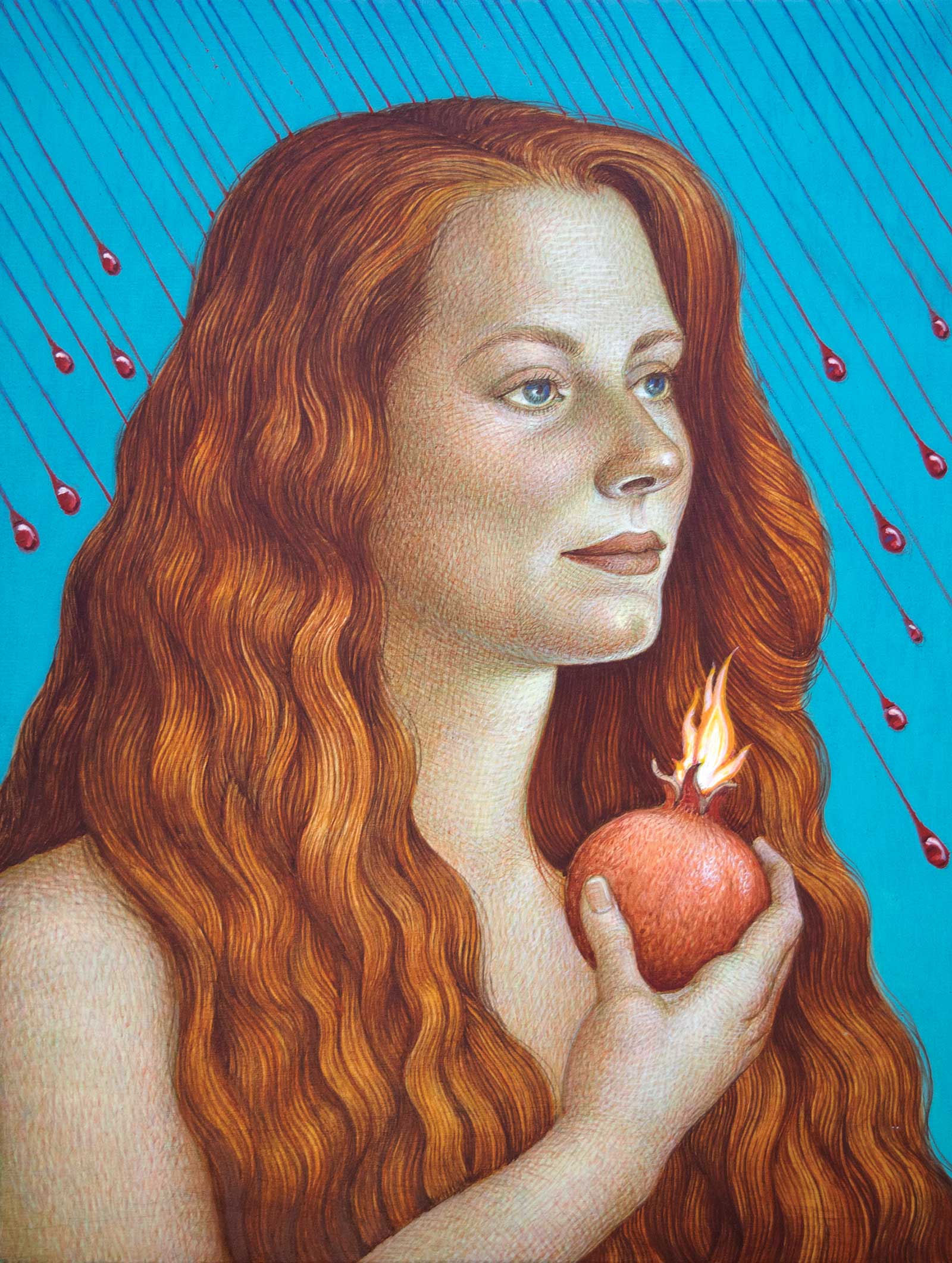 Persephone’s Revelation, egg tempera, 12 x 9” (30 x 22 cm)
Michael Bergt
Inspiration
Persephone’s Revelation is an egg tempera painting done in the tradition of the early Italian Renaissance. With a nod towards Botticelli, I was drawn to this model for her red hair and appearance. The “revelation” in this painting is the realization that Persephone’s escape from Hades meant that the world would become fertile again. The very pomegranate seeds that force her to return for four months a year, are now the seeds that rain down on the earth—symbolic of the fertility she will provide. The flame emerging from the fruit is her realization of her own power and escaping the darkness of Hades.
Process
I followed the methodology presented in Ceninno Cennini’s book, Il Libro dell’Arte, a 14th-century treatise on painting that codifies Giotto’s adaptation of icon painting. Flesh is underpainted first with a green earth tone to provide a complimentary color and a cool base for the veils of sinopia laid on with cross-hatched strokes. I paint directly and with glazes to build many layers of semi-transparent colors. The result is a high color key painting closer to fresco than to oil painting.
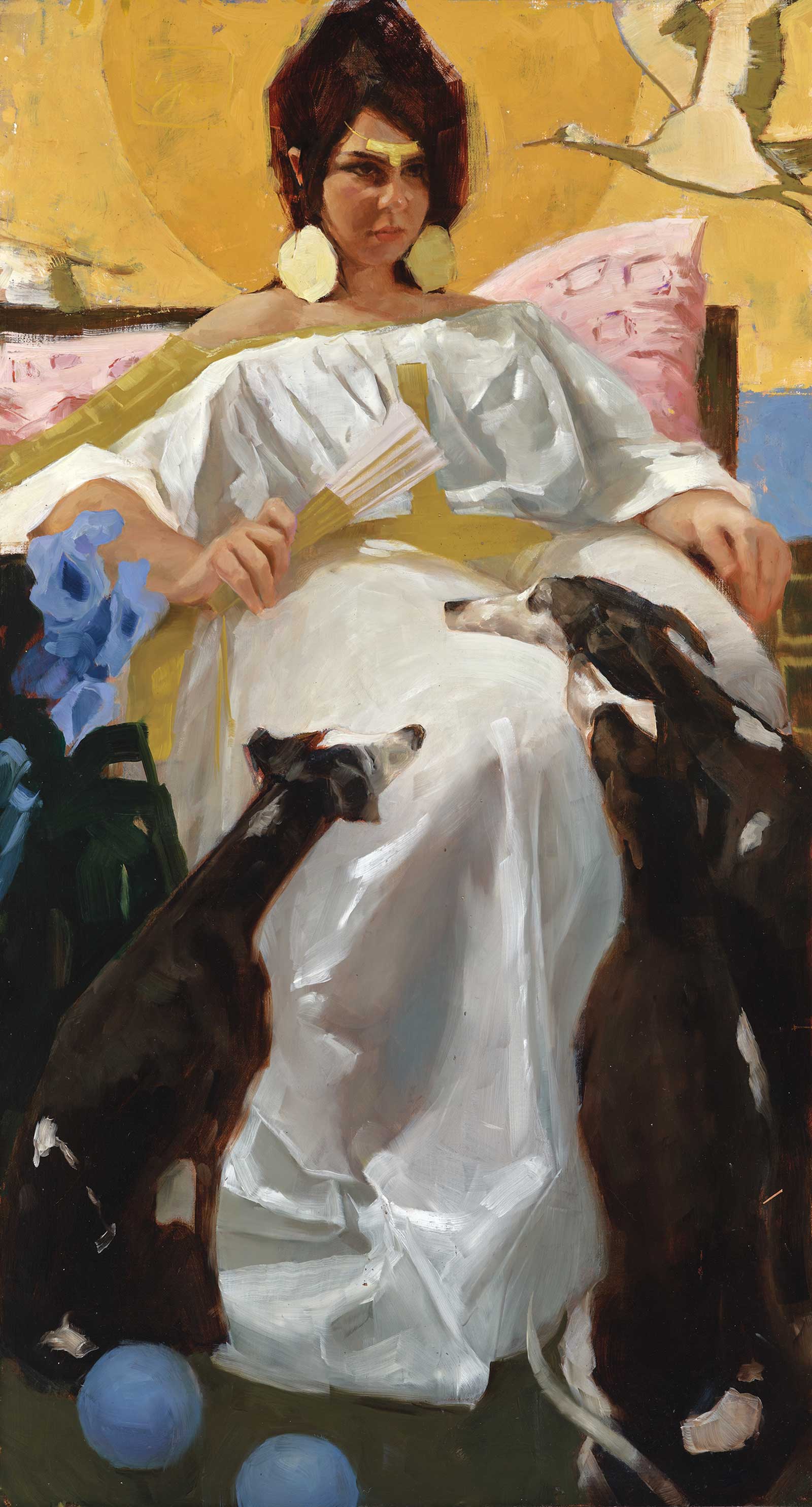 Octavia’s Revenge, oil, 24 x 13” (60 x 33 cm)
Crystal DeSpain
Inspiration
John William Waterhouse’s Cleopatra has always captured my imagination. After analyzing what made his piece so powerful, I challenged myself to use it as a springboard for my own work—both by building a “sister” narrative and by incorporating some of the techniques he employed. At first, I intended to paint my own version of Cleopatra. But as I delved deeper into her story, my focus shifted to her love rival, Octavia. In my imagination, as the sole survivor of the ill-fated love triangle with Mark Antony, Octavia didn’t win the man, but she did end up with Cleopatra’s prized pink pillow, a nod to Waterhouse’s painting. I used an extended family member with a powerful presence and my dog, Indie (a whippet who thinks she is a queen), as my models. I shot video and photo references right in my kitchen.
Process
The heart of my process lies in composition building using Procreate on my iPad. This stage allows me to play, problem solve and fully immerse myself in the project. I meticulously plan everything: transparent and opaque layers, narrative elements, and, most critically, value shapes. It’s a safe place to be bold and take risks. To ensure my digital vision translated well to oil, I also painted several studies, as oil paint has a more limited value and saturation range compared to digital. In the end, it was a win-win-win-win: I completed a painting that I felt good about, my model got paid, Indie got treats and Octavia got her small measure of revenge.
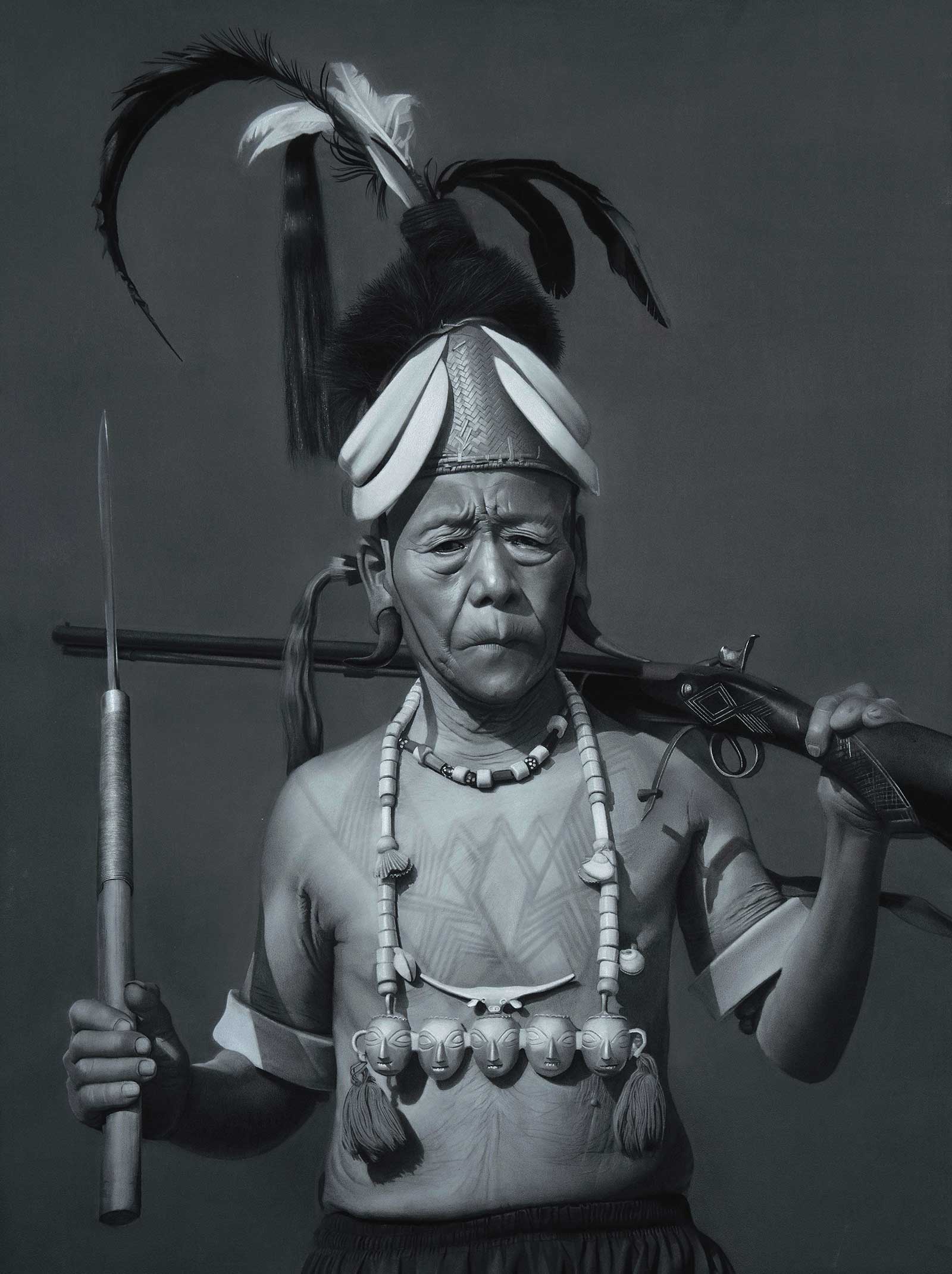 The Last Headhunter, charcoal on canvas, 48 x 36” (121 x 91 cm)
Sumanth Marda
Inspiration
I found inspiration when I first heard about the Konyak headhunters of Nagaland, a once-feared warrior tribe known for their tradition of taking human heads as trophies, signifying their valor in battle. Now reduced to only a handful of surviving members, I felt a strong need to find and document them before their legacy was lost. This portrait is of Nyeiwang Wangsa, a former headhunter of the Konyak tribe. The tattoos across his chest, once earned through acts of valor, mark his status as a warrior. His hands, worn by time and battle, bear the cost of his past—with fingers severed in combat. The five brass heads on his necklace symbolize the number of enemies he had beheaded, a tradition central to his tribe’s honor. His elaborate headgear, adorned with hornbill feathers, once signified his rank and fearlessness in battle. Now it remains a fading emblem of a bygone time.
Process
During my time with Nyeiwang, I took countless photographs hoping to capture an image that felt both striking and honest. I carefully selected one that resonated with me emotionally and felt compositionally strong. I prepared my canvas with gesso and pastel ground to achieve a textured surface suitable for charcoal. Working in controlled layers, I refined shapes, values and edges to build form and likeness. The textured surface complemented the subject, allowing the drawing to carry rawness that felt true to his story.