Like many artists, I find inspiration from nature where I observe color combinations and imagine how I would create texture from what I’m seeing in my art. I fell in love with watercolor many years ago, and I am still exploring and enjoying the adventure of finding new ways to create with it as a medium. I am intrigued at how versatile pigments can be, giving us completely different results each time we use them. I work with them as if they are my friends, and I do not aim to control them. Instead I prefer to be guided by what they do naturally, as I believe that this partnership brings out the best of both of us-the artist and her tools. I have always worked without a preliminary sketch, a technique I share in my following demonstration. There is a thrill in working this way that I find unbelievably exhilarating.
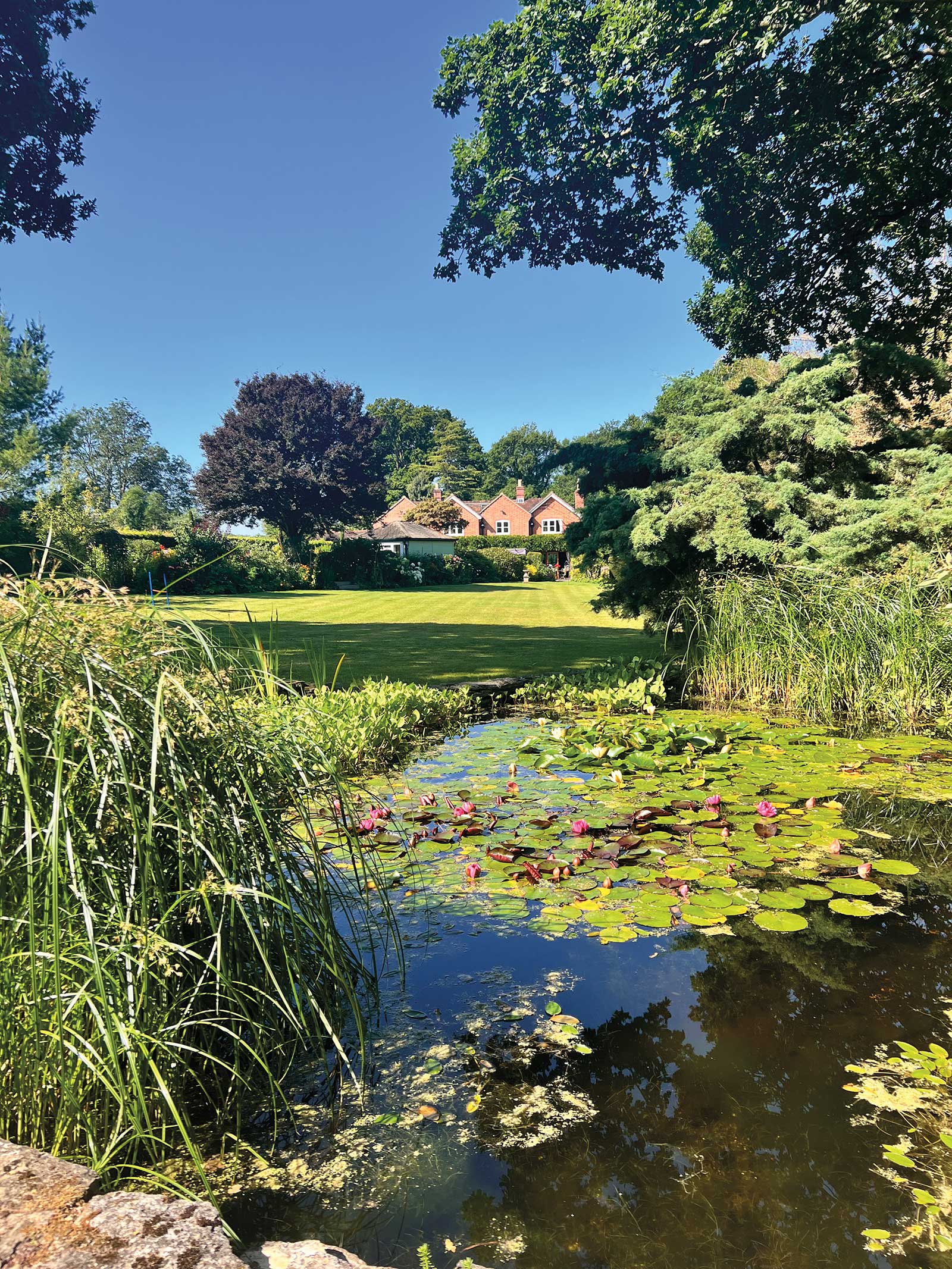
A view of our home and garden, where I sit and paint regularly. It’s peaceful and inspiring. My studio is to the left of this photo.
My studio is located in the garden of our country home in England, which is nestled by a canal surrounded by gorgeous countryside. As the seasons change my eyes are automatically drawn to different colors. I am always looking for something new and often find myself inspired by the history of art.
I do believe that the way I create at the moment is more like a scientist than a watercolor artist. I am always combining different ideas along with using conventional watercolor products, testing them for durability and staining. I find this work enhances my creations when I move back to painting with pure watercolor pigment.
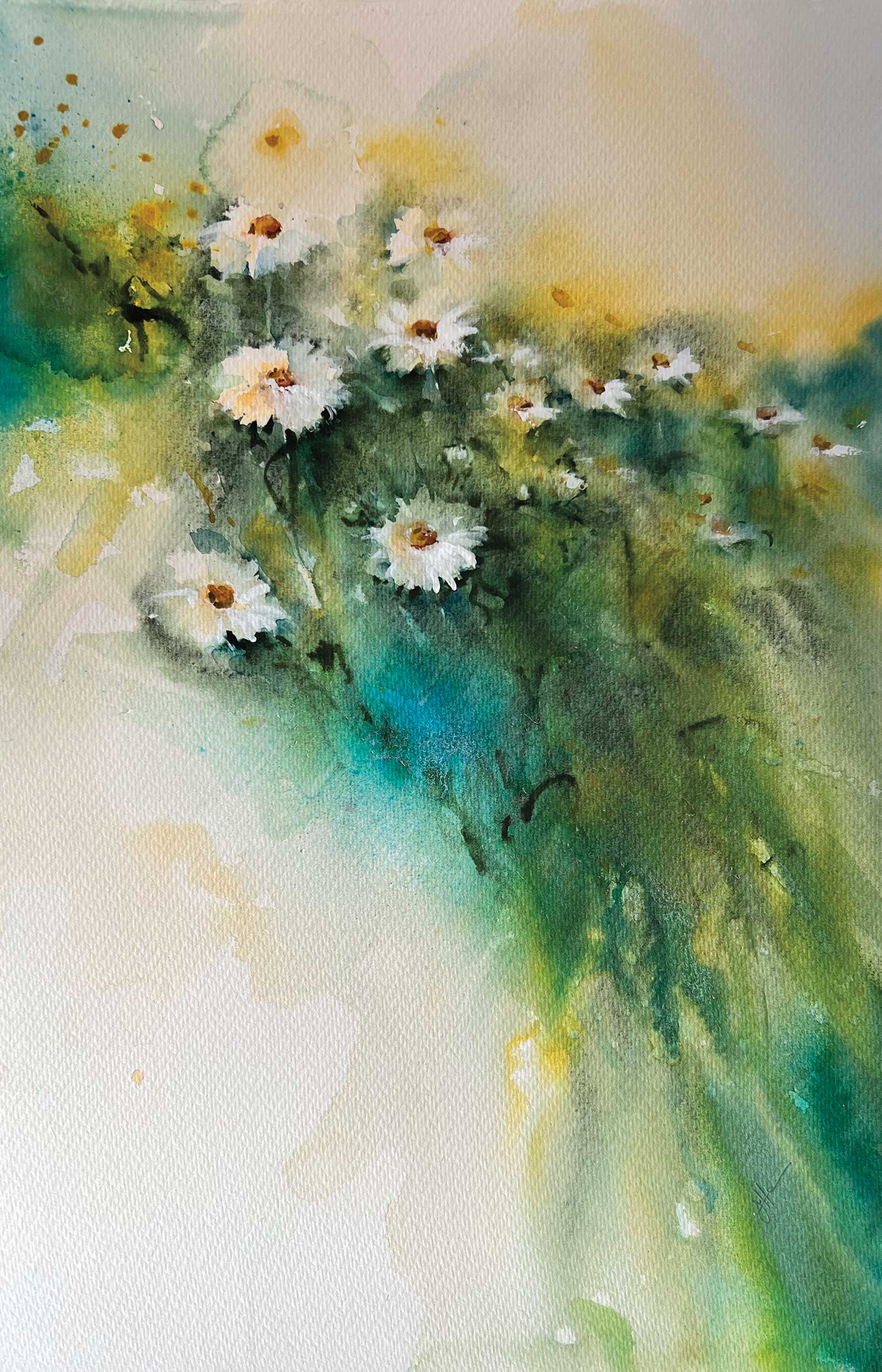
Fresh as a Daisy, watercolor, 23¼ x 15” (59 x 38 cm)
It is the element of always being excited about learning, I believe, that keeps us healthy, acutely aware and enthusiastic about art. I am a gemini, which is the star sign well recognized for being creative. And I am always on the lookout for something new. I do find it impossible to sit still in my art journey, which is why I believe my art style has evolved over the years, and keeps evolving.
When I’m in my studio, I do feel as if I escape into a world of creation where nothing else exists. And for me, that is a luxury to never be taken for granted. If I could pass on any advice it would be to trust your instincts and always be true to yourself. I’ve never been scared of veering away from the tried and tested path of painting, and I love the idea that tomorrow I’ll find that magical something new—that no one else has ever heard of or tried.
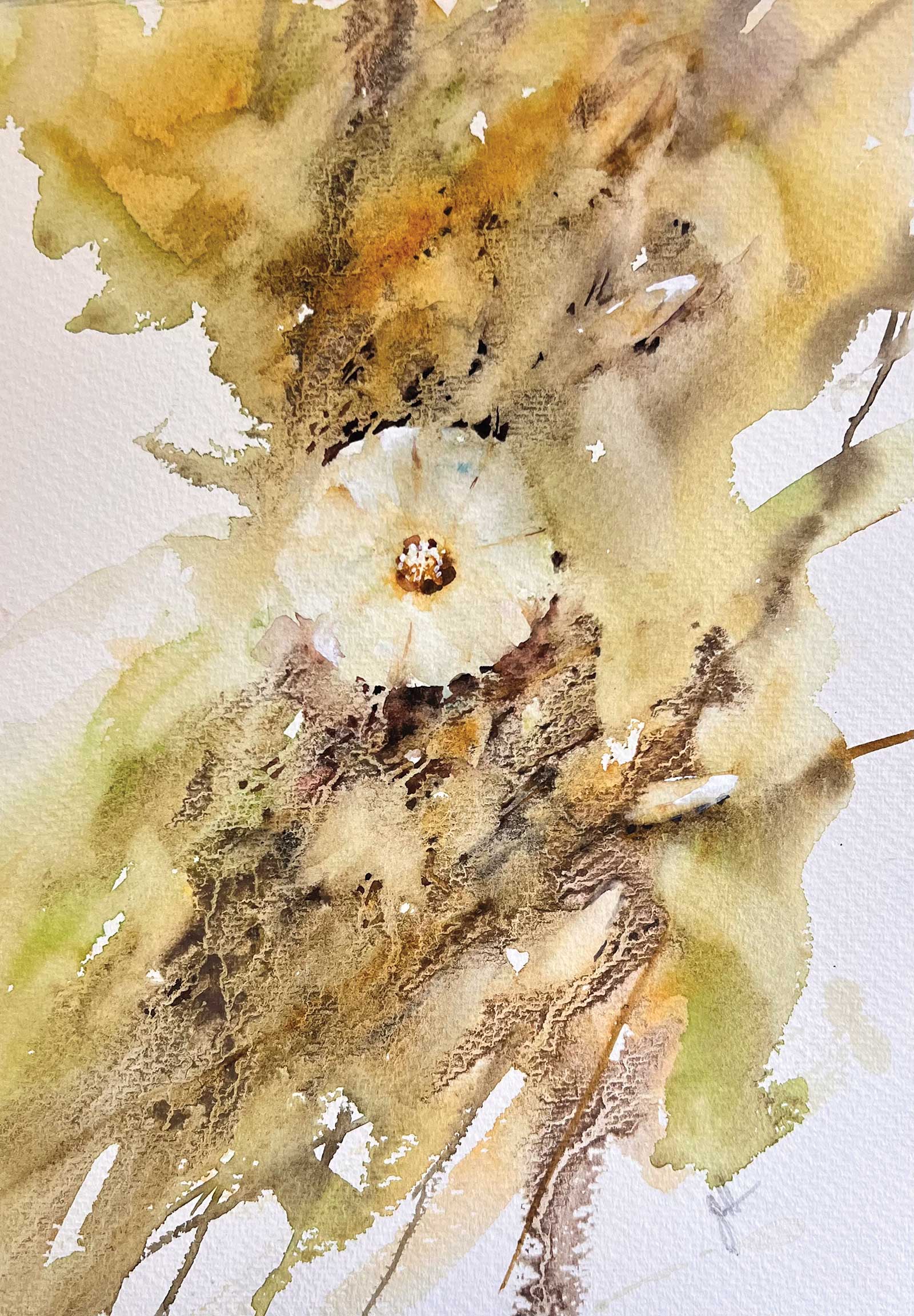
Nature’s Treasure, watercolor, 14½ x 10¼” (37 x 26 cm)
In fact, I suggest that art is a destination with the journey being the greatest of adventures. A journey that will never end. From the minute we pick up our brushes to the second we put them down, only to find that our soul yearns for them to be picked up again.
My Art in the Making Tranquility
I live in an idyllic setting for an artist: a rural country home and a very large garden that I actively maintain. My favorite place to paint is by our waterlily pond, which I have deliberately designed for this purpose. I have always been an avid fan of Monet. This peaceful space is where I create at my best, always inspired by nature.
 Stage 1
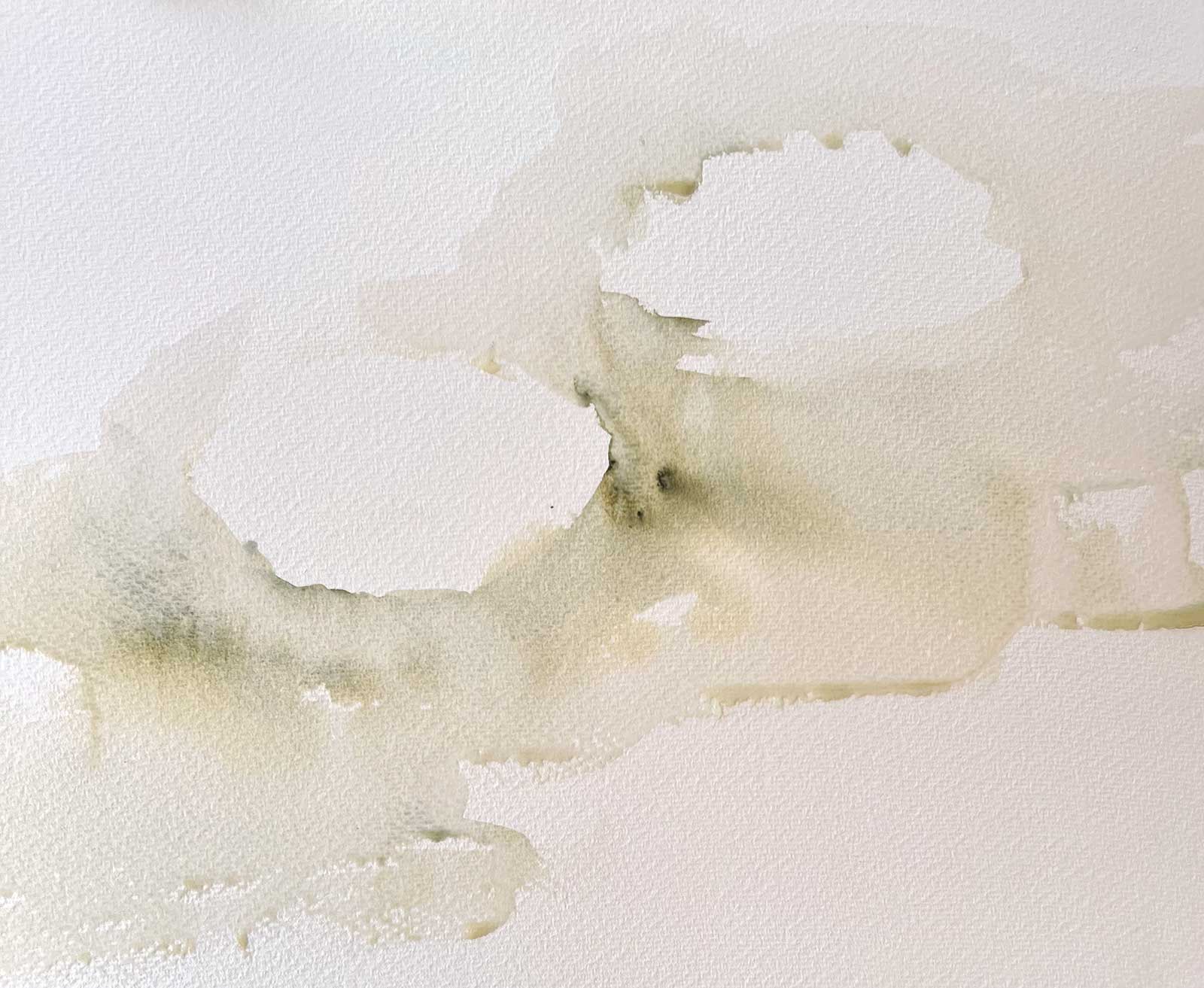
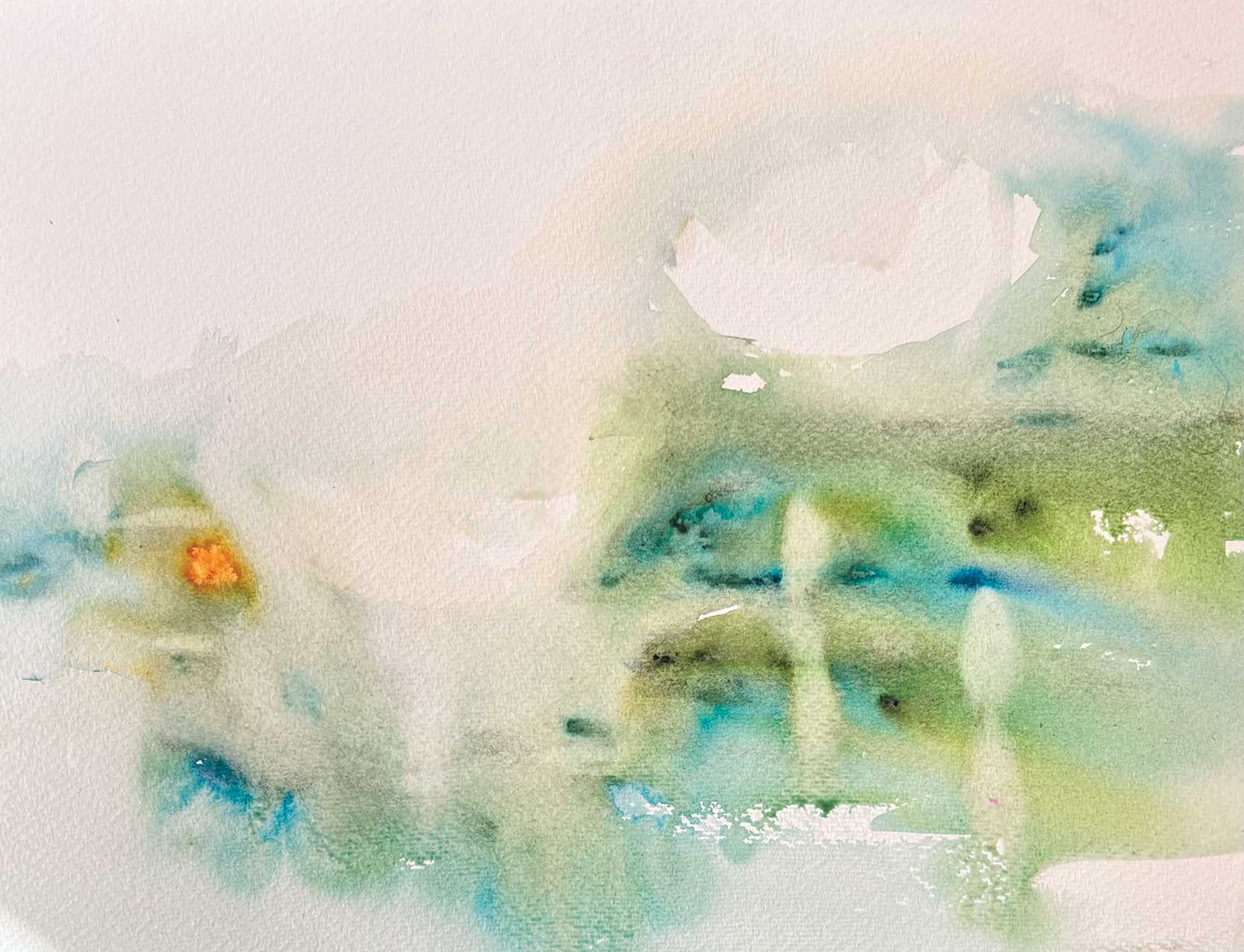
Stage 1 Composition
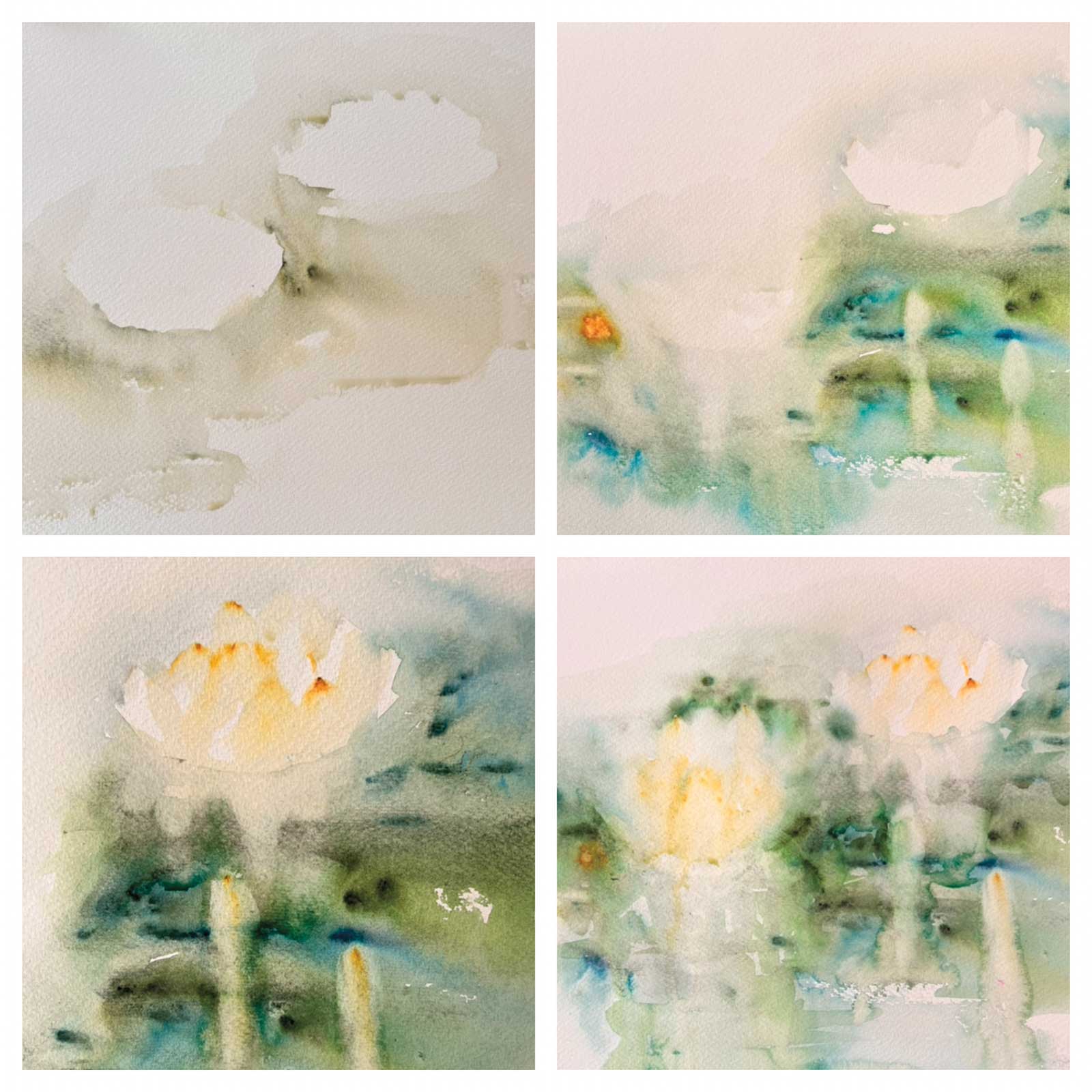
Once I have chosen my subject, I will decide on a pleasing composition. As I work without a preliminary sketch, I often use a faint wash to mark where my central flowers will be placed. Here I have used Daniel Smith undersea green as a weak wash to act as a foundation for the rest of the painting. I do not aim to perfect the outline detail of the flowers at this stage because I want the work to be spontaneous, loose and atmospheric in style. As I paint I allow my work to almost dictate what happens where, because I will add color where I instinctively feel it is needed. I listen to my inner artist’s voice so that each piece is completely unique.
WHAT THE ARTIST USED
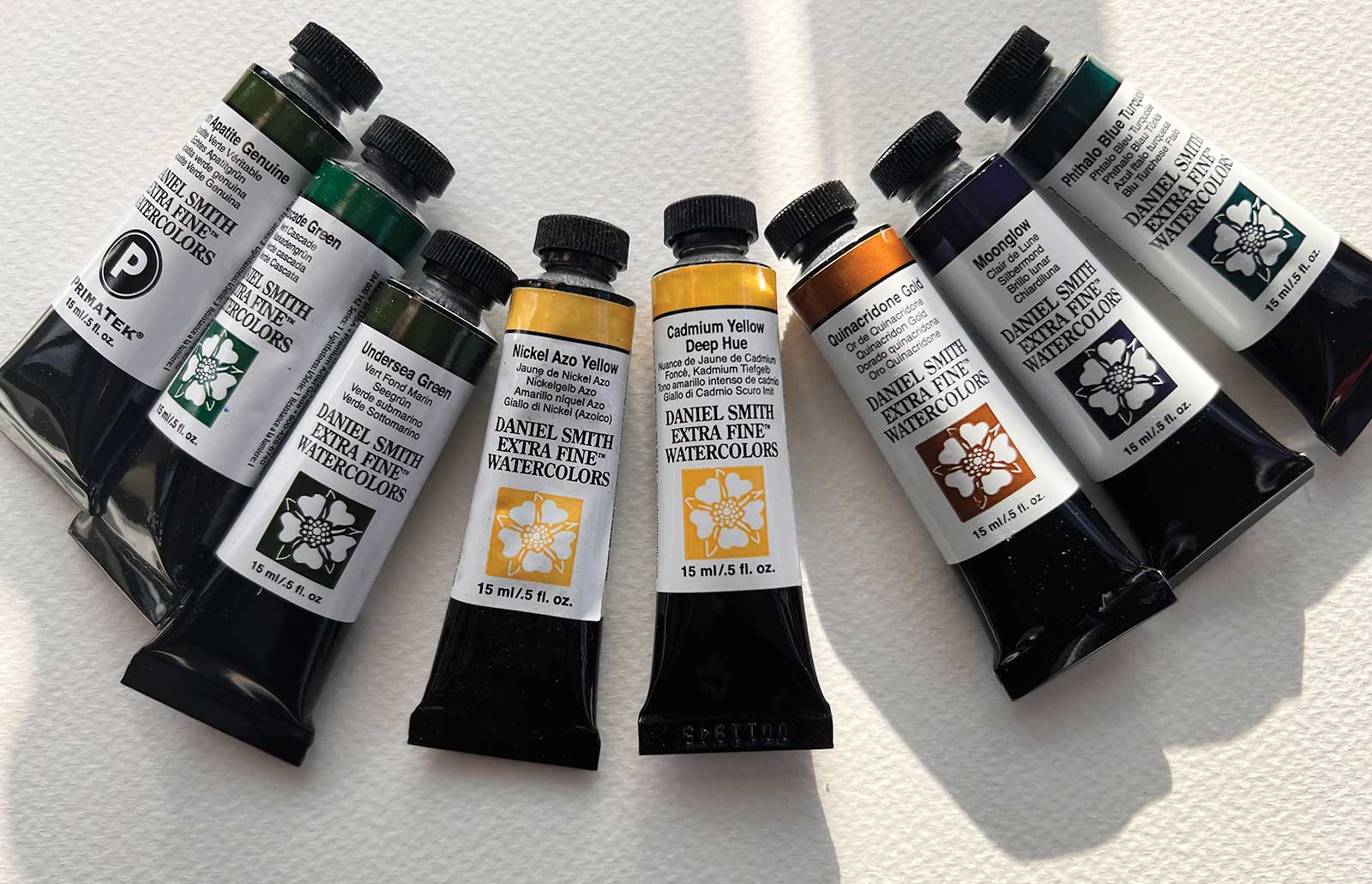
Daniel Smith Watercolors
Green apatite genuine, Undersea green, Cascade green, Cadmium yellow deep, Nickel azo yellow, Quinachridone gold, Moonglow, Phthalo blue turquoise
Additional Materials
High-quality 300lb watercolor paper, My own personal range of brushes: size 12 for larger areas, size 10 for medium detail, rigger for the finest details, White gouache
 Stage 2
Stage 2 Building the Background
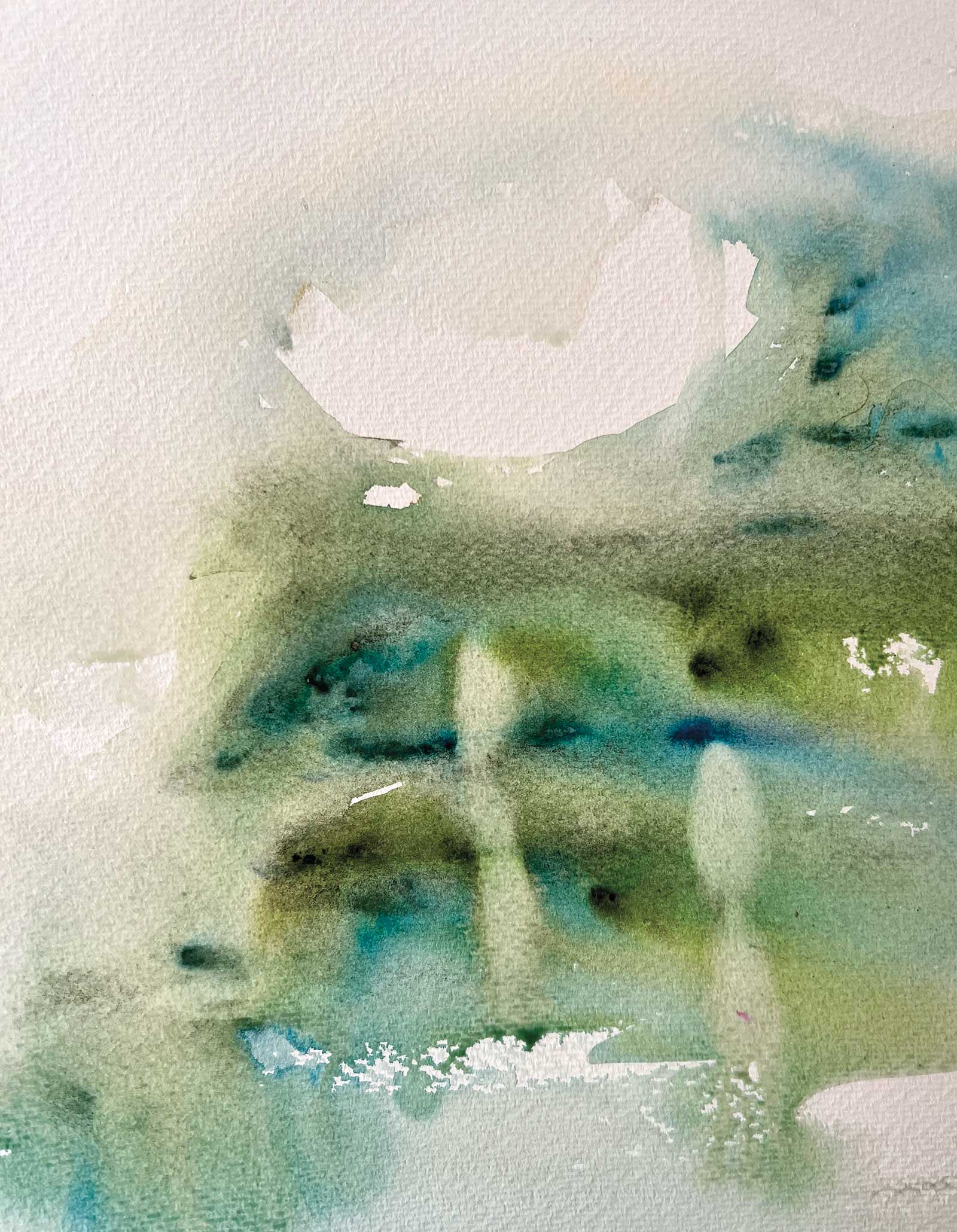
I gradually build up the background color as I am working around a white subject. Initially, I used cascade green combined with phthalo blue turquoise. At this stage I add the soft beginnings of buds appearing in the composition. I aim to depict what I’m seeing accurately. At this point I often turn my paper sideways so that lines of color flow across my composition, knowing this will lead to a pleasing result when the work is dry. The stronger color patterns seen here are gained by using Daniel Smith green apatite genuine, which is a beautiful shade and particularly well suited for this subject.
 Stage 3
Stage 3 Greens
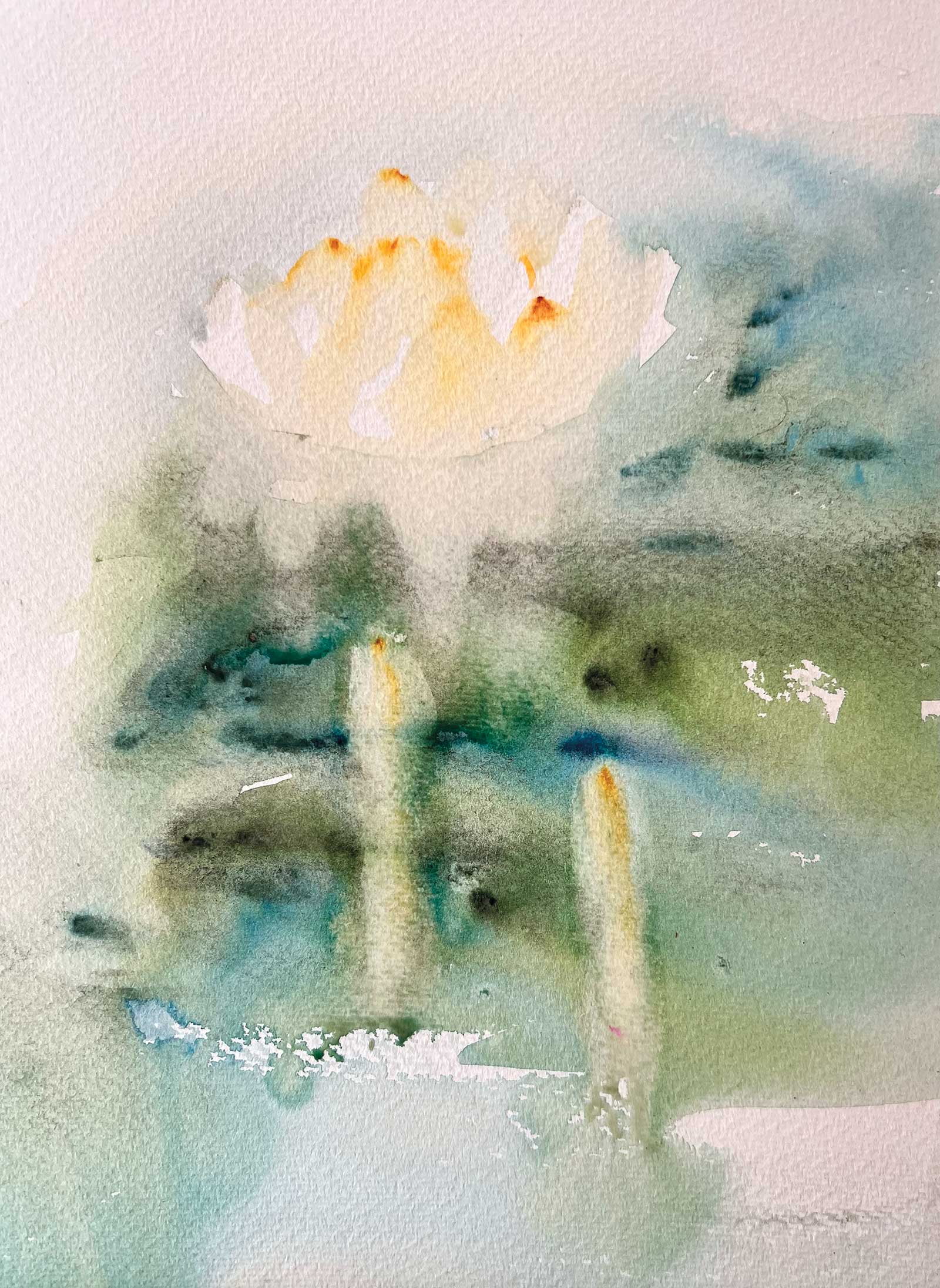
In this particular close-up of the painting during the creative process, it is easier to see how wonderfully the pigments interact, giving me a fascinating result. This is why I frequently experiment with color, constantly looking for the very best products and outcomes in my art. I am aware that greens can be so calming and pleasing to work with in a painting, just as they are in nature. I incorporate them in my art regularly for this reason. I believe that if the subject is a peaceful scene, then capturing that essence within my work is essential. The white of the paper is still very stark, and I will soften it in later stages. All I’m doing at this moment is focusing on the background, which will make my focal points, the flowers, sing.
 Stage 4
Stage 4 Observations
For me it is important to capture the reflection of the flower in the pond. When I sit calmly and look at my pond, I can free my mind and simply be. When I am looking at these flowers, I don’t initially see all of their intricate details. In fact, if I take a look at the many photos of this particular pond, sometimes all I see in them is the white bowl or cup shapes of the flower rather than the individual petals. Sunlight can play a huge part as to what is happening on the water and how I paint it. Simply sitting and observing a subject is the best way to improve art skills. In this particular close-up, there is no detail and no definition. There is a very loose shape of what could be, but the story is already told, although this is far from a finished piece. I have used quinacridone gold to create the petal tips, adding a sense of warmth to my painting without being overly bold. Many watermarks also begin to appear. I strongly believe the beauty of watercolor is how it interacts with water. Rather than control these watermarks I embrace them and include them in my artworks. I find them completely magical and unrepeatable, adding a unique enhancement to my finished pieces.
 Stage 5
Stage 5 Spontaneity
The unpredictability of working without a pencil sketch adds to the thrill of painting with my technique. As an artist, you never really know what is about to happen, but with each new brushstroke you move towards the completed painting. This is painting from the heart and creating by instinct, a technique that comes naturally over time. I am portraying what I see with my eyes to color formations on paper, from the very first step where I create an outline around possible flowers to the gradual building up to a complex scene. A quiet painting that could be left as it is or enhanced with darker colors.
Dancing Ladies
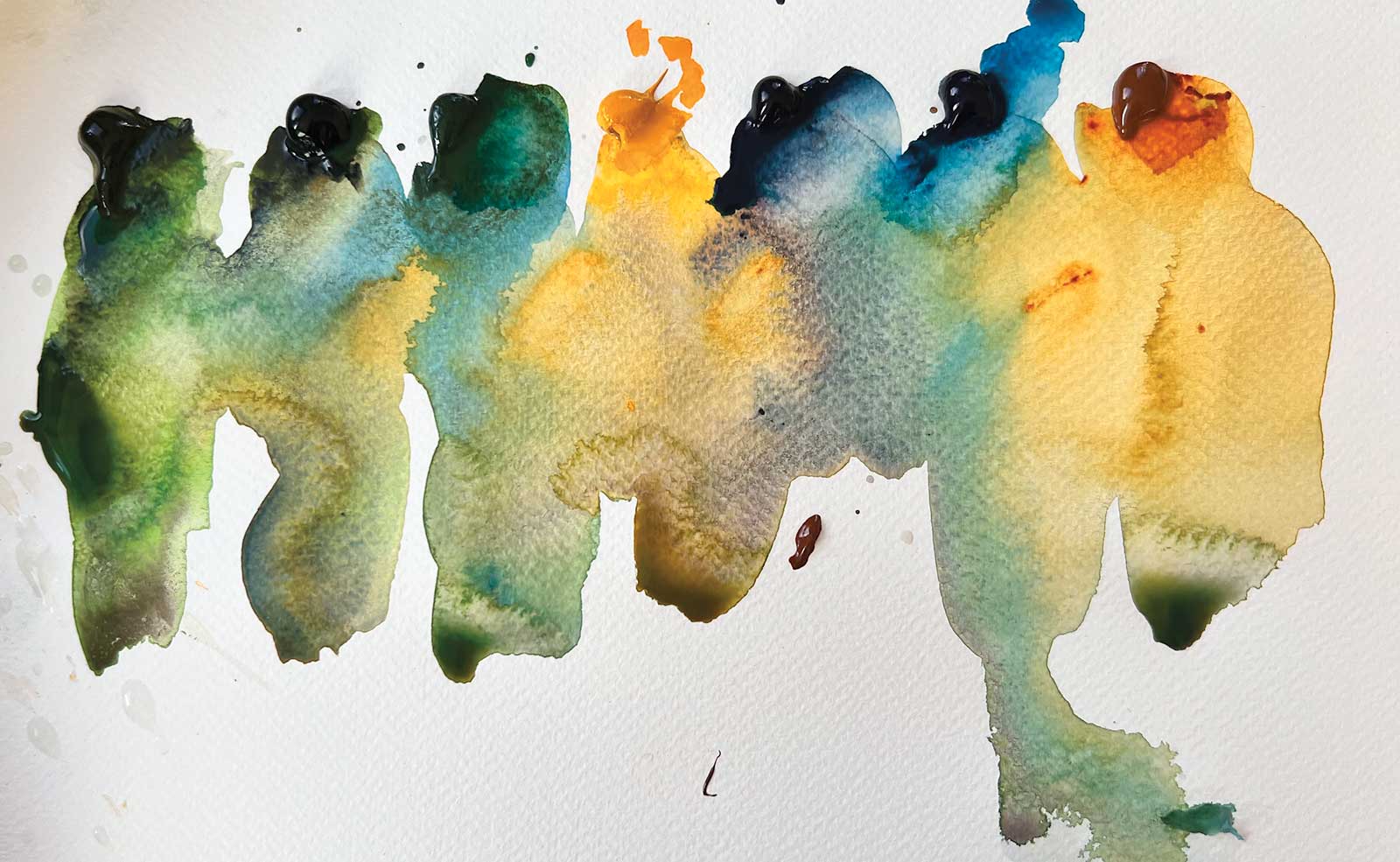
I tend to place dots of each color on a clean piece of paper to work from. Initially this is my color swatch to observe how the pigments interact with each other. This method has lovingly been named my “Dancing Ladies” color selection due to an artist in one of my workshops noticing the dots looked like a row of heads with flowing colorful robes beneath them. The name stuck and had become a popular part of my presentations. I often find that as the colors dry new and exciting color combinations appear, which are utilized in my creations. I work from this color sheet for each new painting. So the swatch acts as my palette—keeping my colors clean and fresh, minus the temptation to stray from the harmony of shades I have originally chosen. The dynamics have to be right from the very beginning of each new painting.
 Stage 6
Stage 6 Finished Artwork
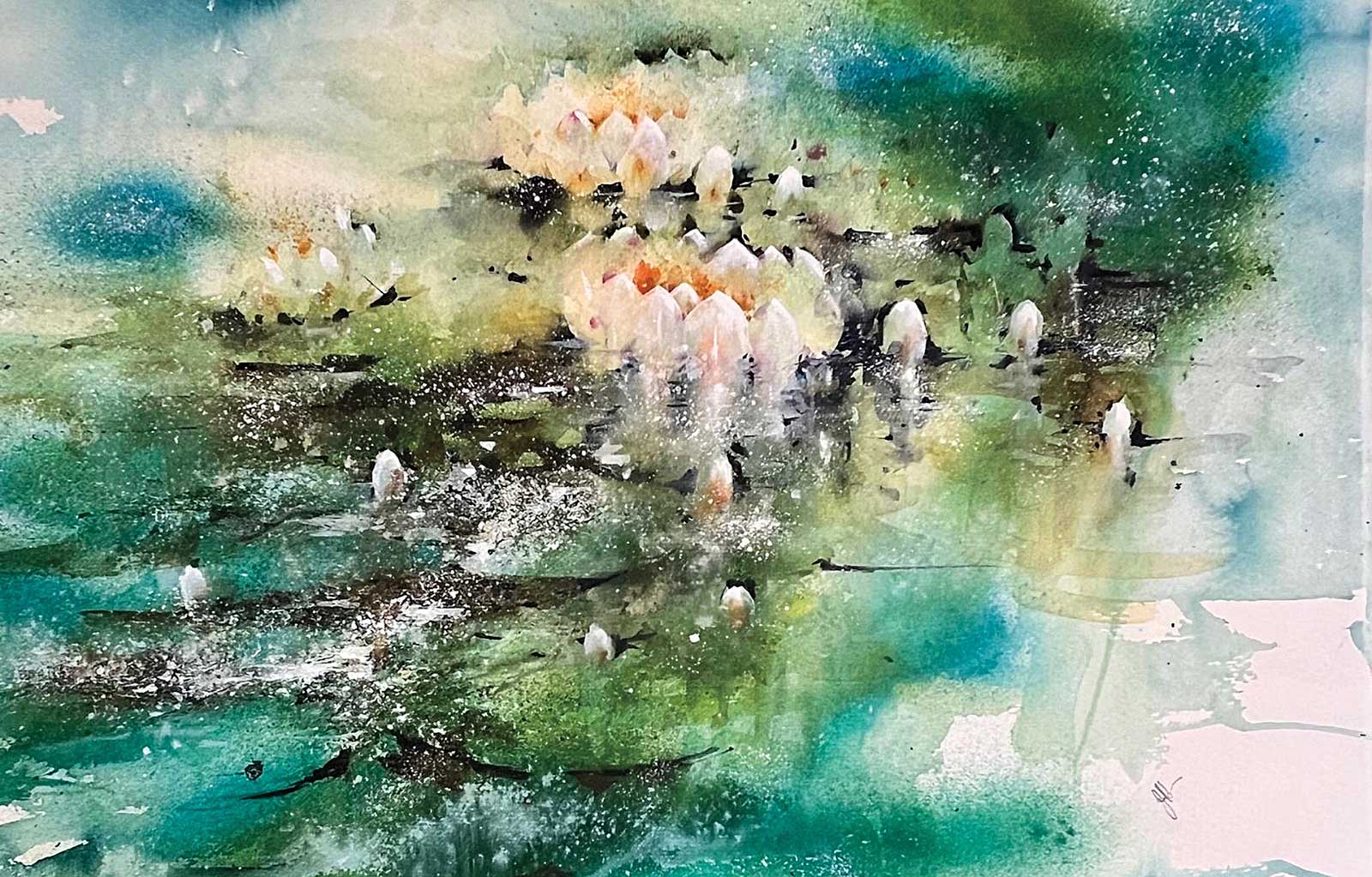
Tranquility, watercolor, 201/2 x 29” (52 x 74 cm)
This highly defined painting has drama due to the really bold addition of darks within the water of the pond. Petals have been defined sharply. The center of each lily cup has a wonderful gold definition, which adds depth and interest to each flower. There is a contrast here of quinacridone gold and opera pink, both by Daniel Smith watercolors, that give a wonderful central glow to the composition. Horizontal lines separate the lily pads around the flowers. A final addition of white gouache adds a sense of sparkle and dappled light to the magical scene. To add any further detail to this piece could lead to overworking. The painting is finished and the story is told.
About the artist
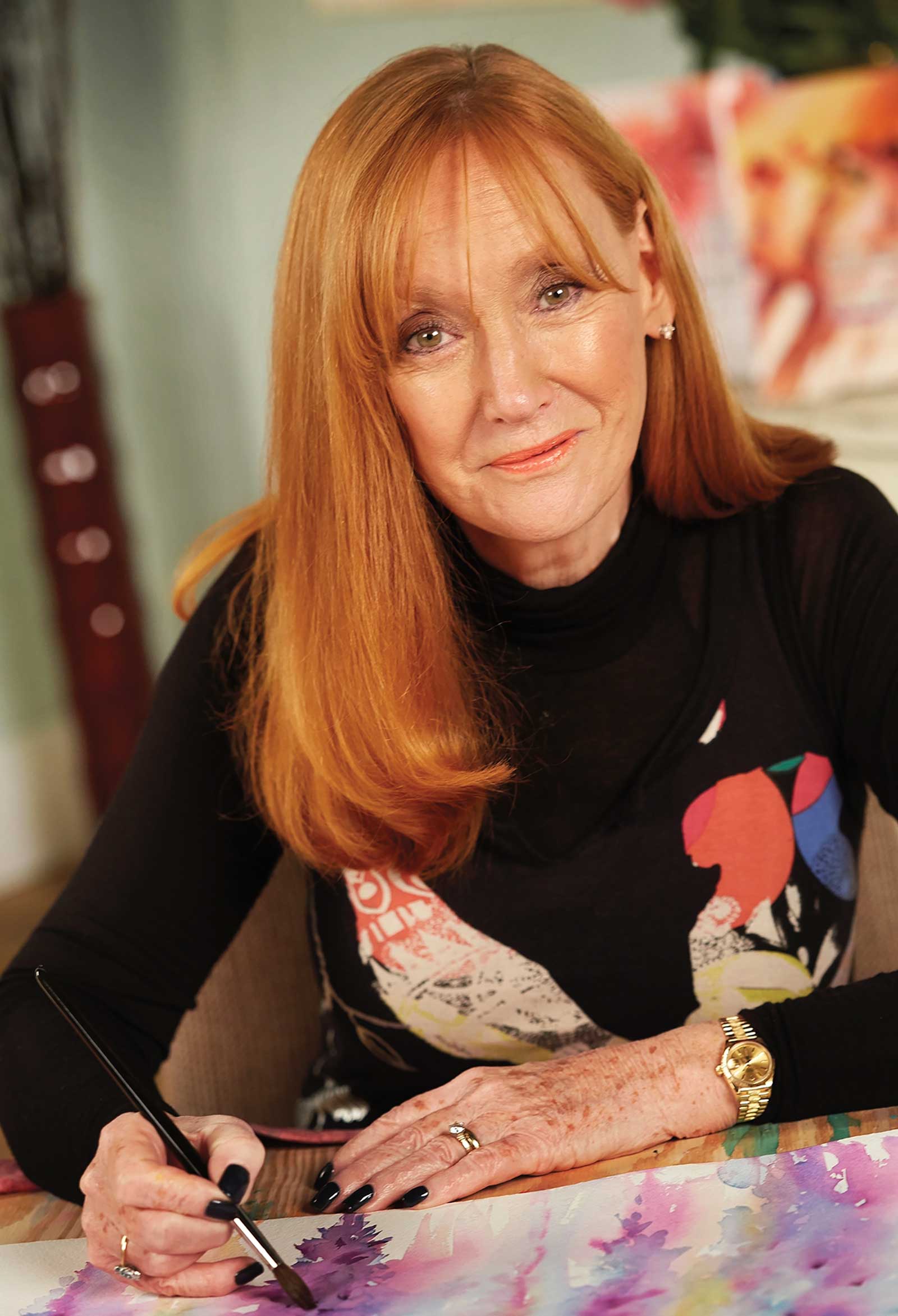 Jean Haines
Jean Haines has become highly respected and recognized as a leading professional artist and author worldwide. Her publications are now so popular that they are published in many languages including French, Spanish, Chinese, Italian and German. Extensive traveling along with living in Asia, the Middle East and Europe enabled Haines to study under many watercolor masters. Initially a highly detailed botanical artist, Haines’ style evolved over time to her now well recognized atmospheric and loose style. Her art journey began in England where landscapes and floral art originally drew her into painting. However, moving to China brought about the opportunity to study the importance of brushwork, and it is here that her shift toward painting truly began. From here, she moved to the Middle East and became fascinated by portraiture, studying under a number of esteemed portrait artists in oil, pastel and watercolor.
Her passion for watercolor as a medium became the driving force behind her work. An innovative creator, Haines enjoys her thirst for creation, believing there are still many ways of working with the medium that are yet to be discovered.
Haines took up teaching in Dubai and has since taught watercolor workshops internationally. Always with sold out schedules, Haines exhibits her artwork, acts as a juror for leading art shows, writes as an author and paints daily in her studio.
Contact at
jeanhaines.com