It makes a big difference which art supplies you bring for sketching on location because every medium has its own opportunities and special challenges. On each page I’ll focus on a single medium and I’ll demonstrate that medium with two kinds of subjects: a vehicle and an artist.
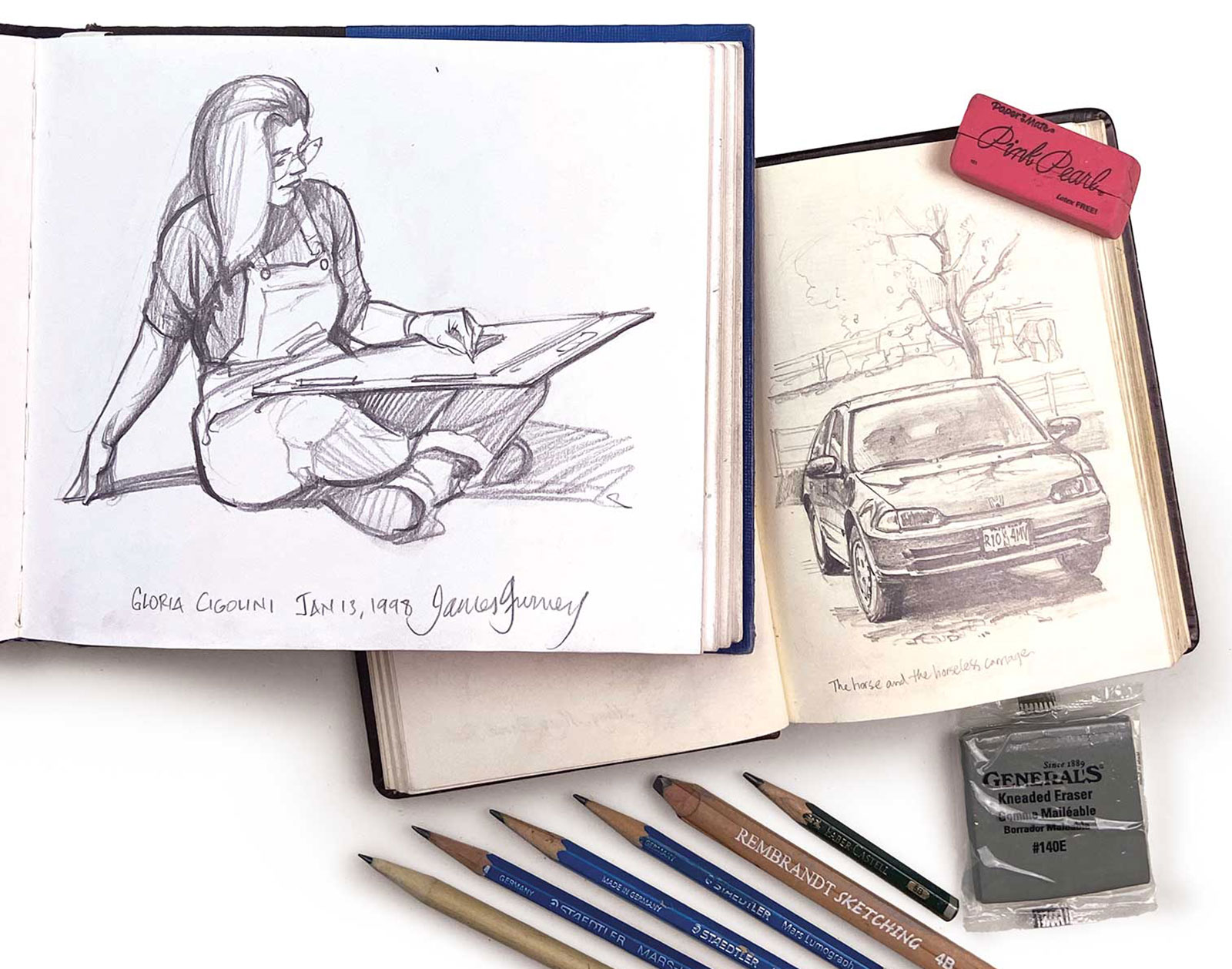
Left: Horseless Carriage, pencil, 6½ x 4½” (16 x 11 cm); Right: Gloria, pencil, 7 x 8” (17 x 20 cm)
Pencil
Opportunities
By removing color from the equation, graphite pencils let you focus on expressive lines and tonal relationships. It’s easy to erase pencils, and that opens possibilities for both fixing errors and making painterly light strokes.
Challenges
Graphite pencils don’t go much darker than dark gray, which means you can’t get all the way down to black. They smudge, so it helps to work from the upper left to the lower right if you’re right-handed, and then use some fixative when you get home. To avoid graininess, try the water-soluble options such as Derwent Graphitint.
My Approach
I hold the pencil loosely in my fingertips in the early stages, which delivers a softer line, then I switch to a normal grip for details. I often start with a harder pencil like a 2H or H, and then finish up with dark accents with a 4B or 6B.
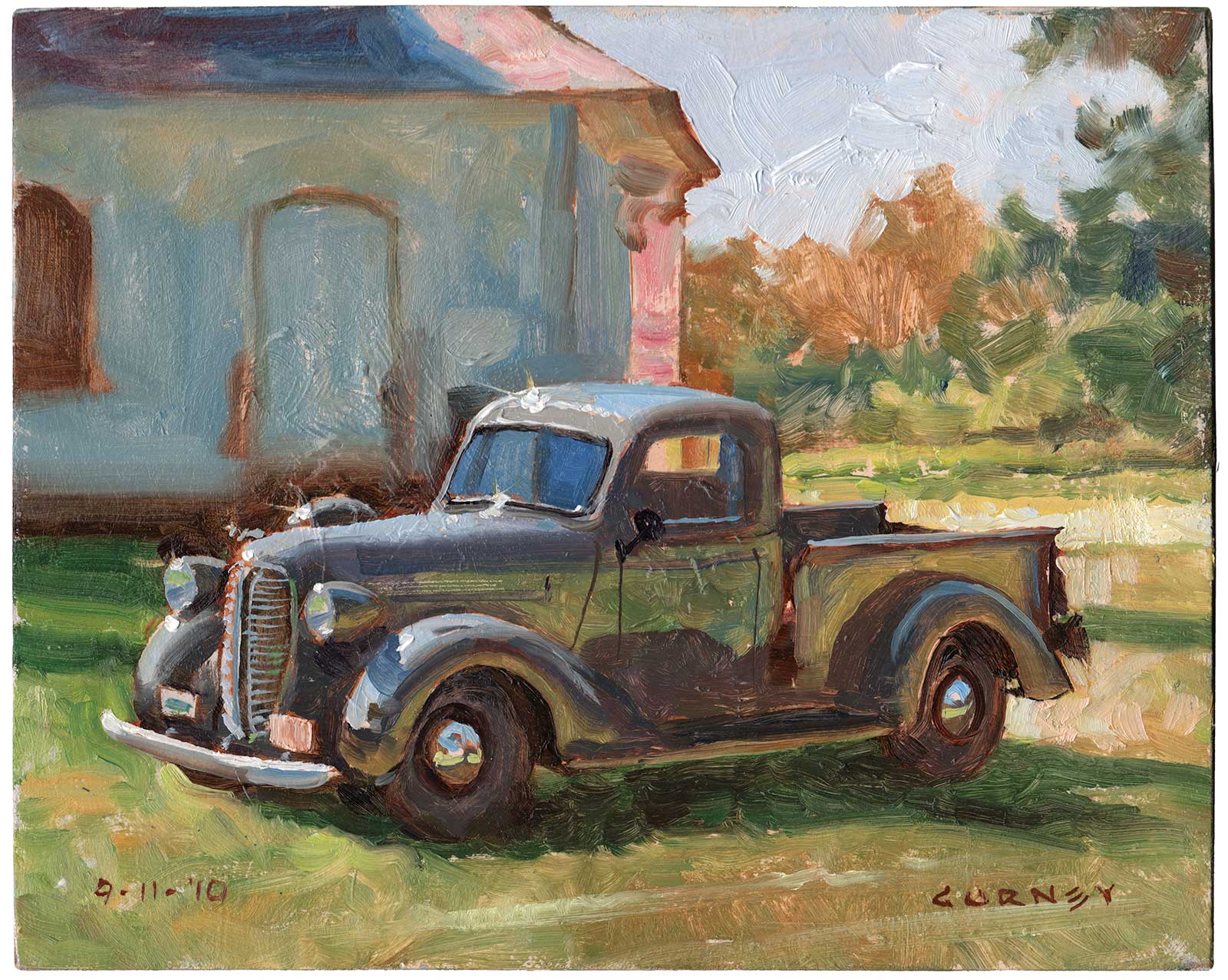
1938 Dodge Pickup, oil, 8 x 10" (20 x 25 cm)
Oil
Opportunities
Oil paint is still the standard for plein-air painting, and for good reason. It’s durable, flexible and forgiving. Because of its slow drying time, you can easily soften edges or paint a whole area out of focus.
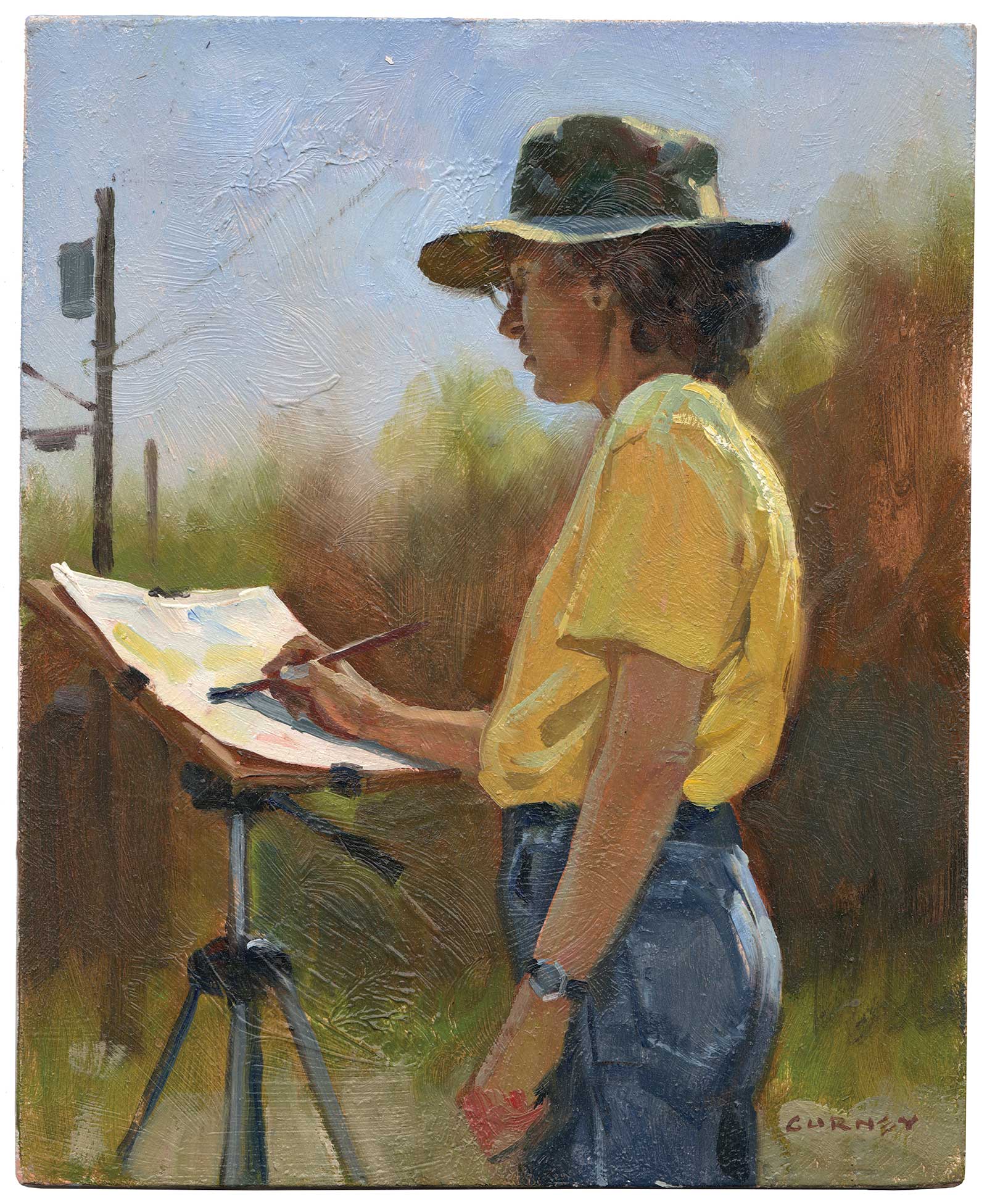
Jeanette Painting, oil, 10 x 8" (25 x 20 cm)
Challenges
The downside of the slow drying time is a tendency to muddiness and a difficulty placing fine strokes such as twigs or wires over a wet sky. Wet paintings require protection in the field. Cleaning brushes and traveling with solvents can present other issues for on-the-spot work.
My Approach
I like to paint over a pre-textured ground on an illustration-board or Masonite panel. The acrylic modeling paste for pre-texturing allows me to use the final oil colors relatively thinly and still give the appearance of thick impastos. To protect paintings on longer trips I bring along a slotted box to safely store wet paintings.
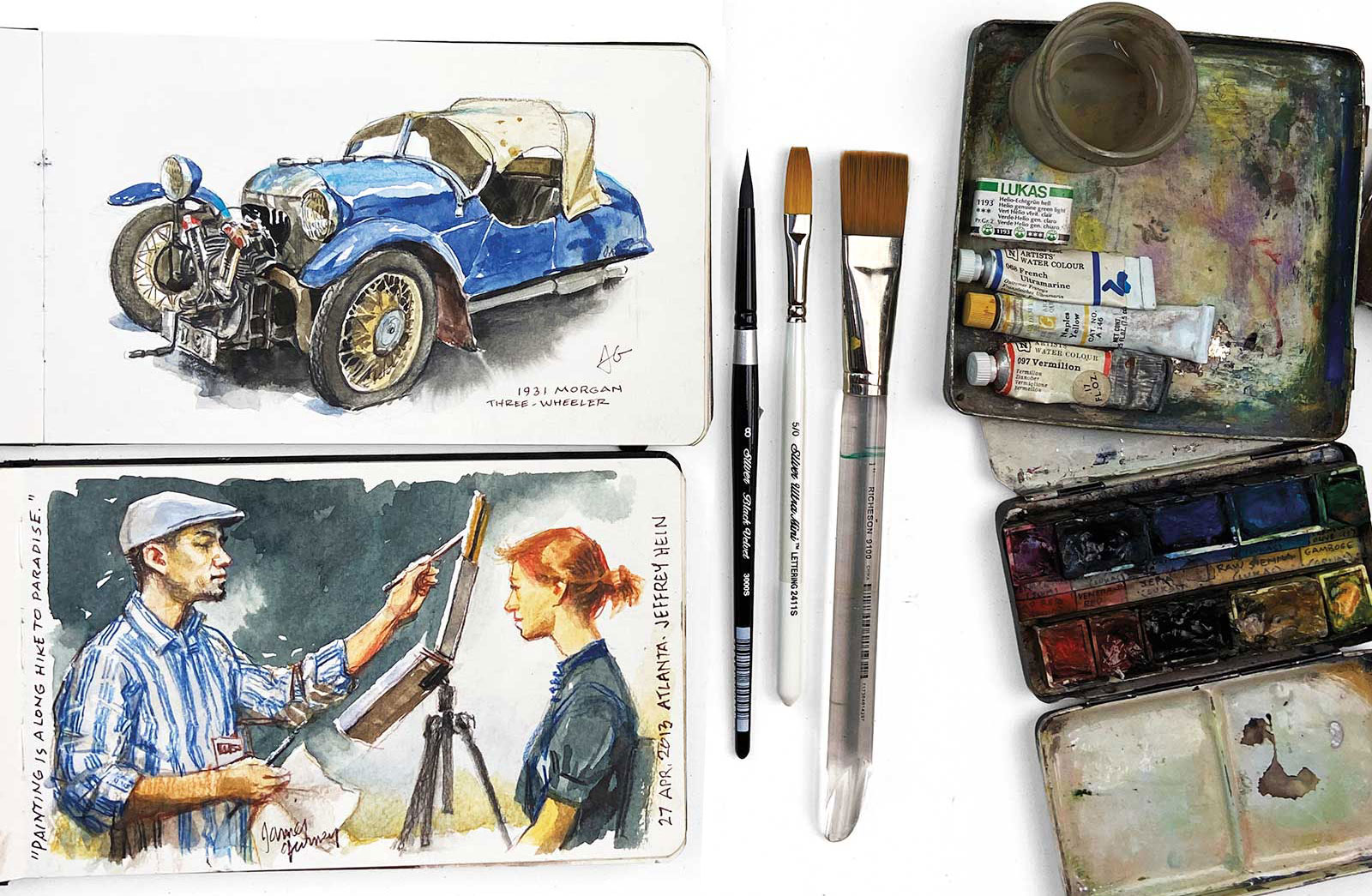
Top: Morgan Three-Wheeler, watercolor, 5 x 8” (12 x 20 cm); Bottom: Jeffrey Hein, watercolor, 5 x 8” (12 x 20 cm)
Watercolor
Opportunities
Watercolor is ideal for capturing information relatively quickly and directly. Its transparency allows for subtle layering and blending. Whether you use it from pans or tubes, it’s portable, responsive and easy to clean up. I like to think of it as the easiest—and the hardest—medium.
Challenges
Pure watercolor requires careful planning, as the white of the paper must be preserved for highlights. It can be unforgiving, as mistakes can be difficult to correct. The paint can also be unpredictable with unexpected bleeding or backruns.
My Approach
I like to start with a loose, wet-on-wet approach in the first pass to establish the overall tone and value structure. Then I switch to a more controlled, wet-on-dry method for details and textures. I often use a range of brushes, from flats to rounds to riggers.
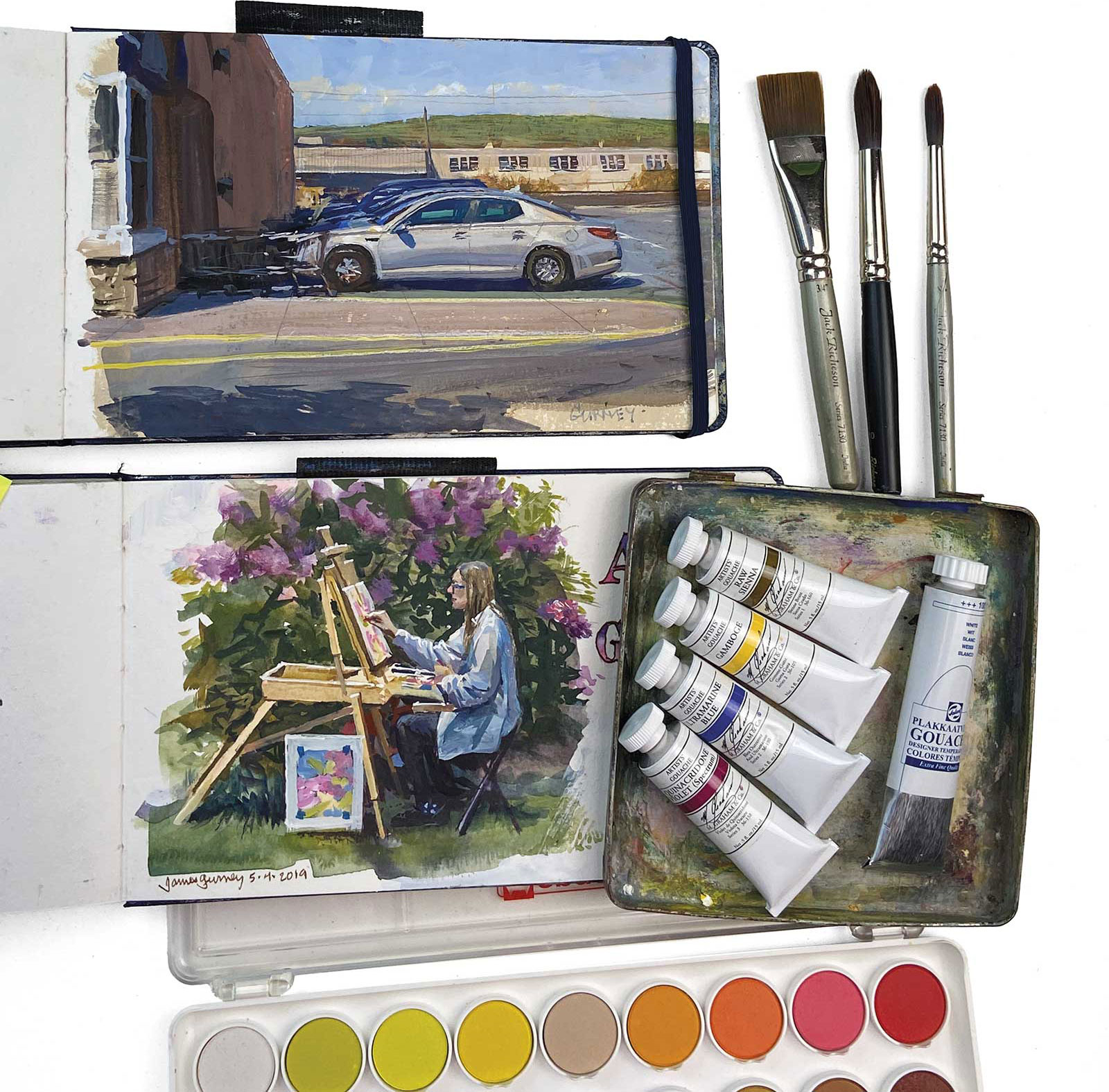
Top: Parked Car, gouache, 5 x 8” (12 x 20 cm); Bottom: Veronica, gouache, 5 x 5” (12 x 12 cm)
Gouache
Opportunities
Gouache can deliver bold statements and fine details and it comes in tubes, pans, and jelly form, with a wide range of color choices. It generally offers a high pigment concentration, and the better brands list the actual pigments. Gouache also retains its solubility even after it dries, which can be an advantage if you want to soften edges later. Its flat, matte finish makes it perfect for illustrations, designs and abstract compositions.
Challenges
Gouache isn’t cheap, so if you want to try it out, I recommend buying a small set or just three or four tubes from each of the leading brands. It can be difficult to match a given dry passage of color, as the paint tends to dry quickly and shift its value when it dries. Finished paintings have a fragile surface that must be protected behind glass or in a sketchbook. Because it dries matte, it can look chalky on a dark image, but you always have the option to varnish it.
My Approach
I use gouache mostly in a watercolor sketchbook, or on a rigid surface, such as illustration board. I often start over a preliminary pencil lay-in, or dive in with the brush, using a loose, gestural underpainting to establish the composition. As you’ll see if you watch my YouTube channel, most of my gouache paintings go through an “ugly duckling” stage.
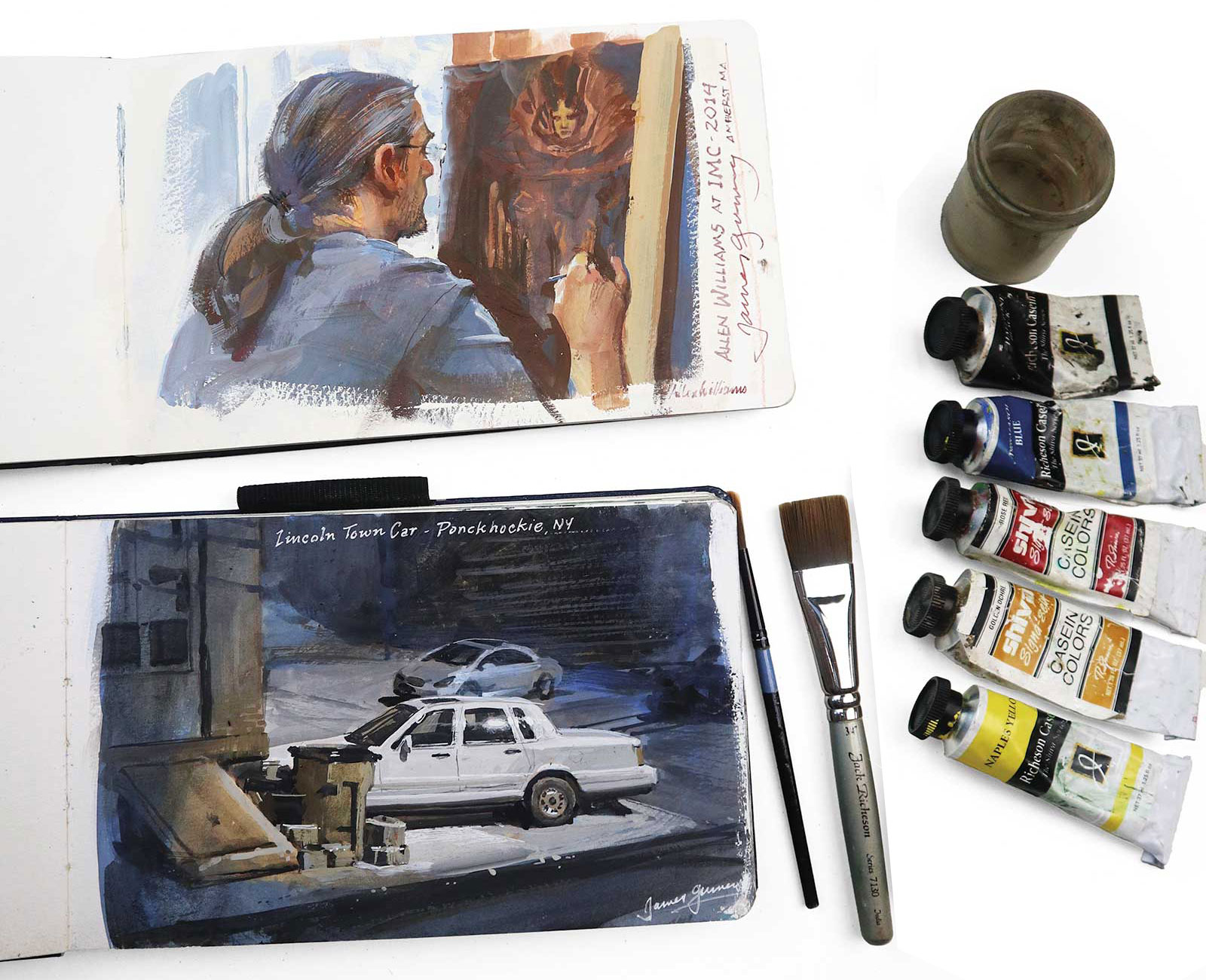
Top: Allen Williams, casein, 5 x 8” (12 x 20 cm); Bottom: Car Noir, casein, 5 x 8” (12 x 20 cm)
Casein
Opportunities
Casein is a fast-drying, opaque, water-based medium that can speak in many artistic dialects, from thin, watery washes to thick, impasto textures. It resembles gouache, but unlike gouache it dries with a relatively sealed surface, which means you can run a quick glaze over a dried section without reactivating the earlier layers. But the emulsion isn’t as strong as acrylic, so it’s easier on brushes.
Challenges
Casein can be prone to flaking and cracking if it’s applied thickly to a flexible surface, so if you want to build up impastos, it’s best to paint on a rigid panel. Casein has a striking “cleaning solvent-like” smell that you should test first to make sure you’re okay with it. Some folks love it and some don’t like it, but I wouldn’t use casein in an enclosed space among strangers in the wild for that reason.
My Approach
I reach for casein when I want a water-based medium to give me more of an oil-paint feel as it comes off the brush, giving a more buttery tactile experience. I also like to use casein in my sketchbook as a priming medium to paint over later in gouache, where gouache is the finish medium. When I go 100 percent casein, I typically paint with just six or fewer colors. I use a range of synthetic brushes—flats, filberts, and rounds—to achieve varying effects. For darker paintings, I use a non-yellowing gloss varnish to bring out the dark colors.
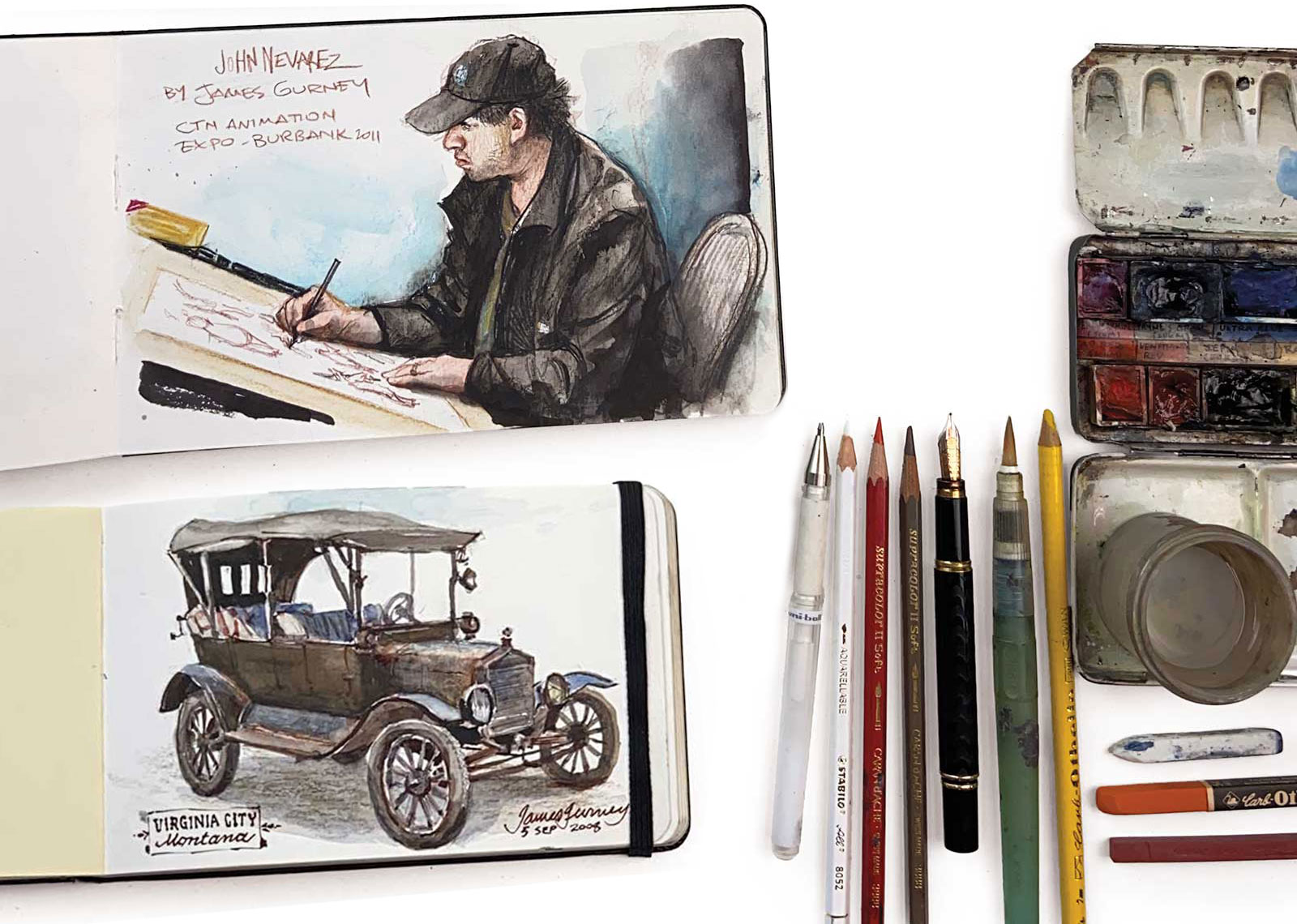
Top: John Nevarez, mixed media, 5 x 8” (12 x 20 cm); Bottom: Virginia City, mixed media, 3½ x 5½” (8 x 13 cm)
Mixed
Opportunities
You can combine most water-soluble media (such as acrylic, watercolor, gouache and casein) in a single picture as long as none of them dries with a glossy surface. You can also add lines from fountain pens, water-soluble colored pencils, hard sticks like Conté or Nupastels, and chalk-pastel pencils like CarbOThello pencils. White gel pens, like the Uniball Signo gel pen, are perfect for highlights and edge lighting effects.
Challenges
If you put down too thick a base coat of opaque paint, it can be hard to get dry media such as the pastel pencils or the colored pencils to grab onto the surface. Not every pigment and every medium is 100 percent stable or free from fading or rubbing off over time, so it’s a good idea to do test swatches of every combination you can imagine. As with any non-traditional analog method, experiment first and see if it works for you.
My Approach
When I want to sketch in a tricky situation, such as an art museum or a classical concert, I often use water-soluble colored pencils and water brushes, because they give me painterly effects with a minimum of bother. I also use a fountain pen with water-soluble red-brown ink, which conveyed the rust effect on the old car here. The colored pencils gave me the texture under the car and the lines on John’s paper. —
Disclaimer: Some of the products featured in this article were provided to me free of charge for testing purposes with no expectation of a positive endorsement. My opinions are based solely on my experience with the products and I’m not paid for including any brands.