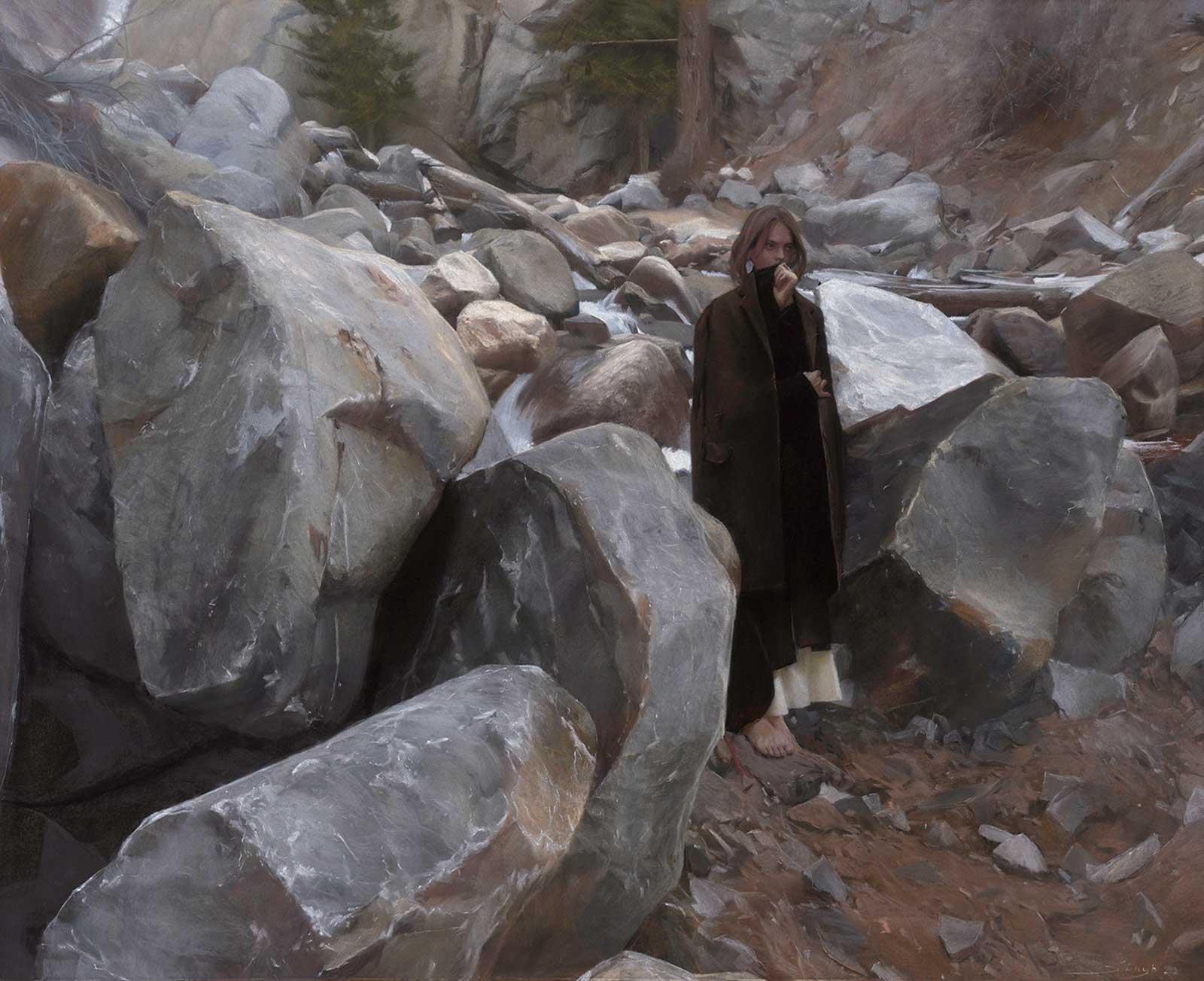
 Rockfall, charcoal, conté and pastel, 38½ x 47½" (97 x 120 cm)
Sean Layh
Inspiration
Rockfall is suggestive of an underlying story, but unlike many of my other works, the inspiration for the piece was not narrative but purely aesthetic. I had in mind a steep ravine cluttered with boulders, the evidence of a landslide that had swept away trees and ground. I wanted the piece to have a twilight feel: the gloaming atmosphere that makes such landscapes enigmatic. The artwork resolved when I placed a figure, whose softer features contrast nicely, among the clean edges and sharp angles. I find the work to be calm and pensive.
Process
Rockfall is a mixed dry media artwork that uses tinted charcoal, conté and pastel on watercolor paper. The process is messy and satisfying, with a ground layer of compressed charcoal acting as the substrate. The color tinted charcoal gives the work its subtle hue shifts, while scumbling conté creates many of the hard edges. Finally, pastel is responsible for the middling highlights that make the scene pop.
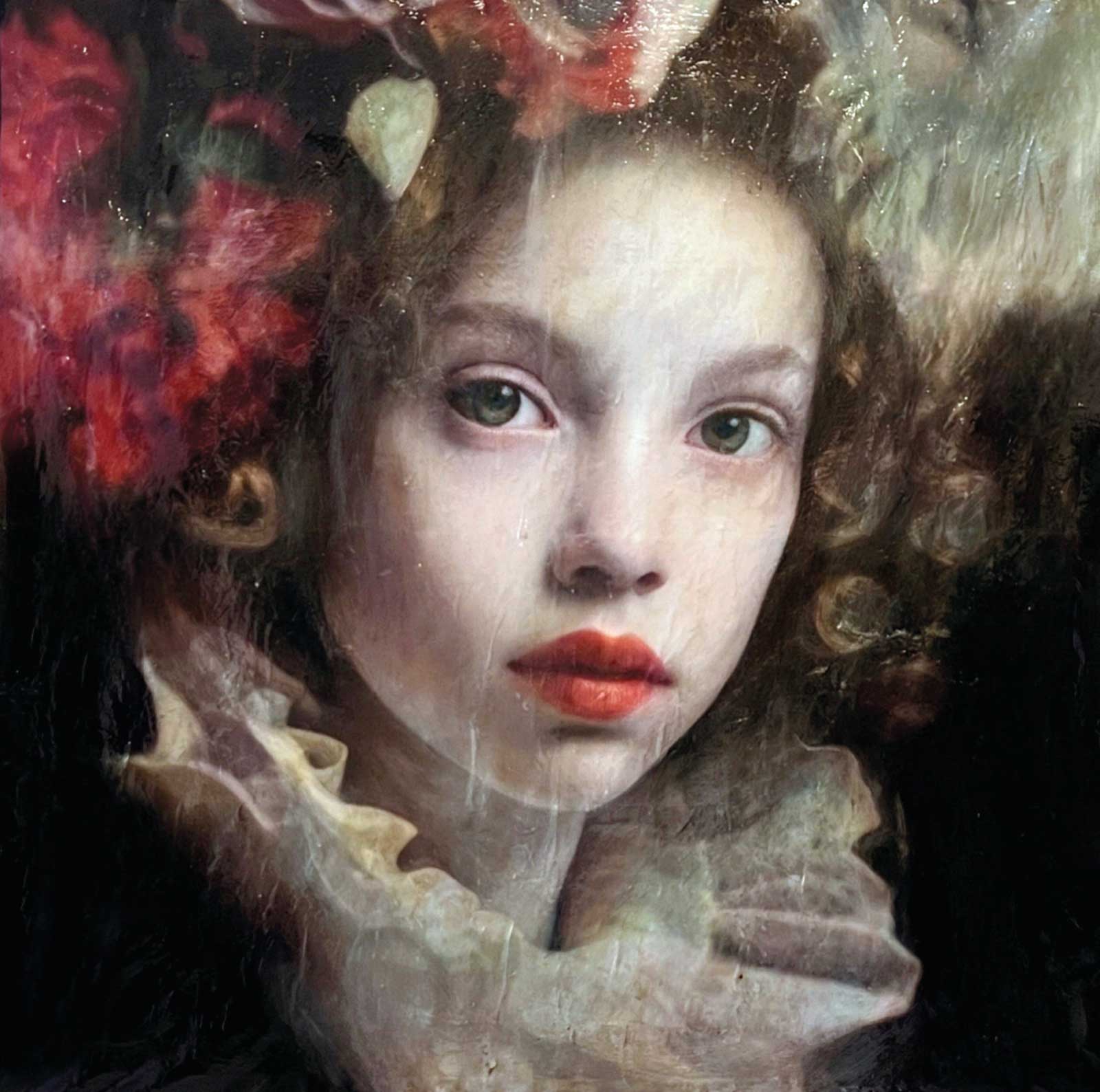 How Can Dust and Ashes Be Proud #2, acrylic on paper on canvas, 60 x 46" (152 x 116 cm)
Lavely Miller
Inspiration
I painted this while working on a solo exhibition earlier this year at Galleri Ramfjord in Oslo, Norway. Most of my work is primarily visually inspired and without narrative context. I think about and paint what I see, or what I imagine I see. Having said that, I work so much that I’ve run out of real people to paint, so a lot of my work comprises faces I’ve made up. I combine pieces of various individuals I’ve worked on over the course of several decades until I see something I recognize.
Process
For the past 20 years, I have painted primarily in acrylic with my fingers. In recent years I’ve started experimenting with an adapted type of Flemish-style painting, building up the image with thin glazing layers, which I paint over paper affixed to canvas. The glazing layers help create a greater sense of realism and depth, and the paper contributes to the wrinkled, aging texture in the background.
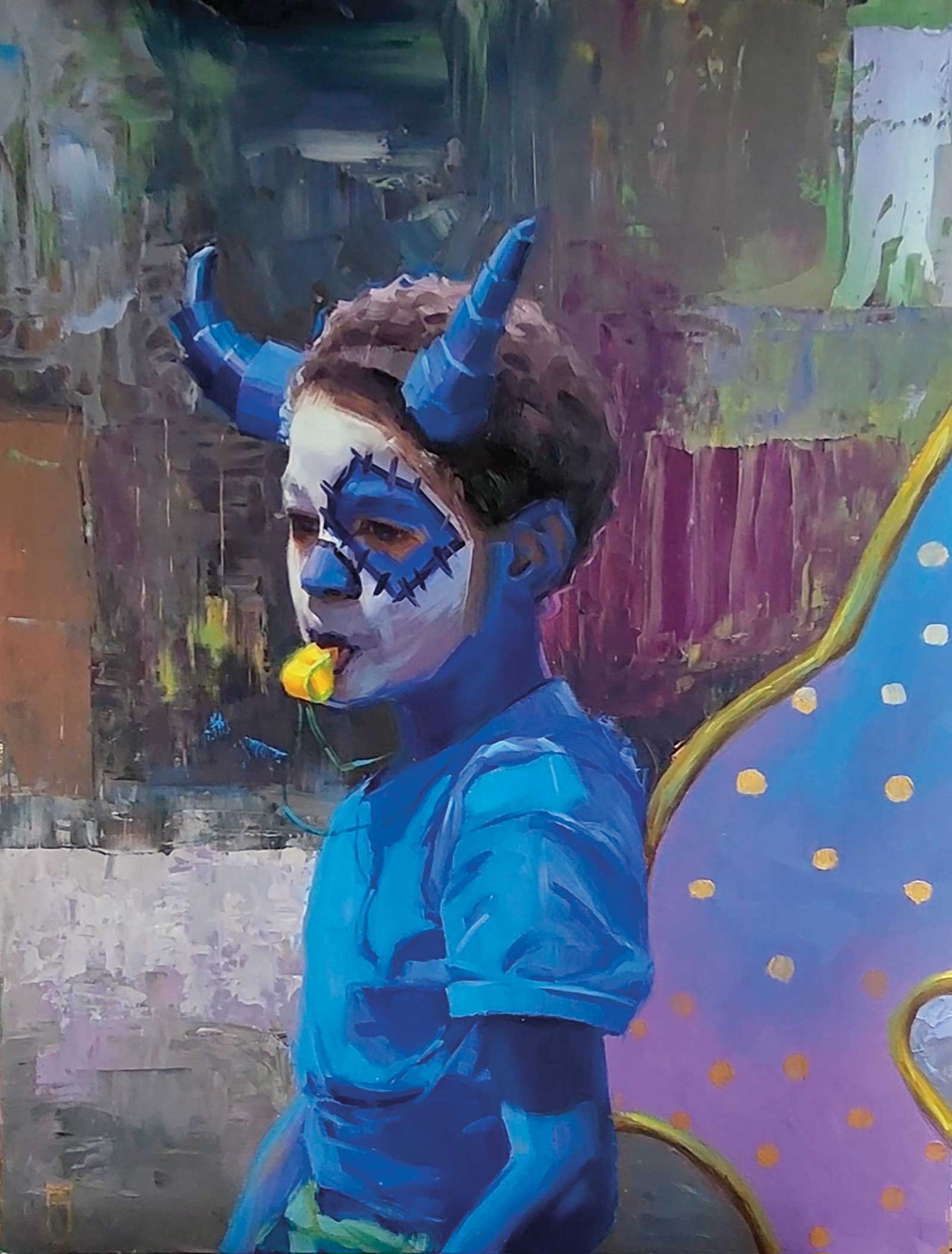 Whistleblower, oil on primed linen, 16 x 20" (40 x 50 cm)
Marissa Lee
Inspiration
There is an annual national celebration in Trinidad and Tobago called Carnival which includes weeks of festivities, competitions, masquerades and large-scale parties. It culminates in a nationwide, two-day parade. The main aspect of Carnival is the masquerade, known locally as “Mas,” which falls into two categories: “Pretty” and “Traditional.” Under Traditional Mas, there are characters with very specific features that performers dedicate their lives to portraying every year. One is the Blue Devil or Jablé. The devils (Jabs) are covered in “Blue” which is a substance made from rendering grease and laundry blue. They wear horns, tails, wire-framed wings and carry PVC pitchforks while dancing through the streets to the music of drums made from burnt biscuit tins. Blue devils are known for raw, high-energy performances while often doing fire breathing stunts or blowing shrill whistles. I am friends with a troupe called the Next Level Devils who have allowed me access to their camp and festivities, resulting in a huge amount of material and inspiration for my work. The Next Level Devils also has a kid’s section, which was the subject of this painting. The model is a young boy named Marcel who is being raised by a family of blue devil performers. The painting is of him during the Kiddies Carnival parade in the streets of Port of Spain.
Process
For this painting I used photo reference taken during the Carnival festivities. I started with an under sketch in burnt sienna, which I used to map out my shapes and values before adding color. The rest was done alla prima over two or three sittings. I find it easier to finish a section at a time before ending a session to preserve the wet-on-wet feel that I prefer. I used a palette knife in the background to stop myself from getting carried away with detail and to bring in some abstraction.
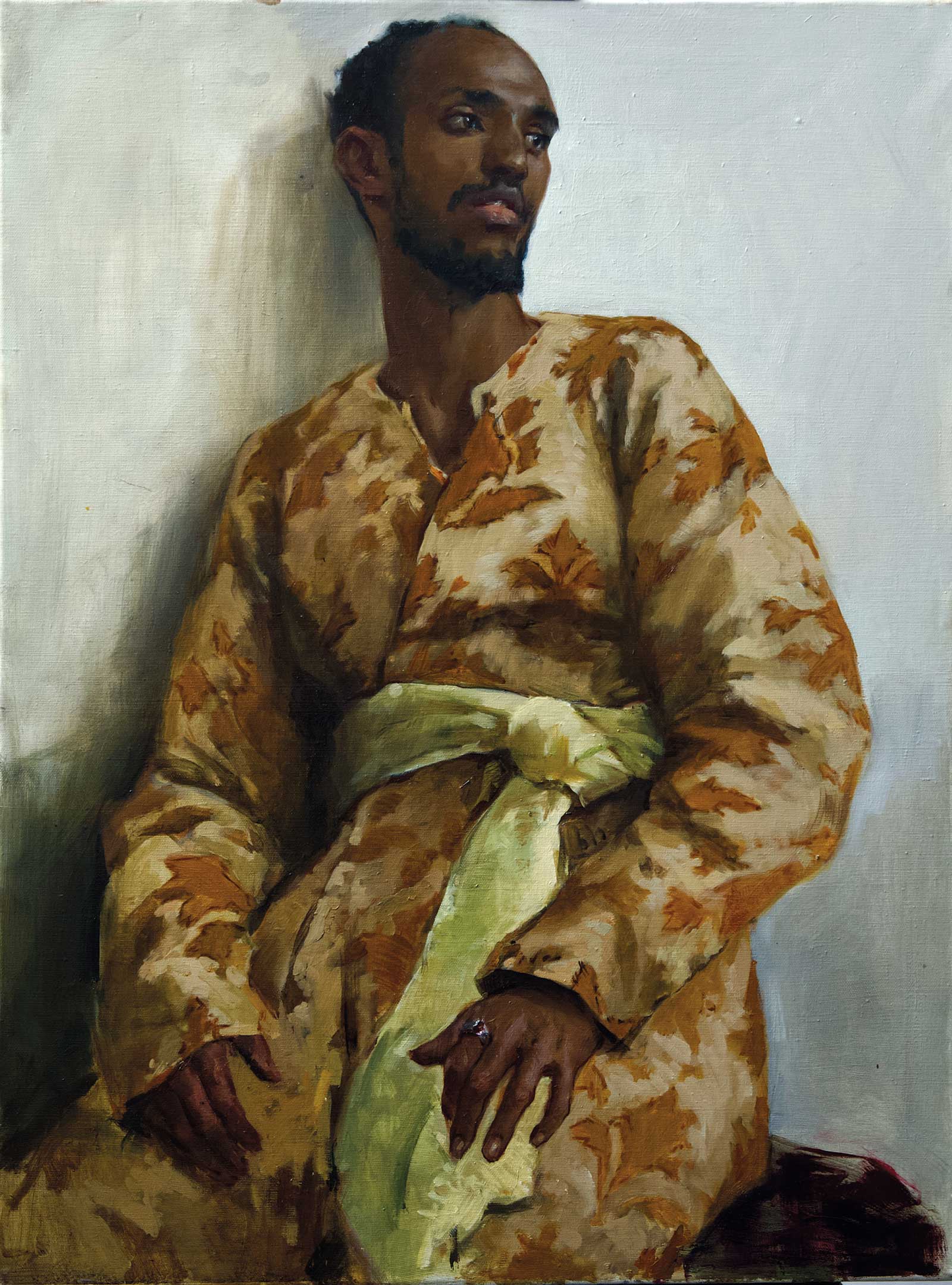 Teo, oil, 31½ x 23.6" (80 x 59 cm)
Olga Guzhbina
Inspiration
During my studies, I worked on portraits of different people every day. When you study, the main task is to capture the character of the subject, make an accurate drawing, and understand the color and tonality, but I always wanted to pay more attention to the image. I think that a truly good portrait is made not only by pictorial accuracy but also by psychology. This is one of the reasons I try to work with a live model as much as possible. I am interested in observing the model and looking for his or her most expressive and beautiful manifestations. It is a very exciting process, to feel a person.
Process
Teo is my colleague, also an artist, and I asked him to pose for me. I was inspired by the work of orientalists, particularly Vasily Vereshchagin. It seemed to me that Teo’s image is very close to that aesthetic. The most difficult thing was to find a suitable pose and angle. I tried various positions for Teo for a long time, asking him to look up, then down, again and again. In the end, the pose was found. I wanted to show a moment of some expectation. I used a limited palette for this portrait. We met five or six times, and the clothes required a lot of attention because I wanted to create an accurate pattern on the clothes. —