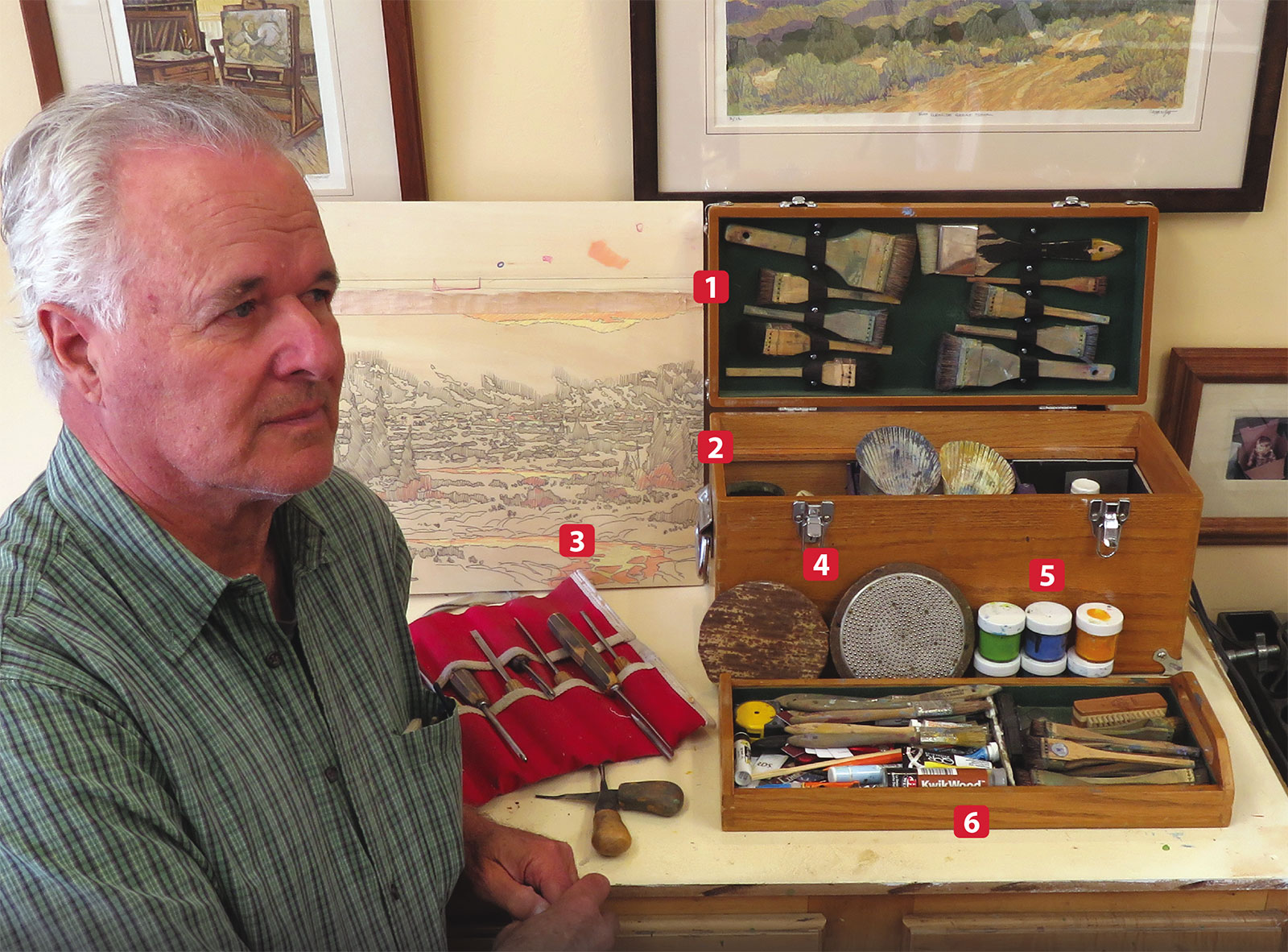
My woodblocks are created using the Japanese style of printing commonly referred to as moku hanga. I find the print process can be very painterly and spontaneous, as much as a slow and tedious process can be. The most attractive aspect of moku hanga is that it is all hand-work—no mechanical equipment is involved. Everything I need to print fits into an oak toolbox. This means I can print anywhere I can carry my printbox.
- The lid holds an assortment of inking brushes, which allows me to ink large areas or small delicate details. The rectangular stiff-hair brushes are made specifically for moku hanga in Japan.
- The body of the printbox holds an assortment of materials from pigments, rice pastes, mixing trays, ink jars and various barens.
- My carving tools are stored in a cloth roll-up and are carried separately from the printbox.
- Assorted barens are stored in the body of the printbox. The baren is a round disk usually covered with a bamboo leaf. The baren is the printing press in moku hanga printing. There are different sized barens as well as textures.
- The ink for moku hanga is a mix of rice paste, water and pigment. I mix the colors I need and store them in small jars that fit into the body of the printbox.
- The top tray holds some smaller inking brushes, assorted brushes, registration tabs and other handy tools.
With the printbox, all I need is a sturdy table to start printing. This means I can print in my mountain studio, my Denver studio or gallery events with my favorite tools at hand. My woodblocks vary in size from 9 by 6" up to 18 by 24". Obviously, a larger block requires a larger table, but the materials and equipment remain the same. —