There is often a world of difference between what we look at and what we see. If a dozen painters of equal skill are asked to paint the same subject, you would likely find an equal number of wildly different interpretations. Despite objective training and experience, we cannot help but interpret our visions of the world through the prism of our own unique memories, hopes, dreams, fears and aspirations. Human experience is our way into art and how we begin to find our own creative voice.
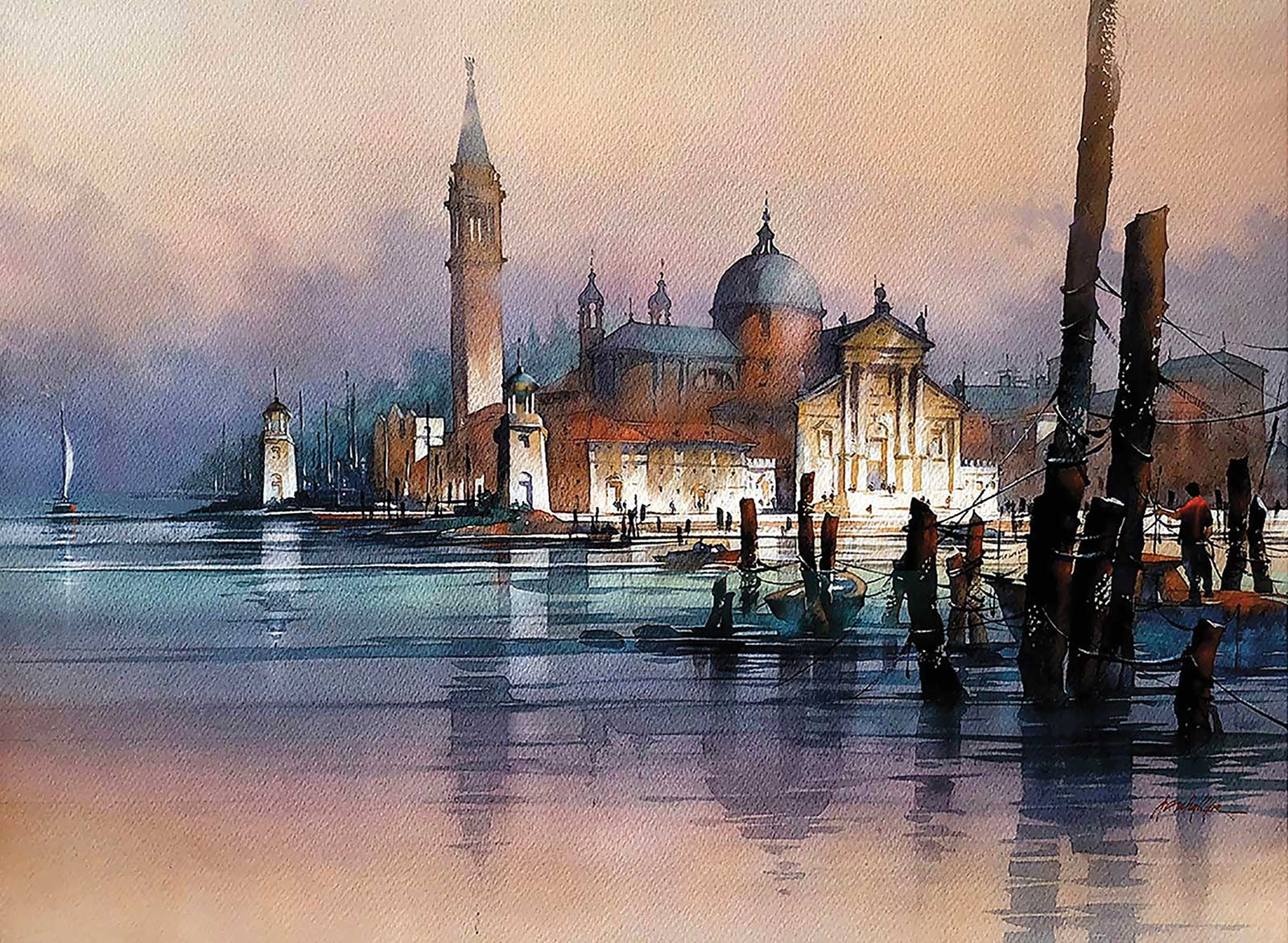
Floating City, watercolor, 22 x 30" (55 x 76 cm) Probably nowhere on earth is more often painted than beautiful Venice, Italy. And for good reason. It is indescribably beautiful. It is also a deeply moving tribute to the ingenuity, resilience and capability of humans. It is also simply a most improbable place, floating lightly on the sea as it seems to do. The subject of this painting then, is not so much the beautiful Palladian masterpiece shown, rather the dream-like improbability of the place itself.
I never wish to simply paint a faithful replica of a person, place or thing. Rather, I always try to interpret my personal experiences of those people, places and things—whether they exist in the real world, or as memories, or even constructs of imagination and pure invention. And in this way, if my paintings succeed, I will have established an intimate, silent dialogue with fellow humans across the span of time or place through the wordless language of art. There is nothing more important than the hope of this very human connection.
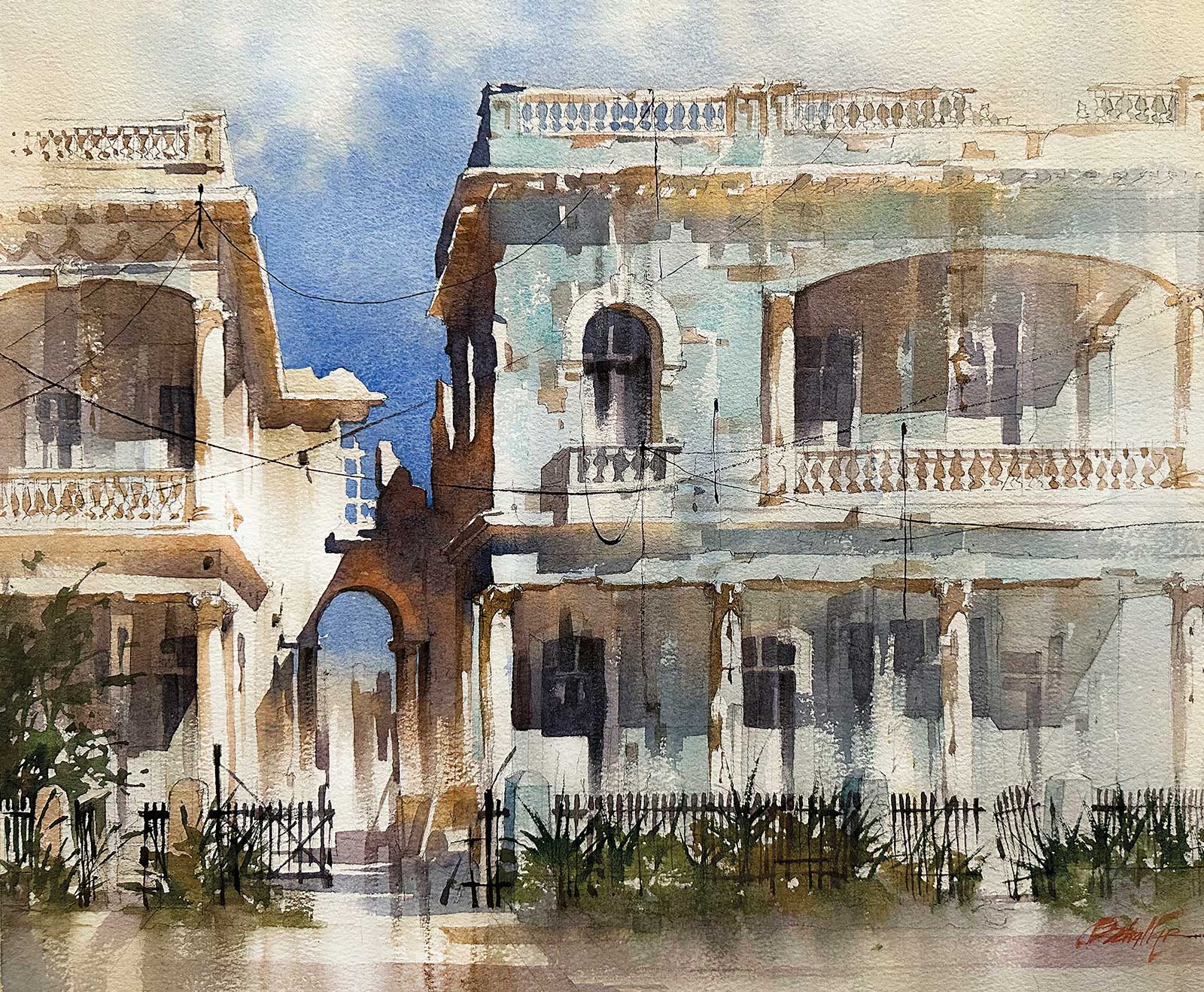
In the included demonstration painting for example, at first glance, the subject may seem to be two historic buildings in Havana, Cuba. But it is not. The subject is actually the space between the buildings. By orchestrating the focus in this way, I hope to use atmosphere and negative space in dialogue with the built environment as a way to spark a deeper conversation about substance and void, construction and deterioration, and the passage of time. This beautiful city can break your heart. Battered as it has been by constant political, economic and environmental unrest, it still retains a defiant beauty, elegance and optimism. And that is the real subject of my painting.
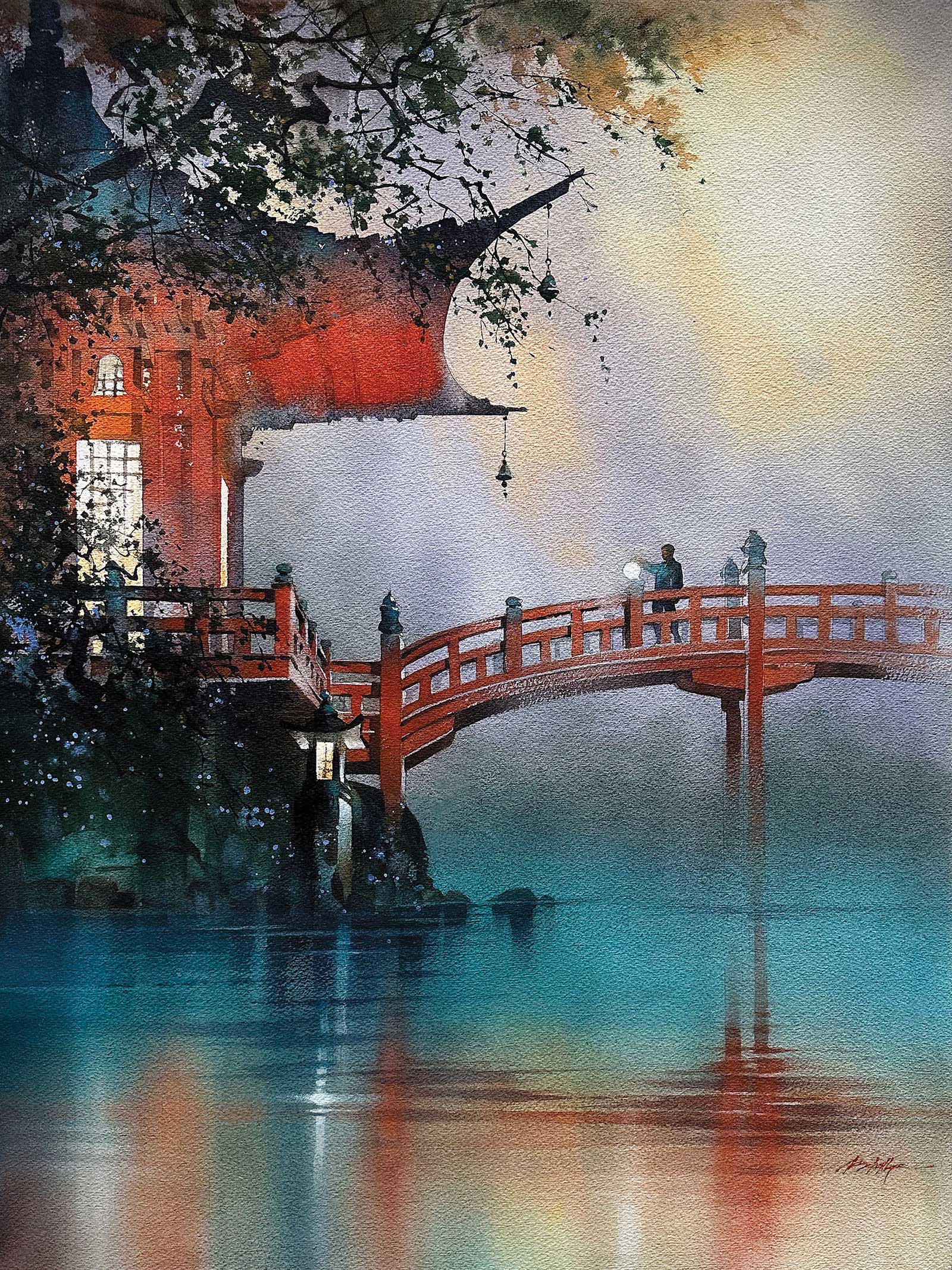
Kyoto Nocturne, watercolor, 28 x 20" (71 x 50 cm) My visits to Japan, the Kyoto area specifically, have been life-changing. This painting represents no actual place, but rather a memory-based amalgam of the transcendent, spiritual beauty of so much of what I experienced there.
As an instructor, I am often asked how an artist develops a personal style—a way of painting that sets one apart from others. Of course, this is a question that we all must answer for ourselves, but I can offer a few suggestions that have seemed to help me along the way. There is a natural tendency among aspiring painters to concentrate too intensely upon methods and materials. What works for another may or may not work for you. And more importantly, we should strive never to compare ourselves to others. Of course, there will be painters we admire who seem to do things we could never do. And that is true. We cannot paint like them. Nor should we want to. And remember, they could never paint like you. The most crucial thing is to trust your own instincts. When we learn to trust and respect our own inner voice, it will guide us toward the subjects only we wish to paint. And the methods and materials will emerge as the ones that best serve our style. Lastly, what and how we may paint can be interesting, but why we choose to paint in the first place is crucial. I believe we all have within us everything we need to be the best painter we can possibly be. When we learn to trust our own unique creative voice, the possibilities are boundless.
My Art in the Making The Space Between – Havana
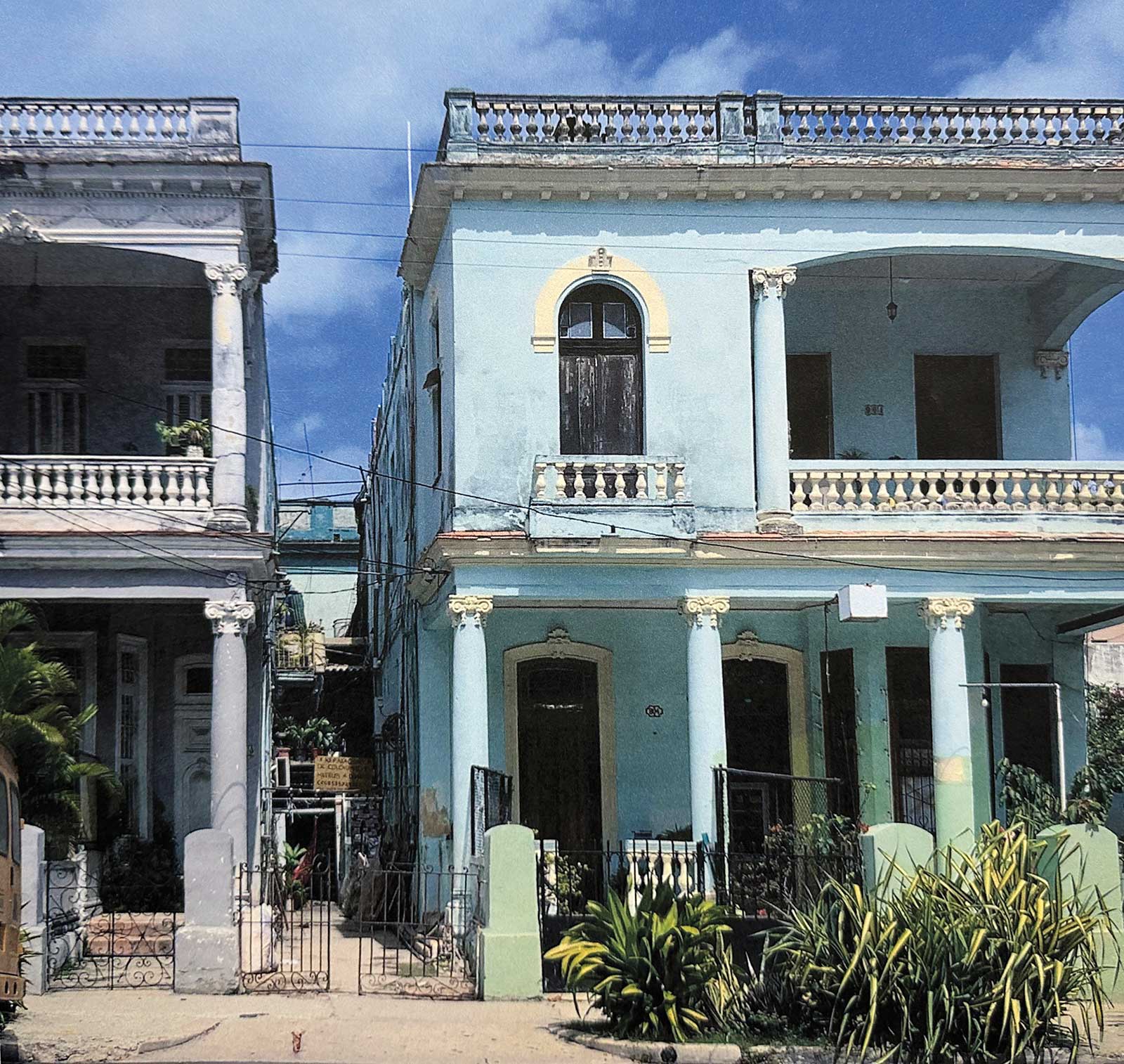 Reference Photo
Reference Photo
Havana retains a beautiful resilience. This seems equally true of the people, the culture and the architecture of this great city. The faded elegance of so much of the city’s fabric speaks eloquently in the silent language of time as much about what is not there as it does about what is. This is the story I want my painting to tell.
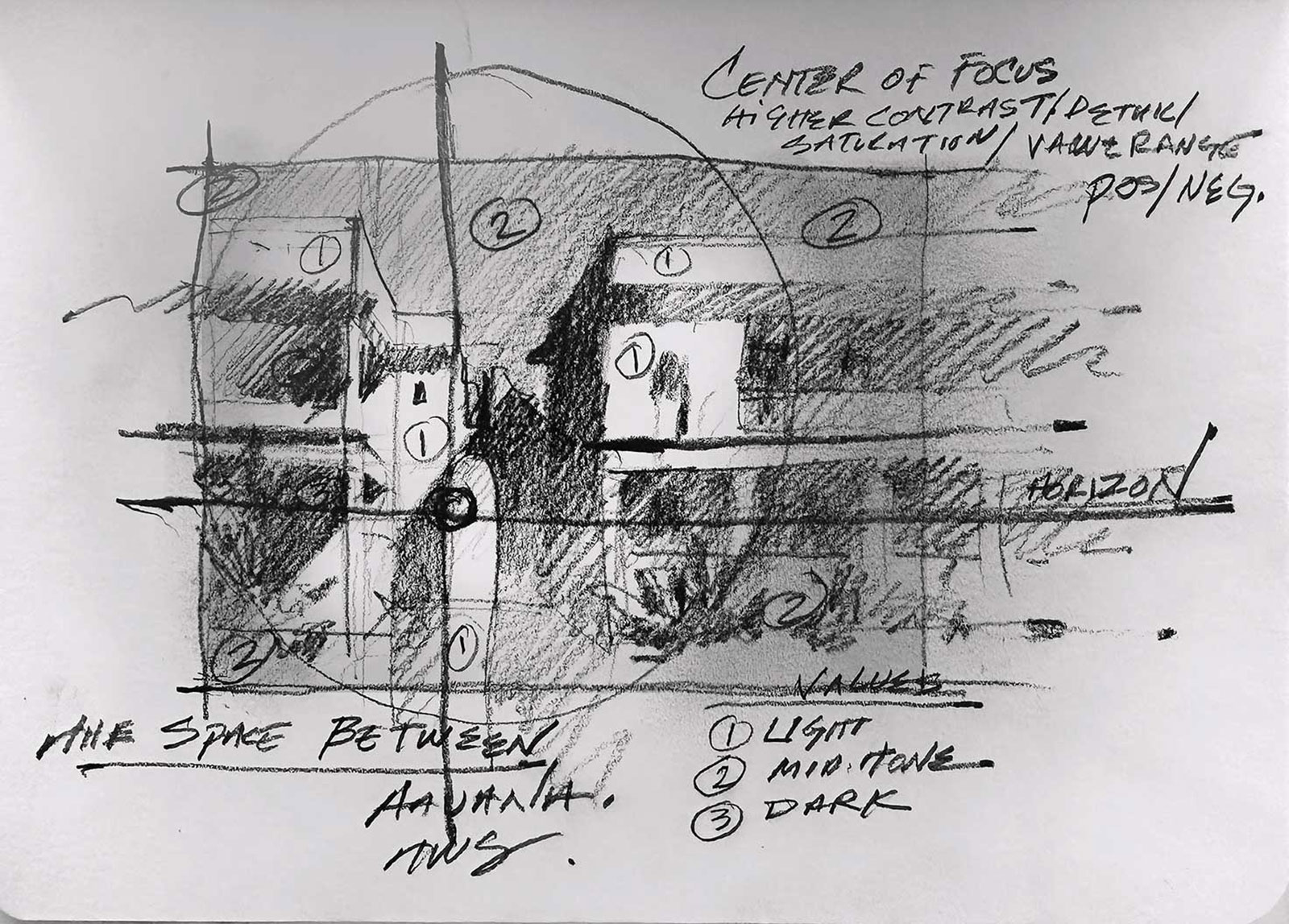 Stage 1
Stage 1 Composition/Value Study
My process prioritizes the importance of a quick preliminary study. Here, I am able to transition from the reality of observation or photography to the more emotive reality of artwork. In my sketchbook, I decide the format and the focal point of the work. My intention is to emphasize the space between the two buildings rather than the buildings themselves. All other decisions will spring from this idea. I begin to design the elements—real and imagined—into the painting I hope to create.
WHAT THE ARTIST USED
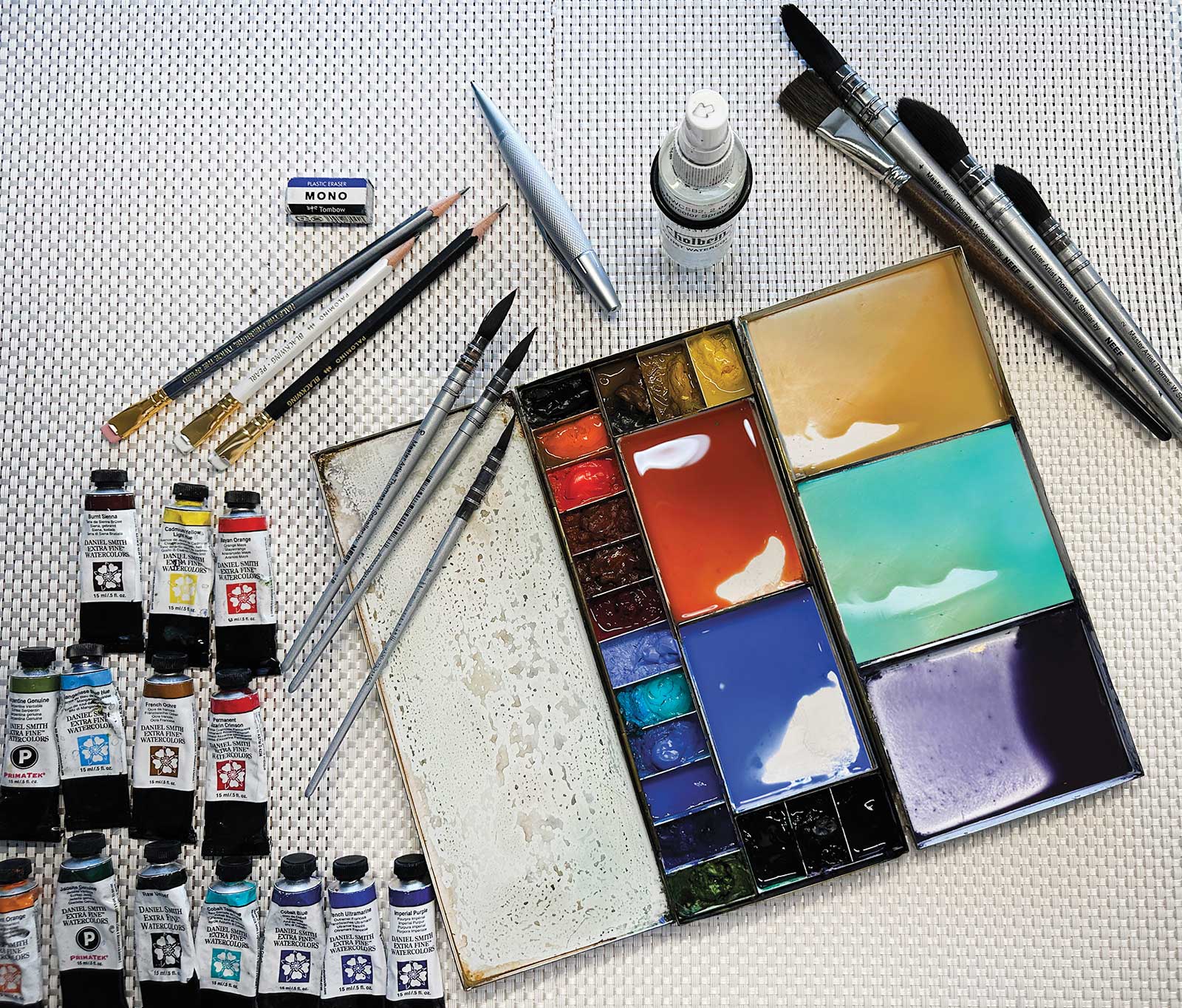
Daniel Smith Watercolors
Naples yellow, French ochre, Raw umber, Sepia, Permanent orange, Mayan orange, Burnt sienna, Alizarin crimson, Cobalt teal blue, Magnesium, Cobalt blue, French ultramarine, Imperial purple, Neutral tint
NEEF Brushes
Master Artist Thomas W Schaller Series, sizes, 6, 4, 2, #/0, 2/0 and 1/0
Escoda Brushes
Versatil Series, ¾" flat, ½" flat, Perla Series, size 12
Additional Materials
Baohong Masters’ Choice watercolor paper, rough surface, 300 gsm, Gatorboard support, Stillman and Birn Beta Series sketchbook, Blackwing 602 and Pearl Series sketch pencil, Faber-Castell E-Motion mechanical pencil, Tombow MONO eraser, Holbein water mist bottle, Masking tape, Paper towels
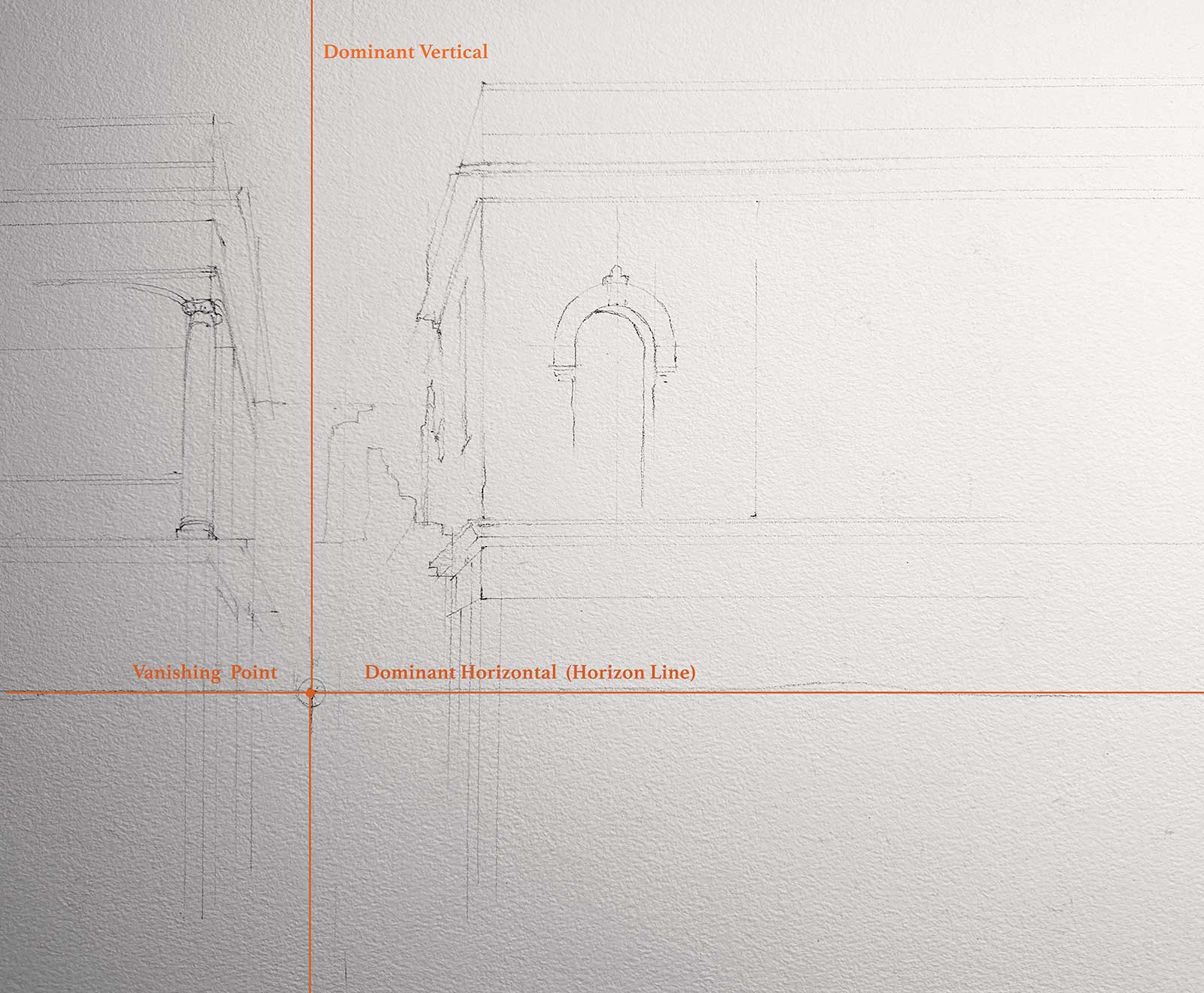 Stage 2
Stage 2 Initial Line Work
Moving on to the linework on the painting surface, I begin to translate what my intention and my sketch has taught me. I redesign the space between the buildings as the focal point of the painting to come. I have widened this area and invented a visual axis deep into the painting to highlight and support my intention. The point at which the dominant horizontal and dominant vertical lines cross is the single vanishing point in this simple one-point perspective. These also demonstrate the creation of a harmonious “rule of thirds” landscape format composition.
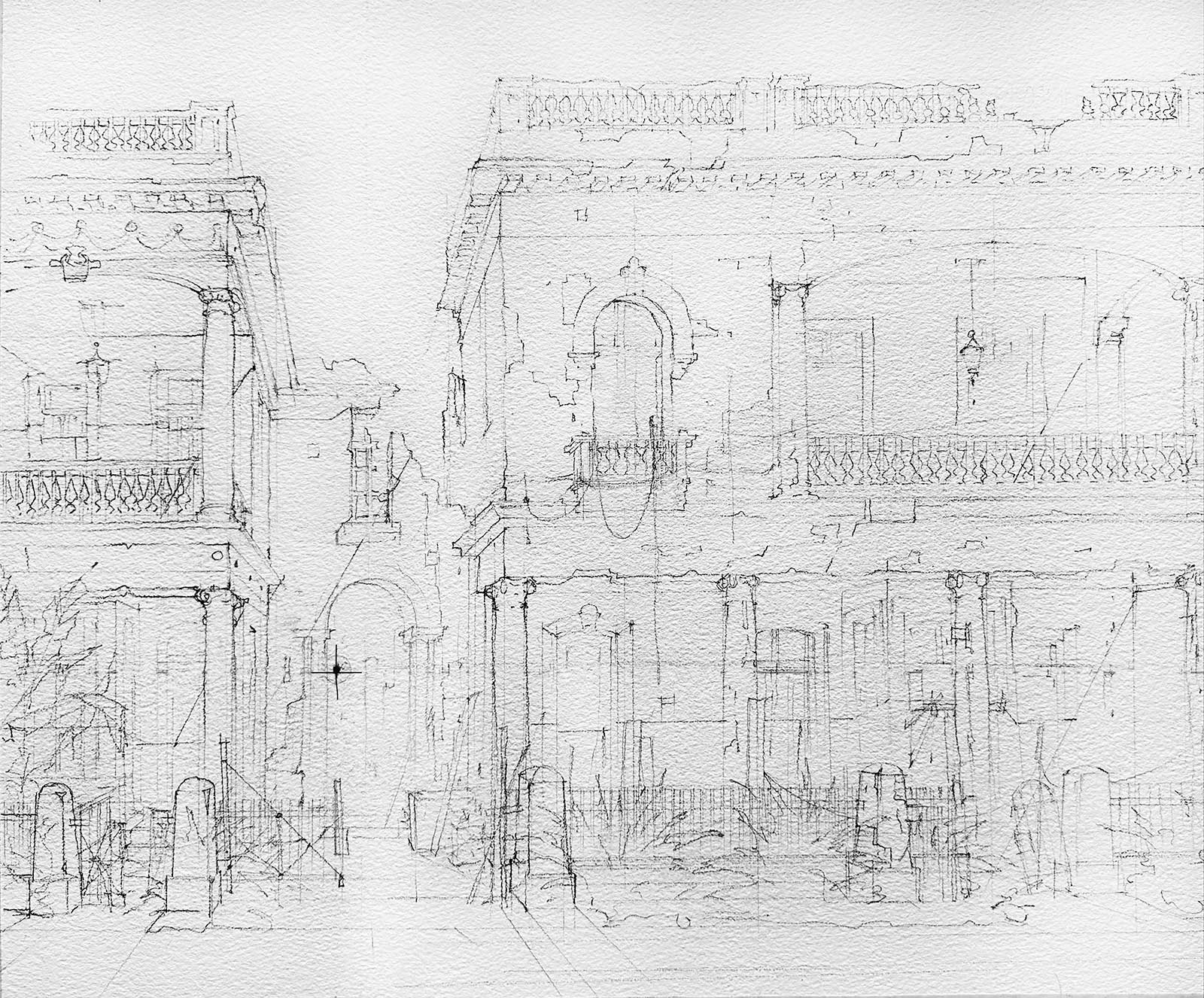 Stage 3
Stage 3 Final Line Work
All elements of the work have been lightly sketched onto the painting surface. The invented focal point begins to emerge as the star of the show. The single perspective point and design of elements has created a harmonious rule of thirds landscape composition.
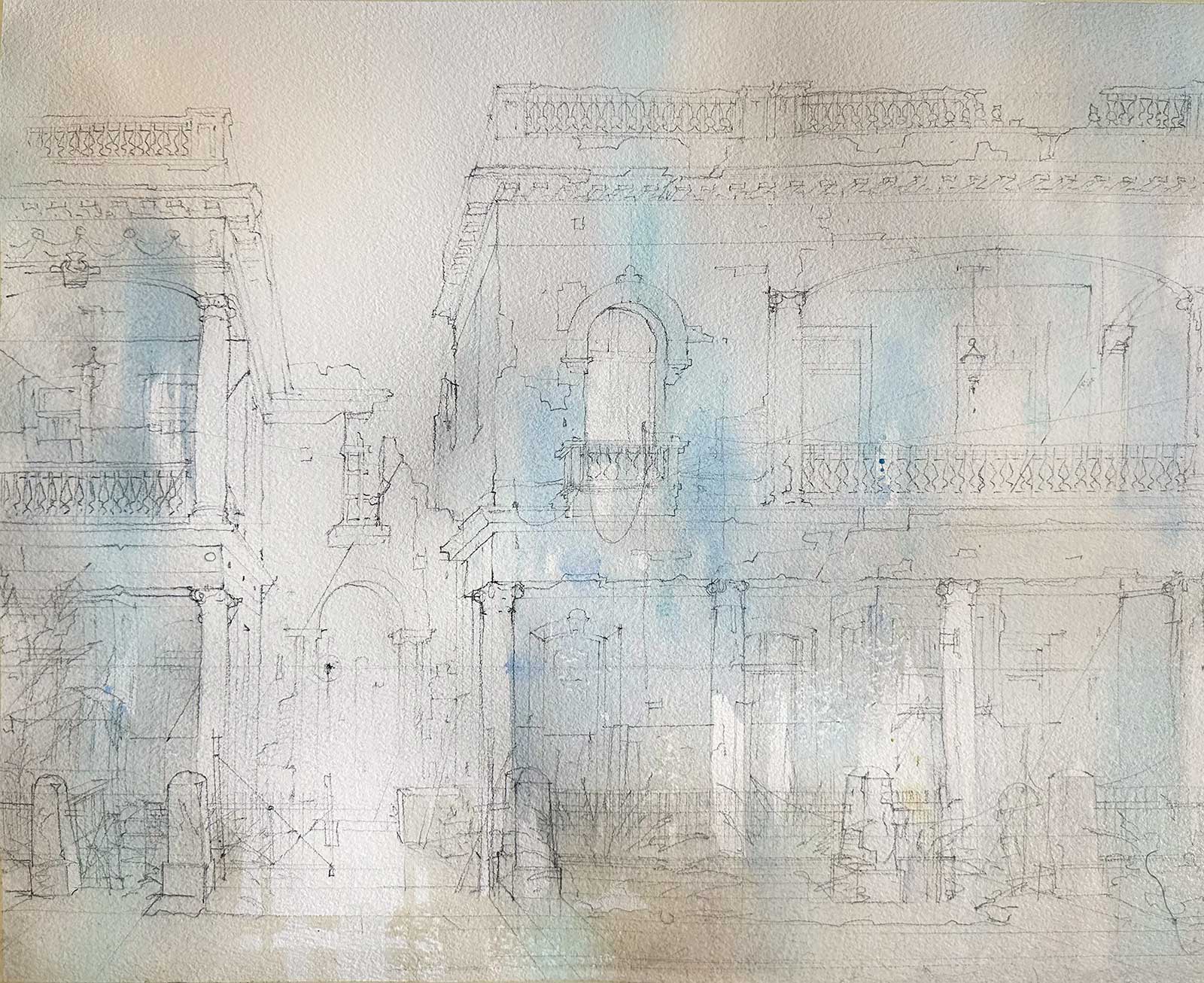 Stage 4
Stage 4 Carving the Light
In watercolor, we do not paint light—we reveal it. One hundred percent of the light is already there on the unpainted paper. In this sense, watercolor is a subtractive medium. We subtract enough light, by adding shade and shadow, in order to give light its identity. Here, using mostly larger flat brushes, I begin to vigorously carve away light to ensure that the focal point of the painting will be the area of maximum lightness, darkness and contrast. The viewer’s eye will naturally be drawn there.
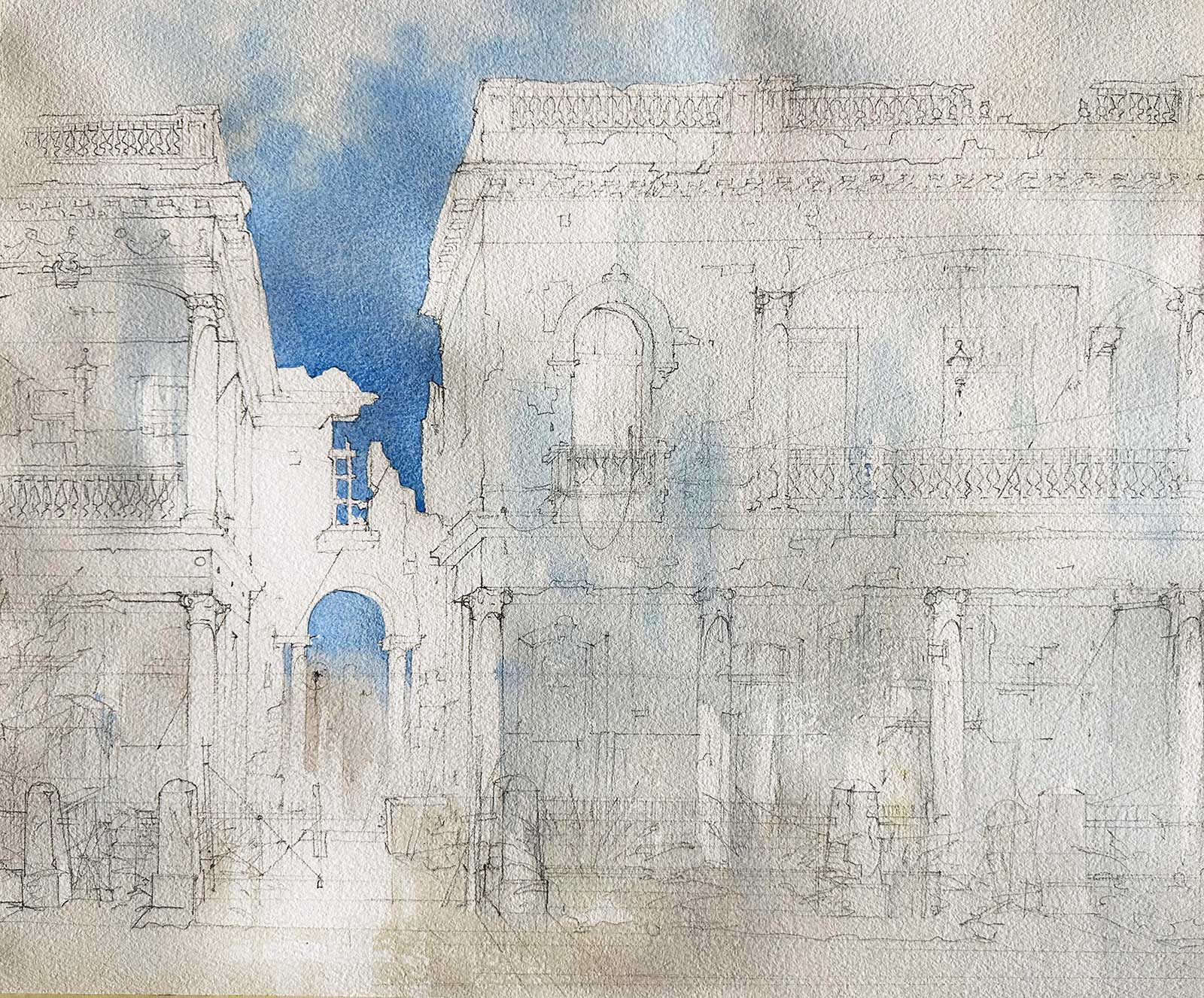 Stage 5
Stage 5 Sky Wash
Using a mid-sized mop, a simple background sky is laid in as a compositional element. More saturated areas of the sky have been applied as negative-shape painting near and around the focal point of the painting to enhance its interest and help direct the viewer’s eye here.
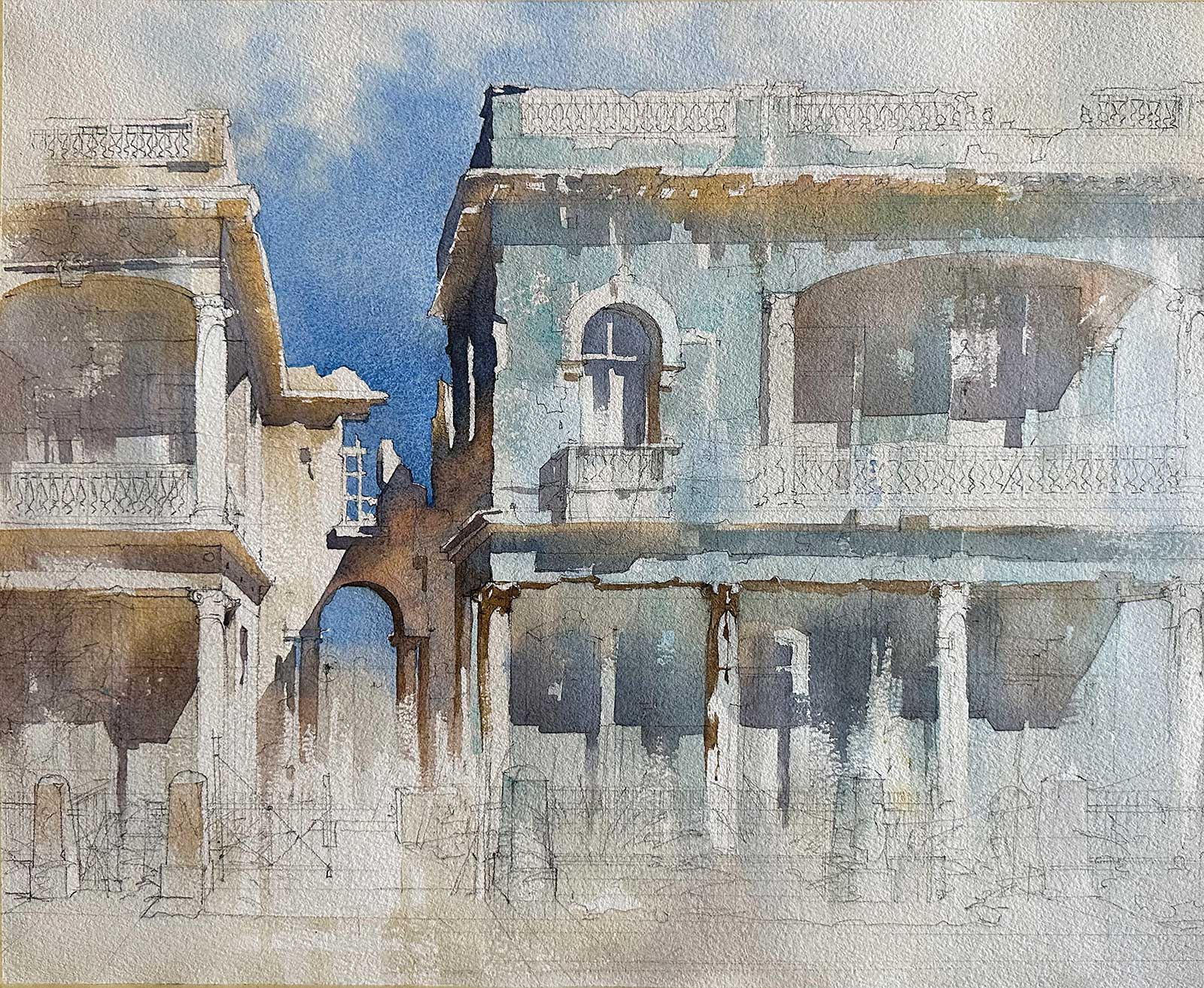 Stage 6
Stage 6 Primary Shadows
To reveal the light and direct the viewer’s eye toward the focal point, the primary elements of the building’s material and the dominant shadows have been laid in using a mid-sized flat brush. The clearest and more saturated elements are applied near and around the focal point. All begins to fade subtly as it radiates out further and further from this area.
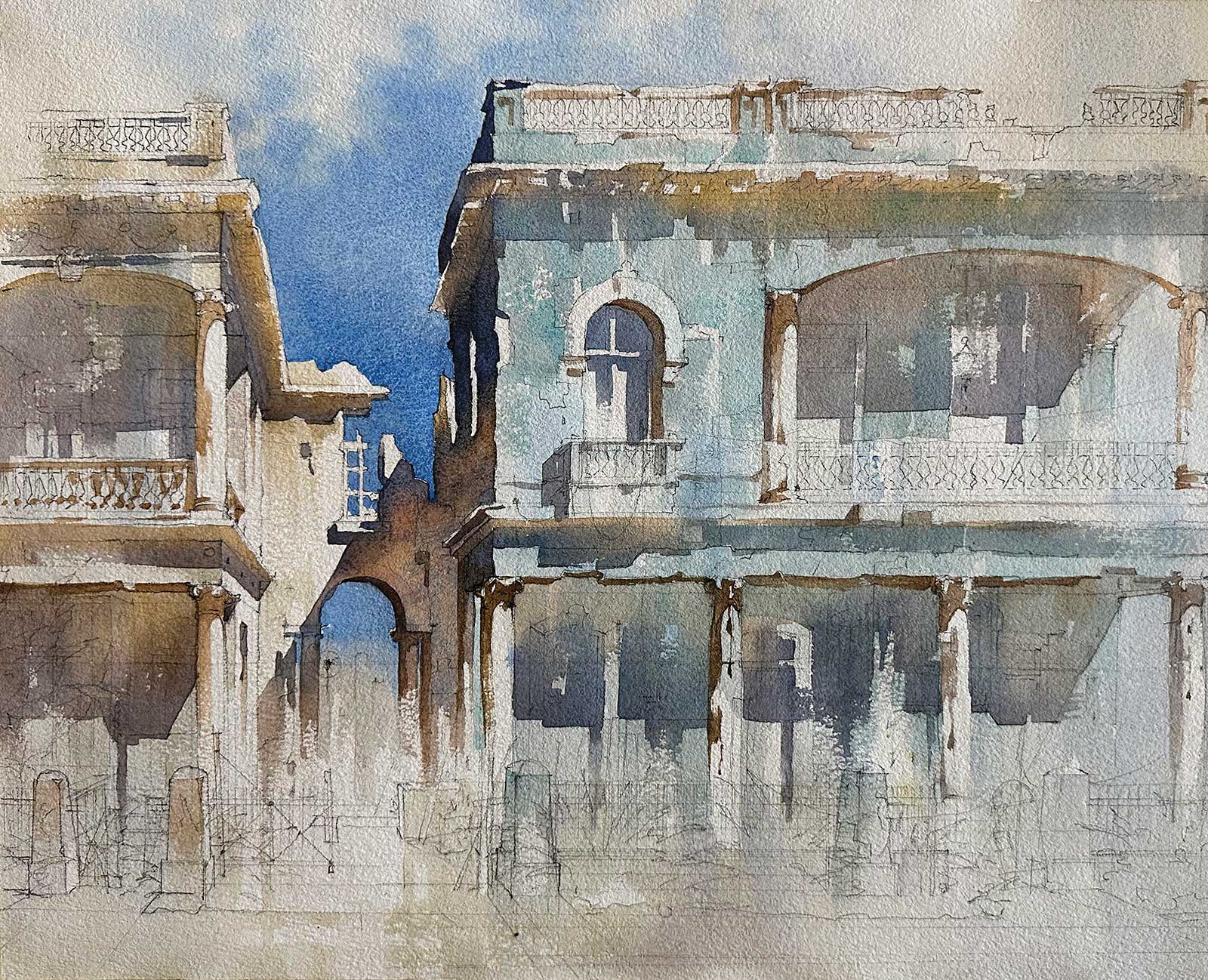 Stage 7
Stage 7 Final Shadows
The final shades and shadows on and from the building areas are applied using rounds and small to mid-sized mops. I have taken care to enhance the clarity, value and saturation of these elements the closer they come to the focal area of the work.
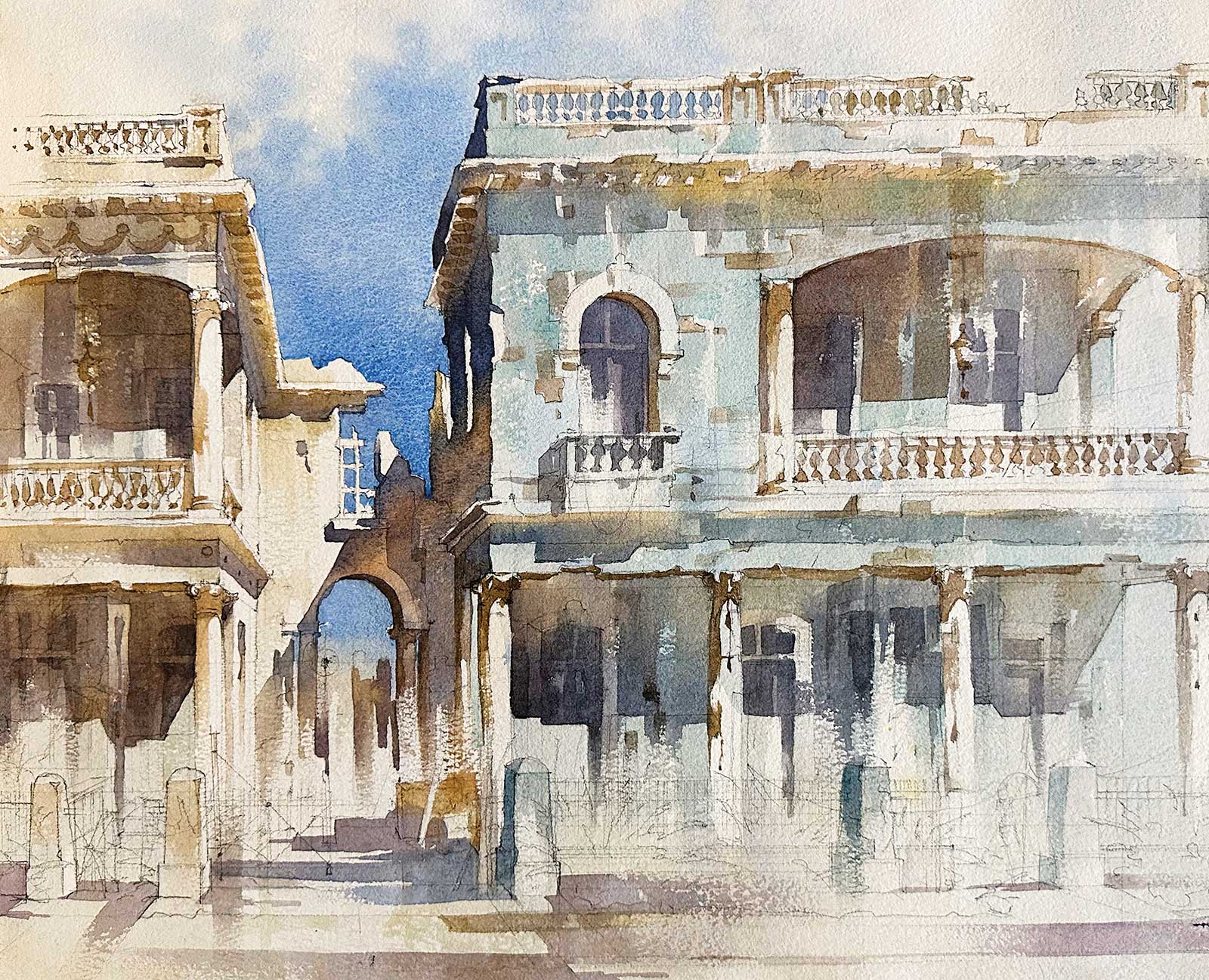 Stage 8
Stage 8 Last Building Details
All late-stage building elements are added using small round and flat brushes. It’s important to note that I have not been referring to the reference photo at all for some time. I am not attempting to be “accurate” or pictorial. I am adding only what I believe will enhance the story of the painting.
 Stage 9
Stage 9 Finished Artwork
The Space Between – Havana, watercolor on rough 300 gsm Baohong paper, 15 x 20" (38 x 50 cm) The smaller foreground elements are added, including the landscaping, fencing and power lines, in a less transparent way. I am using a very small NEEF mop brush much like one would employ a rigger. These marks are not intended to represent “reality” as much as they are meant to add important texture, dimension, and help to connect all elements of the work.
About the artist
 Thomas Wells Schaller
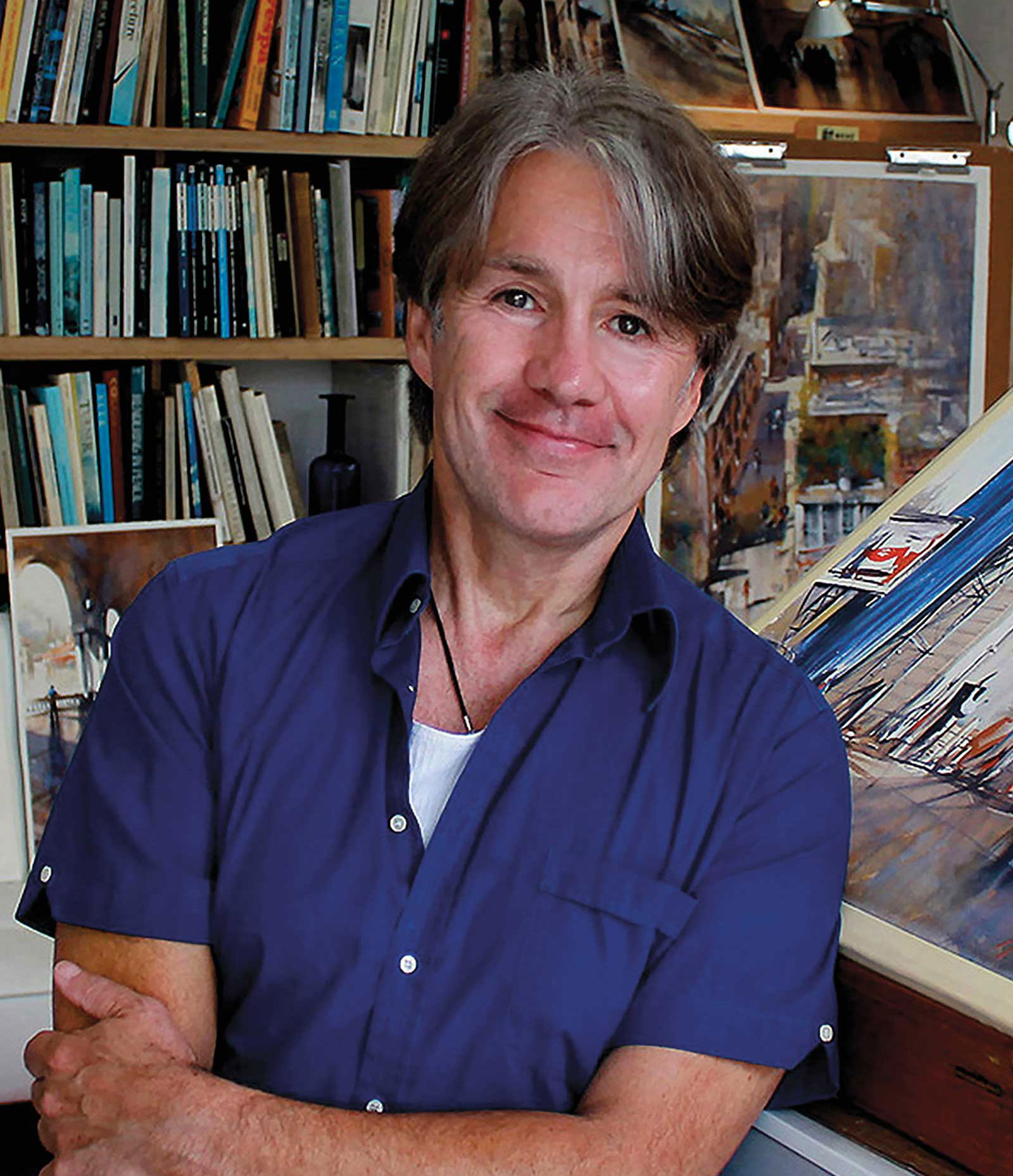
Thomas Wells Schaller is an internationally-acclaimed artist, architect and author based in New York City. Recently, he was named the 2024 recipient of the Arthur Ross Award in Fine Arts by the Institute of Classical Art and Architecture, winner of the Ogden Pleissner Award by both the American Watercolor Society and the Salmagundi Art Club, and First Place Award winner in Watercolour International. A two-time winner of the prestigious Hugh Ferriss Memorial Prize, he is also the author of three books, including the AIA award-winning Architecture in Watercolor. His latest, Architect of Light, is published by Penguin. His best-selling DVD, The Power of Design, is published by Streamline Media. And his interactive online mentorship program “Design and the Power of Imagination” is hosted by Terracotta LLC. Schaller is a Signature Member of many arts groups around the world.
Represented by
Gallery 71, New York, USA, gallery71.com
Contact at
thomaswschaller.com