My work is representational with the main focus on the figure. As a classically trained artist, the style and techniques utilized in the art-making process is a more traditional approach, which includes painting and drawing. Oil painting has a long history and tradition, and the medium is not limiting—the range of possibilities that exist with using oil paints is what captivates and excites me throughout the process of creating work.
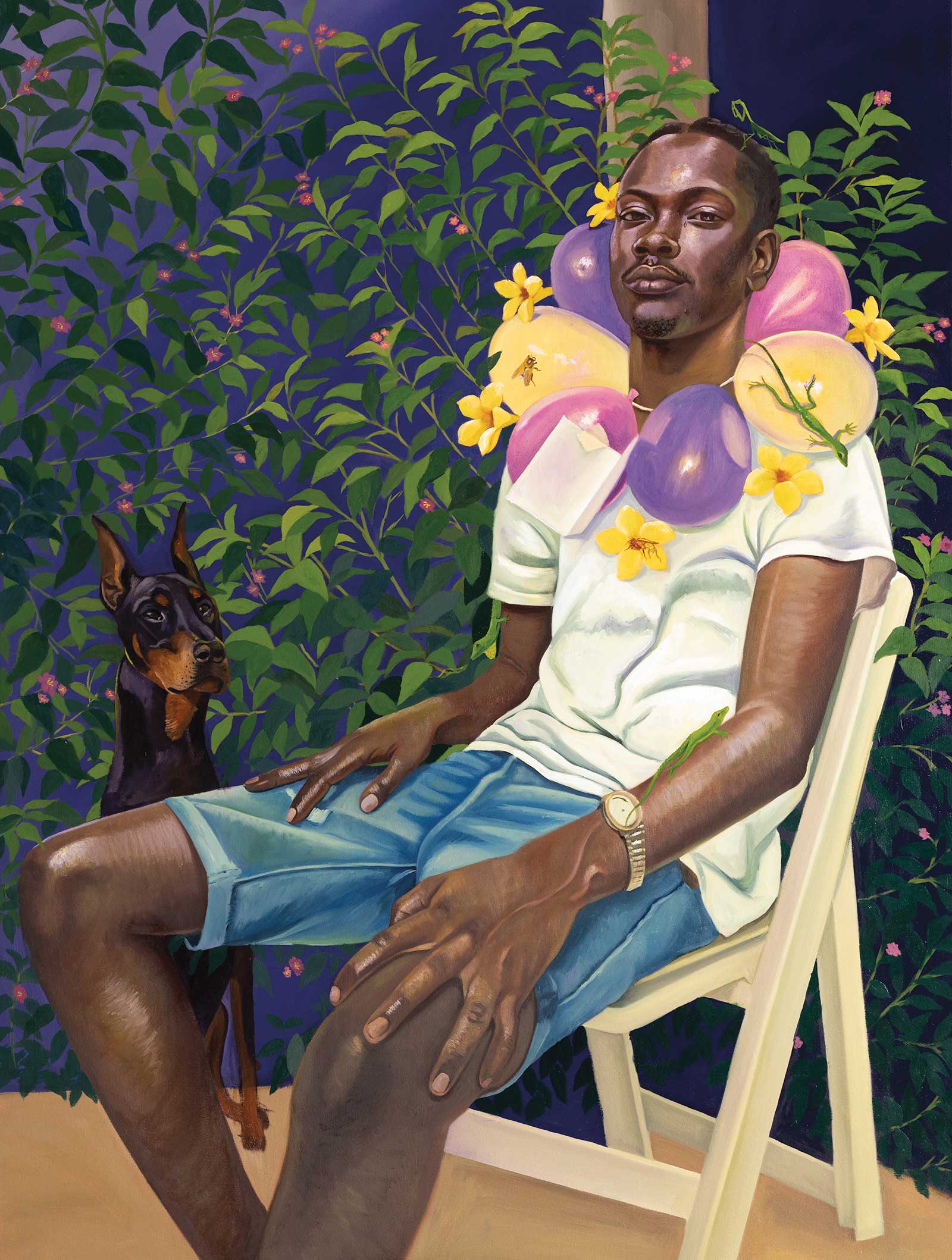
Love notes from my father in a foreign land when the apple trees blossom, oil on canvas, 48 x 36" (121 x 91 cm) The painting is from a series called What about the men?, which highlights the young men in my family and the impact that the absence of their fathers has on them along with the expectations of family and society in becoming a man. The painting above is a portrait of my cousin, the son of my uncle who is a contract farm worker. In the Caribbean, a large number of men leave their families for long periods to work in the United States, Canada and other countries through the farm labor program. Through the painting, I try to highlight the longing my cousin shared that he had for his father and the impact his father’s absence had on his identity and becoming a man. The title of the painting speaks to a longing for a father, his presence, guidance and love. The balloons adorning the neck of the figure reference the ruff collars that were popular during the Elizabethan era and represented the aristocrats. In the painting, I use the reference of the collar as an object of power as well as an object of lure, anxiety, expectations and the responsibilities associated with masculinity in the Caribbean/Jamaica. The position of the figure in a natural environment and the use of the colors purple and green, which are associated with a magical or fantasy world, is an attempt to escape from reality. The painting brings forward the issues associated with absent fathers in Jamaican families as a result of them leaving their homes for long periods to work in countries of colonial power, which continue to impact the cultural identity of the Caribbean region.
Through the exploration of the fundamentals of color, form, space, lines and texture, I focus on capturing the realistic and emotive qualities of my subjects using a combination of painting languages and techniques to produce a unique and powerful effect.
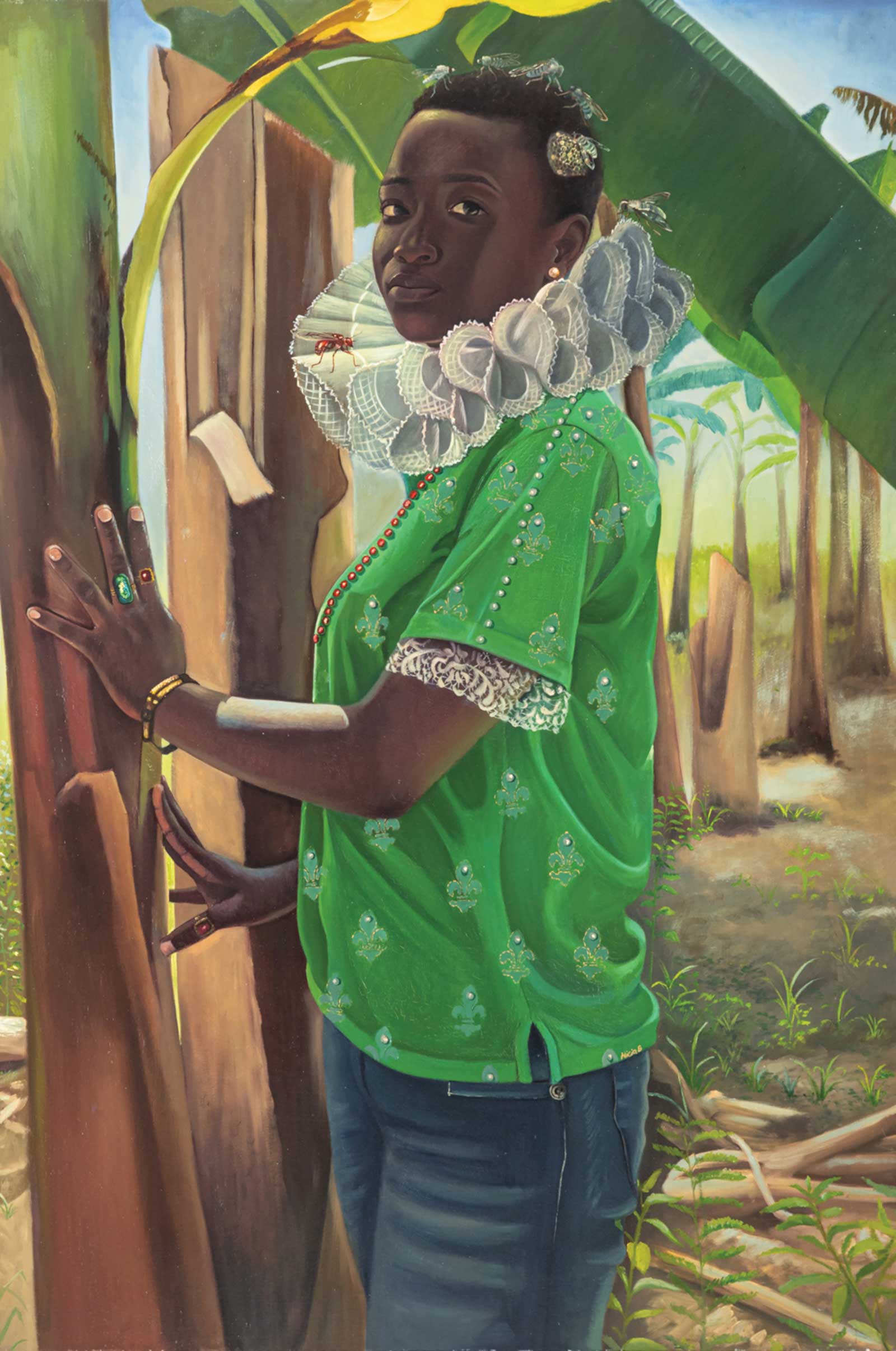
Opposite Page: Queen Anmarie from Old Harbour, oil on canvas, 48 x 36" (121 x 91 cm) This painting was inspired by a student I met while I was teaching at a college in Jamaica. I was drawn to her beauty and quiet demeanor and the history of the place she lived in Old Harbour in the parish of St. Catherine, which was named after the queen of King Charles II who was on the throne of England when it was formed in 1660. At the time I met her, I was making a series of works that explored the nature of “lure” inspired by a line from the essay by Derek Walcott, “The Caribbean: Culture or Mimicry?”, which reads: “What if the man in the New World needs mimicry as design, both as defense and as lure? We take as long as other fellow creatures in the natural world to adapt and then blend into our habitats, whether we possess these environments by forced migration or by instinct.”
Using the history of portraiture as a starting point, I am deliberately representing an ordinary young black woman in a space surrounded by banana trees, which was a part of the plantation system. The figure in the painting is in a pose that references the history of royal portrait paintings; the ruff collar around the figure’s neck is a symbol of aristocracy/power and dignity, something that was only worn by the upper class. By adorning the figure with objects associated with aristocrats juxtaposed with regular clothing, I wanted to highlight the tension and dependency that the Caribbean region still has on the colonial powers and the devices utilized by the natives, such as mimicry, to reinvent new identities that aid in adapting to their environment and to gain acceptance. The process of creating the painting involved both traditional and contemporary painting languages intending to position the work in the history of art as well as make it relevant in the present contemporary art dialogue. By merging different languages in the painting, I want the work to attract, tease, entice and lead the viewer through a performance.
Depending on the size and subject of the work, I normally start by making a full-scale drawing on paper in preparation for the painting. This is a traditional technique that was used by artists during the Renaissance period. I like using this technique because I work mostly from photographs, which are the reference for both the drawing and the painting. Using the grid method, a drawing is created from the photograph, which allows me to get an accurate replica of the image. I use this approach for various reasons: I see and treat drawing as a separate discipline from painting, which requires a different approach, thought process and execution.
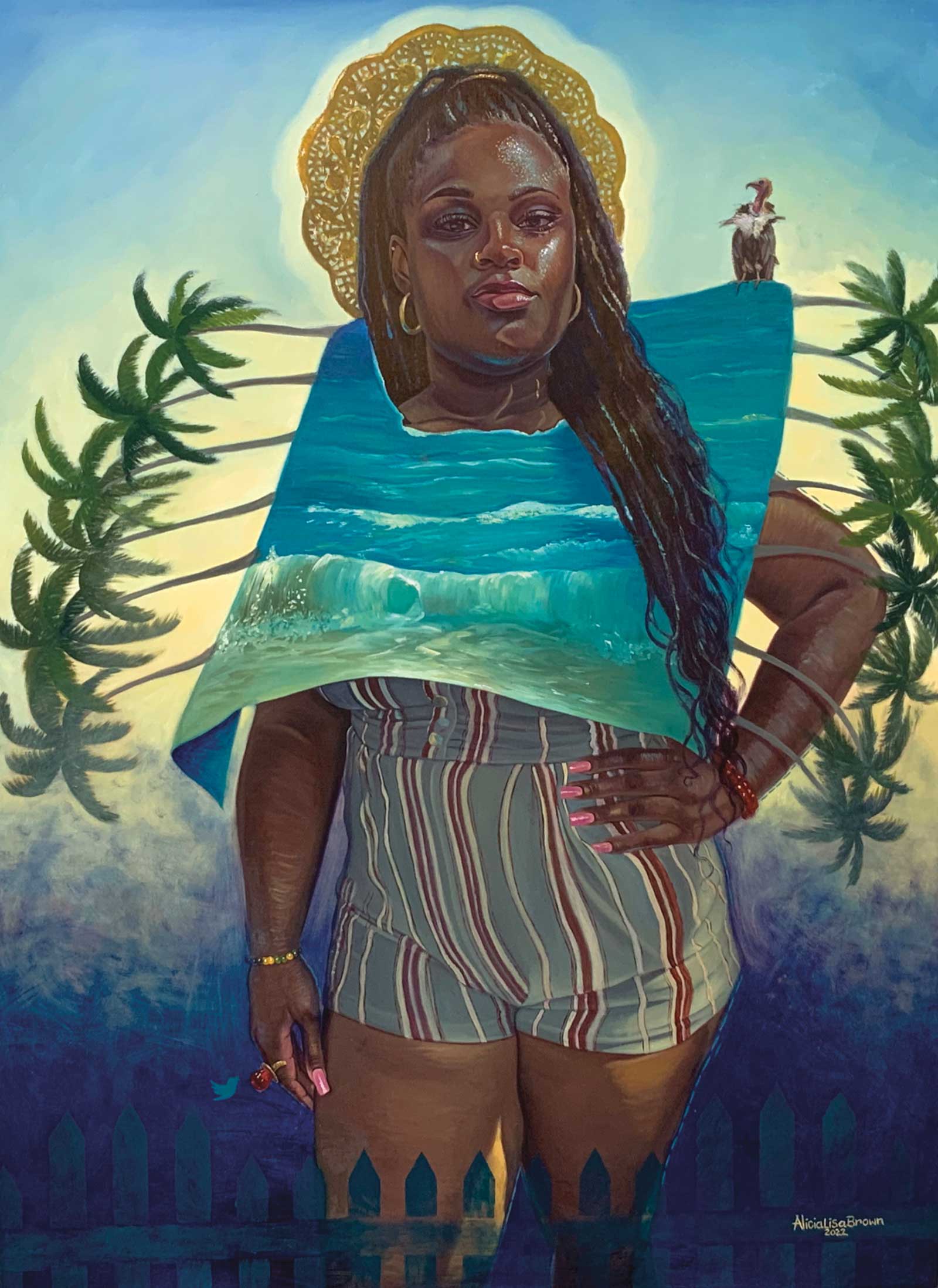
Princess in Ghetto Paradise, oil on linen, 48 x 36" (121 x 91 cm) Ghetto Paradise is from a recent series called Imaginary Homelands. While making the painting I was listening to the song “Ghetto Paradise” by Jamaican artist Chronixx and was inspired by the lyrics because it highlighted some of the issues and ideas I wanted to bring forward in the work. The multiple factors that influence the formation of the Jamaican cultural identity and the strong contrast between the reality of the life of the people and the fantasy world that is sold to the world through tourism are fascinating to me because it presents viewpoints about a place that is, in a sense, imaginary or made up. The woman in this piece is portrayed in a pose that is a common gesture displayed by ordinary women in the Jamaican space, as well as a reference to the history of portraiture and a style that is surrealist in the design and representation of the subject within the space. In this piece, I’m using elements like palm/coconut trees and a collar around the figure’s neck that shows the magnificent colors of the Caribbean Sea and the reference to religious iconography such as the halo around the figure’s head. I am interested in altering the ways women in certain social franchises are viewed and understood to change the relations of power that determine the conditions of their lives. Who is accepted in society, how do the remnants of history, religion and global trends impact the space that one has to adapt to, and who is accepted within certain social spaces? The painting presents a narrative that is conflicting, surreal and haunting.
When I make the drawings I can immerse myself through a slow process of exploring the use of lines to capture a realistic likeness of the model without thinking about other technical aspects such as value and color. Anatomy and proportion are crucial to the way I work, so while I am creating the drawing I am constantly making adjustments so I don’t get any distortions that are present in the reference image. Thinking about the drawing as the foundation for the painting, everything has to be correct before I begin the painting process. After the drawing is completed the next step is to transfer it to the canvas or panel. I usually transfer the drawing to the canvas by using burnt umber or any other fast-drying oil paint to the back of the drawing.
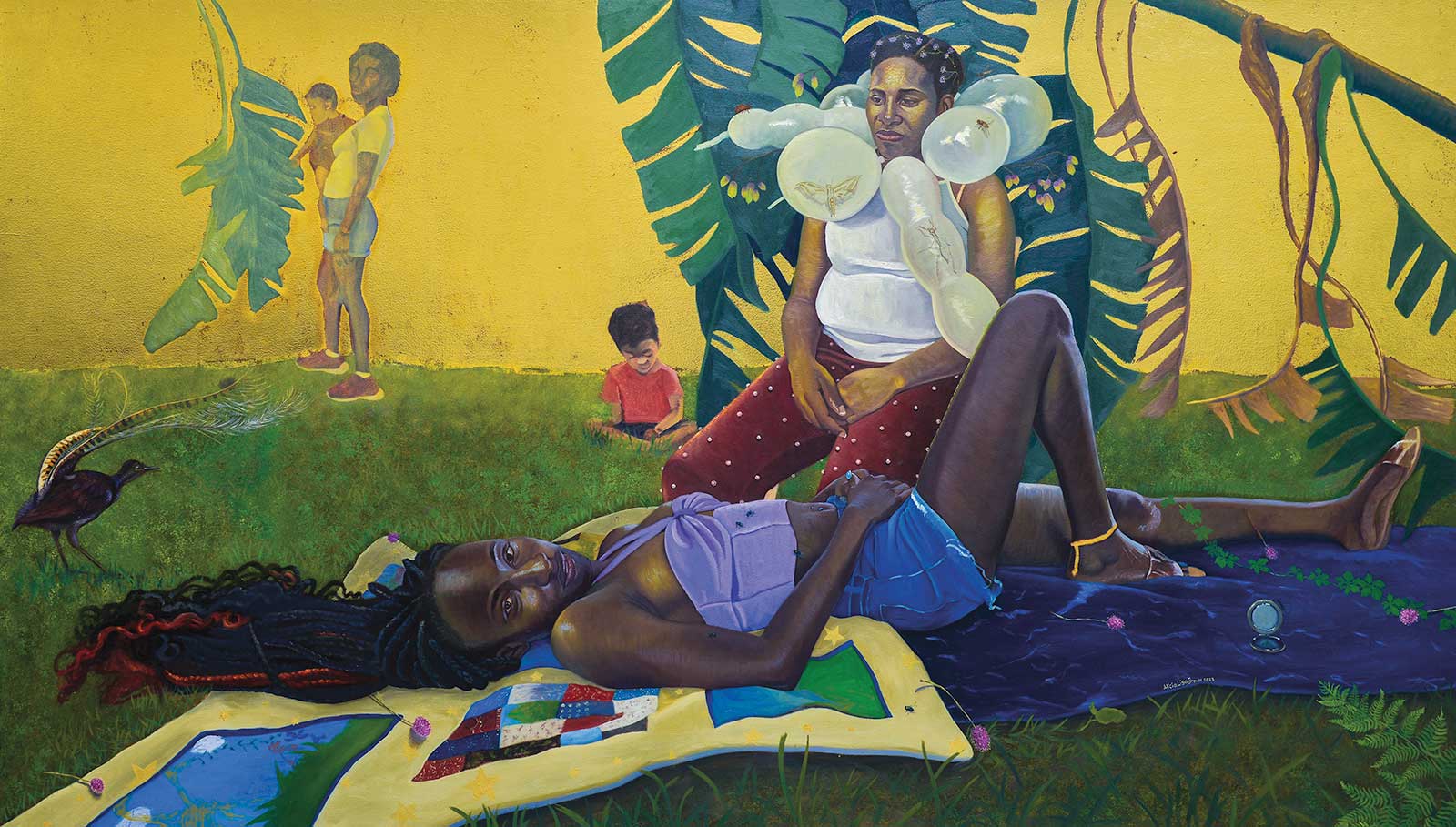
Citizen in the promised land, oil and 24k gold leaf on panel, 84 x 60" (213 x 152 cm) This is one of my newest paintings completed in September 2023 as part of my solo exhibition, Coming to ’Merica: Invasive Species with Winston Wächter Fine Art in New York City this past fall. In the painting, members of my family are the models who activate the narrative, highlighting the journey of migrating from Jamaica to the United States and the ways they invent new identities to adapt to the new world. The title makes biblical references to the idea of heaven as the Promised Land and also the song “The Promised Land” by Jamaican singer Dennis Brown. My sister, the central figure in the painting, was the first sibling to migrate from our home to live in America and become a citizen. With this in mind, I made her the main subject of the composition. The figure in the foreground, my niece, leads the viewer’s eyes into the painting. The arrangement of the composition and the choice of materials utilized to make the painting is crucial to the story, as well as the various references to art history and the way we are accustomed to viewing a movie screen. In the painting, I wanted to create a space that looks real yet feels fantastical. The idea that most outsiders have of America is a place that is paved with gold—a land where money grows on trees. The painting is about an ideal, imaginative and fantastical image of what it is to be and live in America. By incorporating historical narratives sourced from the archived accounts of immigrants who entered through Ellis Island along with the stories from my family and my personal experiences of living in America, the painting activates and presents various viewpoints surrounding the concept of becoming and the devices utilized in the process of fitting various elements of Jamaican culture into a space. This includes native plants, animals, objects, symbols and idioms with elements from Western art and history, allowing us to examine the duality of who a subject was in their homeland and who they become to adapt and survive in a foreign culture.
Making a painting occurs in stages and utilizes a combination of techniques. Normally, I begin a painting with a cool or warm underpainting, which is created using the wipe-out or bistre method. With this technique, the canvas is covered with a layer of medium-dark paint, a lintless cloth and cotton swabs. A soft brush is used to wipe out or lift sections of the canvas, which brings back the white of the canvas and allows me to quickly shape light and dark values. After this layer is dry, which normally takes a few hours or a day, I start to block in the painting using thin layers of paint mixed with linseed oil. Once I have established the shadow areas, I start to build up other areas of the painting such as the local color of the clothing. The process of completing a painting is achieved through about four to five layers of paint starting with the first layers with thin application and then more impasto or thick application toward the final layers. —
About the artist
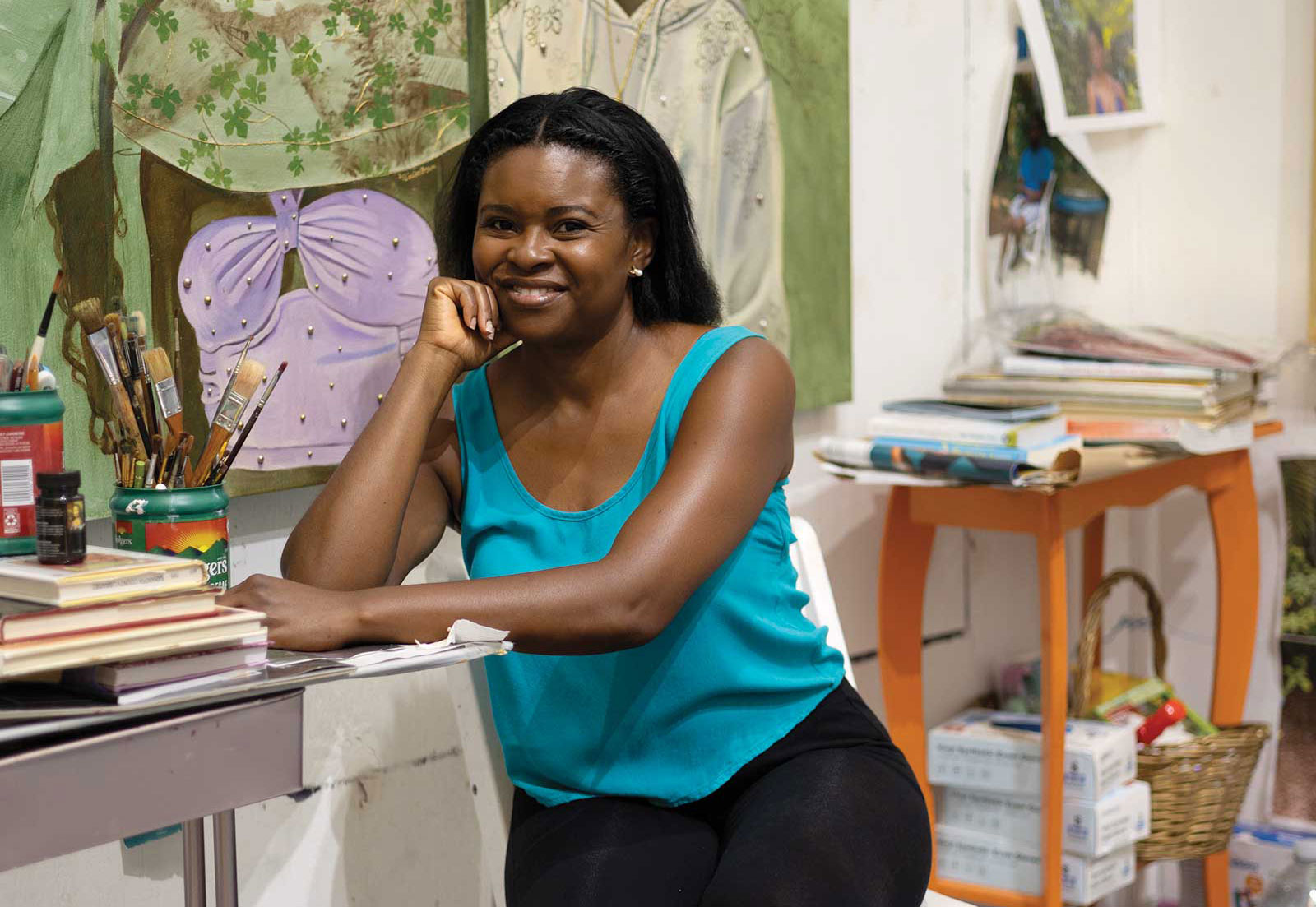 Alicia Brown
Alicia Brown was born in 1981 in St. Ann, Jamaica. She attended the Edna Manley College of the Visual Performing Arts in Kingston, Jamaica, receiving both a diploma in art education and a BFA in painting. Brown received her MFA from the New York Academy of Art in 2014 and was awarded a residency scholarship in Leipzig, Germany, as well as the Joan Brady Grant and LCU Foundation Grants. She is a 2019 and 2021 recipient of the Elizabeth Greenshields Foundation Grant and was one of the winners of the Dawn Scott Memorial Award in the Jamaica Biennial 2017.
Brown uses traditional and contemporary painting techniques and iconographic references to examine cultural identity, adaptation, beauty and social status. Her body of work incorporates figurative compositions that reference the Renaissance and Dutch periods. Her work has been exhibited both locally and internationally including at Prizm, Victoria Gallery, Winston Wächter Fine Art, Springfield Museum of Art and more. Her work has been featured in Beautiful Bizarre, PoetsArtists’ Painting the Figure Now, The Gleaner, Jamaica Observer, Caribbean Quarterly journal and other publications.
Contact at
www.alicialisabrown.com