When I embark on an outdoor painting session, I am fully aware that nature can present itself as an adversary. The wind can blow hard, the rain can fall incessantly, the cold can penetrate to the bone, and even the sun, which warms us, can become a challenge as it dances across the sky, accompanied by constantly moving clouds.
However, despite these obstacles, I find a unique opportunity to deepen my understanding of the nature that surrounds us. Every detail around us—from the landscape that unfolds before our eyes to the air we breathe, the aromas that permeate the environment and the sounds that fill our ears—connects us to a sense of gratitude and wonder. This connection is the first crucial step in creating a truly meaningful work.
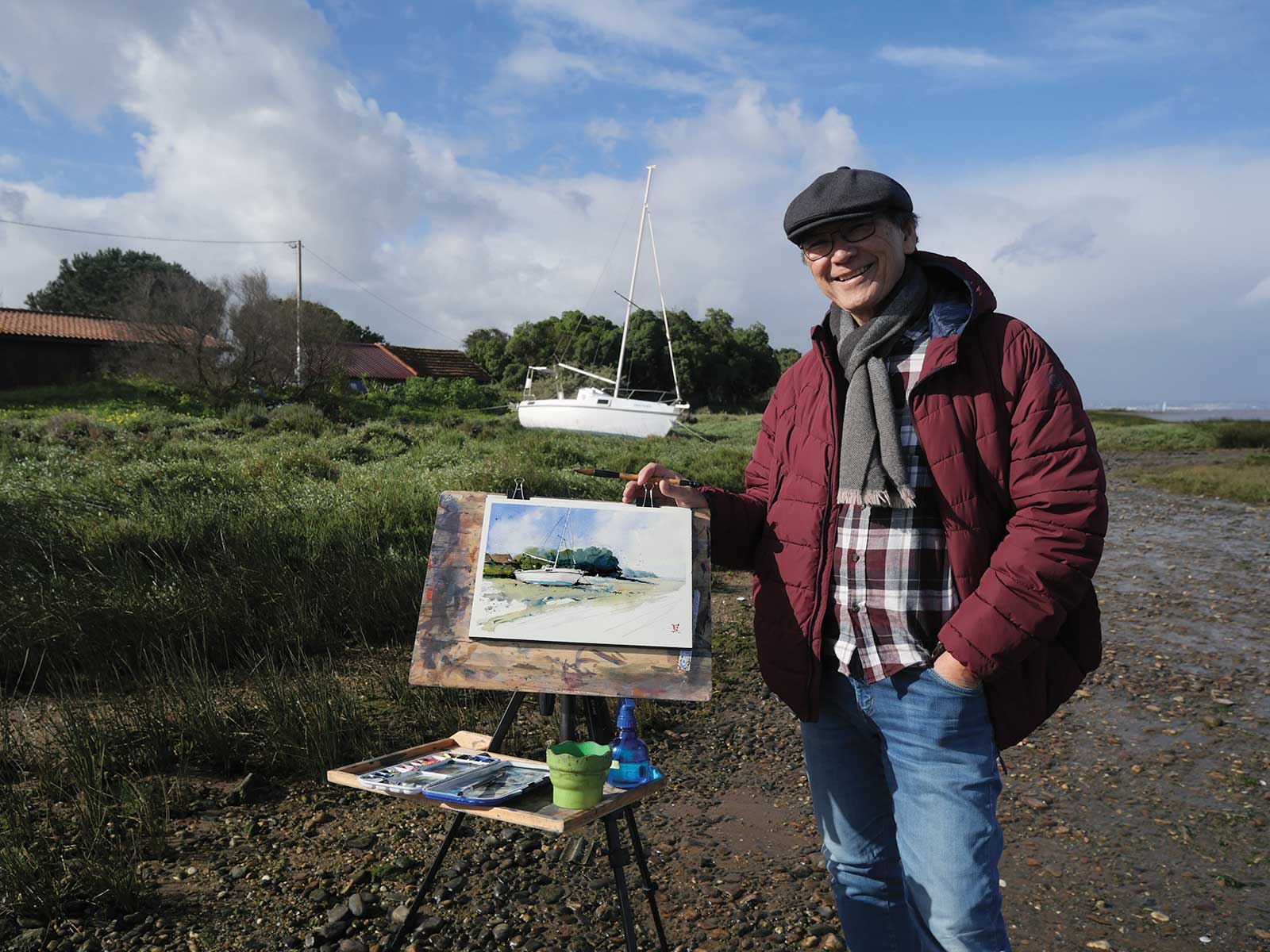
Artist André Kano painting in plein air.
Although I greatly value the experience of painting outdoors, I can’t ignore the comfort and convenience of a well-equipped studio, especially on heavy weather days. Over the years, I have garnered extensive experience as a graphic designer, which has given me the privilege of always having a comfortable workspace at my disposal. I often turn to my personal image archive, filled with thousands of photographs captured with my mobile phone or camera, to find inspiration for my works.
I often choose to depict scenes where the presence of boats is prominent. I have a special affinity for painting them, considering their unique design and abundance of details that contribute to the overall composition, adding movement and elegance to the work. My relationship with colors has always been harmonious, and I make a point of keeping it so by applying them carefully and expressively in my works. I’m an enthusiast of fluid, showy watercolor, and I’m always disappointed when I see my approach veer off into a different direction. I have a regrettable habit of turning unfinished works into twisted piles of paper that end up in the rubbish bin. I recognize that I can be a bit blunt in this respect, and I hope I won’t be criticized too much for it.
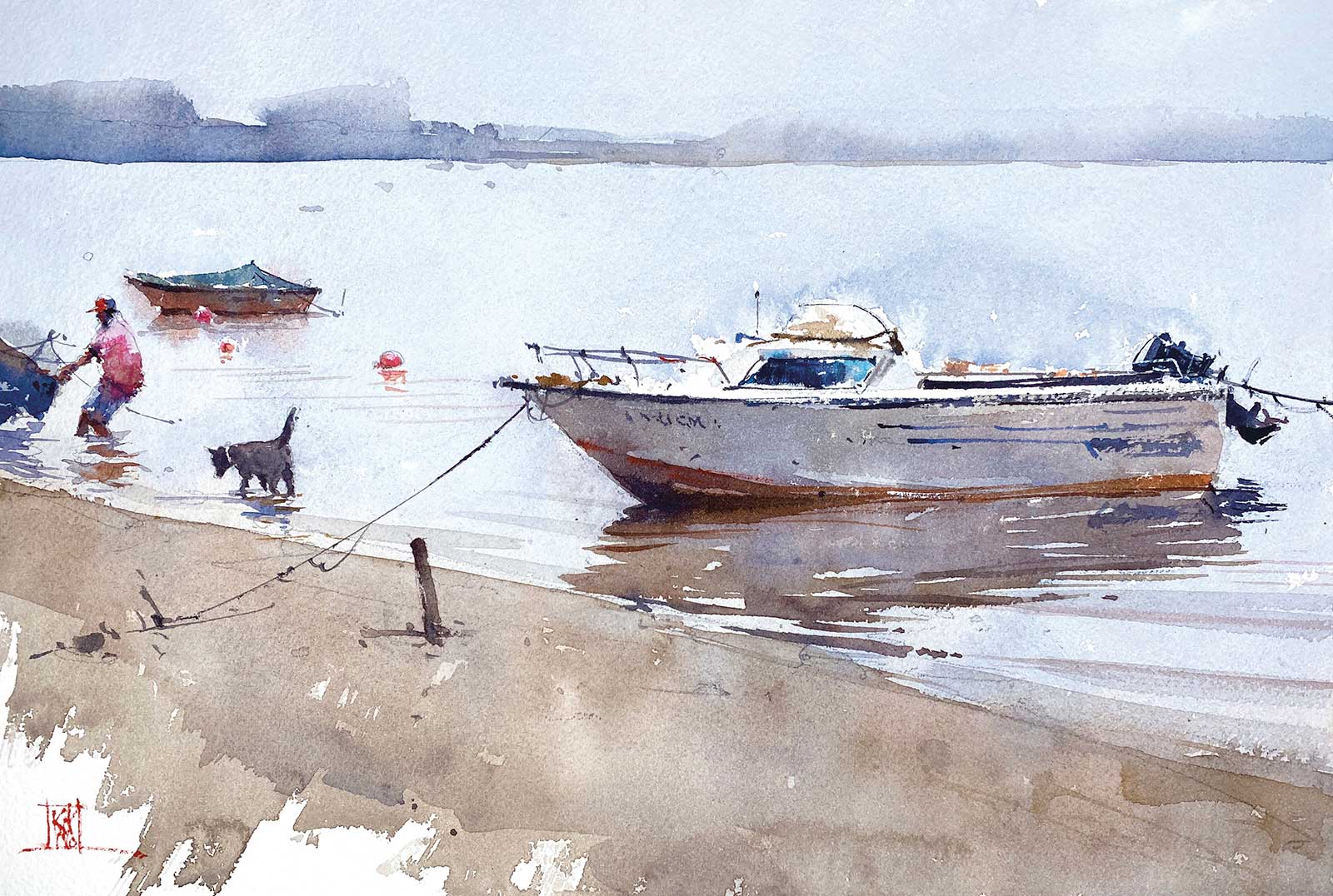
The lightness of Obidos Lake, watercolor on Arches fine grain 140-lb paper, 9½ x 14” (24 x 35 cm) This work was created during a plein air session with friends. Due to the absence of direct sunlight and the lack of projection of striking shadows, I concentrated on exploring contrasts at strategic points, preventing the work from becoming excessively bright.
I always try to explore the play between light and dark, highlighting the contrast between the elements and, of course, making sure that the colors harmonize in a balanced way. And these very colors in my works clearly reflect my preference for sober tones. By avoiding the excessive use of vibrant, saturated colors in large areas of the paper, I try to provide the viewer with a more subtle, immersive sensation. The constant feeling of serenity present in my works reflects the path I have been treading, intrinsically tied to my own personality.
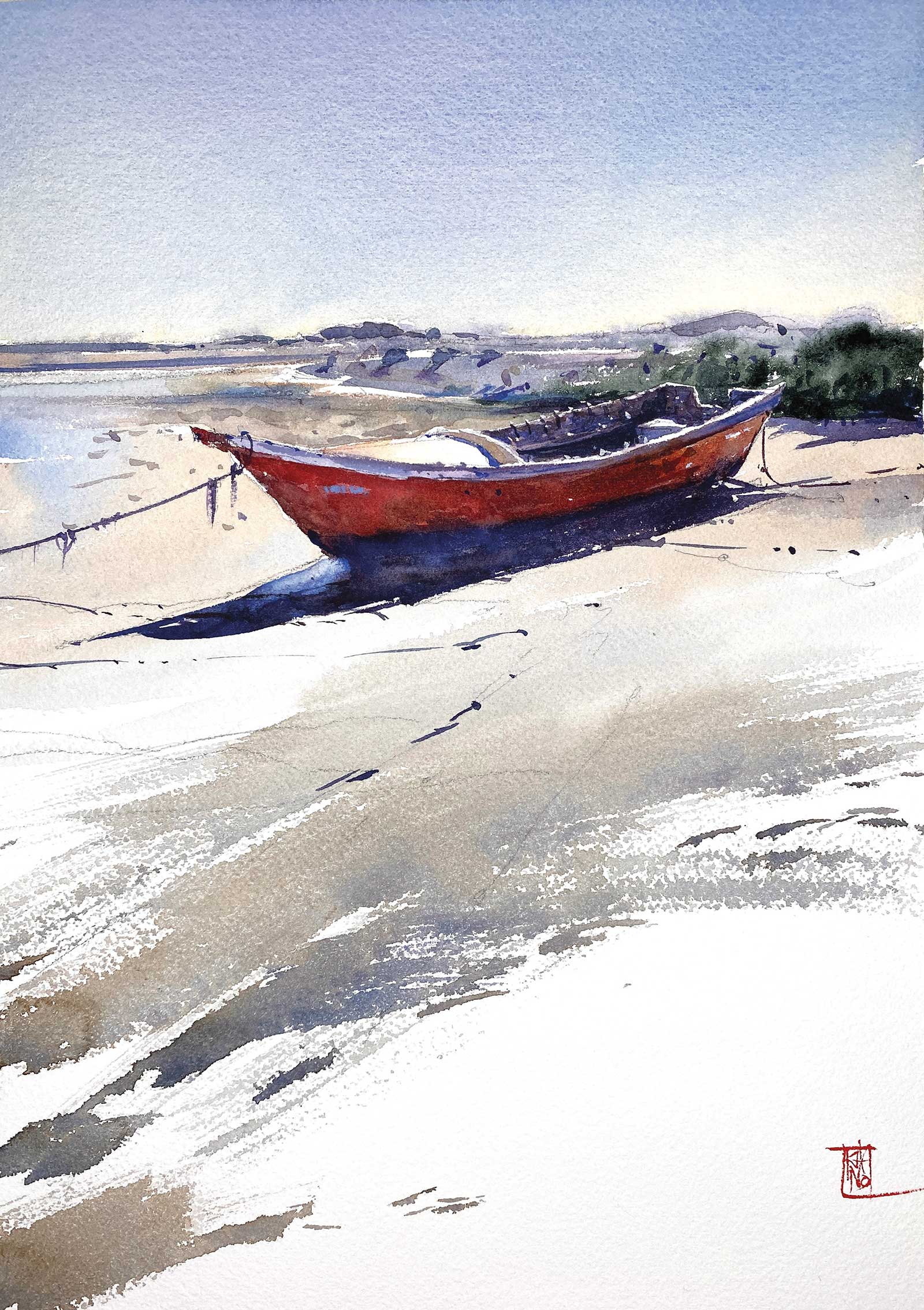
March Boat, watercolor on Saunders Waterford fine grain 140-lb paper, 14 x 10¼” (35 x 26 cm) This scene caught my attention for its serenity and tranquility, even under the scorching sun. I carefully explored the intensity of the light, leaving wide blank spaces in the sand, while the quick brushstrokes contradicted this apparent calm, adding an element of movement and energy to the composition.
I try to clearly explore the blank areas of the paper, as I believe that leaving spaces unfilled helps to create a sense of breathing, balance and composition, making the work less fatiguing for the viewer. In my palette, I select colors that can form pleasant combinations. I avoid using all of them at once in each work, preferring most of the time to adopt some form of the famous reduced palette. I don’t have a preference for specific paint brands, but I believe that choosing a brand with a high standard of quality in its products is crucial to achieving satisfactory results. The intensity, ease of dilution and durability of the pigments are elements that enrich the essence and character of a finished work.
In the course of this demonstration, I’ll be sharing a detailed, step-by-step guide to the technique I’ve developed over years of study and practice. I hope you enjoy this journey as much as I have.
My Art in the Making Riverside
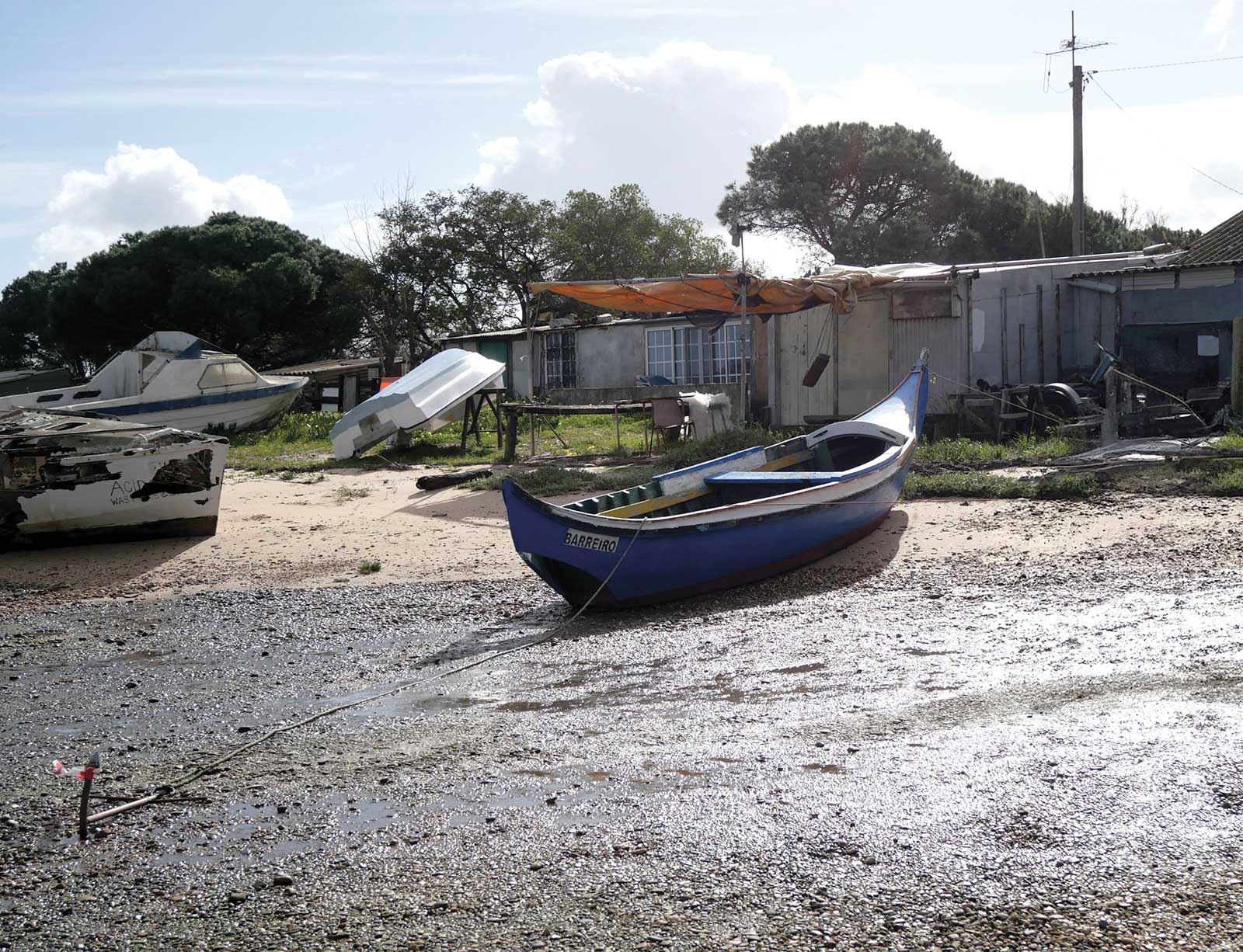
Reference Photo
When I decided to create this watercolor, I started by photographing as accurately as possible the atmosphere provided by the daylight. Then, in my studio I prepared all the necessary materials, starting with the selection of what to use, always with the aim of capturing the essence of this unique environment. During this process, I chose to work with the wet-on-dry technique, ensuring that the paper was stretched by fixing its edges with adhesive tape to a plastic board.
 Stage 1
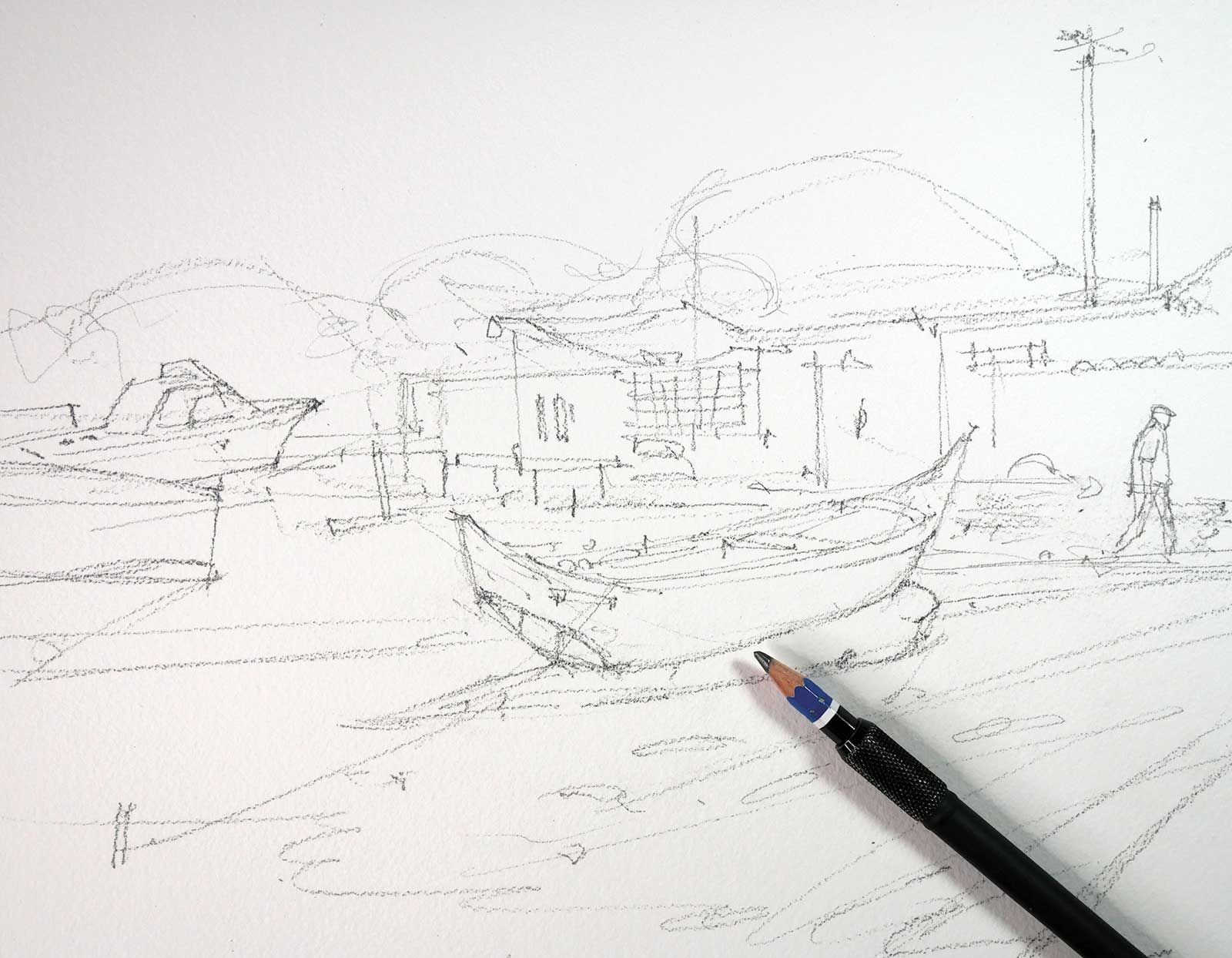
Stage 1 Initial Drawing
When I start a painting, I begin by making a sketch in pencil (7B), taking care to include the most important elements that will be part of the scene, without worrying about the details.
WHAT THE ARTIST USED
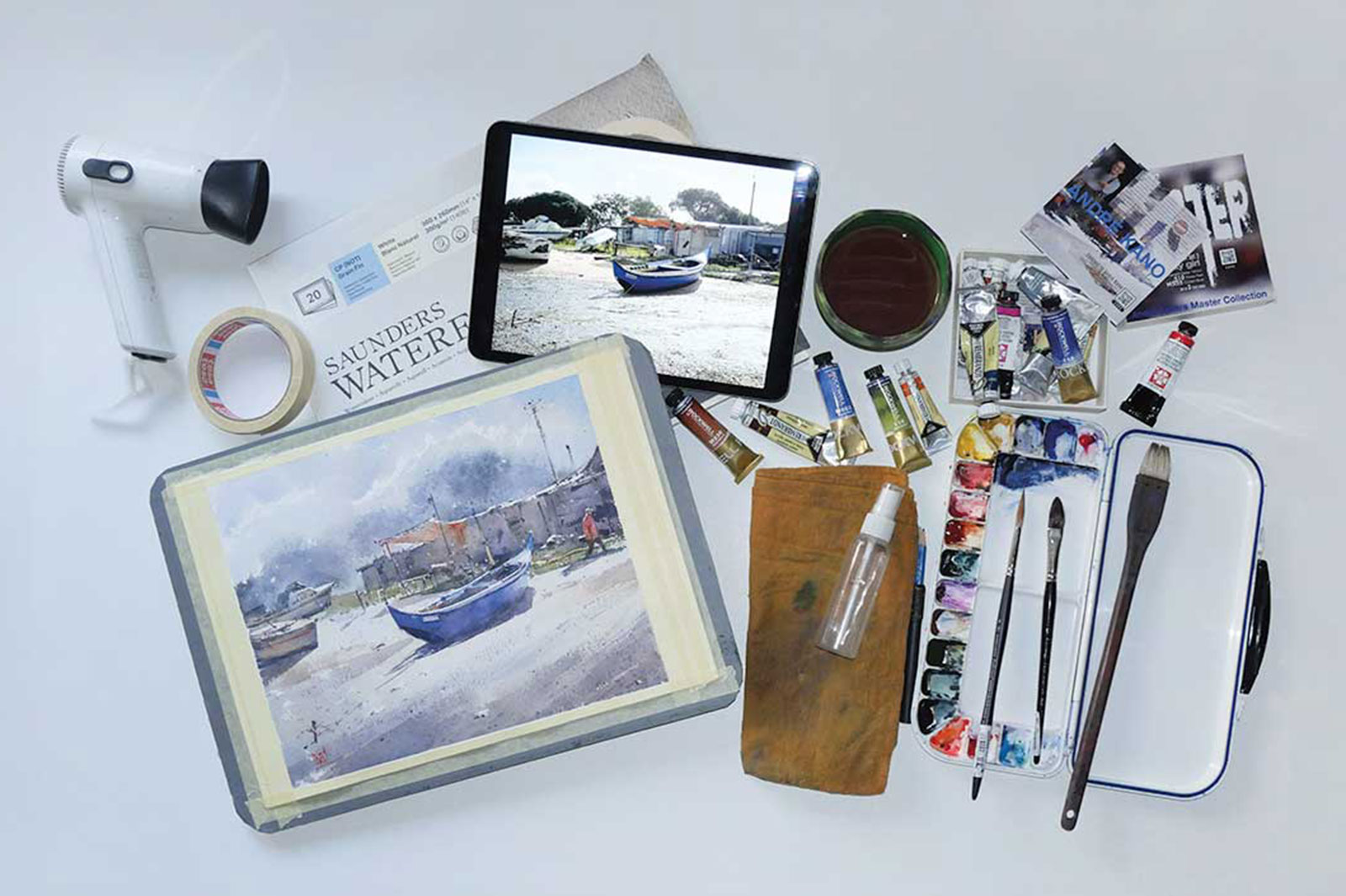
Watercolors
Cobalt blue, Burnt umber, Burnt sienna, Orange pyrrole, Olive green
Additional Colors On My Palette
Cadmium red, Opera rose, Payne’s gray, Neutral tint, Indigo blue, Ultramarine blue, Indanthrene blue, Cerulean blue, Yellow ochre, Titanium white
Brushes
Herend flat brush, 25 mm, Raphael, Petit Gris Pure, 903 series, nº12, Winsor & Newton professional watercolor sable, series 5068007
Additional Materials
Saunders Waterford fine grain paper, 140 lbs, Corrugated plastic sheet, larger than paper, Masking tape, Palette, Rubber, 7B pencil, Hand towel, 11" iPad, Piece of old cotton cloth, Hair dryer
 Stage 2
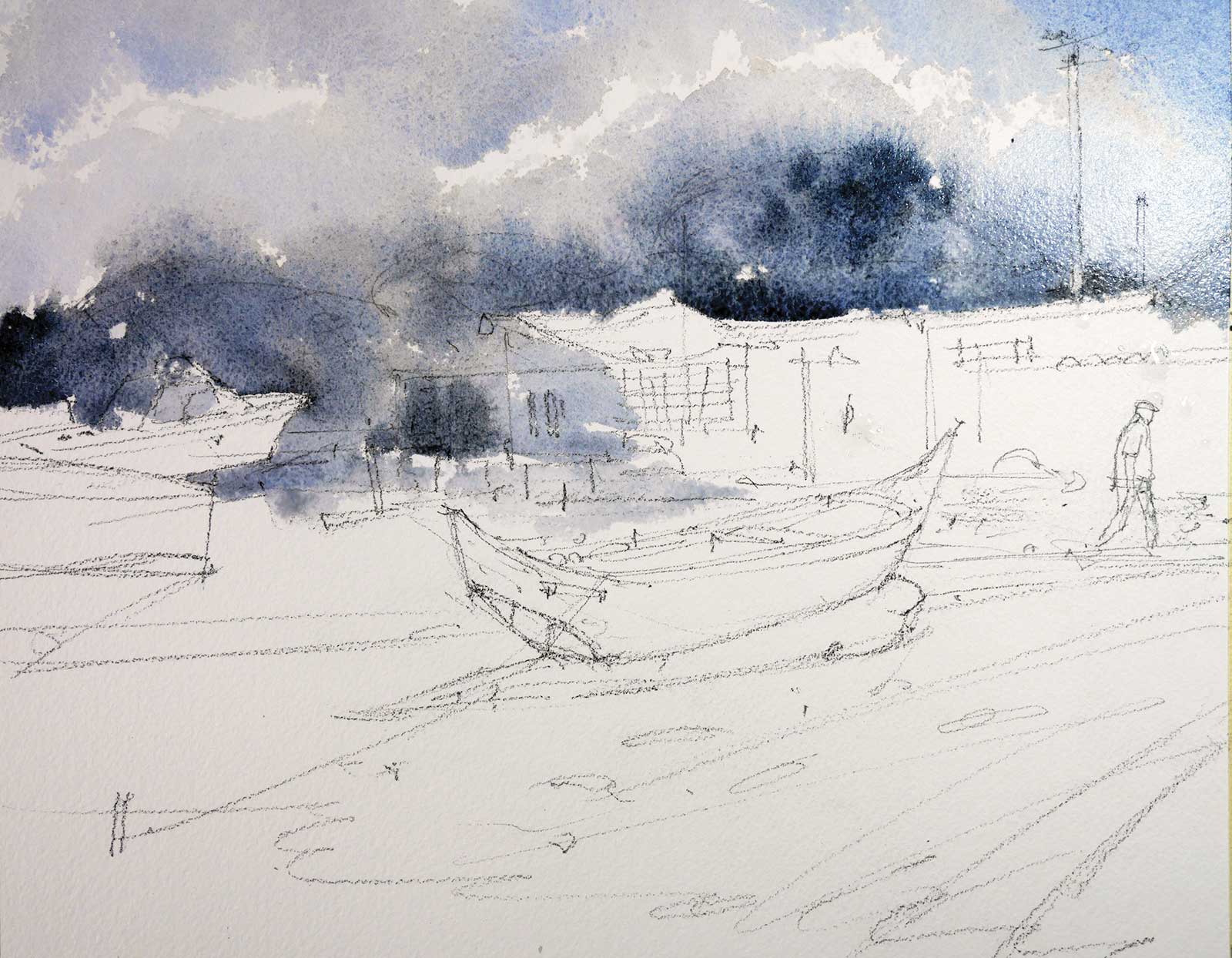
Stage 2 First Wash
At this stage, I began painting the sky by applying the first wash with the pigments diluted in water in a correct mixture of cobalt blue, burnt umber and burnt sienna.
 Stage 3
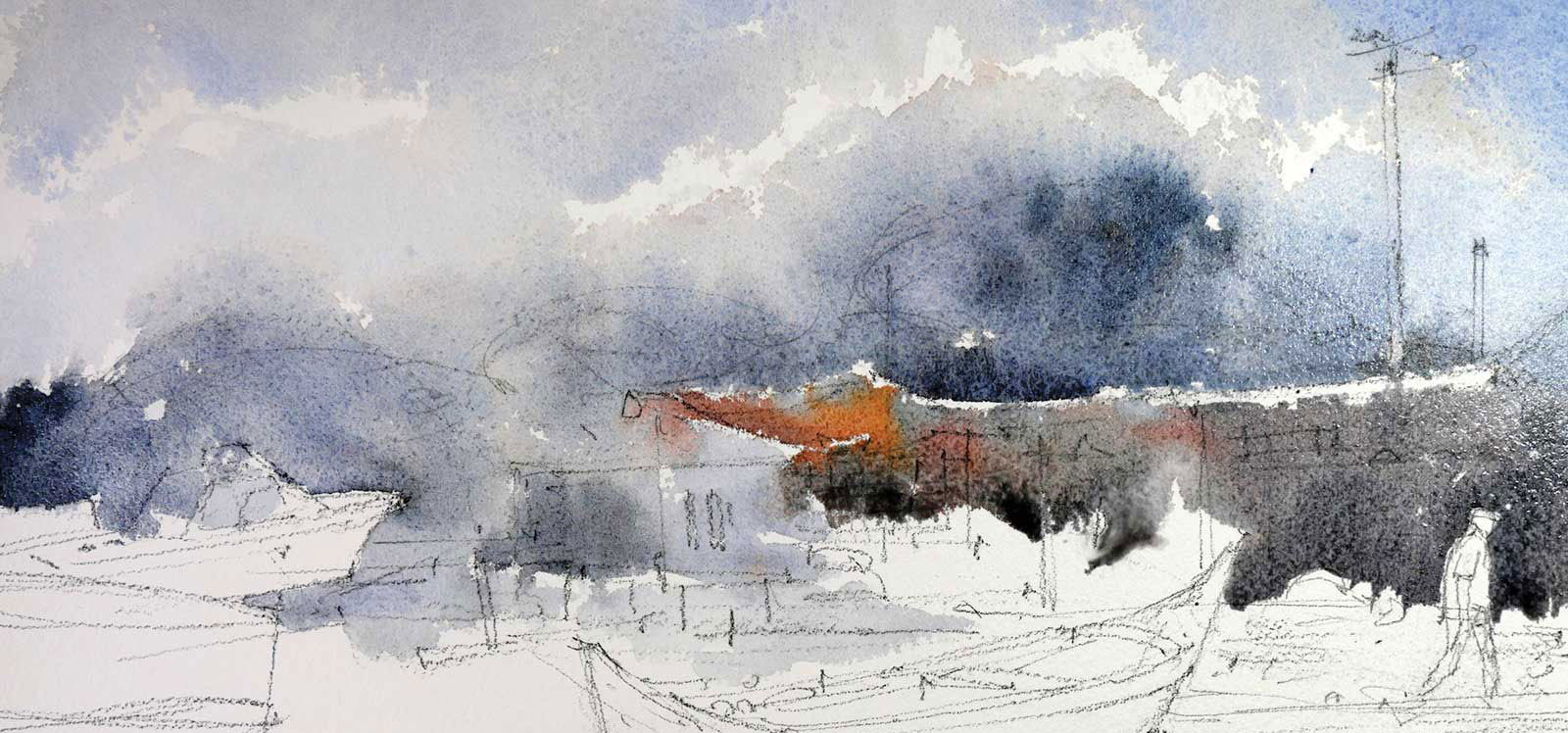
Stage 3 Bold New Colors
Daring to use more colors is a step to take into account. Here I continued to add other colors that added richness to the atmosphere, taking care to leave white areas where the sun is reflected.
 Stage 4
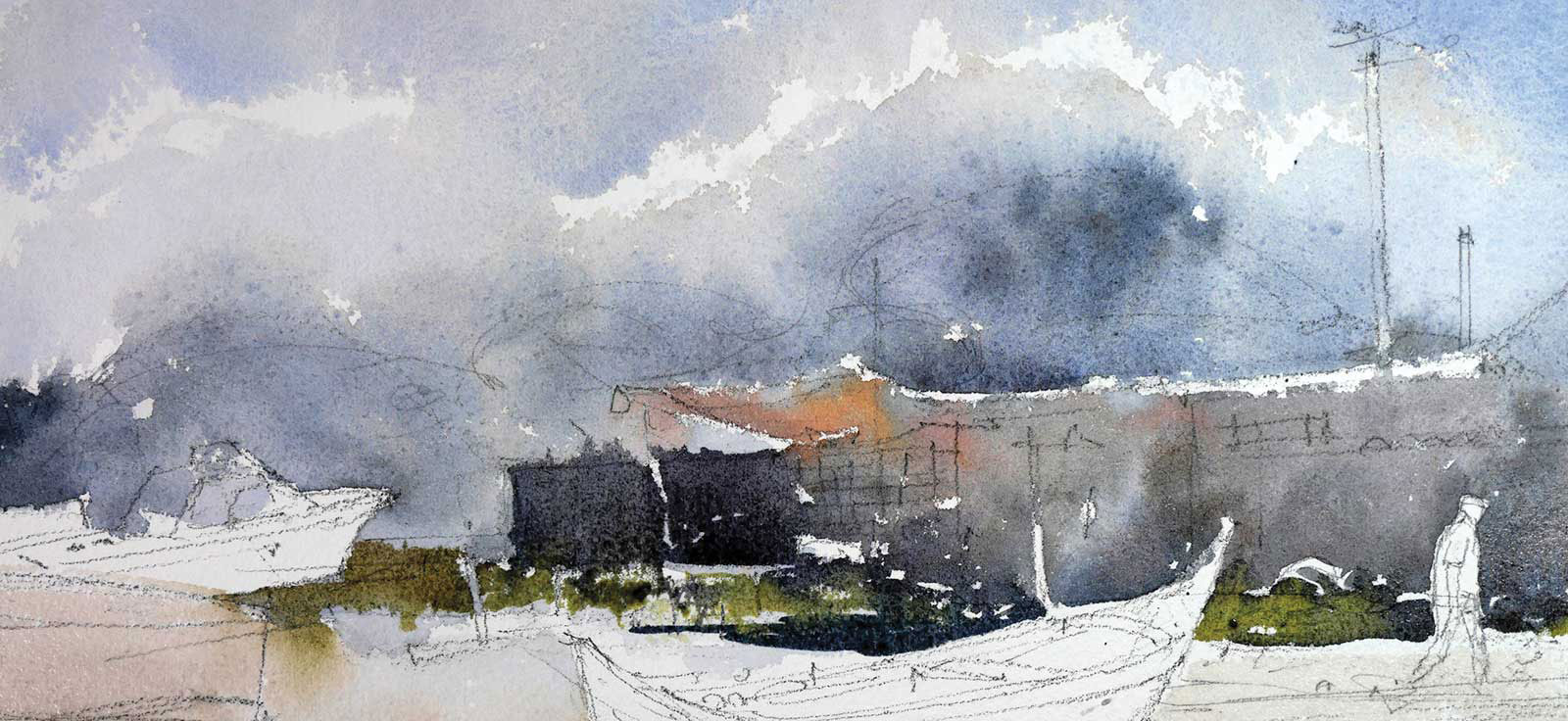
Stage 4 Fast Movement
Throughout the process I maintain a certain speed in my brushstrokes, and the work gains personality and style. As I move the colors towards the base of the paper, I add weight and volume. I used olive green, burnt umber and cobalt blue.
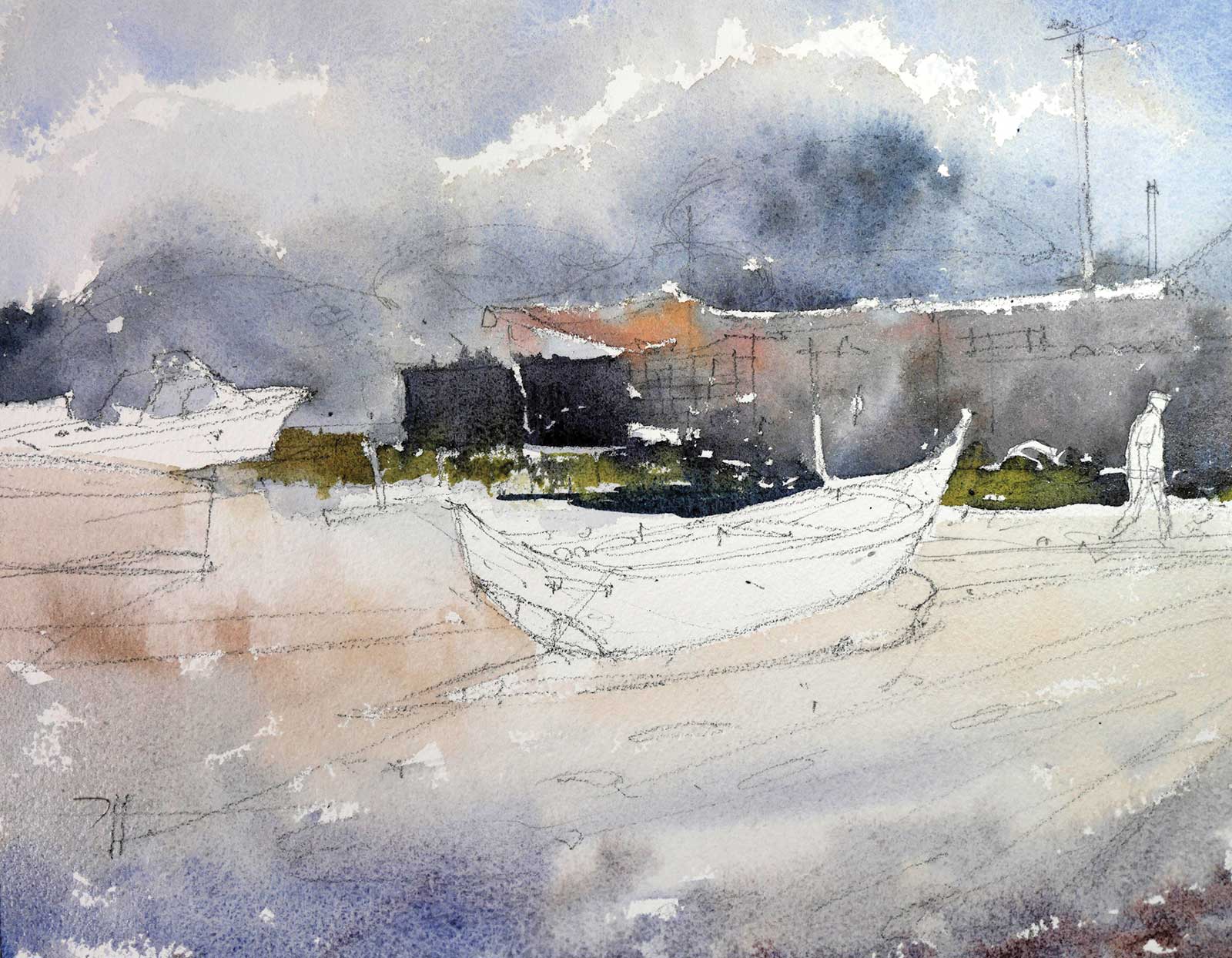 Stage 5
Stage 5 Think Three-Dimensionally
Adding more weight to the area near our eyes gives a greater sense of depth and volume. Once again, the combination of colors is of the utmost importance.
 Stage 6
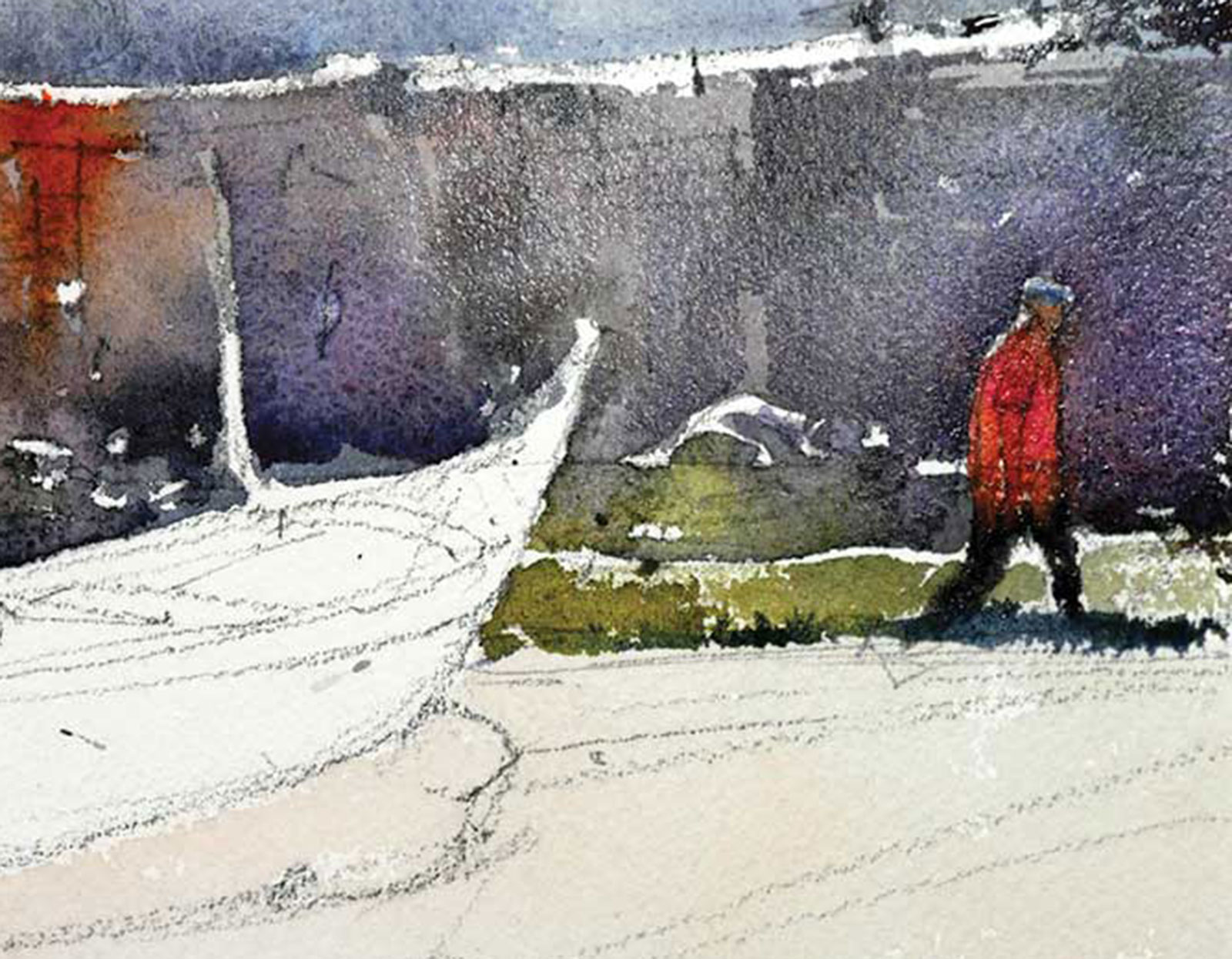
Stage 6 A Human Touch
The presence of a human figure in a painting always gives me the feeling that this person is carrying a story. A work of art has this power to involve and elevate our feelings. I chose to add a figure in a strategic place.
My Design and Composition Tactics
- Choosing a Theme: When selecting a theme, we often find ourselves wondering what kind of composition we should adopt for the work at hand. Even when this composition is laid out before our eyes, it doesn’t always match absolute perfection.
- Composition: Among the numerous rules relating to composition, I prefer to follow the one that results in something pleasing to the eye, even if that means leaving these standards aside. If a certain arrangement and distribution of elements on that piece of paper brings us complete satisfaction, we have already gotten far.
- Atmosphere: This is possibly one of the most significant elements that I go to great lengths to explore in order to convey to the viewer a sense of presence and a journey through time. It is gratifying to witness the magic of the work as the artist manages to capture that exact instant.
- Color: Harmonizing colors while the mind is immersed in the task of conveying the atmosphere of a scene is a constant challenge I find myself struggling with. Working with a reduced color palette intensifies this challenge considerably, and I would venture to say that the artist’s style is intrinsically connected to this process.
 Stage 7
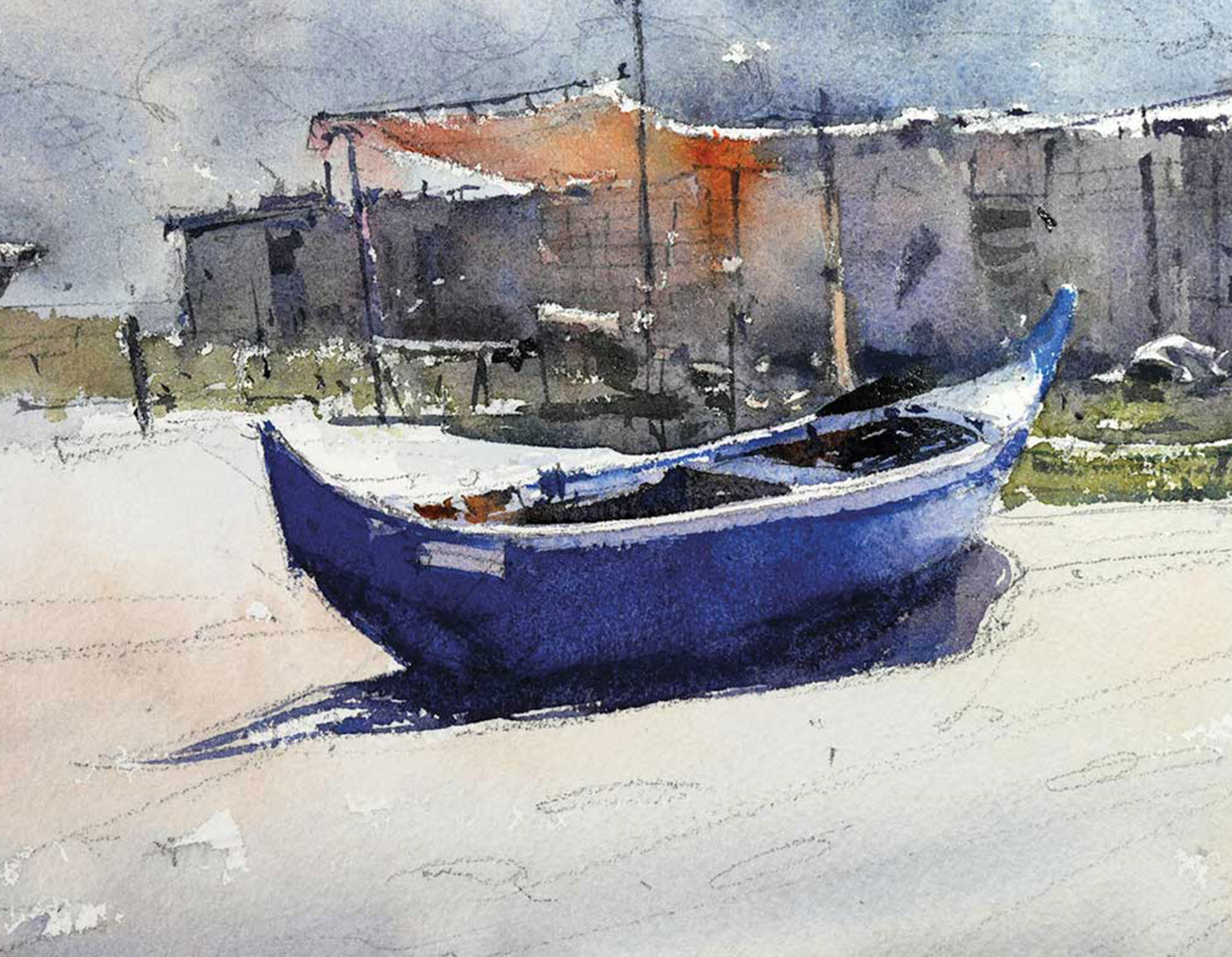
Stage 7 Focal Point and Contrast
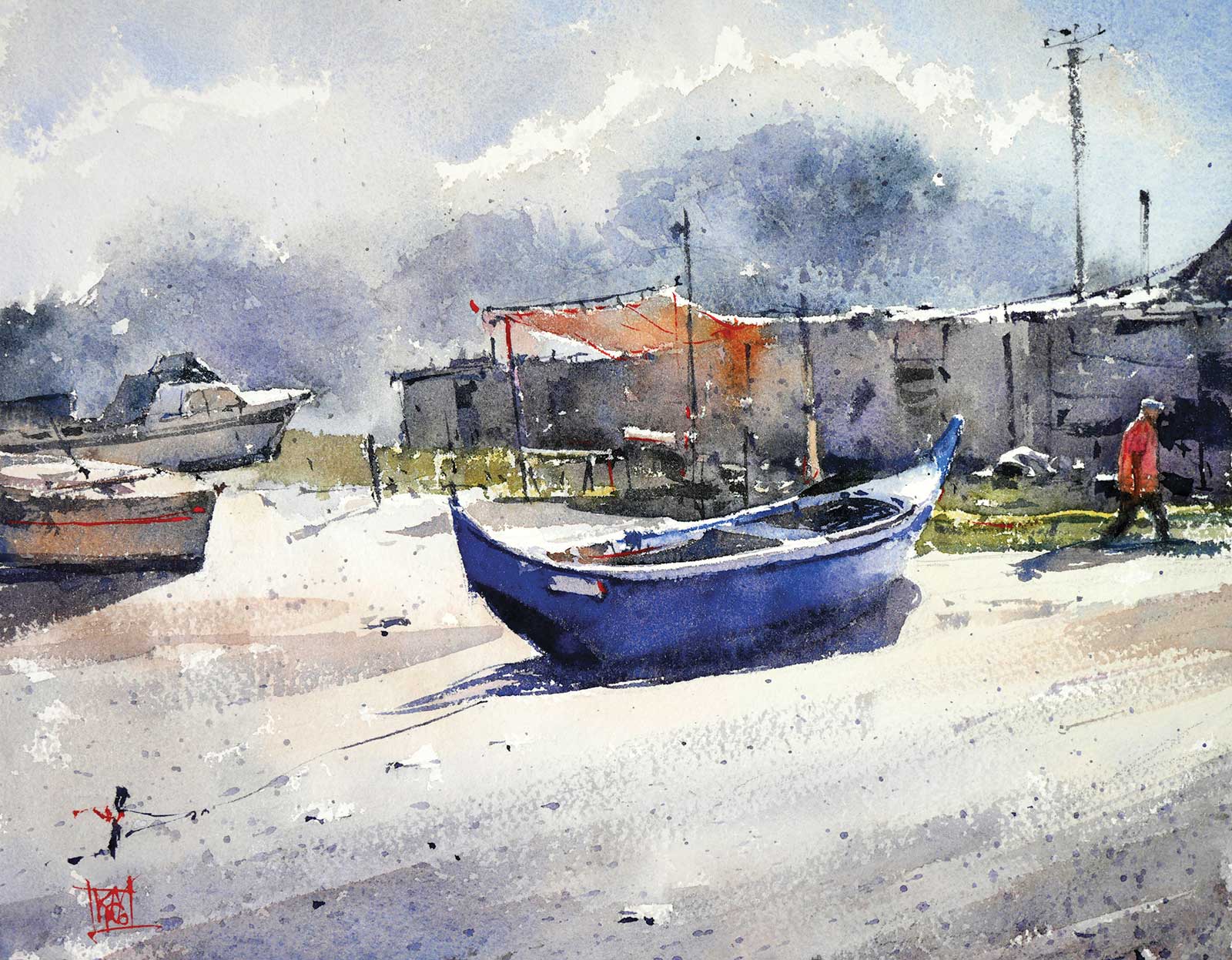
I colored the boat last, which is the main focus point of the entire piece. Here the colors are more saturated and its presence in the (near) center is highlighted—an almost pure cobalt blue with its nuances and shades.
 Stage 8
Stage 8 Finished Artwork
Riverside, watercolor, 10 x 14” (25 x 35 cm) Finally, I make a few touches, adding some noise, accentuating shadows, making subtle brushstrokes and checking that everything is in line with what I planned at the beginning. I erase the pencil marks, sign and declare the work finished.
About the artist
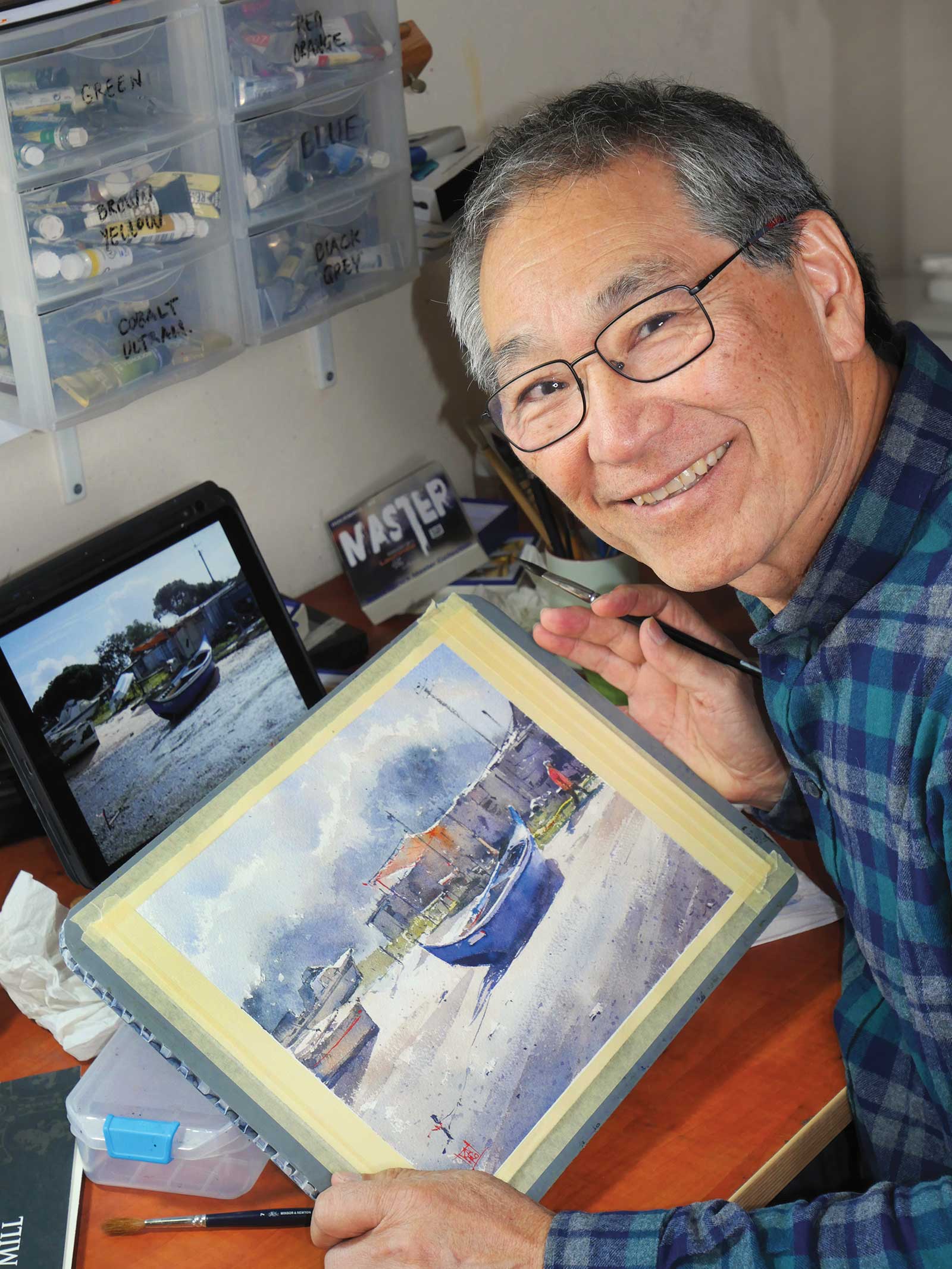 André Kano
André Kano was born in São Paulo, Brazil. From an early age, he was deeply influenced by the great impressionist artists. This awakened an unshakeable passion for painting. Before leaving Brazil, Kano explored his creativity as an illustrator and graphic designer, activities he continued after arriving in Portugal more than three decades ago. Although the artist dedicated his career to graphic design, he never strayed far from his true passion for painting.
Kano currently serves as a member of AAPOR (the Portuguese Watercolor Association) as well as Country Leader for Portugal for FabrianoInAcquarello. He is also frequently a guest artist at numerous events related to the world of watercolor. His presence has left its mark in countries such as Switzerland, Italy, Spain, Morocco, Portugal, Luxembourg, Brazil, France and Turkey, taking part in demonstrations, exhibitions and workshops. In the last five years of intense activity as a watercolorist, Kano has had the honor of winning several national and international awards.
Contact at
andrekano@gmail.com
andreakano.com