As one sets out to create new work, it is so often the case to look to the Old Masters for inspiration. After all, they achieved a great level of success and notoriety with works that we have come to know well. It’s important to come back to these masterworks as they can teach us so much. Though my style is much tighter and more rendered than the great impressionists and post-impressionists, I can’t help but look to their paintings for inspiration and subject matter. Their subjects are often everyday people doing everyday things. Those little moments in the coffee shops and cafes, the low-lit pubs and nightlife. I look to the works of Edgar Degas, Claude Monet, Mary Cassatt and Henri de Toulouse-Lautrec. In portraiture, John Singer Sargent continues to be a guiding light as well as other 19th-century American painters. The great masters who we will never know personally still speak to us through their paintings, which live on. We study the great works of art principally for the use of color, paint application, composition, drawing, brushwork, etc. “Standing on the shoulders of giants” is often the phrase uttered when looking to the great masters just as in math and science. Great new discoveries are often made through the achievements of those from the past. It should be noted that I did not set out to copy these artists but rather have found common themes between my own paintings and some of the artists I admire. It could be said that some of these works live in my subconscious and have found a way to influence me.
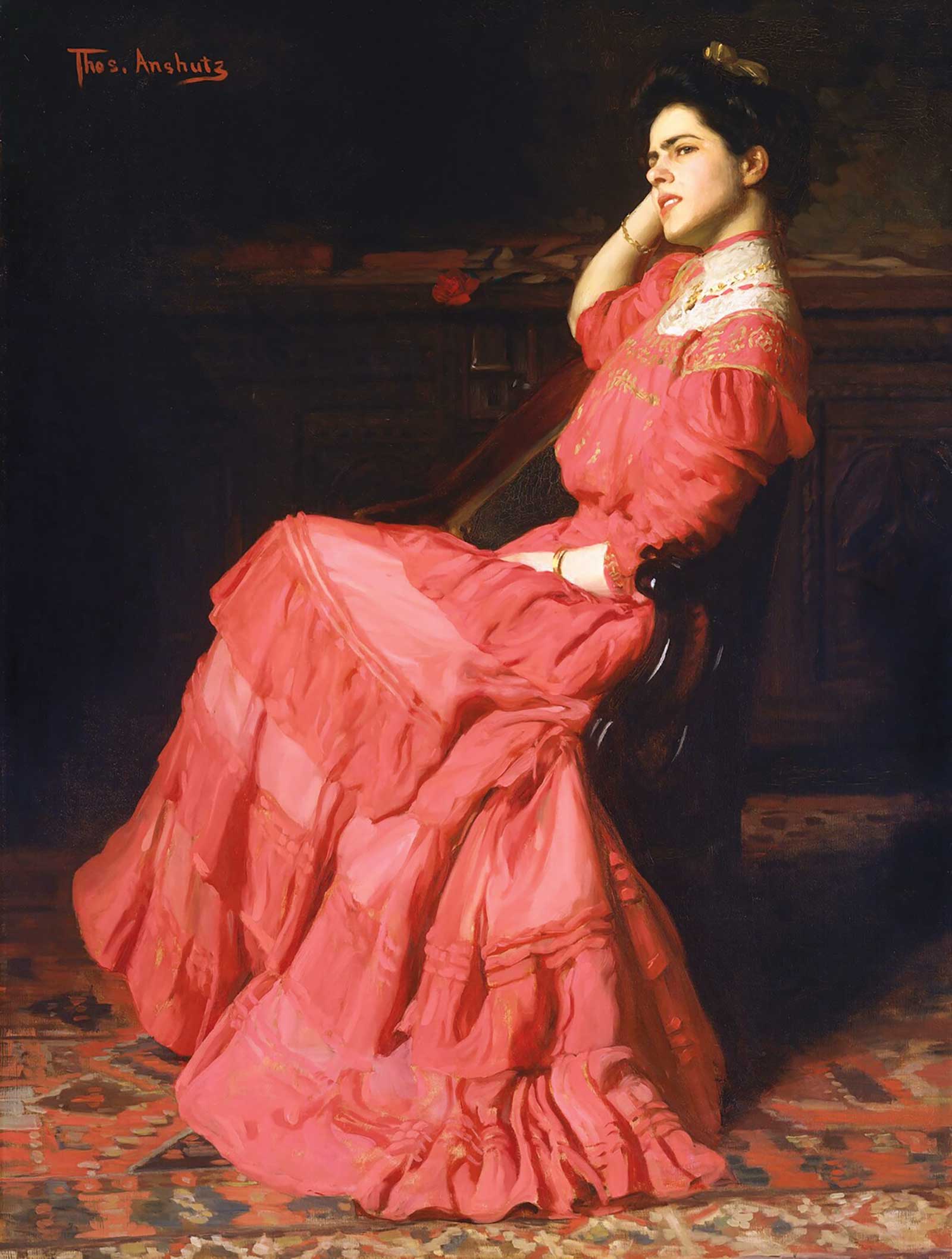
Thomas Anshutz (1851-1912), A Rose, 1907, oil on canvas, 58 x 44" (147 x 111 cm). Marguerite and Frank A. Cosgrove Jr. Fund, 1993. 1993.324.
Recently, I found myself wanting to develop a new series that was calm and quiet, capturing little moments like these old impressionist painters. I’ve been painting images that I would want to be a part of. When gathering reference, my model and I visited many of my favorite hidden gems in New York City including cafés, chocolate shops and restaurants. My model was a willing participant sipping cappuccino, sampling chocolate and drinking red wine. We used 1920s-style felt hats, a houndstooth coat and scarves as props. These works in some sense have tried to capture the feeling of a Parisian cafe, perhaps in the ’20s, like Hemmingway’s A Moveable Feast, which recounts his life living in Paris as a poor writer with his wife.
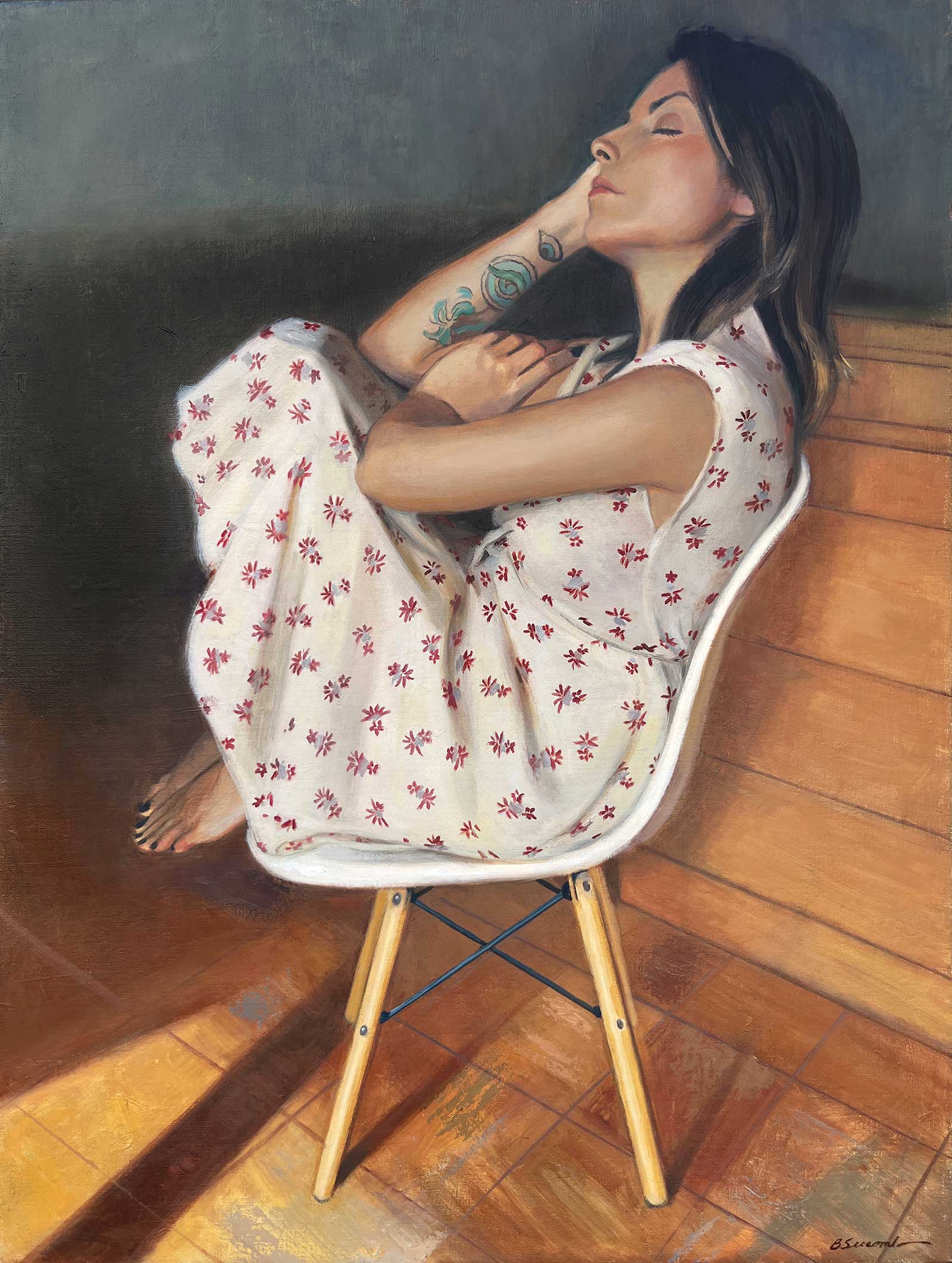
Billy Seccombe, Black Nail Polish, oil on linen, 30 x 40" (76 x 101 cm)
Cappuccino finds a girl sitting alone in the back corner of a small café. This quaint cafe was once on Madison Avenue in Midtown Manhattan. It was a warm and charming space where I frequented during my days working in New York City. The lace on her arms was mesmerizing and I could have painted it for days. I could feel the puffiness of her winter hat. The girl leans forward to sip the cappuccino and the moment seems frozen in time. Similarly, Parisian Cafe pulls the viewer into this little world through the composition using the small copper tables in the foreground drawing the viewer into this moment. The small interior had hat boxes, spice jars, ceramic hand-painted tea pots, cabinets of coffee and chalkboards with the day’s flavors. The tables were intimate and sat two or three people.
I was influenced by Degas’ L’Absinthe where similarly the woman sits enjoying her French liquor. The woman depicted stares off with a sad or lonely look. A man is seated next to her with a pipe. The subject was actress Ellen Andrée dressed in her fashionable hat while the man with the pipe beside her was artist Marcellin Desboutin, a painter and etcher. The painting is set in a café where Matisse, Van Gogh and Degas would often meet in Paris. I love the looseness of this work and the confidence to leave brushstrokes somewhat unfinished and the bold line art in places to bring out the drawing. One may also point to Renoir’s Au Cafe, which is done loosely and more focused on capturing a moment or feeling. This painting looks to be done quickly and I continue to get this point in my own paintings. I strive to achieve this level of confidence and looseness to my own work. Degas’ portrait of Mary Cassatt has the same sensibility, albeit looser but the color scheme is something I find reappearing in my own work. The confident brush strokes and the willingness to let parts of his painting be somewhat unfinished are wonderful.
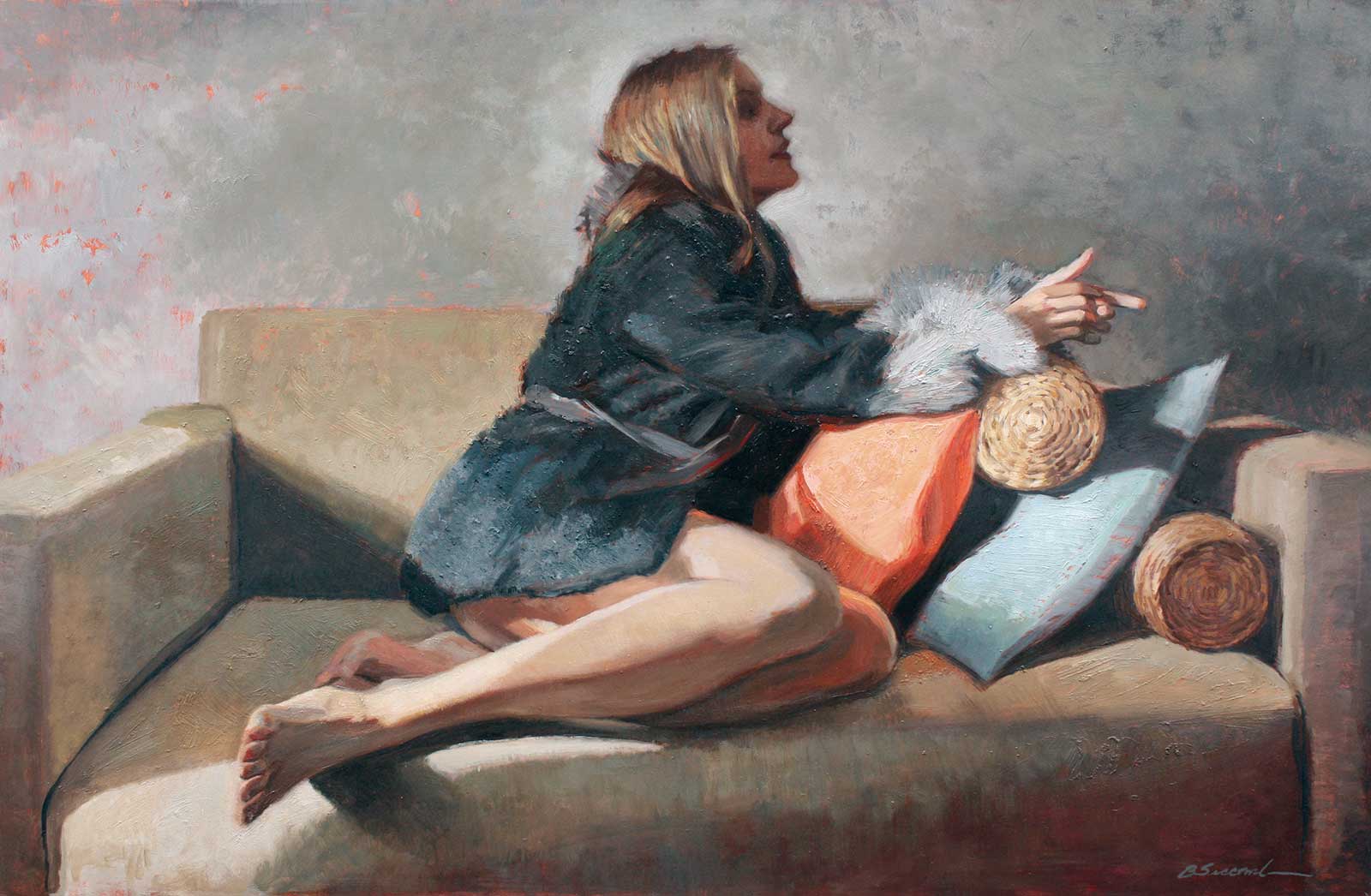
Billy Seccombe, Venus, oil on panel, 24 x 36" (60 x 91 cm)
I’ve often admired the work of Thomas Anshutz who was a Pennsylvania painter. His painting A Rose demands to be looked at and the folds in her dress are impeccably rendered and nearly come alive. It is a simple yet striking work with a strong composition. I looked to this painting as an inspiration for my painting Black Nail Polish. Much in the same way as Anshutz, I’ve anchored the model in a chair with her sun dress on and head resting backwards. The painting brings me to that moment after the morning chores are done. She pauses to put her feet up contemplating the day. The early Brooklyn light pours through the sliding door and she slipped away in a dream. The tattoo on Maryanne’s arm seems to come alive and the ditsy floral pattern dances about the fabric on her dress.
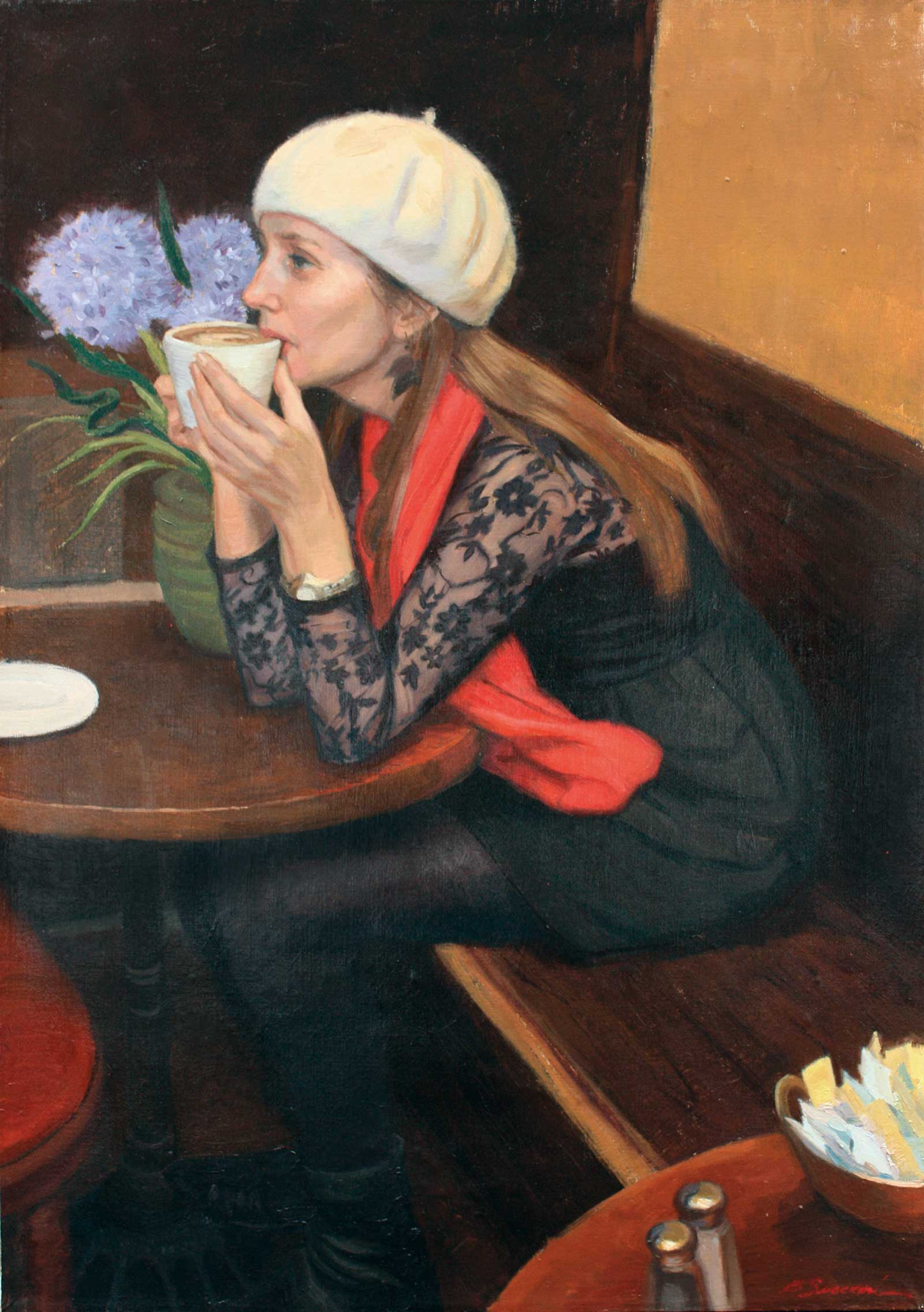
Billy Seccombe, Cappuccino, oil on linen, 36 x 24" (91 x 60 cm)
A Glass of Cabernet was part of the series of photos we took that cold winter day in New York. Seated alone at the bar the girl turns and gazes to the side. She is waiting for someone with the low-lit bar in the background. Her glass of red wine sits full on the counter. I loved painting her winter beret for this series and building up the textures. Her coat and hands were painted effortlessly and the image took shape quickly. What I love about this painting is how timeless it is. It could be from any era. The Crooked Knife was one of my favorite haunts where my wife and I would love to stop for lunch. Its eclectic environment and low-lit space made it very inviting. Painting Afternoon Tea from this same location reminded me of the brick walls, Victorian wallpaper and quirky decor.
This theme is present in many of Toulouse-Lautrec’s work. The nightlife scenes and the women in bars. In The Hangover by Toulouse-Lautrec, the thinly painted picture depicts Suzanne Valadon, a former circus performer and artist herself, who was a mistress of the artist for two years. She is seen drinking alone with a half empty bottle of wine. It captures yet another small and private, perhaps somber moment.
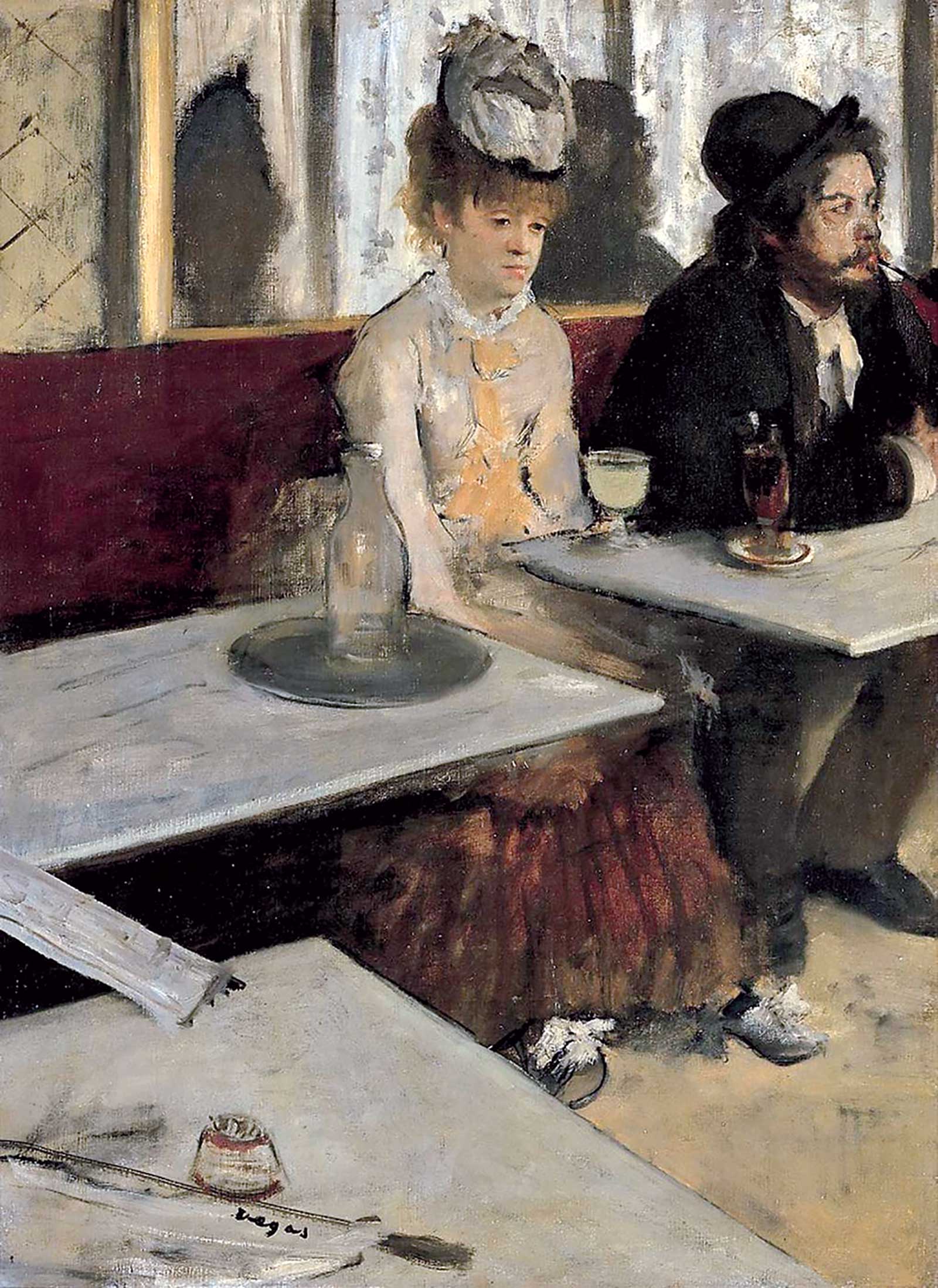
Edgar Degas (1834-1917), L’Absinthe, 1876, oil on canvas, 36¼ x 26¾" (92 x 67 cm). Musée d’Orsay, RF 1984.
Through the Fields represents one of my favorite places to escape the busy world. It’s a quiet little farm town called Tewksbury, New Jersey. This rustic country village is filled with apple orchards and large sprawling fields. I go there to clear my mind and to wander among the fields. It truly feels like you are one with nature. You become one with the rolling hills and the far off purple-gray tree line. It is absolutely silent for the exception of the sound of the wind as it rustles through the trees. Her red felt hat sings in this piece. This painting was a second attempt at the same pose. I had painted a similar version of this a few years ago but wanted to revisit the pose in a new environment. I wanted the background to feel loose and impressionistic with thick impasto paint placing her in a farm field.
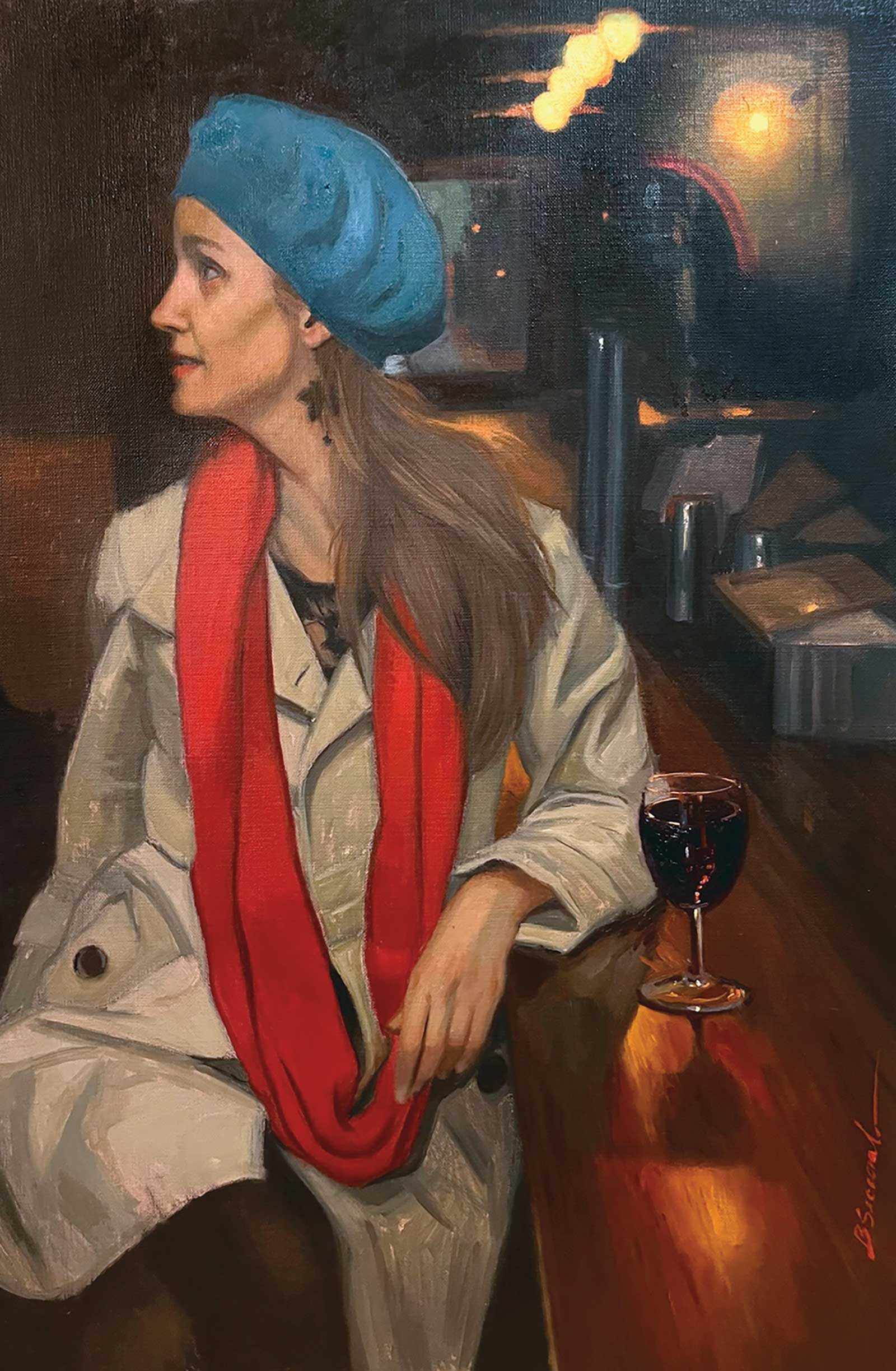
Billy Seccombe, Glass of Cabernet, oil on linen, 36 x 24" (91 x 60 cm)
Painting fur has become one of my favorite tasks and the textures in Venus allowed me to get lost in its creation. This work was looser than the others and more spontaneous. I was playing with brushstrokes here and a looseness to the mark making. Her coat was made by a fat build-up of paints and her face falls into shadow. It’s mysterious yet simple composition makes the work interesting to me. I started this painting some time ago and set it against the wall only to be revisited months later. This time my eyes were fresh and I thought of the painting differently. The brushwork was faster and loose. Occasionally an artist must abandon a work if it becomes stale and return only with a new perspective and fresh energy later. One can find inspiration in similar subjects in the reclining woman on the couch as seen in works from John White Alexander in Repose or Ramon Casas’ A Decadent Young Woman After the Dance.
In speaking of how the great masters continue to inspire me, I had the pleasure recently of participating in the New York Metropolitan Museum of Art’s Copyist Program. The program offered by the museum has its beginnings in the 1870s and has allowed painters the privilege of painting in the museum during public hours. This up-close-and-personal painting program allows artists a series of eight Mondays to copy a great masterwork of your choice in the museum. My selection was without hesitation John Singer Sargent’s Mr. and Mrs. Phelps Stokes. The daunting task of emulating Sargent with his confident brushstrokes must not be understated as the simplicity in his marks makes it a tall order to emulate. I must admit I became very comfortable setting up my painting in the museum space at the foot of Mrs. Stokes. Fighting the glare from overhead lights I was able to get a better sense of Sargent’s use of color and brush work. I did not dare to paint the 10-foot canvas to scale but rather zoomed in for a closer look at Edith Stokes’ face as a study. The program gave me an intimate look at Sargent’s work and as I’ve heard others say, the masters are teaching you with their works and they continue to speak to us all. There is no greater teacher. For me, Sargent seems to have come alive in the museum as I painted and I felt at times I was beginning to know him better.
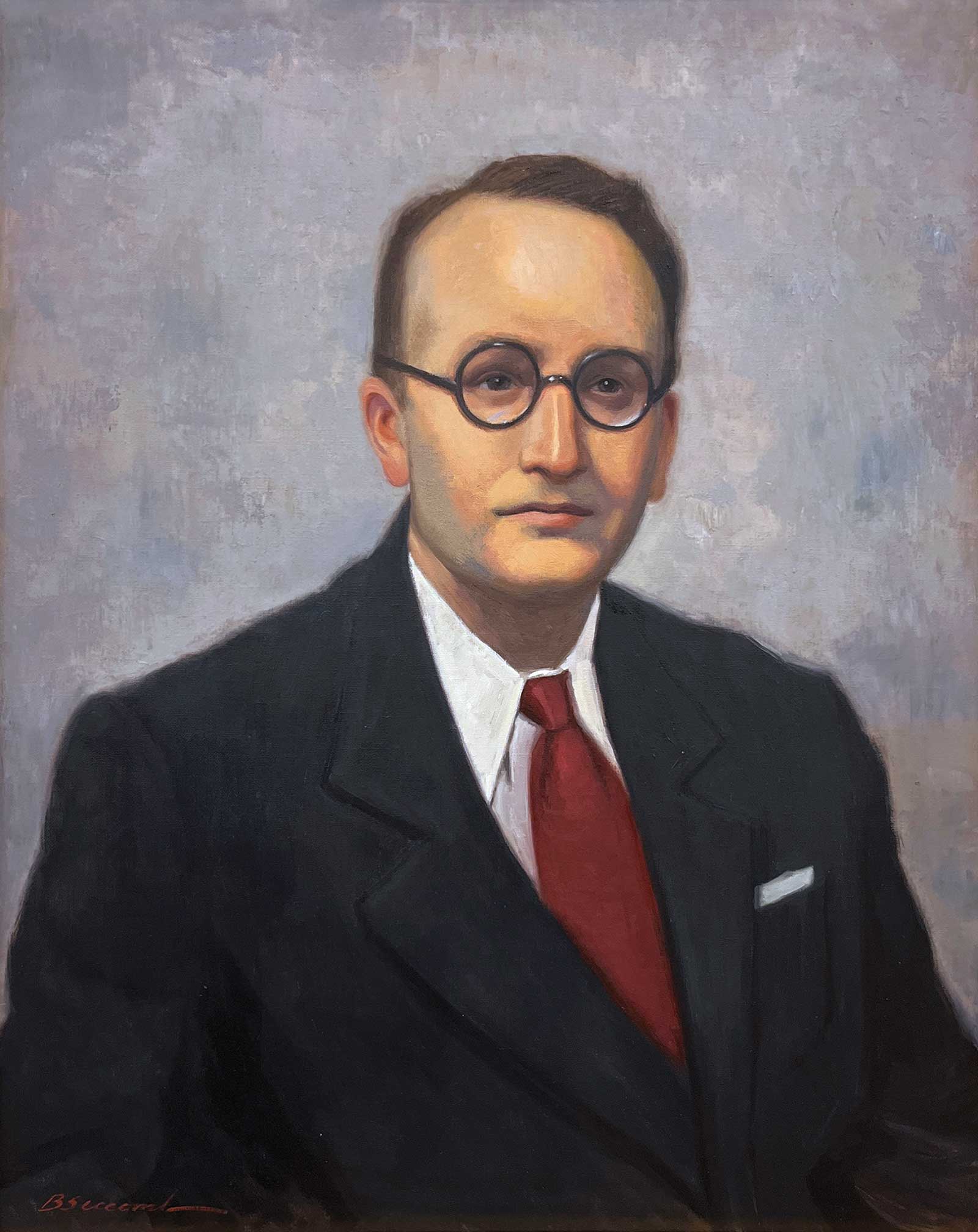
Billy Seccombe, Hubert Huntley, oil on linen, 30 x 24" (76 x 60 cm)
Lastly, reflecting upon a recent opportunity to paint an official portrait of Dean Hubert Huntley of Union County College in New Jersey I will share the process for this piece as it served for a unique challenge. The college had reached out to duCret School of Art inquiring if there were any painting instructors interested in the commission and I quickly jumped at the opportunity. Huntley was the first dean of the school in the 1930s and the college was without a formal portrait of him. What served as a unique challenge for this piece was the limited reference I had to work with. Being that he held the position in the ’30s there was only one small black-and-white image with which to work. This can both be limiting but also open the door for some imaginative work-arounds. How would I translate a black-and-white photo to a full-scale color oil painting? Working from the photo as reference I also relied upon a close friend who ironically has similar features to Huntley. My friend was a willing model and I asked him to pose in a suit. Together with this reference as well as utilizing myself as a secondary model I had the necessary reference. The piece took two months and was formally presented to the college. It’s a very proud moment for my painting career as the portrait hangs next to one of my friends and fellow Portrait Society of America painters, Nanci France-Vaz and her portrait of a former dean. This portrait of Dean Huntley, though more academic, had to rely at times on an imaginative approach and creative problem solving which felt impressionistic at times when color and edges had to be invented.
I’m enjoying making images that appear to be from another era—or could be. I feel transported back to another time. It offers an escape and provides for a quiet respite from life. These feelings translate into my work and it is these ethereal fleeting moments I am trying to capture. So many of the great masters succeeded in pausing a moment and offered a view into their lives. They are small moments and honest works. —
About the Artist
Billy Seccombe is represented by Dacia Gallery in New York City and is a painting instructor at DuCret School of Art in Plainfield, New Jersey. He is the New Jersey Ambassador to the Portrait Society of America and is a board member of the Allied Artists of America. He is a featured artist with Michael Harding Oil Paints and Rosemary & Co. brushes. For more information, visit billyseccombe.com. Seccombe is represented by swaingalleries.com and daciagallery.com.