Natural history illustration is a challenging, exacting and fascinating craft that you’ll never stop learning about, striving towards or being fascinated by. This gorgeous genre of painting brings art and science together along with a wonderful, multi-layered purpose to your work and a bar of excellence that keeps you constantly striving. From the simple pleasure and beauty of fine art, to the important documentation of our natural world, to the personal challenge, this fascinating genre is nourishing to the mind and soul, and I find that incredibly appealing.
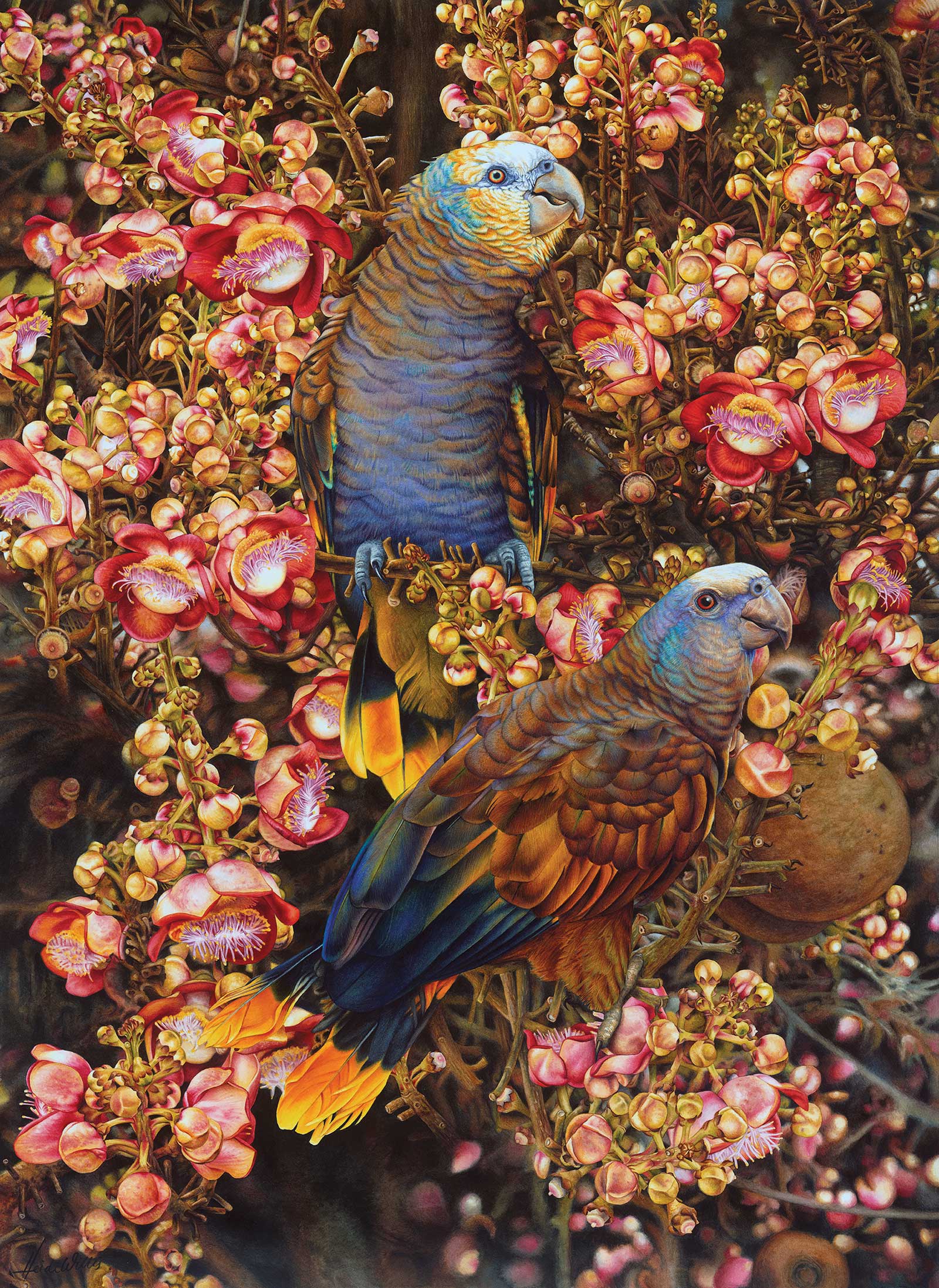 St Vincents Amazons & Cannonball Tree, watercolor, 35½ x 26" (90 x 66 cm)
For me it’s all about the exploration of our remarkable natural world, exploring the world, subject, medium, science and self in each story. Nature truly offers an endless plethora of inspiration to us as artists, so full of beauty, divine color, endless textures, myriads of intricacy and complexity to delve into, and an abundance of magic and wonder to express your visions with. For me, even after all these years, I remain enthralled and completely sustained by its focus, driven still by the desire to do it better.
Being a nature and science painter, realism and accuracy is the goal when representing my subjects. As artists however, we also have the luxury of entwining our own self and expression into the story to create this wonderful balance between these more rigid and creative realms.
So how is the actual painting done? Well, there’s no fast road to realism in any medium. Put in the simplest terms, I work in many delicate, intricate layers that ultimately collect into one story. With watercolor, I work in the wash to rough my painting in, glaze to volumize, intensify and create form, and then dry brush to refine and finish the painting. The careful combination of these three approaches is a fabulous, effective way to work that creates a really wonderful outcome.
Color can also be reduced to simple combinations and even single colors at a time too. Many simple steps, I find, can still amount to a complex outcome, so for students I’ve found this approach is ideal. Understanding that you can match your approach and your subject to meet your level of experience certainly gives great comfort and confidence to step in and explore this beautifully rewarding genre.
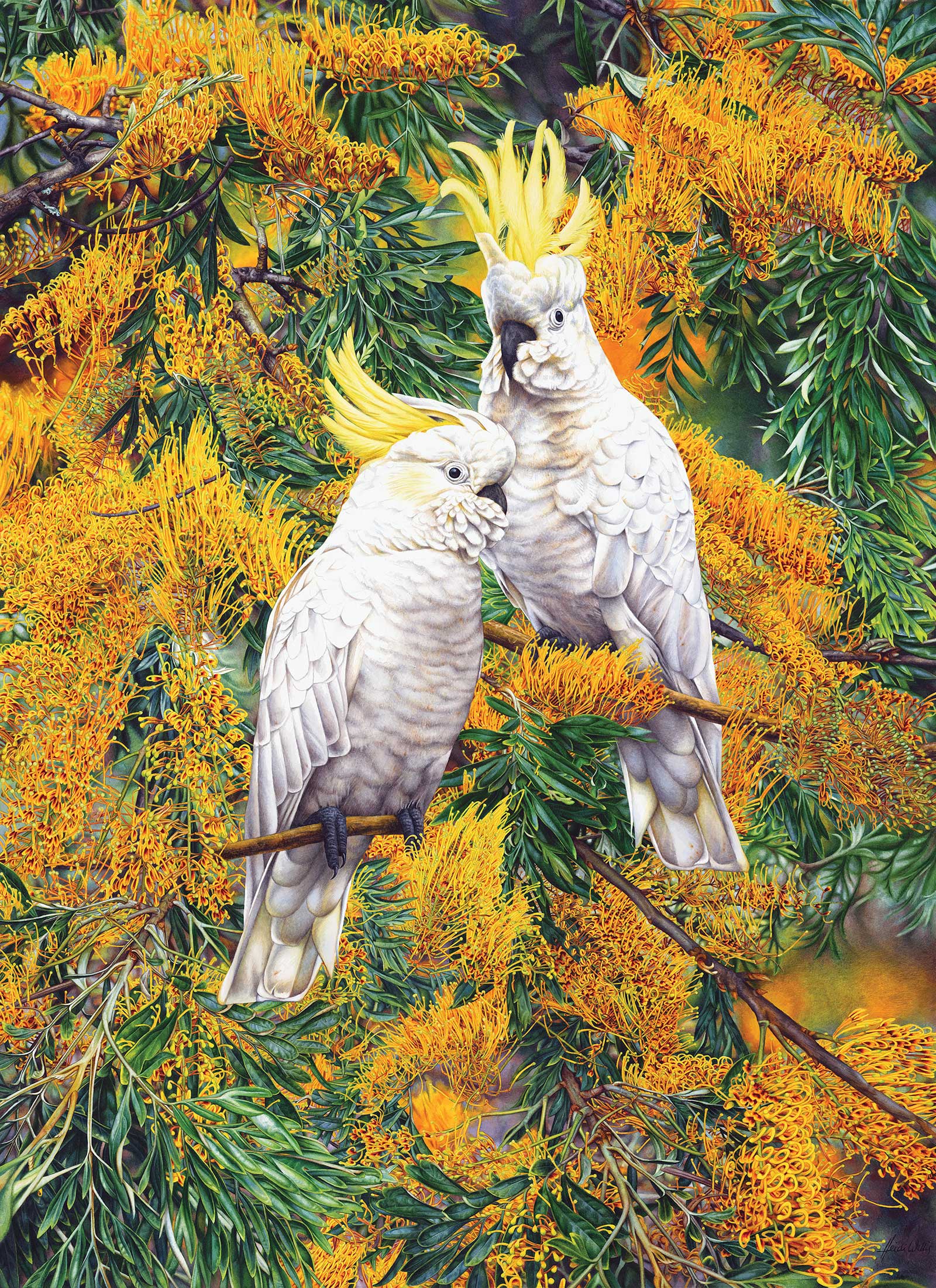
Cockatoos & Silky Oak, watercolor, 35½ x 26" (90 x 66 cm)
It’s difficult to be a good natural history artist while avoiding too much detail when Mother Nature is all about complexity. For me this is exactly what draws me so much to the art form, the fabulous challenge of it, that incredibly gorgeous tangle of color, texture and life to get lost in. Some compositions are simpler, some are not, some pieces are large, some are small, but my goal in my work is simply to try to capture and honor nature’s beauty and each little story I’m presented as best I can, and to share a little joy with the world through my work.
Gang Gang Cockatoos and Brachychiton captures two classic naturally Australian subjects, both bird and botanicals, and I am thrilled to be sharing a deeper look into this painting with you here. This large study is one I’ve wanted to paint for some time now, but because of its ridiculous complexity, I kept putting the idea aside because I knew it was a marathon of an undertaking to create. Aren’t they always for me though? Paintings have a way of nagging me until they are done, and this was one of those persistent stories.
In this piece I wanted to capture the outrageous beauty, complexity and wonderful relationship between these subjects. I love how the male cockatoo takes a back seat to the female in this piece, allowing her to shine. It’s a magical love affair all around and watercolor seemed such a beautiful, romantic medium to express it with. As I often do, I wanted to work in a large size to tell the story just as it is in nature, so I finally accepted the challenge and set about bringing this unique and significant natural history painting to life.
My Art in the Making Gang Gang Cockatoos and Brachychiton
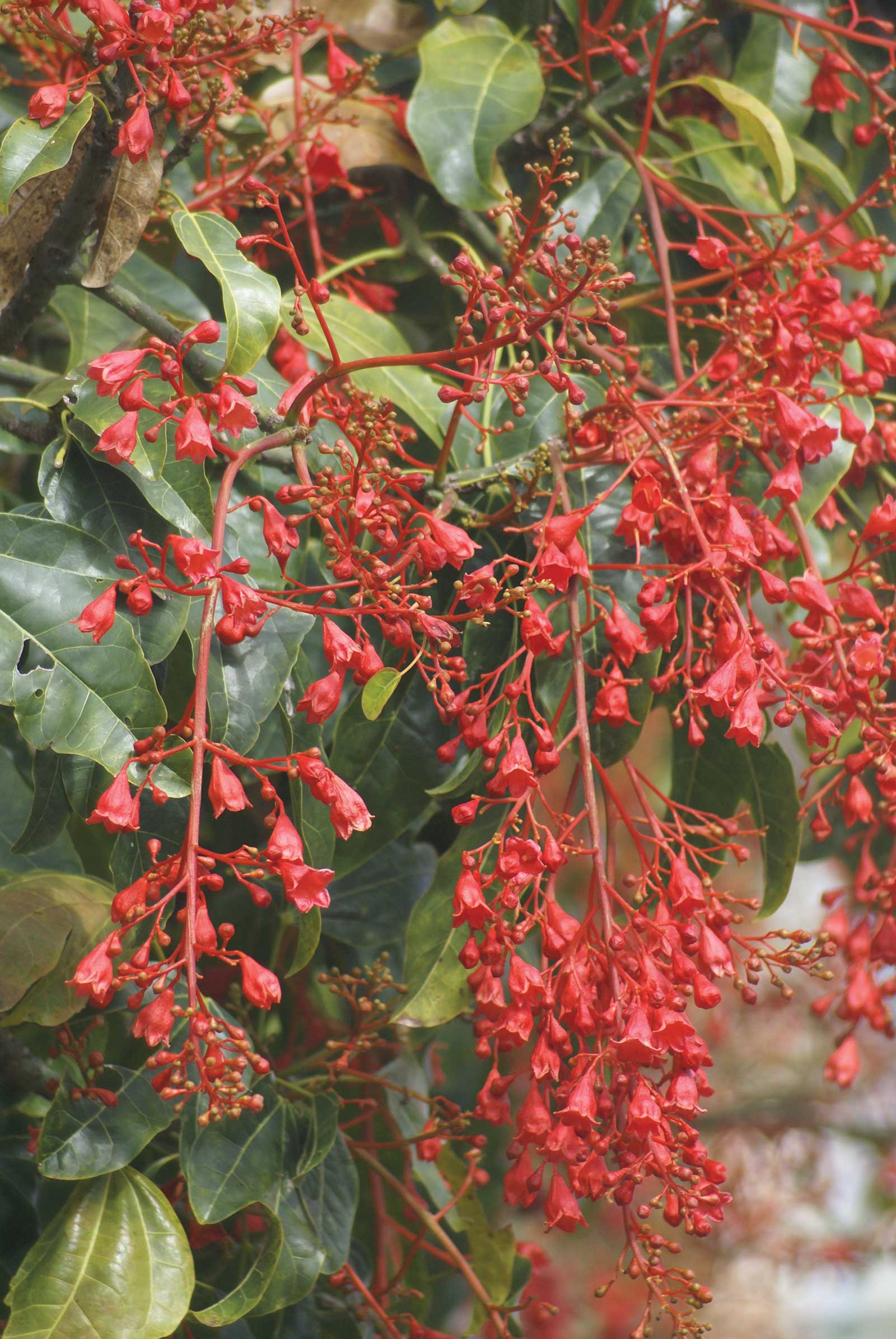 Reference Photo
When creating immaculate work, every step in the process must also be immaculate. It takes time, patience and care to produce realistic styled work, and every mark and stroke on your page must be considered. Creating a strong familiarization and connection between your subject and painting is essential, and this really starts to solidify in the drawing process. It’s like getting to know each other, understanding and respecting the uniqueness of this balance and building strong foundations of the relationship to come.
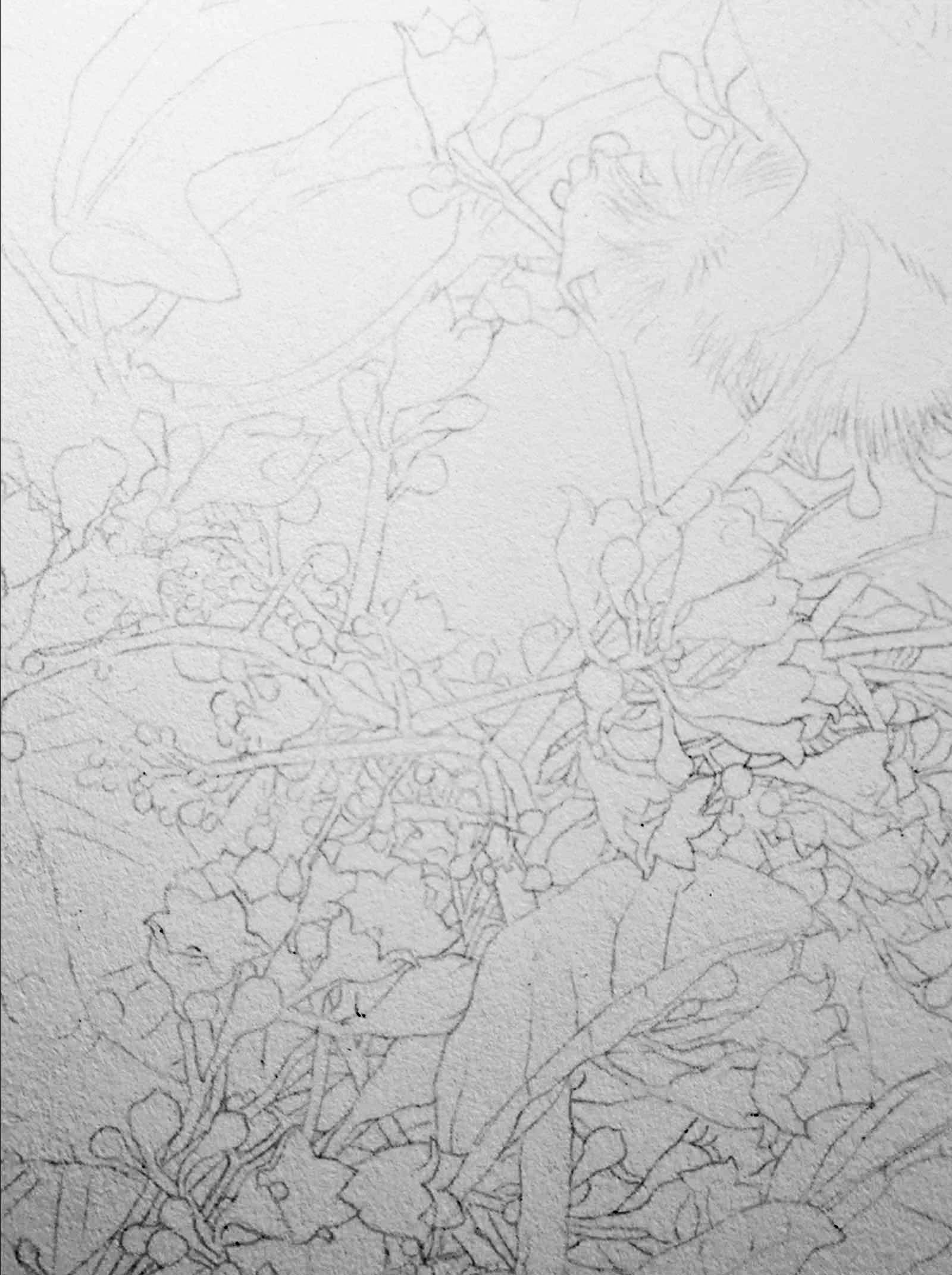 Stage 1
Stage 1 Small Section of Drawing
The first step is the drawing. Being such a complex piece, this takes time, and accuracy is critical. Every line needs to be clear, consistent and purposeful so you don’t lose your way amongst the complexity.
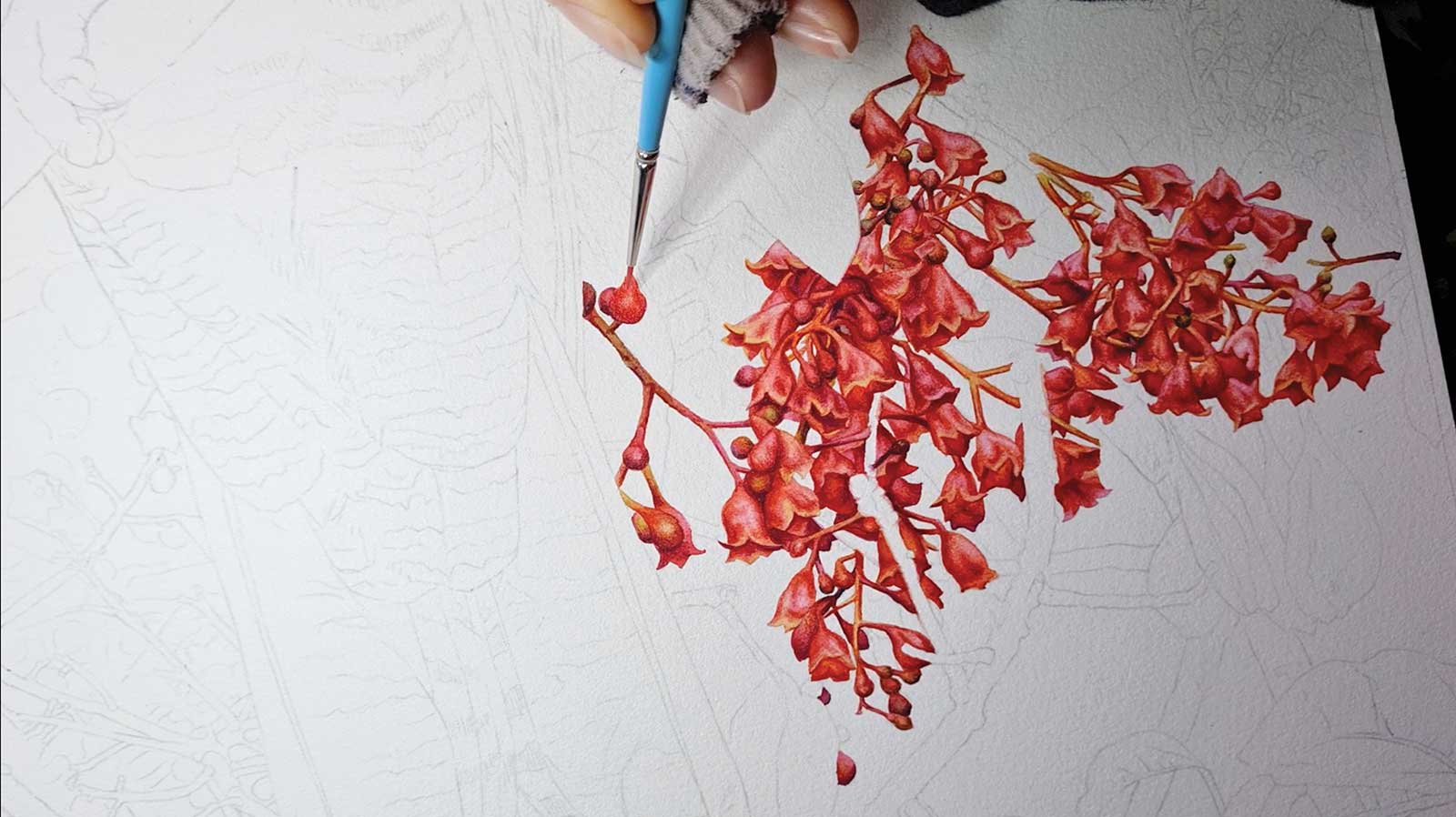 Stage 2
Stage 2 The Red Flowers Begin
Stepping into the first strokes of this painting, I begin the detangling process or rendering the intricate masses of red micro-sized flowers that cascade and sweep across the painting, each of them completely unique.
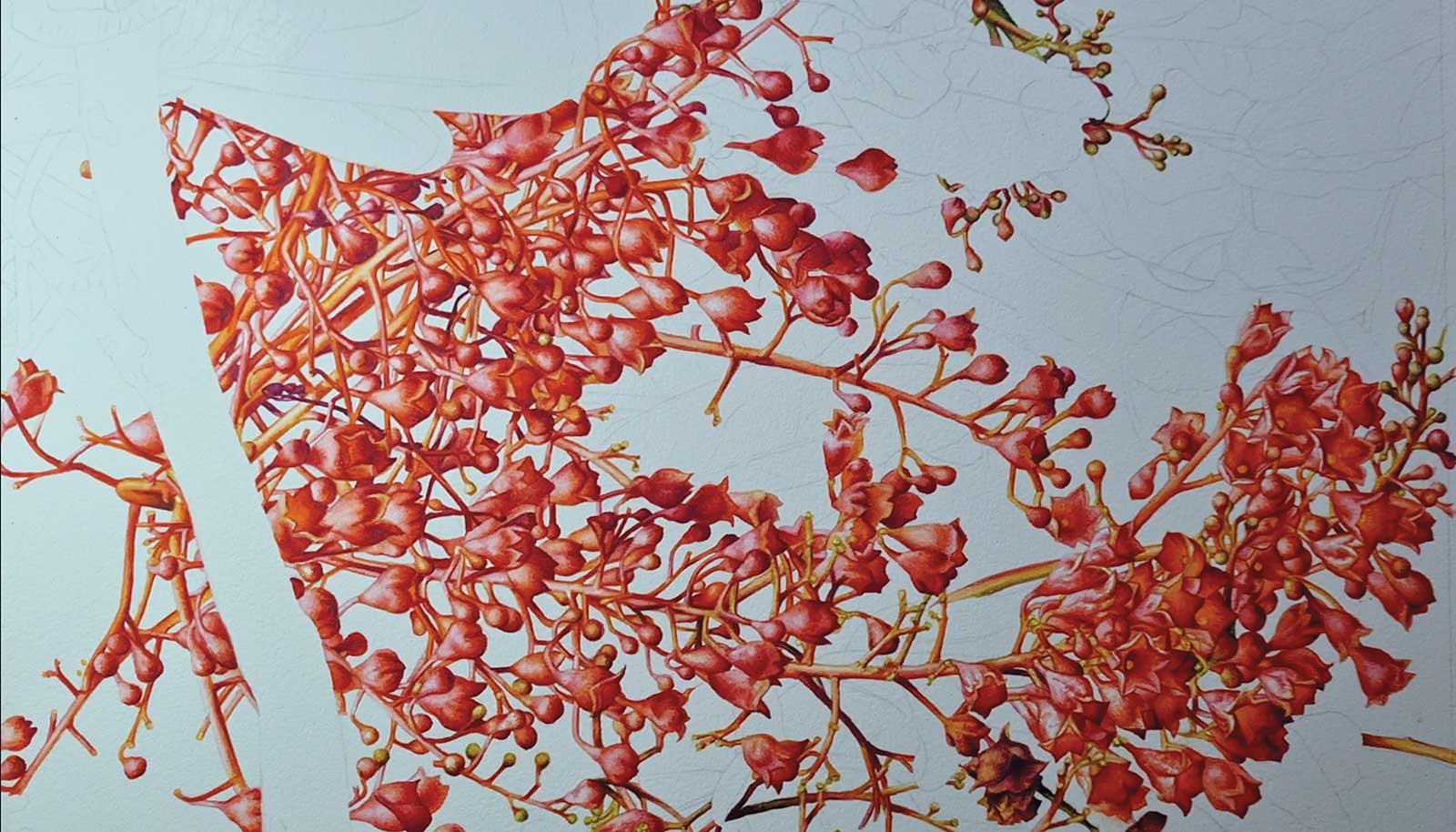 Stage 3
Stage 3 The Red Flowers Grow
Here we can see that many individually rendered red flowers takes shape, meaning and substance, creating a dense coverage of flowers throughout the background. Individual flowers are now forming trusses of richness, bold color and delight.
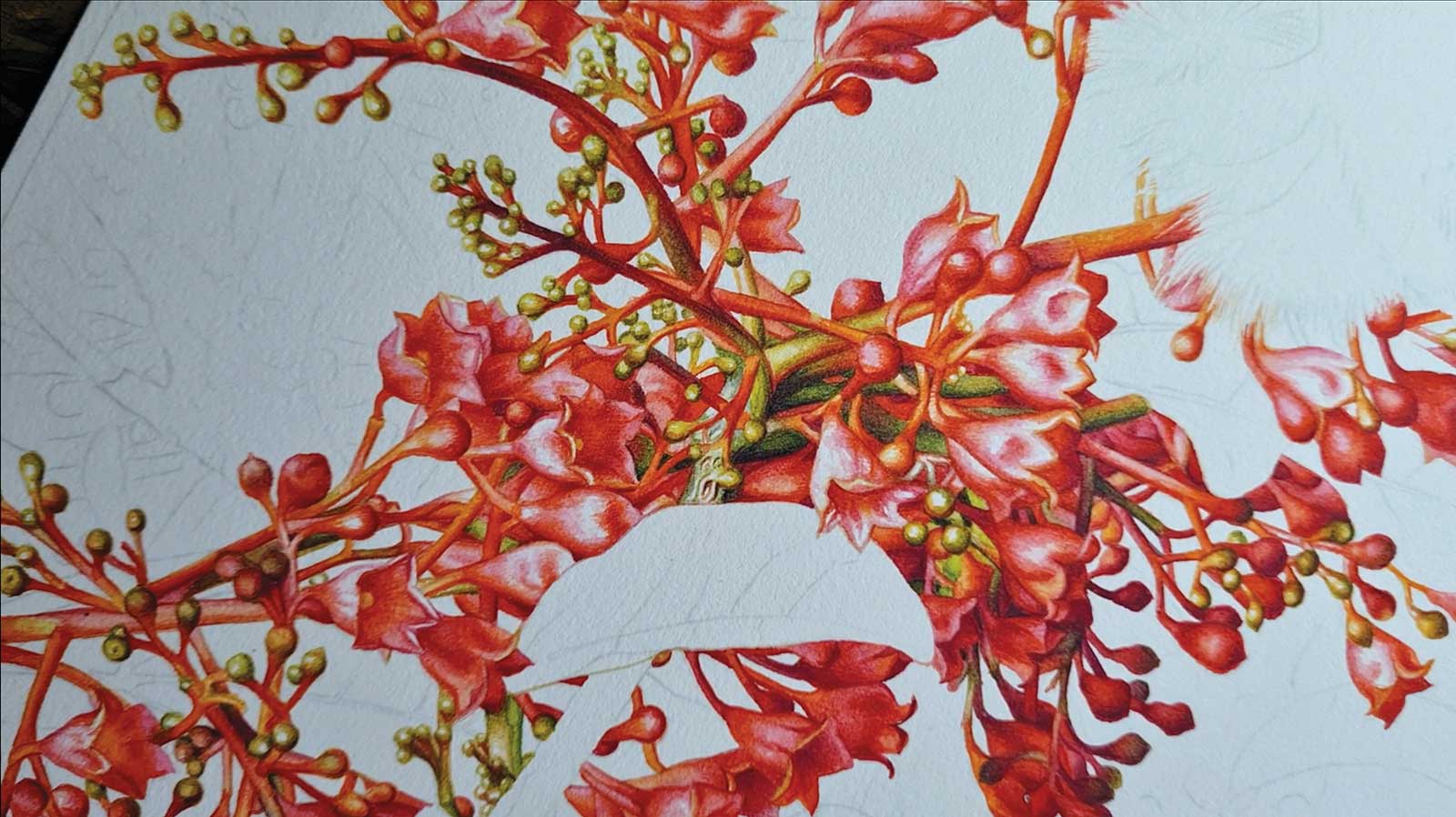 Stage 4
Stage 4 Flowers Meet Background
In this step, we start connecting the red flowers to the background of the painting, creating more substance, connection and depth in both the flowers and the larger background overall. Our palette shifts to more diversity too.
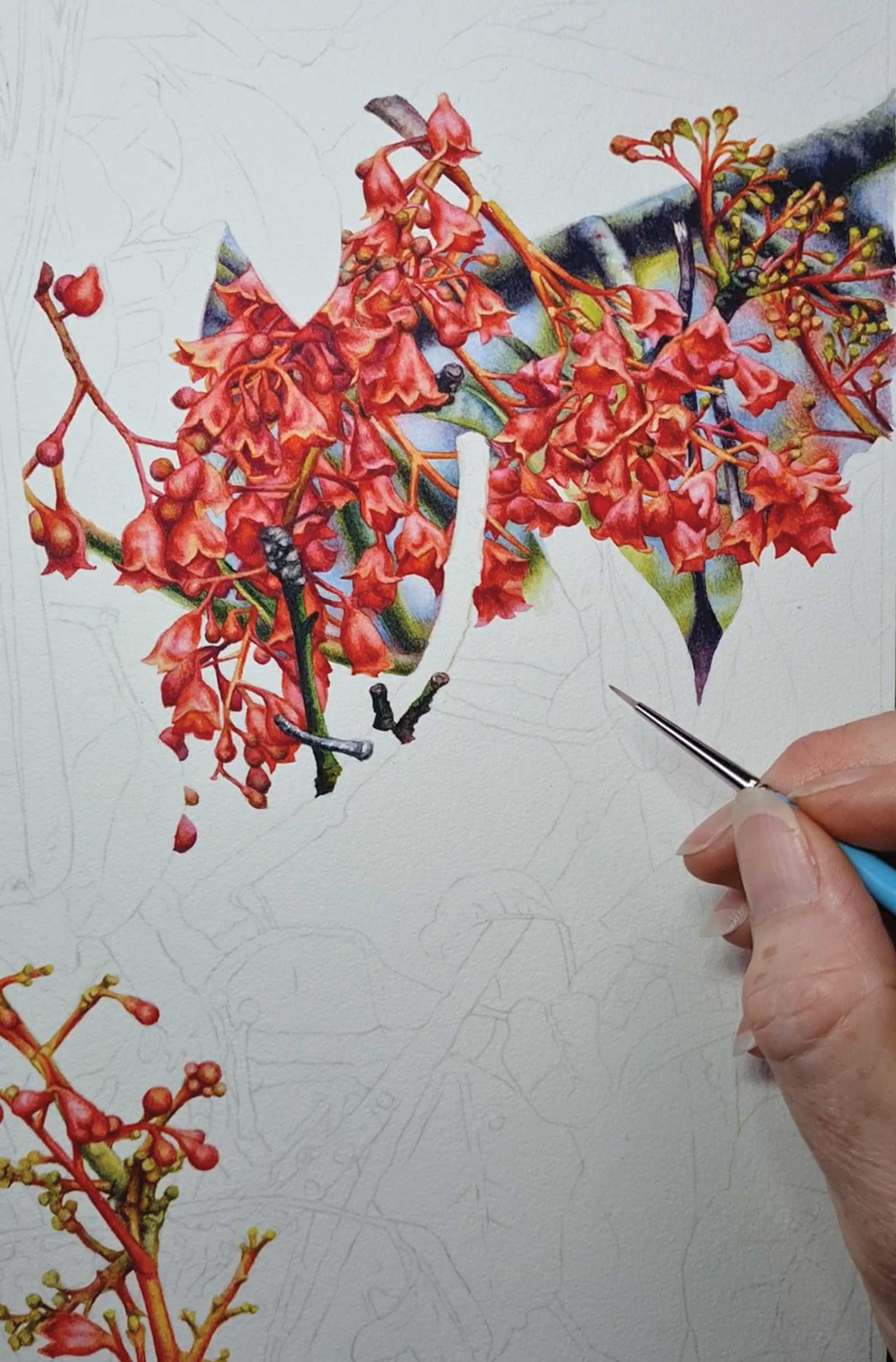 Stage 5
Stage 5 Growth
Here we start to incorporate more of the background elements, which shifts the story significantly, bringing new colors, textures and interest to the mix. While I’ve kept the flowers in focus, the rest falls away to softness.
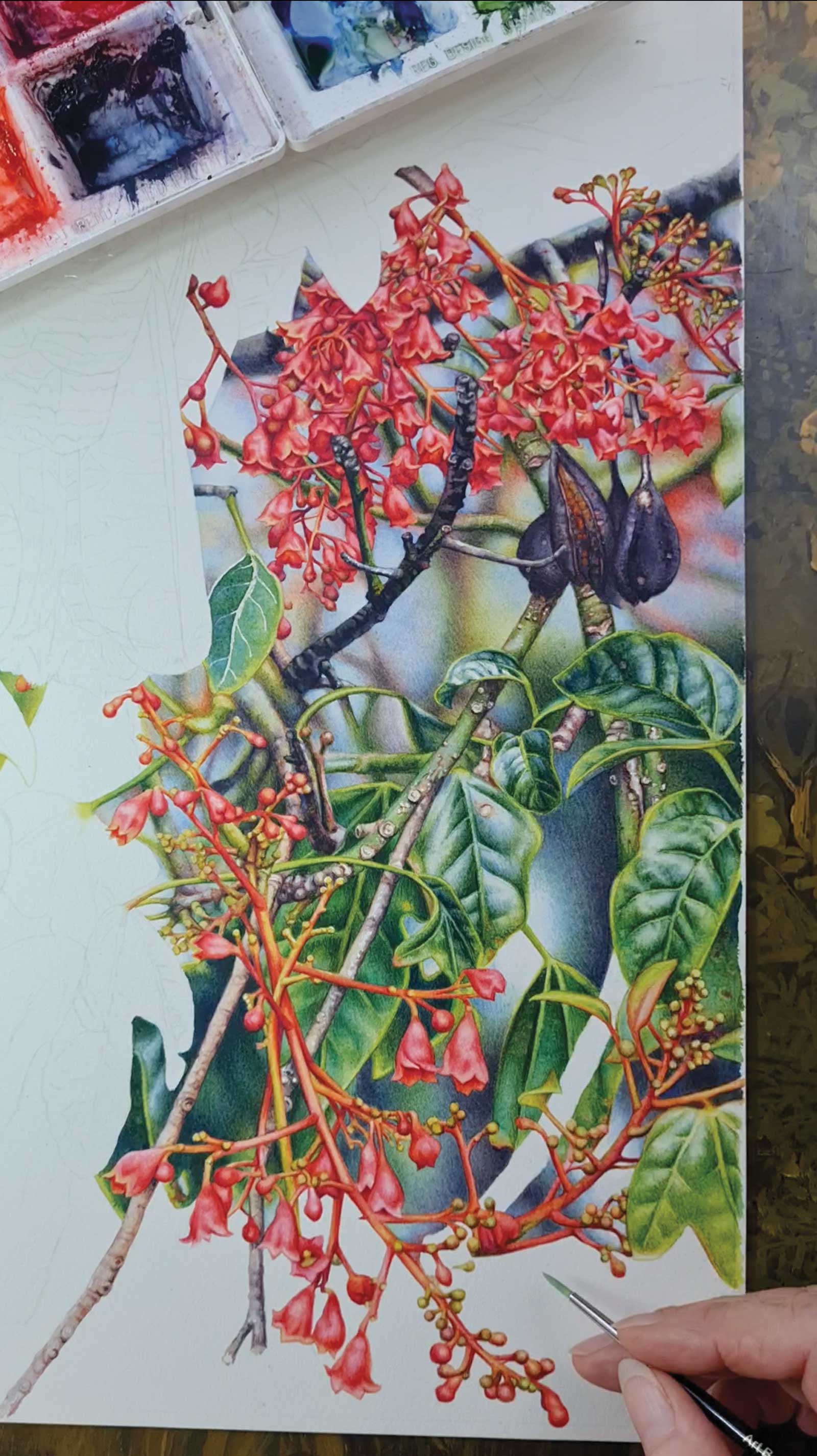 Stage 6
Stage 6 The Background Grows
Incorporating the first of the leaves here, we meander through sharp and soft focus, slipping in and out of the story’s depths with color, tone and technique. I love this complicated play in my work.
My Design and Composition Tactics
- Be Resourceful Much of my own unique style comes from my limitations—and there were many, especially starting out. I had to be resourceful with my materials and adjust my style to meet those challenges. In time I came to realize that it’s those limitations and resourcefulness that created so much of my treasured uniqueness. This will be the case for you too, so work with it positively and see the opportunity at hand.
- Walk Your Own Path Being so young and broke when I began, I started out simply “using what I had,” and I am still a great advocate of this now (outside of the importance of good pigments). One very significant thing this led me to were the brushes, a product I loved so much I’ve literally put my name to them as my own brand. For me they were so good! Completely against the grain back then, I found these to be a true asset moving forward. Affordable, durable and manageable, just by being open, experimenting and following my own path.
- Let Your Loves Inspire You For the design and composition of my work, I leave this largely to Mother Nature. If ever there was a divine knowledge and skill in design, nature is where to find it! My goal in my work is to capture what I see and love in my subjects. In nature, the more you look the more you see, so I am guided enormously by what it suggests.
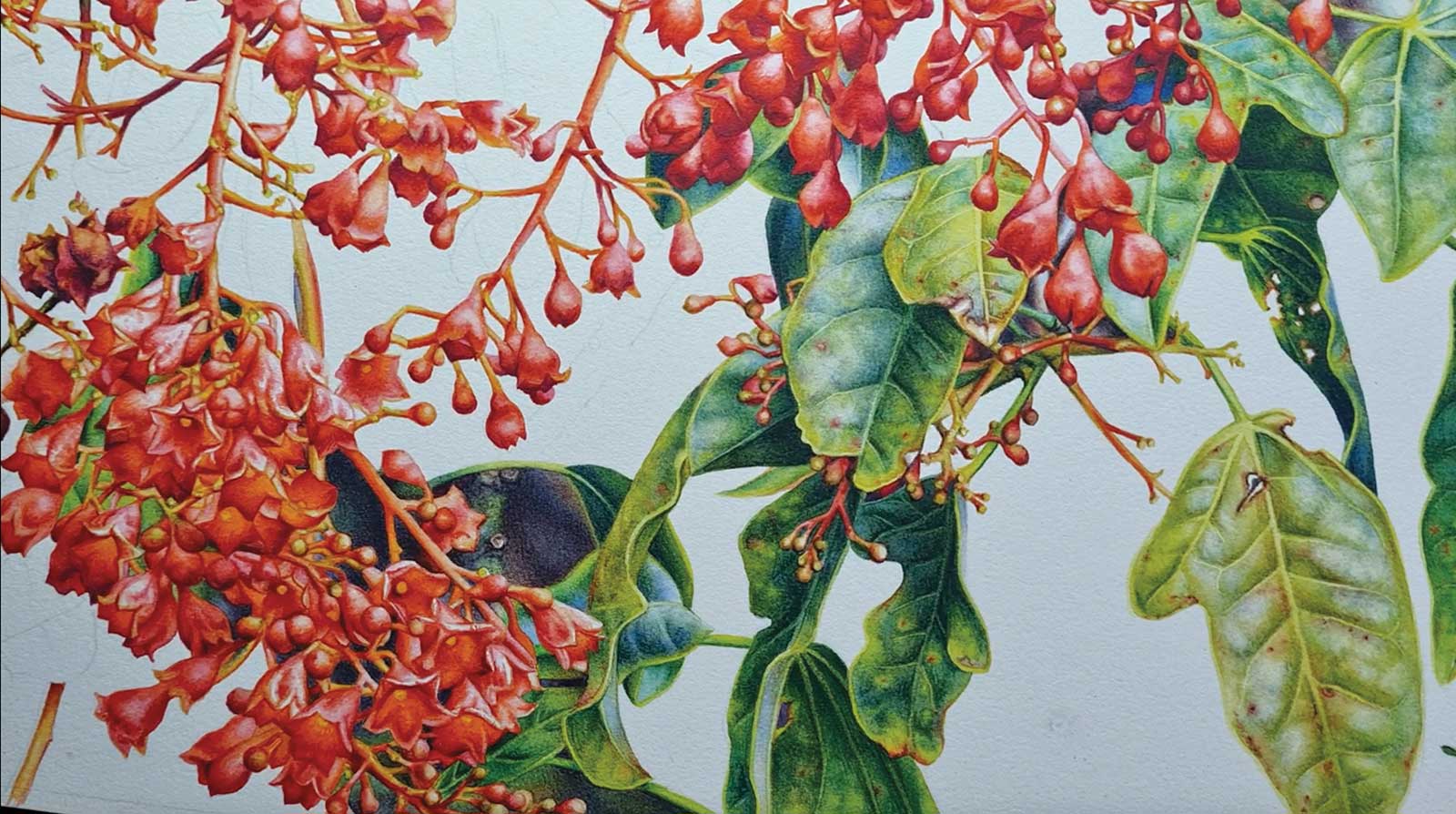 Stage 7
Stage 7 Focusing on the Leaves
Focusing strongly on the leaves in this stage, a flush of lively, earthy green emerges, bringing a luxuriously organic shift to the balance of the background. It’s not just flowers now, it’s a complex show of stunning Brachychiton.
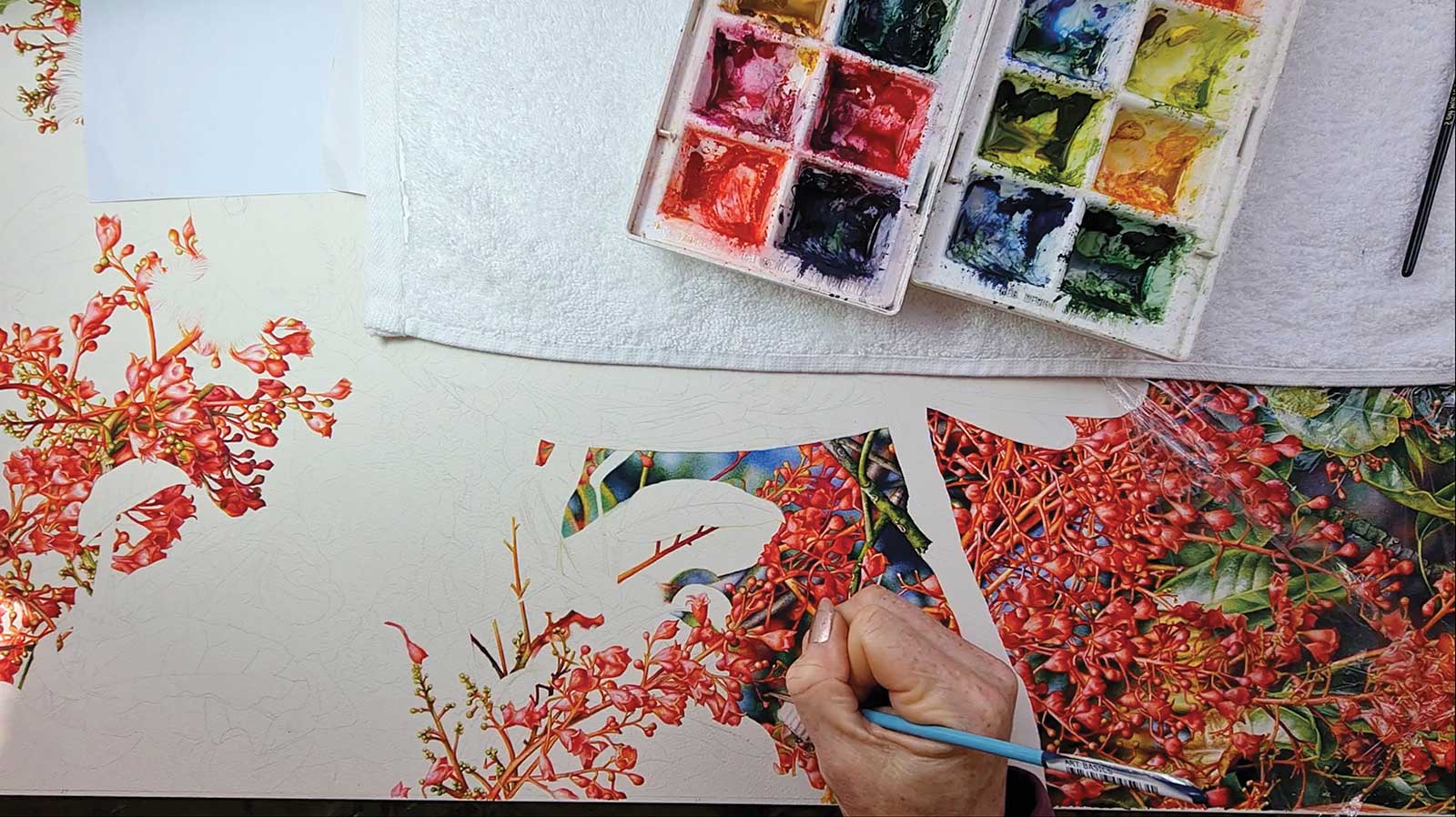 Stage 8
Stage 8 Flowers, Leaves, Branches
Flowers, leaves, branches and soft background fill the white of the paper here, completing the Brachychiton story more with every brushstroke. It’s a feast for the senses now, reflecting the glorious tangle of this stunning tree.
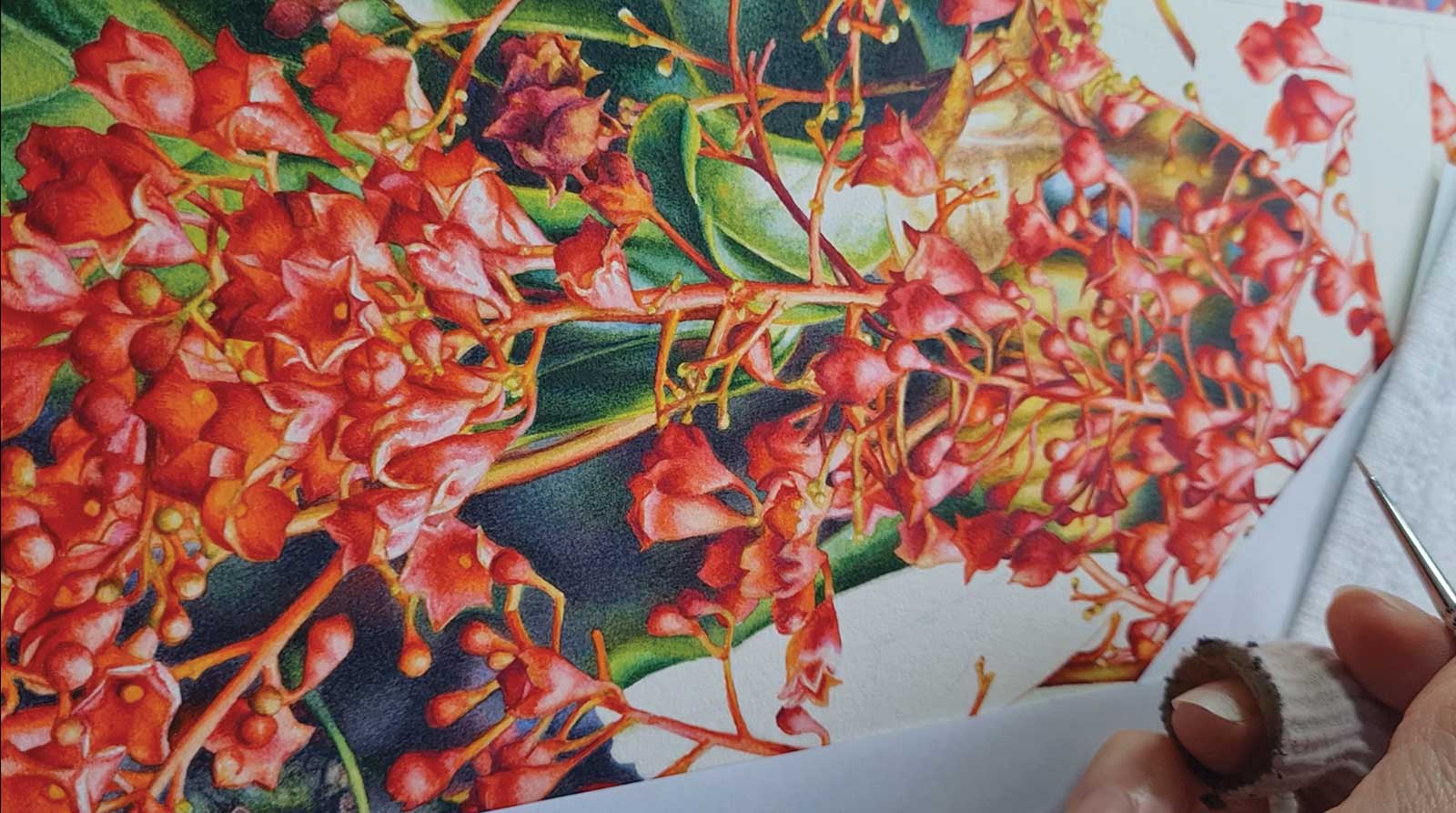 Stage 9
Stage 9 Building the Backdrop
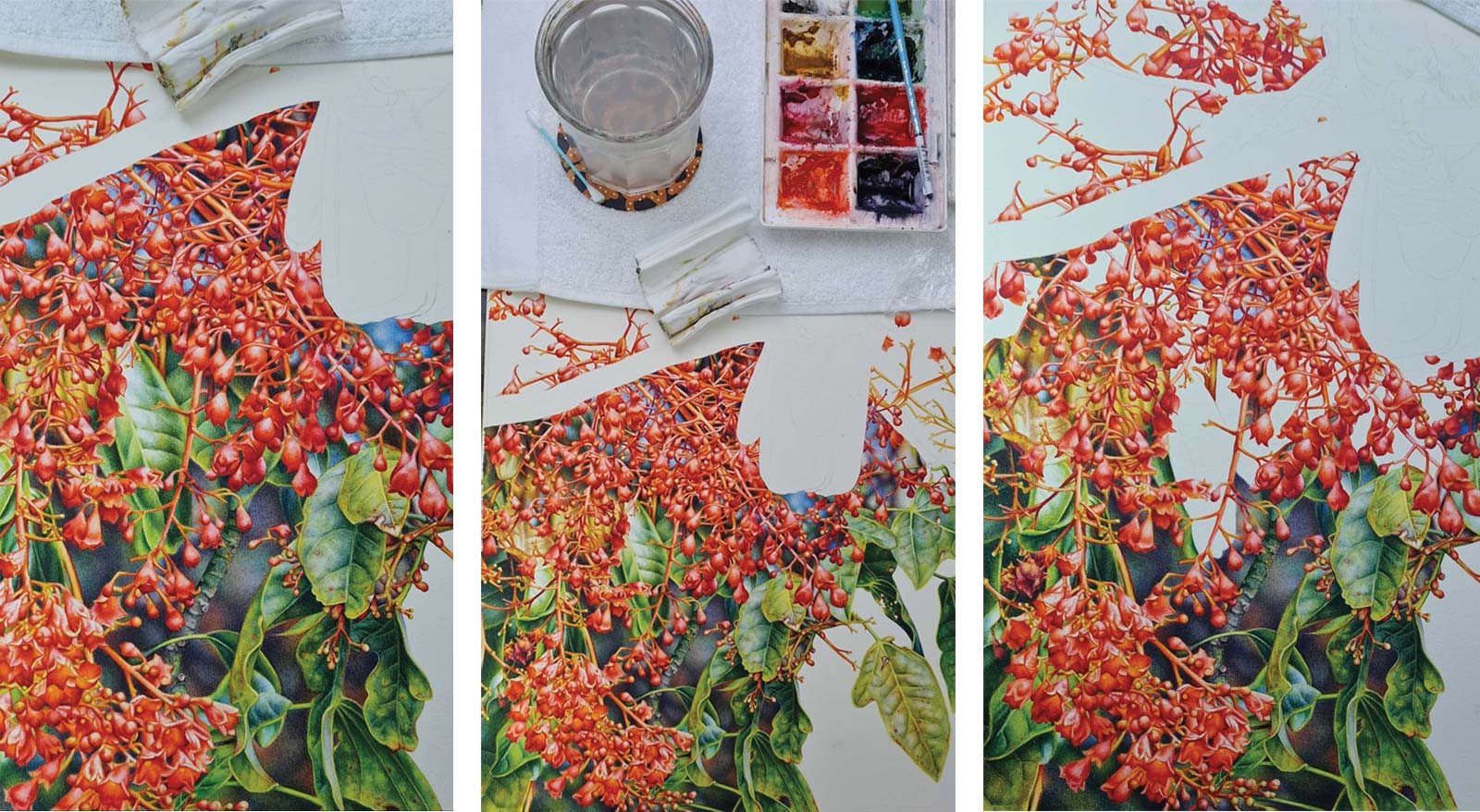
The background is large and intricate and there is much work to be done in its rendering. Slowly, the background closes in, consuming the white of the paper, bringing every part of it carefully to life.
 Stage 10
Stage 10 Maintaining Focus
Many weeks into the process now, focus shifts to patience, perseverance and endurance while maintaining a completely present and total love affair with your painting. Too far in to quit, too far out to look ahead. It’s a practice of mindfulness and being present in the moment.
 Stage 11
Stage 11 Bringing the Background Elements Together
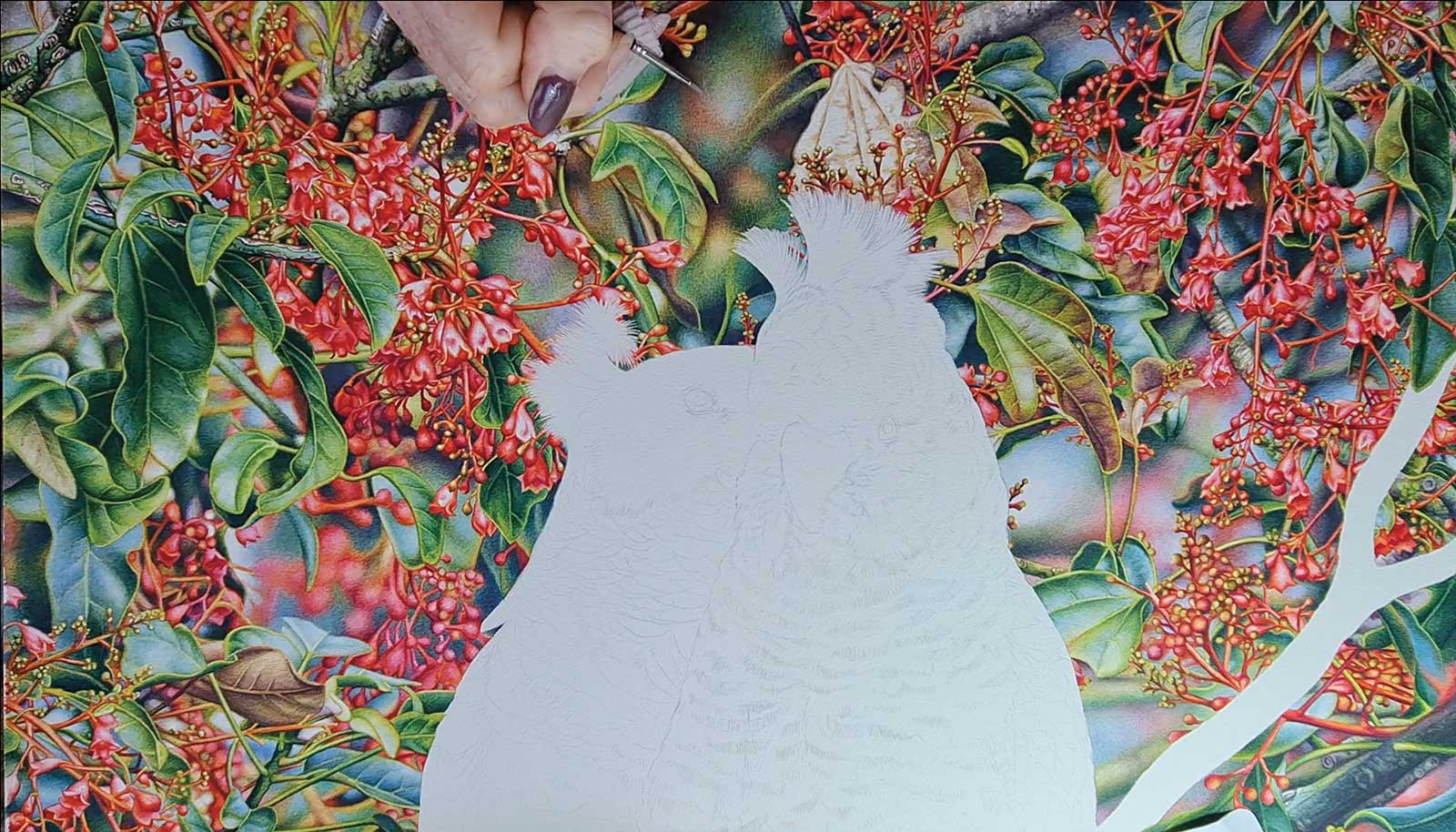
The final brushstrokes go down to complete the background, tying all elements together with cohesion, depth, diversity and interest, strong enough to hold the gang gangs in their dreamy, beautiful natural environment, nestled in amongst the Brachychiton.
 Stage 12
Stage 12 Main Branch
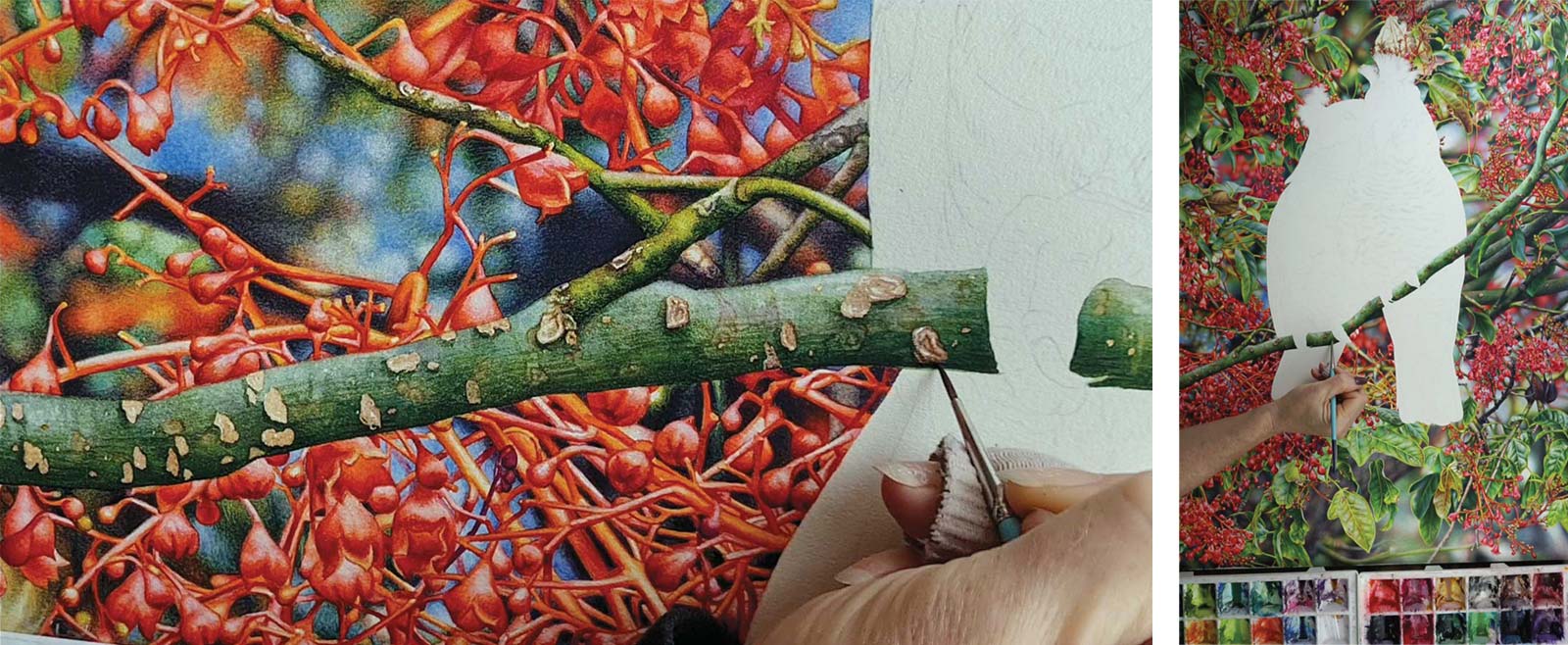
We come to the primary branch now, which could be seen as an entire painting exercise and study in itself. Rich in color and texture, you can really lose yourself in this element alone.
 Stage 13
Stage 13 Starting on the Cockatoos
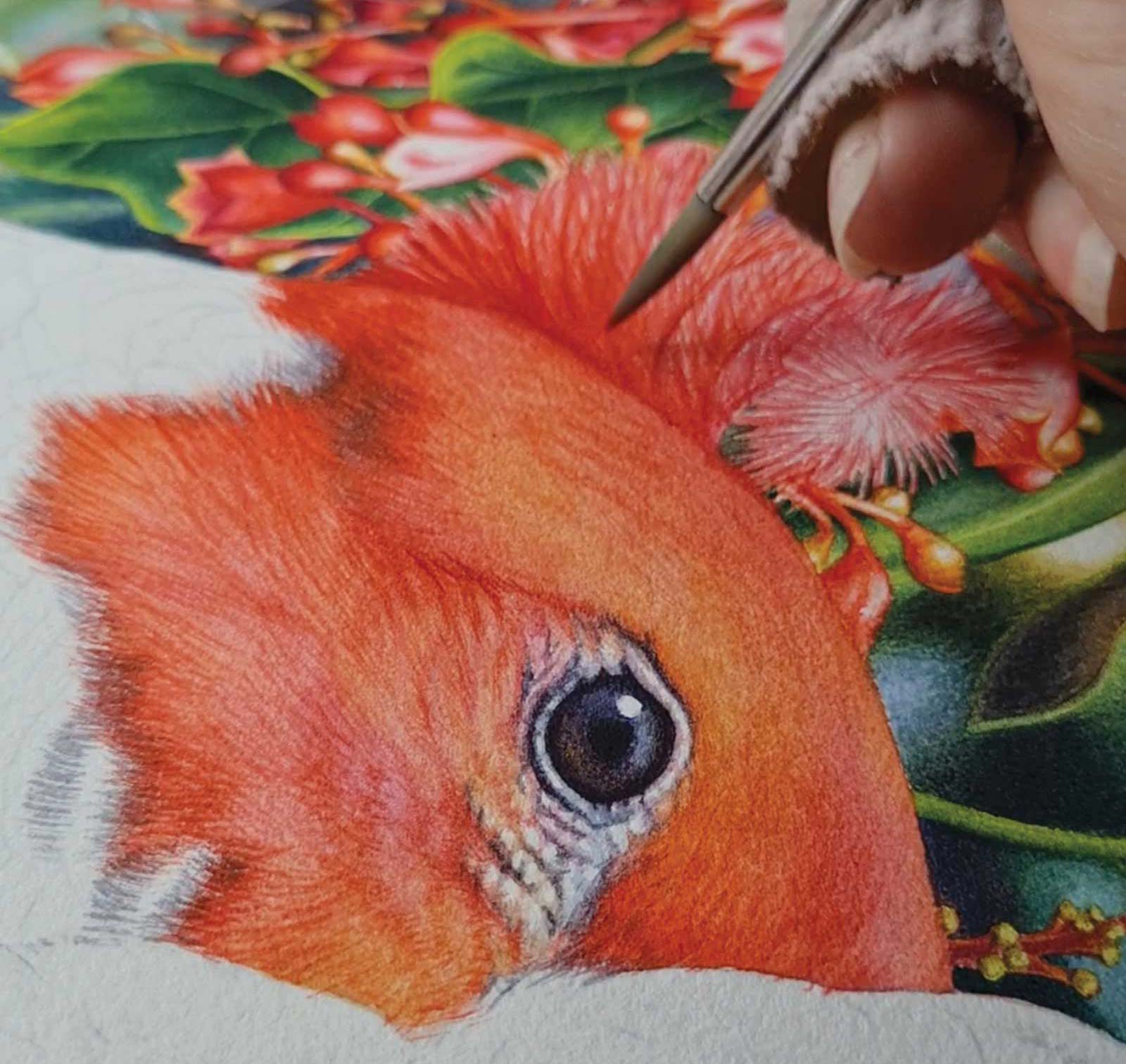
The rendering of the first gang gang begins with the males brilliantly colored red head, and it’s a delight. He has such a beautiful eye, bold colorings and soft texture, all coming together to create this character.
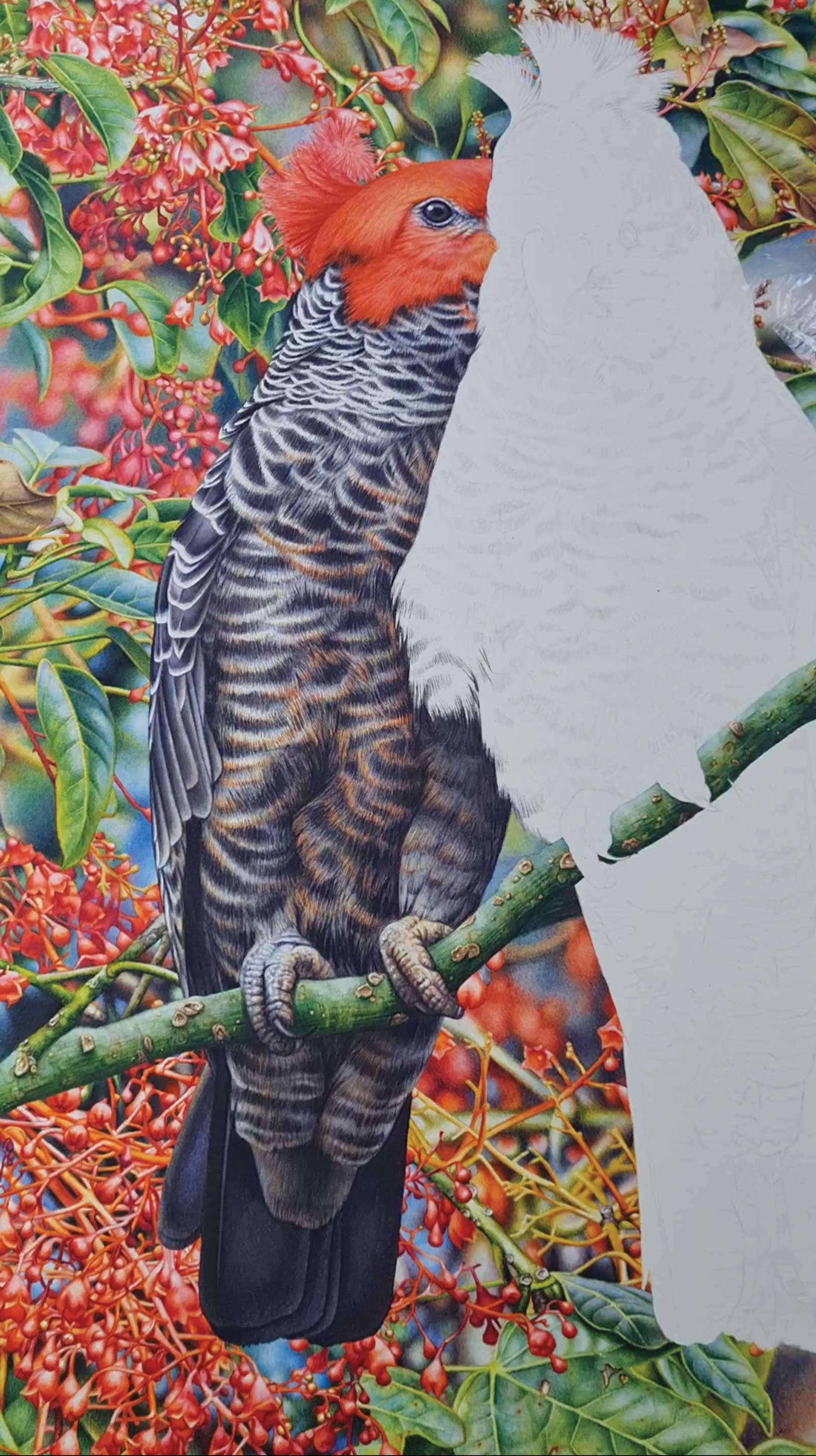 Stage 14
Stage 14 Male Cockatoo Complete
The male cockatoo is now complete, head to tail. The colors are diverse, the tone broad and the texture consistent throughout, making this an extremely challenging painting subject—but wait until we tackle the female!
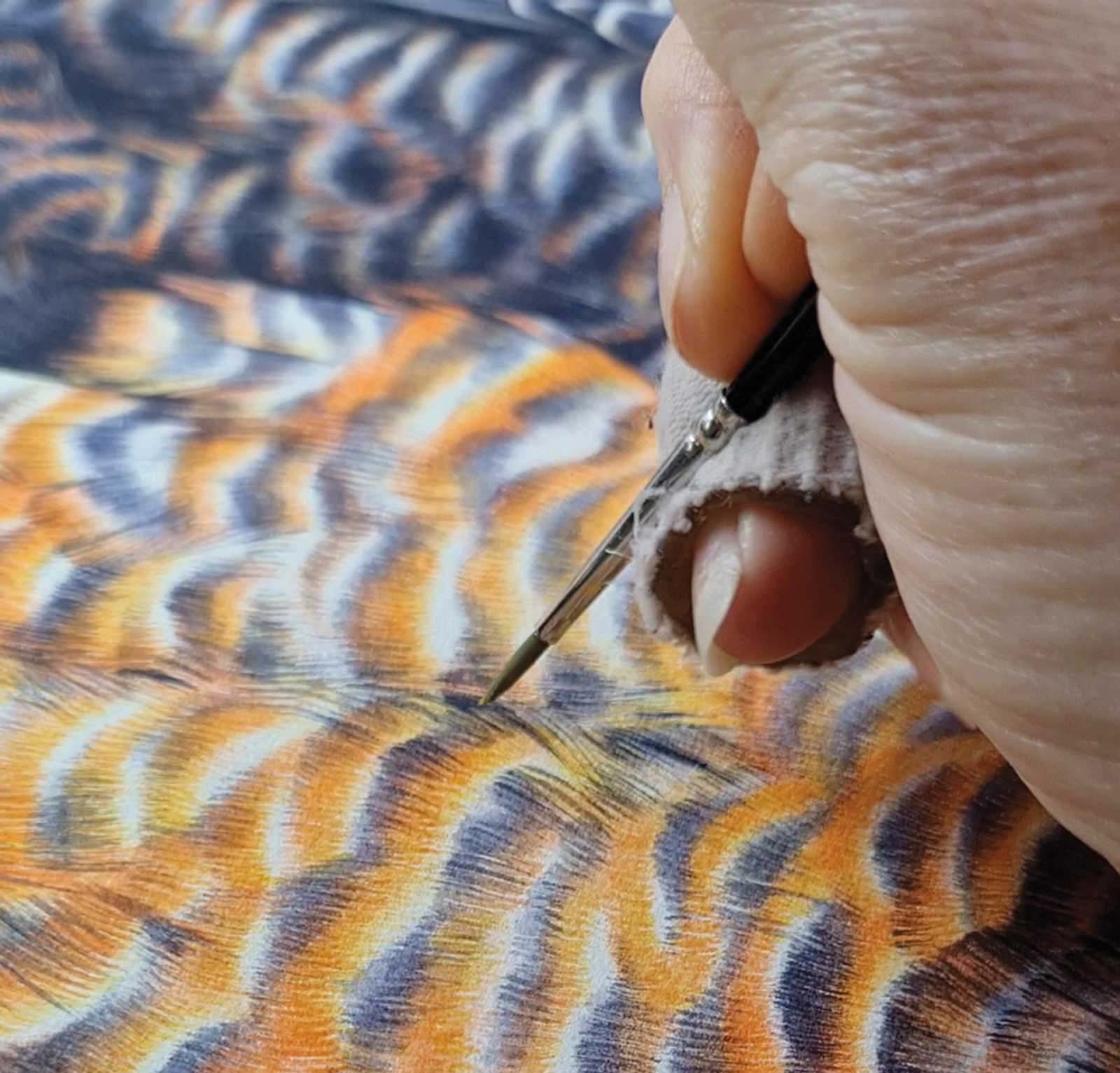 Stage 15
Stage 15 Female Cockatoo
With the female cockatoo, the challenge only intensifies as her complexity, palette and texture increases. Layers are built up slowly with a million tiny brushstrokes and delicate color shifts coming together to capture her beauty.
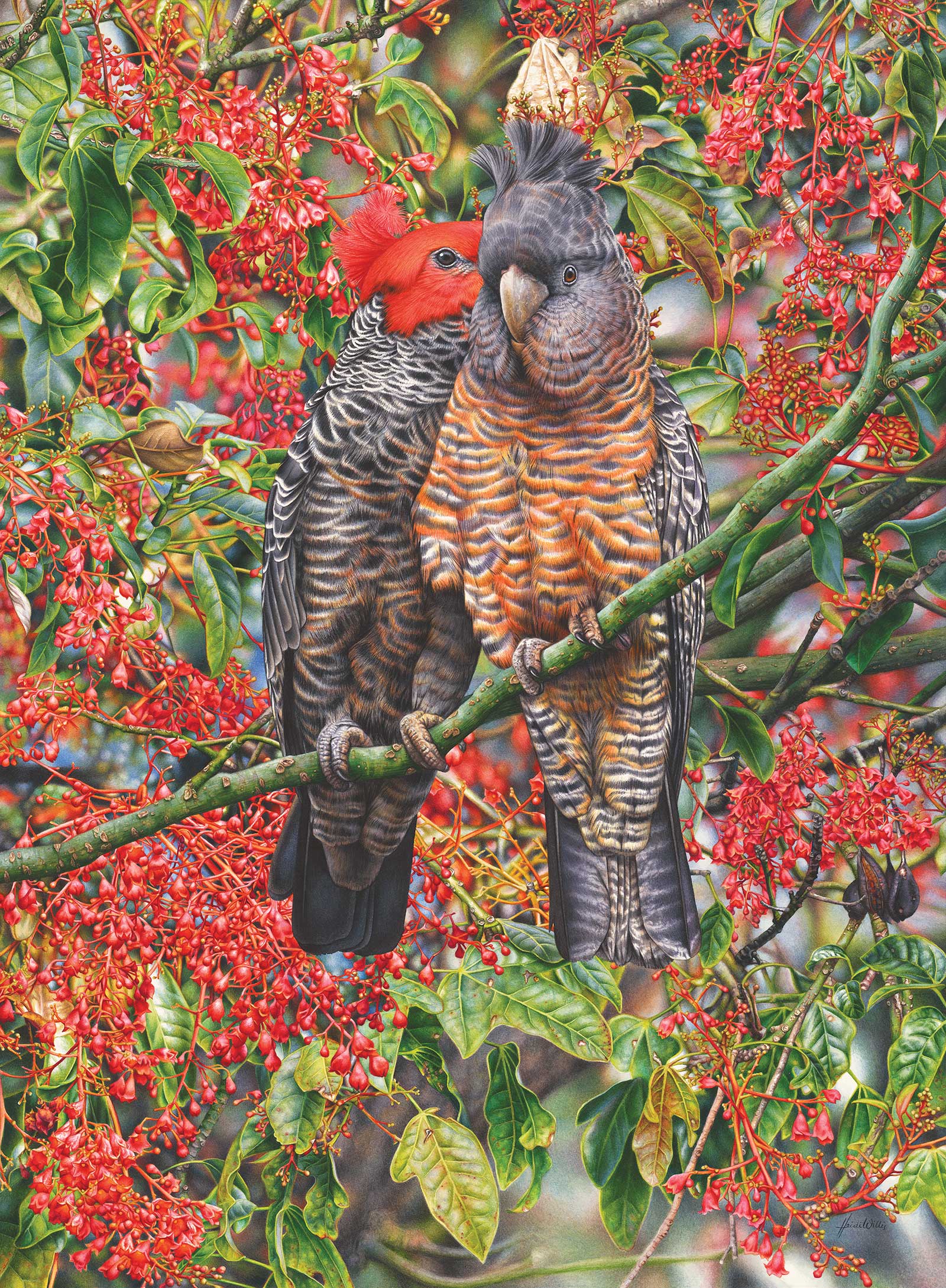 Stage 16
Stage 16 Finished Artwork
Gang Gang Cockatoos and Brachychiton, watercolor, 30 x 22" (76 x 55 cm)
About the artist
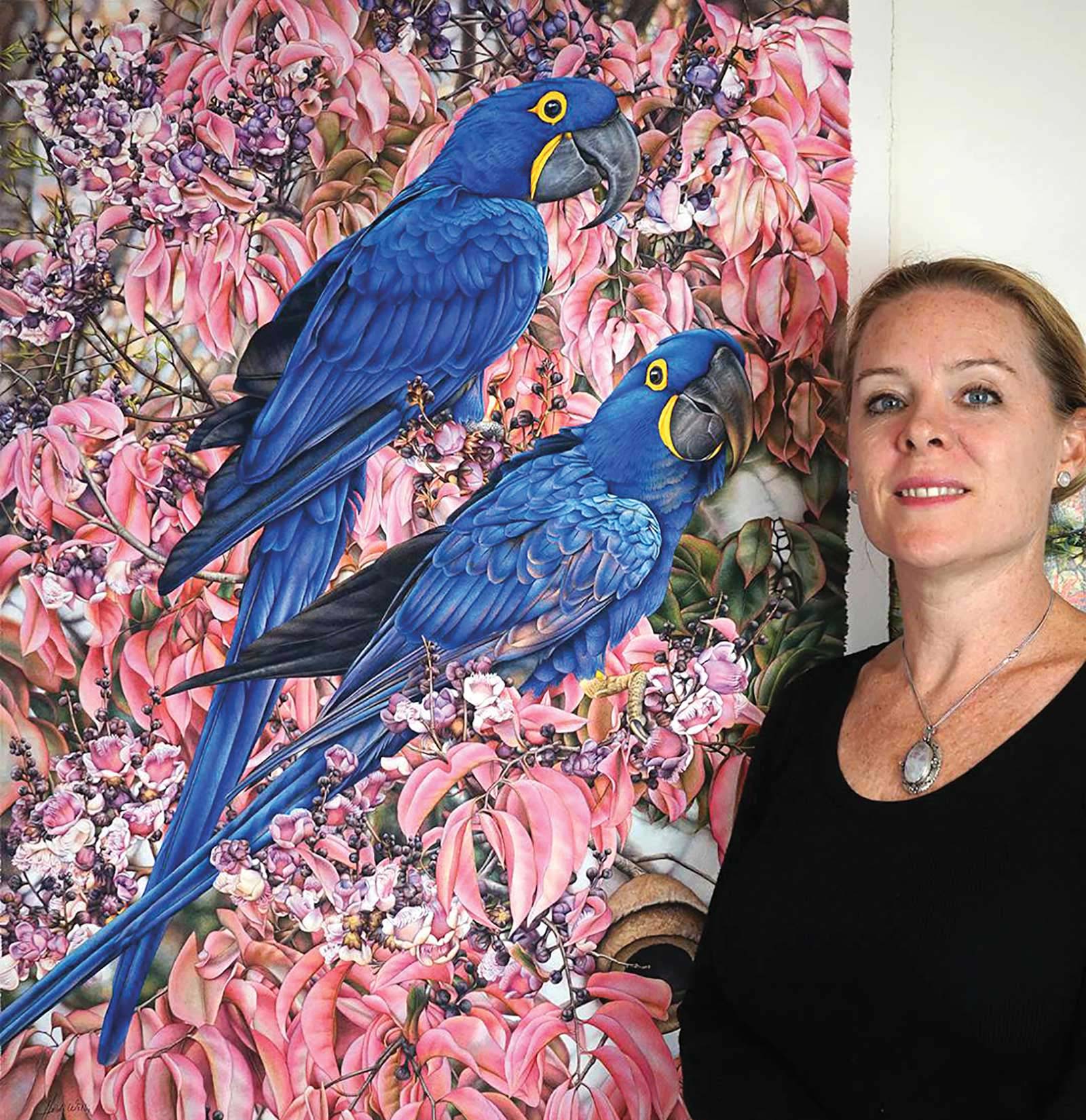 Heidi Willis
Australian-born Heidi Willis is an entirely self-taught natural history watercolor artist, specializing in botanical illustration and bird painting. Painting full time since 2003, Willis quickly established herself as one of Australia’s emerging artistic talents. Her reputation as a leading natural history, wildlife and botanical artist is well-established, and her meticulous and intricate studies of botany and birds can be found in significant public and private collections around the world.
Willis’ work has been featured in prominent national and international exhibitions over her career including the Waterhouse Natural Science Art Prize at the South Australian Museum, the Hunt Institute for Botanical Documentation, the Shirley Sherwood Collection and Birds in Art at Leigh Yawkey Woodson Museum in Wisconsin, USA. Willis is a freelance illustrator for clients around the world and is highly sought-after due to the quality, reliability, consistency and diversity of her work.
With over 20,000 students from around the world, Willis is also a well-established painting teacher and tutor with online courses available on Udemy. Artists can join her Patreon community and enjoy her monthly painting lessons, large and small.
Contact at
www.heidiwillis.com.au