Sir Mark Welland was coming to the end of his term as Master of St. Catharine’s College Cambridge when he contacted me about the possibility of painting his portrait. I enjoy the collaborative process of a commission, and one of Mark’s fundamental requests for his portrait was that it should somehow include his family, which breaks the mold for a Master’s portrait. I love a compositional challenge and was determined to make this added dimension of the painting work for him symbolically and for me artistically.
Mark is a physicist, a leading nanotechnologist, and was also chief scientific adviser to the Ministry of Defence. Our first meeting was at the Master’s Lodge, and it was important for me to see Mark in his environment, as it would open clues as to what might be possible to include in his portrait. I also met his wife Lyn and eventually their family, who would feature in the portrait. Having seen the richness of the Lodge’s interior, I knew that it would have to form the setting for the portrait, and this eventually provided the key for incorporating Mark’s family as a reflected image in a mirror in the painting.
 Stage 1
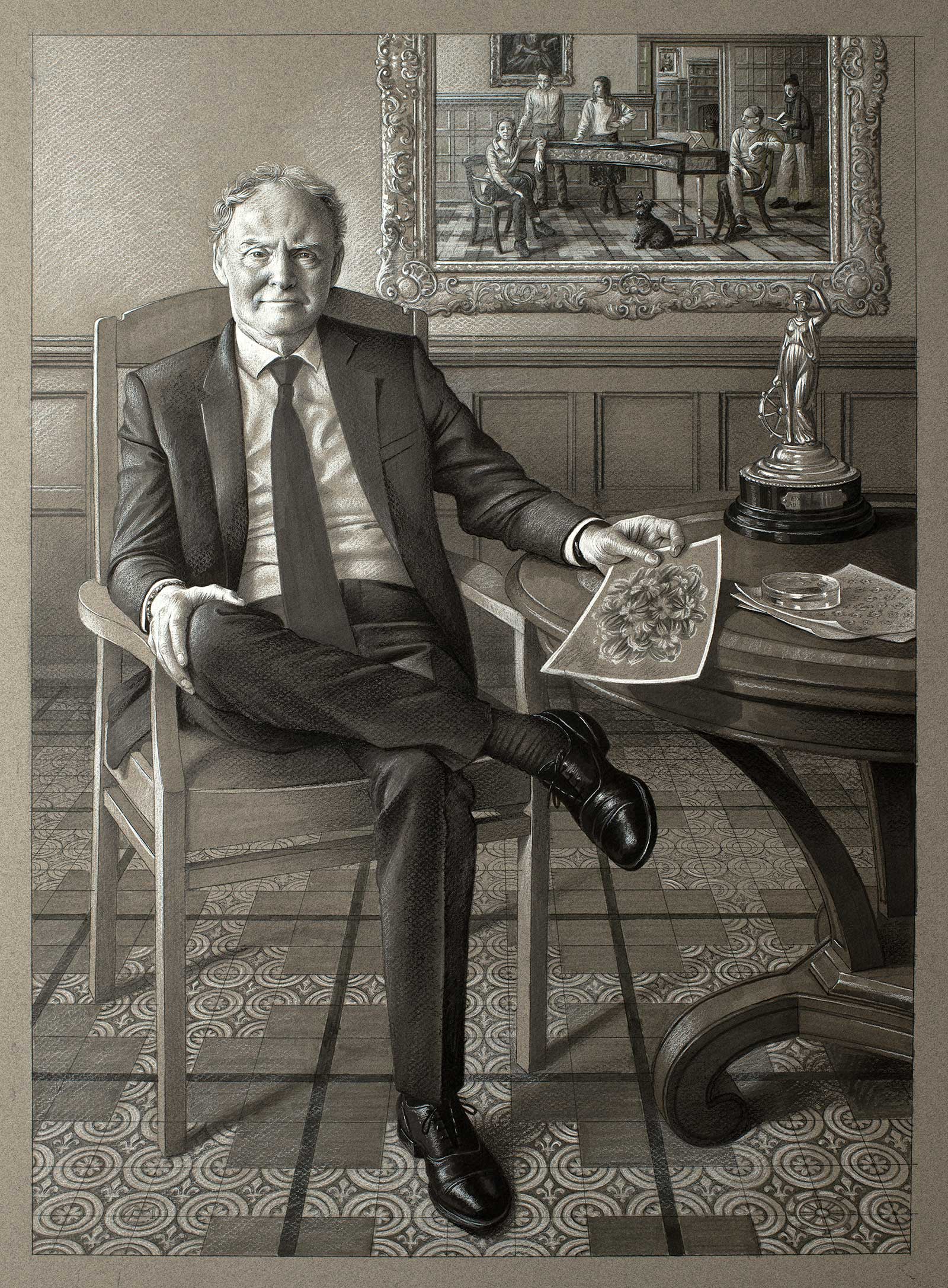
Stage 1 - Exploring Composition and Symbolism: Composition and symbolism are very important elements in my paintings, so as well as working from life as much as is practicable, I always take many photographic references at the outset of a sitting as these allow me to explore possibilities for the layout of the painting in my own time. Despite the high degree of realism in my work, there is always a large part of invention too, often expressed in the environment around the sitter. The first stage is to prepare at least one layout drawing for the portrait, which is always tonal and shows the client the direction of the work, but also helps me resolve the composition and lighting. I love process and drawing, so in truth I indulge in these layouts to a higher degree than is necessary.
 Stage 2
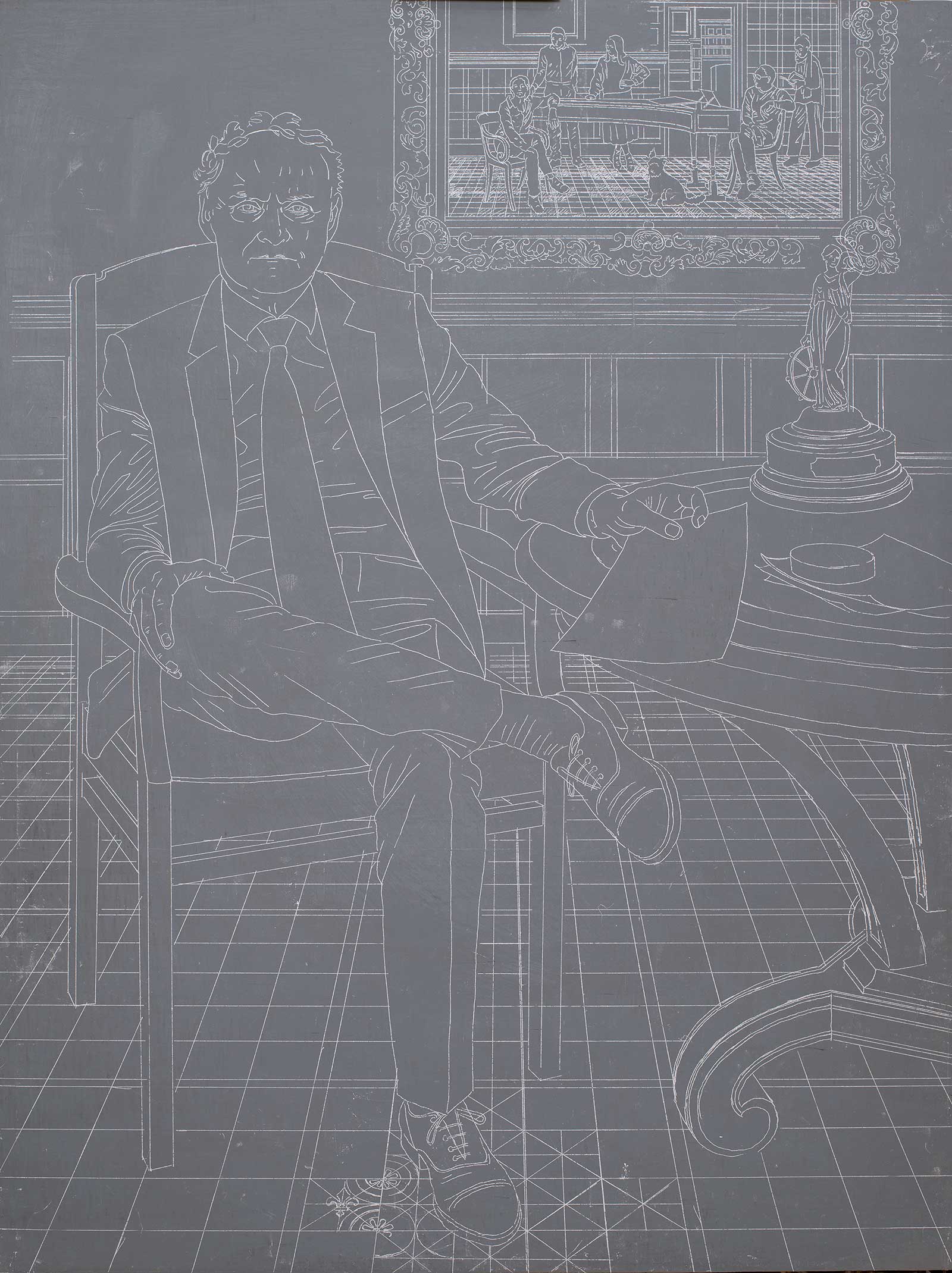
Stage 2 - Establishing the Foundation: I paint on panels, which I prepare myself and to which I apply several coats of mid-tone gray gesso. I focus on value before color when evolving the painting, so not fighting a white surface is hugely helpful. I transfer the essential lines of the drawing onto the panel by gridding up or by printing it out to scale and tracing it through, as was the case here. These lines become the scaffolding on which the painting is evolved, but they can shift and be refined as I progress with the work.
 Stage 3
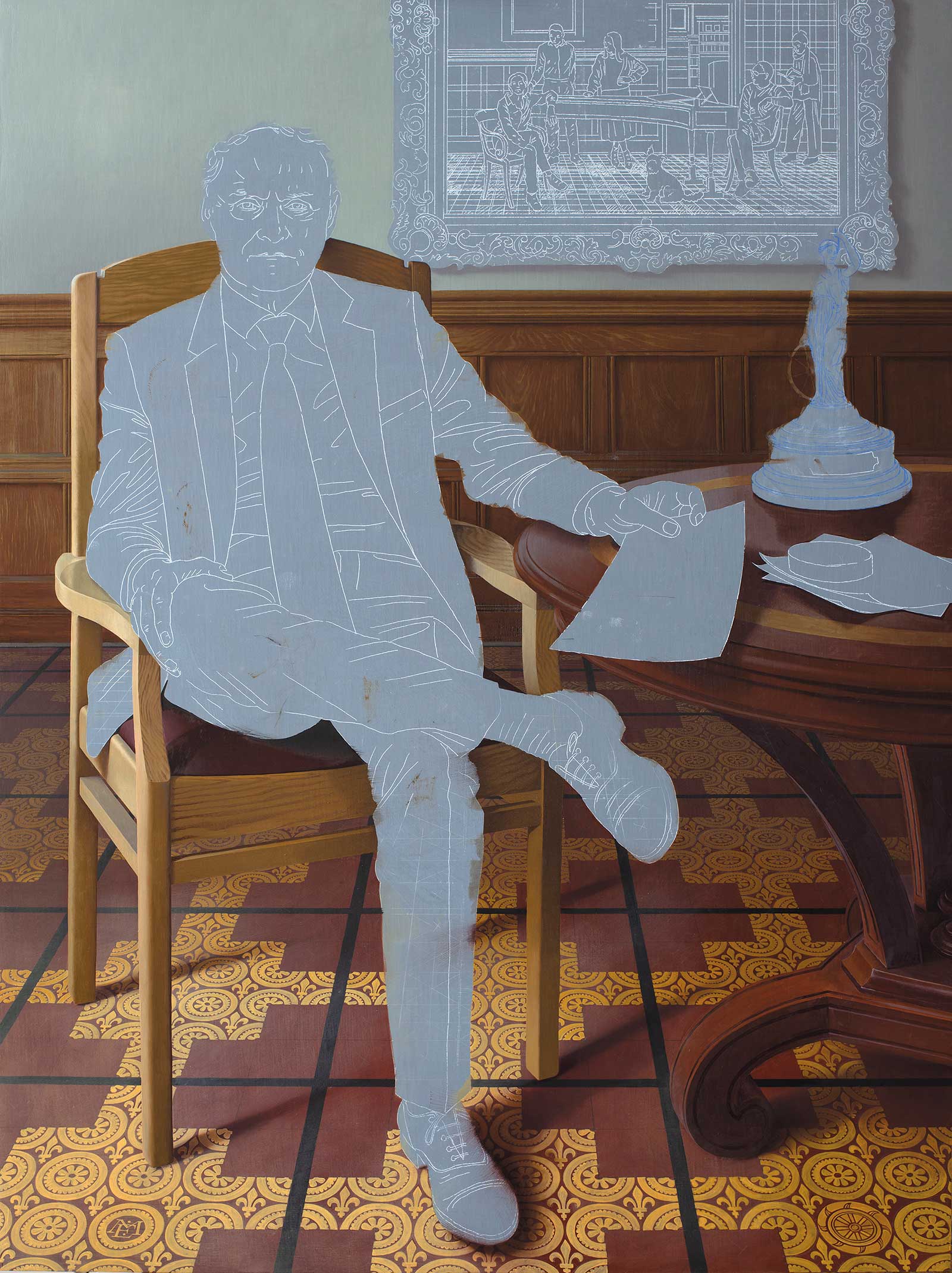
Stage 3 - Setting the Scene: I key in the background areas before starting on the figure. I have a slight obsession with the ground and floor areas of paintings, as I am fascinated by perspective, but I also feel the ground sets the stage for the narrative of the painting. The tiled floor of the Master’s Lodge was a gift for me compositionally as it helped me create a sense of space and light in the work and provided a link and visual echo with the image of Mark’s family reflected in the mirror in the background of the painting. I try to resist the temptation to get drawn into too much detail at this stage.
 Stage 4
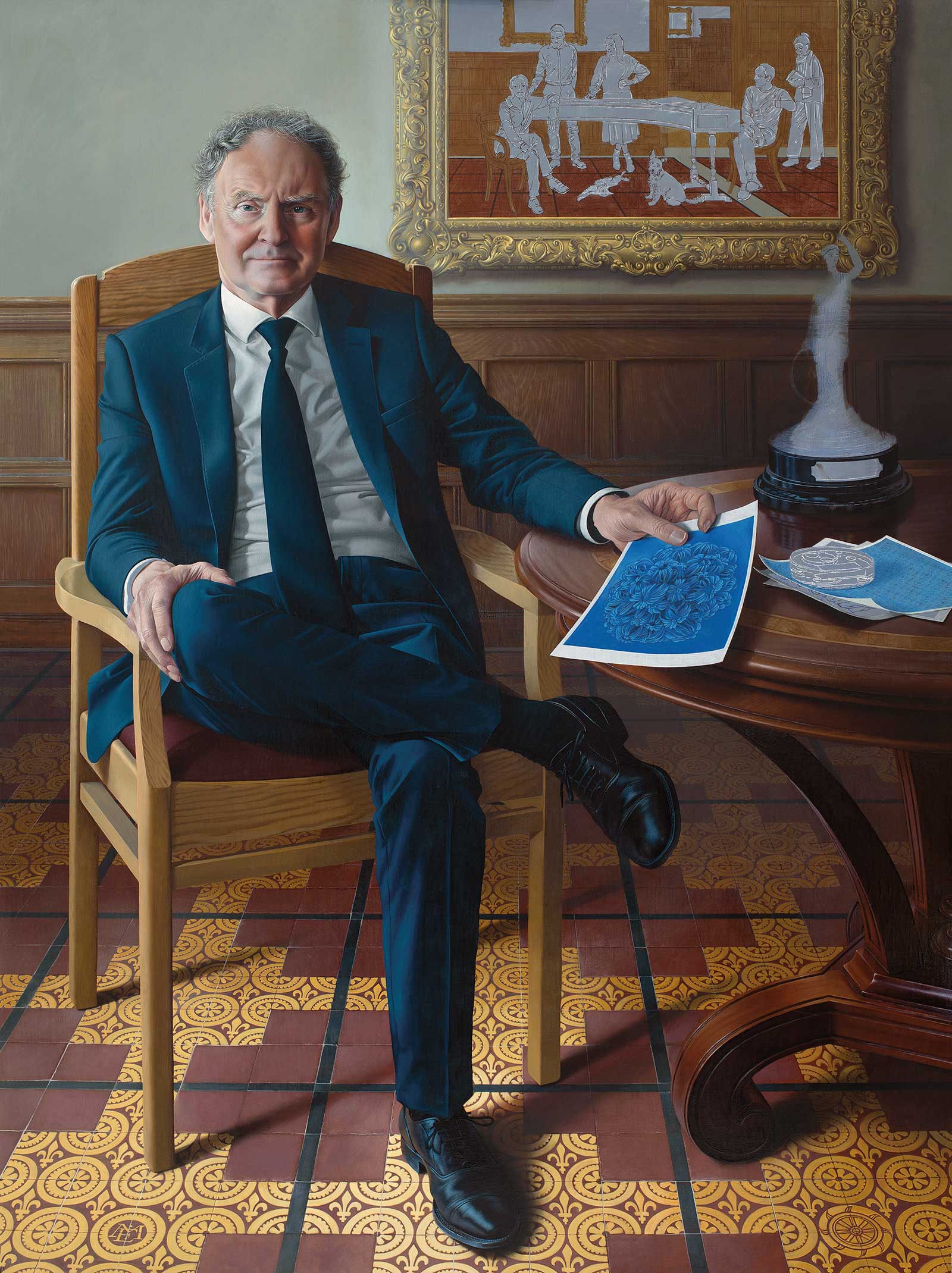
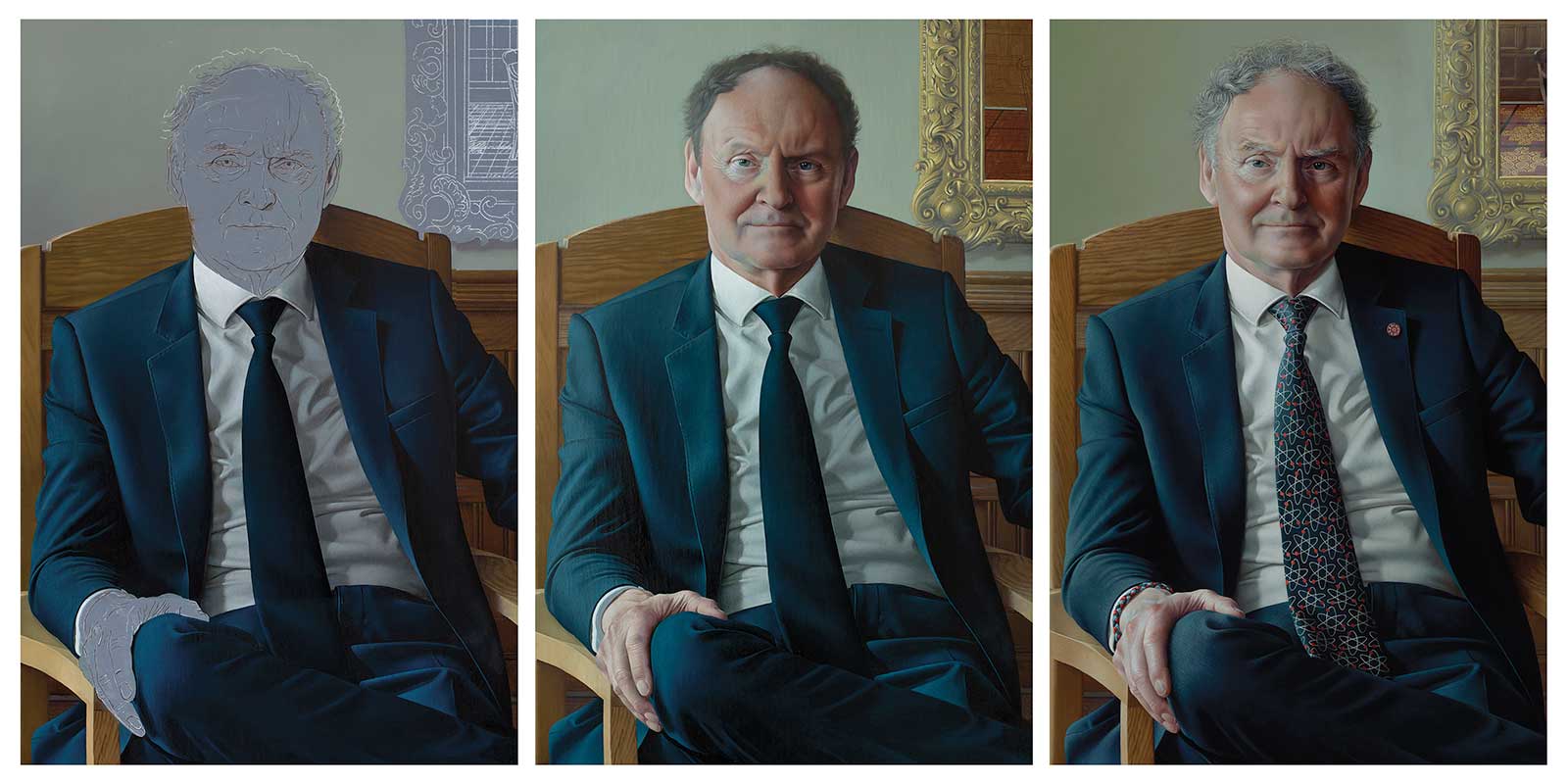
Stage 4 - Layering Atmosphere and Depth: After most of the blocking in is completed, I will start to introduce glazes, to add subtlety and atmosphere, to refine volumes, add spatial qualities and adjust light values. Glazing is a fundamental part of my painting process, and I use it throughout most of the painting stages. My paintings take months to evolve and probably half that time is spent on micro-adjustments of light and color. Some areas of a painting can have about 20 or more layers of paint.
 Stage 5
Stage 5 - Conveying Character and Essence: A portrait is about more than just capturing someone’s likeness, it is ideally about transmitting their character and essence. This can feel very elusive as the smallest most unexpected details in a face often hold the clue to the character of the person, and they are never predictable. It was important to me that my interpretation of Mark should convey his phenomenal intelligence and strong character.
 Stage 6
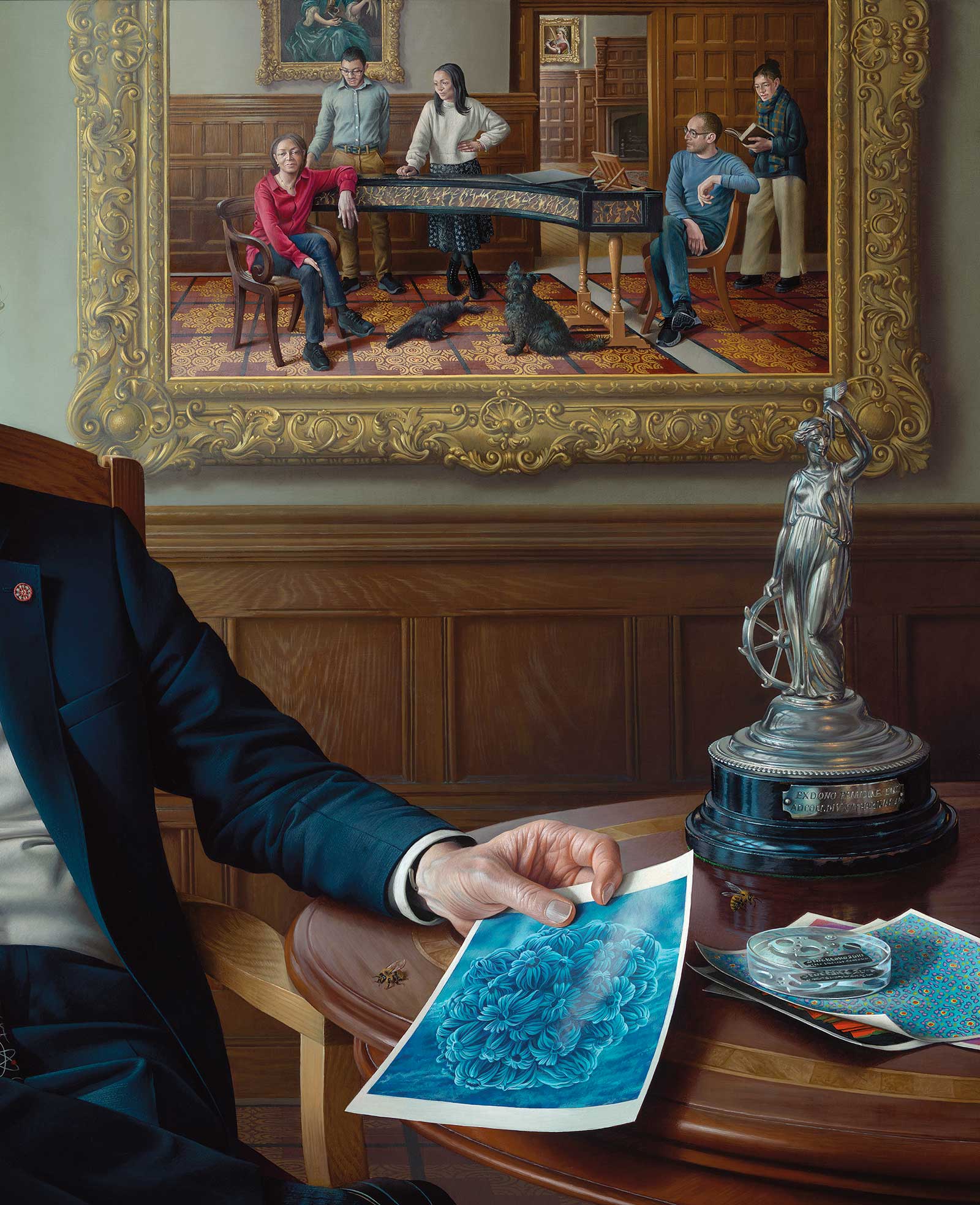
Stage 6 - Incorporating Biographical and Artistic Suprises: There are several biographical elements of Mark’s professional life reflected in the objects on the table. I also like to include an element of surprise in my paintings, and this portrait provided an opportunity for this in the family group setting, which is set within a reconfigured Master’s Lodge interior. In the room glimpsed through the doorway, I whimsically included the Self Portrait as Saint Catharine of Alexandria by Artemisia Gentileschi. Aside from being the College’s patron saint, St. Catz also has a very fine replica of the original Gentileschi, made for them by the National Gallery. In my painting the Gentileschi is about the size of a thumbprint!
 Stage 7
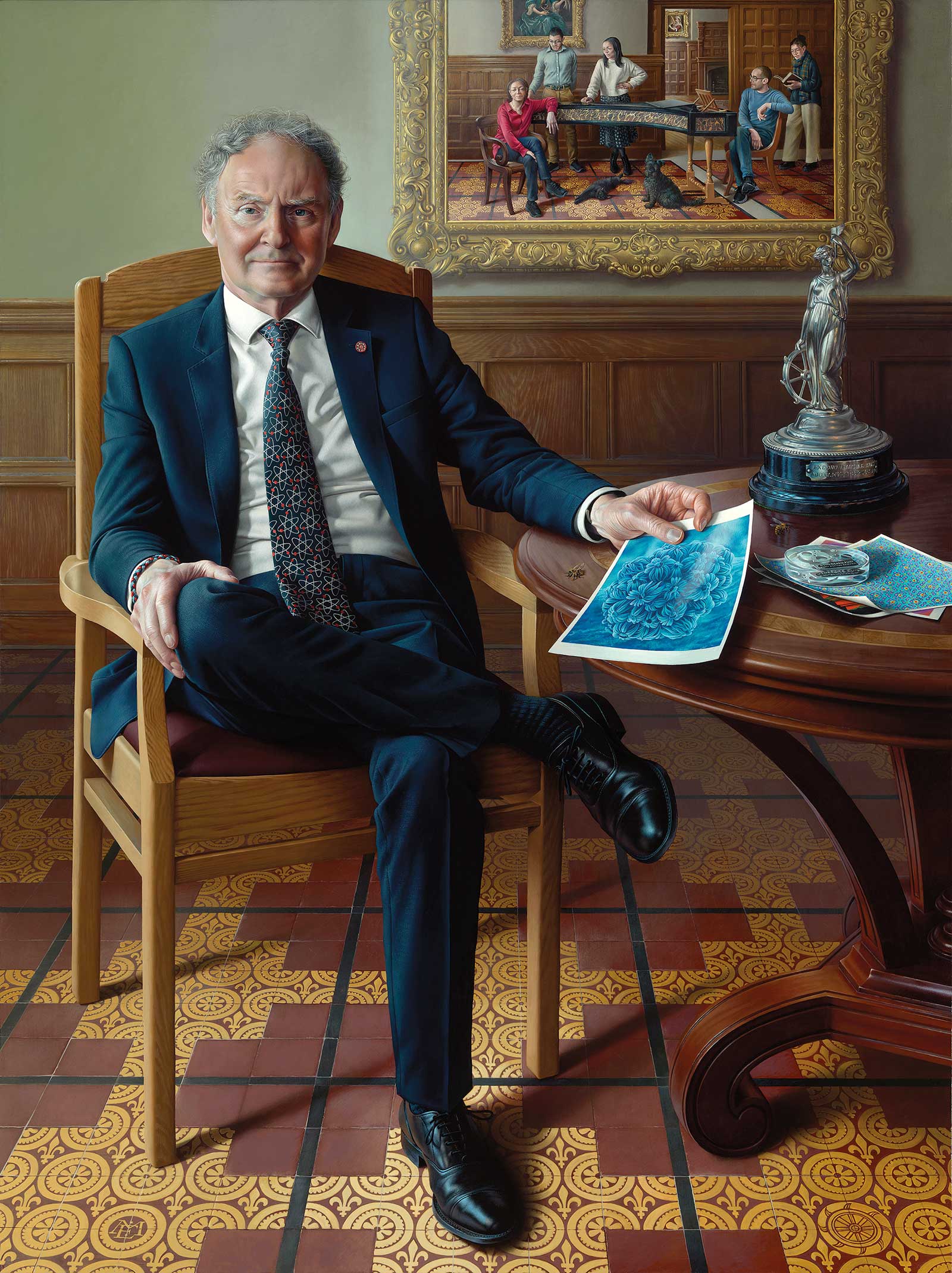
Stage 7 - Finished Artwork Portrait of Prof Sir Mark Welland, Master of St Catharine’s College, Cambridge, oil on linen over panel, 47¼ x 35½" (120 x 90 cm) Miriam Escofet was born in Barcelona, Spain, and moved to the United Kingdom at age 12. She lives and works in London and has exhibited internationally. Escofet was awarded First Prize at the BP Portrait Award 2018 and was commissioned to paint HM The Queen for the Foreign Office in 2020. She is a member of the RP.