Born in 1939 in Park City, Utah, Edward Fraughton is a distinguished American artist, sculptor and inventor, renowned for his monumental works and collector editions, many that reflect the rich history of the American West. With a civil engineering background and a Bachelor of Fine Arts from the University of Utah, Fraughton’s evolution from a struggling artist to a celebrated sculptor is as captivating as the narratives portrayed in his artworks. Selected as the Portrait Society’s 2024 Gold Medal Recipient, Christine Egnoski recently interviewed Fraughton about his career, inventions and latest project.
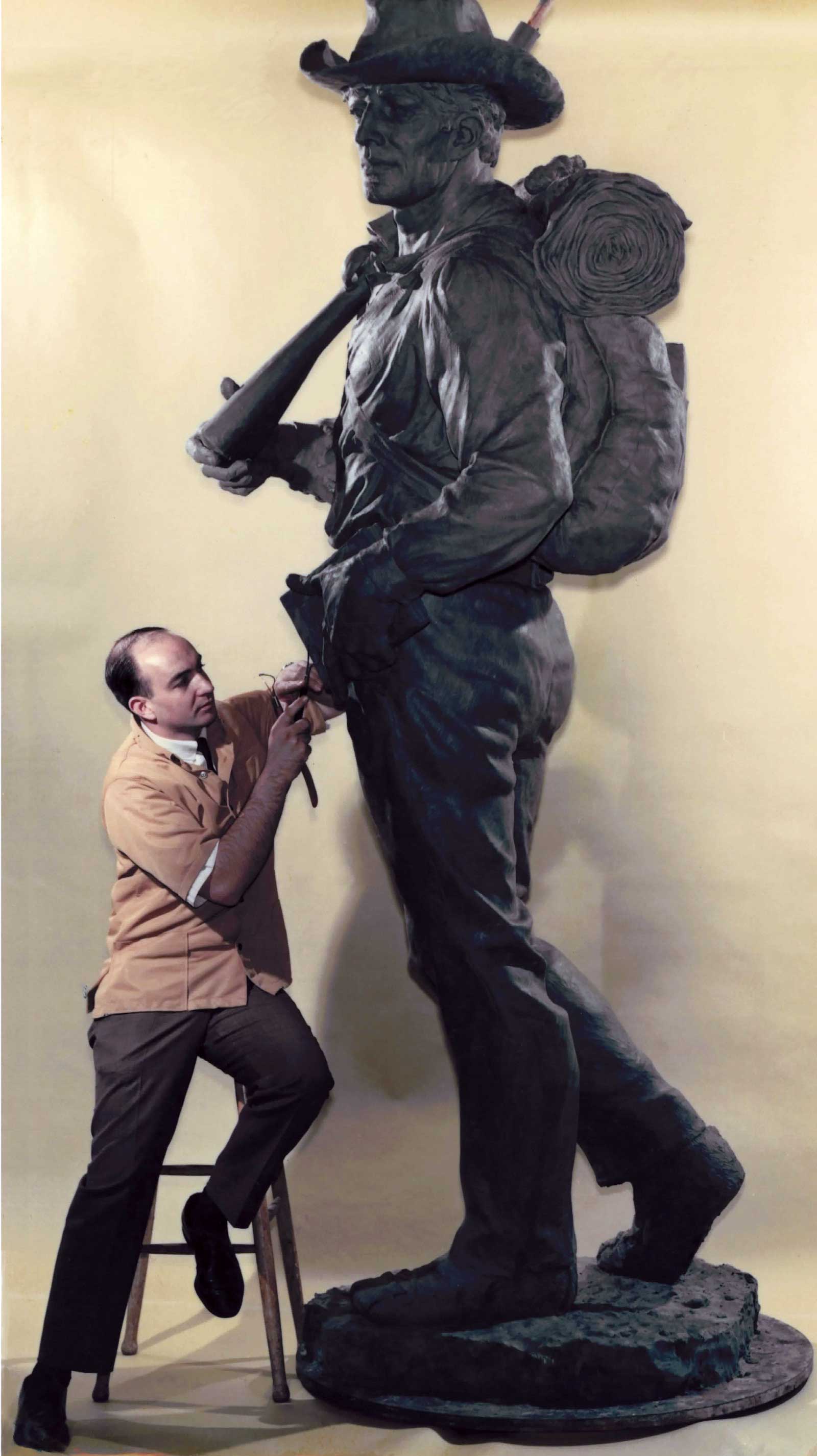
Edward Fraughton, Mormon Battalion Monument, bronze. Fraughton’s first monumental commission, San Diego, California.
Christine Egnoski: You attended the University of Utah, majoring in civil engineering, but changed your major to sculpture. Can you tell us about that time in your life and how you made that decision?
Edward Fraughton: My University of Utah experience was somewhat exasperating. As a civil engineering student in 1957, I loved inventing and building things. I also played in the concert and marching bands, but I signed up for far too many classes. Struggling to survive on the $15 a month my family was sending me for food, I was literally starving. I failed a couple of classes, and as a break, decided to take an art class. Most students had studied art in high school, but coming from a poor family in an old mining town that offered no art classes, I had had no formal art training. However, as a child I had always been creating art. After my first college art class I thought, “I love engineering, I love music, and I love art.” Although I hadn’t yet made a decision relative to sculpture, and since I wouldn’t be taking my first sculpture class until the end of my second year, I definitely made a decision to change my major to art. This is how I reasoned, “I could be a good engineer, an outstanding musician, but what is the one thing I could do that I think would make a greater contribution to society?” That is the day I made my resolve, then never turned back.
CE: When you look back at your career, which spans more than 60 years, what are some of the specific sculptures that you have created that stand out for you?
EF: Each piece I do is purposely designed to stand out in some unique way. Of course, my most comprehensive monumental piece was the Omaha project, which will be mentioned later. Several others include the Mormon Battalion Monument, which was my first major monumental commission; Spirit of Wyoming for the State Capitol Building in Cheyenne, Wyoming; Clearing the Haul-Way for Rock Springs, Wyoming; Study-Time for Ricks College in Rexburg, Idaho; The Cadet at Randolph-Macon Academy in Front Royal, Virginia; my 20-foot-high Ancient Ones (Anasazi) at Mesa Verde National Park; and the latest A Man to Match My Mountains, a mountain-climber/skier monument at Snowbird Ski Resort in Utah.
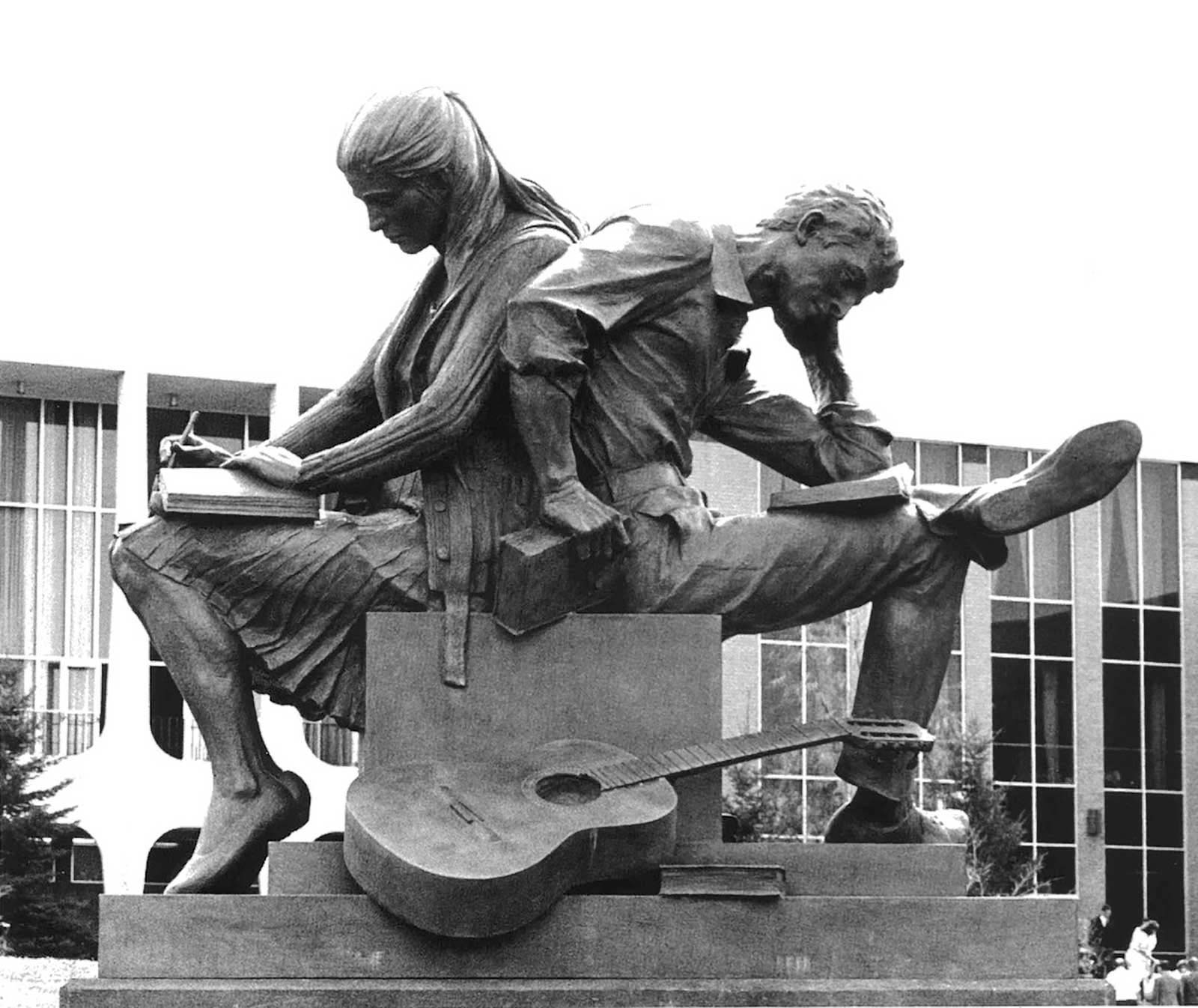
Edward Fraughton, Study-Time, bronze. A monument to education on the campus of Ricks College.
CE: In addition to being an artist, you have made a mark as an inventor in both aviation and sculpture. Can you tell us about the technology you invented for tracking aircraft that is now used by the FAA and known as the ADS-B?
EF: A mid-air collision over the Salt Lake Valley in 1987 in which 10 people lost their lives is what led me to creating a new technology for tracking, not just aircraft but traffic on the ground, ships at sea, vehicles or people walking on the ground. In brainstorming the concept, a simple question came to mind: as Leonardo da Vinci of old might have wondered, how is it possible that birds are able to fly in tight formations without colliding, and how are they able to communicate with one another? The answer was obvious; they talk, look about, feel the air currents, anticipate the movements of one another in motion just as we do when driving, walking through crowded streets or running in a marathon. A pilot is isolated inside a closed-in cockpit, so the answer was quite simple: get rid of the closed environment. If everyone knew their position in space and transmitted a periodic report, anyone within proximity with a radio receiver could know who else was reporting their aircraft ID, their 3D position (latitude, longitude, altitude) and speed. That’s it. So, I built a system that worked, demonstrated it to the FAA, and in 1991 patented my technology in 17 countries. It was later adopted by the FAA and given the acronym ADS-B (automatic, dependent surveillance-broadcast). The rub was, they failed to honor my patents and simply waited until my patents became public domain, so I will never receive the recognition or see any money from my 15 years of technology development. And by the way, the Find My Friends app also uses the same technology, should anyone care to read my patent (U.S. #5,153,836).
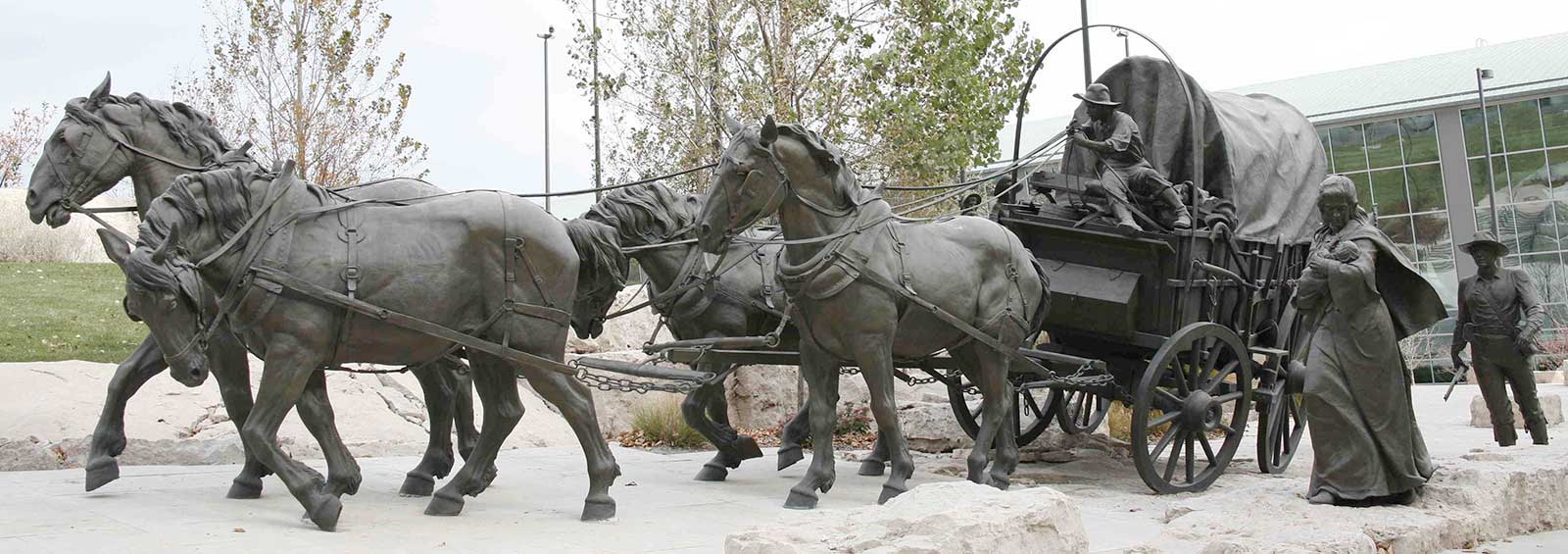
Edward Fraughton, Home is Where the Heart Is, bronze. Omaha, Nebraska.
CE: You also developed an improved method for enlarging sculpture into monumental scale. Can you tell us more about that method?
EF: That one is quite simple. In this day of 3D scanning and 3D printing or enlarging, any computer-savvy engineer will tell you, “I can take your model and enlarge it to any size,” and they can. Using routers and/or 3D printers, they can produce a replica, which must then be covered with clay for further refinement. This approach has its limitations. Instead, I decided to create a mold into which a thin layer of clay could be poured or painted, then backed up with a layer of polyurethane foam, into which an internal metal structure or armature can then be added. When removed from the mold, each component part, like bricks, already have the layer of clay with its highest level of modeling and textures on the outside surface of the piece. Thus, the aesthetic integrity of the original model, into which I put so much creative time and effort, is preserved. The end result is, instead of spending 15 to 18 months producing a single monumental element, I created an equivalent of three and a half major monumental elements (figures) per year over a span of 10 years. The process is more labor intensive for my employees, but saves 70 percent of my normal worktime, while producing a better end result.
CE: Recently you completed a 10-year collaborative project with fellow sculptors Kent Ullberg and Blair Buswell for the First National Bank of Omaha, which was installed over five city blocks in Nebraska. The expansive multi-piece sculpture features a historic pioneer wagon train moving through Nebraska’s wilderness, encountering a herd of American bison, which in turn run through the city streets towards the bank’s new 40-story office building. Can you tell us how this project came into fruition and what parts of this collaborative project did you undertake?
EF: I was invited to participate in an open Request for Proposals and sent a packet of information. Several things piqued my interest. The prospective client was looking for a team of “top” sculptors to create a westward migration monument to honor America’s pioneer history. The location was Omaha, Nebraska, a key point for travel west, since early emigrants needed to follow the water before construction of the transcontinental telegraph and railroad. Other than stating that wagons, animals and people were to be employed and depicted in a traditional manner, the client offered an open canvas to the artists, with no pre-defined time or budget limits. Once selected, the artists were to work together to develop an overall plan, design, budget, timelines, etc. What was really great is that the three artists chosen knew each other well and their works were entirely compatible. The project took 10 years to complete and covered a linear area of five city blocks long. Personally, I completed 36 major monumental elements, which included a wagon pulled by draft horses, a wagon pulled by oxen, about 18 human figures, a dog and hunter group of a rider pulling a pack horse loaded with wild game.
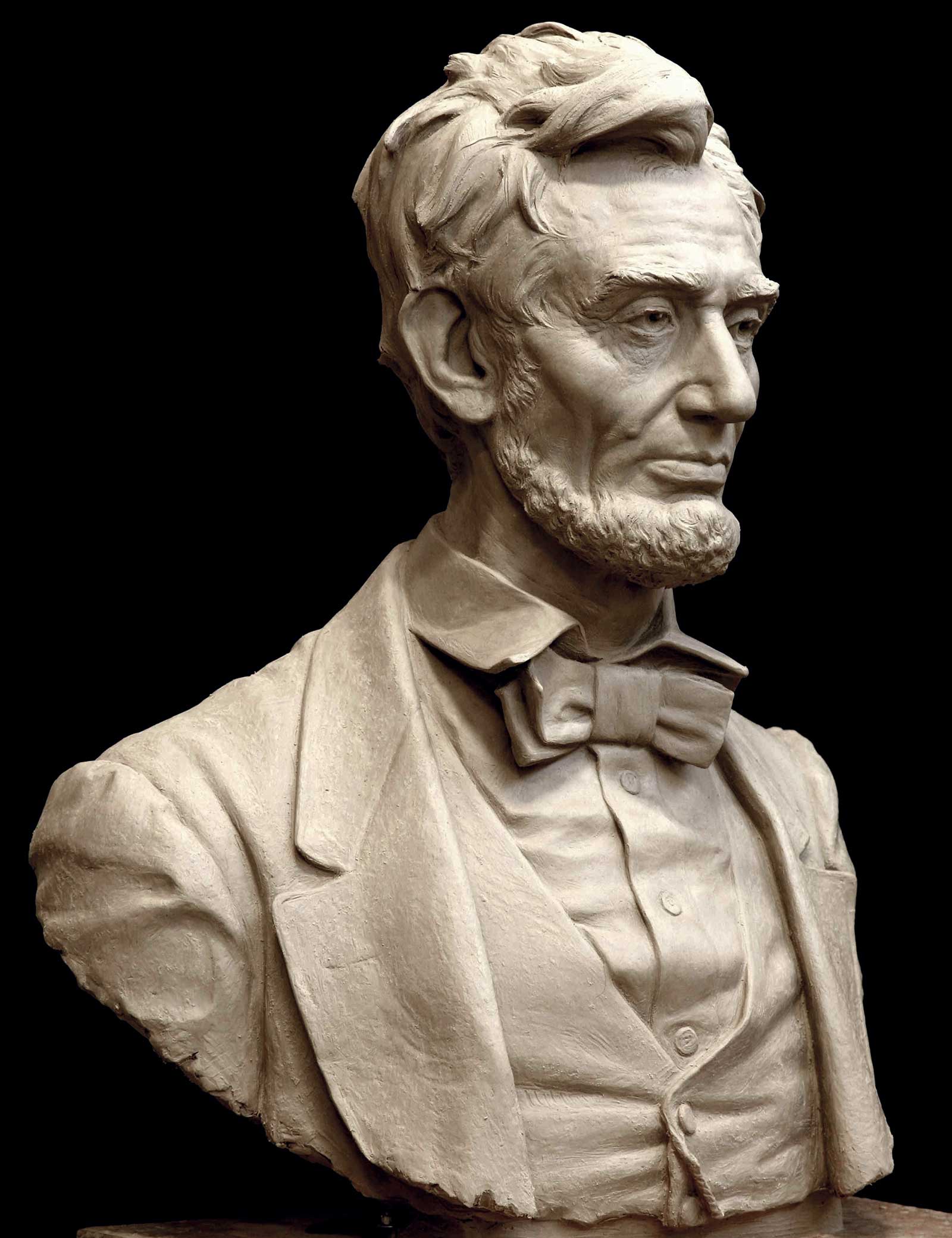
Edward Fraughton, Lincoln, Now He Belongs to the Ages, clay.
CE: In addition to being a sculptor and an inventor, you have taken on the role of teacher and mentor by helping to launch the online New Masters Academy and serve on the Board of Directors for the Beaux Arts Academy of Utah. Can you tell us why teaching is so important to you?
EF: I guess I thought of what I had missed. Then I heard a statement: “If you don’t own it, you can’t give it away.” Later, when invited to show my works with some of the greatest artists in America, giants like Everett Raymond Kinstler, Bettina Steinke, John Stobart, Tom Lovell, Bob Lougheed, Wilson Hurley, Harry Anderson, John Clymer, Arnold Friberg and others, I saw mentors willing to give everything they had to help each other and younger [upcoming] artists. Unlike the artists I had encountered in the official state-owned education system, whose works typically stay in one place and look dead to me, I wanted to be more like them, my real heroes and mentors, to continue to develop and grow. The surest way to grow is to share what you do know and your life experiences with others. After all, if they are to become as impassioned with their work as we are with ours, we know how difficult it will be for them to reach their highest goals. And isn’t that the real purpose of being alive? Aren’t we all here to learn how to help one another?
Christine Egnoski is the executive director of the Portrait Society and has served in that capacity since the organization’s founding in February of 1998. —