Throughout human history, people have used art to express themselves, record their daily activities, capture moments and share their emotions. Think back to those ancient cave paintings in places like the Lascaux caves—they are like snapshots of life dating back to 15,000 BCE. Or think about paintings like the Mona Lisa’s smirk or Van Gogh’s Starry Night and how they communicate the creator’s vision with us, the viewer.
Now, fast forward to the 21st century and at the forefront of both excitement and skepticism is artificial intelligence (AI). The fusion of AI and fine art sparks both controversy and enthusiasm, challenging traditional notions of creativity, authorship and the very essence of art itself.
Although most of us probably think of AI-generated art as a new idea, it actually dates back to 1968 when artist Vera Molnár began experimenting with early programming languages to produce randomly generated artwork. Now in 2024, the use of AI to create art has become accessible to anyone with a computer and an internet connection. With AI text-to-image generators, one can simply type a prompt (such as “impressionist painting of a landscape with a river and purple trees”), and the AI creates the image, usually in under a minute. If the user isn’t happy with how the text was initially visualized, the process can be repeated to generate more images, either using the same prompt or by changing the wording a bit to better refine what the user is envisioning.
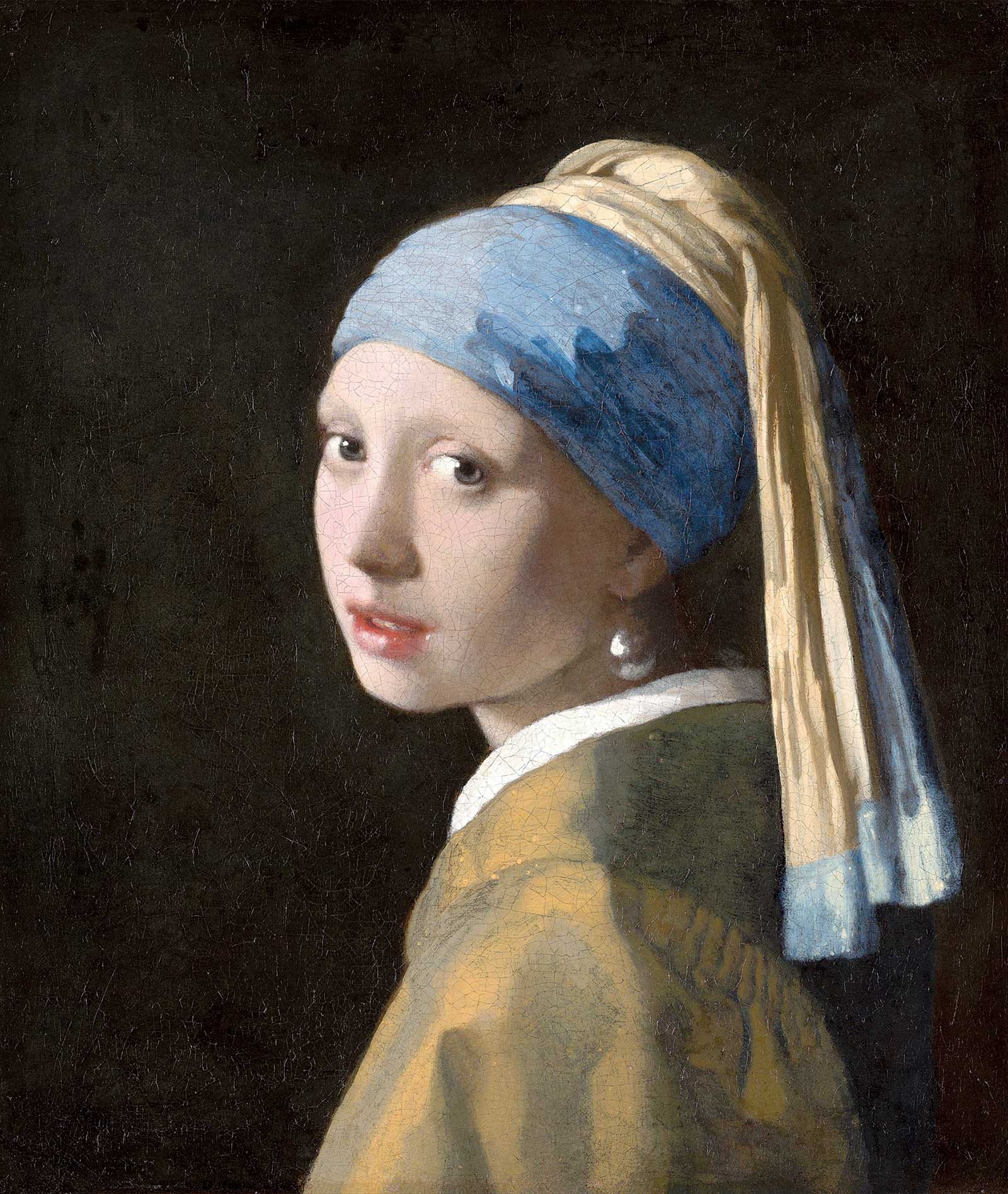
Johannes Vermeer (1632-1675), Girl with a Pearl Earring, 1665-66, oil on canvas, 17½ x 15 1/3" (44 x 38 cm)
At its core, art has always been a deeply human endeavor, full of emotion, intuition and personal experiences. It serves as a means of self-expression, reflection and cultural preservation, transcending mere aesthetics to evoke profound thoughts and emotions from the viewer. However, the use of AI-generated art introduces a fundamental disconnect between the artist and the creation. By using algorithms, the very essence of art is diluted, reducing it to a mechanical exercise. While proponents argue that AI can mimic artistic styles and techniques, it inherently lacks the depth of human experience and consciousness essential for genuine creativity.
Art is not merely about copying what one sees in front of them, nor is it simply about creating aesthetically pleasing images. Art is about capturing the feeling and the spirit of the subject that is being painted, drawn or sculpted. As my mentor, Everett Raymond Kinstler, often said about photography, “The camera records. The artist selects.” Much like a camera, artificial intelligence is a tool that is incapable of the kind of selection an artist must make when painting, drawing or sculpting. AI-generated art ultimately devalues the labor and craftsmanship that goes into the artistic process. In a world inundated with algorithmically produced artworks, genuine human art risks being overshadowed and marginalized, relegated to the sidelines in favor of novelty and technological gimmicks. This not only undermines the economic livelihood of working artists, but it also erodes the intrinsic value of art as a form of human expression.
Another issue with AI-generated art is that it stifles innovation and diversity in artistic expression. AI uses an extensive database of images to recognize patterns and create new images based on the data set that was used in its programming. For example, if you give an AI generator a prompt to depict a chair, the AI will take all the information it has learned about what a chair looks like to create a new image. Because AI algorithms dictate artistic trends and preferences based on past patterns, there is a risk of stagnation and cultural regression, depriving society of the richness and diversity that is inherent in human creativity. In other words, rather than fostering true artistic innovation, AI-generated art risks reducing art to a formulaic exercise, devoid of the spontaneity, passion, and individuality that defines true artistic genius.
This argument came to light recently when the Hague’s Mauritshuis museum loaned out its crowned jewel, Girl With a Pearl Earring, for a comprehensive Johannes Vermeer exhibition. Without the famous painting on view, the museum decided to launch a competition for any interested artists to reimagine the artwork created in 1665. Out of nearly 3,500 submissions, the judges selected five winners, and one stood out but was created with the AI program, Midjourney. Thus began a social media frenzy with comments running the gamut between decrying the use of AI to condemnation of the choice to elevate machine created images over the handiwork of real human artists. Many of the posts pointed out the difficult questions that arise from AI and fine art including artist agency, copyright and market value.
Watching the process of AI creating something visually in a matter of seconds from only a few words typed in a prompt is truly amazing. However, we need to think how AI may negatively affect the future of the art world. By separating art from its human roots and reducing it to a mechanical process governed by algorithms, we really do risk sacrificing the soul of art on the altar of technological progress. Only by preserving the sanctity and authenticity of art can we ensure that it continues to inspire for generations to come.
Sincerely,
Michael Shane Neal
Chairman