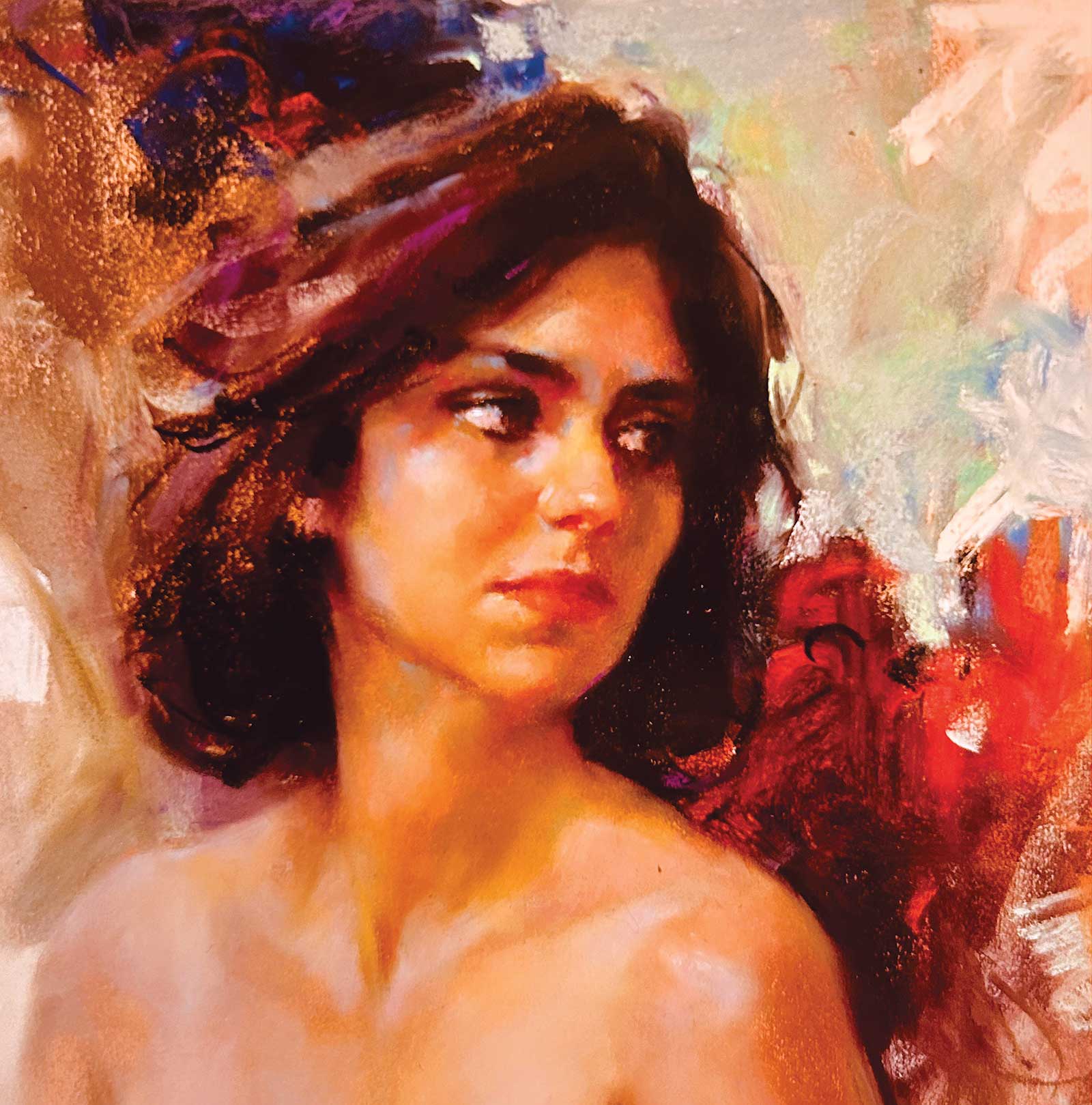
She’s Here, pastel, 20 x 18" (50 x 45 cm)
- What is she looking at? Her thoughts are a mystery.
- Dramatic turning: Her shoulders turned one way with her head turned to her left and her eyes turned further.
- I didn’t think about anatomy but about combining shapes that are always different depending on the moment.
- The shapes in the background help the overall design.
- The slight cool shade in the background complements her warmth.
- Her charismatic presence creates this artwork.
- Try to imagine what she is seeing 100 years from now.
Our Time in History
Artists of our present era are amongst the greatest in history. I say this with an impassioned heart, having observed art all my life. I’ve experienced so many of today’s works in museums, studios, art events, books, magazines and traveling to countries around the world.
I cannot fully express my emotions when speaking here of representational artists; they are phenomenal in so many ways. Certainly, art is timeless. Centuries ago, shapes, shadows, colors and designs were observed and expressed in art. Centuries from now, the complement to red will still be blue/green. Design and drama are important. Center of interest will have contrasting colors, values and details. Just remember, one or more of your art works will be seen and appreciated way into the future.
Let’s Be Real
There are those who think representational art is simply no more that a photographic copy on canvas. Yes, we are realists and every stroke we lay onto canvas or paper is our personal depiction of the subjects in front of us. Just as actors use their own portrayals as they stick to the actions and scripts given them.
Singers stay with the melodies and words of great music, using their own memorable delivery. I was raised with classics in music, but I also played piano in night clubs—jazz and boogie bits but sticking close with the original melodies. As do impressionists when they keenly emphasize the colors and shapes, staying with realism in their interpretations.
So, these words are about the claim that we “representational artists” are painting or drawing exactly what’s in front of us. We do stick close to our subject. But, as you know dear reader, at the same time we are using our own totally inspired, individual approach of what we see. In so many ways music stirs receptive cells within artists’ minds, which parallels with art. Now, with music, please go to YouTube, and then watch and experience Khatia Buniatishvili’s performance of Sergei Rachmaninoff’s Piano Concerto No 3. You won’t be able to control your emotions as she goes through glorious passages. You’ll understand what she is feeling as she plays this masterpiece of music.
Mother Nature
Mother Nature is the most original artist of all. Of the trillions of cloud formations she has created, no two are anywhere similar. It is the same with trees, flowers, mountains and waves in the ocean. All offered to us, day by day from sunrise to sunset.
We artists are good at creating from those glories of life handed to us with the colors and shapes and lighting and designs. Best of all, see them with very personal insights—our interpretations unending. Mom Nature is always there, waiting to express herself through us.
We Never Stop
Way back when I didn’t sell much at an art show, I was very upset. I thought no one liked my art. What was I going to do? Well, I kept at it and as the years went on, more pictures were purchased than not. Also, I got to the point when not selling once in a while was something I could handle. My life soon came with a combination of good days and better days.
Always succeeding is not the point. We are humans and learn from failures and going on to achievements. I happily live with life being not perfect, which is perfect for me.
Life, Subject and Me
When I do a portrait, there are two elements that intertwine within my mind. My subject and me. When creating, I allow nothing else to step in the way. There’s a pure flow from subject to eye to brain to hand to paper, continuously flowing back and forth. When I’m fully finished with each art piece, I let my outside world have its way with me: love of life, family, friends, food and whatever else turns up. And always stirring deep within is that very special relationship in art: myself and my subject.
That Wonderful Subconscious
How about this: When typing, our fingers know just where to go as our poetic thoughts come streaming. But do we know which letters are on each key without looking at our typewriter? If you’re like me, you don’t know where any of the letters would go. Our fingers do.
It’s somewhat the same when we’re sketching something in front of us. Our hand is avidly laying variable details; we don’t have to specifically notice each stroke as it’s moving so quickly. And gradually there appears a beautiful drawing of pet cat, “Trudy.” I thank my creative mind and “muscle memory” for my typing, piano playing and years at the easel.
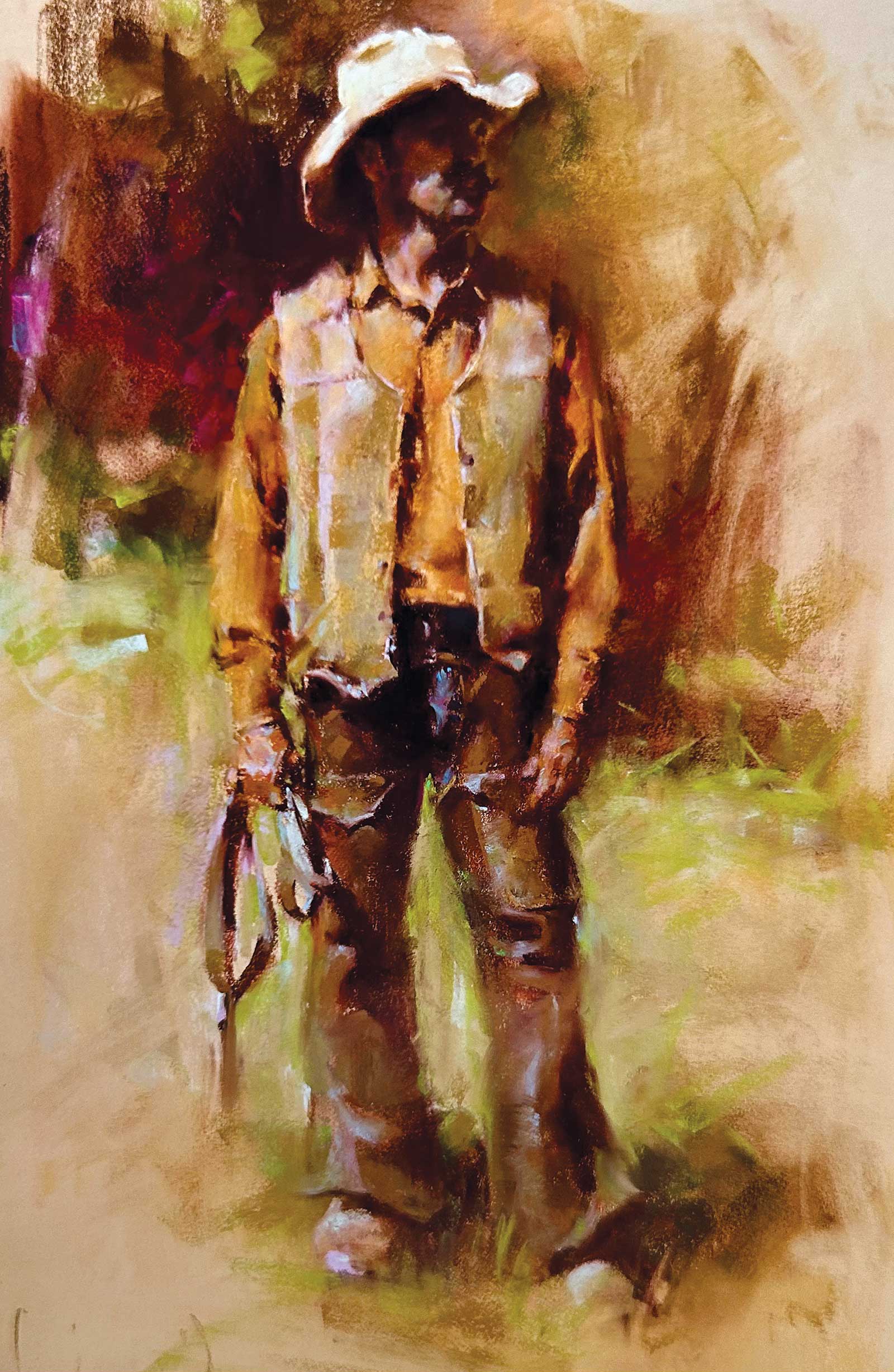
Cowboy, pastel, 24 x 18" (60 x 45 cm)
- Cowboy about to go to the stable.
- Quiet moment in a complex world.
- Lost/found and hard/soft edges.
- Overall warm, with slight touches of cool.
- The hat brings artistic drama.
- No areas fussed.
- The joy of laying in shapes and shadows.
Golden Memories
It is so important to keep connected with artists over the years. My art companions have been blessings throughout my life. Yes, we all enjoy each other’s thoughts and talents but more important is our loving, genuine friendships. Such glorious times. Golden memories so often come back to me. All of us in the art world are truly joined together.
Free the Mind
Once in a while, take some free time doing a bit of physical activity. Also let the mind wander or concentrate: playing a game, tennis, a walk, a buoyant film, etc. It is like getting on a magic carpet and eventually landing back in your art studio with mind and body refreshed and ready.
Interesting Errors
Sometimes a seemingly sloppy stroke is not a mistake, but something inside the artist that yearns to go its own way. The more we paint, the more those “mistakes” become interesting. And we gain insight in knowing when to keep or eliminate.
In the art world, nothing should be taken for granted. Nothing.
Many artists starting out make important mistakes with values. For instance, when the artist sees light areas and makes them all the same. Like the areas of the face or figure; variable lights of the forehead, cheeks, nose, shoulders, knees.
Also, light can look lighter when it is next to a dark area. The artist should closely look at each of the lights and just see how different they might be by covering the values next to them and comparing. Also, a light area makes a dark area next to it appear darker.
A Dream Come True
I have lived the life that I earlier fantasized about. Those fantasies were quite unbelievable. Putting it another way: if the life of an artist sounds ultra bizarre, it’s quite likely true. Dear reader, what you and I do and how we live is quite complex for others to understand. Yet putting it in simple terms, you and I are living a very normal life—for ourselves.
In the arts I won’t say this artist is better than that artist. Like saying Rembrandt is better than Rubens. The arts are not the Olympics. No winners in the realm of the greats. That includes so many of today’s masters. —
BALINOFSKI: Revealing the Inner Mind
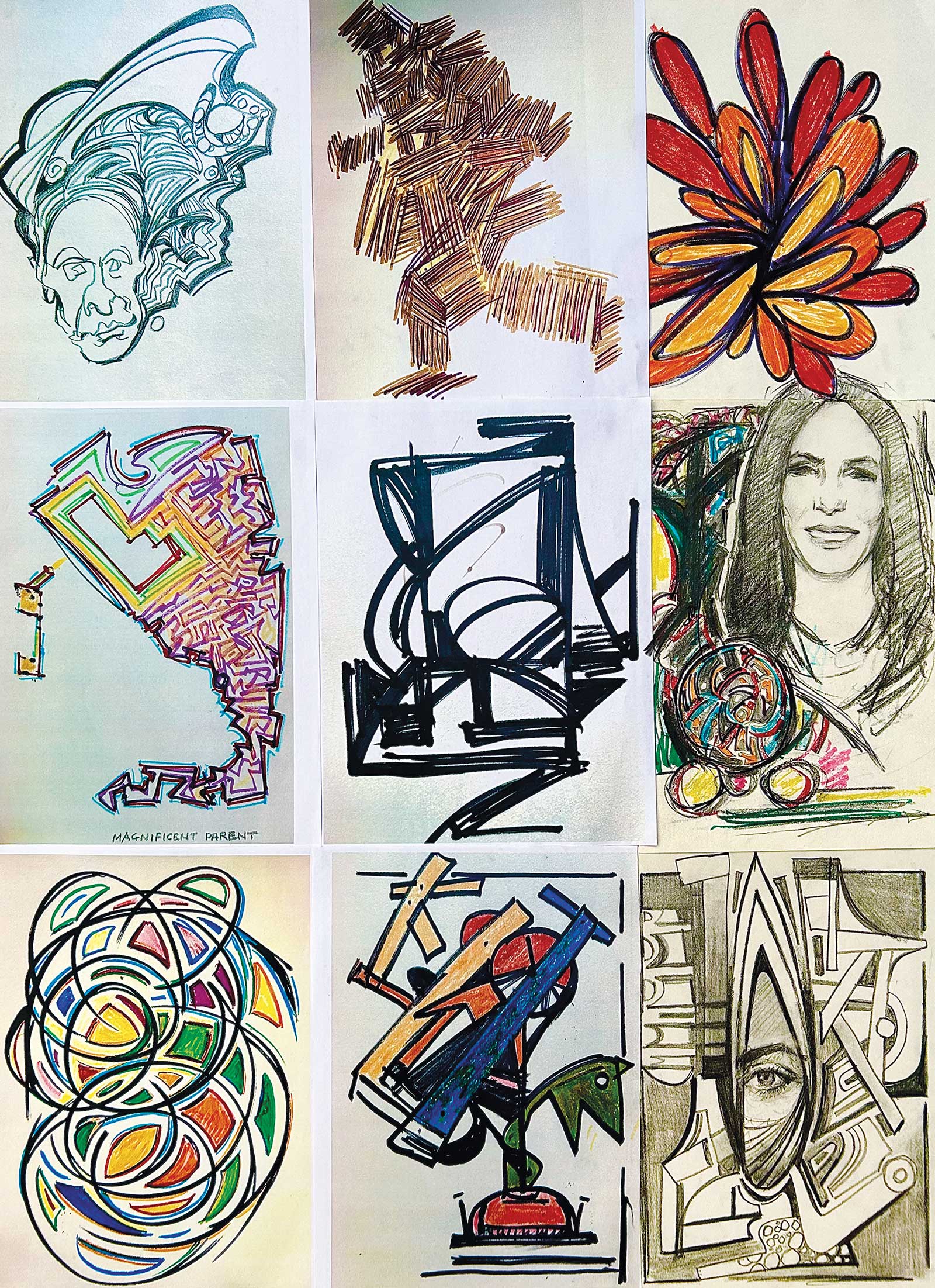
Balinofski wanted me to give a few details about his work in this issue. He says that, as with all his art, the images seen here are created with his inner and outer minds working closely together. He says that having a lifetime creating with nature’s shapes, values and colors, his inner mind is so vision-filled, he’d need several lifetimes to lay them all onto paper and canvas. And this is true of both his representational and abstract art. Every pastel drawing here was expressed with no hesitation, no contemplation. This expressive flow is found in all the arts.
Balinofski asks: “Will you, dear reader, look closely into each of these images and see if you can understand my inner mind?”