
How to Prepare
The key to economically packing painting gear for air travel is to minimize weight, bulk and luggage expense without compromising equipment needs. This article focuses primarily on oil painting because it poses the most challenges, but most of the practices apply equally to acrylic, watercolor and pastel work.
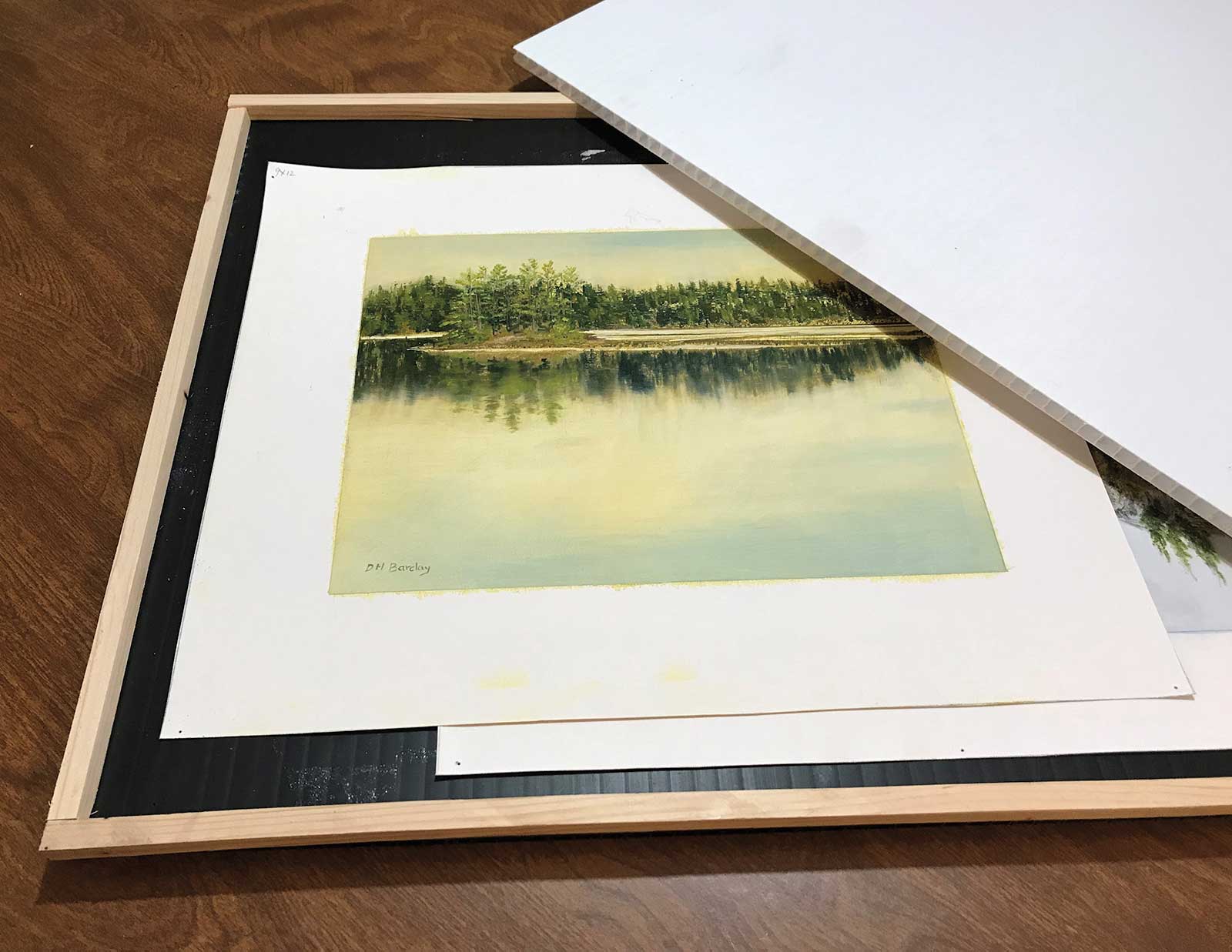
A ½" to ¾" wooden edge attached to the perimeter of a 10-mm corrugated plastic sign board protects canvases in your baggage and doubles as a backing board in the field.
Equipment Weight
The two key takeaways for oil painters are these: 1. Your painting gear will likely weigh between 20 and 27 pounds and 2. Your easel will comprise about half of that amount.
Standard airline weight limits are 50 pounds per checked suitcase, and typical large suitcases weigh eight to 12 pounds. This means that your painting gear plus your suitcase itself will likely fall between 30 and 40 pounds, leaving little weight for clothes. The best strategy is to move the heaviest item—your easel—to your carry-on luggage if possible. It is of course possible to pay the airline to take a second checked bag or hire a shipping service and send one on ahead. This article assumes that you would prefer to avoid that additional cost and travel lighter, whether you are flying domestically or internationally.
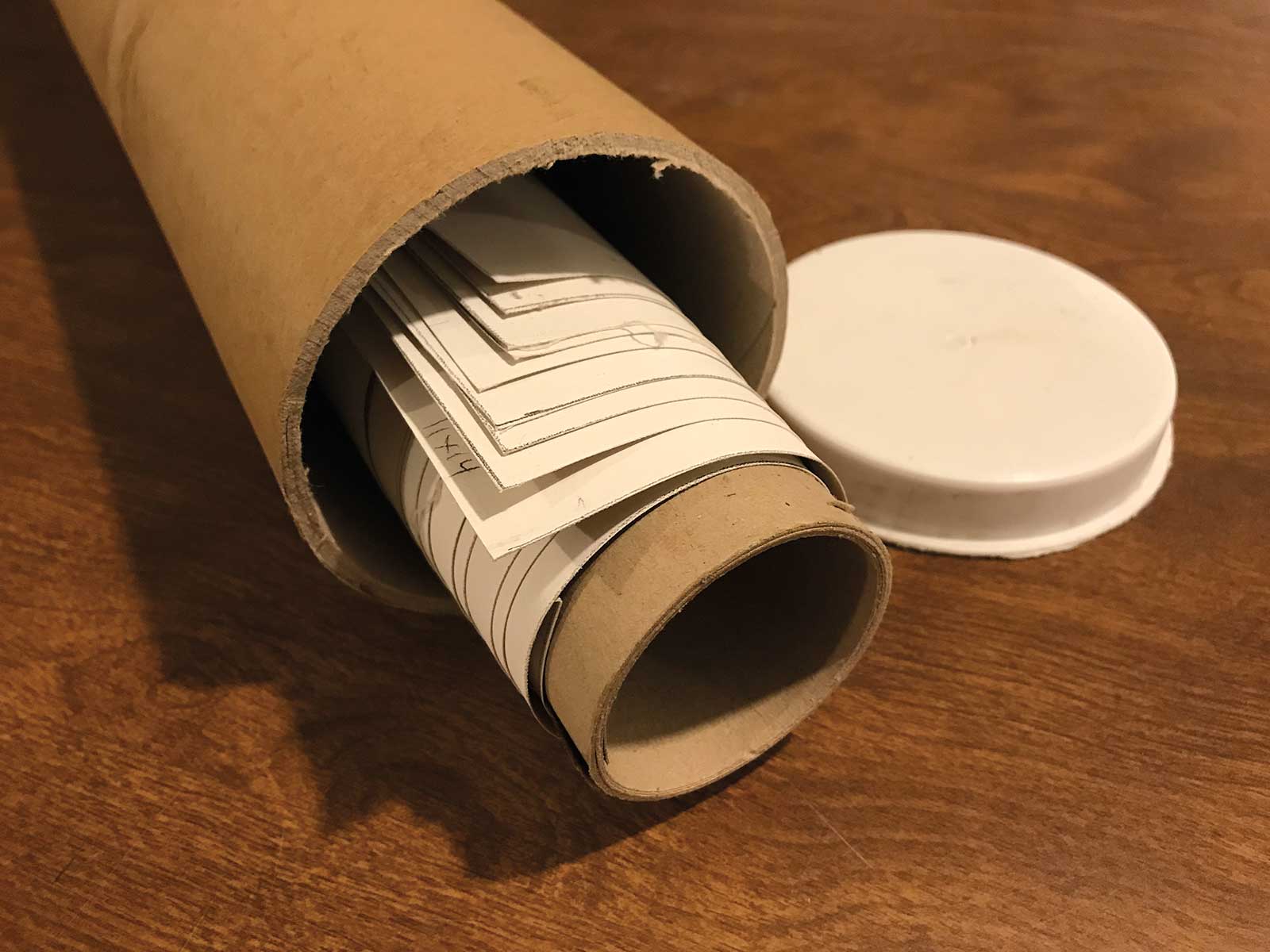
Alternatively, roll the canvas or paper around a smaller diameter tube (2½" or larger) and insert it in a larger protective tube. I recommend a rigid cardboard tube or a piece of PVC plumbing pipe roughly 3½" in diameter. Bigger painting surfaces necessitate the rolled approach.
Packing Painting Materials
Canvas vs. Board
The most lightweight solution for transporting painting surfaces is to cut pre-gessoed canvas blanks in your favorite sizes from a canvas roll. Canvas boards are an option, but they are heavier and require more space.
Transporting the Canvas
Pre-cut canvas blanks can be transported either flat or rolled. For the flat option, glue a ½" or ¾" wooden lip to the perimeter of a lightweight backing board to create a “pocket.” Place the pre-cut canvases inside. A second backing board serves as a lid, creating a protective sandwich to hold the artwork. I simply tape the two boards together. This also works well to protect watercolor and pastel papers.
Transporting Panels
The major advantage of canvas covered or hardboard panels, such as those made by Raymar, is that they do not need to be mounted or stretched later before framing. Some are made with lightweight material. If the paint is relatively thin and a drying accelerant is used, painted panels can be stacked between non-stick paper for transport without damaging the work. The key is to prevent the panels from being pressed tightly together. If no drying accelerant is used, numerous manufacturers offer wet panel carriers that separate the panels. While effective, panel carriers are bulky.
Tip! Package your colors in a leak-proof container or double Ziploc bags. Include the corresponding material safety data sheets and an explanatory note for airline inspectors.
Backing Boards
Flexible canvas blanks need a stiff backing board in the field. I recommend using a 10-mm corrugated plastic sign board or ½" Gator Board as a backer. These are flat, stiff and super lightweight. (Sign board is a thicker version of what is used to make plastic yard signs.) Before painting, attach your canvas or paper to the board with masking tape or push pins. The backing board should be slightly larger than your largest blank canvas to allow for taping. My standard sizes for plein air work when traveling are 9 by 12" or 11 by 14". I pack two or three signboards because I typically work on more than one painting at a time. For pastel work, the surface of the backing board needs to be perfectly flat. Some sign boards have a slight ribbing on the surface, so Gator Board is a better option for pastel work.
Transporting Oil Paints
Oil paints pose a potential problem for airline security and should be placed in checked airline luggage. Art supplier Gamblin offers this advice: “Artist’s oil colors contain no solvents so they are not hazardous. When security asks, ‘What are these?’ never say oil paints. The word ‘paint’ is a hot-button issue with them…Tell them that they are ‘artist’s colors made from vegetable oil.’”
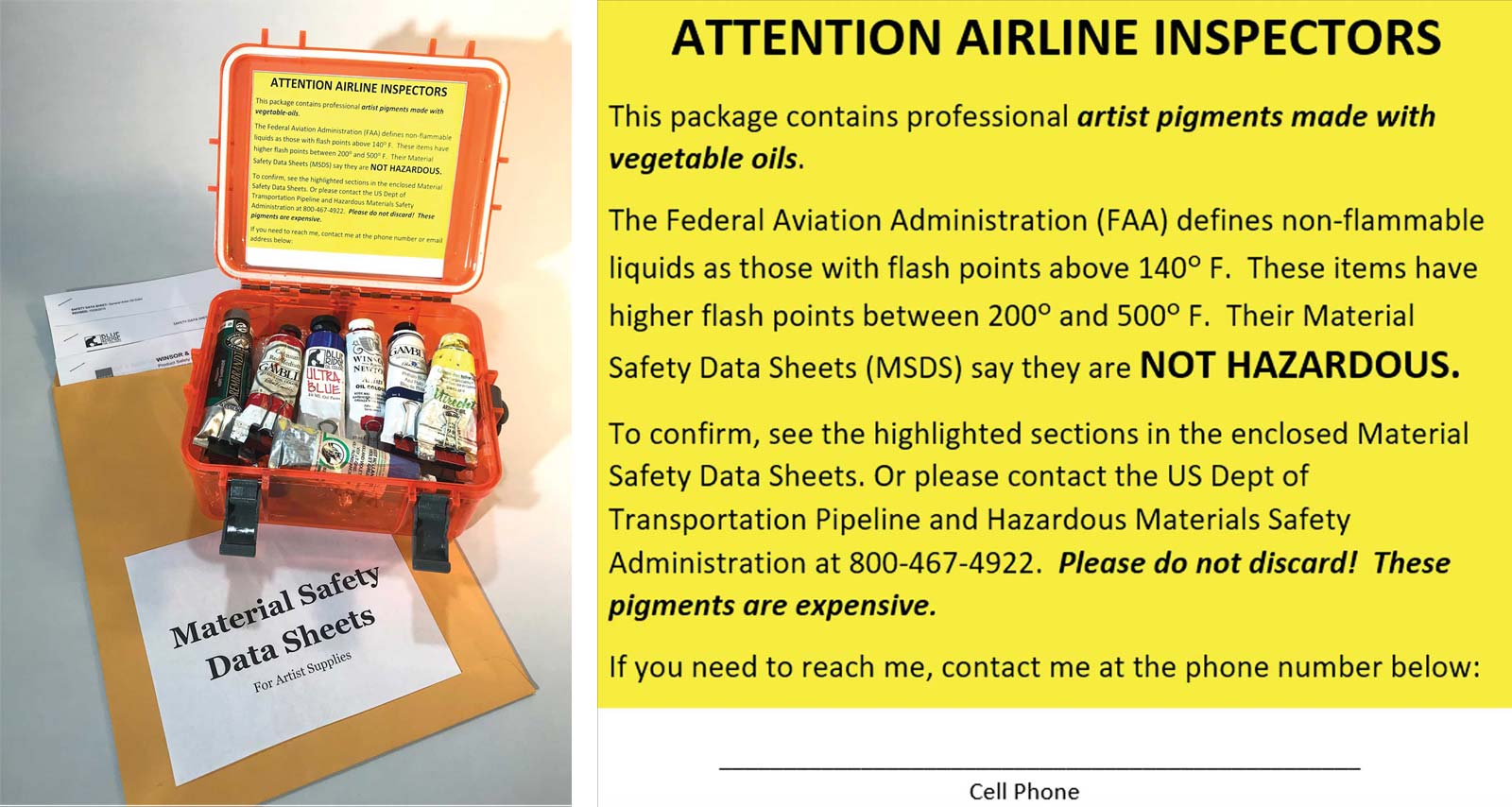
Another professional artist and international plein air painter, Scott Ruthven, recommends labeling the box “Vegetable-Based Artist Colors.” Watercolors and acrylics can be labeled simply “Artists Watercolors.” Pastels need no label. The Federal Aviation Administration’s (FAA) Pack Safe regulations state that, “For transportation purposes, ‘nonflammable’ paints are those with a flashpoint above 140° F/60° C.” I recommend finding, printing and including your paints’ material safety data sheets (MSDS) with your paints and highlighting the products’ flashpoint (section 9 or 10) and the non-hazardous-for-transportation statement (section 14).
Not all manufacturers list flashpoints on their MSDS, but all indicate if the product is regulated for transportation in Section 14. “Non-regulated” means not hazardous for transport. It is not necessary to have an MSDS for each color. Most manufacturers have a single MSDS that covers all their artist oil paints. Take one MSDS per brand. The fewer brands you pack, the fewer MSDS sheets you will need.
I also recommend clearly labeling your paints for airline inspectors with a label similar to this one, which I have adapted from a version by artist Lori Putnam.
Paints should be packaged in a sealable container or multiple Ziploc bags to catch any oozing due to air pressure changes. I use a plastic camping food container with a waterproof seal.
Solvents and mediums cannot be put in checked or carry-on baggage because they have low flashpoints. An art retailer can ship these directly to your destination or you can identify a local art supply store. If you are traveling internationally, don’t let foreign languages intimidate you. Google Translate or other online translation programs make communication about art supplies possible in virtually any language.
TSA inspectors are supposed to make decisions based on MSDS classifications but, ultimately, the agent has the final decision. If there is a problem, Gamblin advises: “Keep your cool—don’t hassle security. Show them the MSDS and explain that you are going on a painting holiday.”

David Barclay painting out in the field.
Checked vs. Carry-on Luggage
Plein Air Magazine’s Outdoor Painter newsletter provides the following comprehensive list of items and how to transport them:
» Checked Luggage Make sure you pack these items with your checked luggage, as you cannot include them in your carry-on: tube paints; mediums for…acrylic and watercolor; palettes with paint on them; containers carrying paint out of the tube; and sharp tools like knives, palette knives, razor blades or scissors.
» Carry-on Luggage Items that you can carry on include brushes, easels in backpacks, clean palettes, pan watercolors, pastels, canvases, panels, paper, drawing materials (pencils, pens, charcoal, erasers or Conté), sketchbooks, paint cups, trays and empty vessels for water and solvents, viewfinders, bottles of ink (3 oz or under), camera, hand wipes and plastic gloves.
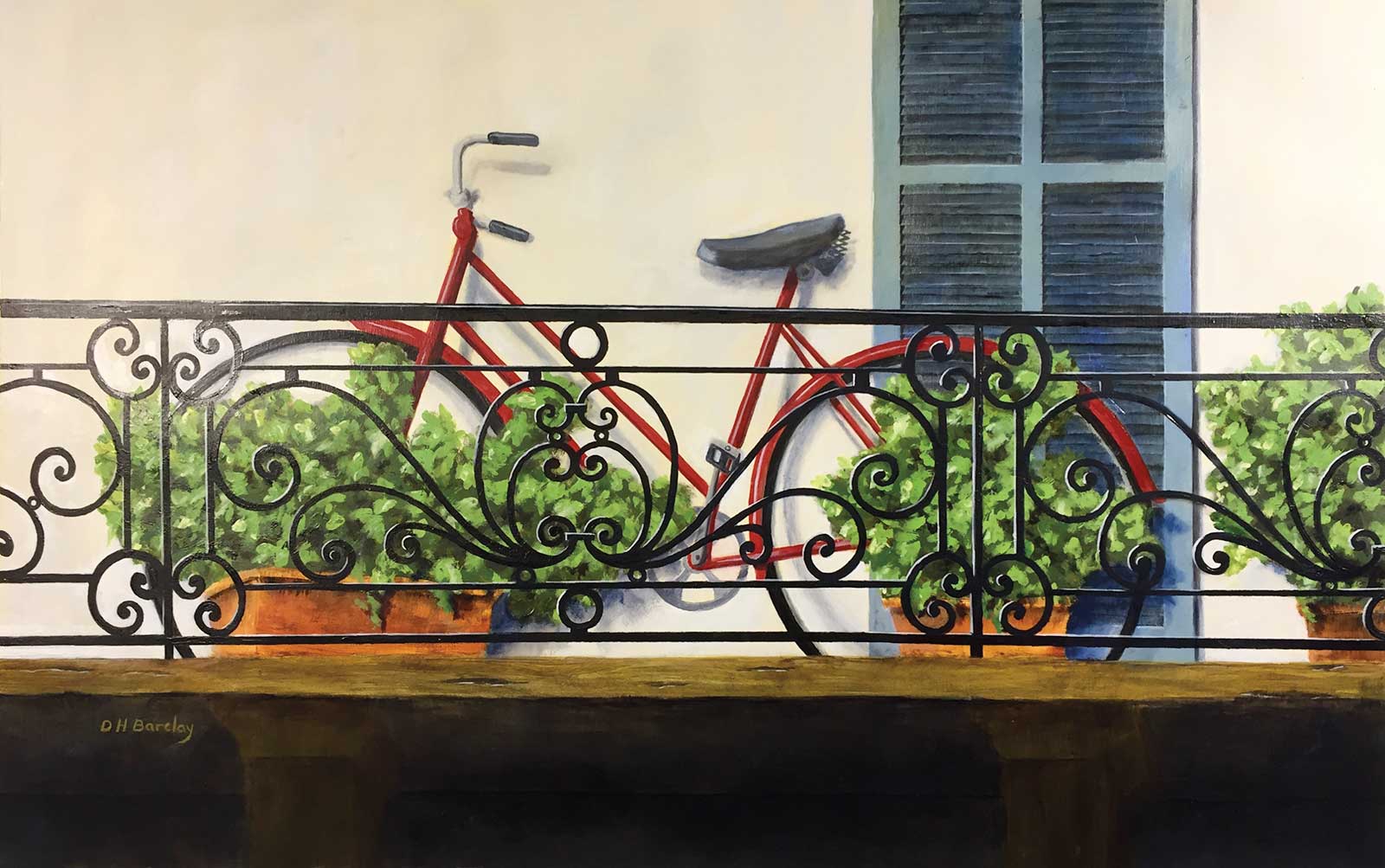
David Barclay, Flight Plan, oil, 24 x 36" (60 x 91 cm)
Easels
A three-part tripod, palette and panel holder system or pochade box/tripod combination generally offer the lightest options. Half-box French easels fall in the middle weight range. Traditional full-size French easels, while quite functional, are the heaviest and take up the most room. Hands-down the weight-to-size winner is the Daytripper Easel/tripod system offered by Prolific Painter, which weighs in at an amazing 5.4 pounds, roughly half the average of other systems. Which easel you take is a personal decision, but its weight and bulk will be the driving factors.
What To Buy On Site
Paper towels, mini trash bags, dish soap for brush cleaning and bottled water are easy to purchase in most grocery stores. I have had some difficulty finding thin protective gloves in quantity, so I pack them.
Protecting Paintings for the Return Trip
Drying Accelerants
Oil paintings must be dry to transport stacked or rolled. My solution is to use a medium that accelerates the drying of oil paint. I use Winsor & Newton Liquin Original or Gamblin Galkyd to ensure my paintings are dry to the touch in less than 24 hours.
Minimizing Space
Ten dry, stacked canvases will take up less than about 1¾" of space when loosely sandwiched between two sign boards. If you opt to bring hardboard or canvas panels, the issue is bulk, weight, and more importantly, how to safely store them on the return trip.
If you use a drying accelerant, your paintings should be dry enough to stack with non-stick paper between them, as long as they are not pressed tightly together. Robert Sweeney, a prolific professional artist and experienced international traveler, recommends putting a layer of Glassine paper between the paintings, because although they are dry to the touch, they are not completely cured. Glassine’s teflon-like surface makes it ideal for separating recently painted oil, acrylic or pastel artwork to prevent sticking and smudging. Kitchen wax paper or non-stick baking sheets are the second best options.
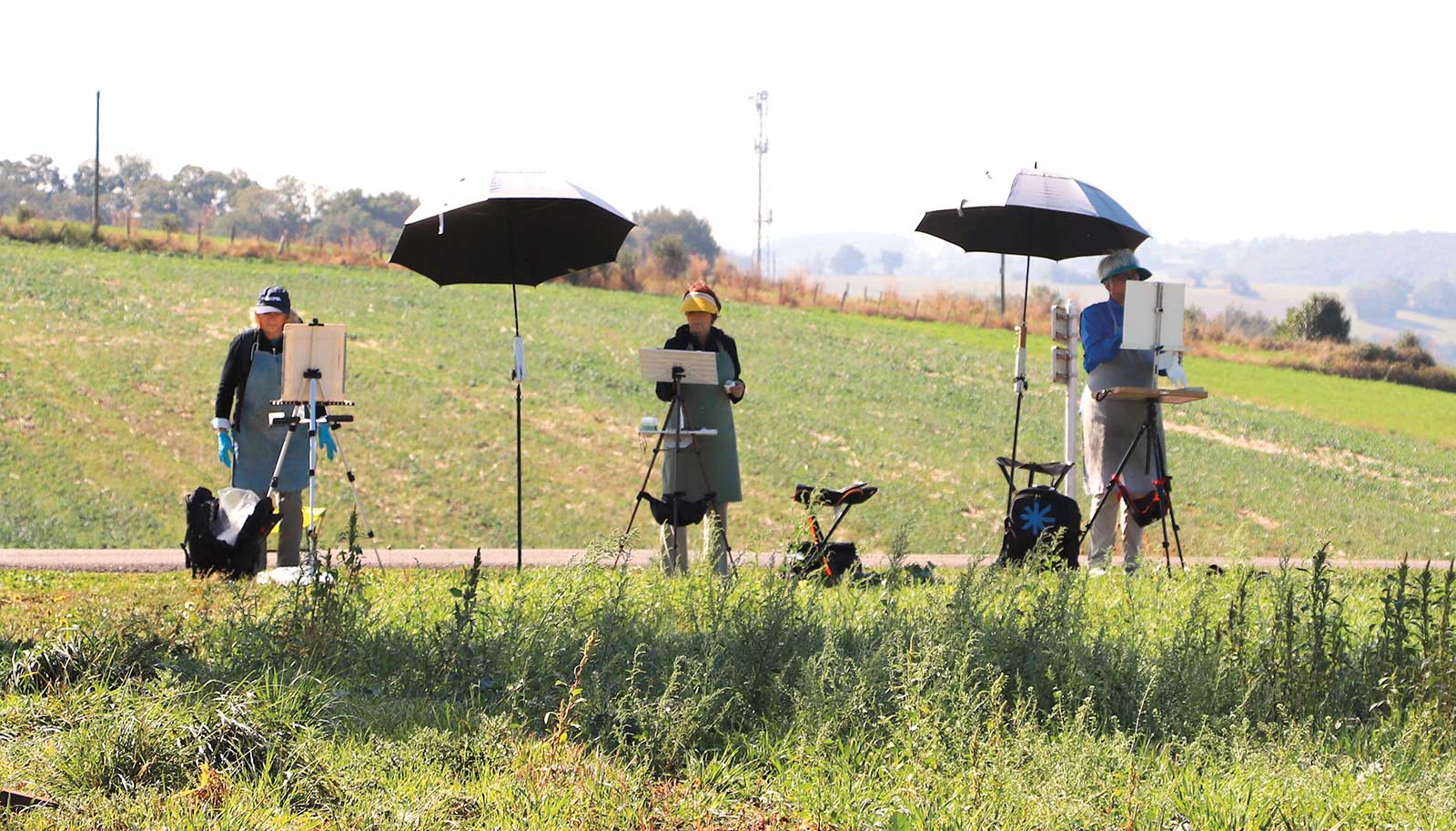
Artists paint during a plein air retreat in France.
Panel Holders
If you do not intend to use a drying accelerant and your canvases are still wet at the time of your return, a panel holder is required. If you paint 10 paintings on your trip, you will likely need multiple panel carriers, and it will take up a considerable amount of space.
Protecting Against Loss
Artist Robert Sweeney also told me he never puts his finished paintings in checked luggage out of concern for potential loss. He always carries his completed paintings with him in his hand luggage on the plane in a special portfolio case. Whether you use carry-on or checked luggage to transport finished work, you can use the same backing board pocket arrangement to protect paintings or, alternately, a tube.
A Final Note: Watch Your Weight and Size
Depending upon your ticket type, some airlines charge for your first checked bag, a carry-on and definitely for a second bag. Confirm your full ticket cost and what it includes before booking your flight. By managing the weight and bulk of your painting gear, you may be able to avoid the expense of a second suitcase. I strongly recommend buying a hand-held digital luggage scale for under $15. Airline weight limits are not all the same, and being told at the ticket counter that your bag is too heavy can be very frustrating. Be sure to check carry-on size restrictions as well. For example, the maximum dimensions for carry-on (AKA hand luggage) for Air France, Lufthansa and Icelandair are all slightly different. —