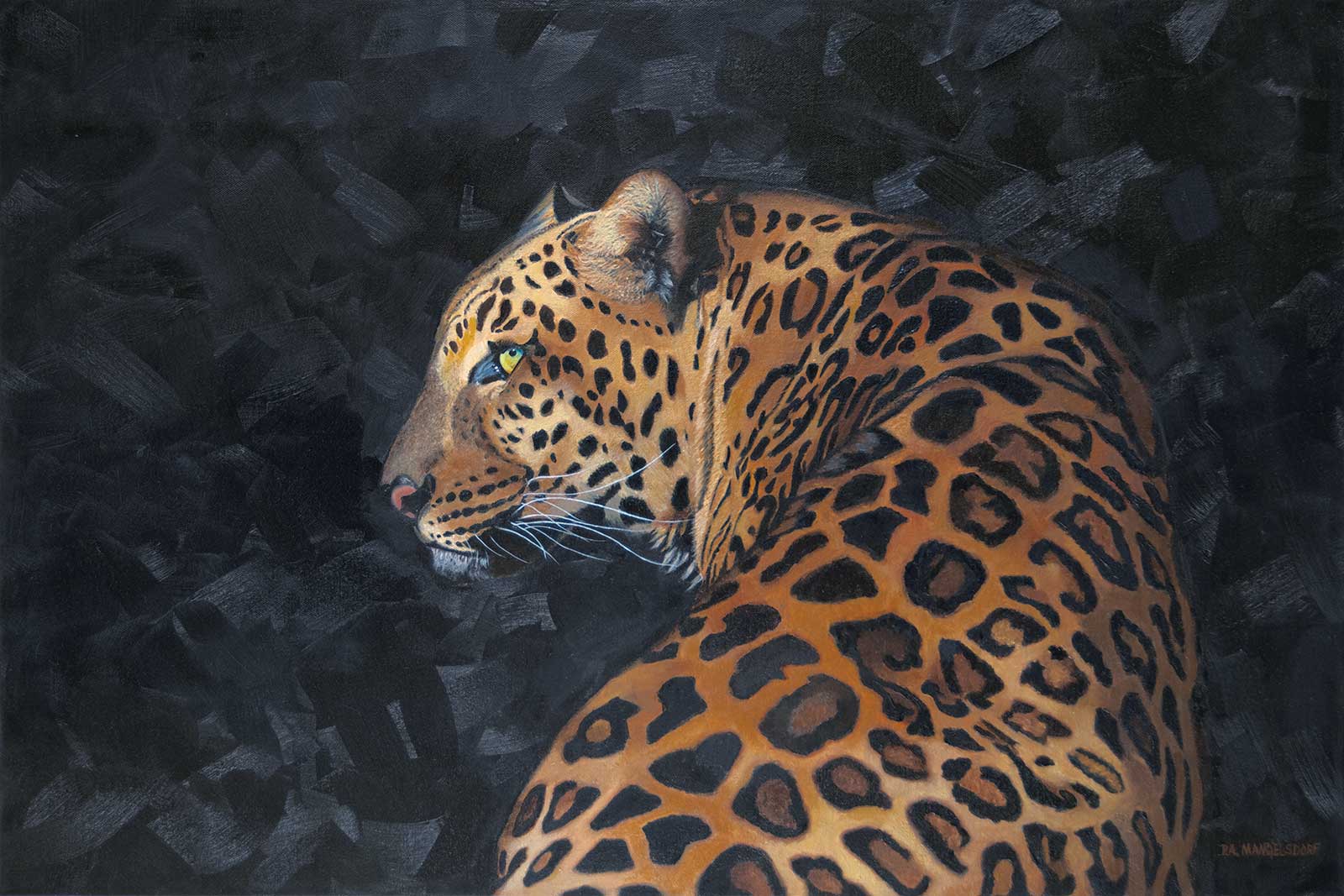
 Leonardo, oil, 24 x 36" (60 x 91 cm)
Pamela Mangelsdorf
Arizona, USA
Grand Prize is a four-page editorial feature in American Art Collector magazine
Intrigue in the Details
Arizona artist Pamela Mangelsdorf works in photorealism, making changes to her reference photos when necessary for the composition she has in mind. Primarily a wildlife artist, Mangelsdorf says photographs are almost mandatory, as most animals rarely pause long enough to capture from life.
“Wildlife is so complex and each species offers its own unique character. My goal is to capture that uniqueness with my paintings,” she says. “My inspiration comes from nature. I’m fortunate to live in the Southwest desert surrounded by wildlife such as coyotes, bobcats, javelina, quail, owls and many other beautiful species. My studio windows look out on these wonderful animals as they go about their daily lives. A trail camera eavesdrops on them during the night providing me with yet another window into their fascinating world.”
Mangelsdorf’s photorealistic style forces her to be very observant of the small nuances of her subjects. “I want to capture the essence and personality of the animals I portray. The shape of the eye, the texture and color of the fur or feathers is very important to me. Attention to detail is perhaps the most important element of my artwork.”
She adds that as she’s developed in her artwork, she has learned how to listen to her own instincts and interests. “I was frequently encouraged to ‘loosen up’ my style and not concentrate so much on the details. However, the details of the subject were what excited me. My subjects are always detailed. The details are what allow me to understand and portray more fully the essence of the animal.”
My Inspiration
Wildlife conservation initiatives are of particular interest to me, and I was intrigued by the story of Leonardo’s life. Leonardo was a beautiful jaguar-leopard hybrid that was born into captivity. Raised in a cage and trained for the entertainment industry, his canine teeth were pulled and his claws removed. He endlessly paced a tiny cage until he eventually found a caring home with a wildlife conservation center in Scottsdale, Arizona. After eight peaceful years there, Leonardo passed away at the age of 17. Magnificent is too small a word to describe how regal Leonardo was, and I hope my painting reflects some of his majesty.
My Design Strategy
My design goal was to create a portrait of Leonardo that would invite the viewer to visually stroke his luxurious coat. After reviewing many photographs of Leonardo, I settled on this over the shoulder pose, which draws attention to his patterned fur. In addition to his coat, I wanted to center the viewer’s attention on his head, eye and whiskers. To accomplish this goal, I deliberately chose to eliminate any distractions by using a dense black background to isolate his features.
My Working Process
Using my chosen reference photograph, I made a 24 by 36" copy and then transferred Leonardo’s image onto my canvas. Next, I painted the black background with a large brush with cross hatch strokes using burnt sienna and ultramarine blue for the black. Then, I began painting the body and the rosettes. I continued to layer until I got the values, colors and shapes correct. The mediums used were Royal Talens and Schmincke water-mixable oils.
Contact Details
Email: pamelamang@cox.net
Website: pamelamangelsdorf.com
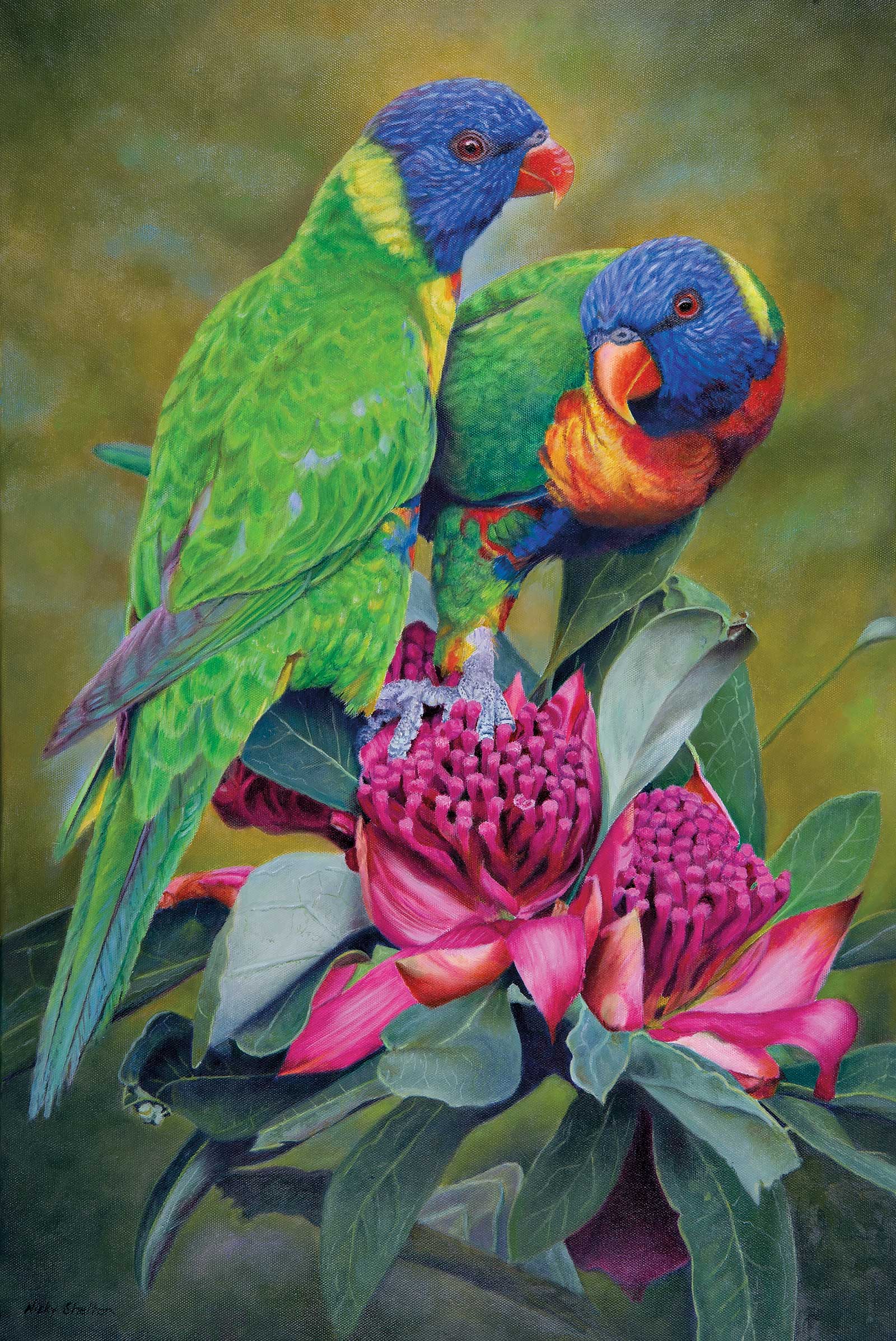 Waratah, oil, 30 x 20" (76 x 51 cm)
Nicky Shelton
Western Australia, Australia
Second Prize is a two-page editorial feature in American Art Collector magazine
My Inspiration
To me birds are one of nature’s gifts. I have always been fascinated by them. It’s not just their sheer beauty, but their personalities and freedom that I love. Rainbow lorikeets are stunningly colorful birds, extremely social, raucous and the providers of entertainment. When I saw David C. Simon’s beautiful photograph of this pair sharing the nectar of a waratah flower, I just had to paint it. I named the piece after the state floral emblem of New South Wales (Australia), the waratah flower. This image captures the sociability and playfulness of these beautiful birds.
My Design Strategy
Through my paintings I endeavor to capture the unique characteristics and magnificence of my chosen subjects. My goal for each artwork is to have them jump from the canvas into the viewers’ own reality. For reference material I have developed a small network of highly talented birdlife photographers who graciously support my passion for birdlife with reference photos. From provided reference material I create a layout concept sometimes using multiple images. I use light and shaded edges to draw the viewer to the focal point and create backgrounds to suit my subjects—in some instances in a more contemporary style. I call this “contemporary realism.”
My Working Process
Once I am happy with a design concept I hand draw the subjects onto stretched canvas, using large grid lines as directives for positioning. Oils are my preferred medium as I believe it is better suited to create a sense of depth and is more easily manipulated for detail. I always start with a blocking in process commencing with the background and progressing to the subject. This process helps me to ascertain the tonal values. I then leave the artwork to dry and start overlaying using fine brushes to capture the detail, color depth and definition of the feather plumage.
Contact Details
Email: nicky@nickyshelton.com.au
Website: nickyshelton.com.au
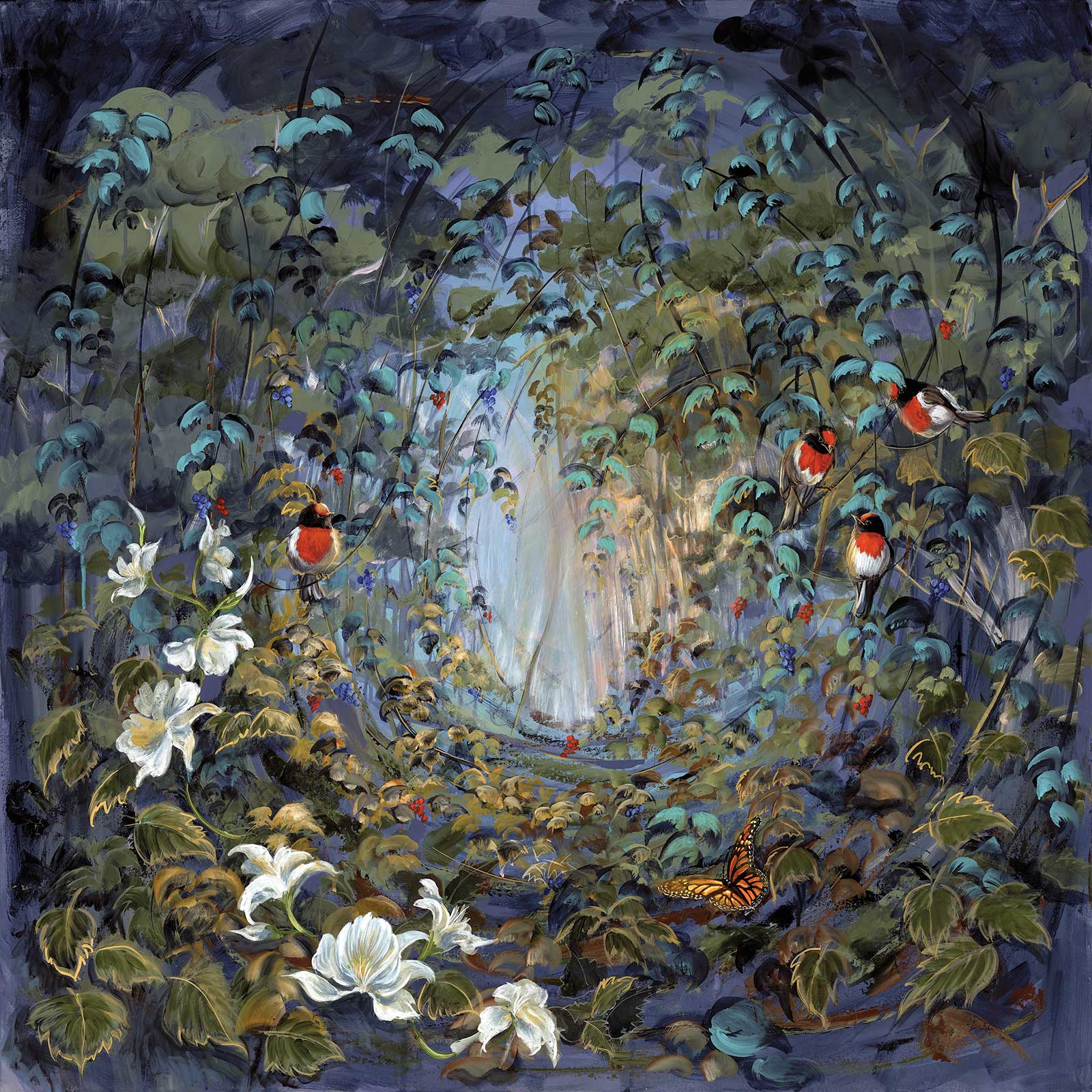 Love to Love, acrylic on canvas, 391/3 x 391/3" (100 x 100 cm)
Priya Gore
Queensland, Australia
Third Prize is a one-page editorial feature in American Art Collector magazine
My Inspiration
I am a compulsive painter. What inspires me is the power of the human mind and the ability to create magic on canvas. It transcends mere replication of the physical world; it becomes a soulful journey of bringing dreams to reality and playing with the strings of nostalgia. Inspired by the Polish master Beksinski, my heart yearns for something deeper, something that resonates with the very essence of my being. Each stroke of paint becomes a vessel through which I pour my feelings about life, nature, love and friendship. The result is a wonderland, a dreamy landscape that invites viewers to immerse themselves in its enchanting embrace. I believe that art should not only captivate the eyes but also stir the soul, evoking deep emotions and provoking introspection. In this world of turmoil, I’m deeply motivated to compel the viewer to believe in “the existence of magic” and also “the magic of existence.”
My Design Strategy
The most integral and the first step of my design process is the selection of the aspect ratio and size of the canvas. I have a penchant for square canvases, as they offer a sense of harmony and allow for the exploration of circular motions within my artwork. The selection of red-capped robins as subjects for this particular artwork is deliberate, driven by their striking coloration and anatomical features, which evoke a sense of love and connection. The background design is meticulously crafted to complement the robins, creating a cohesive narrative that unfolds across the canvas. In this specific painting, the inclusion of multiple figures—represented by the robins—serves to convey a deeper narrative. These birds symbolize my teenage years and the friendships I cherished. However, amidst the flock, there is one special friend who holds a unique significance.
My Working Process
The process of applying paint on canvas is incredibly powerful for me; it keeps me going, helps me to breathe. I lost my mother in 2021, when my daughter was just 5 months old. With each brushstroke, I feel my mother’s presence, her gentle guidance shaping the canvas as if she were by my side. While the technical aspects of paint and canvas are important during the design phase, they fade into the background when I begin to paint. The process of painting is deeply intuitive for me, transcending meticulous planning and preparation. It’s like a dance, a performance where I trust in the countless sketches and drawings I’ve done beforehand to guide me, resulting in bold color choices and powerful brushstrokes that authentically portray my innermost feelings.
Contact Details
Email: hello@priyagore.art
Website: priyagore.art
Finalists
Each receives an Award Certificate and a one-year subscription to International Artist magazine PLUS having their work seen worldwide by international galleries looking for new talent.
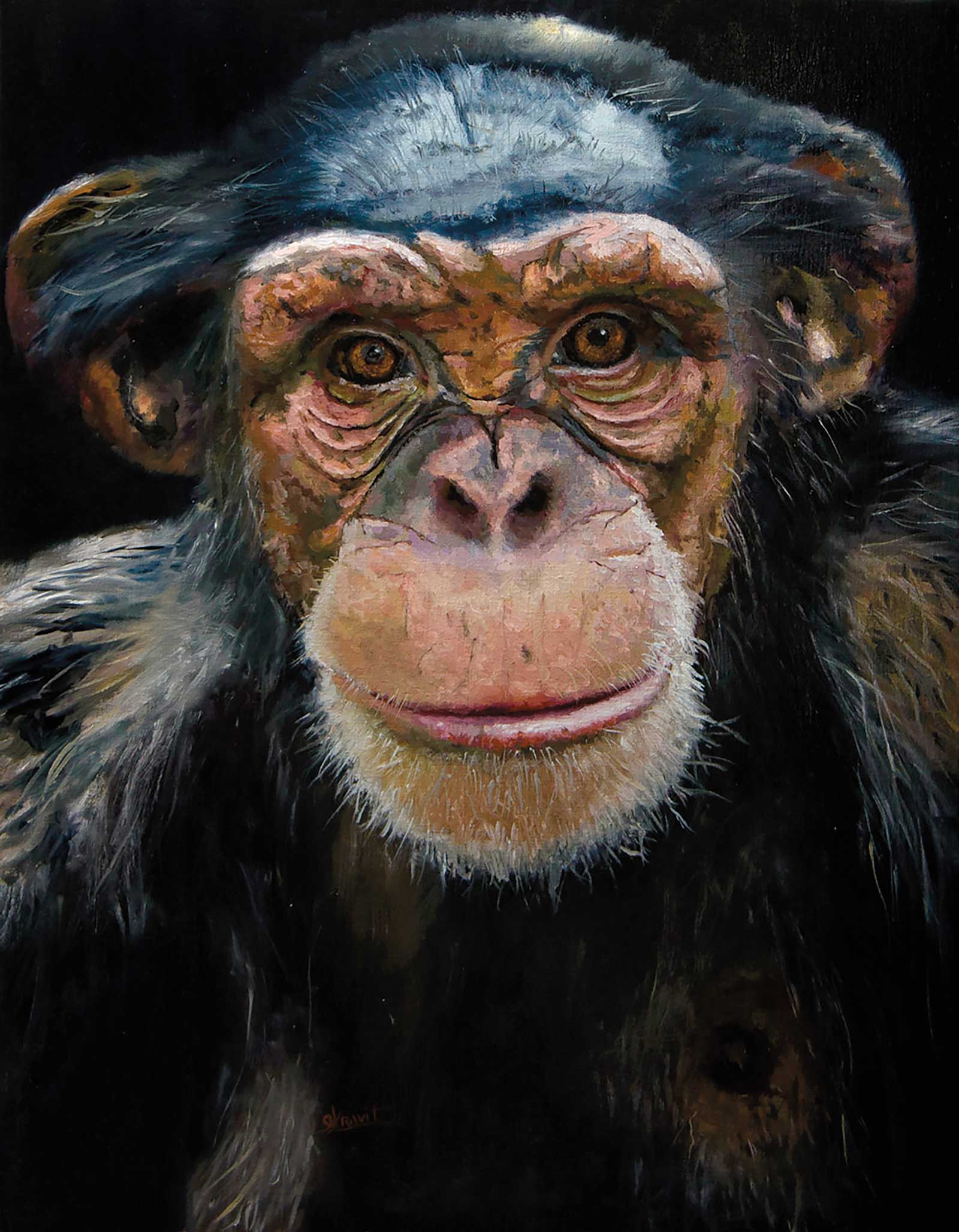 Stryker, oil, 16 x 20" (40 x 50 cm)
Garry Kravit
Florida, USA
My Inspiration
The Center for Great Apes is a non-profit rescue center providing permanent sanctuary to dozens of chimpanzees and orangutans retired from the entertainment industry, research and exotic pet trade. I’m one of several artists who have worked to help support the center. I’ve been painting portraits of the apes for about a decade. On one visit, Stryker’s outgoing personality caught my attention.
My Design Strategy
I try to convey each ape’s personality in his or her portrait. Generally, this requires exacting attention to the ape’s eyes and expression.
My Working Process
Unfortunately, I live many hours from the center, so I work primarily from photographs. (Not to mention that chimpanzees aren’t exactly cooperative models.) Additionally, founder Patti Ragan is protective of the apes and limits their exposure to humans. Back at the studio I block in major shapes and add successive layers, pushing and pulling as necessary while also adjusting temperatures and values, until I’m satisfied I’ve achieved what I’m after.
Contact Details
Email: garrykravit@gmail.com
Website: garrykravit.com
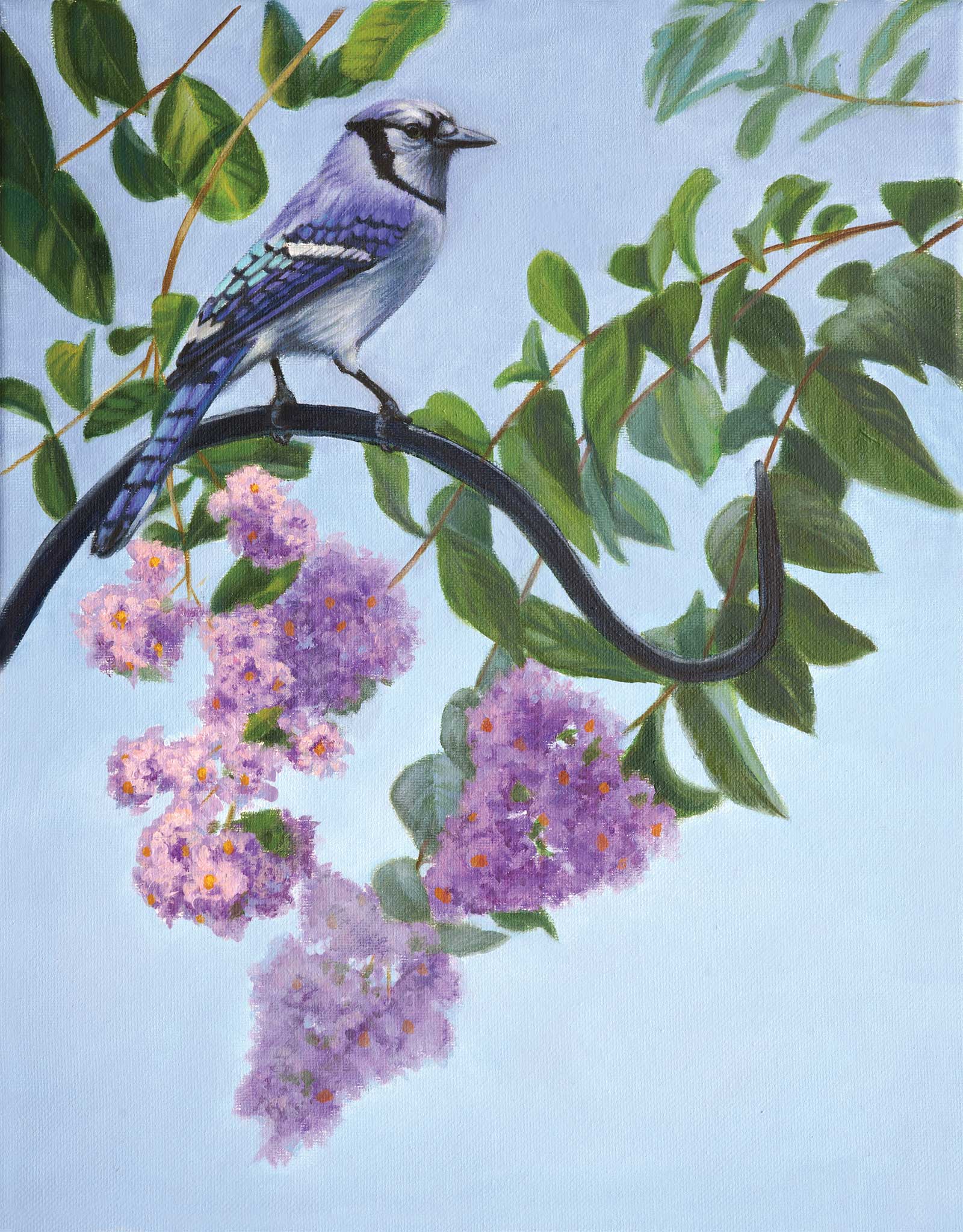 Pink Myrtles, oil on canvas, 14 x 11" (35 x 27 cm)
Deborah LaFogg Docherty
Florida, USA
My Inspiration
The inspiration for Pink Myrtles was childhood memories of our bird feeder and the beauty and fragrance of lilacs in spring. I know the myrtles aren’t the same, but they’re the next best thing. I love blue jays; every morning they greet me by landing on the shepherds hook just outside my door. I was never able to capture them both at the right time in a photo so I decided to paint the scene to recreate a memory.
My Design Strategy
The goal of all of my paintings is to create a flow within. I believe that a painting should be a place to linger, to be enjoyed and make a connection with the viewer like sharing a memory.
My Working Process
I liked the position of the jay in one picture and decided to base the rest of the painting on it. To achieve the right composition and mood I chose a photo of myrtle flowers I had taken to match the bird. Once the digital images were in Photoshop, I designed a composition. I then printed a black and white print to find values. The hardest part was painting the subdued color and blurred definition of the background flowers.
Contact Details
Email: deb@lafogg.com
Website: lafogg.com
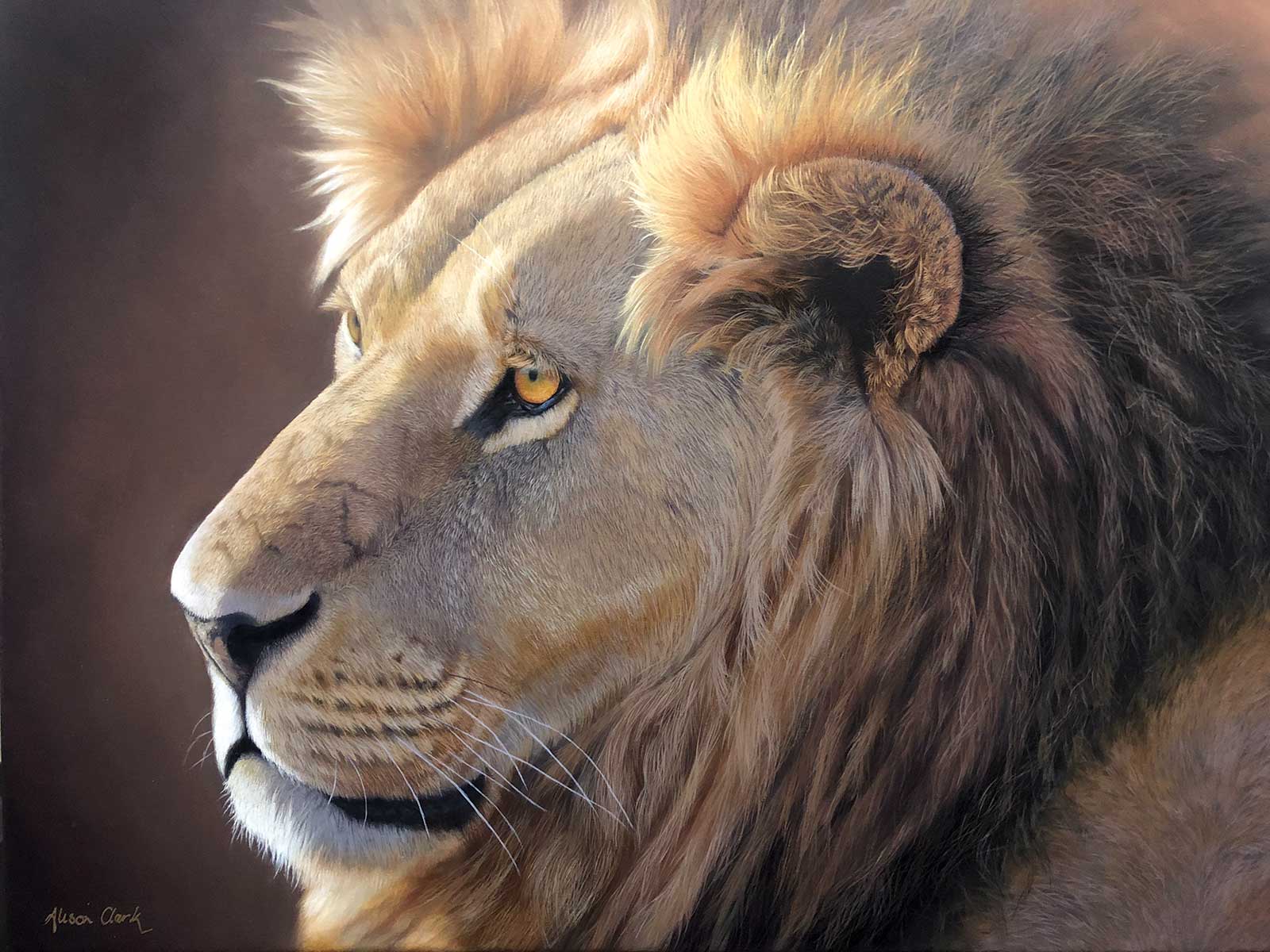 Big Daddy, oil on superfine canvas, 18 x 24" (45 x 60 cm)
Alison Clark
Victoria, Australia
My Inspiration
This magnificent protector of the pride has inspired me more than once, and we saw him nearly every day in a reserve in Botswana. I had already painted him playing the “dad” role perfectly, being tolerant with one of his many cubs jumping on him as he sat in the shade. This time he was alone getting some morning rays, having a bit of “me time.” The sun highlighting the side of his face and his relaxed pose seemed to make him glow in his magnificence, as well as accentuate his sovereignty in his own domain. I had to paint him again.
My Design Strategy
I wanted this painting to be all about the lion and the light, so I gave him free rein to take up most of the canvas, with no distractions. The background is simple in earthy, analogous colors, designed to draw the viewer to his highlighted face, contrasting with his golden yellow eye in shadow. His mane behind his head fades into the background and sends the eye back to his face.
My Working Process
Using large brushes and thinning the paint, I put down the tones and shapes of the darker underpainting before beginning the many layers of detail with smaller brushes. The tip of a dagger striper gave me very fine lines for fur, and I selectively adjusted colors between fur layers with both warm and cool glazes. I kept the finest detail on his face and left some less defined areas around the edges of his messy, bulky mane.
Contact Details
Website: alisonclarkwildart.com
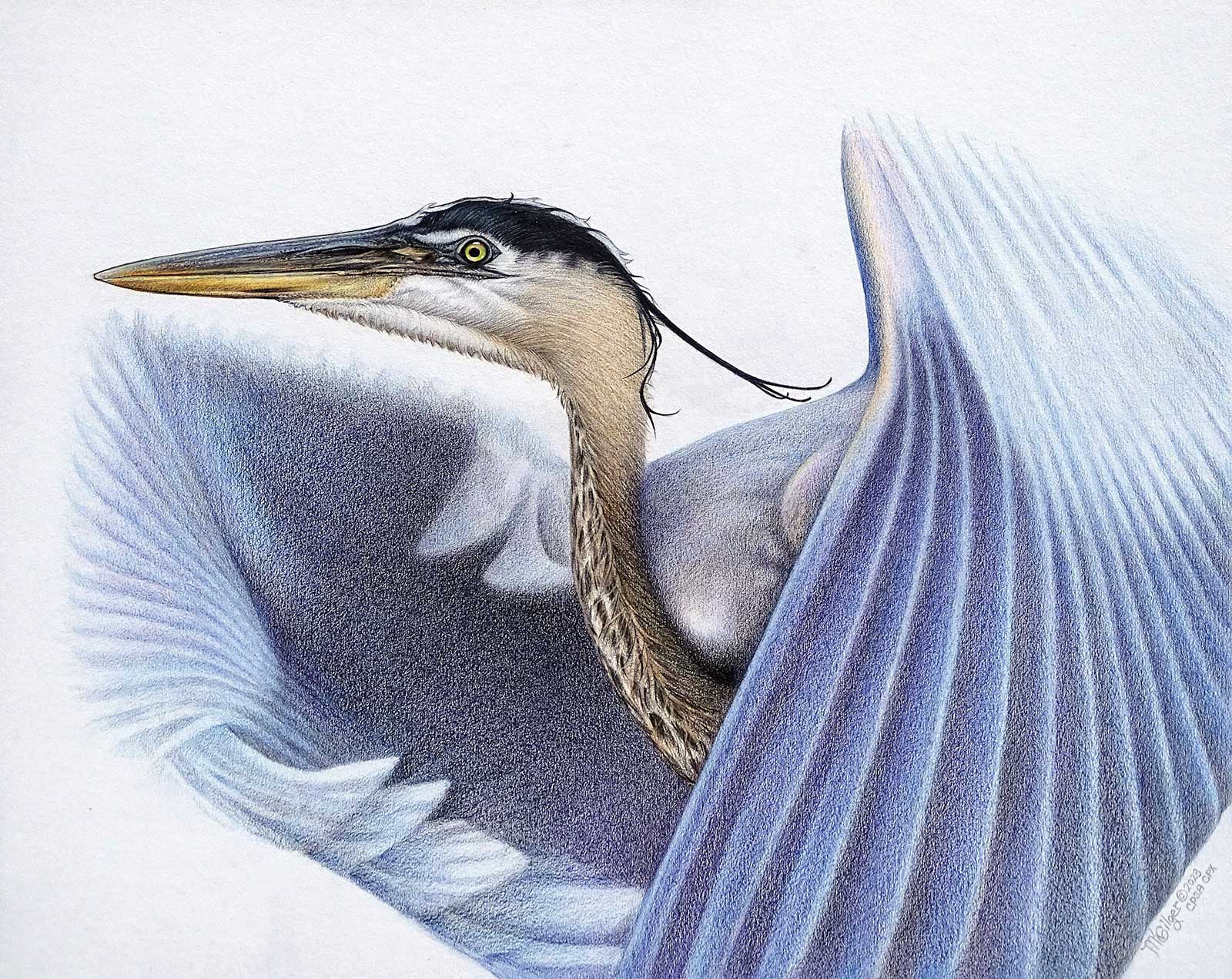 Lift Off, colored pencil, 16 x 20" (40 x 50 cm)
Marsha Gilger
Ohio, USA
My Inspiration
At a quiet wooded pond, a great blue heron crouched in the lily pads, unmoving as he stalked a bullfrog. It was late afternoon and the reflections of blue sky and water saturated the heron’s feathers with even more color.
The heron grabbed his prey and rose from the water as I snapped my last photo. The result was blurred, but I loved the composition and the energy of the scene.
My Design Strategy
I chose a white background so my composition could focus solely on the heron in the moment of lift off. Central to this composition is the head and torso. I referred to prior photos, and close-ups for the detail needed to draw the viewer’s eye to the heron’s intense gaze and its line of flight. An abstract blur of wings and softer pencil application frames the more detailed area of this study.
My Working Process
I began with mock-ups using photos and sketches. I wanted the blurred wing to appear softer and less defined. I used loose strokes and an eraser to suggest the movement and direction of the feathers as they spread and cupped the air like fingers. Pushing the heron up and forward is the downward sweep of the more detailed wing. Using fine pencils, I shaped the wings with soft grainy detail and shading.
Contact Details
Email: mkaygilger@gmail.com
Website: flickr.com/photos/mkg-art
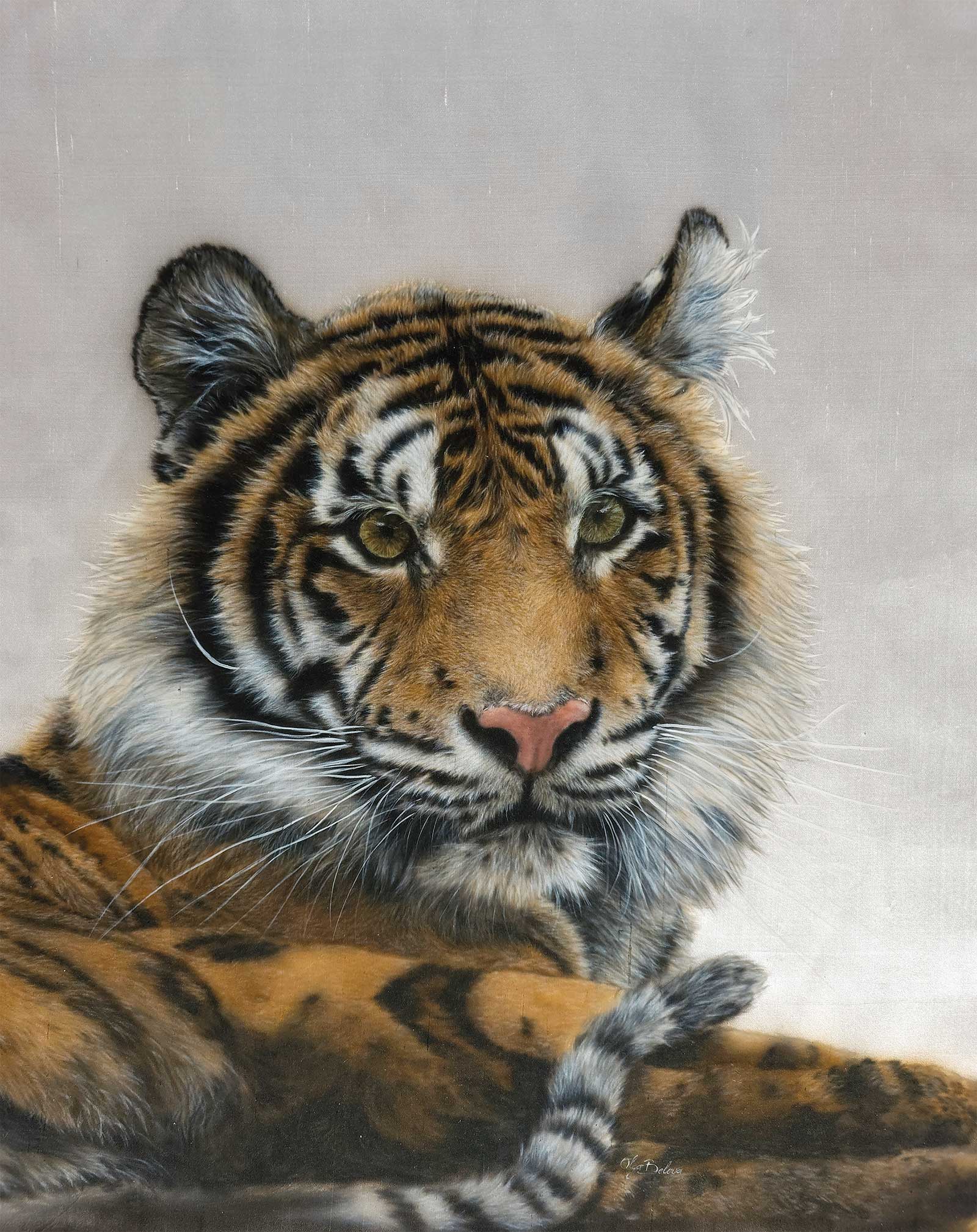 Guard, silk painting, 261/3 x 20½" (67 x 52 cm)
 Olga Belova
Sheikh Zayed City, Egypt
My Inspiration
The most beautiful part of my work is giving people joy and eliciting emotion—to see how people change, how their eyes glow when they see the artwork. The beauty of wildlife is what inspires me the most. Since I can’t be close to them, I get inspiration in photos my fans and followers send to me. Their favorite photos of nature become my subject matter. My painting then brings the photo to life on silk.
My Design Strategy
My silk art has an environmental message. It’s one that inspires the heart to change, rather than add guilt. I want people to see the beauty worth protecting in this world and genuinely feel the need to preserve it. My work celebrates the animals that exist now, as they are part of our present and hopefully part of our future. Through my art, I want people to be surrounded by realistic beautiful wildlife in everyday life.
My Working Process
Even though silk painting is an art form hundreds of years old, very few people know about it. Maybe this is because it is one of the most difficult mediums to work with, as the artist cannot erase or undo the drawing lines at all. Despite its very time-consuming process, the silk on finished artwork doesn’t lose its elasticity and remains very pleasant to the touch. I can surely say that all of my paintings are “touching.”
Contact Details
Email: olgabelova@live.com
Website: sonoseta.com