



Artistic inspiration can be triggered by the most unexpected of circumstances. Those of us living in New York remember vividly the spring of 2020, when the pandemic shuttered the entire city. That spring, ironically, was one of the most beautiful in terms of the weather, with long stretches of clear sunshine all of May and June.
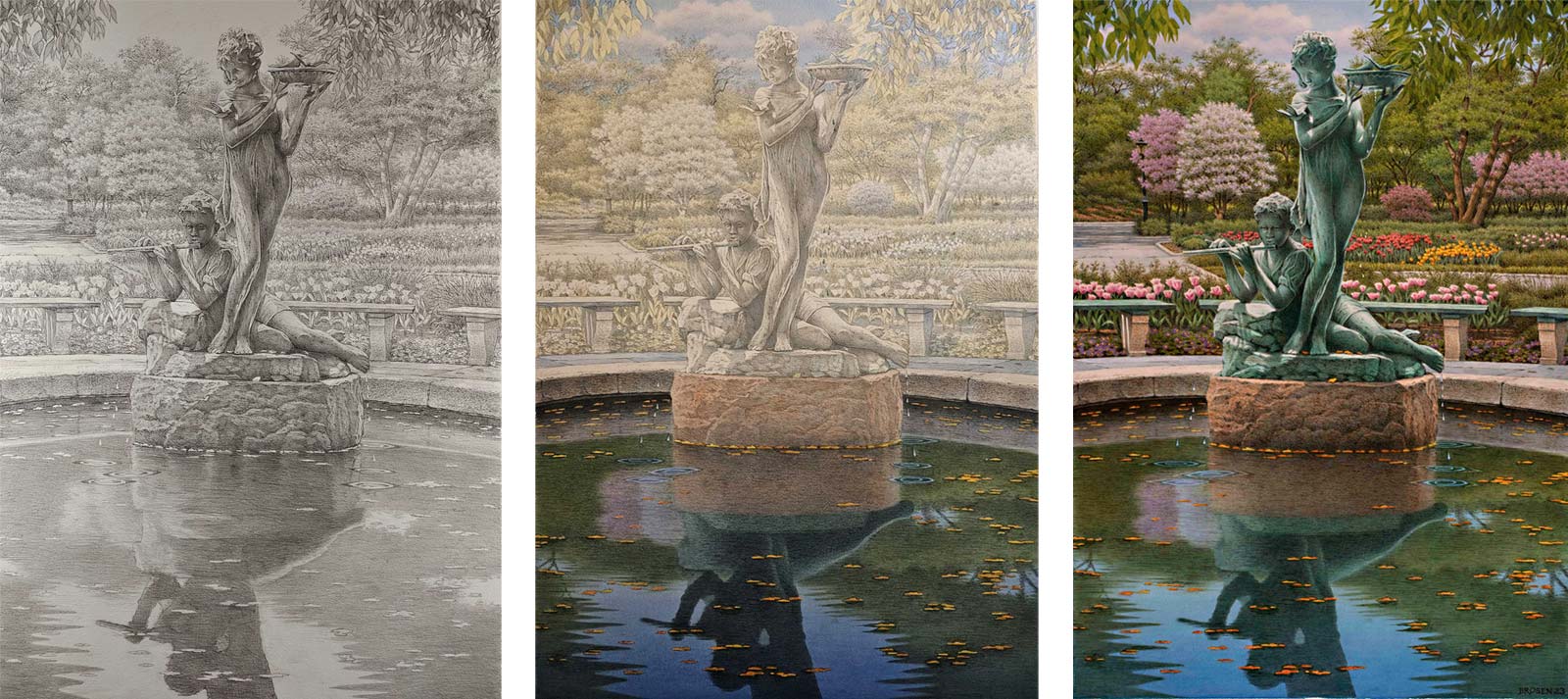
Detail of The Burnett Fountain in the Conservatory Garden in process.
It was then that I rediscovered my deep love of Central Park, that 843-acre oasis that Frederick Law Olmsted and Calvert Vaux created for all New Yorkers to share and enjoy. Drained of tourists, school and camp groups, cyclists, runners and motorized traffic, the greatness of the design was allowed to shine. My love affair with the park goes back to my childhood, to my teenage years playing frisbee by Bethesda Fountain, later taking my young children to various playgrounds, playing basketball in my 20s, 30s and 40s, and now doing the loop on my bicycle.
Over the years I have painted many watercolors of the park, from large views to intimate studies. But with this renewed awareness and appreciation I endeavored to do four major pieces of the seasons, each depicting a favorite place in the park. Unintentionally, all four contain a central architectural or sculptural element and a body of water, which reflects the nature of Olmsted’s original design—every tree, bridge, lake, stream and fountain was designed. When finished, Central Park was the largest landscaping project ever undertaken, an incredibly ambitious forever gift to the people of the city.
Olmsted did not start as a landscape designer; in fact, Central Park was his first design! He was an eastern journalist who wrote on the Antebellum South, a committed abolitionist. The concept of Central Park was an egalitarian escape from the congestion of the city, a place where everyone, high and low, rich and poor, black and white, could peacefully enjoy a respite from the crowded streets. As it was then, so it is today. A continuing heritage for all those generations, then and now, a thread that unites all New Yorkers.
Happily, the four recent large watercolors are on view together at the Museum of the City of New York, installed until late June of this year. They are hung left to right starting with spring.
Spring
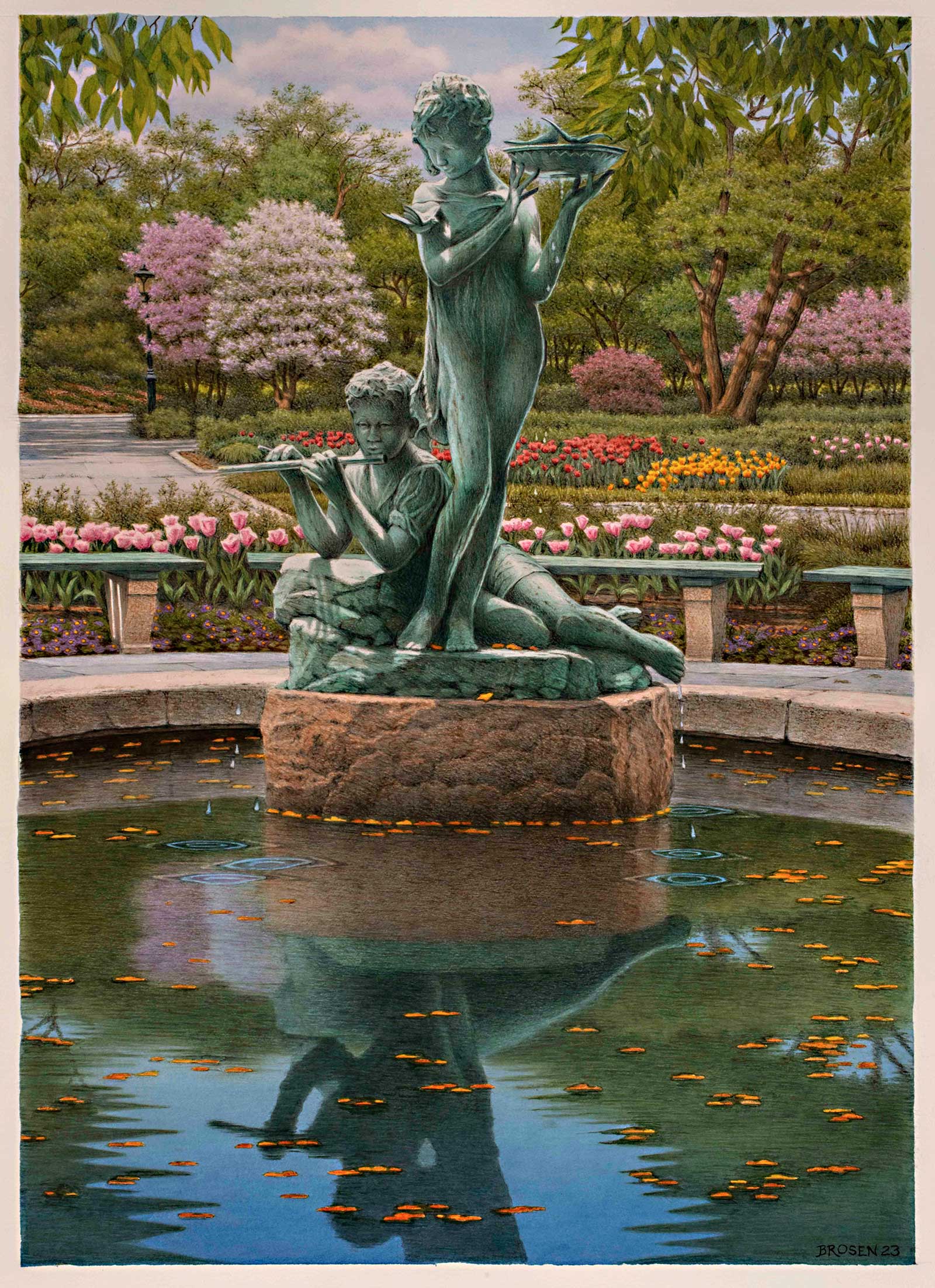 The Burnett Fountain in the Conservatory Garden
A beautiful sanctuary in the park, the Conservatory Garden is the only formal garden in Central Park. The garden comprises three distinct garden styles: the North French Garden, the central Italianate Garden and the South English Garden. Nestled into the South Garden is the Secret Garden statue based on the famous children’s book by author Frances Hodgson Burnett. The cherry blossoms, tulips and seasonal plantings make this an intimate and bountiful springtime escape. A perfect choice for depicting nature’s springtime celebration!
Summer
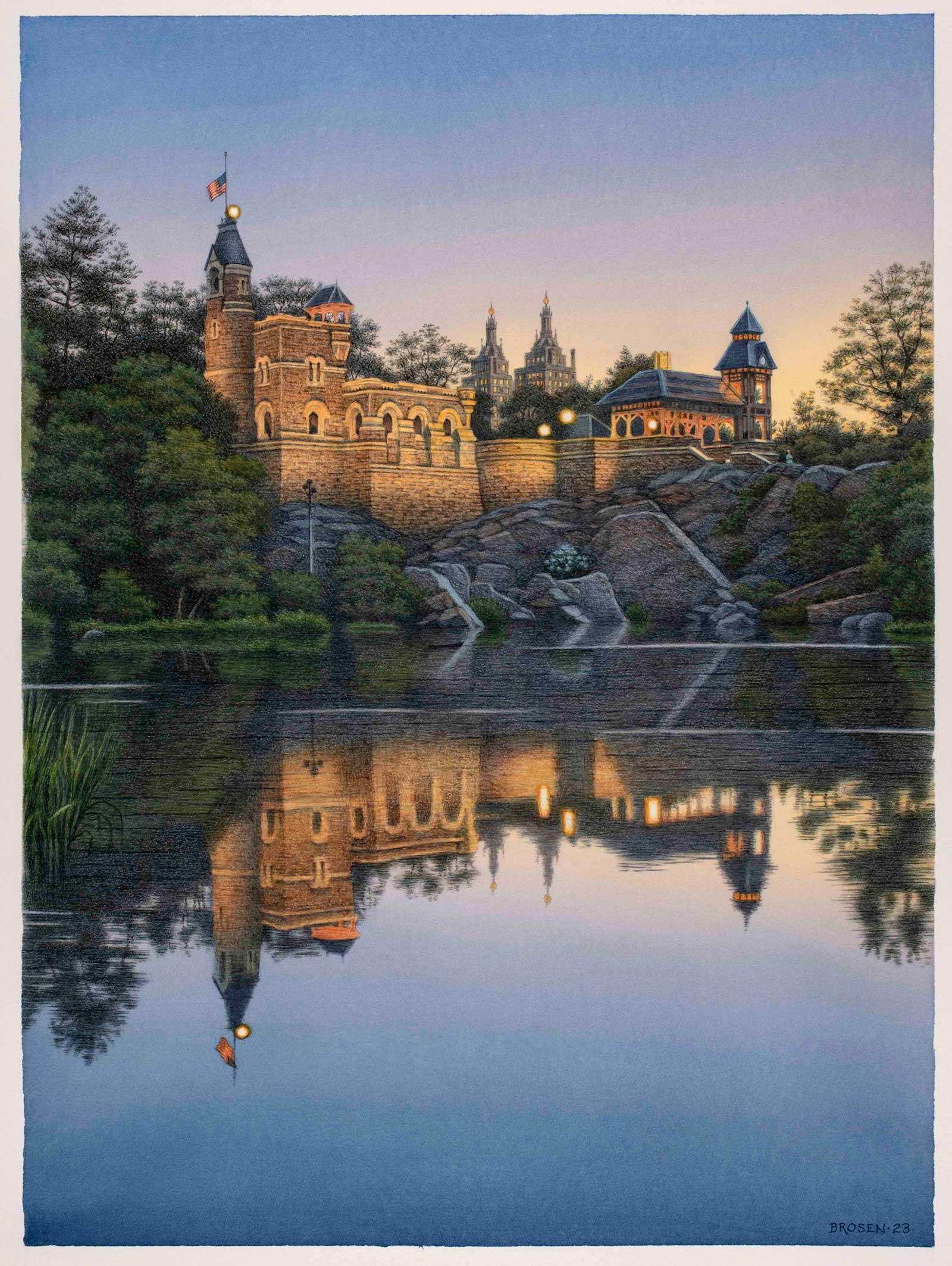 Belvedere Castle
Built into this high outcropping of Manhattan schist, Belvedere Castle offers what its name implies, a beautiful high viewpoint looking north over the Great Lawn in the park. Built as a meteorological station, even today computerized equipment measures the weather in Central Park from this location. Sitting across Turtle Pond, the castle retains a fairytale-like quality, much the same as when it was constructed in the 1860s. I thought the tranquil light and stillness of a summer twilight, with the castle illuminated, would capture a sense of the childlike beauty of the place.
Fall
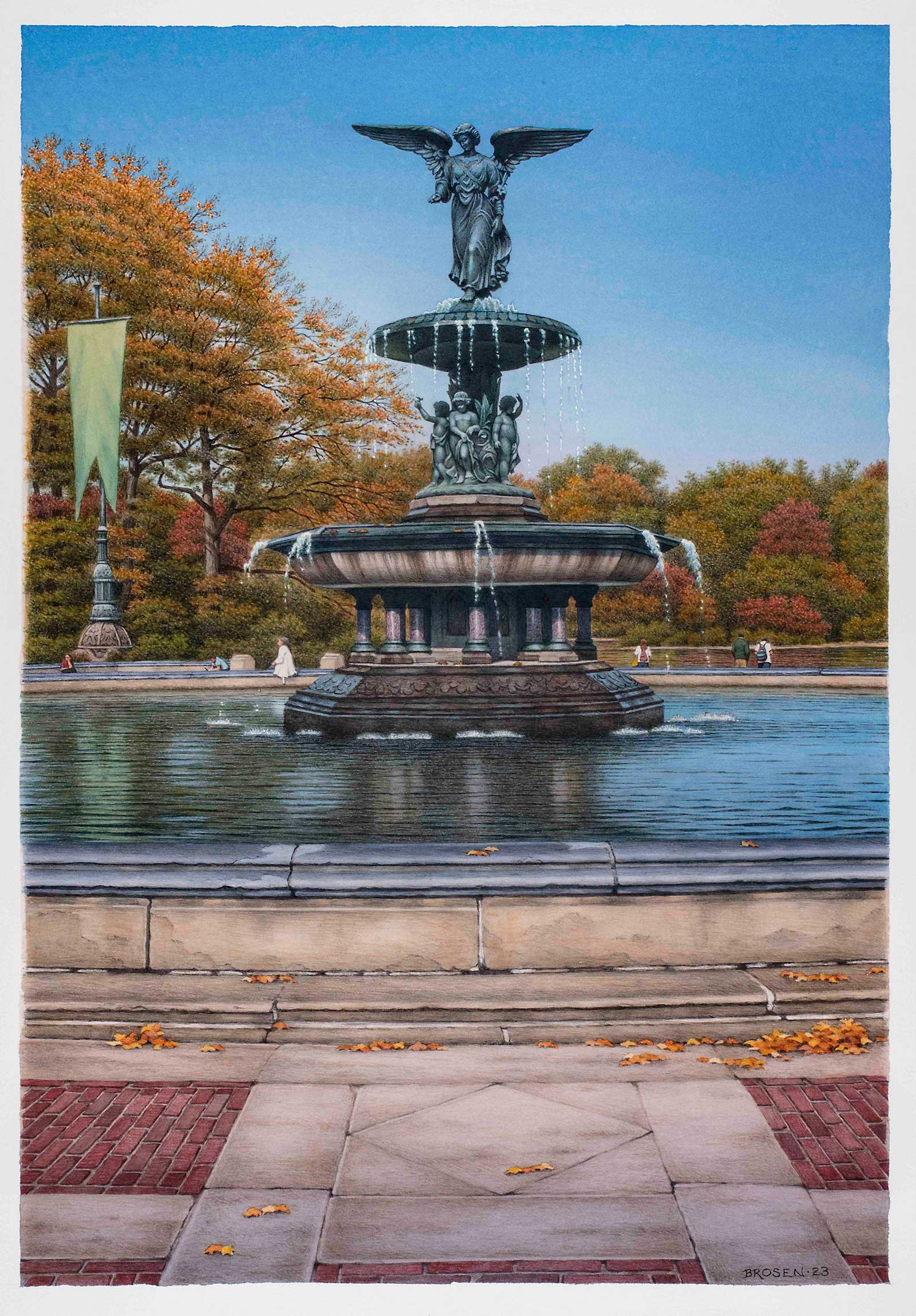 Bethesda Fountain
The beautiful Bethesda Fountain esplanade is a subject I have painted many times over the last several decades. Sandwiched between the Poets Walk and the lake, the fountain was designed to be the heart of the park. As majestic and grand as any European estate, crowned by the figure of the Angel of the Waters, the fountain is intended as a celebration of the opening of the Croton Aqueduct bringing fresh water to the growing city. The figure and four attendant cherubs are the first major public sculpture commission given to a woman, Emma Stebbins, a fascinating person in her own right. I have been a regular visitor to this site for well over half a century and have spent countless summer afternoons under her gentle gaze. I chose a close-up view of the fountain itself, with the backdrop of fall foliage providing a colorful garland.
Winter
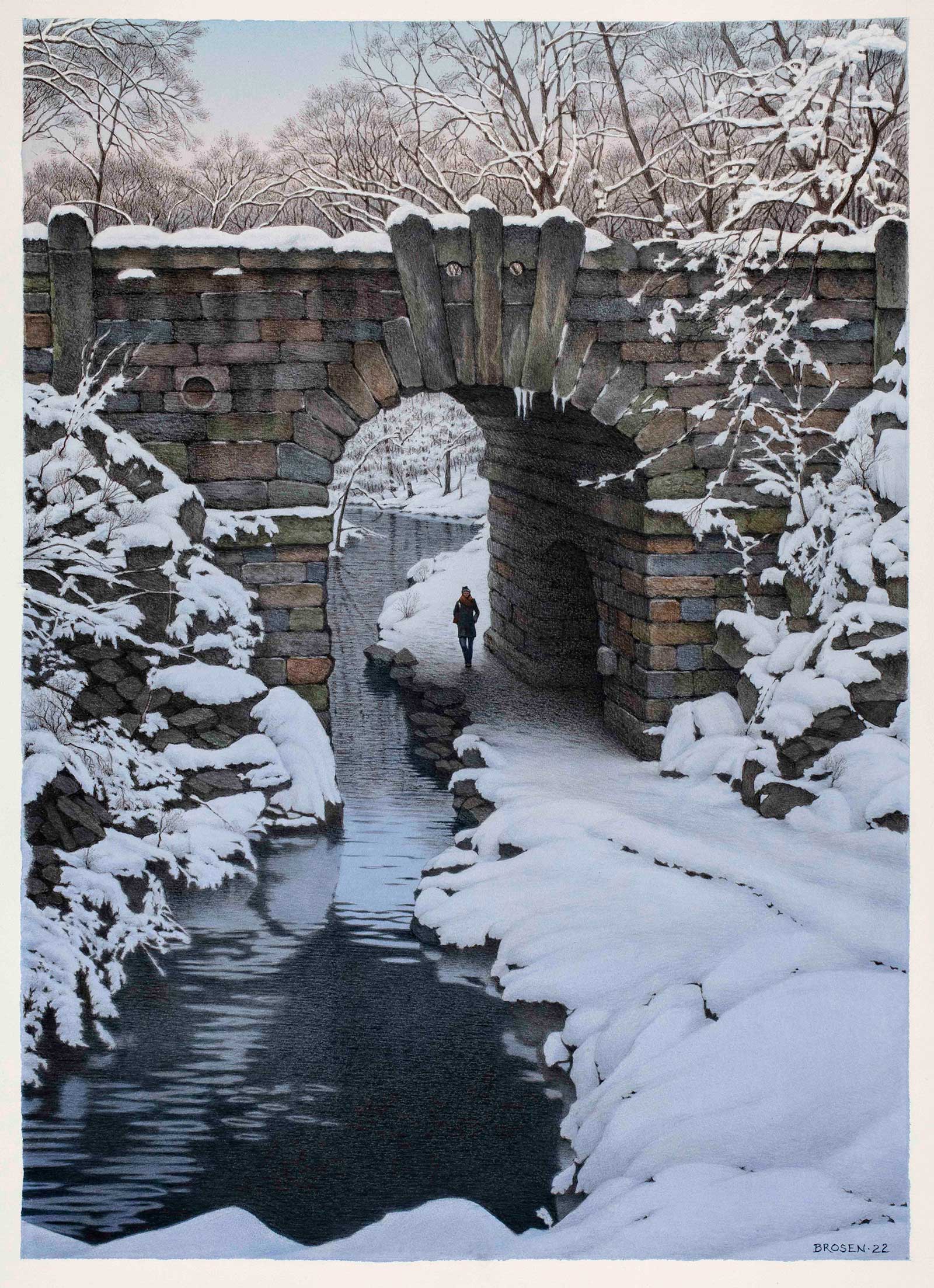 The Glenspan Arch
This original massive stone archway, designed by Calvert Vaux and one of the 36 original bridges and spans, serves as the entryway into the North Woods from the pool. Located at the northern end of the park, a continuous circular water system runs east to the Harlem Meer and back around to the pool. Another of Olmsted’s brilliant engineering designs. The moist blackened rocks serve as a foil to the marshmallow softness of a recent snowstorm. Often a thing of hushed beauty for the first 48 hours in NYC.
The Four Seasons of Central Park: Watercolors by Frederick Brosen runs through June 16 at the Museum of the City of New York. Additional exhibitions for the artist include Recent Watercolors by Frederick Brosen running through April 13 at Hirschl & Adler Modern in New York City.—
About the Artist
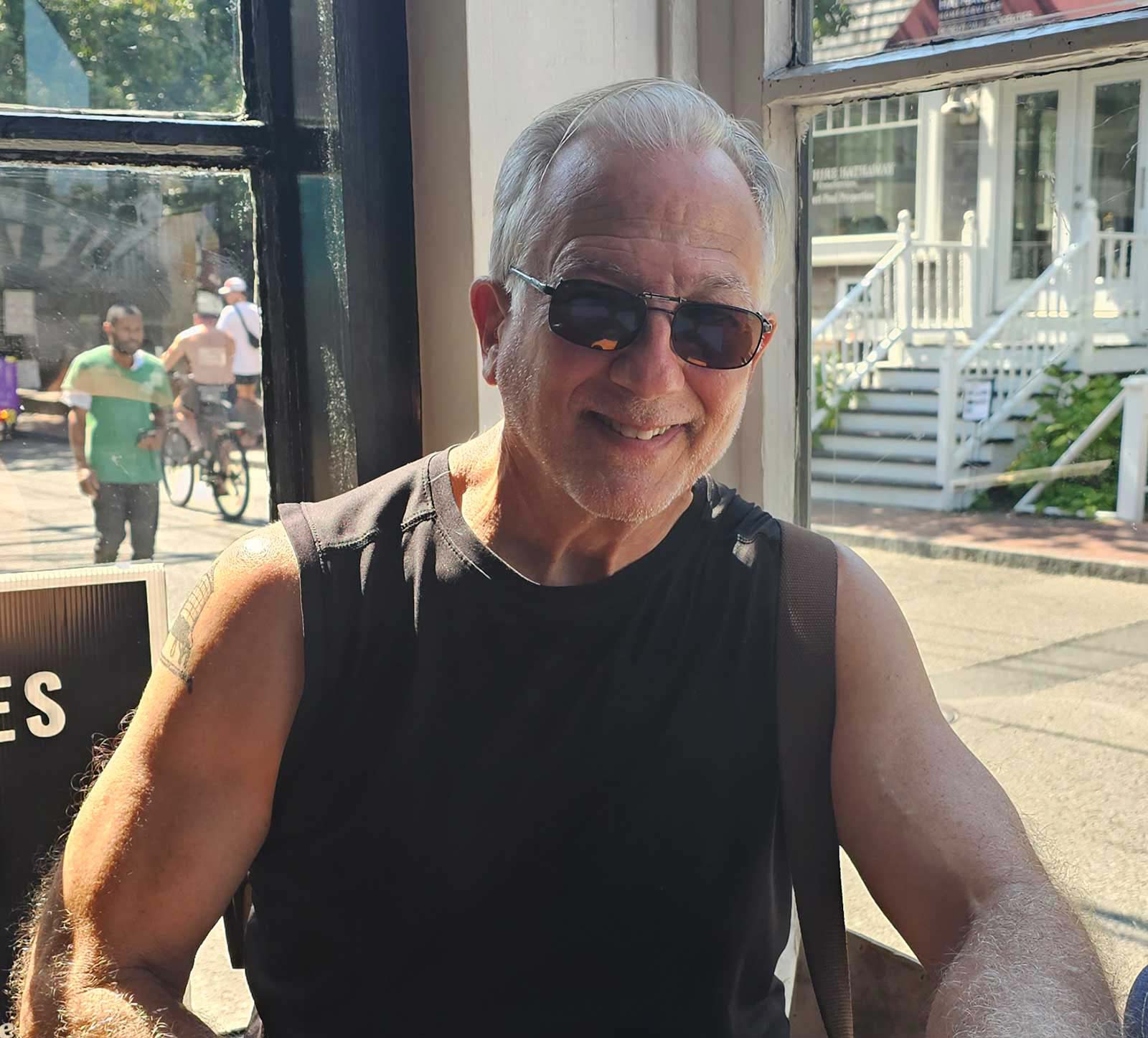 Frederick Brosen
Frederick Brosen’s watercolors have been featured in over 30 solo museum and gallery exhibitions across the country. Notably, the exhibition American Dreamland: Coney Island featured two of his large works and traveled to museums across the country, ending in 2016 at the Brooklyn Museum.
In 2006 a monograph on his NYC watercolors, Still New York was published by Vendome Press, and in 2012 he was awarded the Lifetime Achievement Award by his alma mater, the City College of New York. He is the recipient of numerous grants and awards, including two Pollock-Krasner Grants. His work is in the permanent collection of more than 20 museums, including the Metropolitan Museum of Art, the New York Historical Society and the Museum of the City of New York.
His teaching credits include the National Academy of Design, Pratt Institute, Lehman College and the Art Students League of New York, where he conducts workshops throughout the year. He also conducts yearly travel workshops in Europe, with Amsterdam slated for September 2024. Brosen is proud to have been designated an ARC Associate Living Master last year. He is also a Signature Member of the American Watercolor Society.
Represented by
Hirschl & Adler Modern, New York, USA, hirschlandadler.com
Contact at
rickbrosen@gmail.com
frederickbrosen.com