



Earlier last year I approached John Symond AM, a giant in the Australian finance industry, to ask if he would sit for a portrait for the 2023 Archibald Prize.
Like most Australians, I was aware of his public persona, Aussie John, who famously shook up the Australian home loan market in the 1990s by bringing competition to the industry. Now also known for his philanthropy and his passion for collecting art, I thought he would make a great Archibald subject. I found John to be a very private man who, though initially reluctant to be the subject of a portrait, slowly warmed to the idea and, towards the end, really embraced the experience.
Keen to convey his passion for art, I included one of John’s favorite works in the background, Fred Williams’ Upwey (1967), along with Art Deco furniture and objet d’art from his home. These elements set the color theme for my painting: cool blues, mauve and turquoise that would complement the warm flesh tones and allow them to pop.
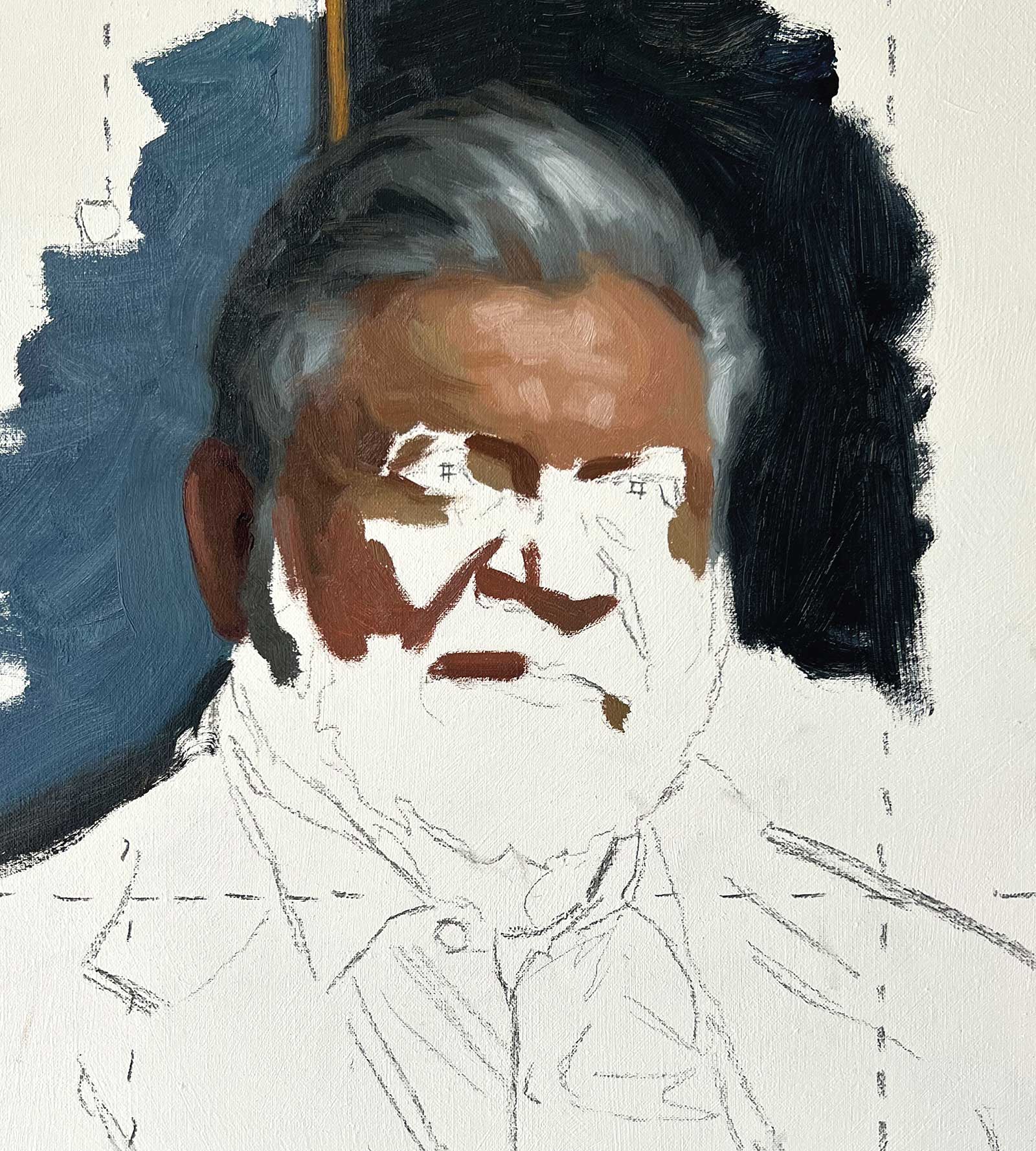 Stage 1
Stage 1: After loosely drawing in the figure with charcoal onto primed linen canvas, I marked out the position of the golden ratio (the dotted charcoal lines), which I used to optimally place elements within the composition. I then began to paint John’s head. I’m always conscious of edges, and so I painted a little of the background next to the head so I could blend the forms, one into the other, to get the right level of softness or hardness along the edge.
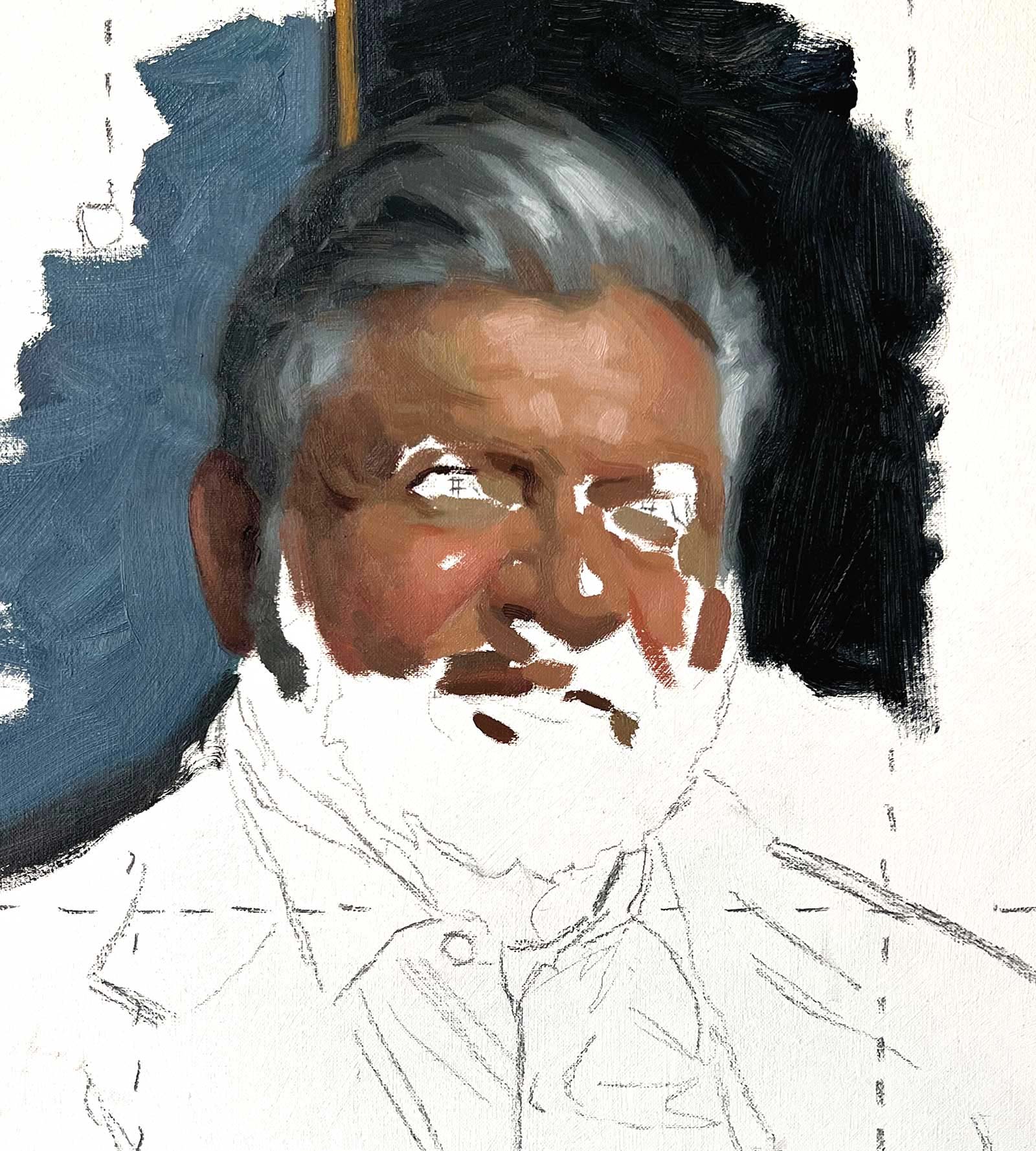 Stage 2
Stage 2: Working from dark to light, I started with John’s hair and then progressed to his face, trying, as far as possible, to complete each area as I painted it. I used a warm dark color in the shadowy recesses of the face rather than a cool color. Conversely, I cooled the temperature of my flesh tone color as I transitioned from the shadows into the lit areas of the head.
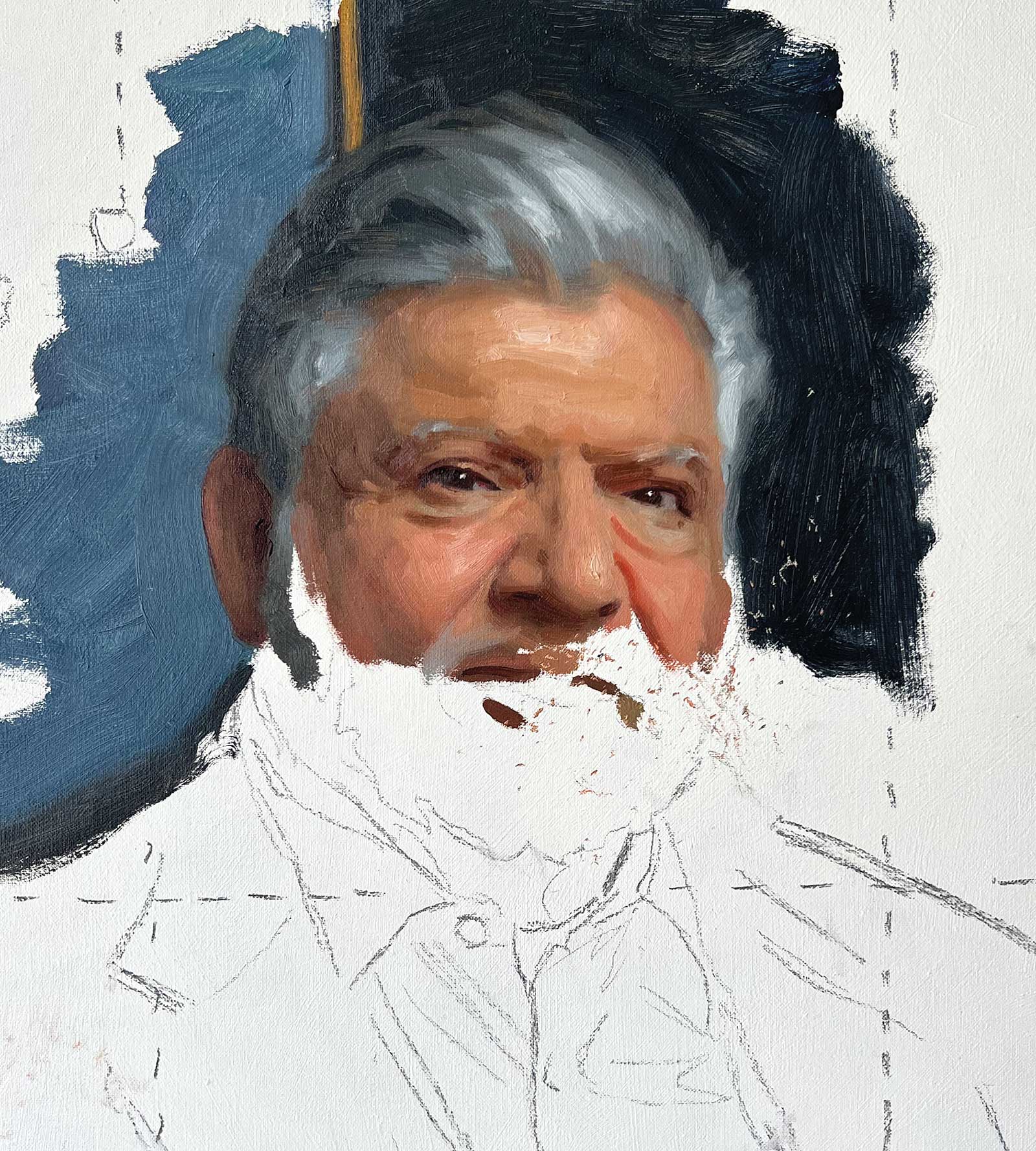 Stage 3
Stage 3: I like to vary the local skin color as much as I can. The forehead is a little more yellow, the cheeks and nose warmer or pinker, and the area under the chin is quite cool. My palette for these flesh tones is made up of viridian, yellow ochre, cadmium yellow, titanium white, cadmium red light, burnt sienna, alizarin crimson and ivory black. In simple terms, skin tones like John’s are a mix of red, yellow and white, which makes a milky orange color. I add a little black to neutralize that color mix and thus gray that milky orange to something resembling human skin. From there I can cool the color by adding viridian or black, or warm it by adding more alizarin or cadmium red.
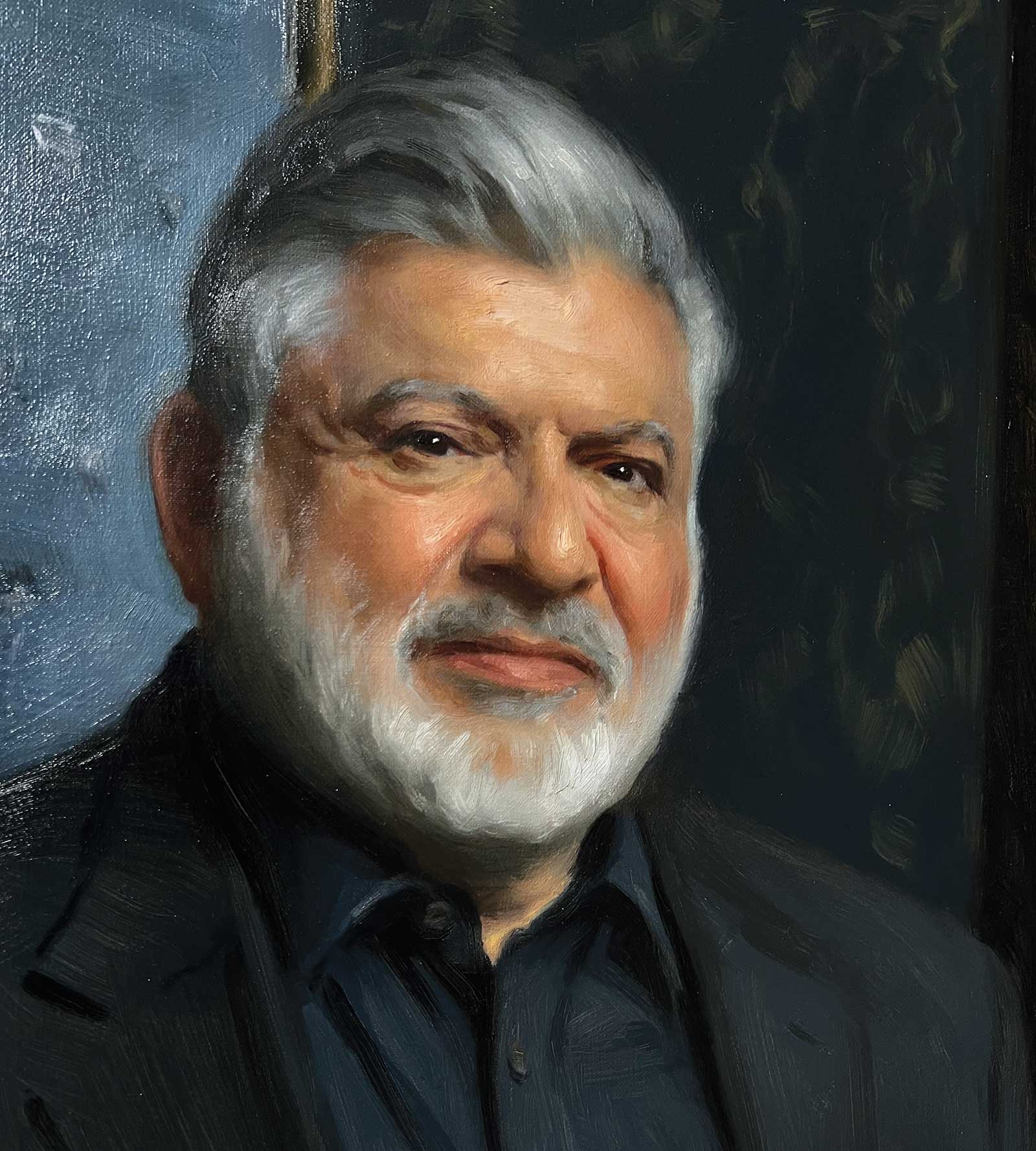 Stage 4
Stage 4: These next few photos are taken at an angle to reduce the light glaring off the wet paint surface. When painting the jacket, I used a mixture of ultramarine blue and burnt sienna, with white added where needed. This is my standard color mixture when I’m painting something black. (I don’t actually use black paint when painting something that’s black!).
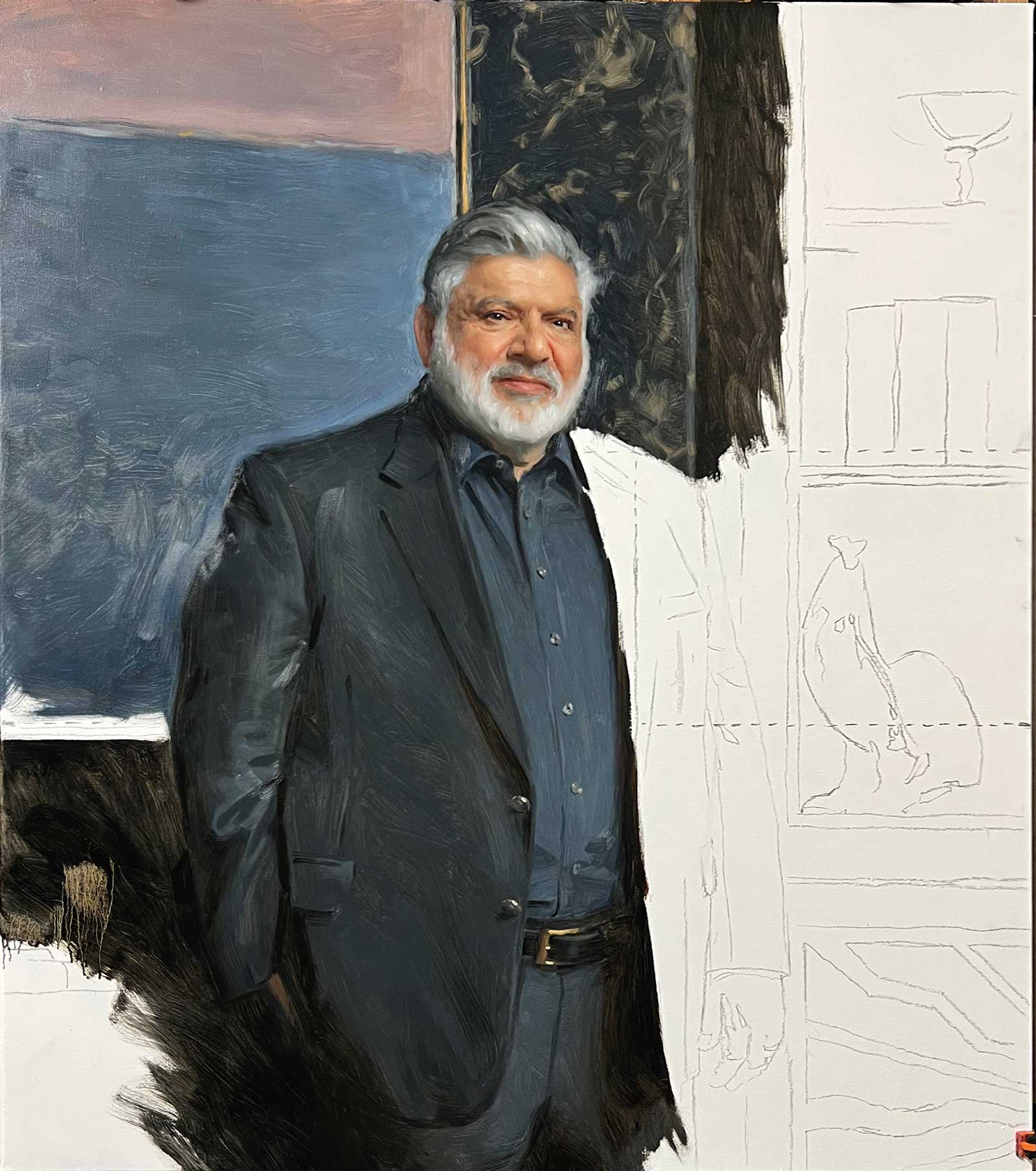 Stage 5
Stage 5: At this stage I’m mapping out large areas in as simple a fashion as possible, attempting to get the tonal values and overall color correct.
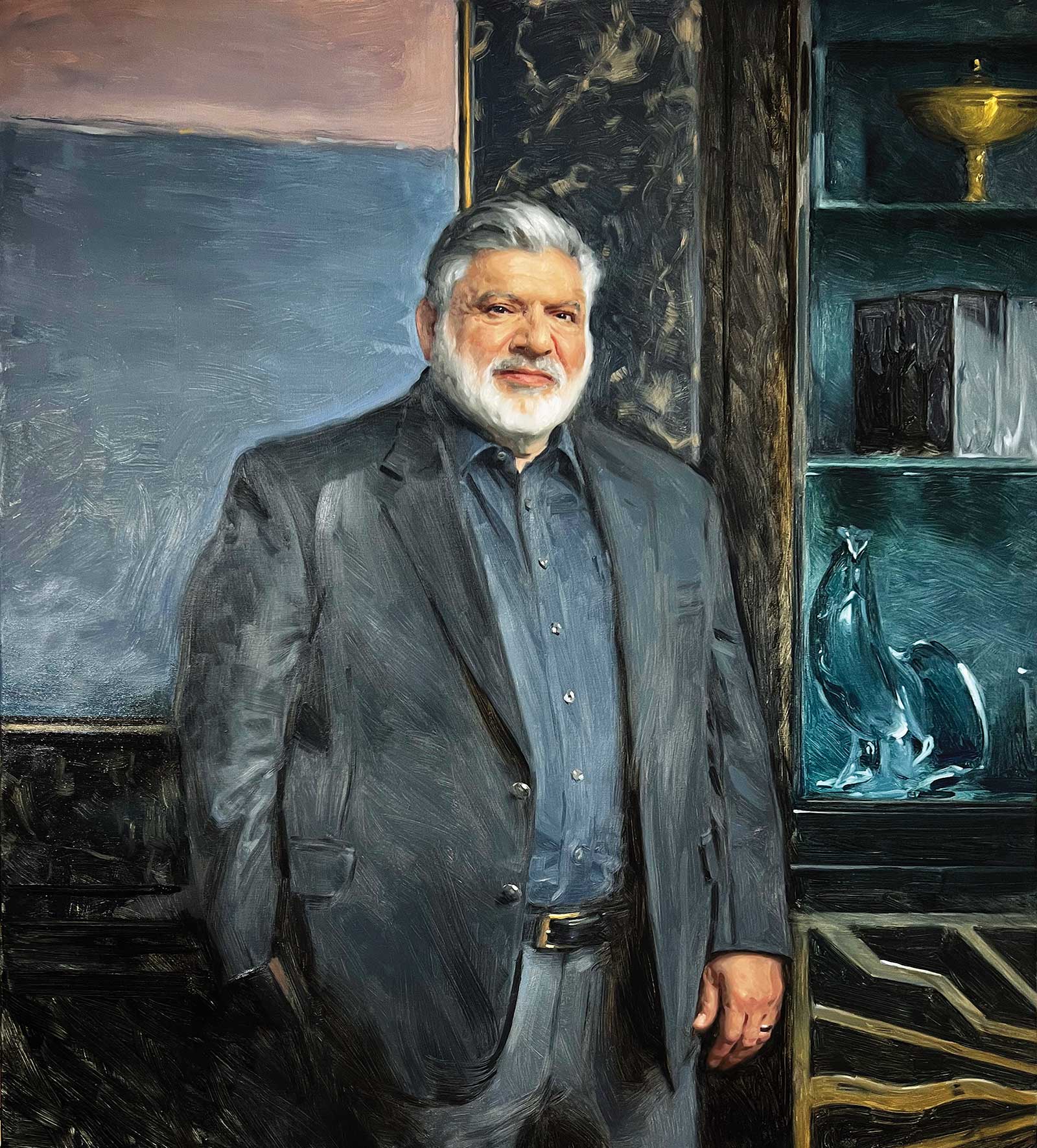 Stage 6
Stage 6: I’ve now covered the canvas—there is no more white gesso showing. I can now look at balancing and fine tuning the tonal value and color relationships.
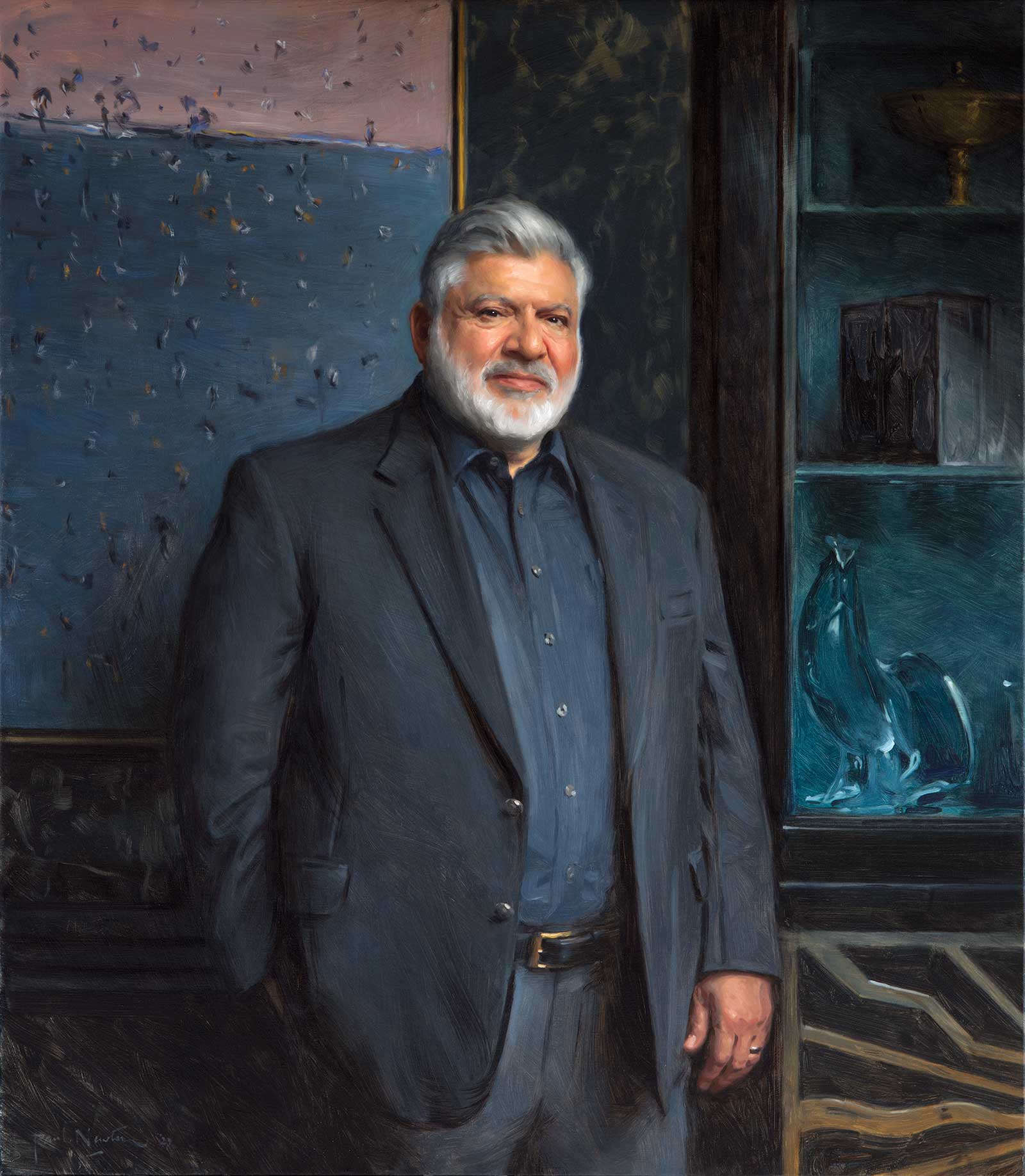 Stage 7
Stage 7: In this final stage, I have painted all the details into the background that were necessary. Less is always more in these situations. I wanted the background to sit back and not compete with John’s figure. You might notice that, in the composition, there is a diagonal emphasis leading from the top left-hand side to the bottom right-hand side and includes John’s hand, whereas the other two opposing corners are both quite dark by contrast.
I’m happy to report that the portrait was selected to be a finalist in this year’s Archibald Prize and is currently on a gallery tour around regional parts of Australia.
Paul Newton is an Australian-based artist who completed a science degree at the University of Sydney before pursuing his interest in painting at the Julian Ashton Art School. Newton has been a finalist in the Archibald Prize on 16 occasions and has been awarded several placements in the Portrait Society of America’s International Portrait competition, including most recently, the Grand Prize in 2023. His works are in permanent collections across the globe including 32 commissioned works concerning the history of Catholicism in Australia for the Domus Australia chapel in Rome.