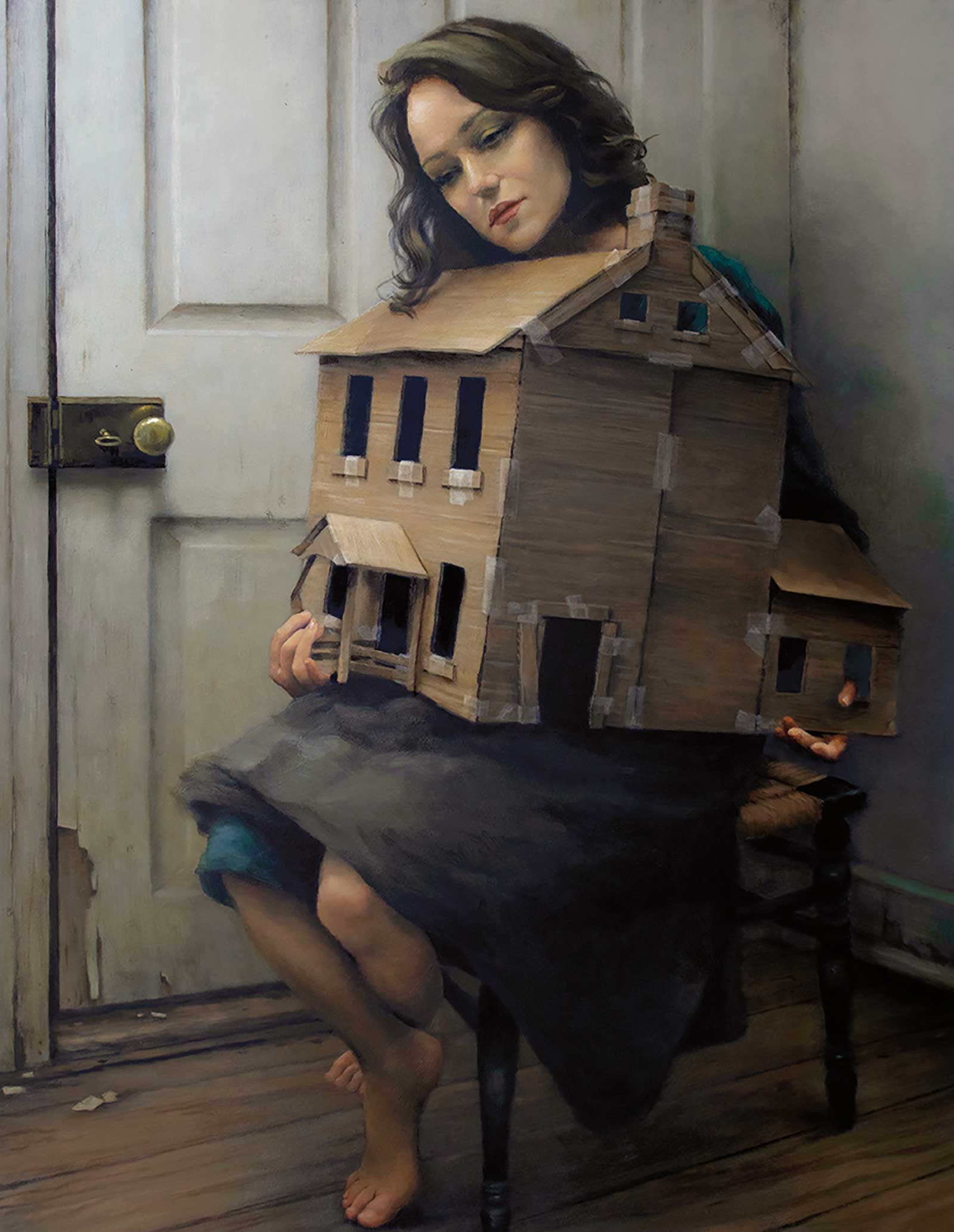
 Housebound, acrylic, 30 x 24" (76 x 60 cm)
Mary Chiaramonte Carroll
Inspiration
I live in a haunted house. If you aren’t already a believer, our home may make you one. When we started renovating in 2019, it had been abandoned for ten years. Countless unexplained events occurred over the many months that we worked. I began researching our home’s past occupants and found Mary. She had died mysteriously in the house in 1946 on her husband’s 50th birthday. I wanted to commemorate her within a series of paintings that considered her life in rural Virginia in the 1940s, as well as the many decades she has spent here as an earthbound spirit.
Process
I put together a crude cardboard model of our house for use in the composition as a symbol for the idea of endlessly inhabiting this space. After shooting many photos with the model, I started the painting from those references. I used acrylic, building up many layers of transparent paint, while other areas were more thickly applied and needed only a couple of layers.
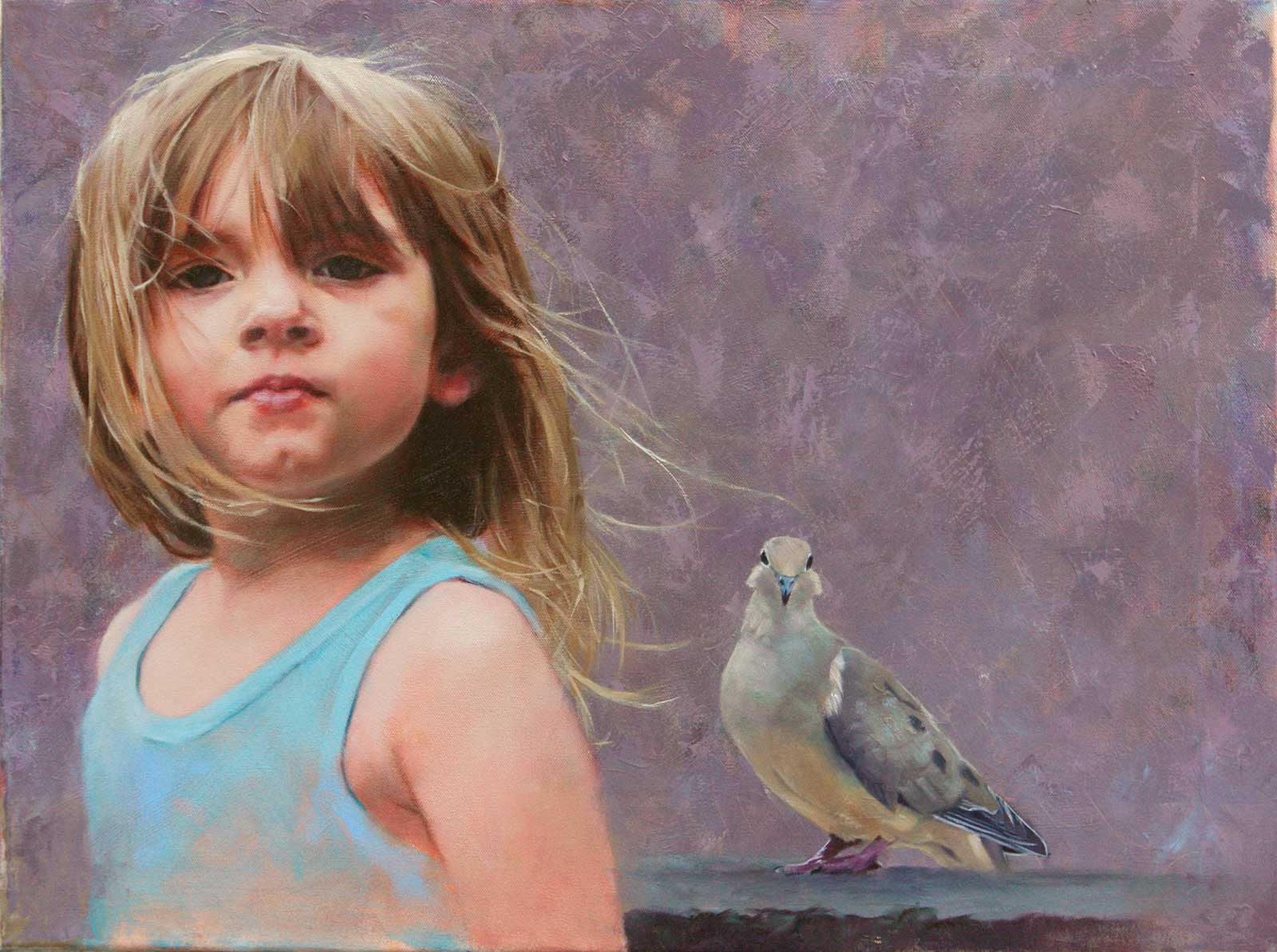 She’s All She Needs, oil, 18 x 24" (45 x 60 cm)
Catherine Hafer
Inspiration
Inspiration, for me, always begins with a feeling. I see something, feel something and everything within me says, “I need to capture that; bring it to life on paper/canvas.” I want people to feel, whatever it is they feel when they view my work. It may resonate differently for every individual. All feelings are truths, and to allow oneself to feel every single one of them is to fully experience life. In this particular piece, I was struck by the feeling of strength and confidence that resonated from within this girl, a sense of valor that gets extinguished in so many of us, especially women. I wanted to capture that feeling of sustenance from within. The mourning dove was added to reinforce this feeling. Always found in pairs, here we have just one, and yet, it’s not alone. No one is alone inside. We all have what we need, a voice of conscience to strengthen and guide us. She’s All She Needs.
Process
Capturing personality and bringing feeling to life requires being able to access a way of seeing, or insights into truths, identifying the main attitude and feeling of the subject. I connect with that voice (wisdom, soul, God) inside. We are not alone when we create. One needs to sense—to listen, hear, see and feel what to do. I let “sixth sensing” tell me what the painting needs, what pose, what colors, what technique.
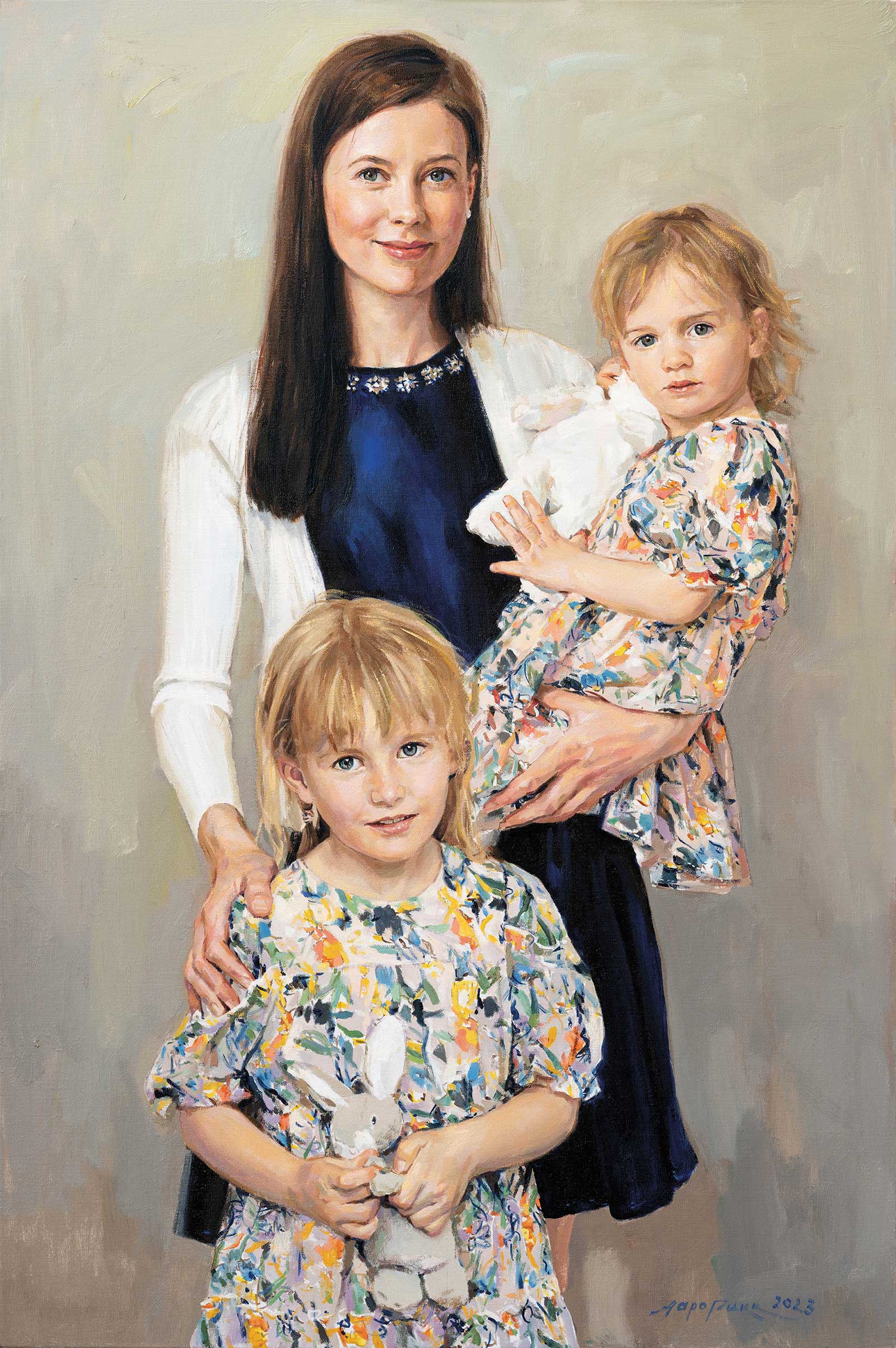 Mirjam, Elli and Emma, oil, 35½ x 24" (90 x 60 cm)
Aapo Pukk
Inspiration
One day, I received a call from Karl-Erich Trisberg who wanted to give a present to his wife, Mirjam, in the form of a portrait. He wanted to thank her for their happy marriage and two lovely daughters, Emma and Elli. We took photographs at multiple times in various poses and different outfits, both in their home and at my studio. Finally, we chose a pose. I had begun making plans when it turned out that they were expecting another child. Karl asked if we could wait so all the children could be in the picture. I considered it and said there should be a painting for each stage of life. I completed the painting with the third child on the way, but invisible to those who do not know.
Process
My task was to express the love I could see in Karl’s eyes when he looked at his wife and children. What are the relations between the mother and her children? What are their individual personalities? How can I make sure nothing is lost and nothing is needlessly amplified? Most of the painting was done based on photographs, although we found time for several live sittings. I try to avoid painting from photos taken by someone else so that I have the closest possible contact with my subjects. My work is often informed by different photos. There was no escaping contemporary times and also Renaissance role models. There were no deliberate guidelines but positions that had taken shape in me and guided my hand as I was painting. When I told Karl about the recognition the painting had received, he said, “This is a recognition of your excellent skills!” And I thought, “Karl, you have the best family in the world.”
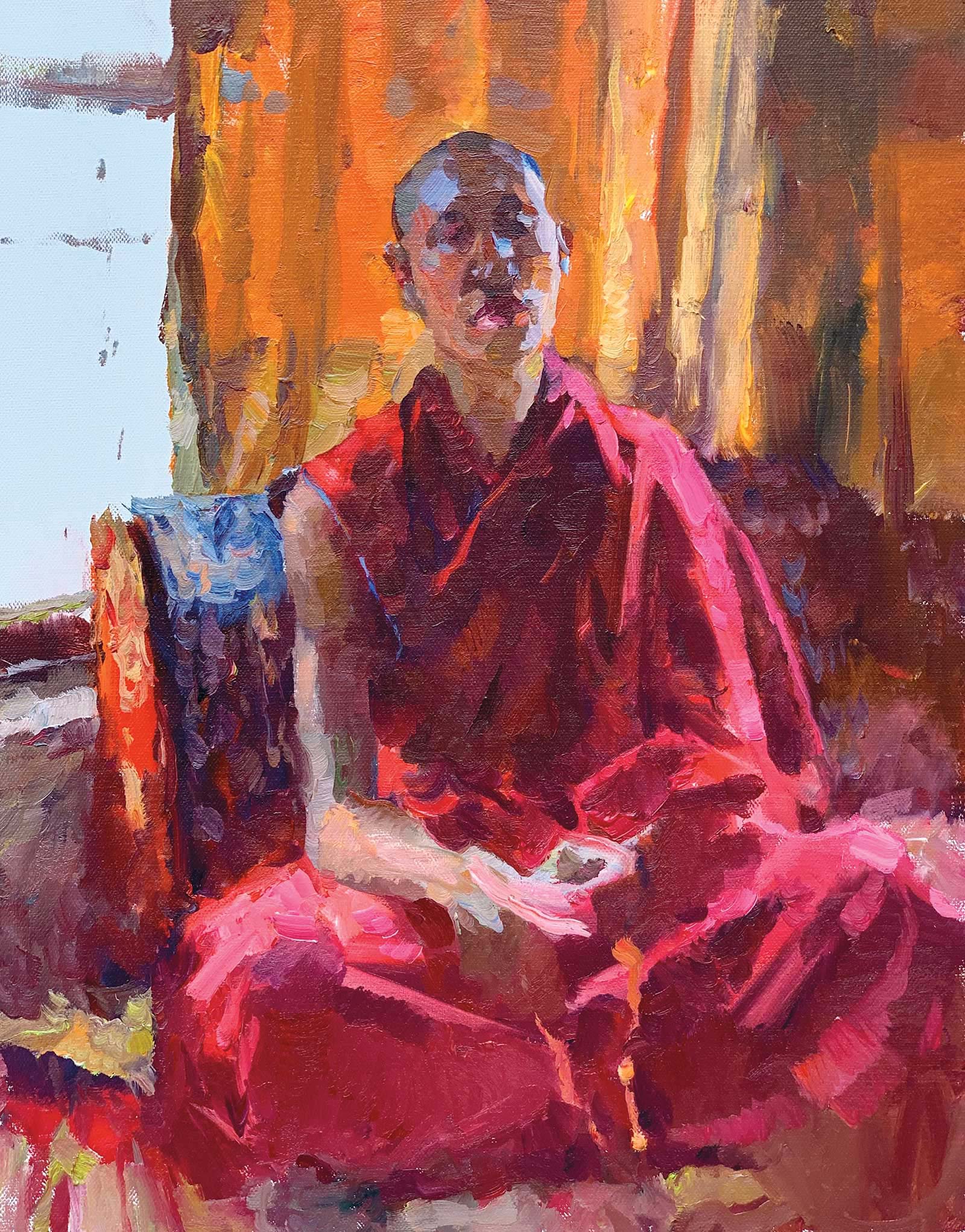 Tibetan Monk, oil, 20 x 16" (50 x 40 cm)
Kevin Macpherson
Inspiration
Portrait painting is the perfect companion to truly engage one’s artistic self. In the high country of Sichuan, I met this kind young man at a primitive, small temple village. He invited me into his house, a 10 by 10 square-foot room with a wood burning stove and a bed that acts as a table and a couch. I painted as he read and played with his two cats. He is a gentle soul. Many boys are sent to the monastery because their families cannot afford to raise them. However, this young man, despite his parents not wanting him to become a monk, went off at 9 years old to live the life.
Process
My process is alla prima, and my goal is to capture the moment and unity of the subject. I usually approach my subjects in one session as the light, atmosphere and my mood during each session are all unique. I try to be intuitive and as reactive as possible. Often the size of my canvas is dictated by the time allowed. This was about a two-hour session. I was in the corner of his small room, the window light overcast, and skylight entered from two sides revealing beautiful forms and colors on his flesh. I paint as fast as I can be accurate. I search for spots of color. Every plane change has a color change. The color notes sculpt the form. Each brush mark carves adjacent shapes, negatively refining the silhouettes. I apply the paint much like sculpting clay. I love to talk to my models and learn about their lives, and in this case, I practiced my Chinese. It’s not easy for a model to keep still, and that’s okay. The conversation exposes character traits. My canvas was oil-primed linen. The final painting is a byproduct of my experience. Art is a journey.—