My greatest desire when I paint is to create landscape stories that evoke wonder and emotion—that connect the viewer to our natural world and unlock cherished memories. Often the paintings where I find the most success in reaching this intention are those in which “story” is created by building energy and depth through many layers.
My painting journey began with acrylics, but I struggled to mix colors that pleased my eye and I was frustrated that the values darkened when the paint was no longer wet. The fast drying time was also a challenge. Once I discovered transparent pigments, I developed a new understanding of how paint could be used. Ultimately oil paint became my preferred medium, but I still incorporate acrylics and these lessons in my early stages of each new work.
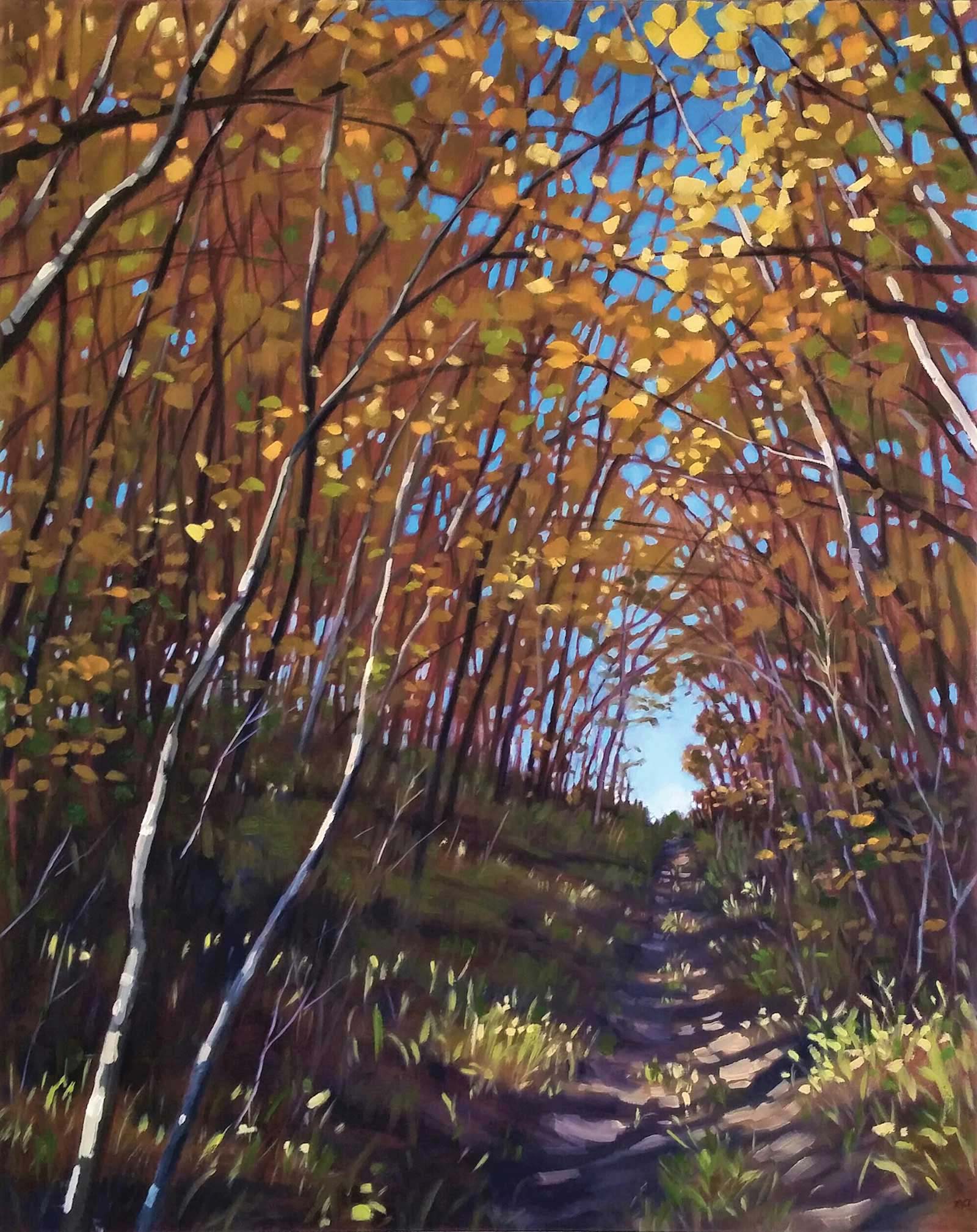
Secret Path, acrylic and oil on canvas, 30 x 24" (76 x 60 cm) The tone was set with an underpainting of transparent acrylic layers in magenta and gold, which built a base for the grasses and foliage. These notes glow through the upper, opaque layers of oil paint. Mystery is created by the density of the forest canopy. The dappled path leads you to the cool blue sky symbolizing hope and enlightenment.
I use a layer of acrylic color to tone my supports because I find it helpful to cover the stark, intimidating white space as soon as possible. The color chosen for this first layer has everything to do with what will eventually be on top. Usually, it’s complementary to the predominant color of the final painting, but other times it’s chosen to help establish a mood. For example, in my demonstration I use magenta as a close complement to the many hues of green that follow.
Through studio playtime and experimentation, a process has emerged in which I not only tone the canvas with acrylics but also establish the initial marks of a composition. This has been furthered by using acrylics to develop a more realized sketch and adding areas of color besides the tonal hue.
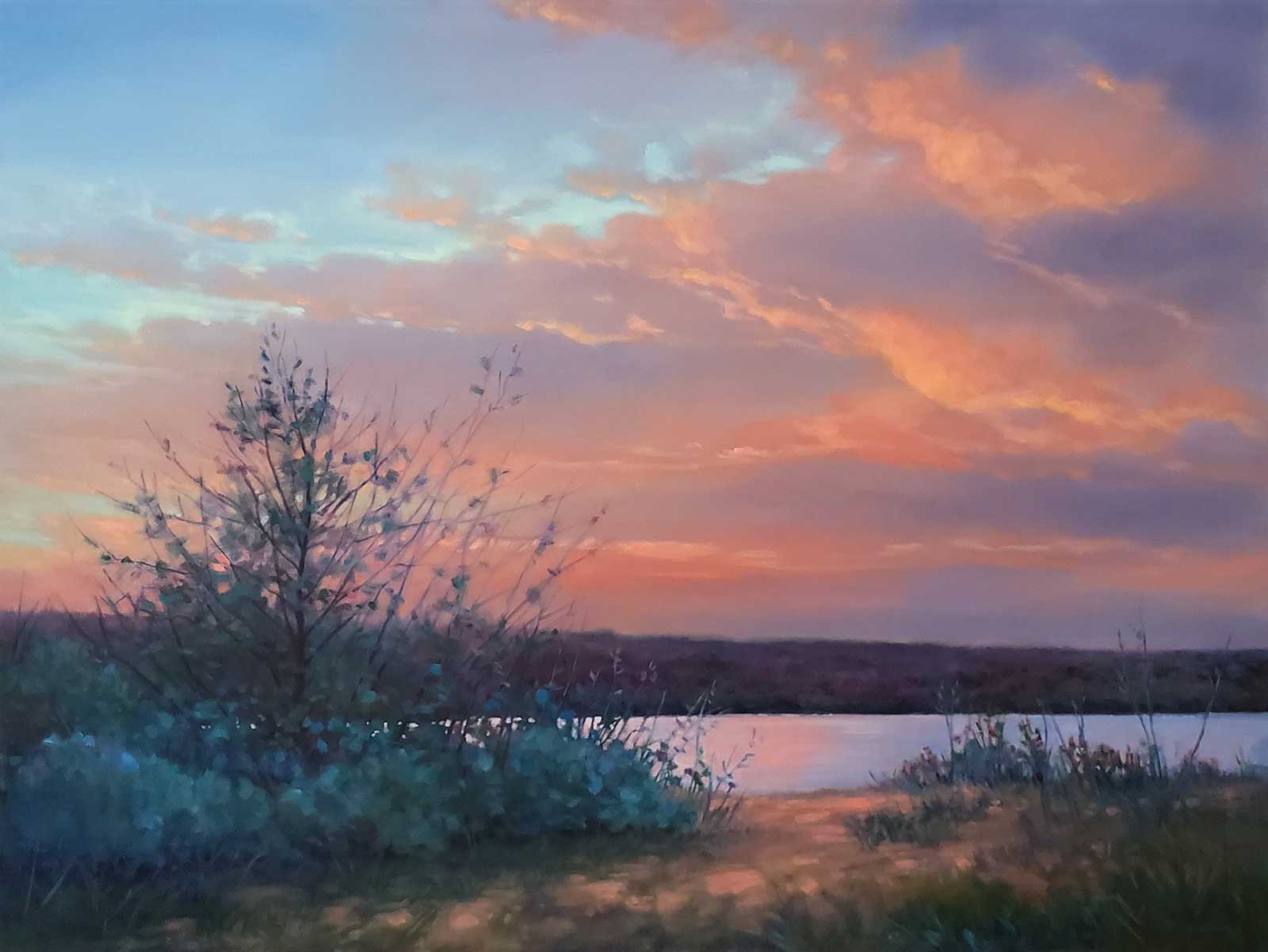
River Lookout, acrylic and oil on canvas, 36 x 48" (91 x 121 cm) Foliage is a challenge for me, especially when it’s compositionally close to the viewer, as I tend to want to paint every single leaf. This was a large-scale exercise in tackling this challenge. My solution was to build areas of mass to create the tree and bushes then layer suggestions of foliage overtop. To create a sense of hope, branches reach up from the shady tree toward the warmth of the illuminated clouds.
In these early stages, I love using transparent, chromatic layers of acrylic to build energy that will vibrate through the upper layers. Once I feel confident that the best base has been created, I begin with oil paint. This part of the process is always nerve-racking since there is no going back. It’s also difficult because the energy of the underpainting usually takes a hit as the oils initially dull the overall image. It’s the “ugly stage,” and I always need to remind myself that I can get it back.
As the palette becomes more muted, I get a sense of how the acrylic colors will pop through the oil layers. Shapes are more important in this stage than details, which goes against my natural instincts, so if I find myself micromanaging my brush marks, I get out a shop towel and smudge the oil around. This has become quite an important step in my process; it’s freeing and adds a hazy, quiet effect that I can build around.
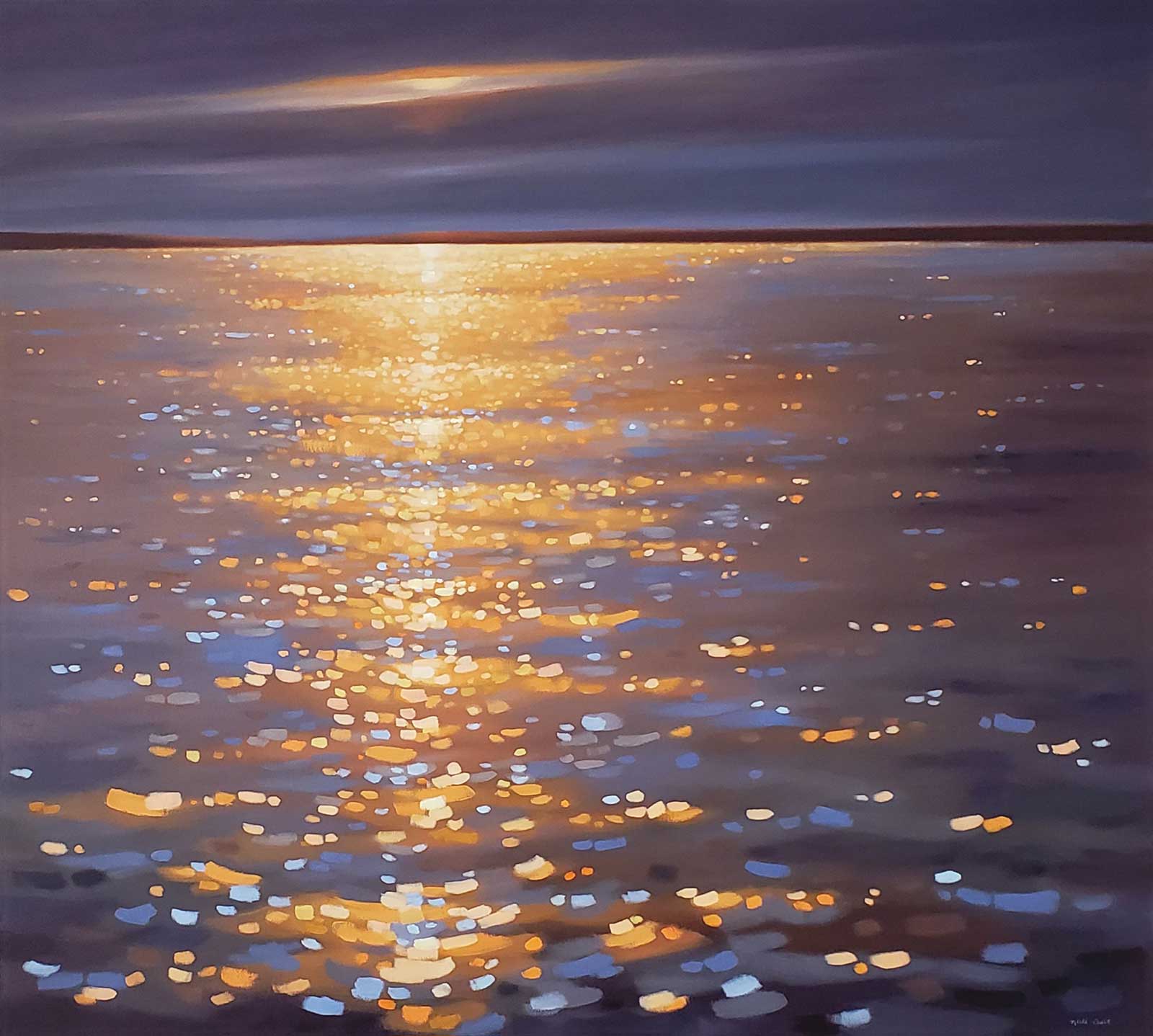
Quiet Light of the Copper Moon, oil on canvas, 36 x 40" (91 x 101 cm) Sparkle, shimmer and imagination—that’s what this was all about. I took the reference photo on a sunny, windy afternoon at the lake. It was very bright and the color seemed bleached out of the landscape. In fact, my photos read as black and white. I took this opportunity to create a different story with my color choices. I imagined a night scene with the light on the water dancing under a copper moon.
The entire process slows down with oils. I used to be very impatient and tried to push further wet-on-wet, but with experience I’ve realized that for the effects and depth I want, there are times when I must stop to allow the oil paint to dry before carrying on. Although the early layers are less and less obvious as the painting evolves, they are still crucial to the end result. They stay with me as I paint. I constantly make sure they glow around edges or burn through areas dry-brushed with oils. I’m always pleased with the juxtaposition of opaque layers next to translucent layers. Finishing touches include glazing to unite the values, color temperatures and shapes, deepening the darkest darks and popping the lightest lights, and finally adding special details to complete the story.
My art practice is driven by a deep love for my province—its places and people, its colors and creative culture, the wide open spaces and the tiny detailed wonders. Nothing makes me happier than when I can connect a viewer or client to a cherished memory of a place or a moment. Through the push and play of building layers, I hope to infuse energy and life into my landscapes.
My Art in the Making Boreal Oasis
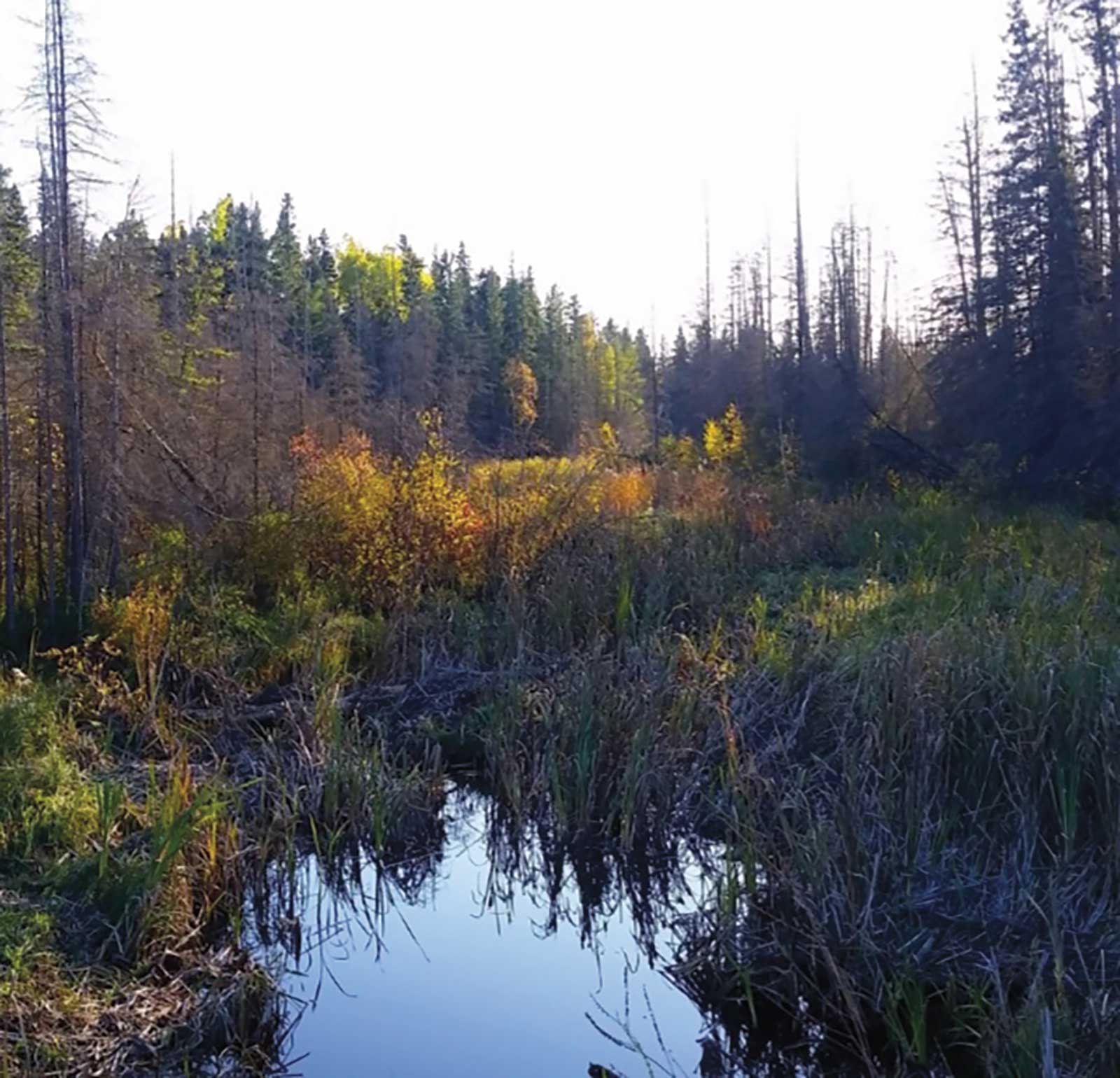
Reference Photo
 Stage 1
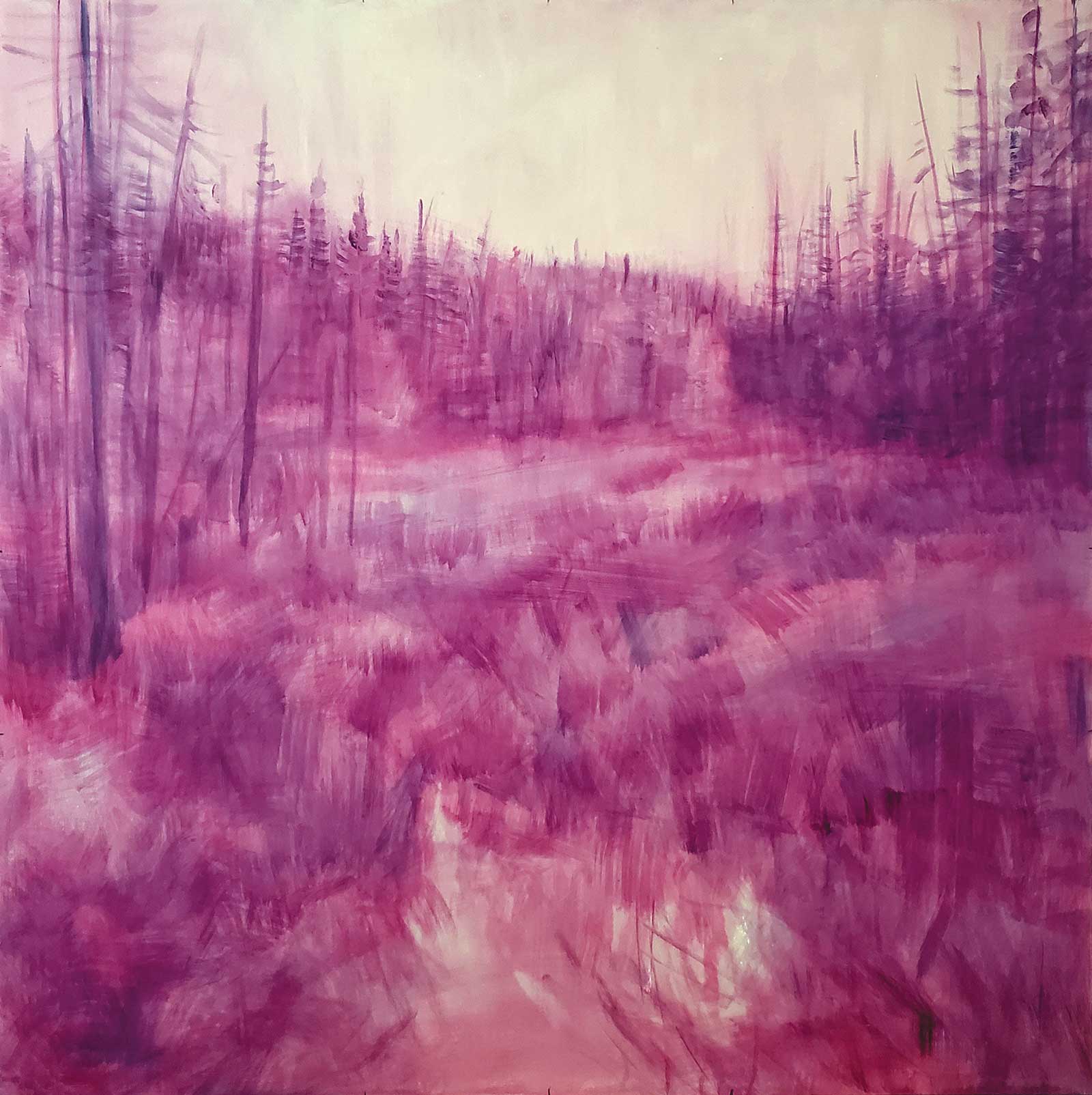
Stage 1 Toning and Blocking In
Acrylics in magenta and violet are used to tone the canvas and sketch the big shapes and mid-values of my composition. The upper layers will contain many shades of green, so the hot pinks of the underpainting will intentionally glow through, adding hits of glorious energy to the overall scene.
WHAT THE ARTIST USED
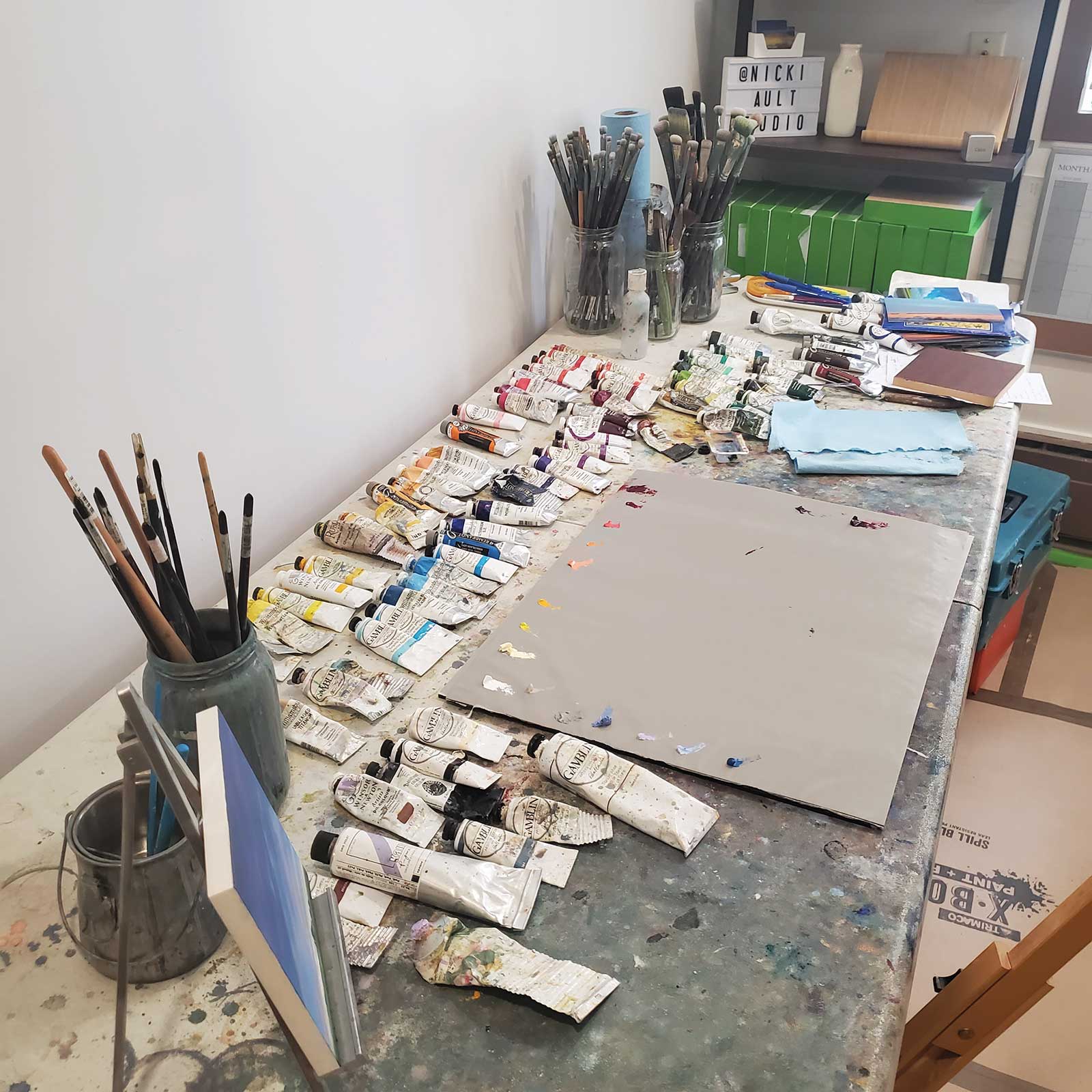
Acrylics
Quinacridone magenta, Smalt hue, Prussian blue, Quinacridone violet, Hookers green, Green gold, Quinacridone nickel azo, Permanent violet dark
Oils
Phthalo blue, Ultramarine blue, Manganese blue, Cadmium yellow light, Cadmium yellow deep, Yellow ochre, Brilliant pale yellow, Magenta, Burnt sienna, Viridian, Sap green, Titanium white, Warm white
Brushes
2½" angled house brush, Synthetic bristle flat brushes, sizes 4-10, 16, Synthetic bristle bright brushes, sizes 4, 8, Synthetic liner brush, size 1 (for signing)
Additional Supplies
Deep profile (1½") canvas, primed and pre-stretched, Shop towels, Water sprayer, Satin glazing liquid, Gray gesso, Odorless mineral spirits, Solvent-free alkyd gel
 Stage 2
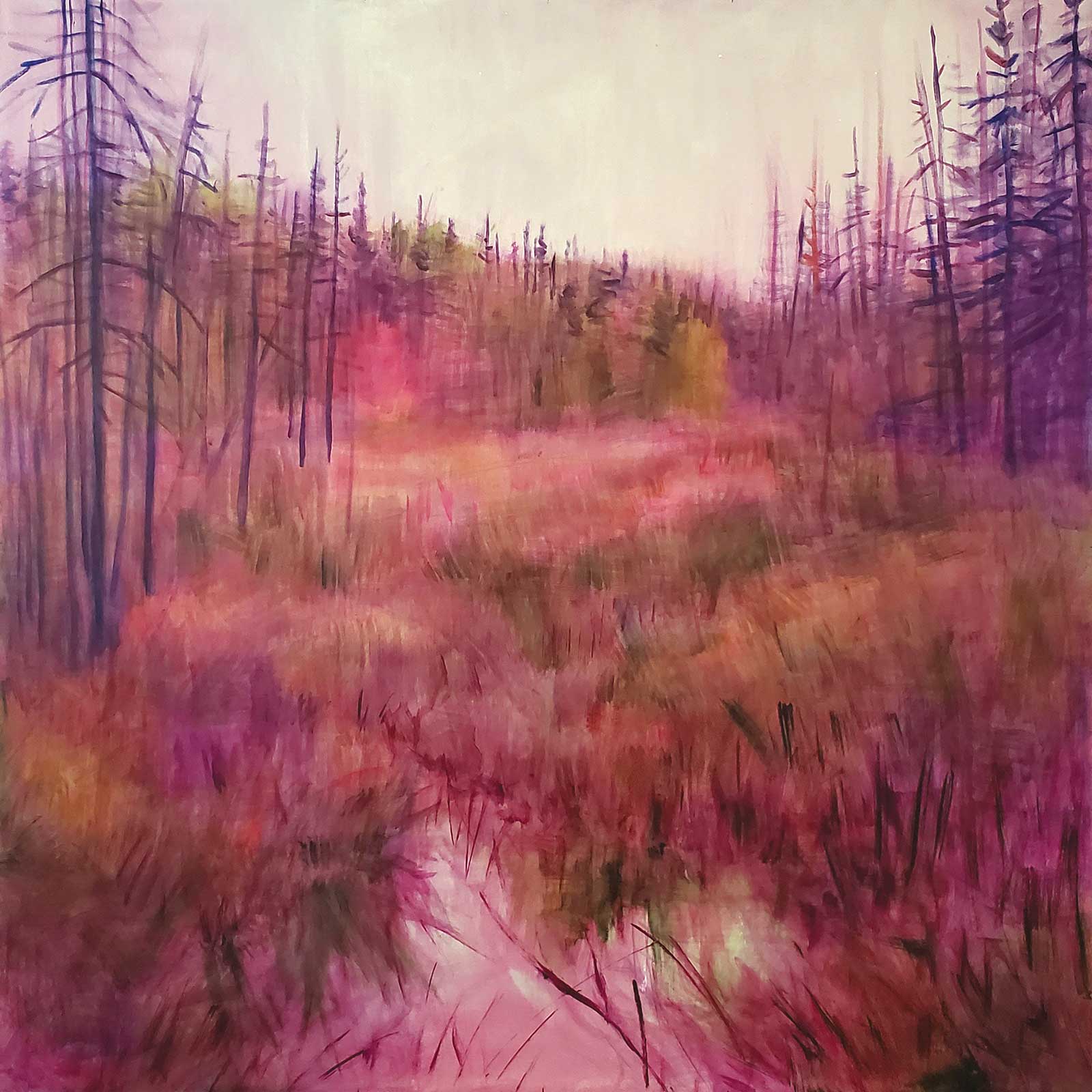
Stage 2 Establishing Structure
Transparent layers of cool green are introduced to settle the heat of the initial underpainting and to create form in the grassy area. Gold tones also reduce the flush of the underpainting. The structure of the trees are further established with blue and violet.
 Stage 3
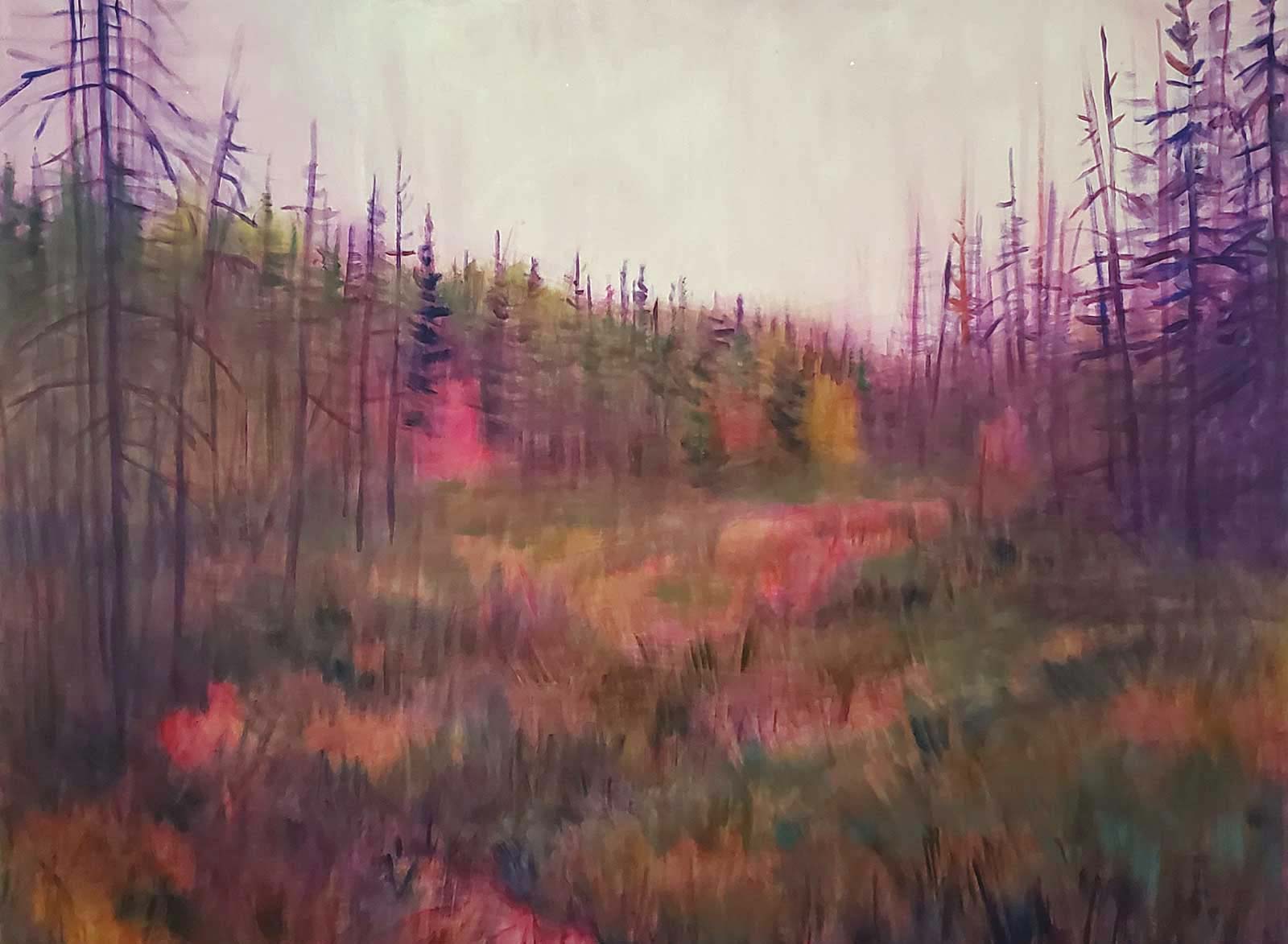
Stage 3 Initial Layer of Oil Paint
Oil paint is introduced. Things are cooled down with muted greens and become somewhat dull. I begin determining the darkest, shady areas as well as angles that will pull the viewer into the scene. The hot pink acrylic underpainting is left intact where the sunlight will touch the foliage.
 Stage 4
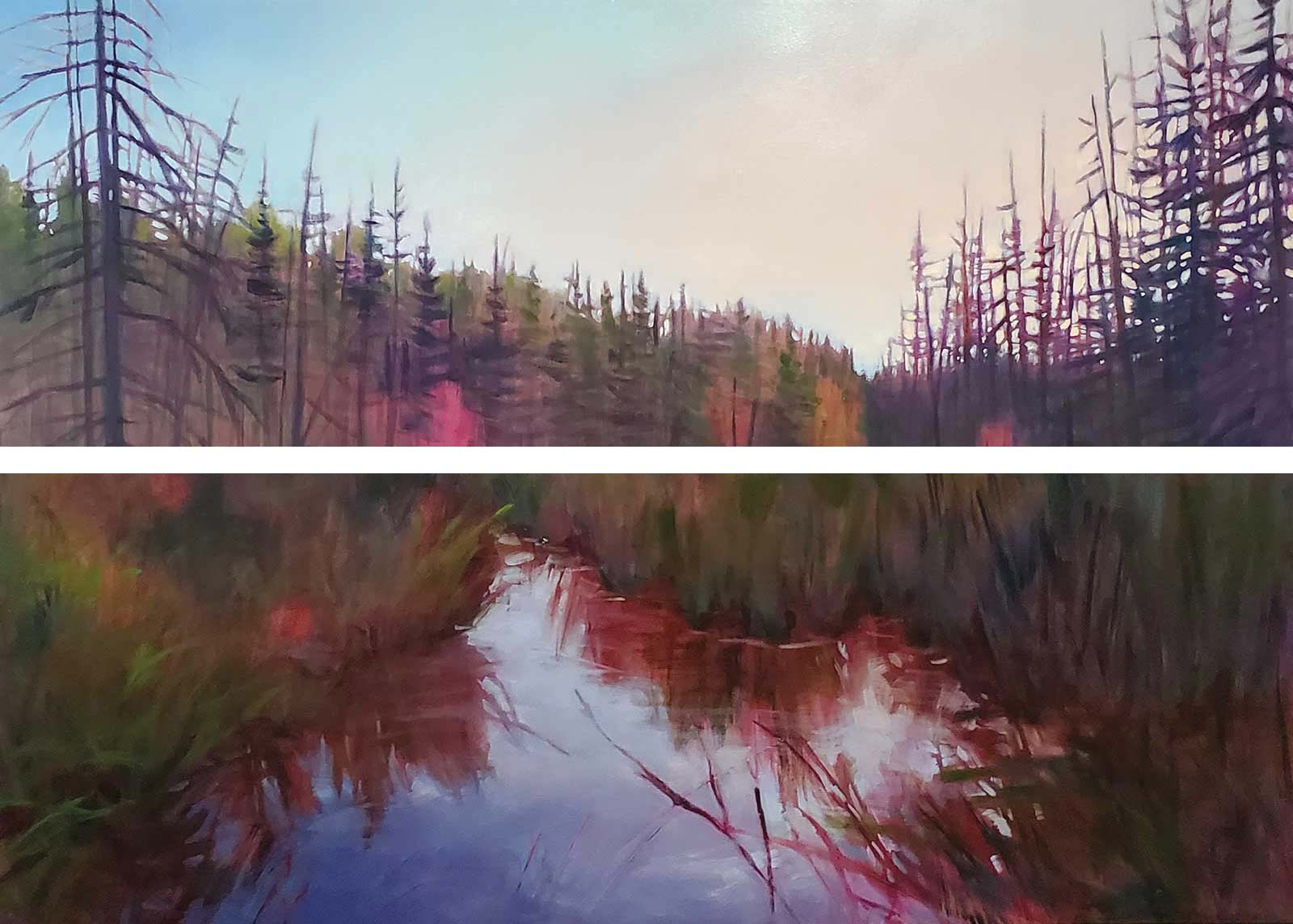
Stage 4 Sky and Water
Here, things are really starting to take shape! The energy builds again with more chromatic layers of green. The introduction of the cool water shape grounds the grasses. I build a luminous gradient in the sky to create depth. Oil paint is used to shape and clarify the branches jutting into the sky. I decide I want the cluster of trees on the right to feel further back, so I bring the grass up more.
 Stage 5
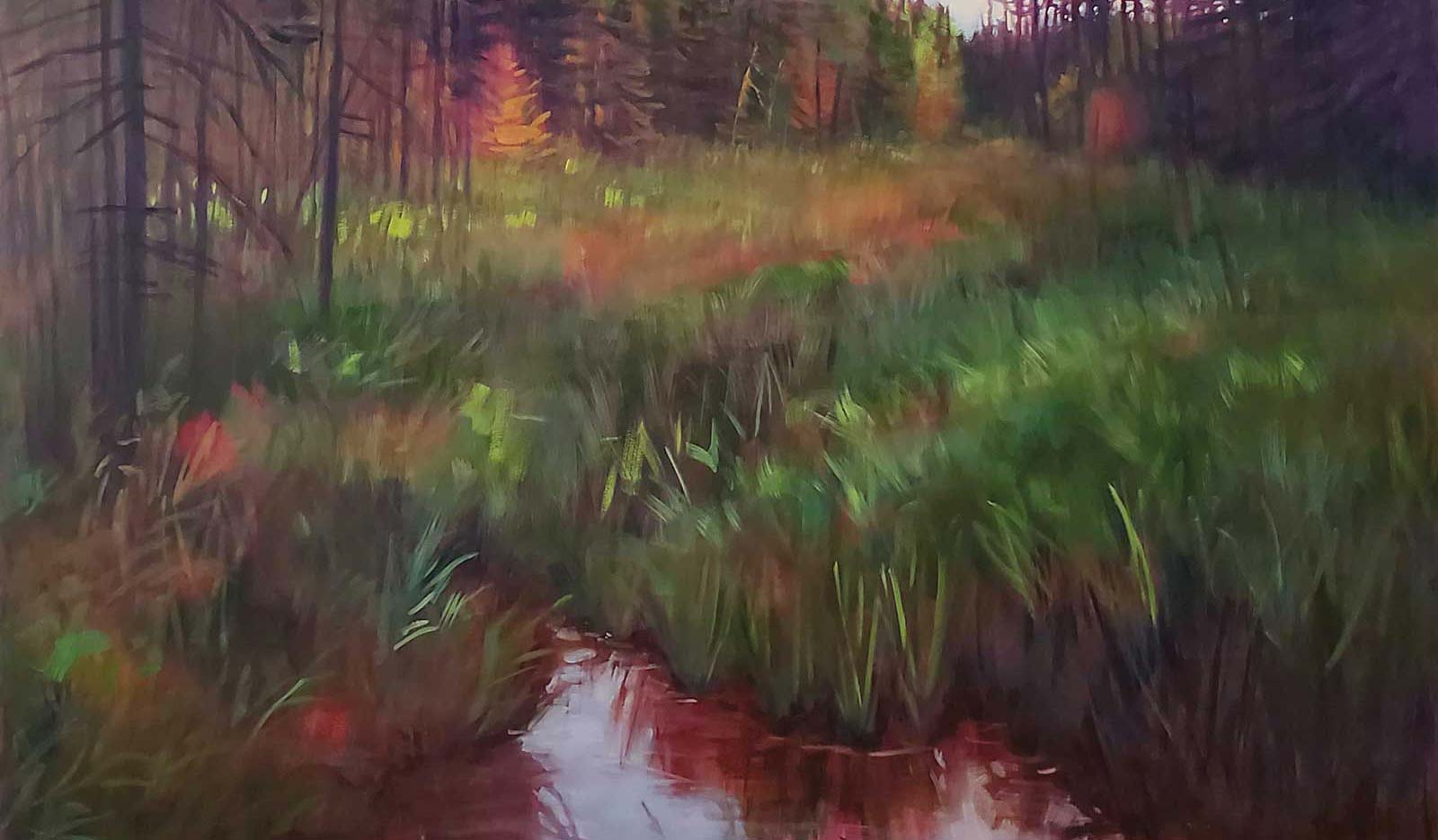
Stage 5 Building Light
I’m now working on the initial placement of light and warm upper layers. Warmer greens are introduced and more defined grasses are placed to get a feel of foreground scale and light traveling behind the trees on the left. The first marks of gold are placed on the focal tamarack.
 Stage 6
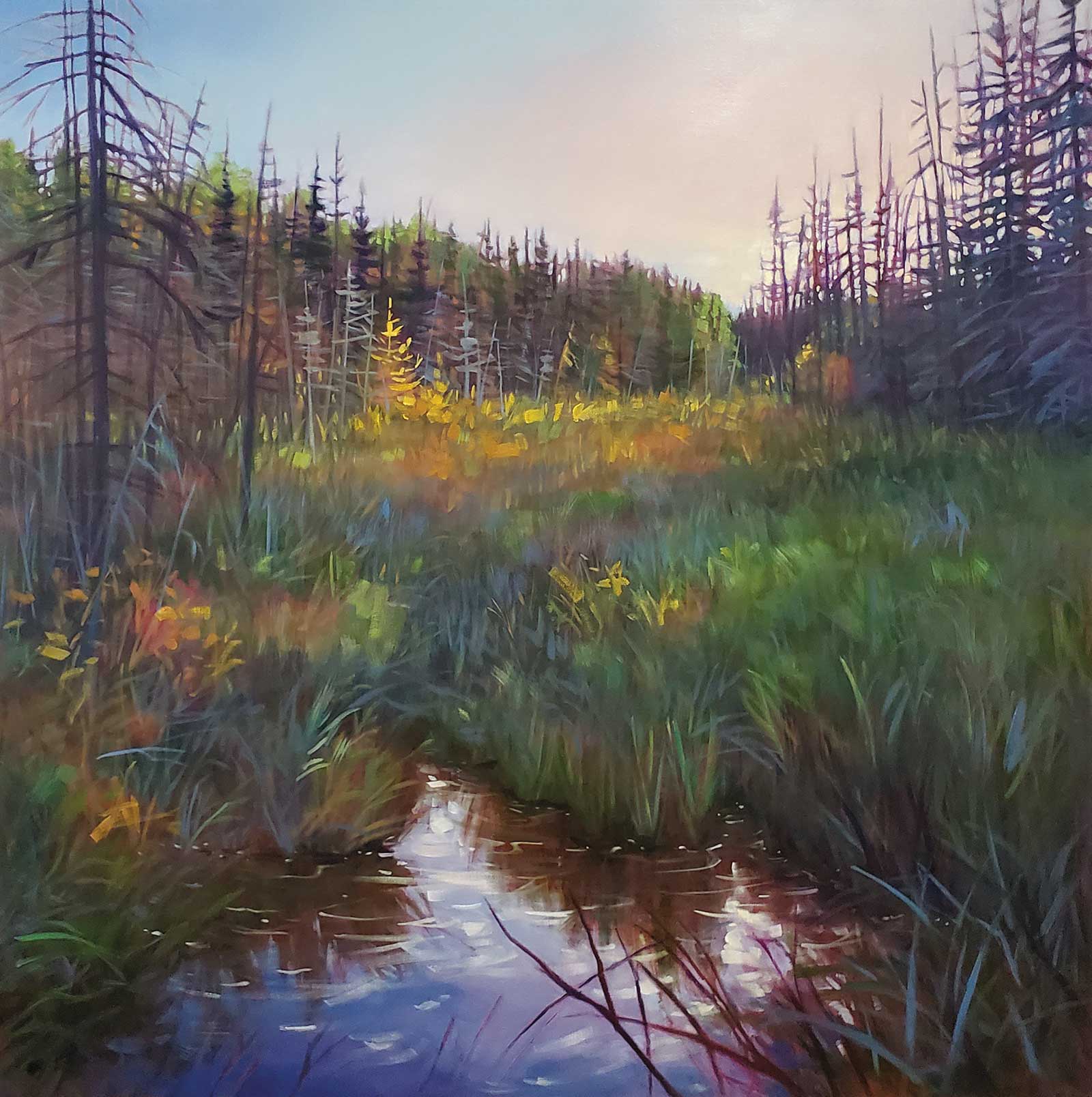
Stage 6 Complementaries
Golden warmth builds in strategic areas while the underlying heat of the magenta underpainting still glows through the layers and keeps things connected. Cool blue/purple grays are introduced to complement the hot yellows, break up the green of the grasses and add to the feeling of shade. Marks are added to create the surface of the water and activate the bottom corners.
 Stage 7
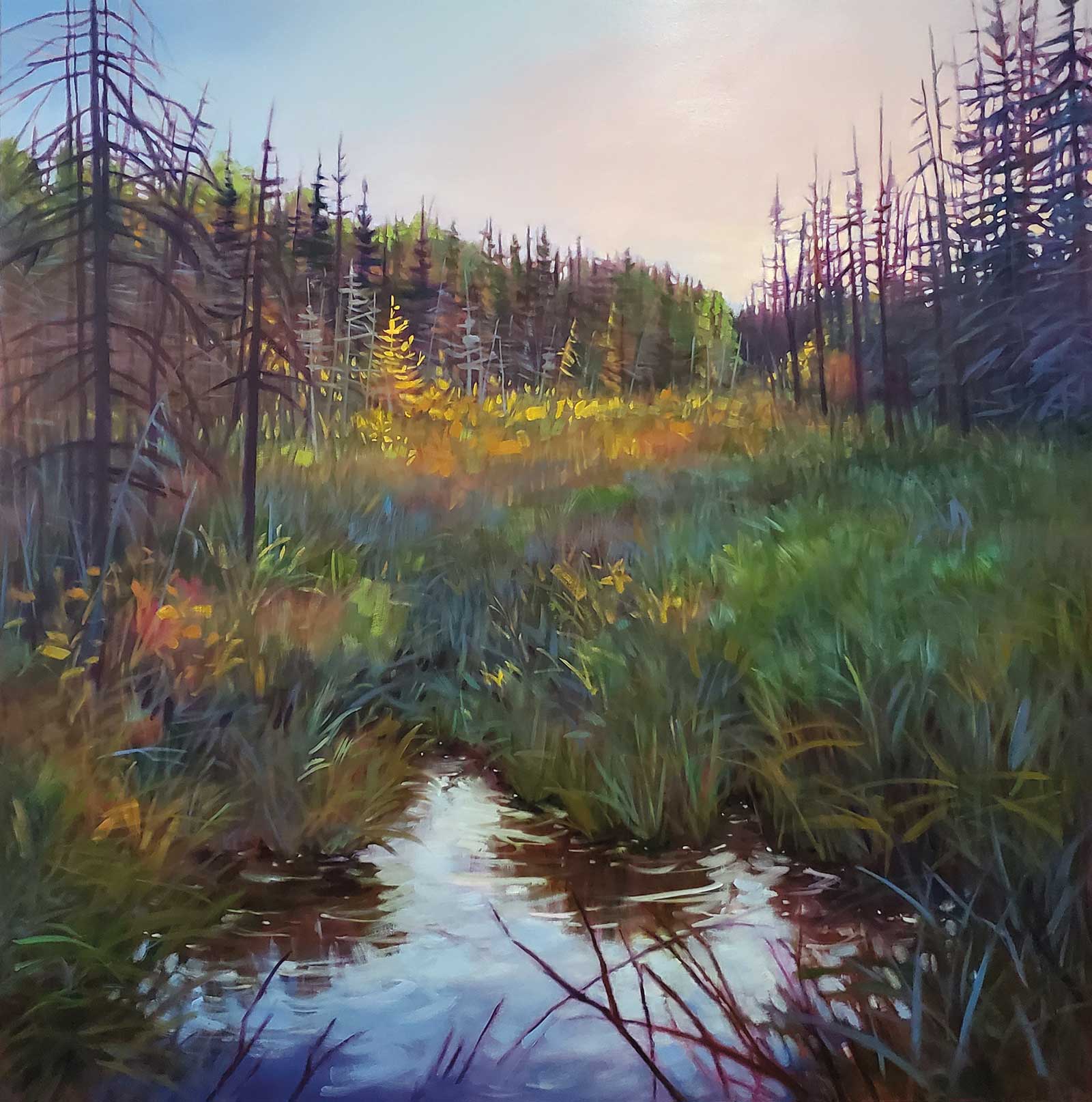
Stage 7 Getting into the Details
Foreground branches and grasses are further established. The water is developed at this stage to better reflect the pale sky and to suggest it is going back into the forest meadow. Small details build around the focal area.
 Stage 8
Stage 8 Finished Artwork
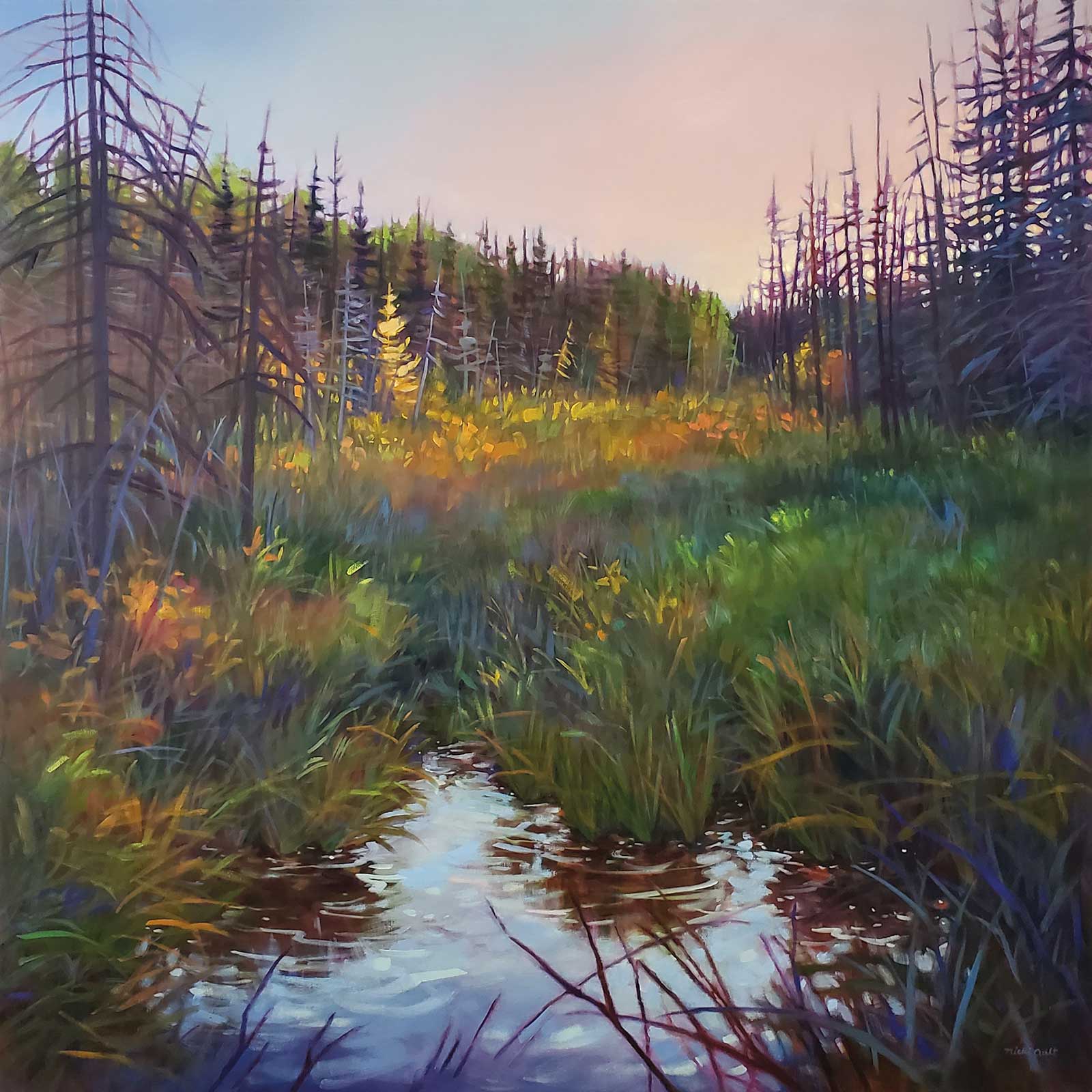
Boreal Oasis, acrylic and oil on canvas, 36 x 36" (91 x 91 cm)
Flourishes of gold and blue finalize the late afternoon atmosphere I set out to create. The focal tree is fully established with the lightest and brightest warm yellow in the painting.
About the artist
 Nicki Ault
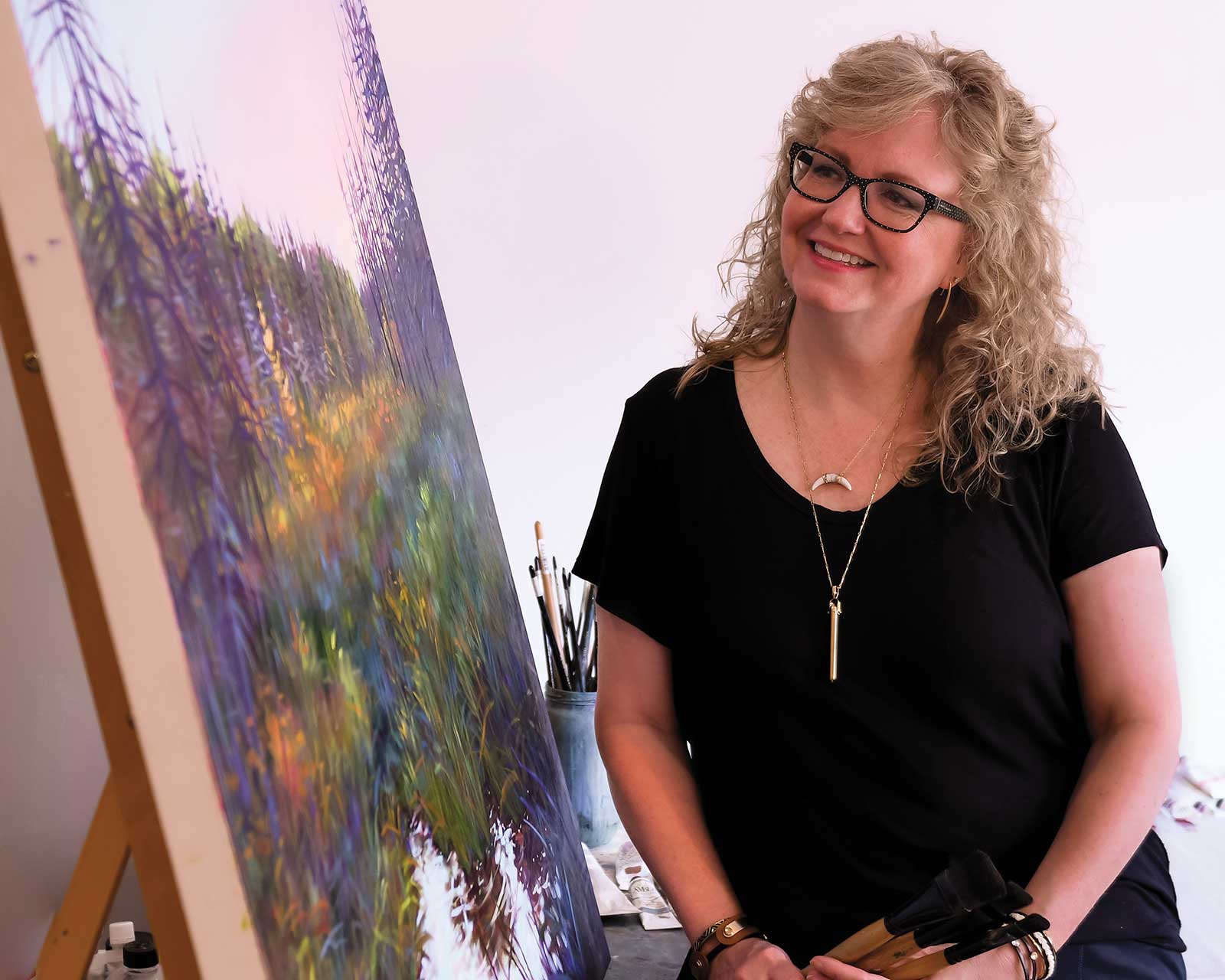
Contemporary Canadian artist Nicki Ault has always loved art and began pursuing painting as a profession when her youngest son started first grade. Her creative freedom increased with each year, and she now works full time in her newly established private studio in Saskatoon.
Ault has an intense love for the Boreal Forest, northern lakes, big prairie skies and wild grasslands of Saskatchewan. It’s in these places she finds endless inspiration for her landscapes. She considers herself to be a lifelong student of art, always determined to learn, grow and keep moving forward. She continually challenges herself to convey light and express emotion in her landscapes. In 2019 a feature was written on Ault’s work in Canadian publication Galleries West, and in 2020 she was named a SaskGalleries “Artist to Watch.” In November 2022, Assiniboia Gallery hosted Ordinary Miracles, Ault’s third solo show since joining the gallery in September 2017. In early 2023 she experienced her first artist residency at the Residence Inn by Marriott Calgary Downtown/Beltline District, where she lived and worked for two months creating a collection of 44 paintings. Ault is represented by Assiniboia Gallery, Woodlands Gallery, Summer & Grace Gallery and Gibson Fine Art.
Contact at
www.nickiault.com