When I was a young boy in a family with six children, we could not afford art supplies. My mother would bring home paper from the butcher for me to draw on, and I used drawing to escape into my own world. I still have the same experience of excitement today when I turn a three-dimensional scene into my own expression on paper or canvas. The process of painting or drawing is a challenging and stimulating discovery of my subject.
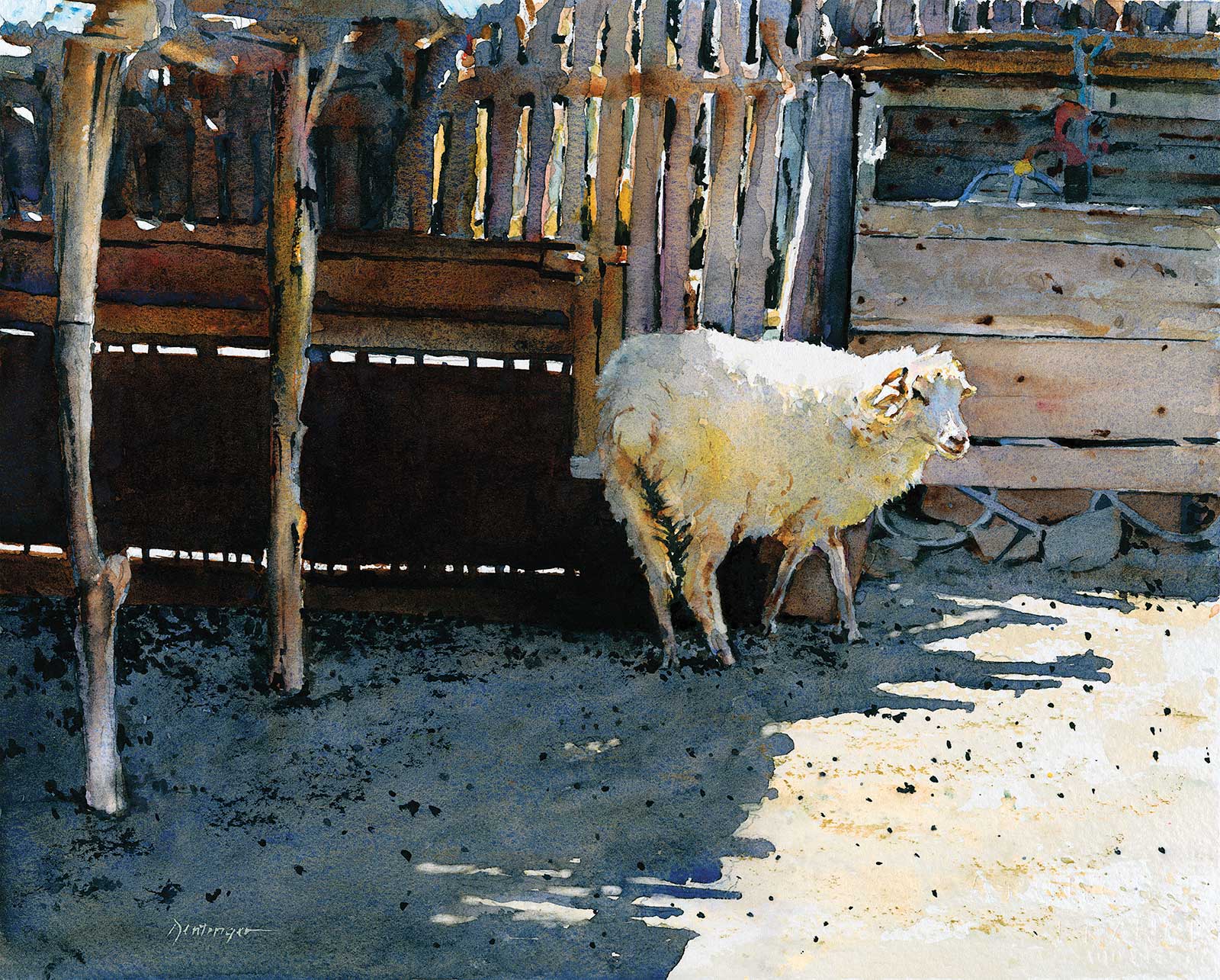
One Shy Charro, watercolor, 10¾ x 13½" (27 x 34 cm)
In the 30 years I have been painting in watercolor, I have often been told, “that’s not how you paint a watercolor.” I work, like most artists, from the value scale. But rather than starting light and working to dark, I first paint the darkest possible value of my subject. With nine being the darkest value and one being the white of the paper, I start with number nine. Finding the darkest value from the beginning frees me from muddying or overworking my painting.
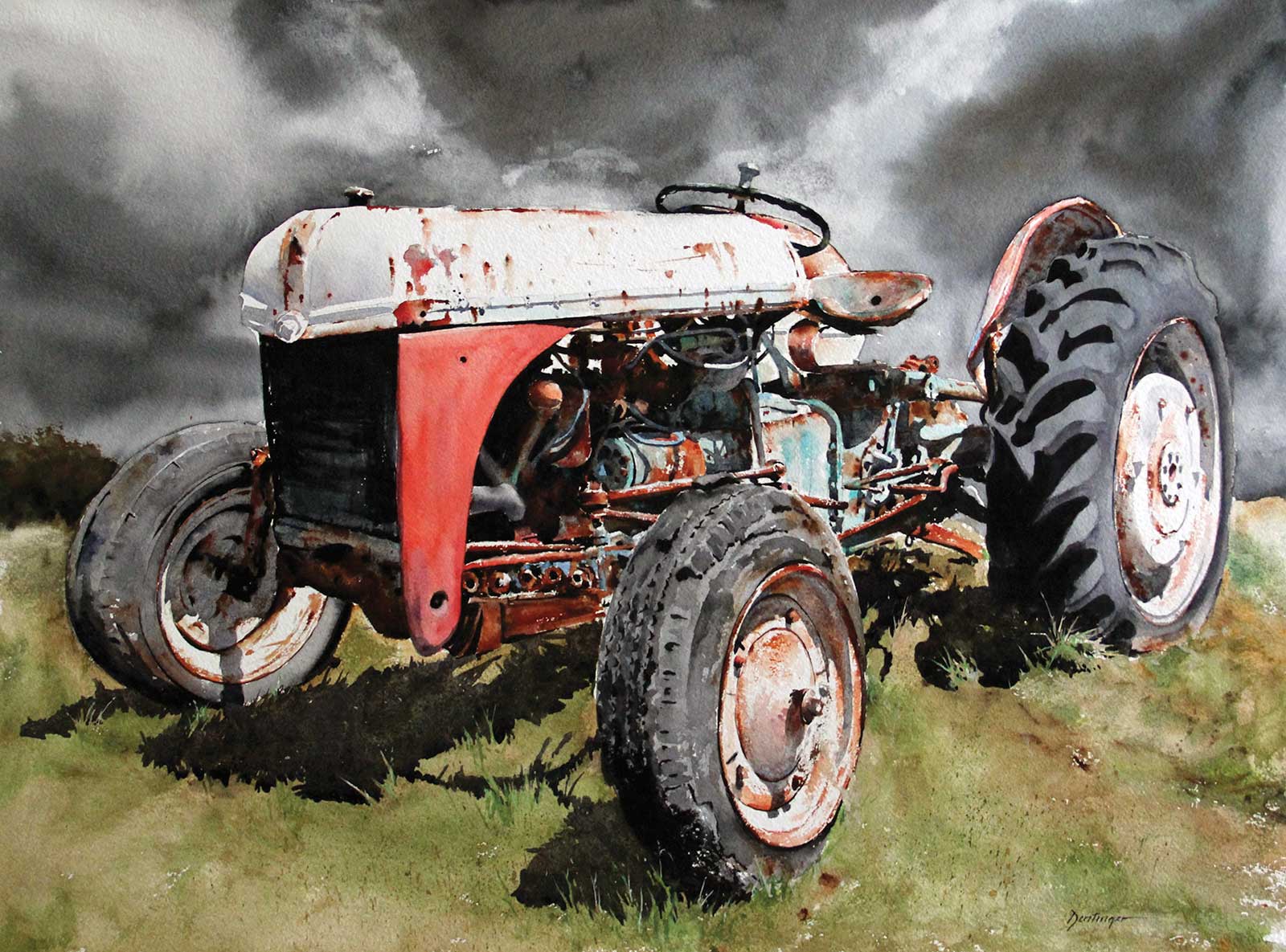
Comfort Tractor, watercolor, 22 x 29" (55 x 73 cm)
After completing a value sketch, I start with an extremely detailed drawing that gives the foundation of my work. Next, I paint in the darkest values, then apply brilliant and exaggerated color. I glaze a shadow wash over the color, which subdues and allows a rich and textural quality. Finally, I touch up the painting, adding highlights and more color or shadows as needed.
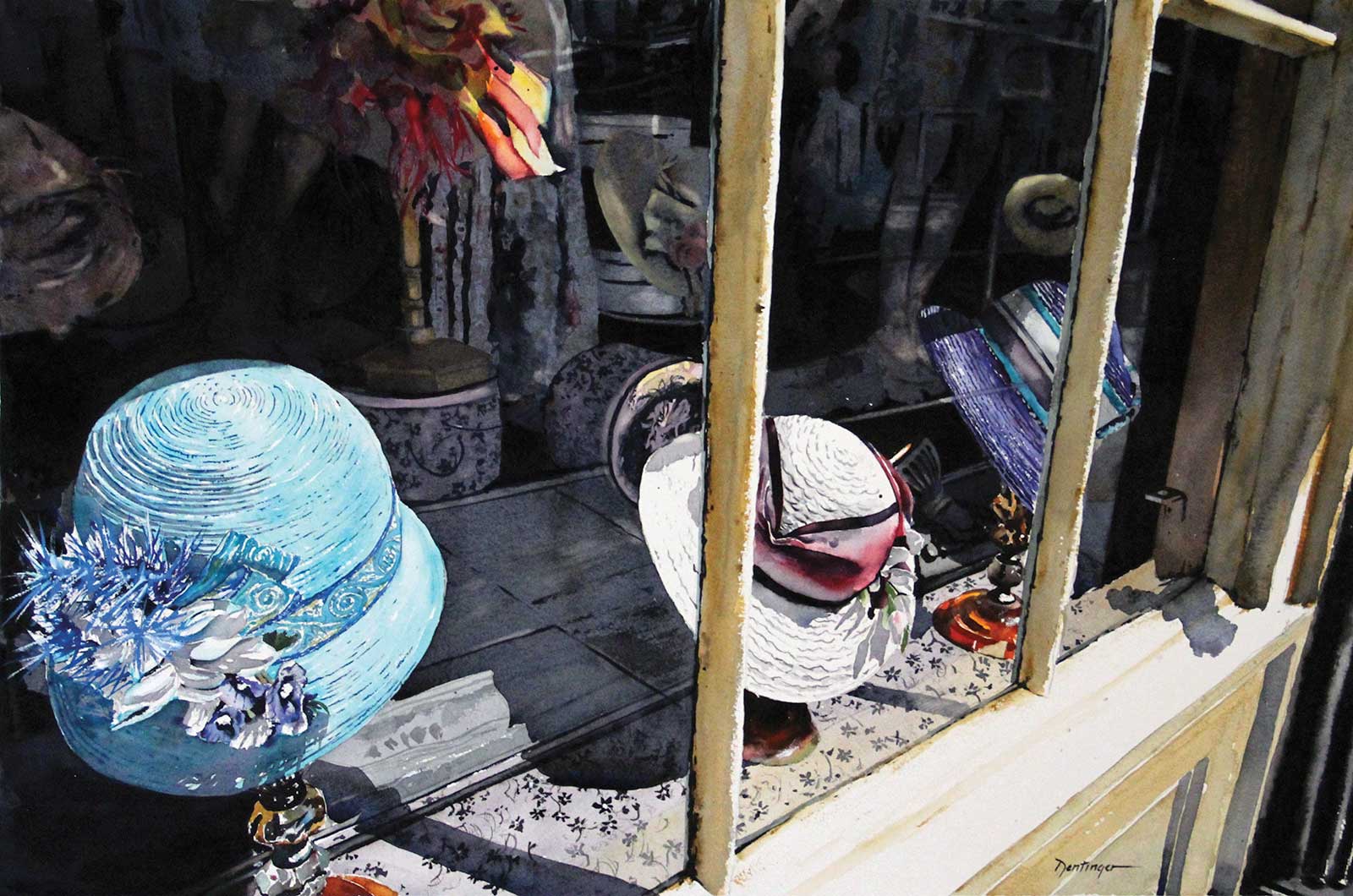
Hat Walk, watercolor, 19 x 29" (48 x 73 cm)
I am most drawn to subjects with strong value contrasts and a certain moody or atmospheric quality. I am excited by many things such as the prickly texture of a cactus, the rust on an abandoned tractor, the excitement of light pouring into a window, the quirky personality of an animal or a stormy landscape. I have a similar approach in my favorite mediums of watercolor, gouache and oil. I believe in using whatever method it takes to achieve the results I want and that successful artists use a variety of techniques to achieve their visions.
My Art in the Making Chama 484
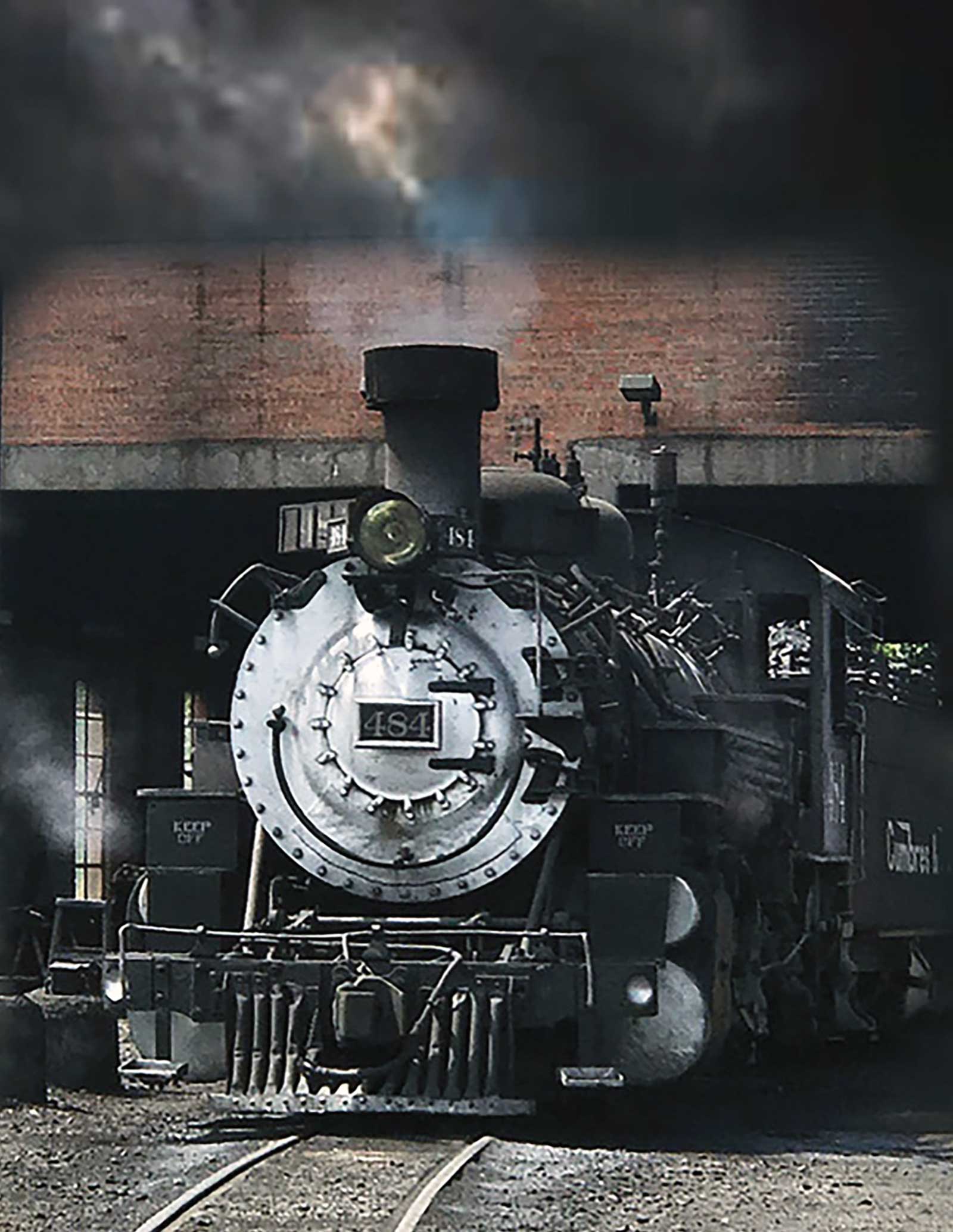
Reference Photo
Chama is a small town in Northern New Mexico known for its old trains and natural beauty.
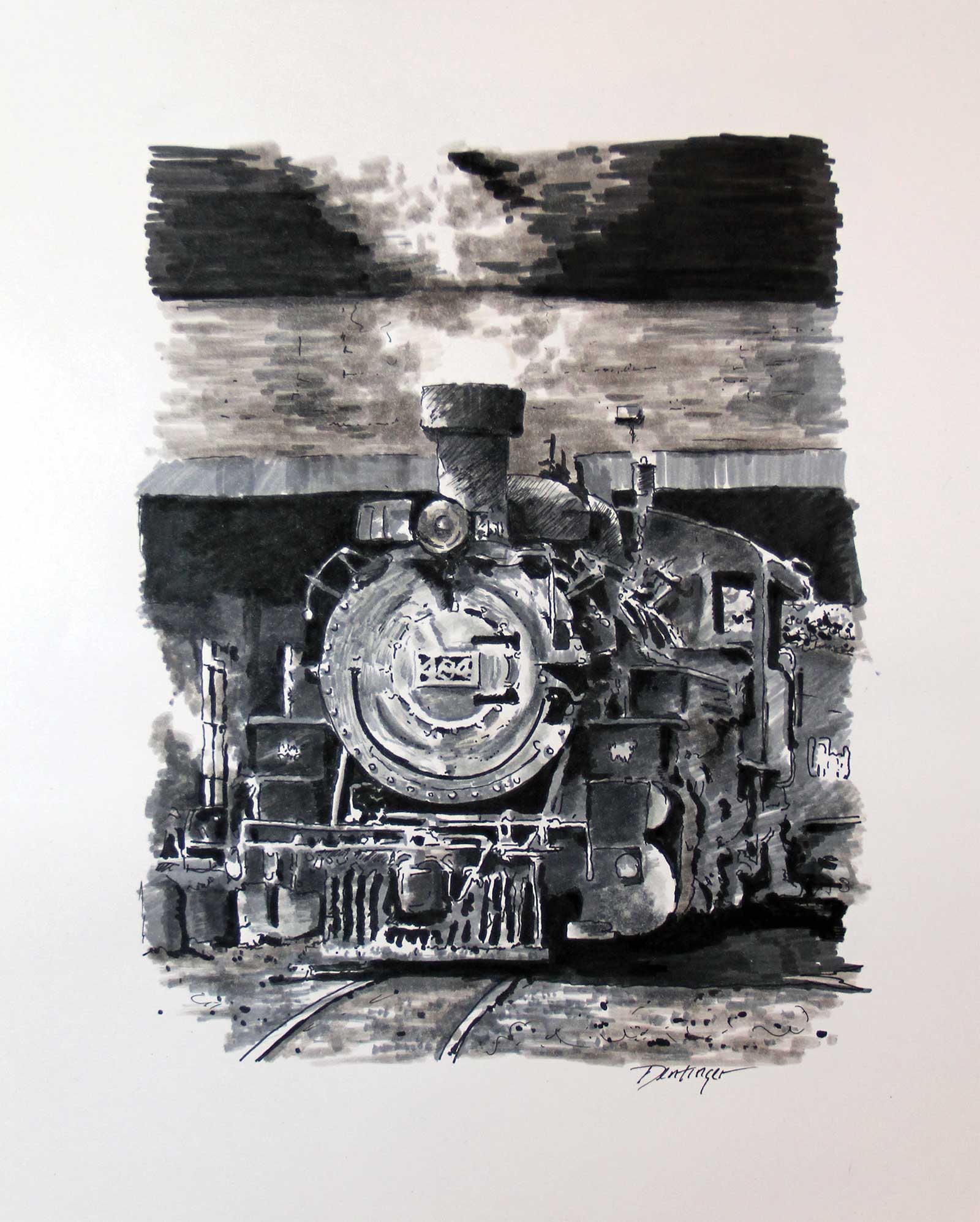 Stage 1
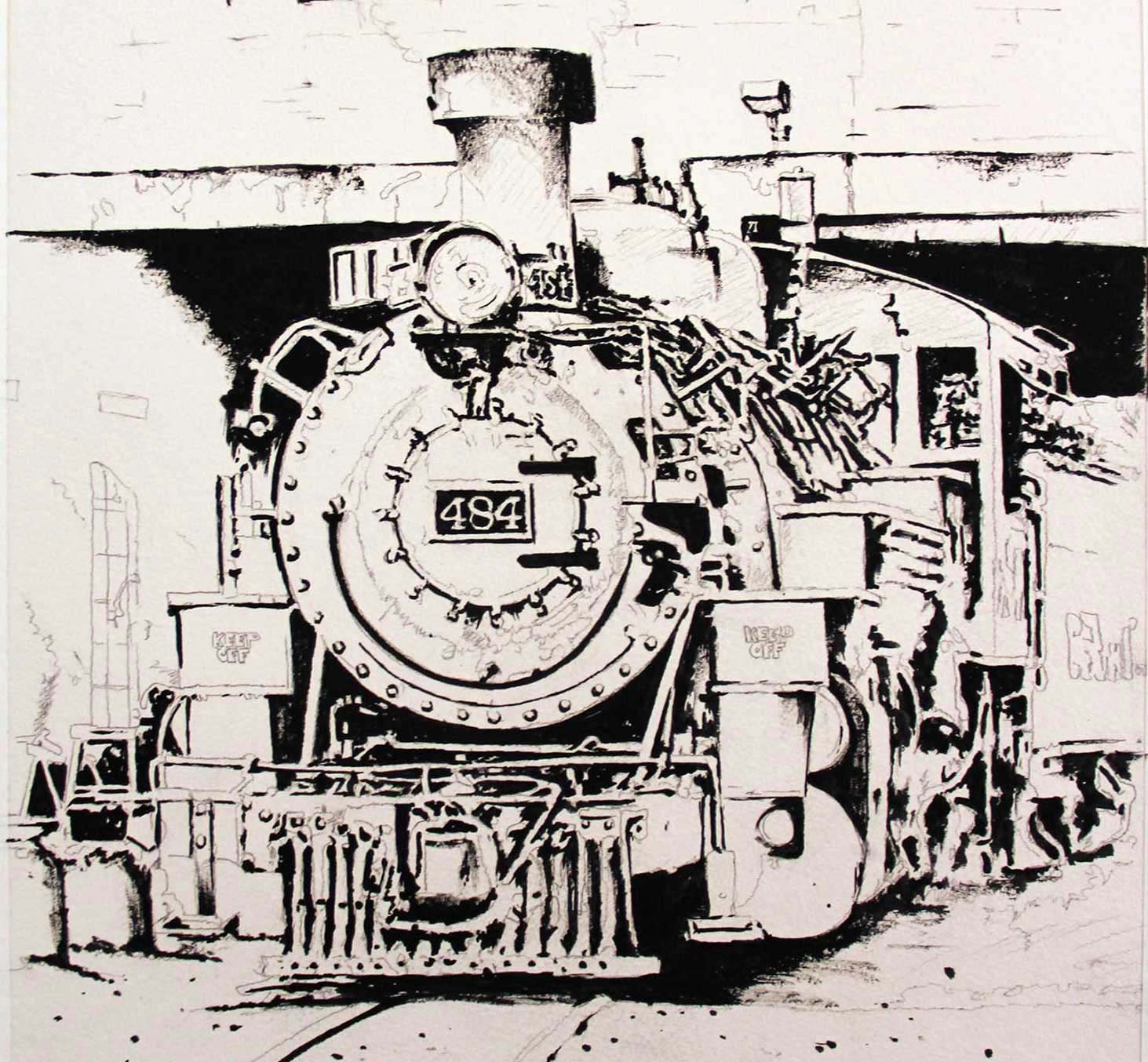
Stage 1 Value Study
I begin the piece with a pen and ink value study.
WHAT THE ARTIST USED
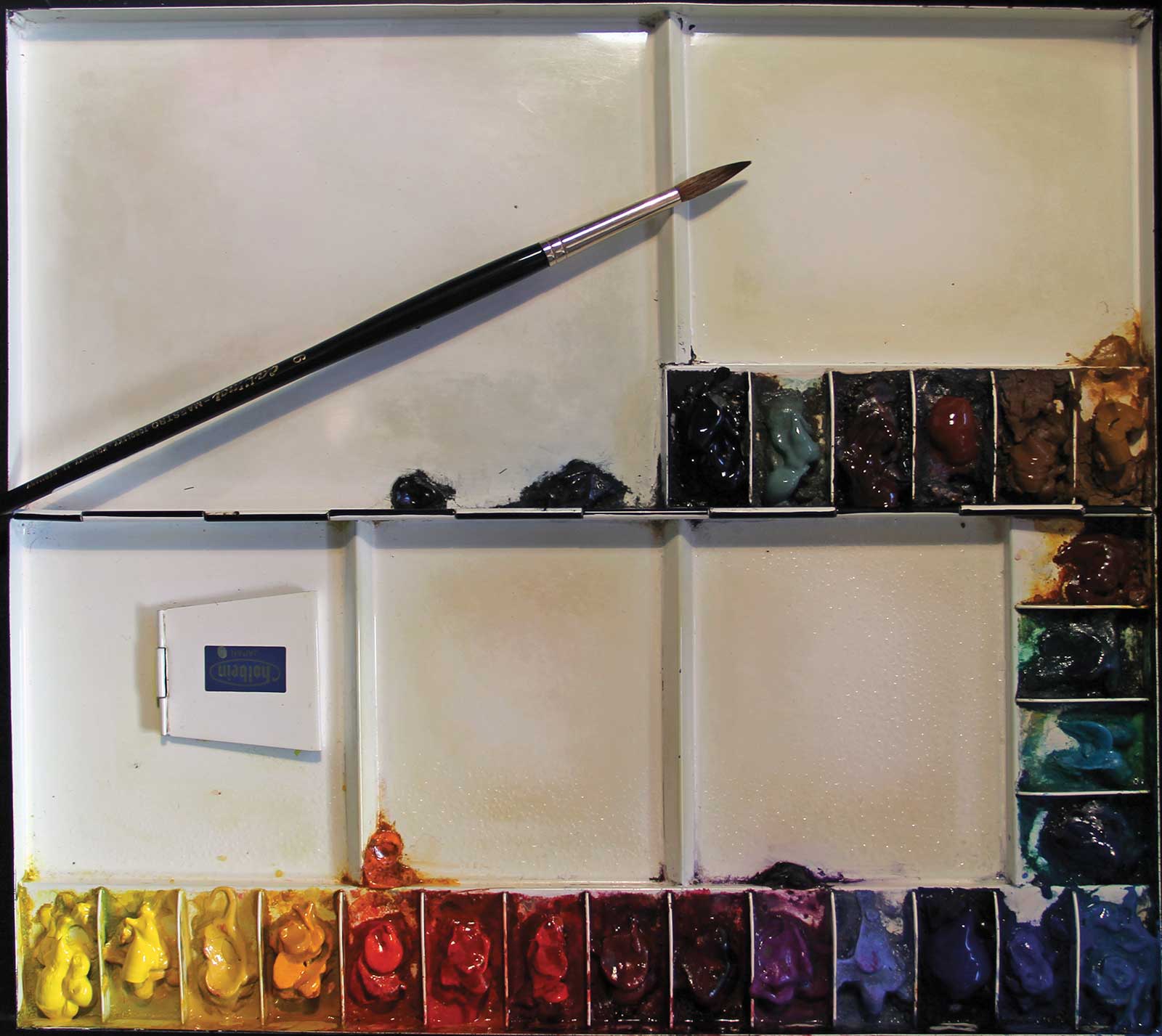
Holbein Watercolors
Cadmium yellow pale, Gamboge nova, Quinacridone gold, Vermillion hue, Pyrrole red, Permanent alizarin crimson, Permanent violet, Ultramarine deep, Cobalt blue, Cerulean blue, Cobalt turquoise light, Peacock blue, Lavender, Viridian hue, Raw sienna, Burnt sienna, Burnt umber, Davy’s gray, Payne’s gray, Neutral tint, Titanium white opaque
Brushes
Da Vinci Maestro kolinsky round sable, sizes 10 and 8, Da Vinci squirrel quill, short handle, size 3, 1” flat, Liner, size 6
Additional Materials
Arches 300lb (640gsm) natural white, Mounted on ½" Gator Board, Watercolor palette, Small drawing pad, No. 2 pencil, Kneaded eraser, Water container, Household sponge, Water sprayer, Paper towels
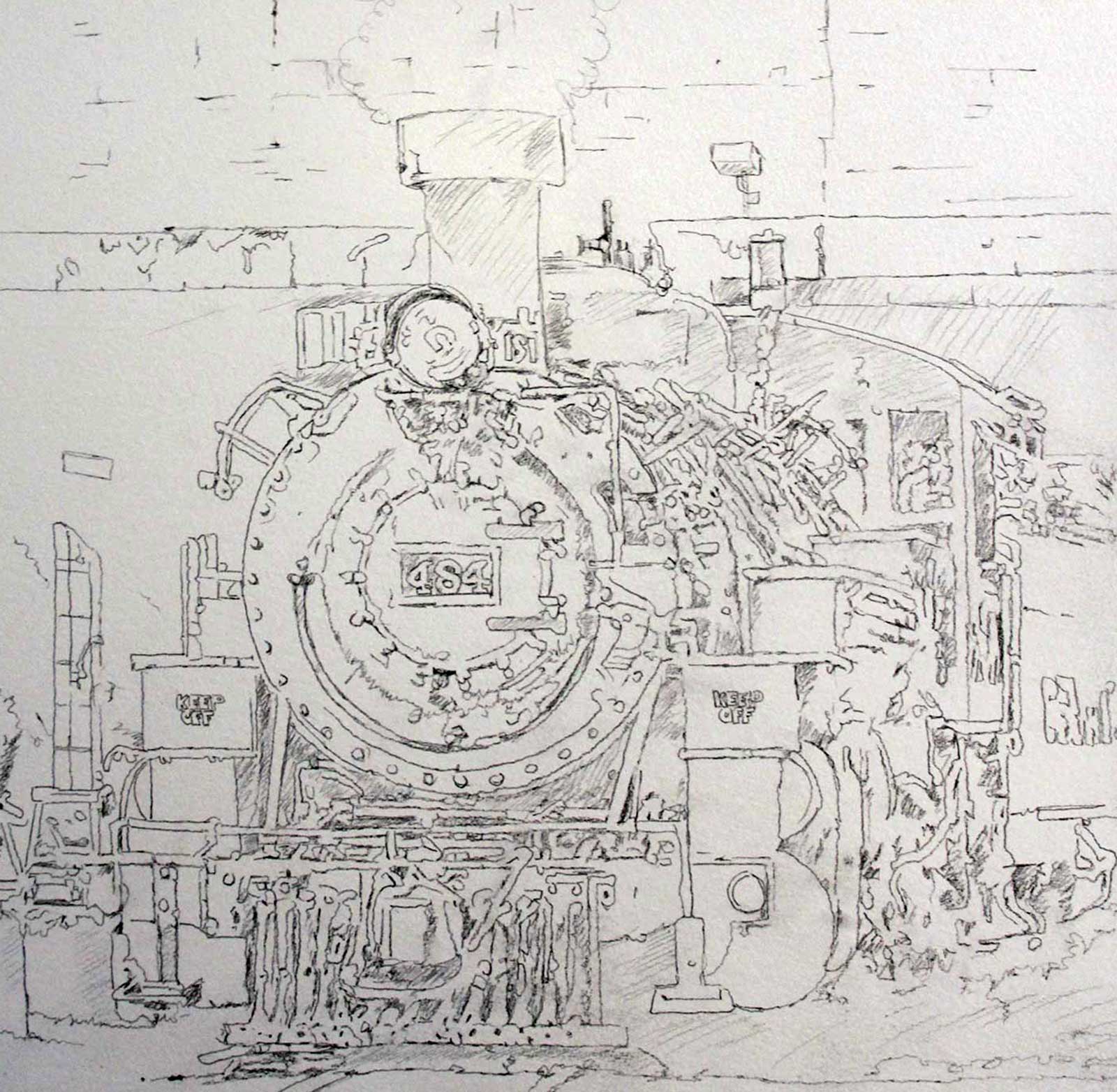 Stage 2
Stage 2 drawing
I then create a detailed drawing of the train and tape it down.
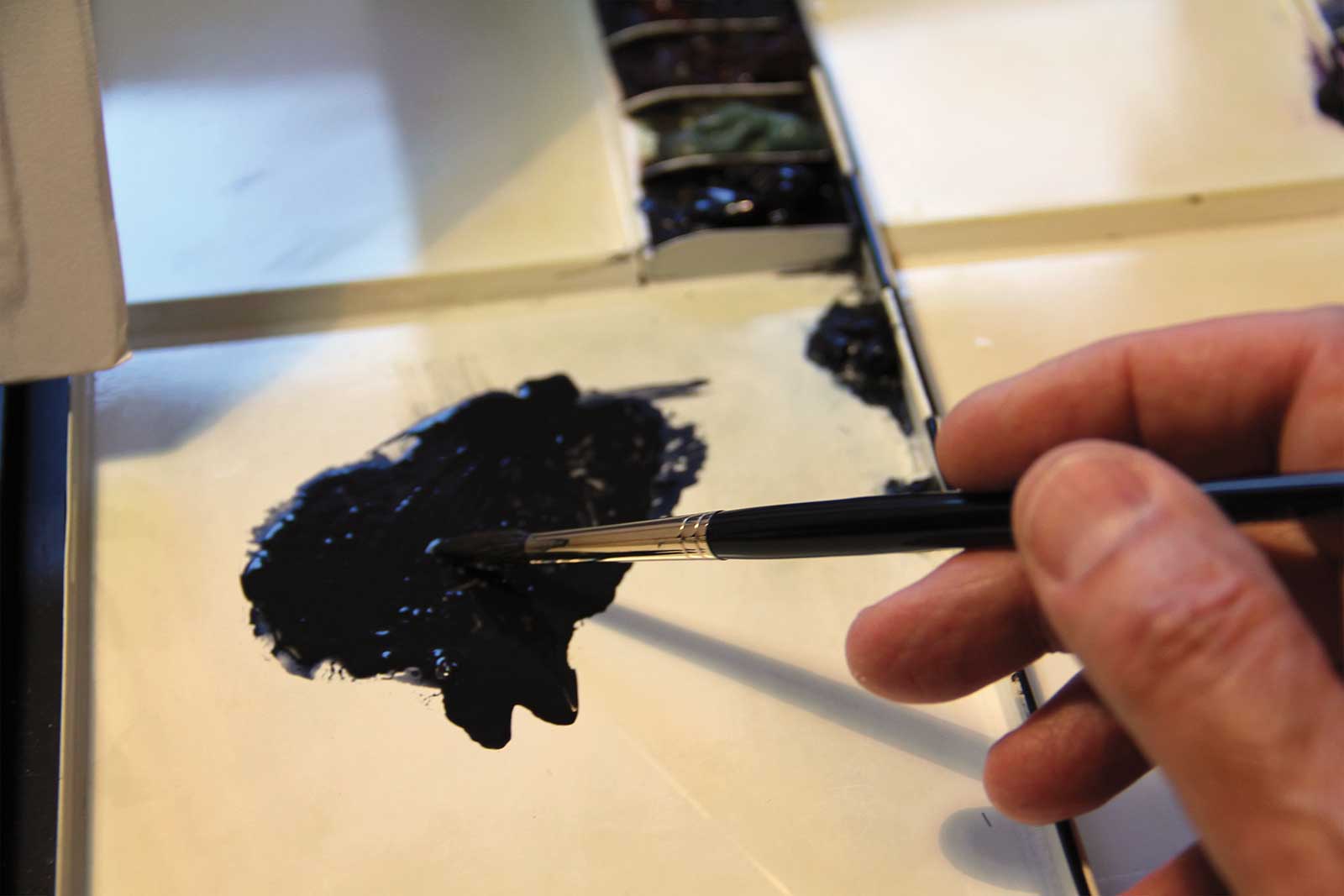 Stage 3
Stage 3 Mixing Darks
Next up, I’m mixing the darkest dark, which is a combination of ultramarine deep and burnt sienna, until it reaches a thick honey consistency.
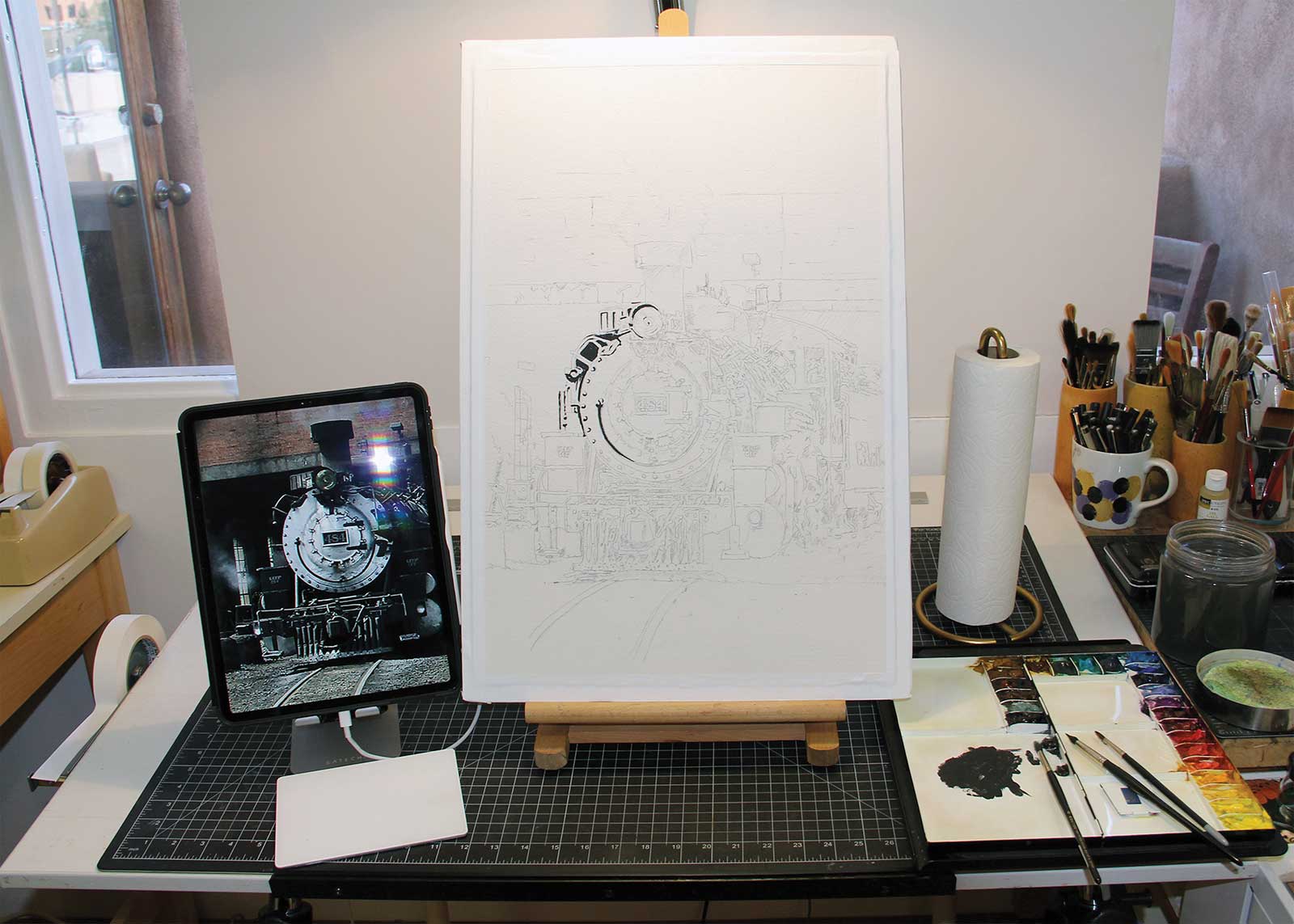 Stage 4
Stage 4 Applying Darks
I’m now beginning to apply my darkest darks to the locomotive.
 Stage 5
Stage 5 Continuing On
Here, I am simply continuing to add the darkest darks, steadily building form in the overall piece. This is where you really begin to see its shape and three-dimensionality come together.
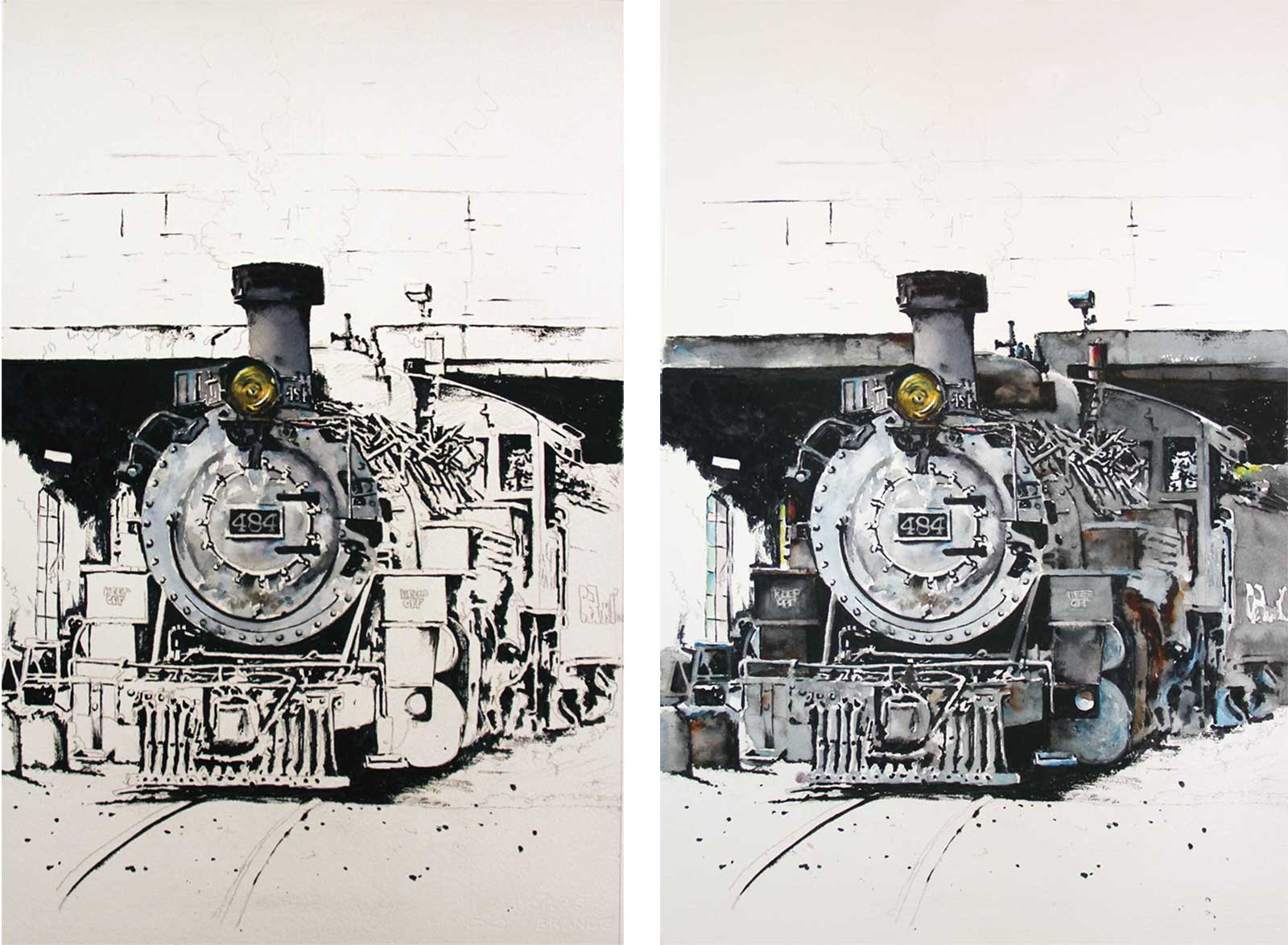 Stage 6
Stage 6 Adding Color
At this stage, I am starting to introduce other colors, using a mixture of neutral tint, Payne’s gray, cerulean blue and burnt umber for the shine on the front. The train light is a mix of cool and warm yellows with some Davy’s gray.
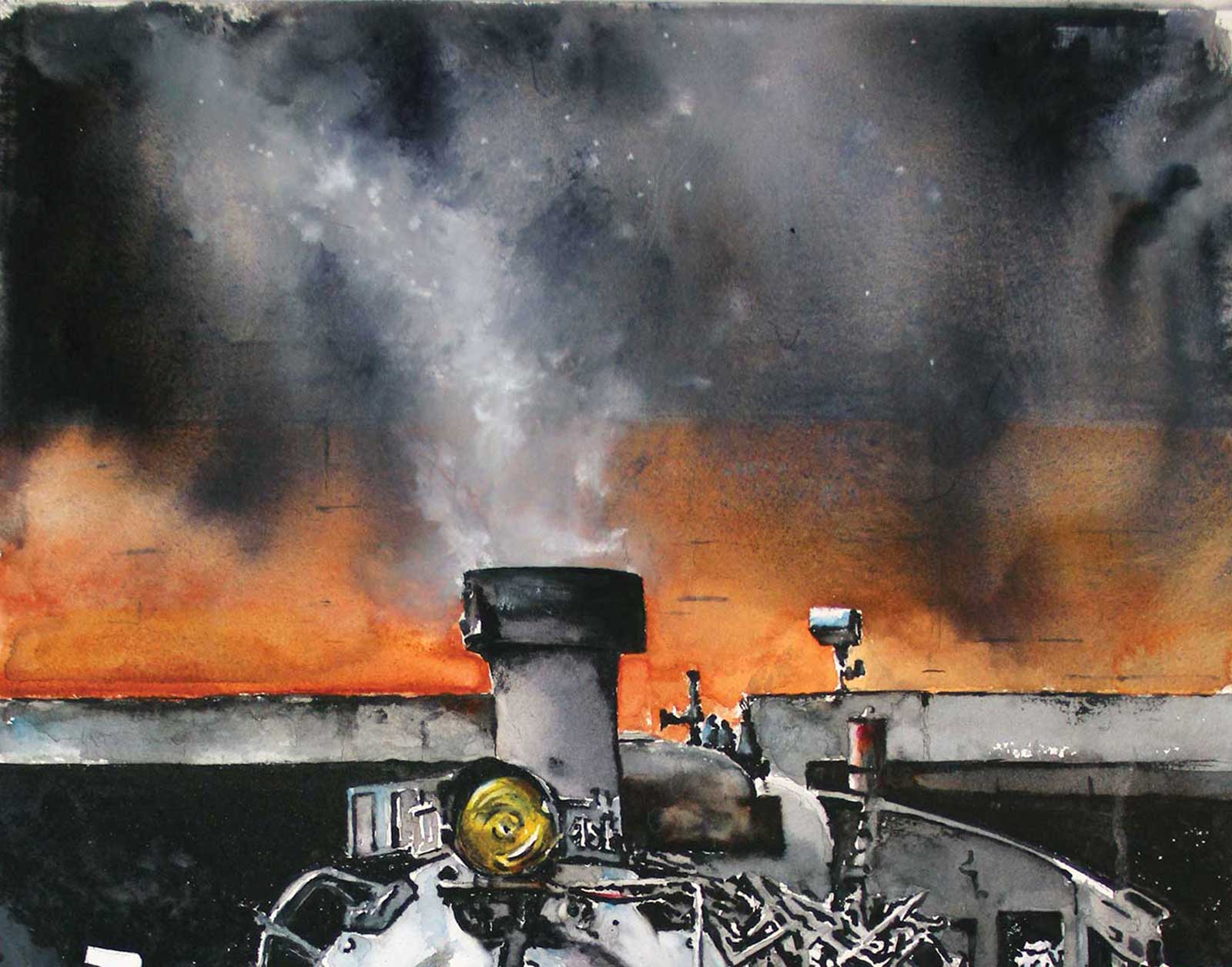 Stage 7
Stage 7 Steam and Smoke
Next, I’m adding more color, as well as the steam and smoke. I added the orange brick building using burnt sienna, vermillion and raw umber. The smoke was created using ultramarine deep, burnt sienna, neutral tint, Payne’s gray and while still wet, I added titanium white opaque. I’m using my Holbein spritzer and tilting my board, and adding white splatter with my brush loaded. The foreground was painted using the same colors.
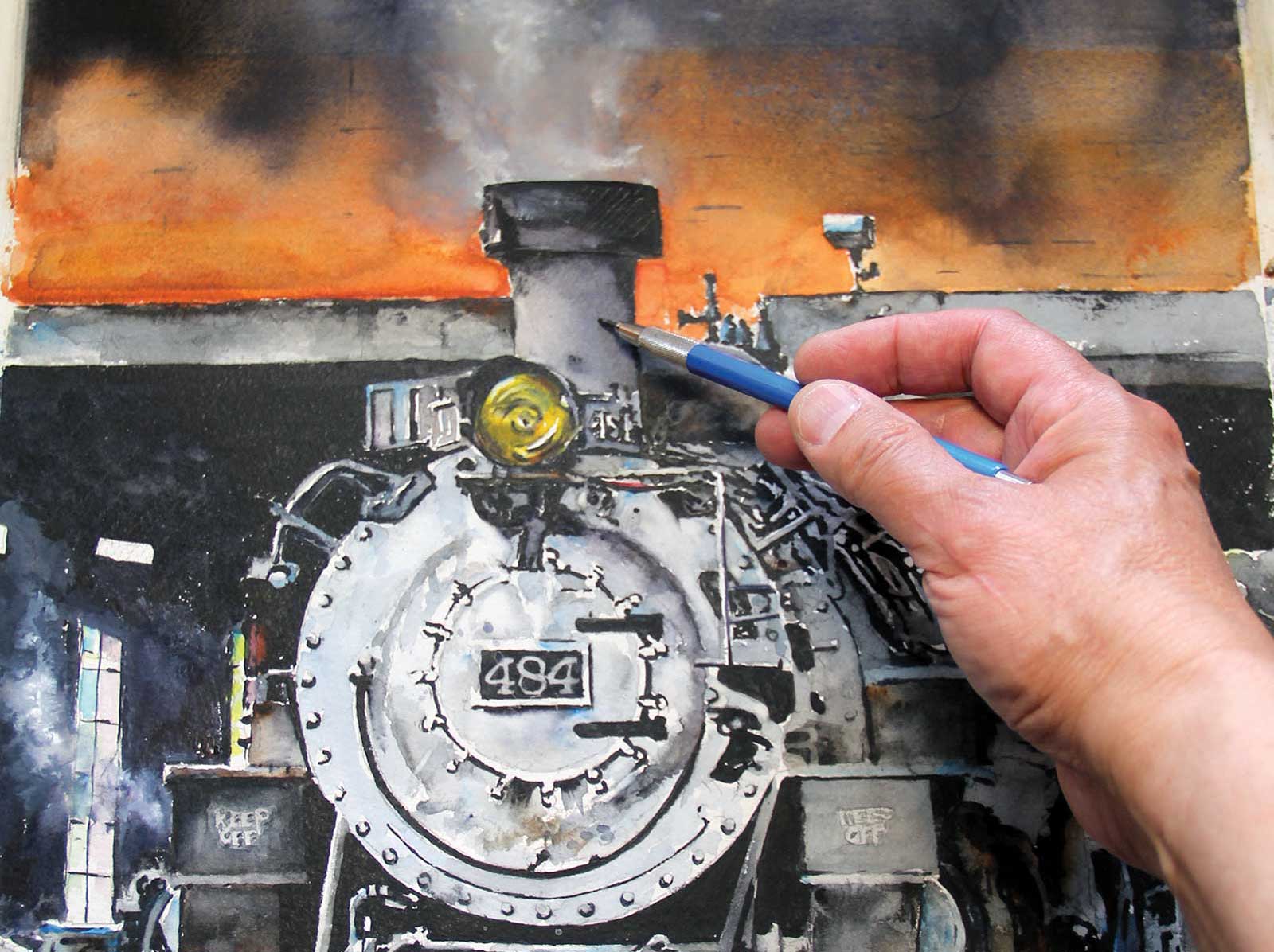 Stage 8
Stage 8 Shadows
I’m mapping out my shadows, which I used a pencil to outline.
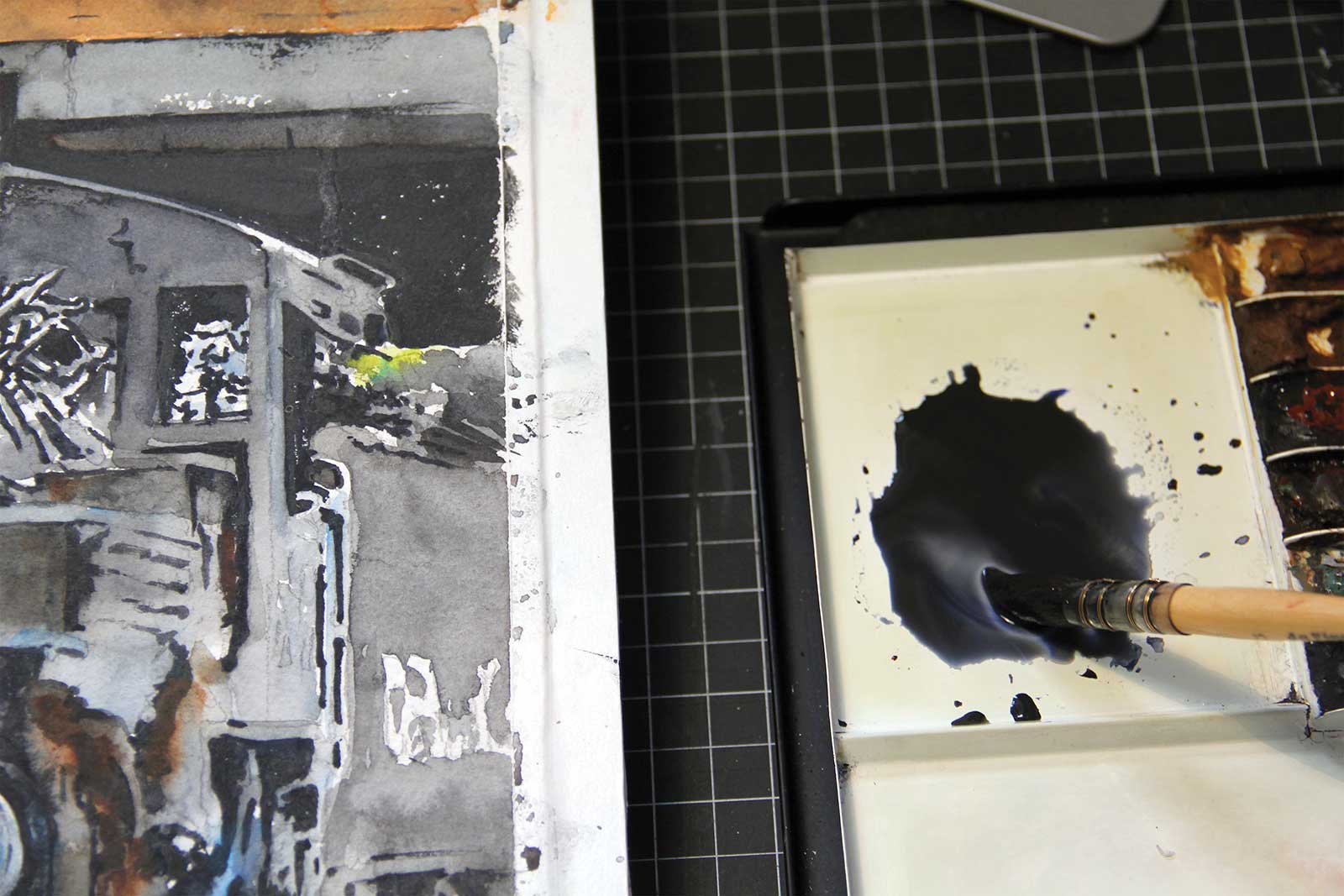 Stage 9
Stage 9 Mixing Shadow Color
Mixing my shadow color, I used a watery mix of ultramarine deep and burnt sienna. I mixed and applied with a #3 Da Vinci squirrel mop brush.
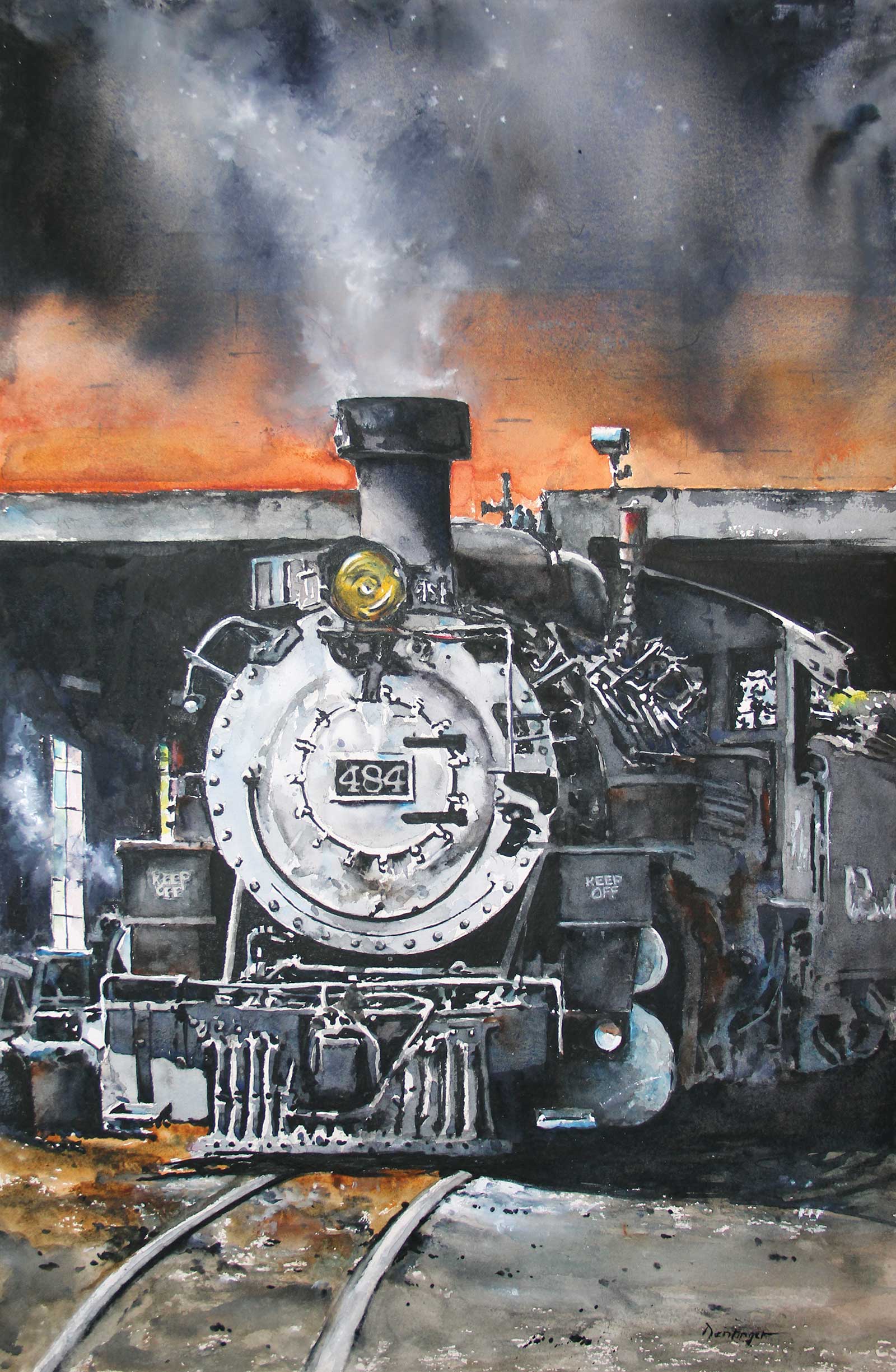 Stage 10
Stage 10 Finished Artwork
Chama 484, watercolor, 22 x 14" (55 x 35 cm)
About the artist
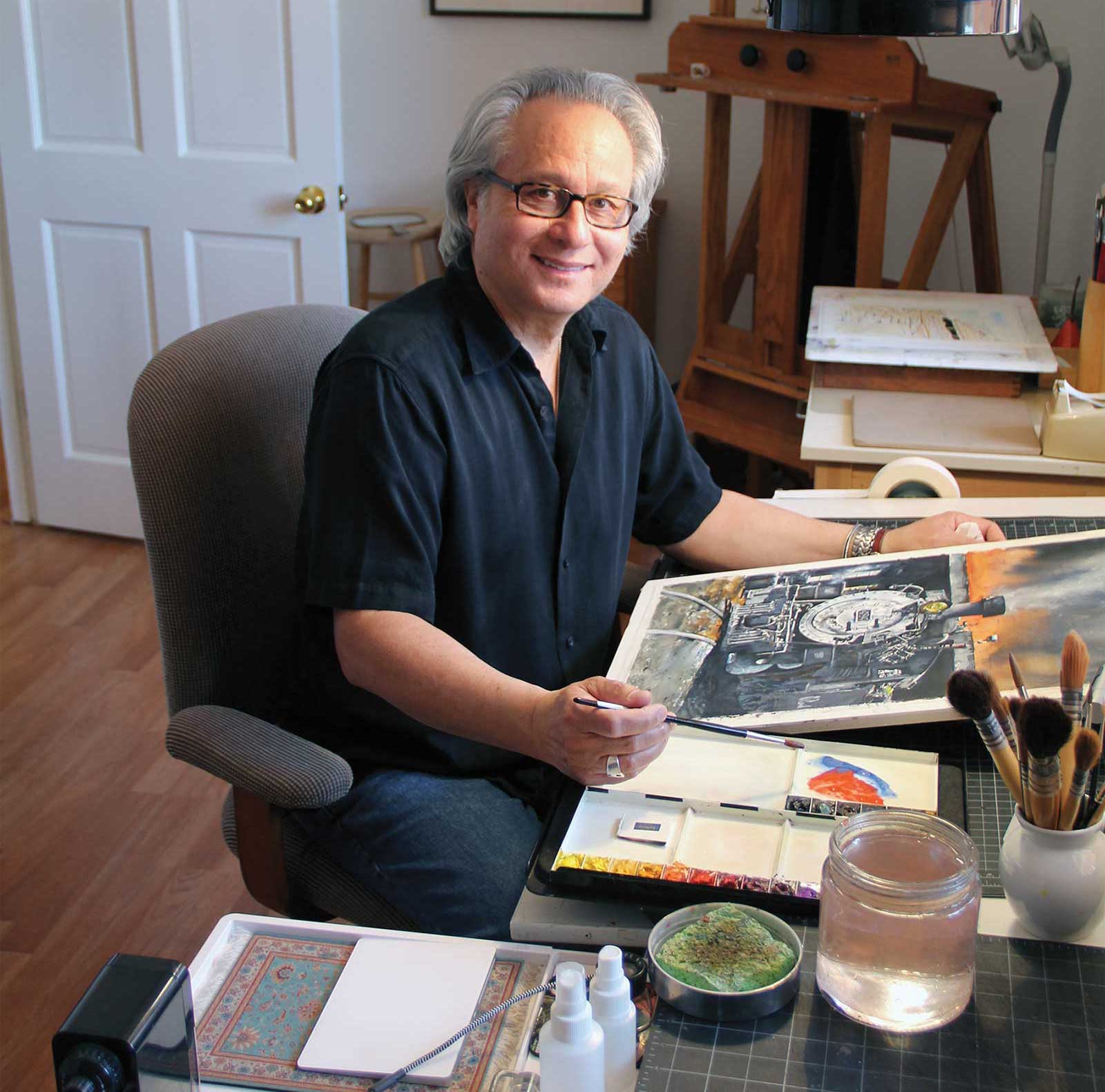 Ric Dentinger
Ric Dentinger has been painting and illustrating professionally for over 30 years while successfully balancing a career as an art director and managing his own graphic design shop. Dentinger has received numerous awards for his bold and dramatic watercolor paintings throughout the United States, including Best of Show awards in Texas and Louisiana, and others in Houston, Philadelphia, San Francisco and Seattle. He has been accepted four times in the Splash series of books highlighting today’s best contemporary watercolor artists. His work can also be found in the book Painting in Watercolor: The Indispensable Guide.
Dentinger has taught many workshops throughout the United States and offers online group classes. From 2009 to 2020, he was on the faculty of the Southwest School of Art in San Antonio, Texas. In 2018, Dentinger was selected as a Centennial Painter with the Art of Texas Parks Project, celebrating the 100th year anniversary of the Texas State Park System. His work is featured in a book published by Texas A&M University Press commemorating the Texas State Parks Centennial.
Represented by
Worrell Gallery, New Mexico, USA, www.worrellgallery.com
Hunt Gallery, Texas, USA, www.huntgallery.net
Contact at
www.dentingerfineart.com