Most of my landscape paintings are imaginary. It is my preferred way to work because there are no limitations as to what I can paint. I don’t have to locate the perfect subject and composition in nature, I can find it in my imagination. However, these paintings are based on subjects I’ve seen or painted from life over many years. To understand my subject on a level deep enough to give my imaginary landscape paintings a high degree of authenticity, a great deal of time is spent plein air sketching. I actually call these plein air works “field studies” because I don’t necessarily consider them finished paintings. Though composition and other artistic concerns are considered, I am mainly looking for an interesting subject to study—it may be a fascinating cloud or rock formation, an interesting building or boat or the colors of a purple mountain range at sunset. The purpose of these studies is to “dissect” the landscape and reassemble it on my panel with paint, which requires analyzing each object in the landscape to determine its shape, color, value, texture and edges. The result is that after years of study, I have become a visual botanist, meteorologist, geologist, architect, builder, farmer, cowboy, mariner, etc. By painting field studies, I understand how light interacts with objects in the landscape, and this helps create the mood and composition of the studio painting as well as giving form to the objects depicted. I have gained enough knowledge to construct imaginary and believable landscapes in the studio, providing for great freedom of expression.
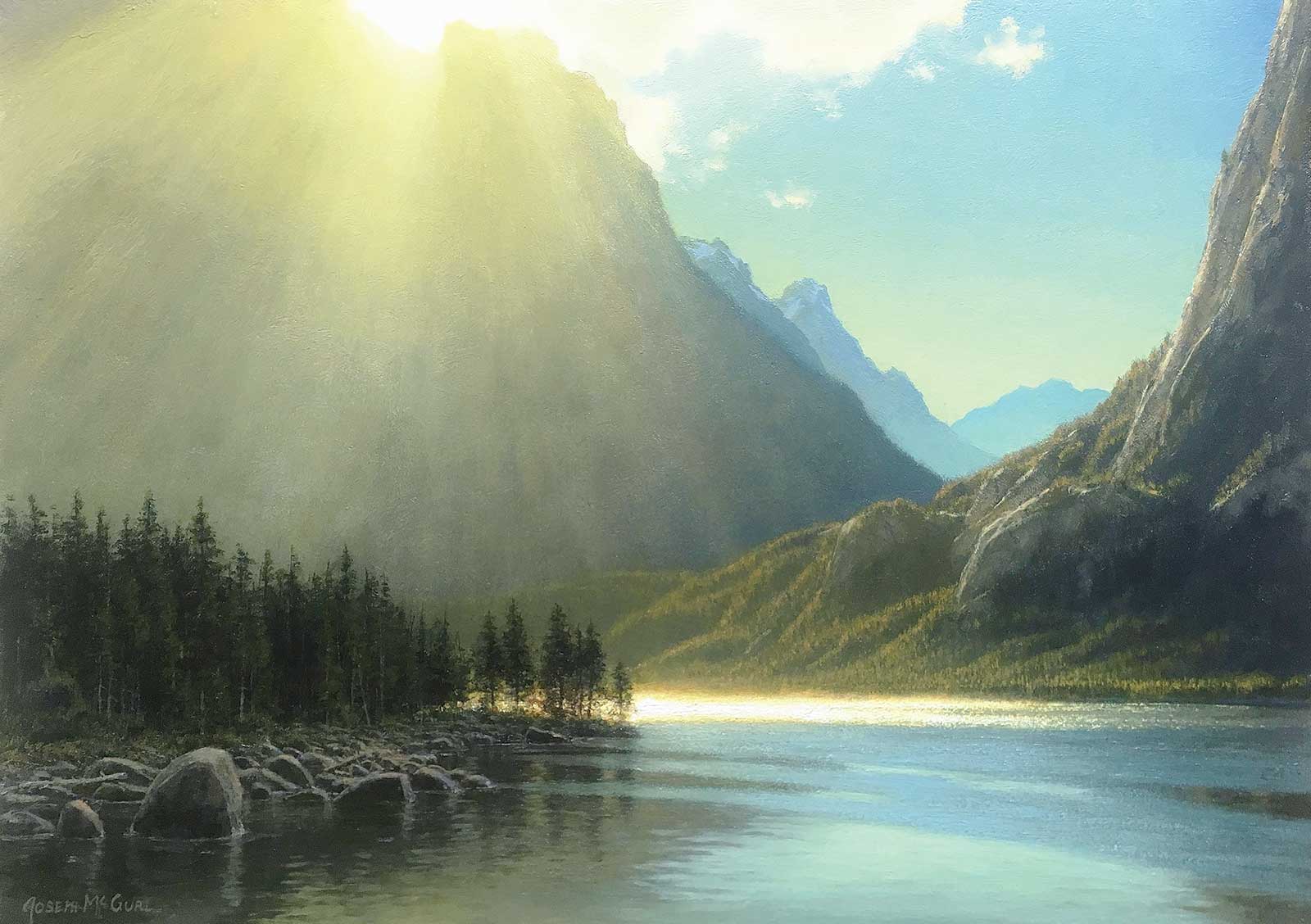
Light in the Mountains, oil on panel, 14 x 20" (35 x 50 cm) The challenge of this painting was to paint sunlight—or rather, the effect of sunlight. To create that sensation, colors and values have to be modified, usually by deepening the values and cooling the chroma throughout the painting except for where the sunlight is strongest. In those areas, the colors will be warmer and values much lighter. By doing so, paint can approach the appearance of a bright sunlit afternoon in the mountains.
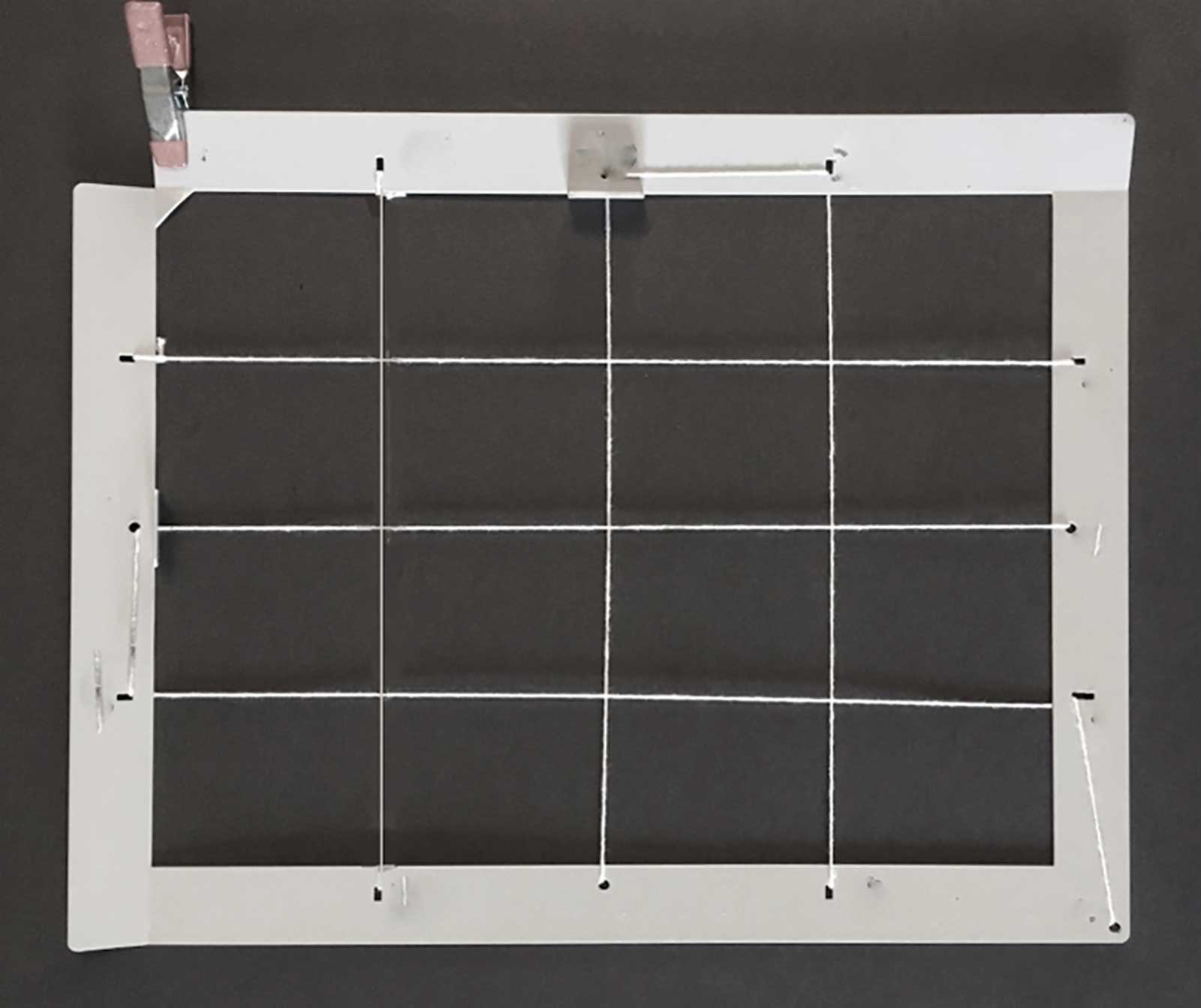
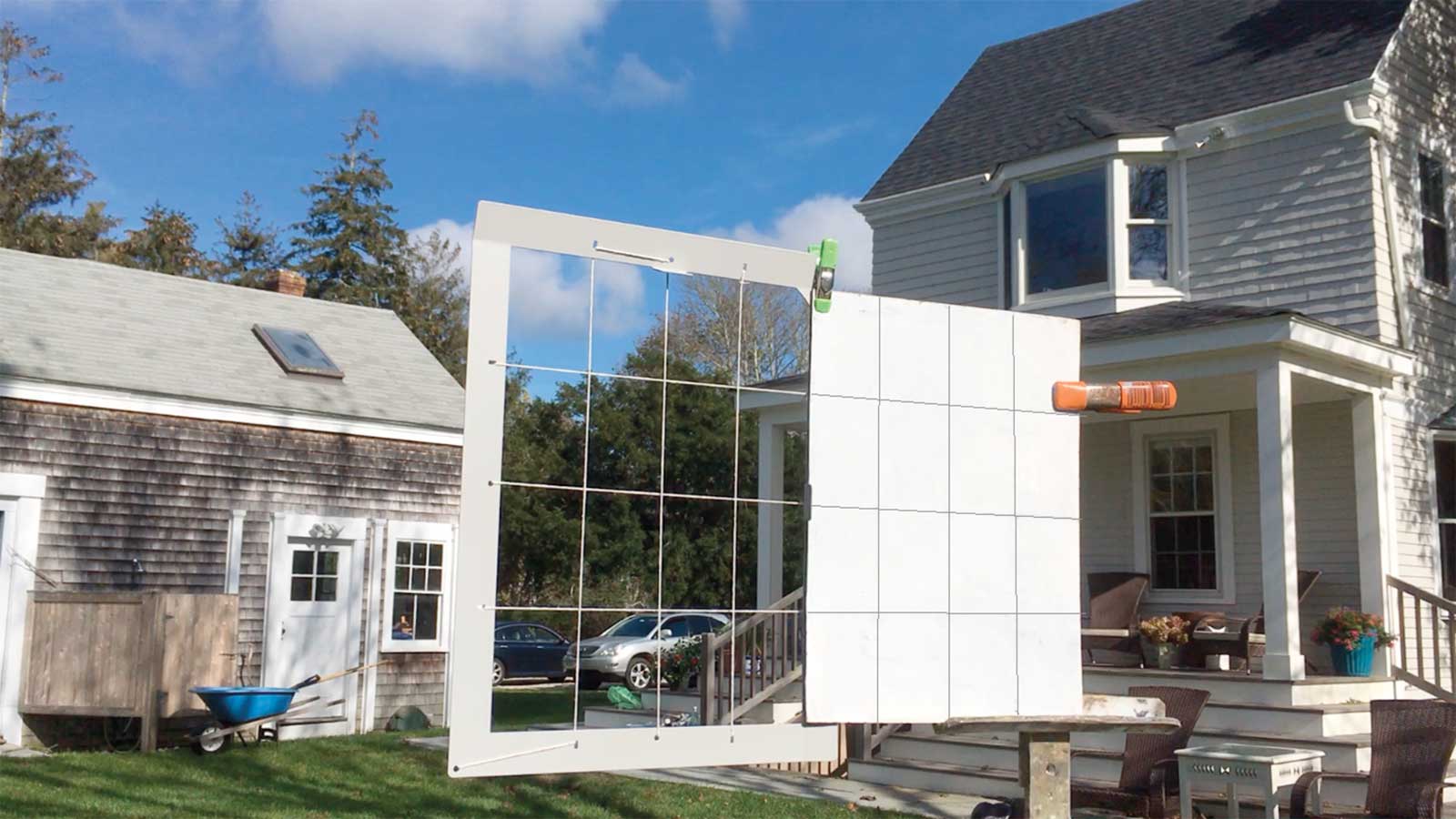
Unlike studio painting, the environment outdoors changes rapidly. This requires painting quickly and accurately as the subject is never static—the sun, weather, tide, etc., are constantly changing, and objects can sail, walk or drive away. When beginning a painting, I estimate how long the conditions will be relatively stable and adjust my approach to interpret with paint on canvas or panel the required elements. On a cloudy day, it may be a few hours, and at sunset it may be a few minutes. To paint more quickly and accurately, I have designed and built a sight-size viewfinder. This device is a metal frame with a string grid attached. It is the same size as the painting panel and attaches to the side or top of the panel. The view seen through the viewfinder is painted on the adjacent panel. It also works well with interior subjects including the figure and still life where speed isn’t important but accuracy is.
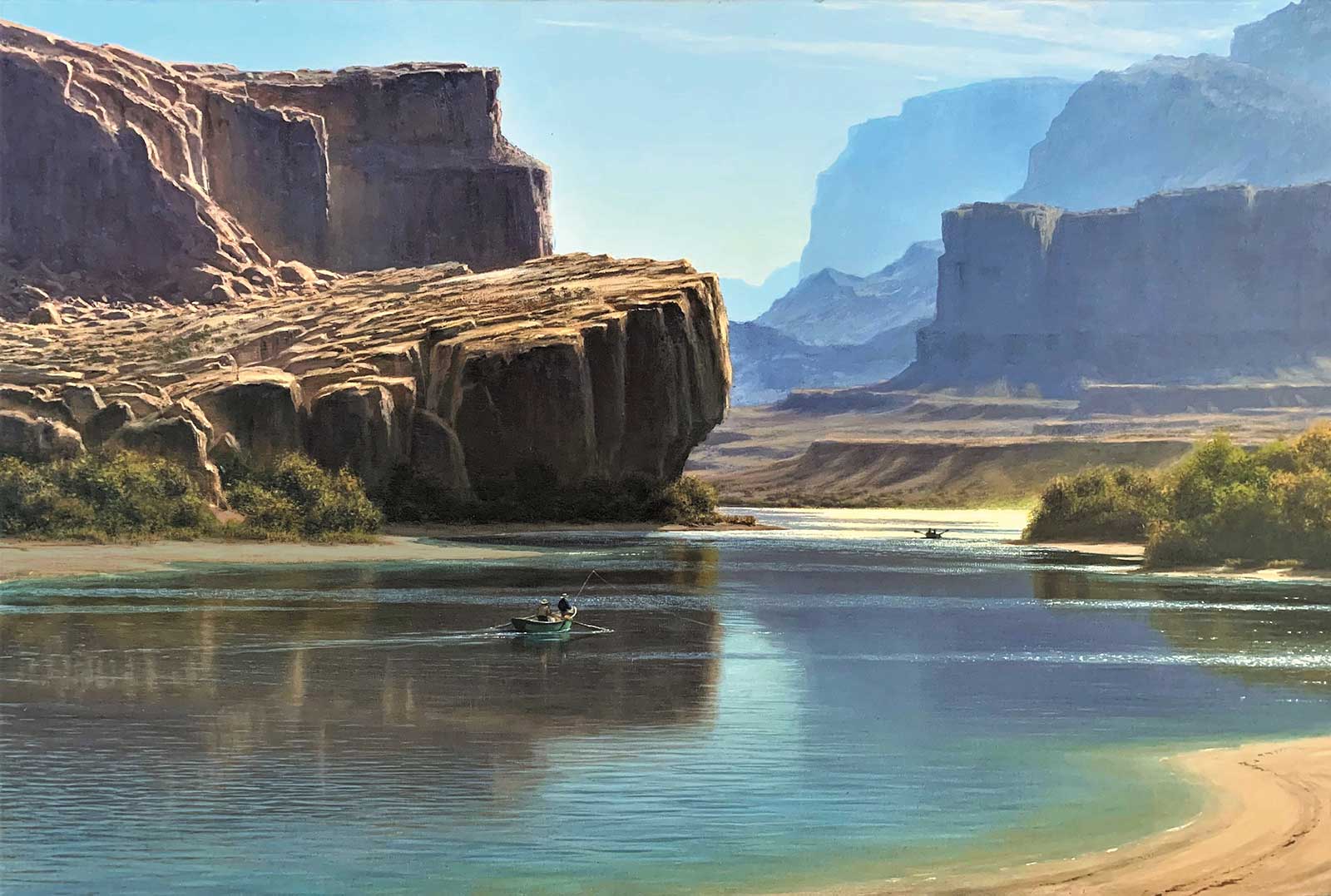
Drift Boats on the Colorado, oil on linen, 20 x 30" (50 x 76 cm) This scene is similar to a sketch I made of the river, but there was a great deal of rearranging the mountains and changing their shapes to make a stronger composition. This is also important to creating a great sense of space and depth. There were some outboard powered rubber rafts motoring down the river. I changed them to drift boats as they’re more interesting to look at.
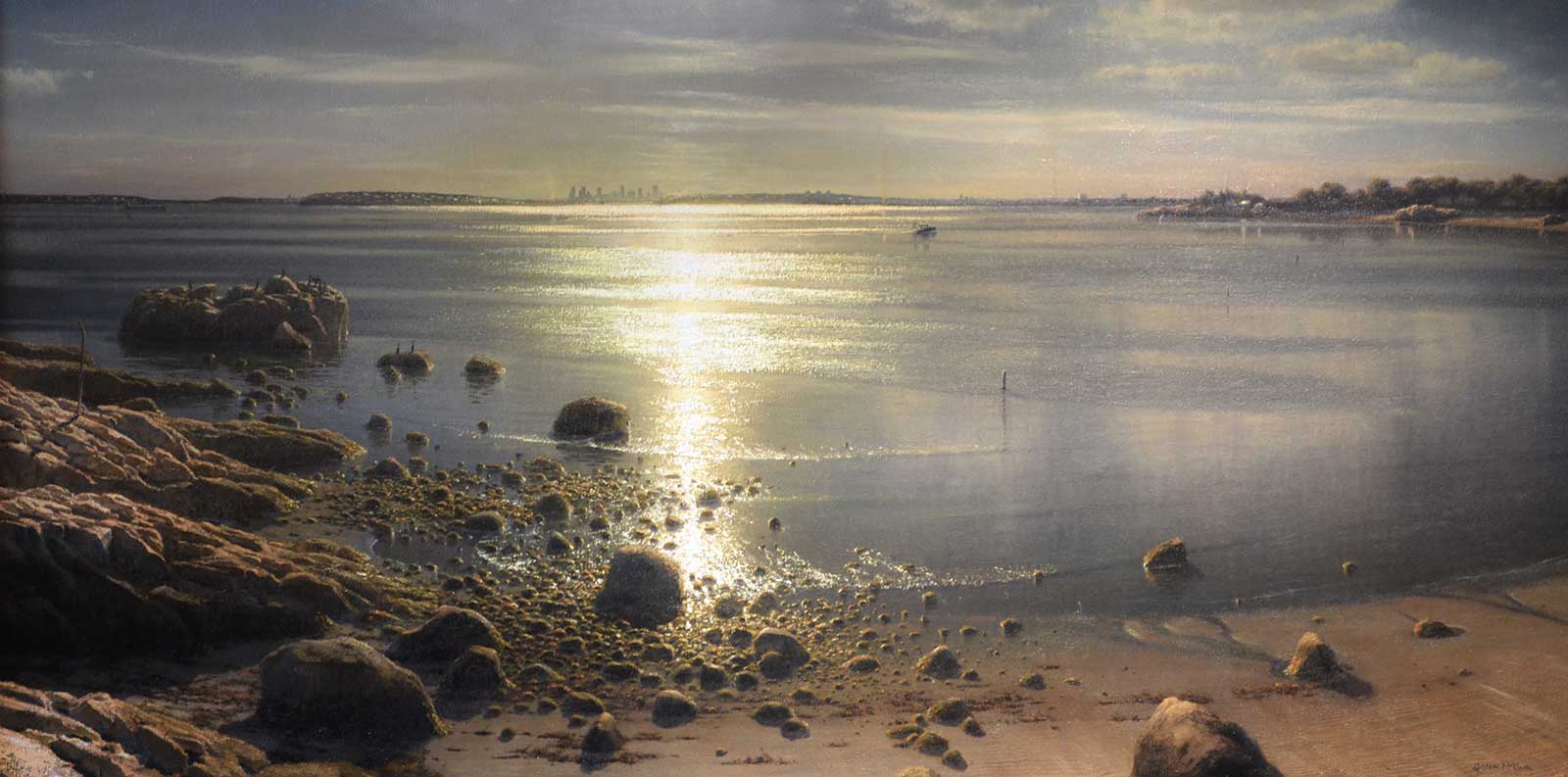
Glare on a Calm Sea, oil on linen, 36 x 60" (91 x 152 cm) This was a commission, so remaining faithful to the topography was necessary. I painted at the site for several days to get a feel for the setting and to observe what light and tide possibilities would give a sense of space, light and atmosphere. I combined aspects of several sketches and used just a bit of artistic license to create a composition that portrayed the unique and subtle qualities of that location.
The sight-size viewfinder was originally made for my own use, but when teaching workshops, I wanted to show the students my working methods. When they saw how well it worked, they also wanted to use one, so I made some for the class to use. Finding the viewfinder helpful, they wanted to take them home. I had a company make them and now sell them on my website. The viewfinder helps artists define the composition and draw more accurately and quickly, which is especially important when working outdoors.
My Art in the Making Grace’s Barn
 Stage 1
Stage 1 Viewfinder
The viewfinder is constructed of powder coated steel, and the view through the frame measures 9 by 12". That is the size I usually use to paint on location as it allows me to record enough information before the conditions change too drastically. There is a tab on one side that hooks onto the panel, and the two clips are used to attach it to the side or top of the panel.
 Stage 2
Stage 2 Grid
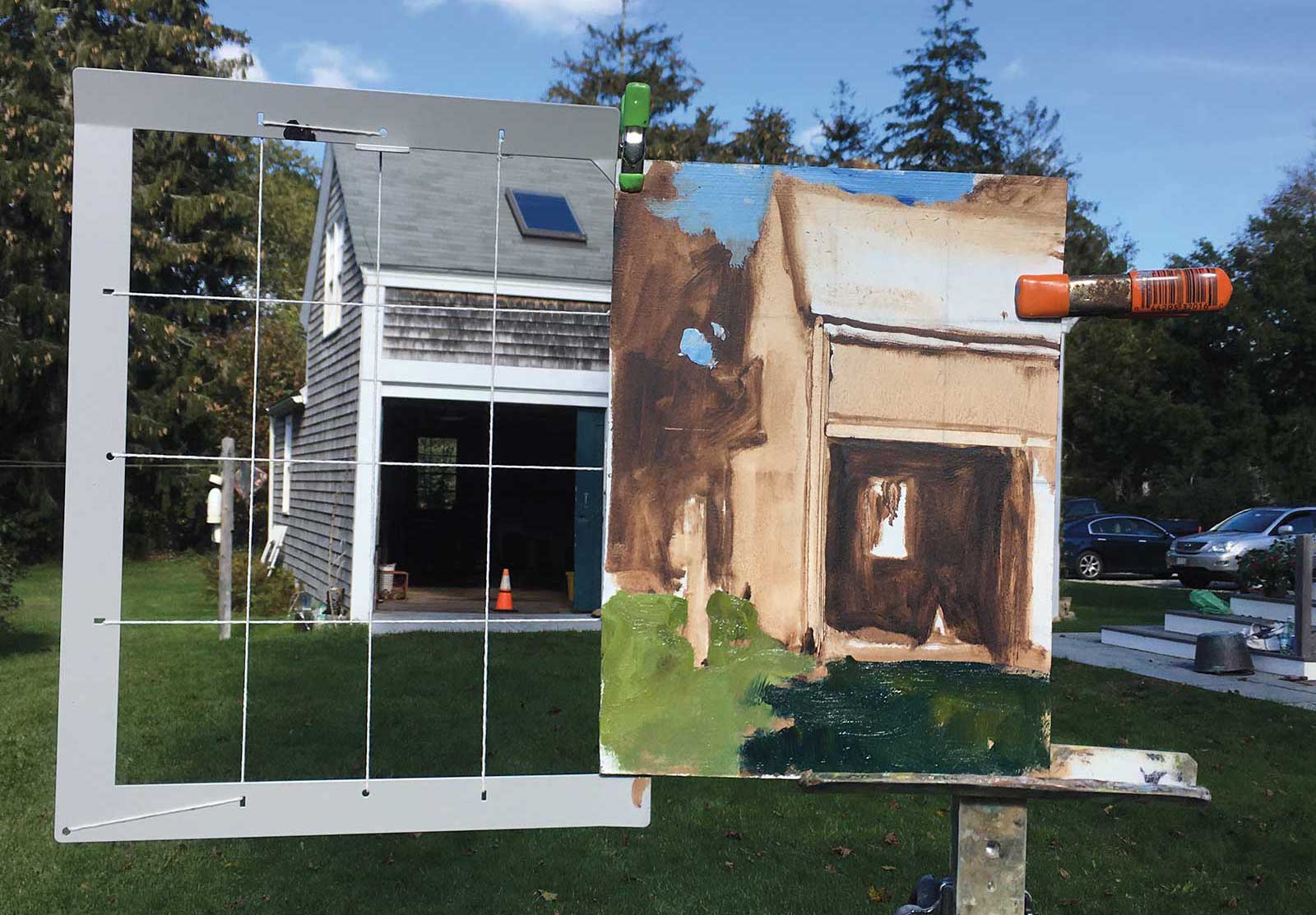
The viewfinder is attached to the panel with clips. I position myself so the scene I am painting is visible through the viewfinder with the panel right next to it. A grid is drawn on the panel corresponding to the one on the viewfinder. I can then draw square by square, which helps the drawing proceed more quickly and accurately. Because the painting and viewfinder (framed subject) are seen side by side and are the same scale, it is easy to make comparisons and adjust the drawing to be more accurate.
 Stage 3
Stage 3 Blocking in Large Shapes
I tone the panel with umber, and then begin blocking in the large shapes first. The paint is kept thin so any alterations are easy to make. I am comparing what is seen through the viewfinder with what I am painting on the panel. I also close one eye while drawing, so there is no “binocular vision,” which would make the image appear to move.
Strategies for Creating My Individual Style
I am constantly striving to create the highest sense of reality. This doesn’t mean in a literal sense where every detail is rendered in precision, but it’s more of a spiritual and emotional sense. I have been drawn to landscape painting because I feel a deep and personal connection to the landscape. In addition to being truthful to its visual appearance, I am trying to infuse my pictures with that higher sense of reality—to paint a living tree that will die in autumn and bloom again in the spring; water that has motion, weight, depth, reflection and transparency; a sky that has no color except that which the sun’s photons and atmosphere’s particles bring to it. In a quest for this higher reality, I don’t use photographic reference. I am trying to portray my response to the real world, not a static, flat visual representation of it, and time spent in intense observation while executing the field studies develops a deeper understanding of and connection to the subject.
Once I have the concept, whether it is directly from a sketch, from my imagination or a combination of the two, I draw it out in graphite on a sheet of paper. I then enlarge and transfer the drawing to the canvas and complete an underpainting in black and white acrylic gesso, allowing me to see the composition in terms of value without the distraction of color. When I am satisfied with the composition, I start adding color. On an abstract level, these paintings are also about the study of light, form, space and color interpreted through paint. It is important for this paint to exist as an interesting surface in its own right. To achieve this, I use several techniques such as thin glazes, thick impasto, scumbles and sgraffito. I give the illusion of detail by manipulation of the paint and of the surface texture and then carefully render only the most important features. I believe this gives a sense of life to my paintings rather than having everything rendered in static detail.
 Stage 4
Stage 4 Approximate Colors
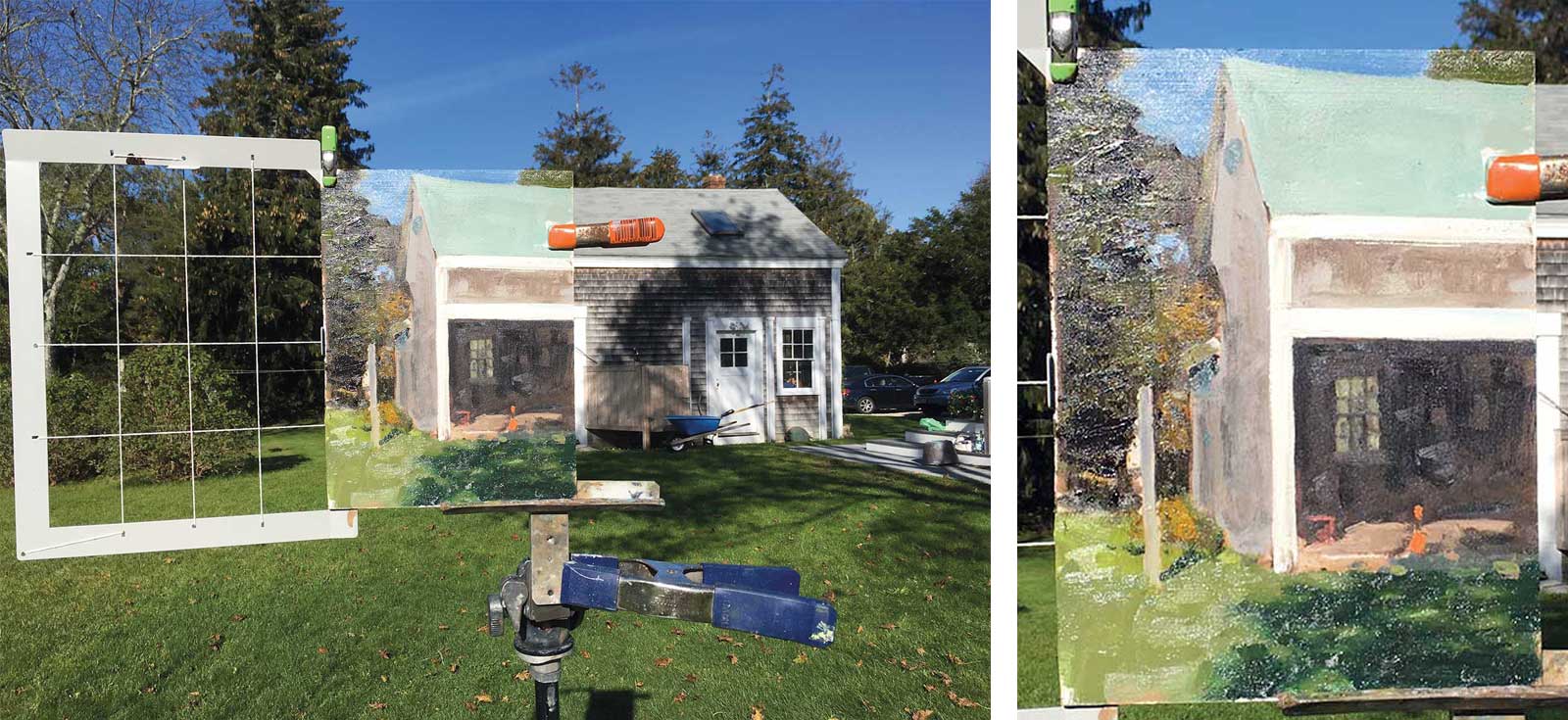
After the large shapes are drawn, the approximate colors are applied. This painting session was in the late afternoon, and the shadows and colors are changing as I work, so I don’t want to finish any one part and have it be out of sync with the colors and shadows of the other parts of the painting. It is important to keep the whole painting progressing at the same pace as much as possible.
 Stage 5
Stage 5 Slight Corrections
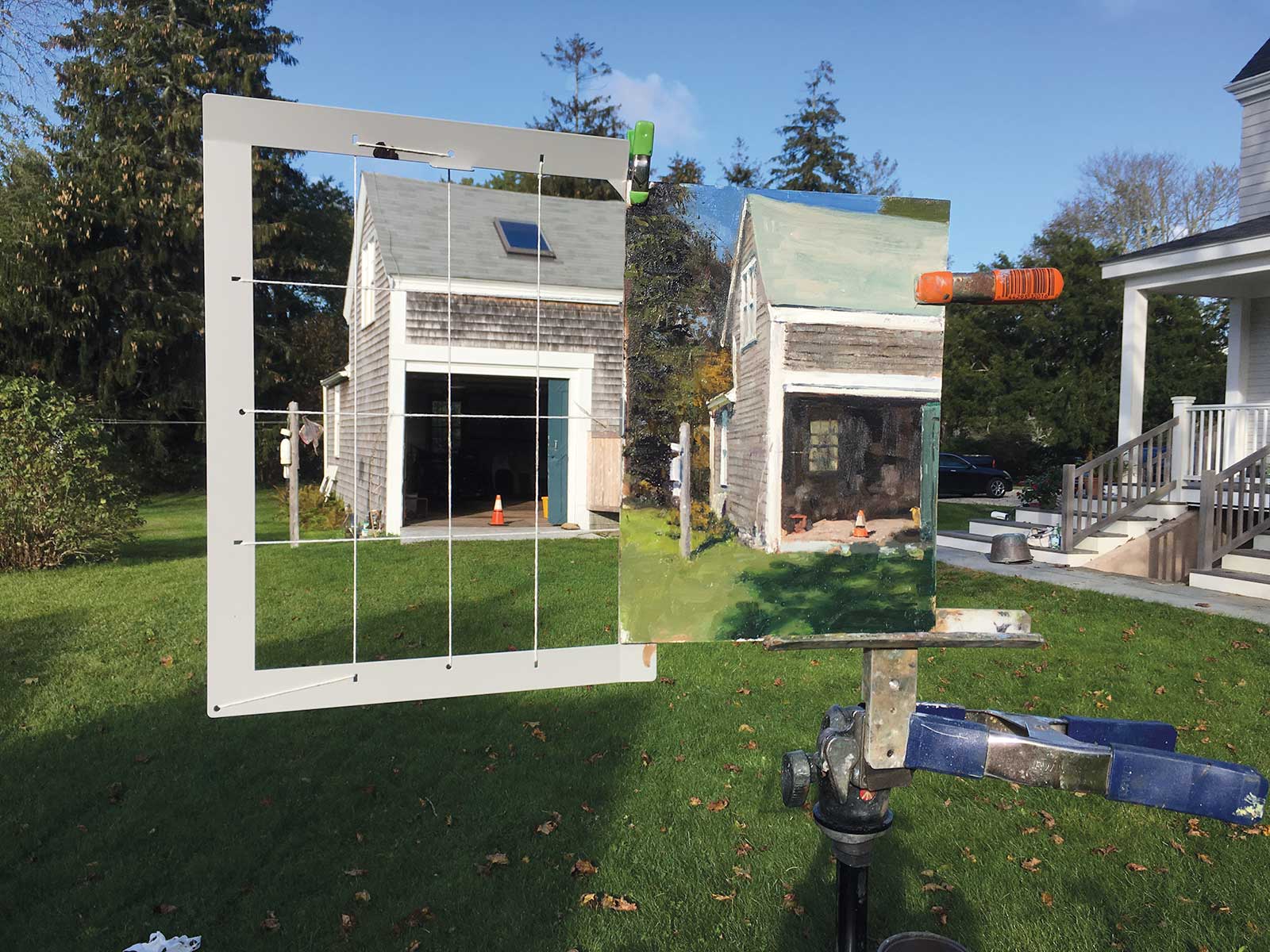
At this stage, there is not much more I can do in the field as that shadow in the foreground will be moving up the building soon. By comparing side by side, I can easily see any corrections that I may want to make. For instance, changing the color of the roof; the lighter green color looks better, so I left it as is. I now have enough information to complete this study in the studio.
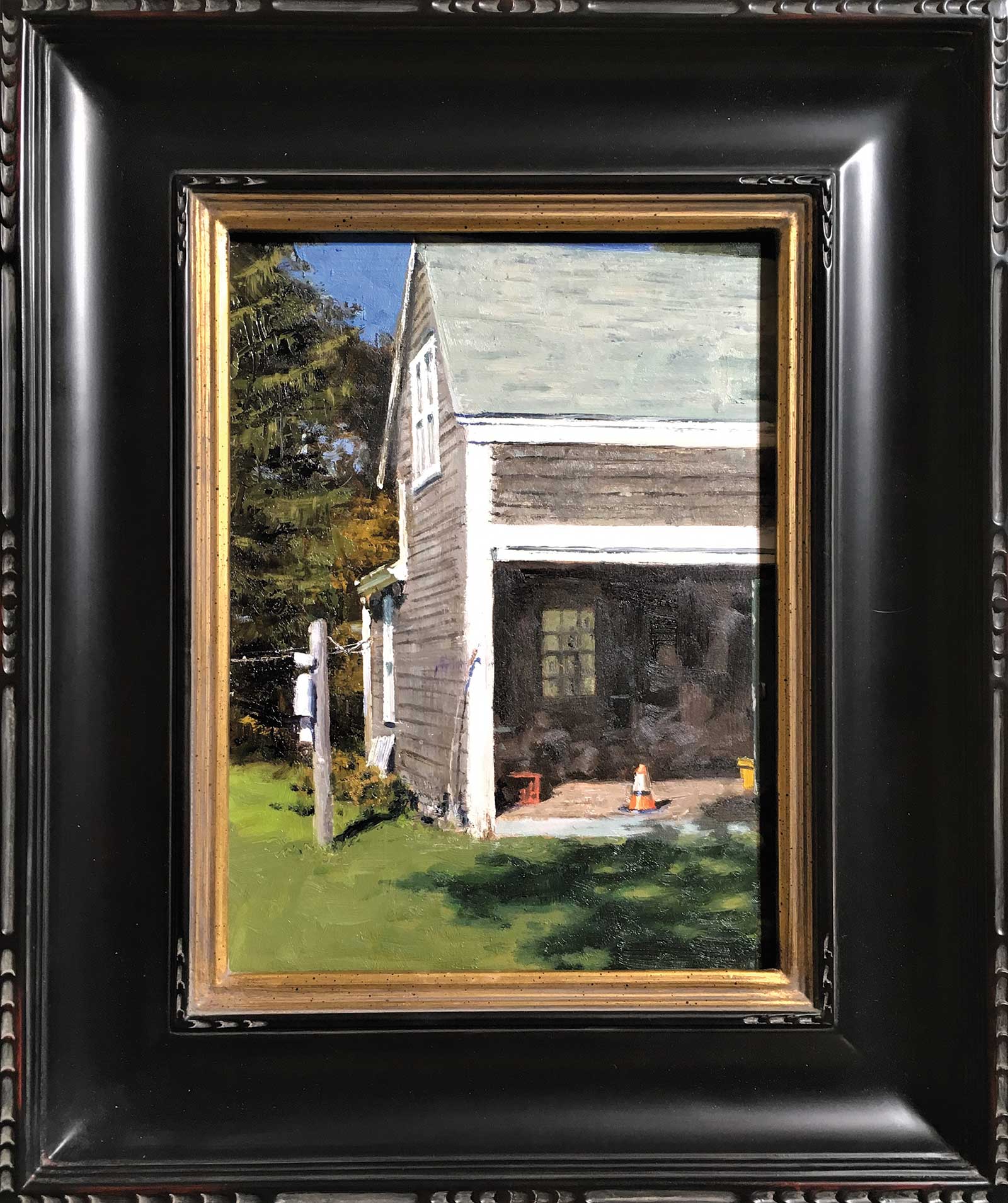 Stage 6
Stage 6 Tidying Up
Some parts of the painting were neatened up, and a few small details were finished in the studio. As mentioned before, these studies are not necessarily finished paintings. However, they often turn out well, and I do finish, frame and sell some of them. As a working artist, I cannot afford to spend the required time on these studies without finding a way to make it profitable.
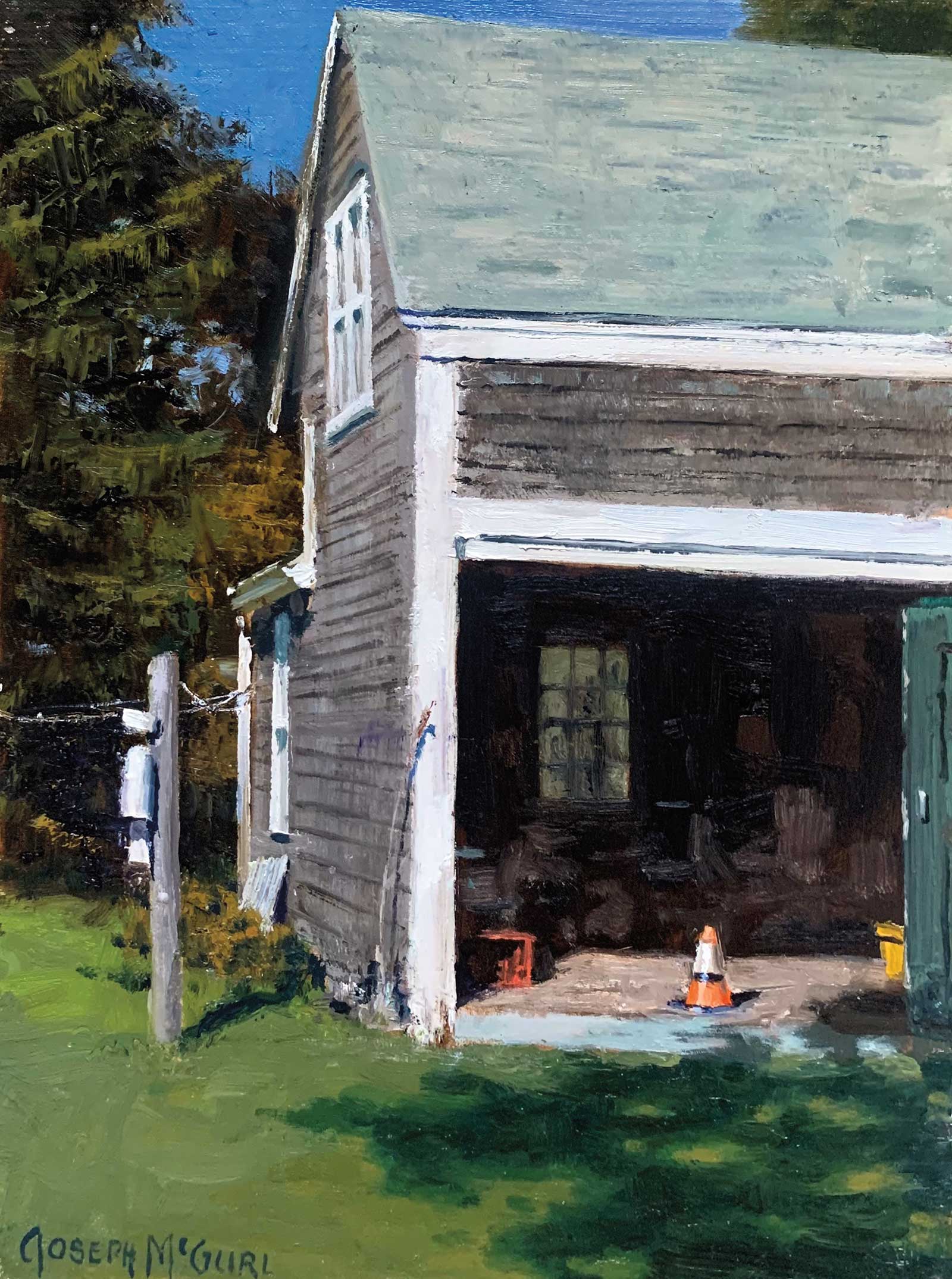 Stage 7
Stage 7 Finished Artwork
Grace’s Barn, oil on panel, 12 x 9" (30 x 22 cm)
About the artist
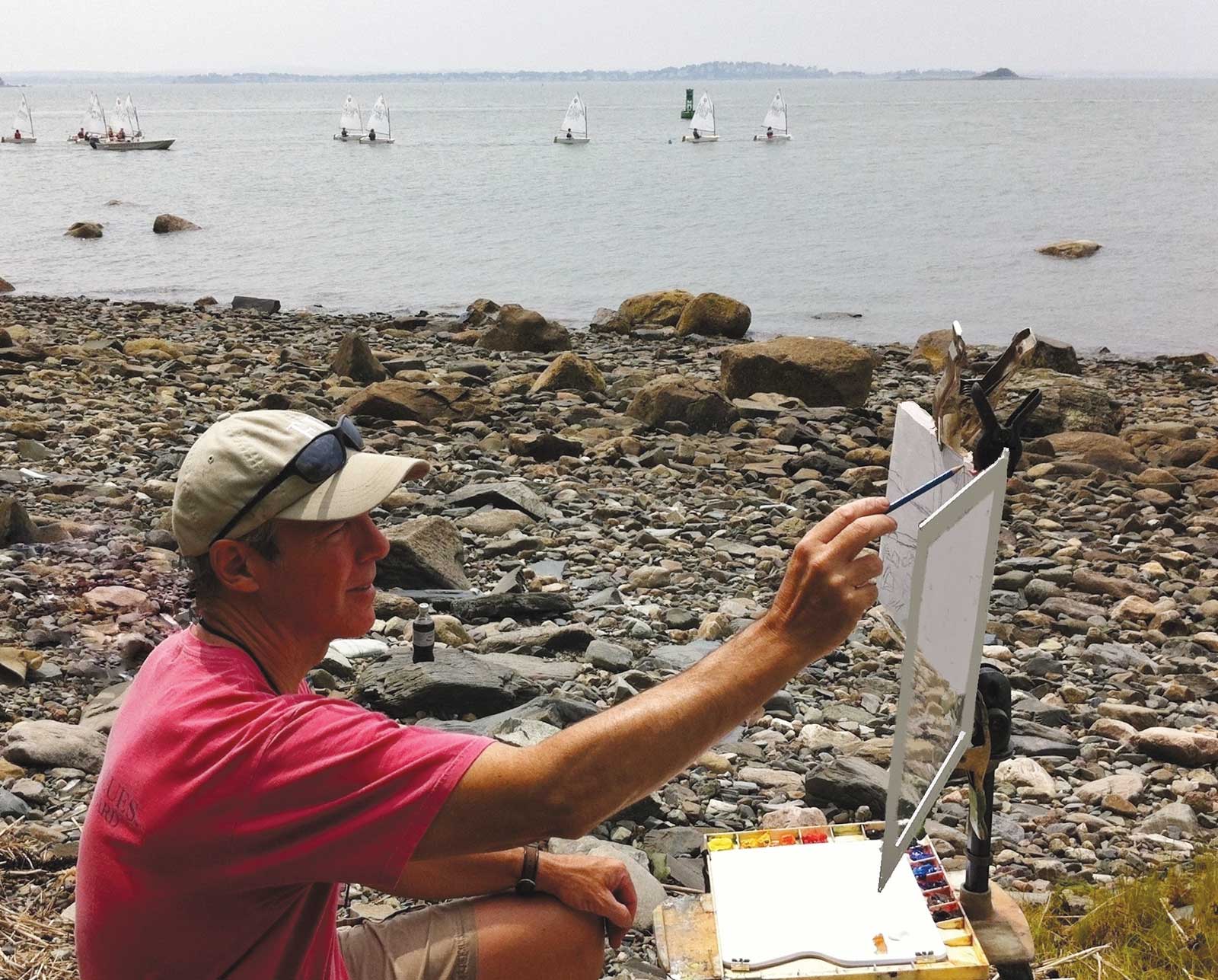 Joseph McGurl
Joseph McGurl’s artwork has been exhibited and collected by museums throughout the country. He has been designated a Living Master by the Art Renewal Center and a Copley Master by the Copley Society of Boston. McGurl is also an elected member of the Guild of Boston Artists, the Salmagundi Club and Plein Air Painters of America, and is a past fellow with the American Society of Marine Artists. His many awards include two first place in landscape awards and a purchase award from the Art Renewal Center, the Guild of Boston Artists Gold Medallion, first place and patrons’ choice in the Laguna Plein Air Invitational, two patrons’ choice awards from the Coors Western Art Show, and the John Singleton Copley Award for Artistic Achievement. His two DVDs produced by Streamline Publishing are best sellers.
McGurl is represented by Principle Gallery in Virginia, Cavalier Galleries in New York and Florida, Palm Avenue Fine Art and Marine Arts Gallery in Florida, as well as Collins Galleries, Folly Cove Fine Art and Guild of Boston Artists in Massachusetts.