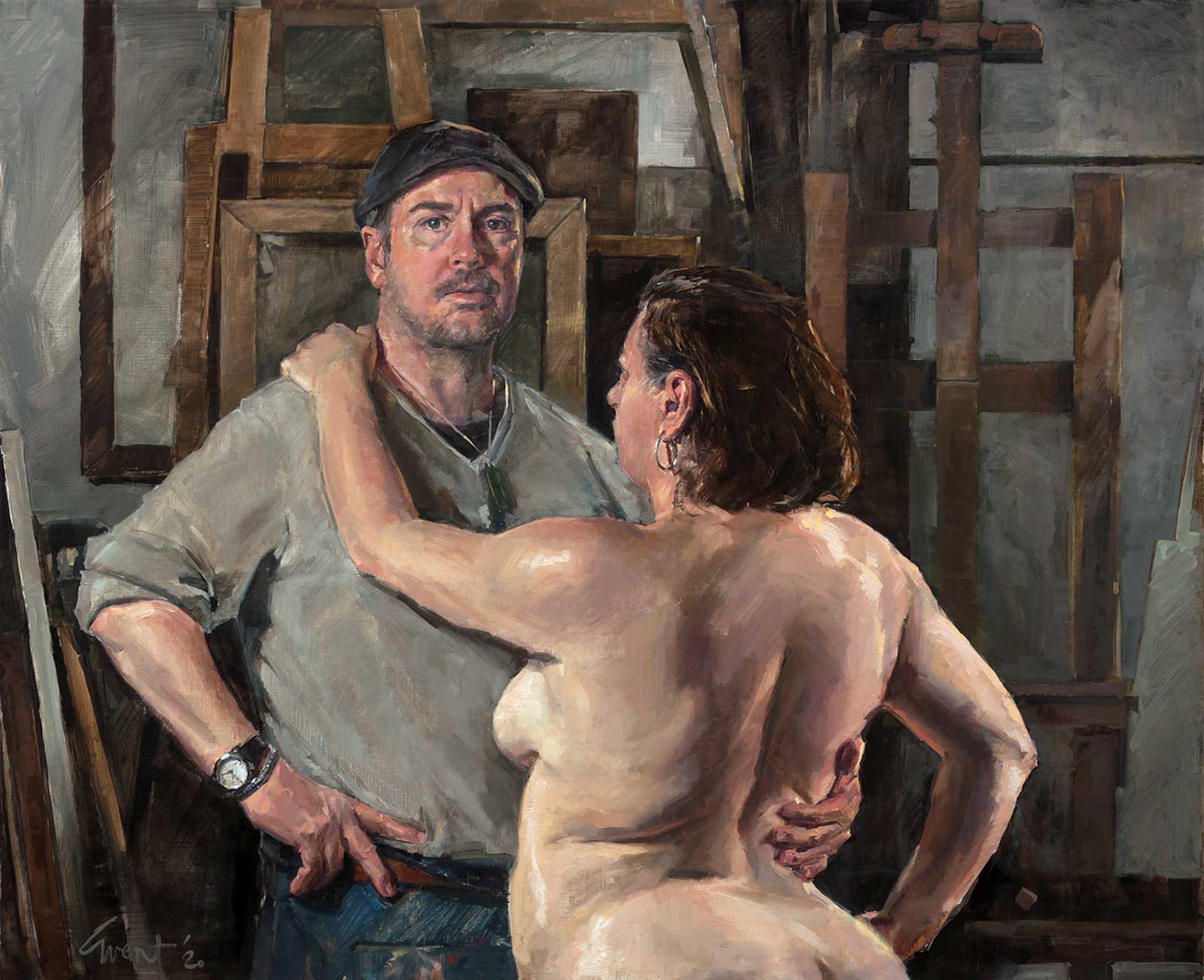
 Eternity - Self Portrait with Ivana, oil on linen, 40 x 48" (102 x 122 cm)
Evert Ploeg
Inspiration
Manly Regional Art Gallery & Museum in Sydney, Australia, celebrated its 90th anniversary in 2020. I was selected, along with other working artists from the Manly area, to create a self-portrait to mark the event. I wished to go beyond my facial features and to include a further narrative that evoked who I am and how my life and art are intertwined. I am not who I am today without my partner Ivana—ours is a symbiotic relationship, complementing each other from bringing up our two daughters to how we talk and discuss what is on the easel. She inspires me, challenges me and supports me.
Process
Together we developed the pose and composition in the studio mirror, wanting the portrait to reflect my art practice, with Ivana symbolizing the classic figurative muse and illustrating the close connection we have as we hold each other. Painted during the Covid lockdowns, we were able to spend extended periods in the studio as I painted directly from life.
Within the pose we echo each other: hands on hips in a mirrored triangular stance. With Ivana’s arm placed on my shoulder, the infinity symbol is formed as the eye is guided in a flowing figure eight. In algebraic geometry, this figure is called a lemniscate and holds deep meaning for spirituality, love, beauty and power—a simple balance of eternity. There is a soft warm color palette throughout the portrait, including the background, with the continuation of geometric shapes that subtly represent studio objects.
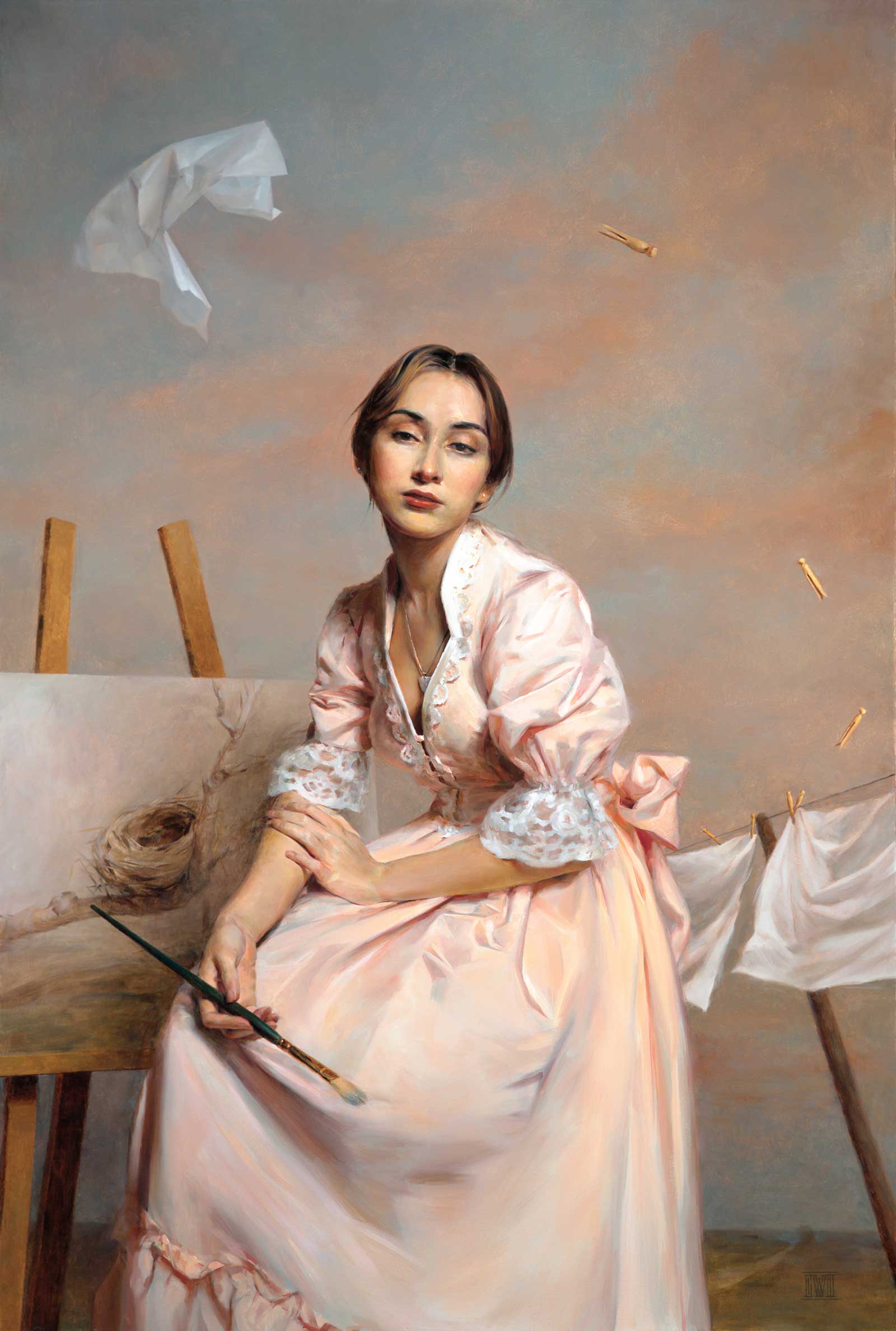 Take Wing, oil, 52 x 35" (132 x 88 cm)
Earnest Wood
Inspiration
I met Amy Baber, a gifted young artist, when her mother was seeking a professional oil painter for instruction and mentorship. Over the course of many years, I watched her grow into an accomplished artist and adult with a unique vision and voice. When she decided to attend KU for an art history degree, I asked her to sit for me, being filled with the range of sentiments many feel when navigating what it means to let go of any young charge. Her portrait became a way to meet the varied emotions of saying goodbye to a dear student: hope, loss, gratitude, celebration of her calling and excitement for endless possibilities.
Process
Take Wing was made using a limited palette in varying layers. A “ground” wash of raw umber and cerulean blue was applied to the lead oil-primed linen surface. Once the ground was dry, a less saturated, verdaccio underpainting was completed of the subject and her dress. The background was painted using only one semi-transparent color layer which became the final finish for that area. Lastly, color was applied to the portrait, beginning with her face and head. These color layers range from transparent glazes to fully opaque colors depending on the intensity and focal points desired in the painting. This blending of approaches is a subtle nod to various art historical movements in oil paint application.
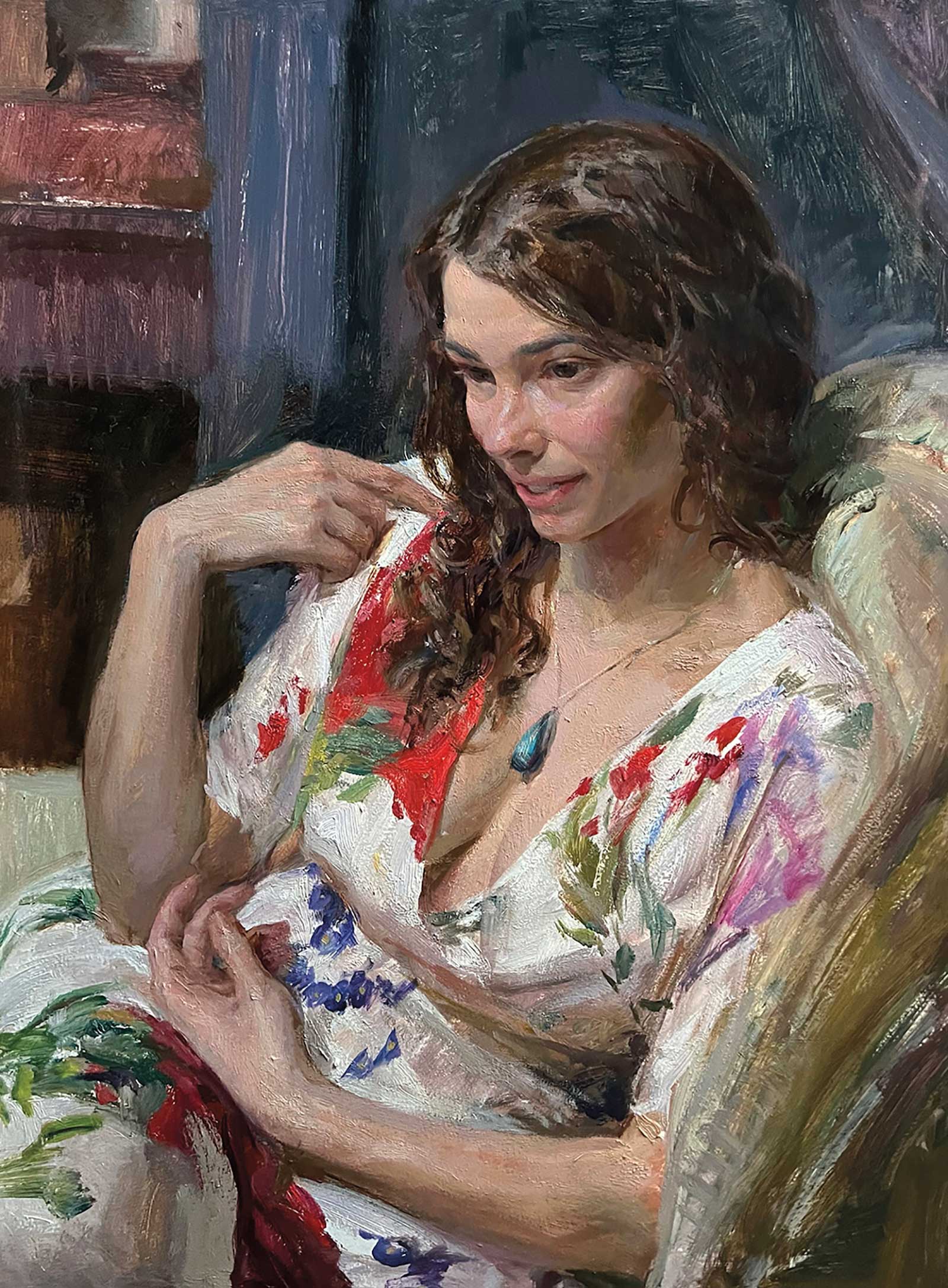 The Seer, oil on panel, 24 x 18" (60 x 45 cm)
Palden Hamilton
Inspiration
I met Noelle when she modeled for the figure drawing class I taught at MICA. I was first struck by her physical strength and grace, and through conversing with her during subsequent painting sessions, I became increasingly intrigued by her inner world. Noelle navigates through life relying on intuition and a spiritual sense, in contrast to my more literal, logical mode of being. For hours, we talked about her experiences with astrology, sound baths, ecstatic dance and other subjects mostly foreign to me. The title, The Seer, comes from oracle card readings she did for me after our sessions, whose outcomes surprised me with their personal pertinence. Painting her seemed increasingly like trying to pin down something immaterial or fleeting, and so the pursuit became a mild obsession for me. I made several failed paintings of her. Artist friends whispered that I was scared to paint her. This painting is the closest I’ve come to “capturing” her.
Process
I’ve insisted on painting from life (without photo reference) these past few years. I’ve found that working in the presence of the person, place or thing I’m painting links an experience with the resultant image, which is a magical component of representational painting. My friend, Karen Warshal, shares this insistence. She arranged this particular sitting in her beautiful north-lit studio in Baltimore, where the portrait was painted over roughly four sessions. Noelle’s subtle smile was a unique challenge:
I questioned at times whether it was possible to paint it without it looking cheesy or wooden. Sargent’s quote about mouths in portraits consoled me during my struggle. I’ll try again in the near future.
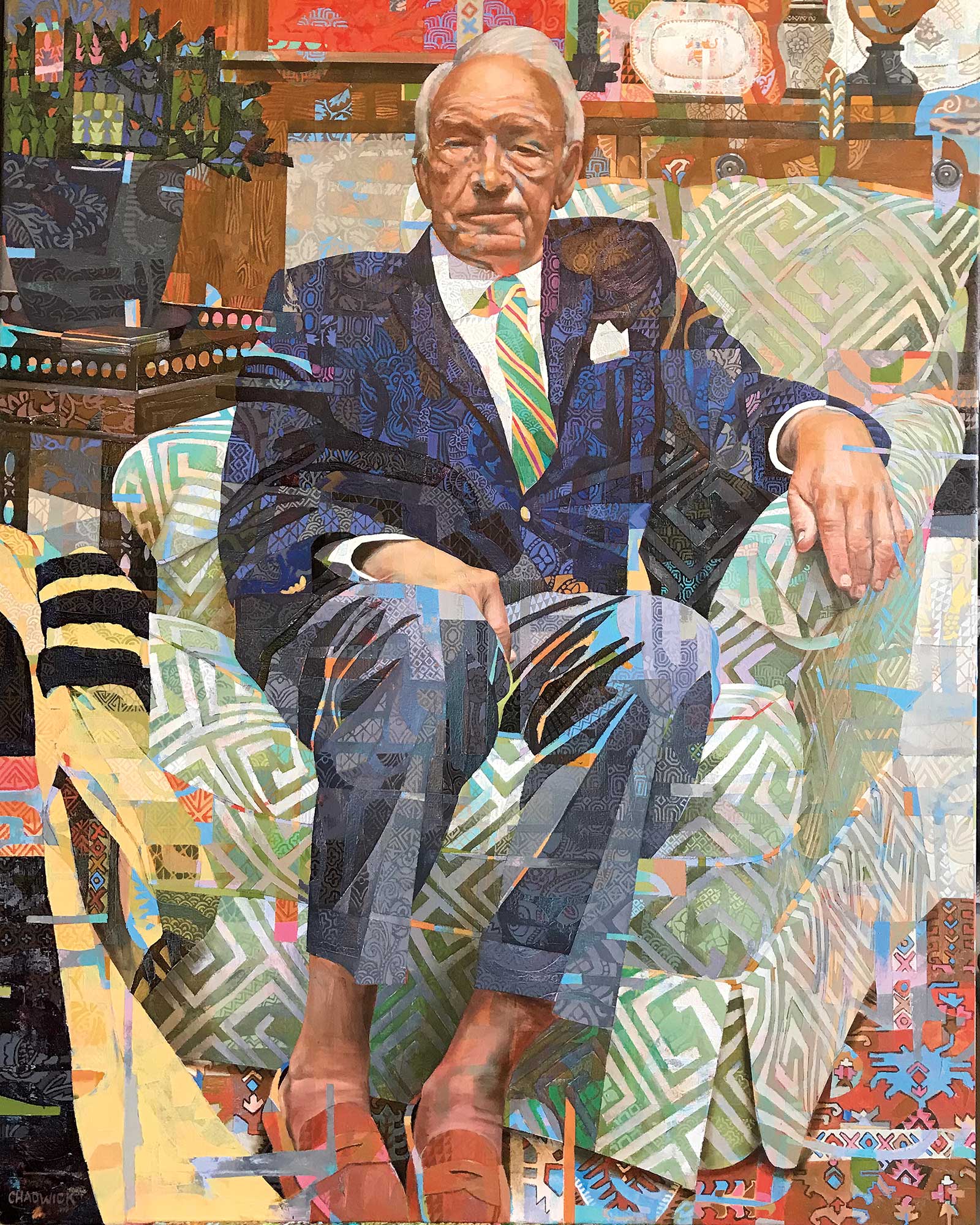 Mr. Lamar Cecil, mixed media, oil and latex, 50 x 40" (127 x 101 cm)
Kevin Chadwick
Inspiration
Lamar’s home was filled with antiques, Asian porcelain and patterns everywhere—a visual feast. He’s a fascinating gentleman, and he gave me full reign to pose him in any position. His only requests were that he wanted his professor’s robe draped, like a painting he once saw, and the button on his jacket buttoned. “A gentleman always buttons his jacket,” he said with a smile. He and his wife required no sketches. They had complete trust in me—a perfect beginning.
Process
Before turning to fine art portraiture, I was an illustrator, and I still use photographs as reference. My pattern work happened by accident eight years ago. Working in both abstraction and portraiture, I experimented in combining them. My technique has changed a bit over time, now more refined. I first cover my canvas with six colors of latex paint, resembling a patchwork quilt. I then cut painters tape into abstract shapes and randomly place them. With another six colors, I scrape over the tape. Once dry, I remove the tape, exposing the colors underneath. Using an enlargement of my image, I transfer it with an old school method of charcoal on the back of the paper. I then tape off areas of similar color. For instance, with the blue jacket, blue paint is scraped in using a putty knife. The sharp edge of the knife picks up the edges of the abstract shapes underneath. I then use the shapes as a guide while I paint in the pattern detail. Pattern inspiration is found in fabrics, wallpaper and magazine clippings. Finally, I tape off the head, hands and skin tones and use oils to paint the detail, careful not to overpaint so the underlying shapes show through.—