My art friends and I often traveled to wondrous countries throughout the world. Many times when we weren’t seeing the sites, we’d be painting subjects like there was no tomorrow. Those were days that inspired us beyond description. Our close friendships and talents pushed us to the limits. Home or abroad, we stuck together for continually remarkable decades. We were “The Tucson Seven.”
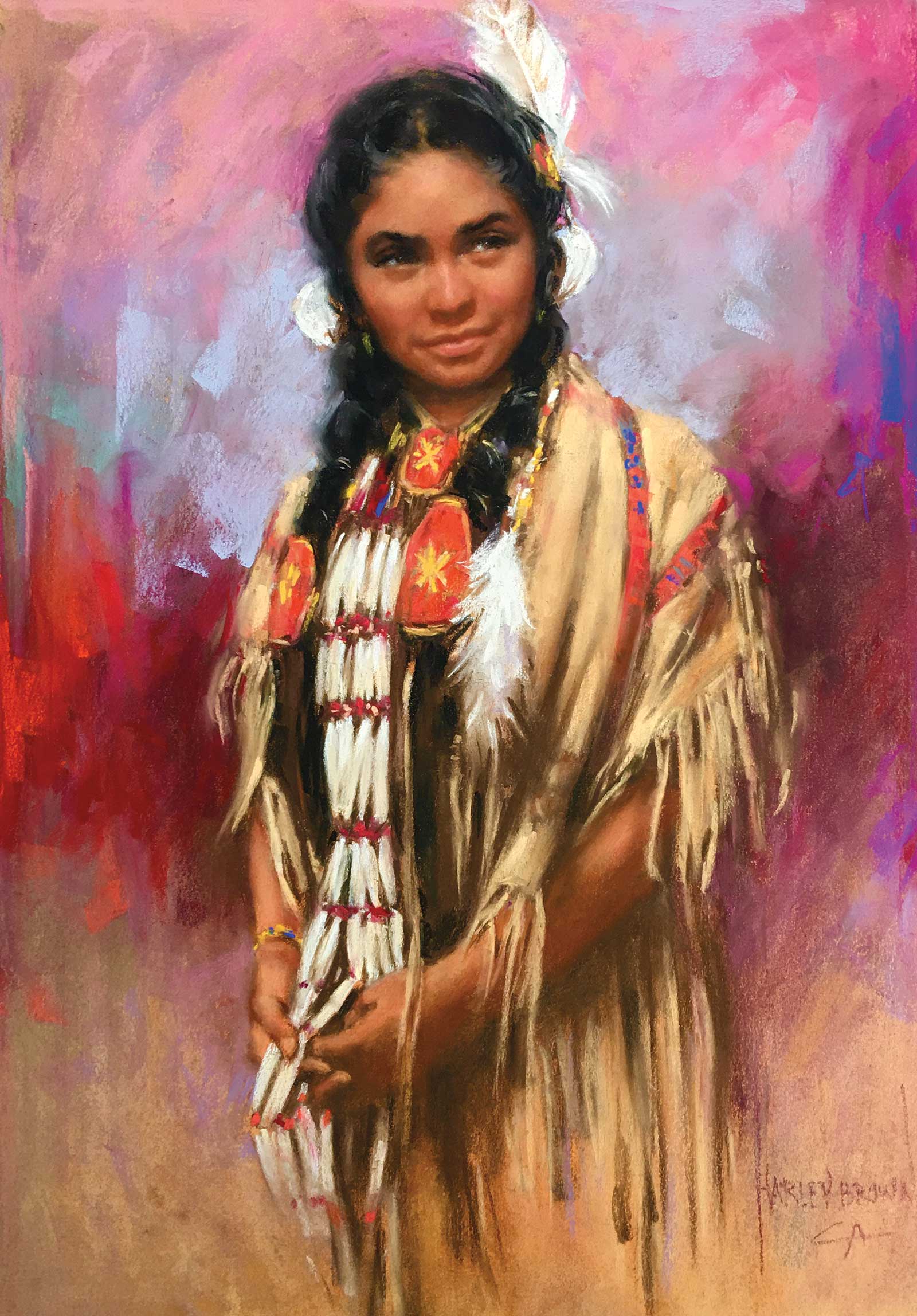 Tallula: In all my artworks, various thoughts flow in and around everything I observe and draw. As with this portrait of Tallula. Developing the features on her face took an amazing amount of time. I wasn’t giving up until I got her intriguing expression in this portrait—something we see here. I’m inspired by what she wears and how it leads into the background. Northern Plains powwow clothing with traditional beadwork. And the bone breastplate going down between her braids; fingers holding it, lightly laid in. The background shapes and values work dramatically with lost and found edges. Overall warm colors with touches of cool. Now I can relax and let my eyes wander throughout this portrayal. Tallula is with us.
The End of Envy
I got rid of feeling jealous early in my career. That’s when I discovered Harley needs to be better than Harley. It actually happened overnight, the same as when I quit drinking and smoking. I had more appreciation for other artists’ works. Actually, I was fortunate to belong to art organizations where we’d take time to really look and experience each other’s art pieces. We’d happily applaud those who won awards, lifting all our spirits. That feeling has never left me.
And Then
Sometimes we have to take mental holidays. Artless times. Those short breaks are needed for us mortal beings. We can go to a soccer game, watch a couple of favorite films or bake a homemade apple pie. It can broaden our minds in different directions with our creativity. Brief rejuvenating pauses after long runs. Then I get back to my art. Right away I might do a few sketches, then off to bed. Next day, on to a piece of art I have planned.
I’ll Add This
When I leave the room to get away from a painting I’m working on, I immediately take my eyes away from it as I walk out of the studio. It disappears from my mind so when I get back later, I’m able to freshly observe it.
Away Too Long?
I remember a while ago I was on a long, exhausting trip. I didn’t do even one sketch during that time. When I finally got back to my studio, I started a piece. My absence from the easel had me slugging away, trying to get the general shapes of my subject. I didn’t like what I was doing but just kept going. I felt like a worn out machine.
But after a good while, I began to feel my trusted inner mind flowing through me. That’s when I started taking out certain areas and putting in my own aesthetic strokes. Aha, I was now the captain, guiding my ship through artistic waters and not lifelessly following the precise orders of my subject.
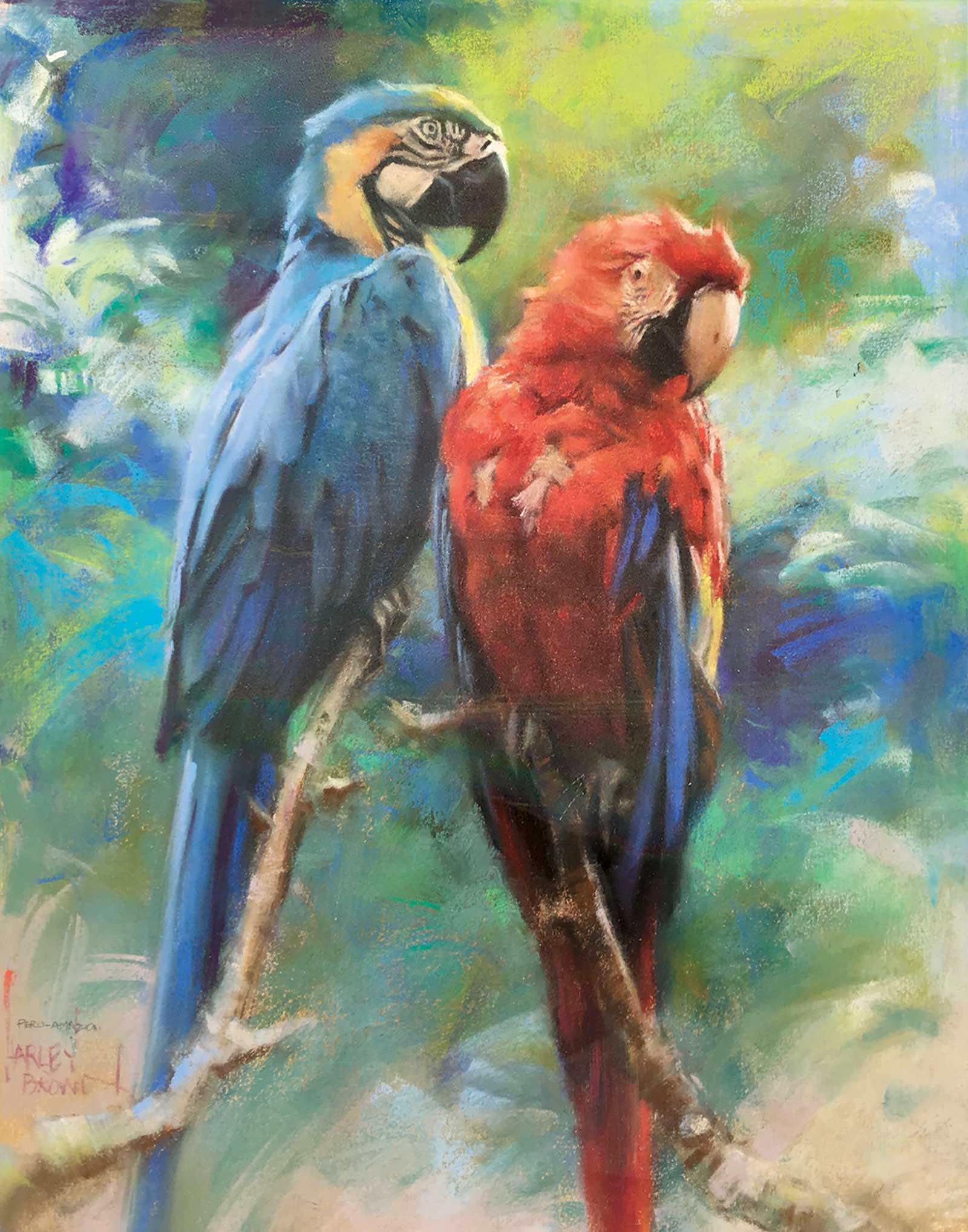
Scarlett and Blue: We were in a small Amazon River encampment in Peru. Here, inseparable macaws “Scarlett and Blue” stayed near us and graciously posed for me. Blue appears in charge. Scarlett has other plans. Scarlett stood out within the massive green landscape. As you see, Mother Nature hands us unexpected visions from which we create.
Differences of the Inner Mind
Don’t try to be different. We are all inherently different. When I start an art piece, my subconscious comes aboard. I keep it going at first and then as it is moving forward, my conscious mind will join in. Indeed, the sub will bring out things that are quite creative and the conscious ties them together.
While working in an area, big or small, keep the feeling going with the whole piece and not just where the strokes are being laid. Like playing a solo instrument with a band. See the strokes and values that are going in and how they are already affecting surrounding parts.
As time goes on, your experienced inner mind will help you through your art creation—it will help bring you solutions and guide you. (Like being able to fully answer unexpected questions.) You’ll know when to expand on areas and simplify others.
We don’t think of every nudge of the steering wheel while driving, or dodges and swerves while walking through a crowd. We know where we’re going, and our inner mind helps us get there as we grab colors, lay in an exquisite stroke here and a glorious dab there.
The Finale
We have to understand when a work is finished. Overdoing it can sometimes happen without us realizing. As mentioned many times, I take a break and come back. And my art piece might finally say to me, “enough, no more fussing and correcting; your subject and you are alive within the painting. Bravo!”
Such a Life!
• Our art studio can be wherever we are.
• The cost of being an artist: pencils and paper. Starting at $10.
• The world is generally quite fascinated with artists.
• No way we are ever forced to retire.
• Ours is a world that others dream of entering.
• We can travel to countries that we’ve always wanted to see.
• Being in our art studio is our free mental therapy session.
• Coffee breaks whenever and wherever we want.
• We don’t go out of fashion. We’re permanent.
• Art immediately takes away a “down” feeling.
The Moment
Keep On Doing
Trying doesn’t work—doing does. Somebody tries something and if it doesn’t work out, they say, “oh well, I tried.” When doing a project and it doesn’t work out, you “keep on doing.” Doing doesn’t always mean success. But doing is an enthusiastic commitment and not adorned with “maybes” and “what ifs.”
I often drew and painted the same things over and over and expected different results. By golly, over time, it worked. I got better. I was getting that welcomed flow and creative confidence melding together. In my late 20s as my confidence grew, I also became more my natural self, with my surroundings and with other people.
Learning and Doing
I’ve always supported going to well-chosen art colleges, also attending the one-week classes with top artists. I recall in my early days when learning major art principles, I’d shake with joy and appreciation. I can give you a list of such moments and actually have done so through my writings and images. Also, not to worry, art students don’t start doing paintings in the style of their teachers or mentors. Dedicated students master their own unique skills and become very individual.
Passing It On
Reading this very magazine, International Artist is a back and forth conversation with artists’ thoughts and images. True nourishment for the brain cells. International Artist brings talented and successful artists to these pages. Artists that feel a desire to pass along what they’ve learned and experienced to others.
Here’s one example of a moment in my art learning days: The instructor told us about light and shadows on our subjects. We shouldn’t put equally fine details in both the light area and the dark area. For instance with a portrait, we decide if the light area is more important, we put the fine details in those light areas and less details and texture in the shadow areas. If the face is mostly in shadow, we put more details in the shadow. Yes, with most portraits, the light areas dominate.
Ah, Pastels
Pastels are my very close friends. There are good days, slight problem days and exceedingly impassioned days. All to do with what those pastel sticks are doing at the ends of my fingers. Art is a boost in the most heartfelt way. It becomes family.
Individual Character
Many years ago I was doing a portrait of a famous person, and I would soon be traveling to its unveiling. My big problem: I didn’t like the portrait. I kept looking and it really didn’t show the individual character of him. My blunder was trying to rectify all of his particular features that weren’t perfect, trying to make him even more handsome. The result was giving the portrait none of his genuine character.
Then, with one motion, I took it off the easel and ripped it up. What happened?! Plain and simple, I so wanted the portrait to absolutely look like him. I started again, but this time, all his slight imperfect features were laid on canvas. He came alive—no doubt at all. As a matter of fact, at the unveiling there were very good reactions: “You got him.” “He’s relaxed, natural.” “This is who the public knows.”
I’m more than glad that I followed my aesthetic emotions and did his portrait again, portraying the real person. I received a very memorable note from him and his wife.
More Thoughts on Likeness
A further thought about commissioned portraits of famous people: the portrait doesn’t have to have the subject looking stiffly formal, wearing a suit, near a desk and holding a book. Unless, of course, that formality is insisted upon. I like to get a bit more into the person’s casual nature. A suit is certainly okay, but it’s the subject’s distinctive personality coming from the painting that holds our attention. —
BALINOFSKI: Giselle
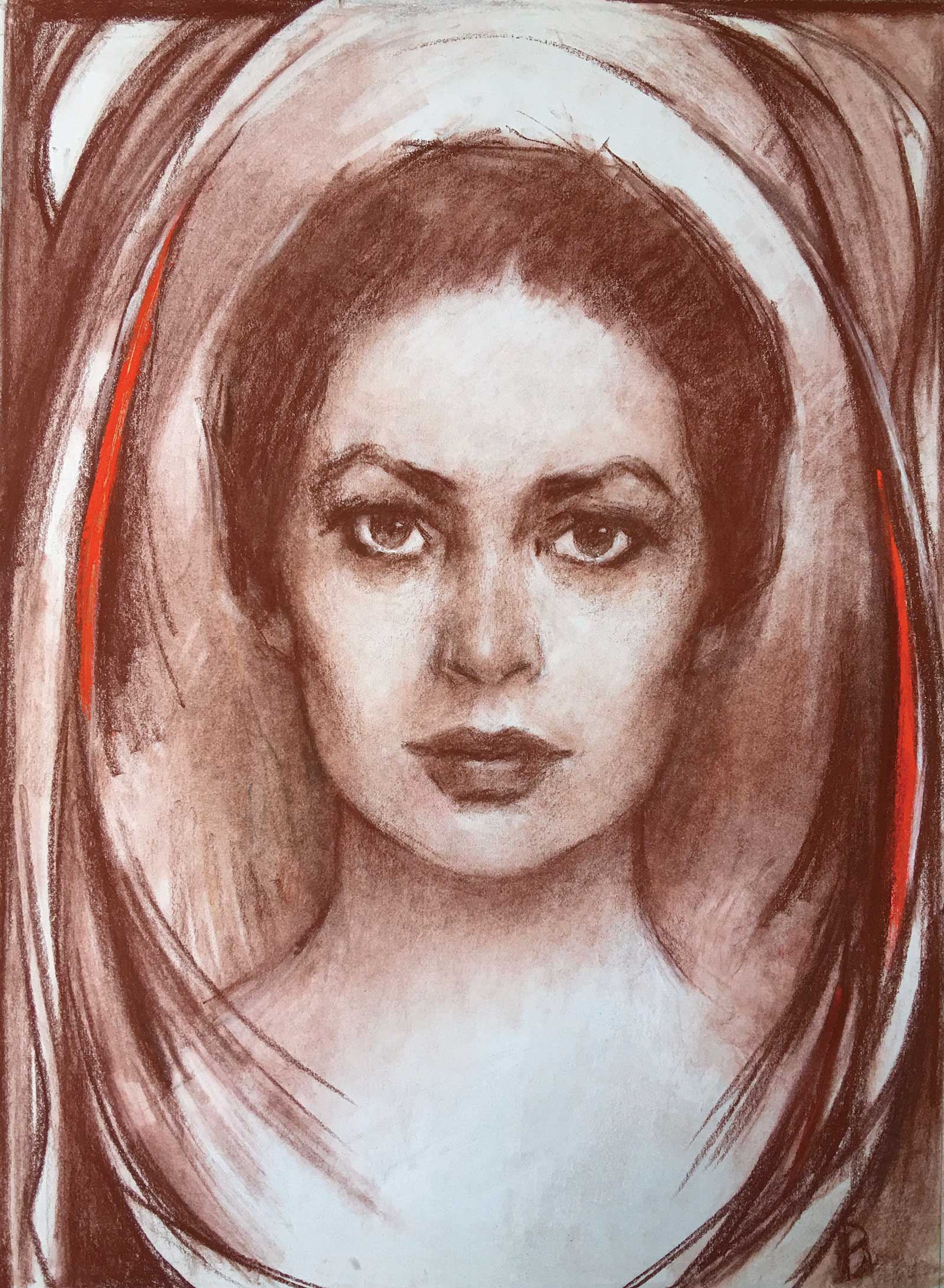 Giselle
This work was done one evening. And as Harley and I often mention: The artwork can say “that’s it, I’m complete!” Here, that sentiment is profoundly right. All her features are realized with her eyes fixed on you and me, or perhaps herself in a mirror. She may never turn away. Put this image of her in your studio so she can “keep an eye on you.”
The background was done without forethought. It happened with the lines and curves just streaming from me. Joyfully moving forward, I’m not worried if this was right or that was wrong. Also, you can see this is a monochrome Conté drawing, but my hand grabbed a hot red pastel and put it in two places. Incidentally, many of you have already guessed: she’s a ballerina.