



I was first captivated by the rich world of line and tone in graphic art. The shapes that emerge from the unique set of curves and straight lines, interspersed with soft dynamics, are still my favorite. It is no coincidence that many famous artists consider this technique the basis of all techniques. I love the simplicity, the broken structure, the “naked truth” of graphics. In my opinion, the basis for everything in art must be rock solid drawing skills. Here, the viewers’ eyes should not be distracted by bright colors and an almost kitschy cavalcade of colors. You have to have a good knowledge of anatomy, and of course, being able to draw is no disadvantage. Even today when I paint, I always draw as a form of relaxation.
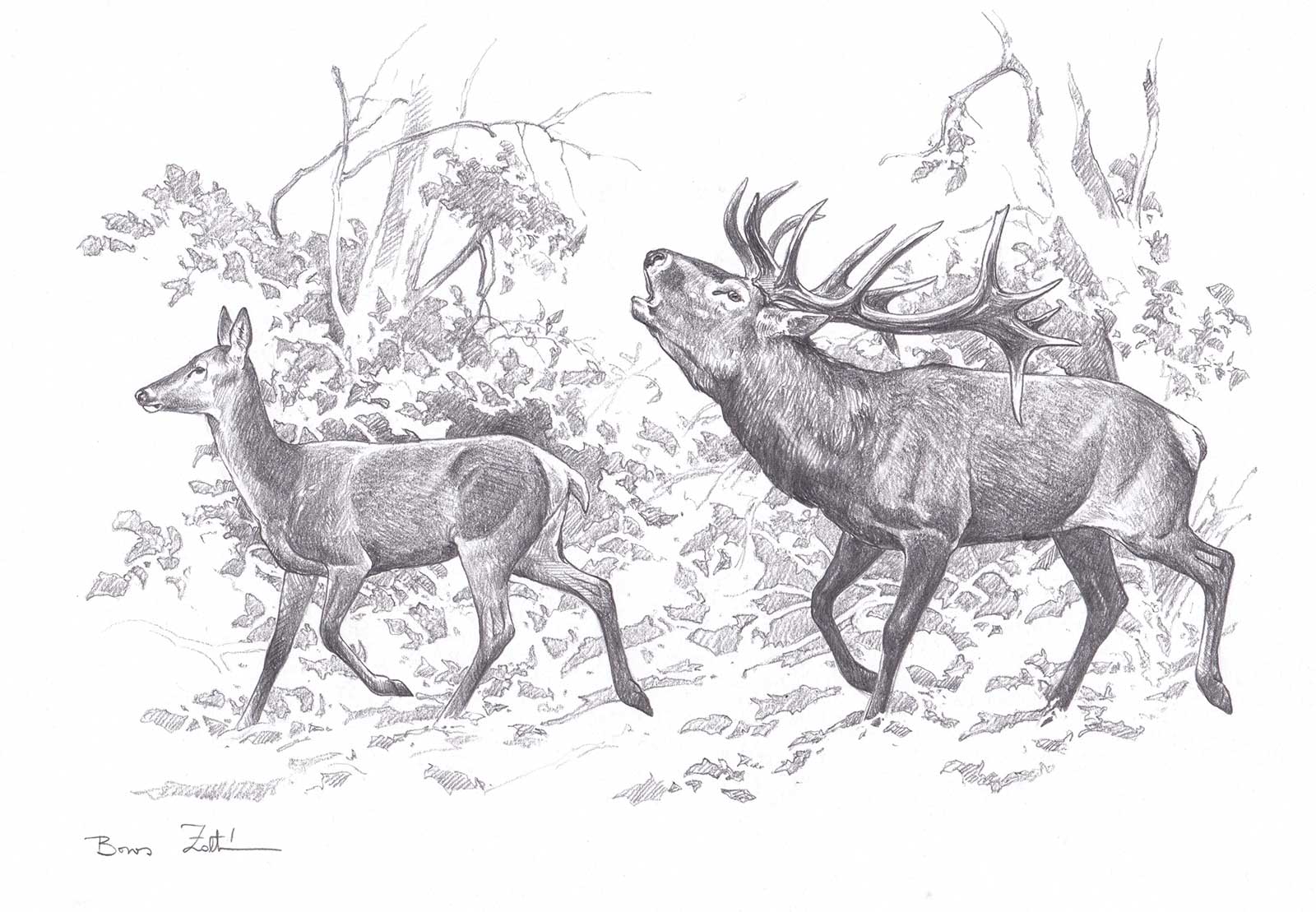
Red deer, pencil drawing, 8 x 12" (20 x 30 cm) Several years ago, my friend encouraged me to visit his hunting territory in the southern part of Hungary. He thought this big red stag might inspire me to draw him. This friend of mine invests extensively in all his conservation properties in order to provide the highest quality habitat for indigenous wildlife, especially red deer. When I first saw this monstrous stag, I knew I had to draw him. The red deer is not only important because it is hunted widely, but according to legend, our ancestors were led to our country by deer. It is a mystical animal to Hungarians.
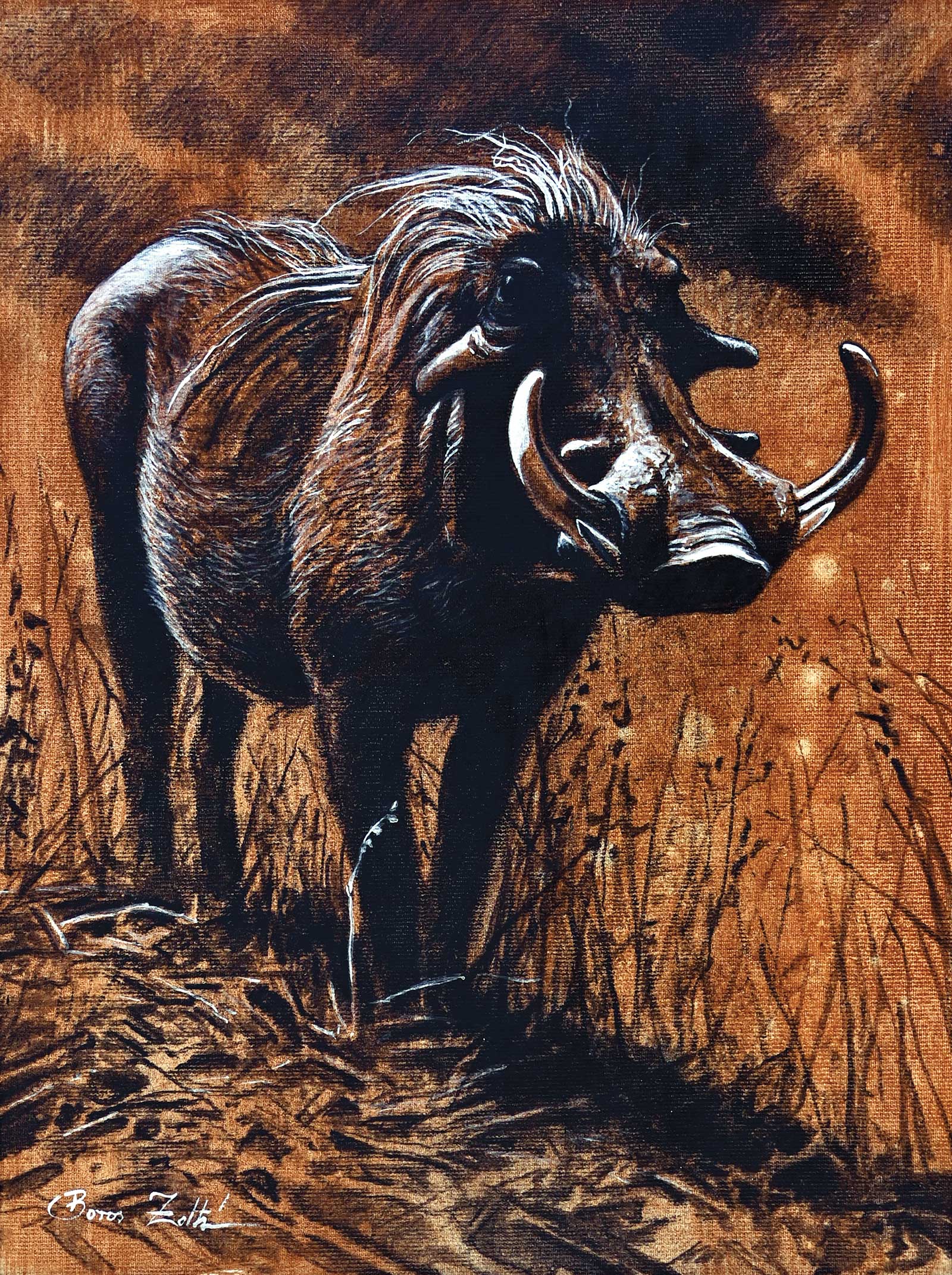
Warthog, charcoal on canvas, 15¾ x 12" (40 x 30 cm) I truly believe that the warthog is the perfect example of how “ugly is already beautiful.” Although covered in bristly hairs, their bodies and heads appear largely naked from a distance. The only clearly visible hair is along the crest of the back and the tufts on their cheeks. I chose charcoal (the simplest tool) to work with the simple elegance of line drawing. However, I wanted to introduce Africa as well. What is Africa? Perhaps it’s sunshine on an ochre reddish brown. I put this color in the background and white on the highlights to make it sunny.
Then the colors came through painting in watercolor and oil. Those who try to paint with oil choose a difficult job. It looks simple but to turn colors into shapes takes real magic. The brushstrokes must form the shapes, the curve of their surface. I am not a fan of photorealistic representation, that’s what photography is for. I practice the realistic branch of painting, but I put a lot of emphasis on creating a personal illusion in my paintings. I trigger the viewer’s imagination, but I leave it up to them to decide what the final image will look like. I leave space and opportunity for the viewers to fill the picture with their own imagination. It is in the airy, translucent technique of watercolor where I have found the greatest potential for creating illusion. —
About the artist
 Zoltan Boros
Zoltan Boros was born in Szabadka, Hungary, in 1976. At a young age, he began developing his talent drawing the local wildlife. Later, he began to paint with oils and watercolors and continued to draw using graphite pencils and chalk. After grammar school, he attended the Agricultural University of Gödöllő. There, he received a degree as a certificated agricultural engineer of environmental management with a major in wildlife management.
Boros spends as much time as possible outdoors, observing nature and the behavior of animals in their natural environments. Through his art, Boros is able to capture the uniqueness of his subjects and the details of their existence. Many of his works depict different species, both juxtaposed, and in harmony. His time in nature stirs his imagination, and his creations reflect a close relationship with his subjects and their habitats. His style is unique and his detailed depictions of wildlife are unmistakable. Whether you are viewing one of his black-and-white chalk or pencil drawings, or a painting, the personality and mood of each animal in his artwork is clear. Boros has received international recognition for his wildlife art, with pieces appearing in exhibitions around the globe. These include the Weatherby Auction in Reno, Nevada; Holt’s Auction in London; and exhibitions in Spain, Germany, Austria, Canada, the Netherlands and his native Hungary. In 2020, he received the prestigious Mr. Peter Balogh Grand Prize for his wildlife art.
Contact at
borosartwork@gmail.com
www.borosart.hu