With your art, try not to alter areas so as to please the eventual viewers. Don’t think that certain things will make for more appreciation. Instead, continue with your own trusted inner self moving ahead with real spirit. If you need to redo parts, do them to make yourself happy. Yes, with all your art, you’ve earned that right as it passionately embraces your mind and body. That approach will keep you going for decades and decades.
We Choose
For many years, I was told what I should like in the art world and why I should fully appreciate it. I’ve never understood most of the contemporary art pieces nor their explanations. I soon decided what to like in art; in the same way I choose food and places to travel. I’ll add that it saves valuable mental time. Here’s me: I create art, love my family and friends, feed the cats and watch the ocean tides come and go.
The Truth
We need to get the beginning of a painting right. For instance, where we want the subject placed in the painting as well as positioning; the angle of the arm and shoulders; facial features in the correct areas; general values blocked in. Some of those values might be changed as the work progresses. We don’t want to make major composition changes after laying in details, but that certainly does happen.
A great work of art often appears as if the artist totally mastered it from beginning to end, and didn’t hesitate or fuss over any areas. In actuality, wonderful artists sometimes do have to struggle getting their piece the way they want it. Yet, the result has that flow of pure brilliance.
Follow, Then Lead
When following a mentor’s suggestions, in person or in a book, get into the depth of what that artist is saying or showing. Like accuracy, values, colors or design approach. Follow closely.
Your gradual confidence will have you bringing out and mastering your own true aesthetic fundamentals. Your personal approach will appear and get stronger. For instance, with light reflected on a face, you will see the mentor’s very subtle differences in those varied lights, some slightly dulled, some sharper, lighter, more important.
You understand those clear basics, and you apply them with your own individual approach. Understanding and using fundamentals is like seriously learning a language and then expressing it your way. I’ll keep on saying that your art is yours just as your personality is yours.
TUCSON GECKO
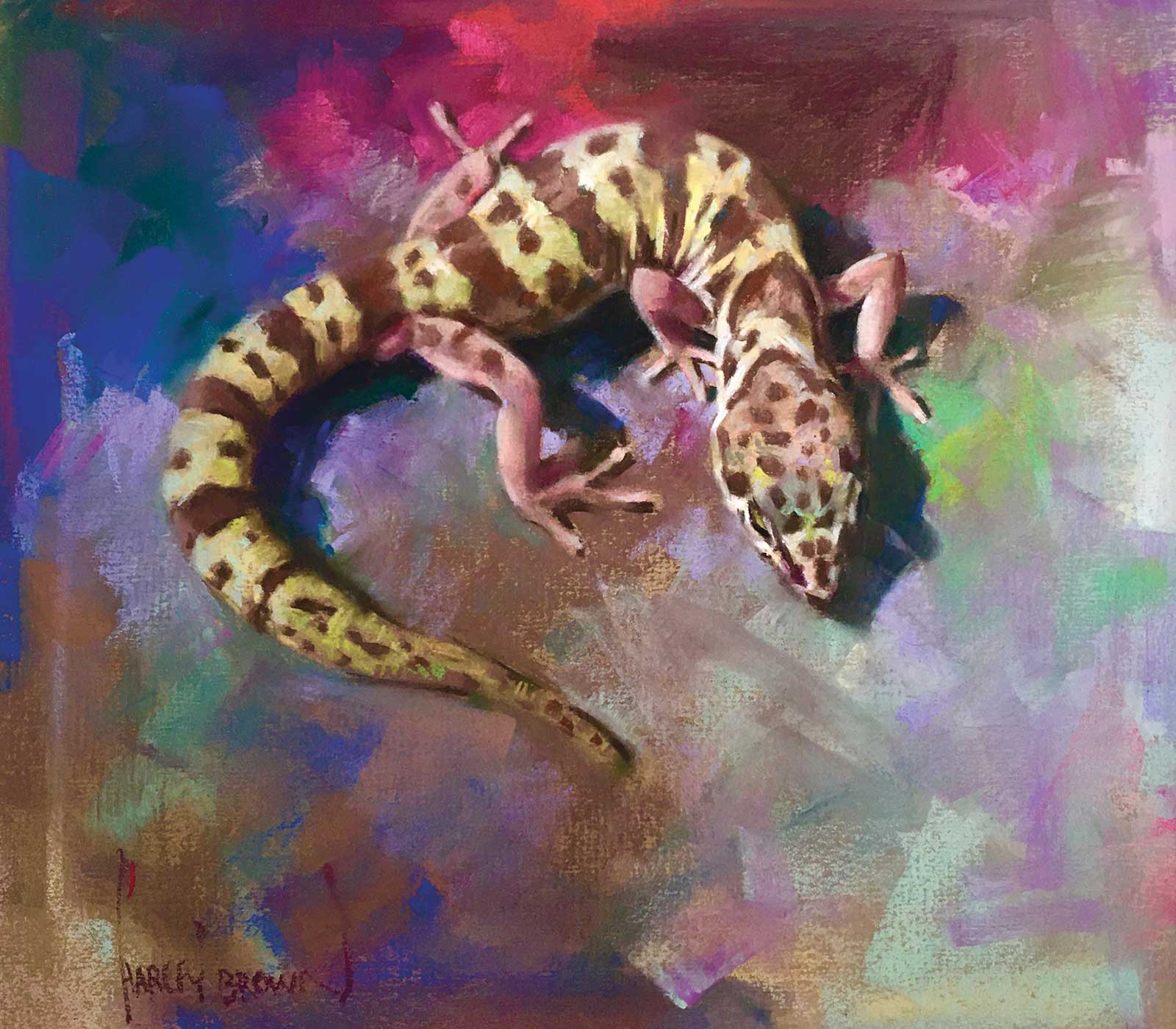 Tucson Gecko
• He’s placed up and to the left. Room to move around.
• We see plenty of lost edges with his markings
Design: his body, markings, cast shadows and “background” tones.
• A splash of red and blue. Not overdone.
• Visual “movement” with curves and angles.
• All creatures on planet Earth are natural at “posing.”
A Few Thoughts
- I visually devour the world around me. If I were stuck forever in the area where I live, I’d continue coming up with subjects to paint, one after the other.
- As an artist, I don’t get too humble and I don’t get too brash. I’m mostly heartfelt around in the middle. (Okay, sometimes near the edge.) Much more gets done. And a plus: my smart watch reads a variable normal pulse.
- If you’re mixing a color and it’s not precisely right, give it a try and you might like it. Yes, I know, a commissioned portrait needs certain features. For instance, the eye color must be dead on.
- My world is mostly in the arts. Still, once in a while I need to be with wise people who are involved with many other things. Our conversations go all over the place and once in a while, I really don’t mind if they’re interested in hearing about my art.
- I do paint subjects other than portraits and figures. I use my portrait approach as with everything; I look for lights and darks, shapes and shadows. Get them correct. When painting a dog, at first I think of him as shapes and shadows and as I progress, he eventually becomes my good friend’s bulldog, “Rosy.”
- I enjoy painting seemingly impossible subjects. I might be hesitant with a grin while standing in front of the easel. But this always happens: With the first stroke I’m flying, my outer and inner minds in full gear, absolutely no stopping. Like skiing down a major mountain with all those jumps and turns.
- Check your values/tones. For instance, if a light area is against a dark area, it might not be as light as you think. Sometimes, I’ll hold in my hand a piece of white paper and compare it to maybe a face or a building in the distance.
- As objects go into the distance, they begin to lose their color and lose their strong light and dark contrasting values. Perfect examples are those far away mountains. That example is extreme but explains the basic principle. For example, my friend’s shirt is a vibrant, strong red as he stands beside me. There’s his brother, a block down the street and with the same colored shirt. Well that red shirt is certainly not as strong.
- My life has had many twists and turns. I discovered that working hard and paying attention to what I’m doing can sometimes make unexpected turns lead to marvelous positives in my art world.
- While working on a piece, the artist often gets a bolder feeling, which can also be transferred to other areas. That bolder feeling happens in our art and in our outside world that is always waiting.
- Visual art “speaks” all languages on Earth. Everyone on this planet can understand what you and I do.
- There is much to know within the visual arts, and it might be best to give certain grand principles immediate importance even while learning and applying other basics. For instance, shadows actually making shapes, working complementary colors. Oh, and again, I repeat: lost edges.
THE EYES HAVE IT
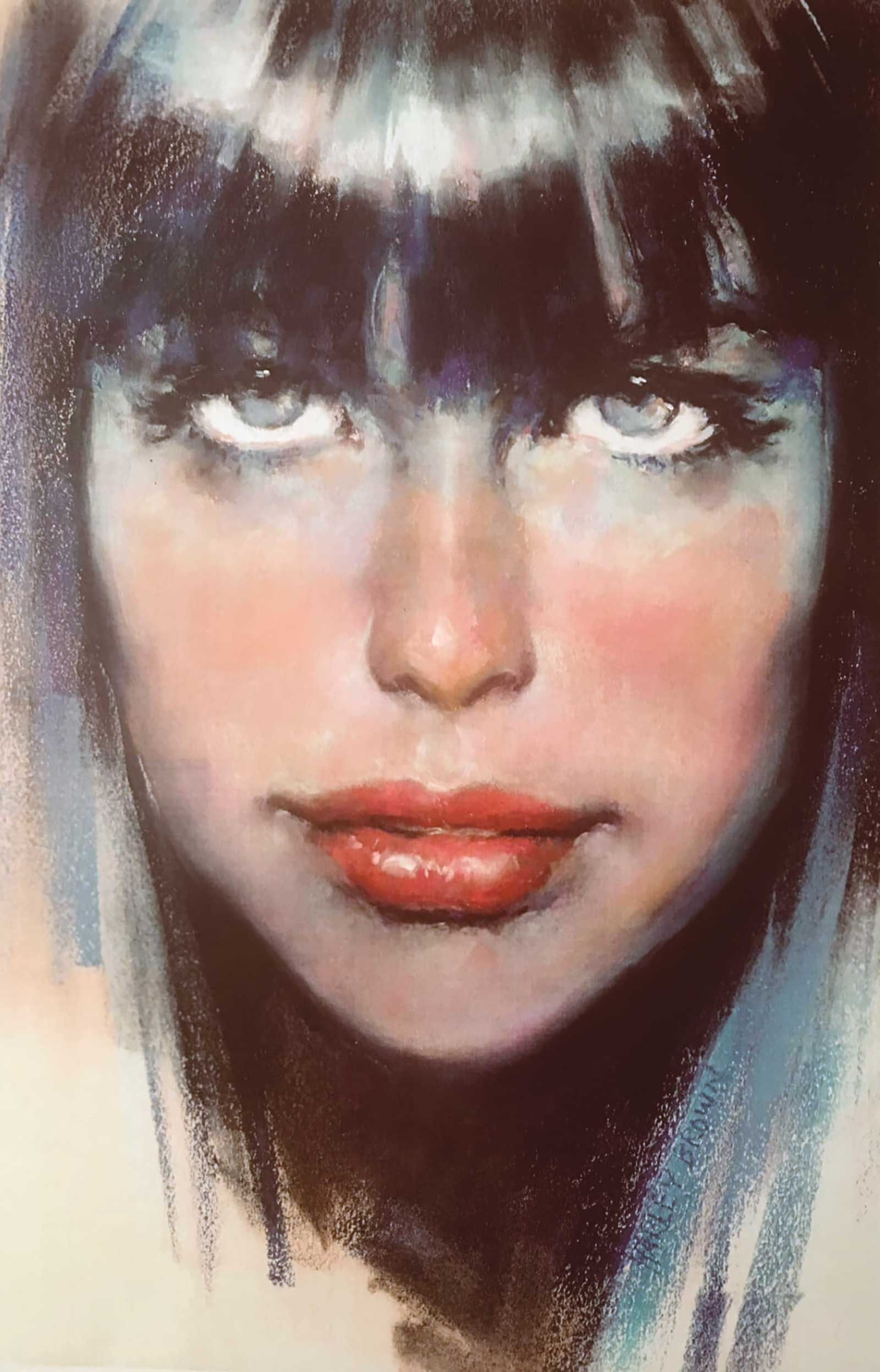 THE EYES HAVE IT
Some of you might have seen this portrait of mine. I brought her here for these thoughts that have burst from my mind. In a portrait, we don’t want a lady’s lips and eyes competing with one another as to which is more important. The visual victor over the centuries are the eyes. As they look at us, her eyes are the grand first movement of the majestic symphony of her face. The second movement—those expressive lips sublimely complement her eyes. The third movement brings us the entire face, eyes and lips gently brought together with her nose. A summary of all her features together in “breathtaking grandeur.” Here, my inner mind observes shapes and colors as it literally guides my hand. You can see my approach with her eyes and lips. You also sense she is in control as she looks at you and me. Portraying a woman’s face is mostly a mystery to me. But bringing what she visually offers me is surely enough.
Uniqueness
Commissioned portraiture demands that we notice and keep close to each person’s important uniqueness. A mother can look at a finished portrait of her son and say, “Yes, everything seems okay but, well, that’s just not ‘Freddie.’ I don’t see him there.”
We don’t let that happen.
Also, you know that your painting or drawing is not a duplicate like a photograph. Your art piece has you pouring into it as you bring that particular person alive—your own interpretation coming out from it. Your individuality is always present. Like passionately singing “Hey Jude.”
Art Forever
Of all my feelings, I’ve never been bored. If I could go on, I would joyfully continue painting subjects in the studio and traveling. Maybe, like old times, I’d play piano in a bar for a few years. Write an ultra long, highly detailed autobiography. Visit with family. Including great, great grandchildren with whom I could tell and retell my favorite stories. Being in the arts gives us many reasons to keep going. Art is our personal creative selves, getting more motivated year after year. Absolutely no retirement age.
Actually, artists do live a long time in an uplifting way. For instance, when I look at a Rembrandt painting, I can see him next to me, at his easel confidently laying in those brushstrokes. I sometimes utter a few kind words of praise to him as he continues on with this masterwork.
It’s the same when I look, with sadness and devotion, at the works of my dear friends and artists who have passed. They are there with me as we were together for so many years. (Let’s now take a break and be with our memories.)
TWO SOCKS
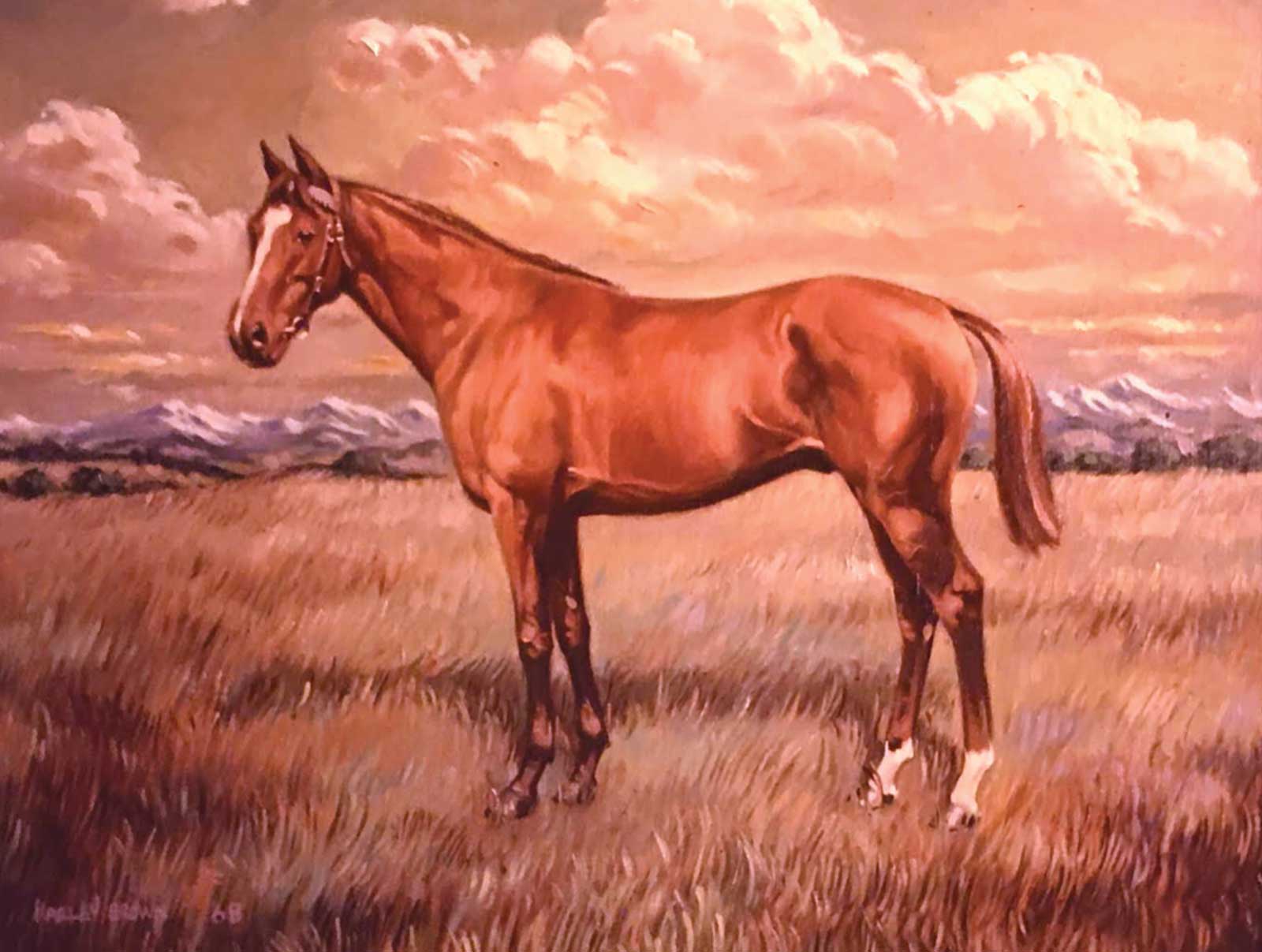 TWO SOCKS
I created this oil painting of Two Socks over half a century ago and received around $200 for it. Back then, that took care of a mortgage payment and some food. I do remember this work and also that I had painted very few horses. But using my intensely observant eyes and understanding of shapes and shadows, I think I brought out some of Two Socks’ magnificence. We see him here in the Alberta prairies with the Rocky Mountains in the background. Interesting how I worked the clouds into the overall design. In those days, many of my artworks were done in oil. My working with pastels started in the ’70s, and I actually got hooked on them literally overnight. I still do an oil painting once in a while.
I’ll Keeping Saying
Don’t take time off from art for long. I’ll explain in an indelible extreme. You’re alone on an island. You have food and water and no one to talk with. After a year, suddenly a boat arrives on shore, a sailor hops off, walks up to you and asks how did you get stuck on this island, where are you from, what have you been doing. For the first time in a year you’re hearing a voice, and you need to answer the questions.
Like after a long period of no art, finally looking at paper or canvas on an easel and wondering “now what?” An extreme example, and it explains why we shouldn’t let any time go by without making art. Right now, time to do a sketch.
We are Art
I’ve been with art friends over the years including many in their 80s and 90s—all of them with minds remaining totally resilient and creative. Our get togethers are always fully inspiring, like our early times.
And I’ve been with older people in a retirement home I’m familiar with, slowly losing their spirit. A while ago, I did a few drawing demonstrations of portraits for them. They each had drawing pads and pencils, and I had them doing the basics, drawing simple facial shapes and shadows in the first few days, the same way I’ve shown in International Artist. Each of them absolutely caught on with their drawings and wanted me to take it to the next level. We sure did, and kept going on to higher levels of drawing what we see! So greatly uplifting for all of us, and these elders stuck with it. Such wonderfully special memories that stay with me.
I cannot over stress the importance of personally creating something and what it does in nourishing the mind and body. Whether good days or so-so days, it gets us streaming out of a lull. I’ll put it this way, art brings us a positive and impassioned life. A life where our inspired mind doesn’t stop. —
BALINOFSKI: A Happy Ending
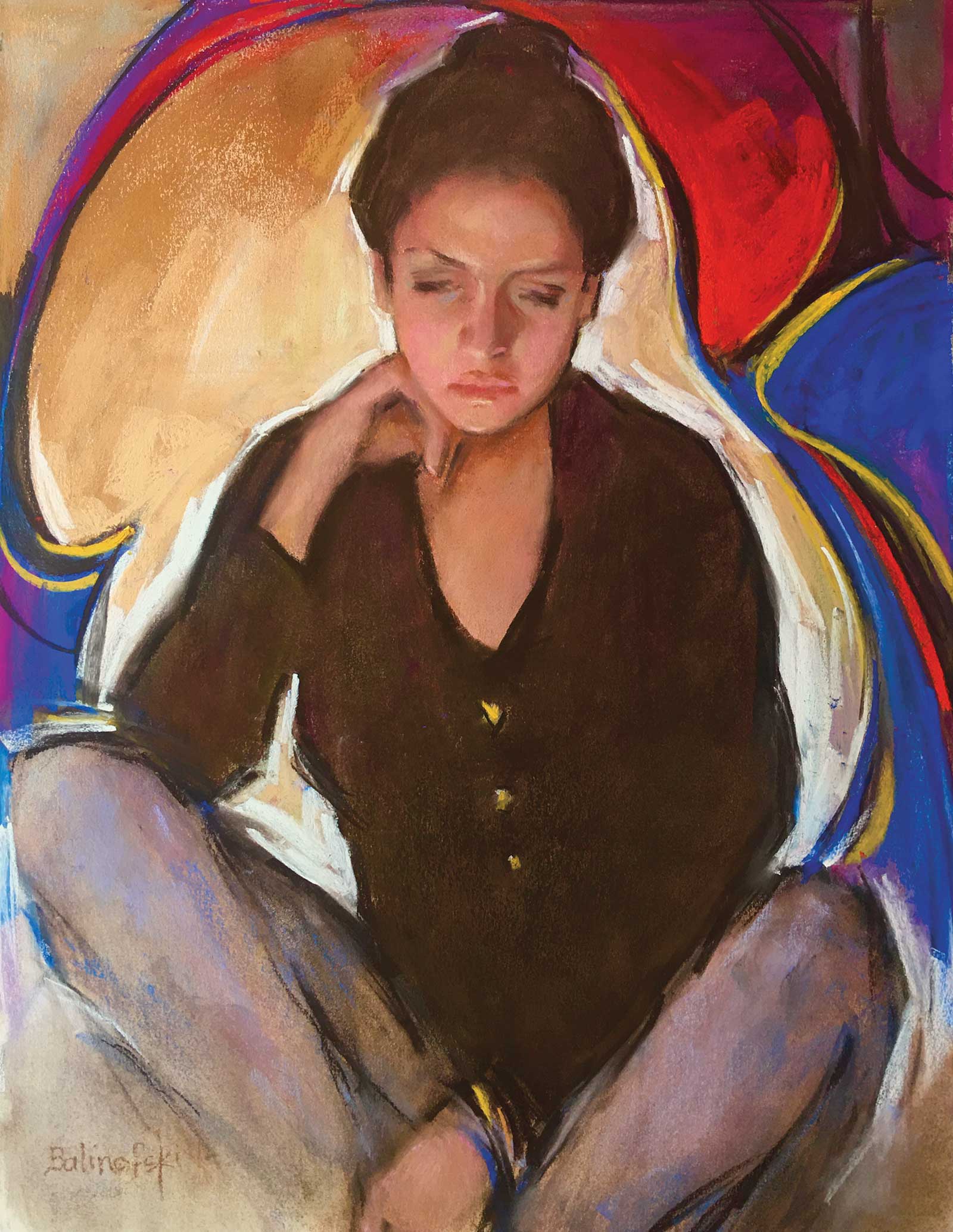 A Happy Ending
This lady came to sit for me, and I told her she could pose any way she wanted. She did so and as I was laying on the pastel strokes, she seemed distracted about something. Suddenly, she stood up, grabbed her jacket, said goodbye, and left my studio. I sat there stunned, having portrayed only her melancholy face. Several months later, she phoned and apologized for her departure. She said she had a personal problem; it was finally solved and she wanted me to complete the art piece. I was thrilled. She came back that afternoon. I decided not to do any more work with her face after that first sitting. So beneath her face, I began creating flat shapes and curves, in both the foreground and background. Then for some reason, as I got near the bottom, I stopped and left the lower part just sketched in. I said, “Finished!” She quickly came over to see what I had done and smiled, totally understanding her expression in the piece. A pastel I’m keeping.