This past winter, the Portrait Society of America hosted our third annual The Future Generation Competition, and in February, we announced this year’s talented group of winners. This competition was created to acknowledge the work of emerging young artists, who are 18 to 25 years old. Our late chair Edward Jonas believed that early recognition in art competitions can have a great impact on a young artist’s career, as it did for John Singer Sargent, who at the age of 23, won Honorable Mention at the Paris Salon for a portrait he painted of his teacher, Carolus-Duran, thus launching his portrait career. Different from our annual The International and Members Only Competitions, which are open to all ages, this contest was created to recognize and celebrate the work of young, talented individuals who have shown a high level of skill in the realm of figurative art and portraiture. This year, the judges were Dawn Whitelaw, Adam Clague and Stephanie Thomson. They viewed over 300 entries submitted from young artists around the world, including China, Austria, Romania, Canada, Italy, Poland, Netherlands, Norway, Nigeria, Germany and the United Kingdom. The artists selected for the top four placements come from different backgrounds and countries, but they all share an early passion for the pursuit of portraiture and figurative art.
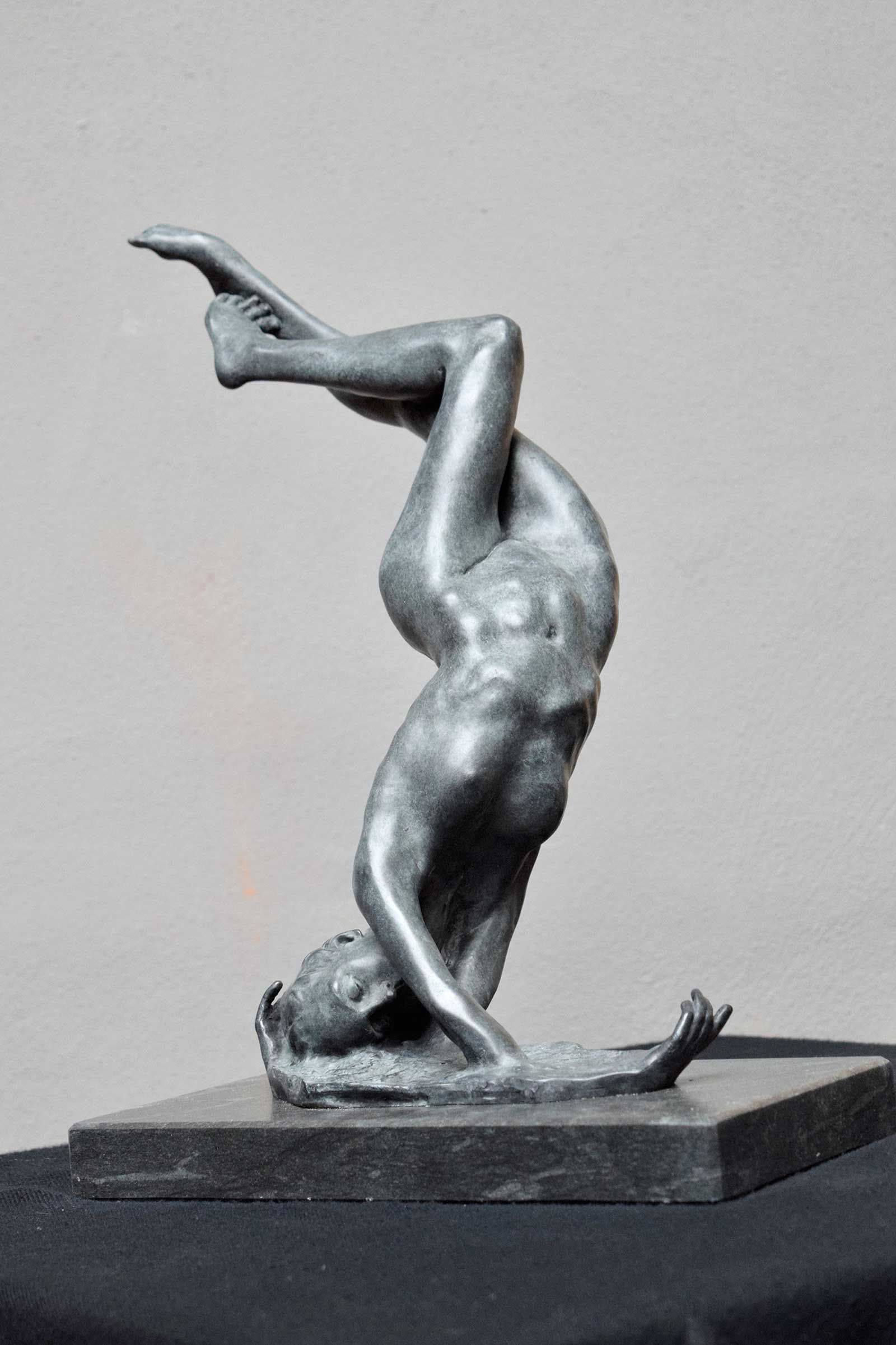
Jana Büttner, Awakening, bronze, 42½ x 15¾ x 19½" (108 x 40 x 50 cm)
Twenty-five-year-old German-Czech sculptor Jana Büttner won First Place for her work Burden, a thoughtful portrayal of two male figures—one holding another on his back—rendered in clay. Büttner currently lives and works in Austria, and despite her young age, has achieved many successes in her career thus far. Beginning her artistic journey at the age of 10, Büttner attended the Musisches Gymnasium Salzburg, a school dedicated to many creative pursuits, including art, music, literature and theatre. After her initial exposure to art at the age of 14, she began studying sculpture at HRL Hallein, a prestigious technical school in Austria. While studying there, she learned how to carve wood, stone, weld metals and work in clay. “The first time I worked figuratively in clay I knew that I had found my language in art,” says Büttner, “but, it wasn’t until the age of 18 that I was certain I wanted to pursue art as a career.”
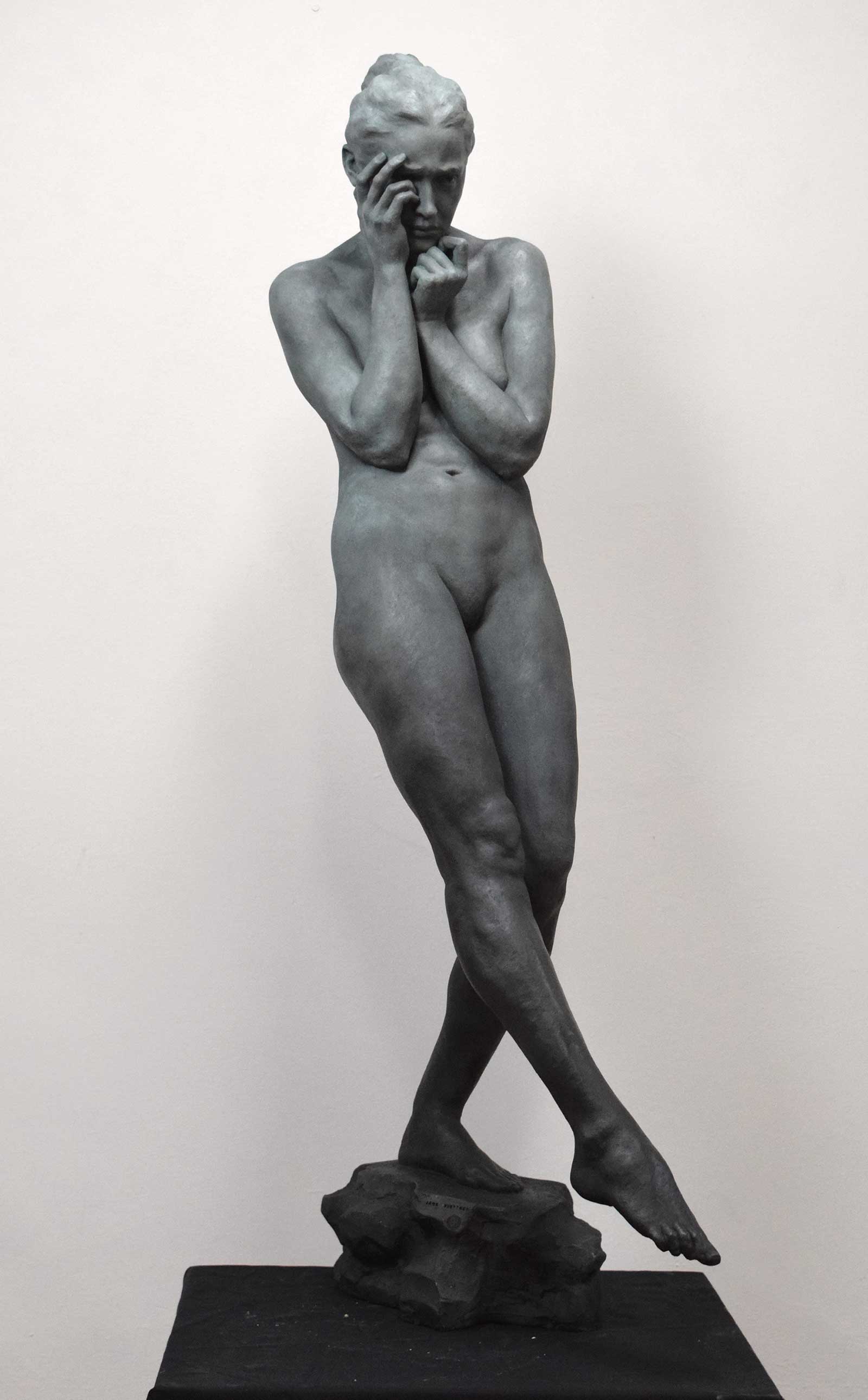
Jana Büttner, Vision, résin, 65 x 15¾ x 31½" (165 x 40 x 80 cm)
After earning her degree in Austria, Büttner attended the renowned Florence Academy of Art in Italy. There she honed her draftsmanship skills and techniques as a sculptor. After graduating from the Florence Academy in 2020, she received a fourth year teaching position there, and the year after that, a position as principal instructor. While she enjoyed the experience of teaching other aspiring artists, Büttner decided to focus on her own work and left the academy to pursue fulltime work as a sculptor. “I knew that I wanted to pursue sculpture as a career,” she explains. “The language of expressing yourself with your bare hands showing emotions and creating something from something that hasn’t exist before is fascinating to me. I think everybody finds their own language in the arts where they feel most confident to express themselves and for me it is sculpture.”
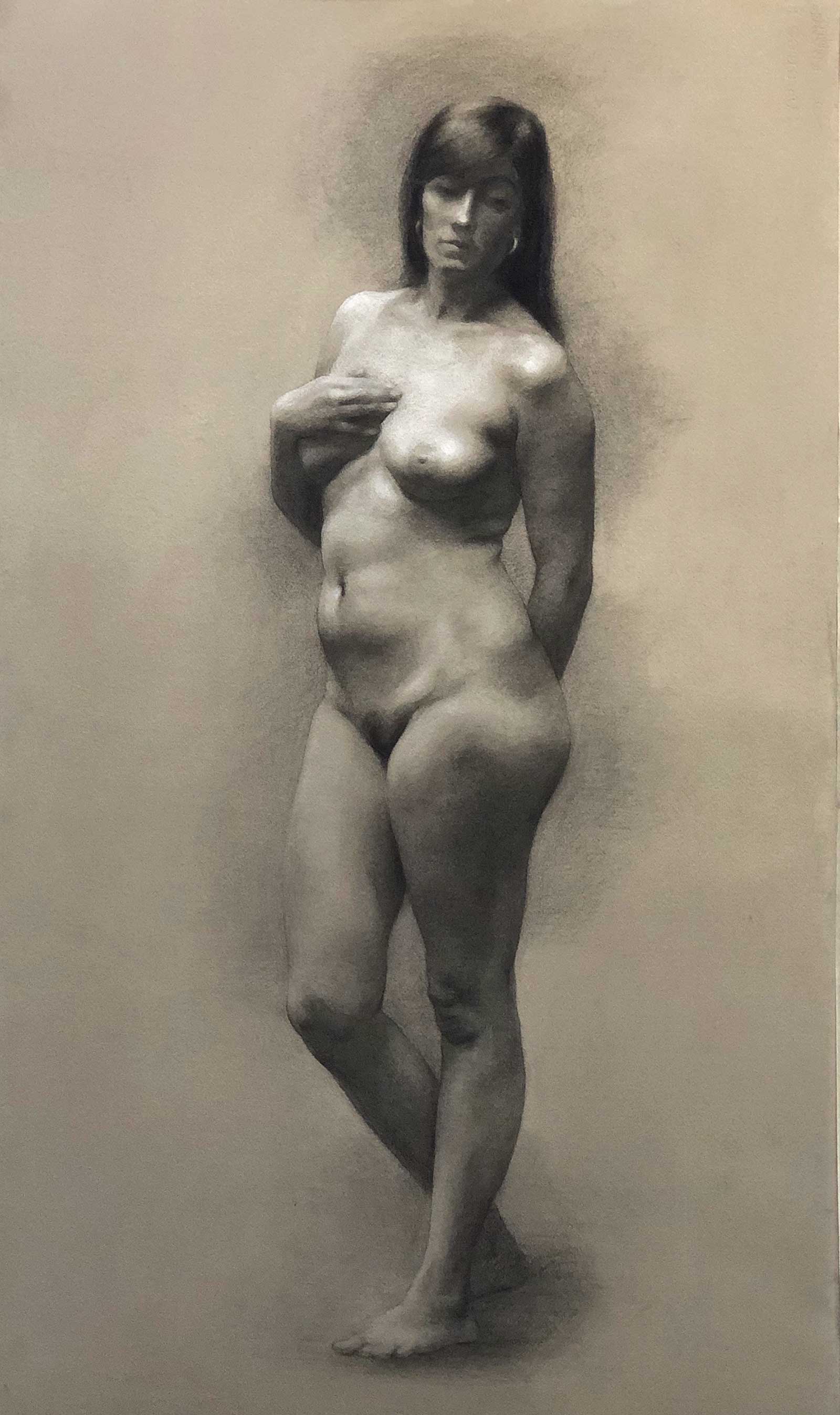
Jana Büttner, Mariana, charcoal and white chalk.
Büttner credits her family for inspiring and fostering her pursuit of art from a young age. “I come from a family that always encouraged creativity, and I think that’s a huge part of why I was able to find my passion,” she says. “When I was younger, I played the violin, I played the piano and I danced ballet.” Alongside those early creative pursuits, Jana recalled family trips to France where she and her mother would source materials, such as pigment and clay. “I remember trips to pigment mountains in France where my mother and I were sourcing our own pigments and made paint,” says the artist. “We harvested our own clay from the riverbeds and sculpted. So, I was always encouraged to express myself creatively, which I am very grateful for.”
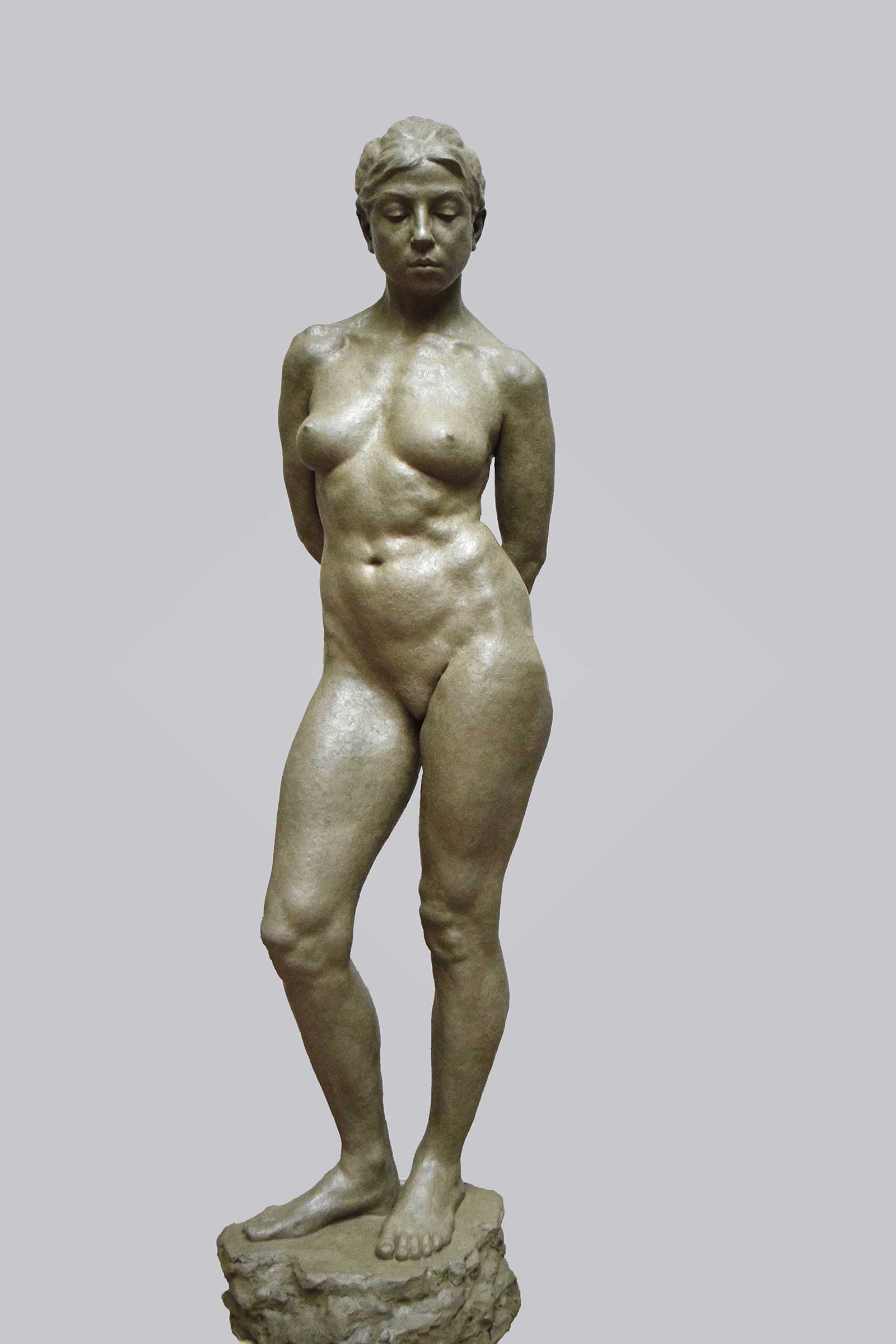
Jana Büttner, Light Ray, résin, 67 x 15¾ x 17" (170 x 40 x 44 cm)
In her winning sculpture work, Burden, Büttner was inspired by the different “weights” we all carry with us in our day to day lives. “In this sculpture I wanted to depict the same person carrying himself,” she explains. So in fact, the two figures sculpted in clay represent the same person. “There is a constant weight we put on ourselves, and we carry it around with us for our entire life,” Büttner says. “It can put us down on our knees, and sometimes is light as a feather that we can’t feel it. Most of the time it is the balance we are looking for, how to not let that weight push us down. It is a balance between our mind and our body. A never-ending cycle even though our bodies are fading, our soul will still continue to carry on.” The highly symbolic work also has personal meaning to Büttner, who has learned from the ups and downs of her own life. “Life pushed me in this direction with all its ups and downs,” she says. “It sounds cliche but when I’m looking back, the downs have made a big impact on where I was going in my life.”
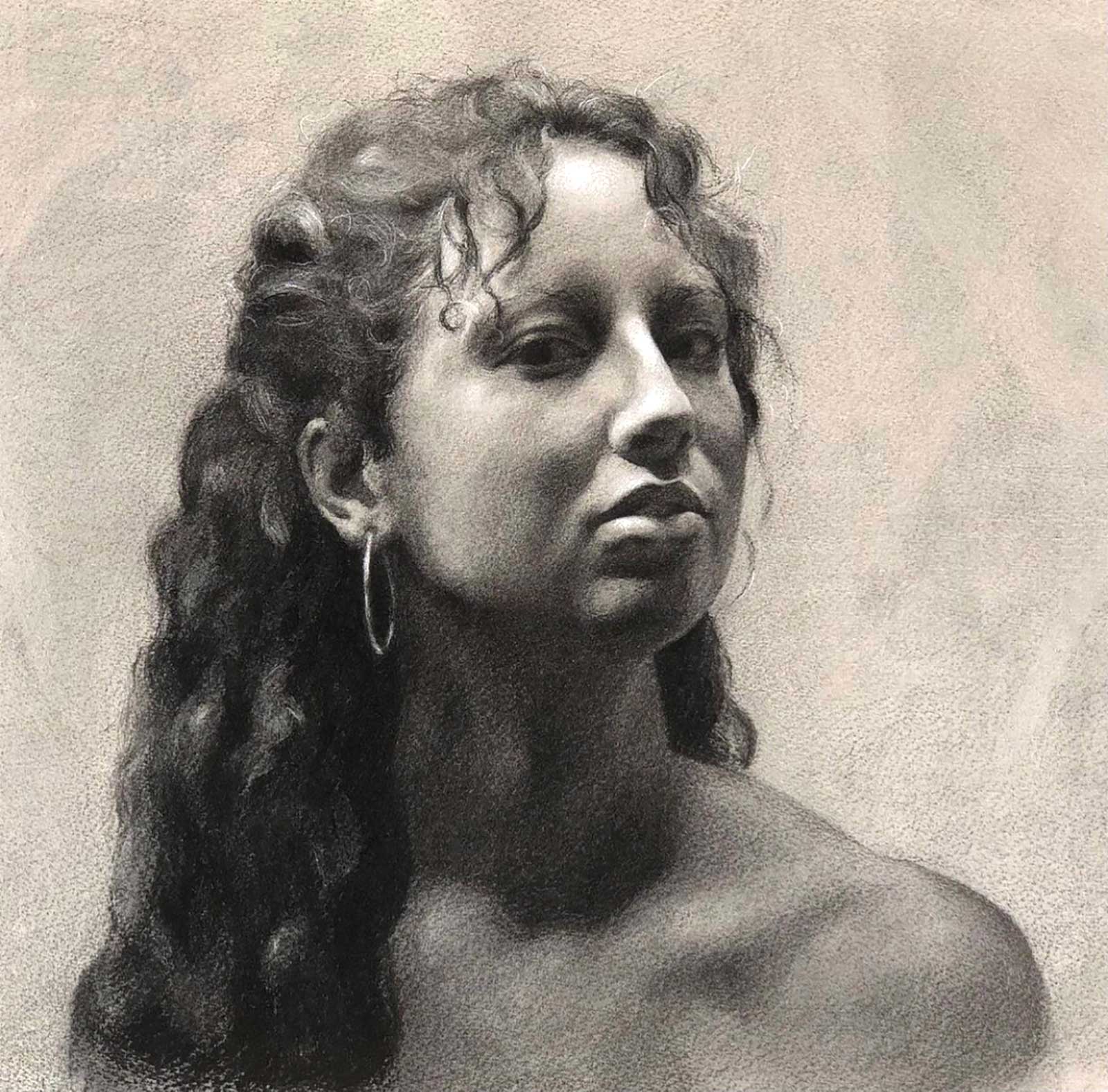
Jana Büttner, Pia, charcoal and white chalk.
Like so many artists, Büttner often finds inspiration in studying the work of other artists, both past and present. “I admire so many artists, and there are certain aspects in each of them I feel inspired by,” she explains. “For example, I admire Giambologna and Leonardo Bistolfi for their multifigured compositions, and I admire Camile Claudel and Paolo Trobetzkoy for their meaningful and moving work.” But it’s not only visual artists who inspire her. “I love to find inspiration through poetry,” she reveals. “It can be Rainer Maria Rilke, Hermann Hesse, Goethe or many others. I find poetry is the fastest way to trigger emotions, and it can paint a clear picture in front of my inner eye.” Büttner also finds inspiration in dance, particularly the movement and intertwining of bodies. She says, “Dance is an incredible way to study the movement of the body and the emotions connected to the movements. It can be classical ballet, but also contemporary dance. And of course, dance is a very different art form to sculpture. Dance communicates through movements which follow after each other. Sculpture is capturing one specific moment, but I love to see what dancers can express with every movement.” Büttner’s careful study of the human body and the lyrical postures of dance are clearly seen in her works, Awakening and Trapped.
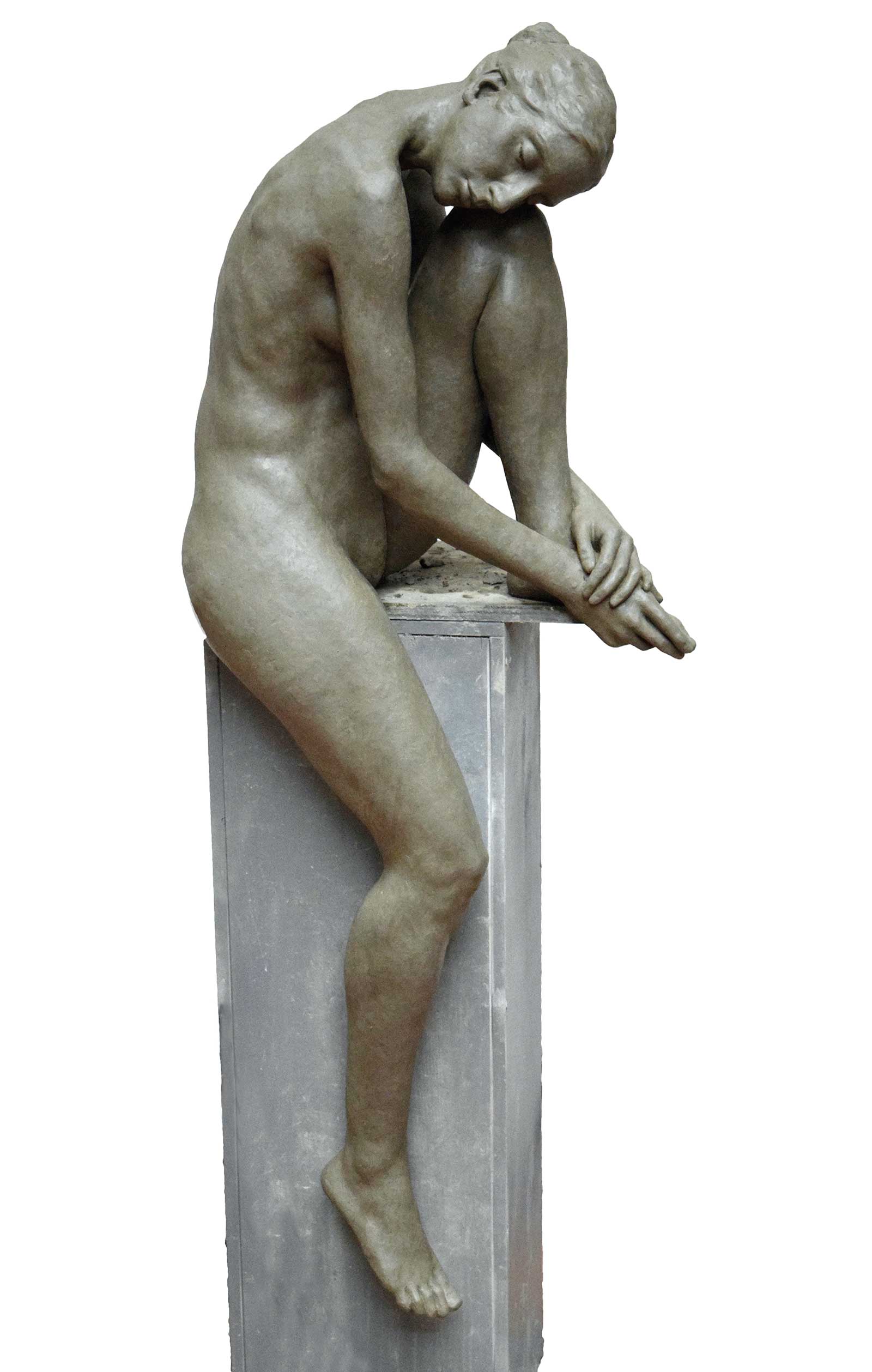
Jana Büttner, Reflection, résin, 46 x 12 x 21½" (117 x 30 x 55 cm)
Over the past few years, Büttner has continued to work from her studio in Austria and has exhibited her work around Europe. In 2019 and 2020, she was an ARC Salon Finalist at the Art Renewal Center, and most recently, she exhibited a piece at the Museu Europe d’Art Modern. “The best advice I ever received,” she says, “was to be truthful to yourself about the works you’re creating.”
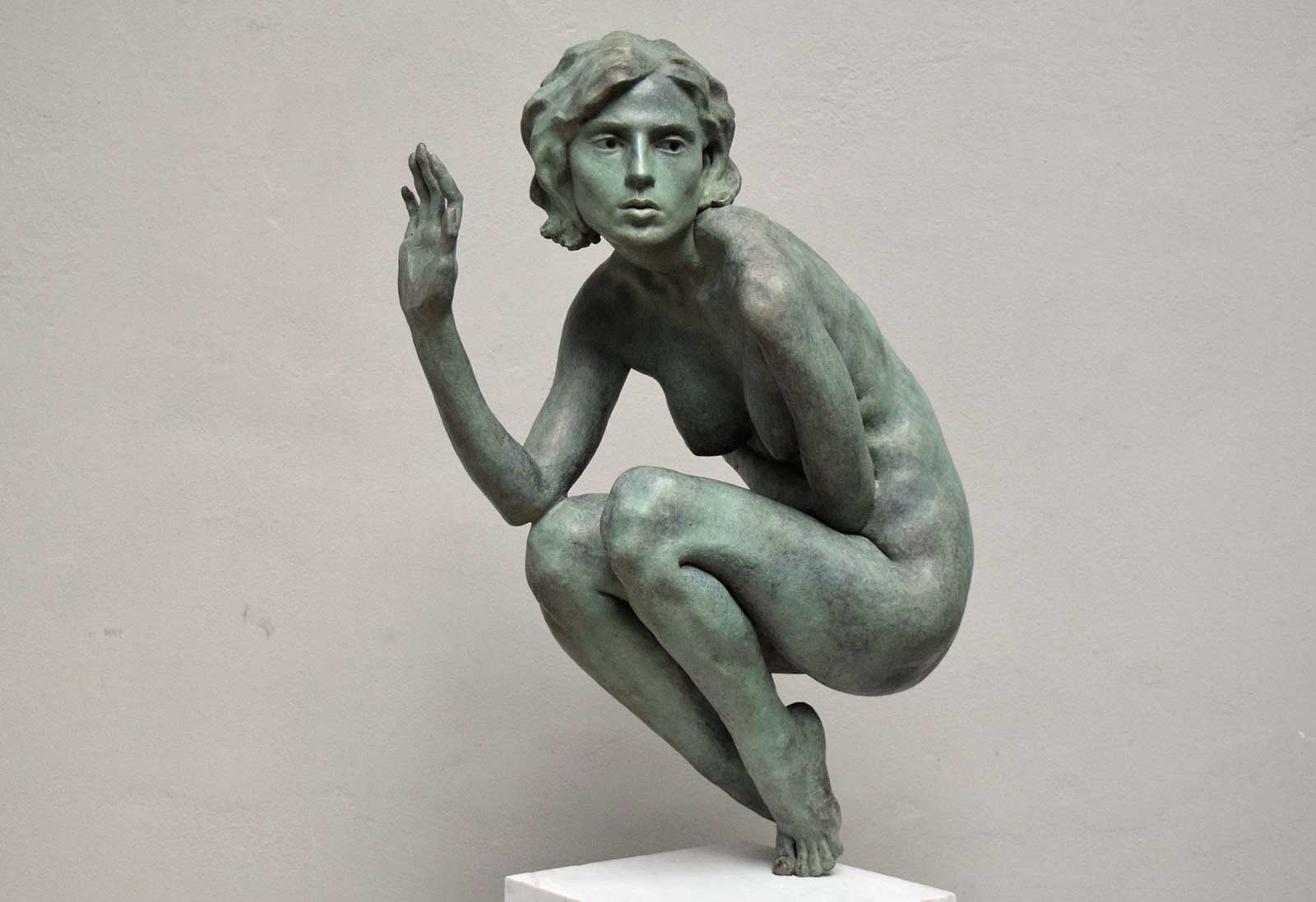
Jana Büttner, Trapped, bronze, 28 x 19 ½ x 12" (72 x 50 x 31 cm)
Congratulations to Büttner and each of this year’s winners, including our Second Place Winner Phoebe-Louise Stewart Carter, Third Place Winner Mikayel Harutyunyan, and Fourth Place Winner Samuel Hoskins. Looking at this group of talented young artists, I feel assured that the future of figurative art is in good hands. —