BRAVE
We Do What We Need
Part of our lives is fulfilling our wants and needs. Think about that: with whom we spend our lives, who our friends are, food, entertainment, where we live, etc. And yes, what we “do.” And doing our dream can happen at any age. I have 100 percent proof of that—from children to a good number of my students well into their 90s.
My Pathway
My head is swimming with art and knows very little about digital (other than to edit images, to type and to push the “send” button). My family and friends are with me, and I’m content in guiding my life along the artistic pathway. I now happily send this thought to you, dear friend.
Recognizing
Here’s a good one: If two hundred people you’ve known over the years were put in front of you, would you recognize each face? We can include those you “bump into” once in a while. Like the person at a regular drive through window.
I’ll answer for you. Yes, you could.
Let’s make this a bit more interesting. Let’s say those known people in your life are all happily standing on a row at a distance of 20 feet. You’re outdoors with a clear afternoon sun that hits each face giving the basic shapes of the facial features. In other words, no fine details. All within hairline and face shape; recognition is with eyebrows and shadow shapes of the unique facial features. Like my drawing of the grand and genial Brad Pitt.
Your mind could recognize all those individuals in front of you, as you observe their basic features. Even ones you might not have seen for some time. It happened to me during the 50th anniversary of my high school reunion. Even though much older, I recognized every face; each implanted and remaining etched in my mind. Shapes of facial features.
This seems impossible, except it is very possible; an inborn talent we all have. Each of Earth’s nearly 8 billion people have generally the same basic features, but all are uniquely different. As artists, we can recognize this fundamental truth when we begin to carefully, artistically lay in those very distinct shapes that we see. Yes, and of course we can fill in the fine details guided by those very distinct shapes. Remember, those shapes are a major part of world history.
Oh, Memory
Another thing that happens to me when seeing an art piece I did decades ago: I’ll look at it, closely observing the strokes, each done by a “living, striving artist.” An interesting part is that I can analyze what my mind was going through in areas, as if it’s happening now. Remembering why I darkened a certain spot, and oh yeah, I loved doing that color over there. I could write a story about myself looking at one of my early works and the drama circling it. Somehow like going to a mystical village I haven’t seen for years. Sometimes with tears.
No Equals
Also an artwork doesn’t like equals. Meaning a work should be unequal in color: more warm than cool or more cool than warm. Also not equal in dark and light…more dark than light or more light than dark. I’ve watched many of my art friends eagerly doing preliminary sketches, working out those colors and values. I’ll add this: they also know that strong design is even more important.
Design?
Okay I do say “design” quite a bit, but I look at it this way, with an ode streaming from my mind: In poetry we say “rhyme.” In music it’s “time.” With art we say “fine,” but mostly “design.”
We Make it Happen
My mind can get desperate and needs to get creating. My subconscious starts buzzing with “let’s get it going!” I might start getting into a challenging art piece I’ve wanted to do for years. Or I’ll draw the first thing I see when I turn my head. Maybe a five minute sketch.
There is a difference in art between secure strokes and insecure strokes. Being away from the easel causes hesitancy. Creating images on a steady basis makes the mind and hand have an earned bravura; meaning those strokes for the most part, become self-assured. There might be “corrections” here and there, yet we’re intensely “into it” with each work as it flows.
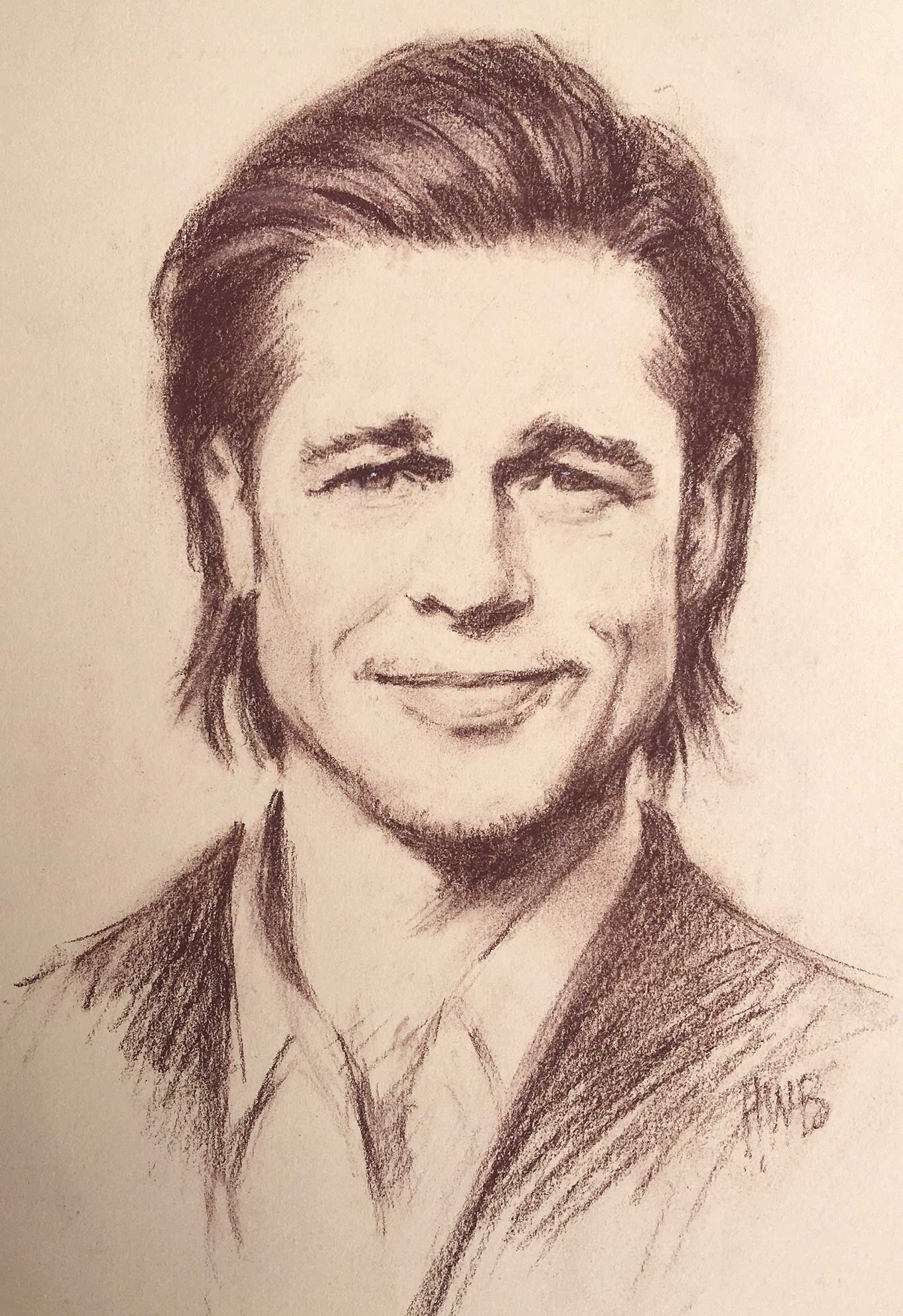
This drawing of Brad Pitt really shows the importance of the shapes of each of our features. Those small, simple shapes tell us who that is, but they have to be spot on. The other 8 billion people on Earth have slightly different shapes. So important in developing a work of art. The drawing was done with one piece of conté on light paper—two values.
It Can Happen, and Does
In our art lives, we learn important principles. Most importantly, we then give what we create our own, very personal interpretations. We eventually take bold, sometimes unexpected moves with our composition or laying colors here and there, pushing shapes. Much like an author putting in dialogue for a stage play or a choreographer with a dance. We each are unique from childhood on, words and actions flowing with sparks of individuality. Art and personal temperament, released from within.
We as individual artists are not being different for difference sake, but something that is streaming from the heart, bursting with creative moments. Freely allowed but sometimes tempered. A mixture of the personal artist working with learned skills and what comes naturally.
It’s an Artistic Marriage
Let the technique side begin to slowly join in with the passionate side. This brings us to a true marriage, as in various areas of the arts. Like Joni Mitchell singing her inspired and unforgettable “Help Me.” Indeed, talent married to passion—the perfect couple.
Interpreting Reality
In representational art we draw and paint what is visually real but not a photographic reproduction. We are unique in that people often know our creations without seeing our signature on the artwork.
Remember
Remember that shadows are shapes and colors have values. When I draw an arm, I look at how it is specifically shaped; I’m not an anatomy expert. Same with a boat, a tree, an elephant. Looking at the light and dark areas shaping a tree and you can use any color if the values and shapes are right. I’ll sometimes make a shadow a bit more flat if its specific shape is needed. Or I’ll lay on a color somewhere just for the elation of self-indulgence that enters my system quite naturally. Sometimes it overrides my conscious mind. Think about that.
Impressions
I bypass first impressions. The second impression? That’s when something could be solidifying. For instance, if someone is a nuisance the first time, it might be I got that person at a bad moment. But on the second encounter, a nuisance begins to legitimize the first impression. The third time is a wrap. Exceptions are rare but do happen, and I’m a perfect example. I’m not using a crafty bit of self-scorn here; I’m being real. Put simply: I take some getting used to. How ‘bout you?
Keep Revisiting
Study a Serov, Degas or Sargent painting some time, and try to analyze why and how certain parts were done. Values, spaces, elaborating areas. Don’t ever stop observing historic artwork and today’s masterworks of art. Our minds love seeing inspiring paintings. Many times I’ve been with great artist friends at art shows and museums where we are totally enraptured and discuss some of the artworks.
Into the Mental Attic
I’m retiring from old movies, TV shows and even some of the places I’ve traveled. But also erased from my mind is much of contemporary art that I’ve never really understood. All in all, it’s a mental “house cleaning” while I sort out my pondering. And now I’m off to a well-earned, very peaceful sleep.
But First
Many contemporary artists proclaim their works are from deep emotions that they must realize on canvas. They say there is more pouring out of them than just pretty pictures. I’ll say this: the non-objective artist does not put more “deep emotions” into his work than you or I do. He’ll utter such words at certain art gatherings. Gatherings I’m happy to be banned from.
Dream Come True
The idea is to not let the outside world be too much of an influence in our art activities. I have a generous side of me and a self-absorbed side. The generous side is with family and friends and many activities. We all want to lift our spirits, and that helps keep us going. Including that other side when I’m in my studio or on location to create art—a large part of my life.
Getting to that Dream
Way back, my mind might go into overdrive and come up with any way to survive, similar to being desperately lost in the middle of a hell city at midnight, without a nickel in the pocket. A bit of exaggeration, but the bottom line here is that in the art world, surviving and doing well can be done. I’ve plenty of art friends who also have stories of “survival.” Best of all, we get through the rough part, which does have some uplifting times. Bit by bit, a life into the world of our dreams. The World of Art.
Also
Often when I’m flying somewhere, I’ll often pick up a drawing pad and pencil at my destination. When finished, I tube it and ship it home. Being an artist includes a rarity, when the only thing we have to take on an easy trip is ourselves.
Speaking of the Self
I’m not necessarily critical of other artists’ works unless I’m asked to judge or an artist wants some advice. But I’m critical of my own art, though I have the deep pleasure of allowing my years at the easel to pour out unhindered. Except when I see something that doesn’t seem right. I want to get it before I put in too much detail, or maybe just get rid of it. As often mentioned, the inner mind becomes an expert through all the years of creating art. It knows if that red area in the background is too self-centered, or if I fussed too much with the nose. My subconscious even knows when I’m chattering about something important. Am I right, Inner Harley? —
BALINOFSKI
THE SPIRIT REMAINS
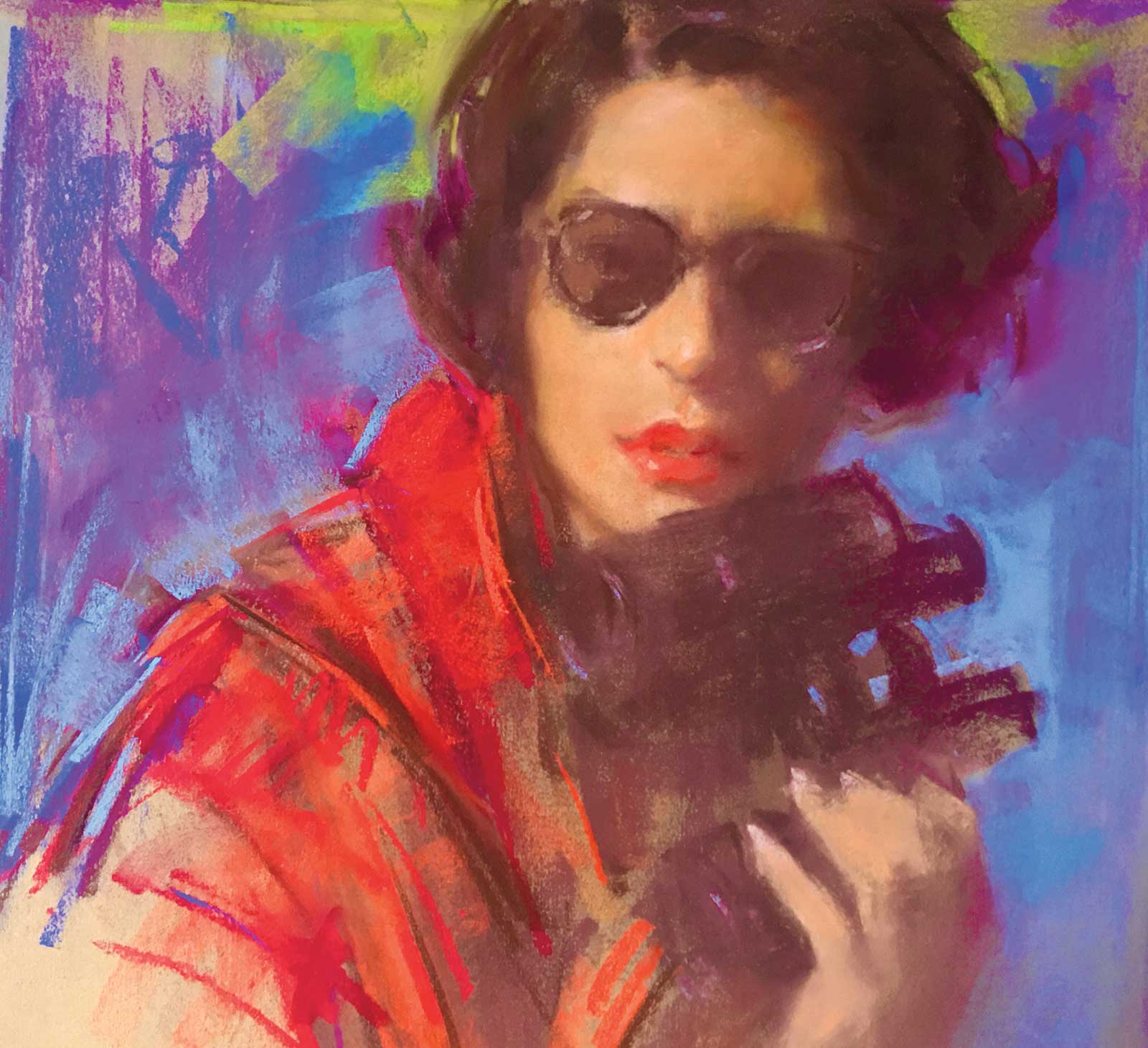
I’ve said it often and each time with the deepest feeling: A woman’s face is, in so many ways, perfect. Even when somewhat hidden, like here, behind those sunglasses and binoculars. We sense her genuine presence and maybe a bit of her feelings about us entering her space. Whenever I visit with this portrayal of her, I’m always mesmerized. She hasn’t moved nor aged, and she still hasn’t wanted me to start a conversation nor stay long. Is she alive? To me, she is most certainly, alive and will remain so. I continue to be totally affected by her charisma. Each time I see her, I want her lips to utter one word. I’ll let you know dear reader.
Her portrait was done at once and with no fussing or “touch ups.” Actually, it was the last pastel stroke when I knew she was finally now with me, evermore. And I sensed she was okay with our momentary, spiritual closeness. Here, she will continue to be a mystery that I cannot explain. But that’s part of what happens in our Art World.