



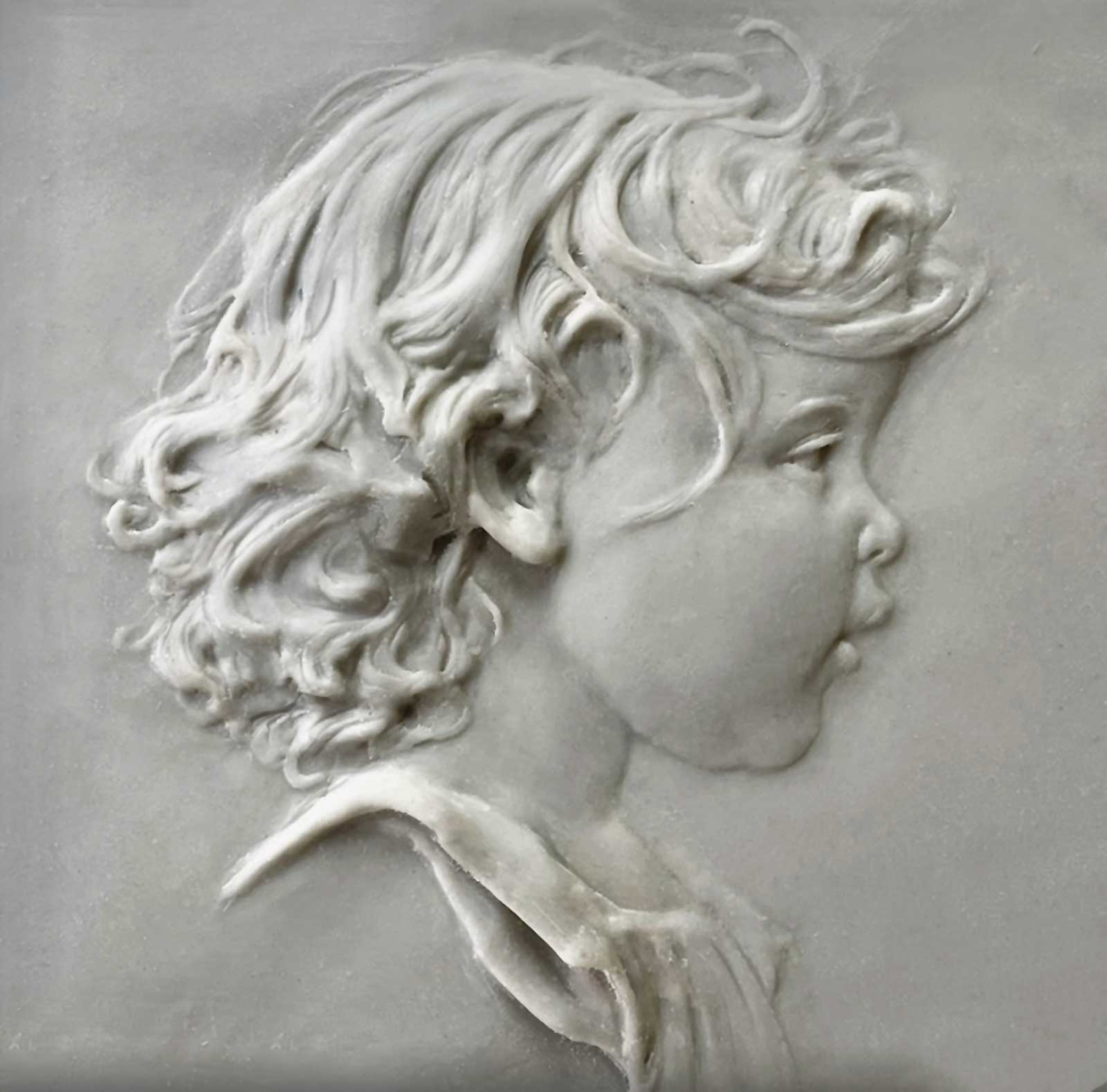
 Little One, Hydrocal, 7½ x 7½" (19 x 19 cm)
Susan Wakeen
Inspiration
What could be more beautiful than the softness and innocence of a young child? With each new bas-relief project, my goal is to stretch the limits of how much depth I can achieve in a low relief portrait. I wanted to create the illusion that her soft curls were twirling in the wind, moving front to back, left to right, and forward on her sweet face. So yes, it was her hair that first got me excited, and the cherub-like profile of this 3-year-old child was also very endearing.
Process
When sculpting a bas-relief, I cover a board with oil-based clay, about 1⁄8 inch thick. I then draw the profile on the clay. I carefully analyze the high planes and low planes of the subject both vertically and horizontally and slowly build the larger forms. When I feel the portrait is close, I create a plaster proof, which involves mold work and casting. Next, a casting with a carving wax is poured, with which I can fine tune the details and subtleties. Since this relief is only 7½ inches squared, I was presented with additional challenges. The quality of my reference is important, and although I am sculpting a profile, I often use other views to fully understand the subject. The ideal end result for me, always, is a successful portrait that feels like the subject as well as represents the subject.
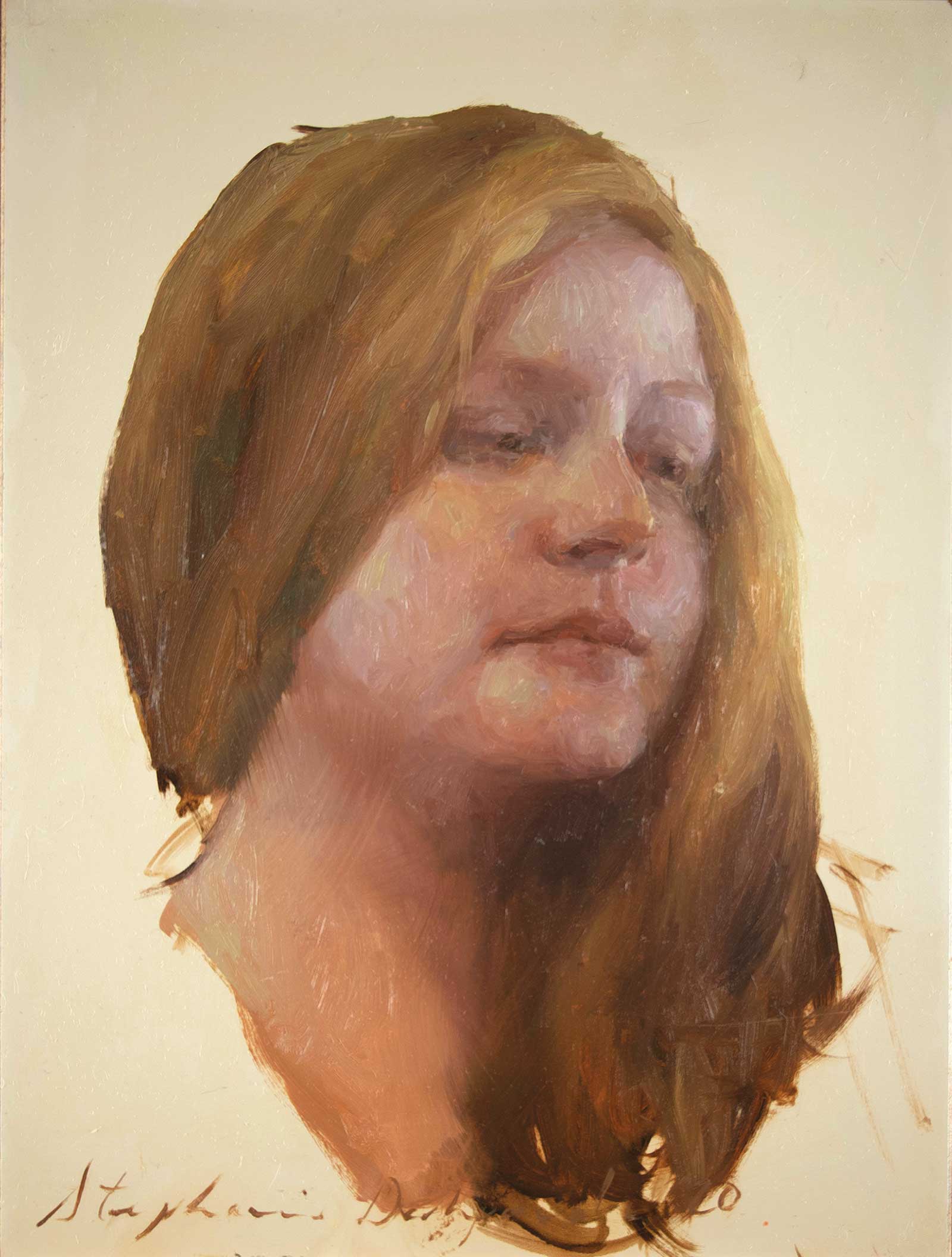 Portrait of Jamie, oil on panel, 12 x 9" (30 x 22 cm)
Stephanie Deshpande
Inspiration
I painted Portrait of Jamie in July 2020, near the beginning of the Covid pandemic. After a few months of isolation, everyone began to ruefully accept that the pandemic wasn’t going away any time soon. For this reason, I was delighted to discover that my alma mater, the New York Academy of Art, was hosting a weekly open studio over Zoom. This virtual gathering was a much welcome way to connect with other artists when no one could meet in person without risks.
Process
I worked on this alla prima portrait for about three hours in my studio while Jamie modeled over Zoom. Although I was working from my small computer screen, painting in a direct manner was enjoyable. Like painting from life, I quickly sketched her portrait with thinned, transparent brown paint on a sepia-toned panel. Then, I blocked in the main colors and values and carefully refined the details. I was inspired to paint this portrait because of Jamie’s elegant pose and thoughtful countenance. Even on the screen, I observed the luminous cool tones in the highlights on her skin and the gorgeous warm hue of her hair. Unlike painting from a photo, working from life online allowed me to work quickly to capture her fleeting beauty. I enjoyed this process because it was spontaneous and didn’t allow me to overwork the painting. I left the background unpainted with some of the original sketch lines showing, giving it an immediate feel.
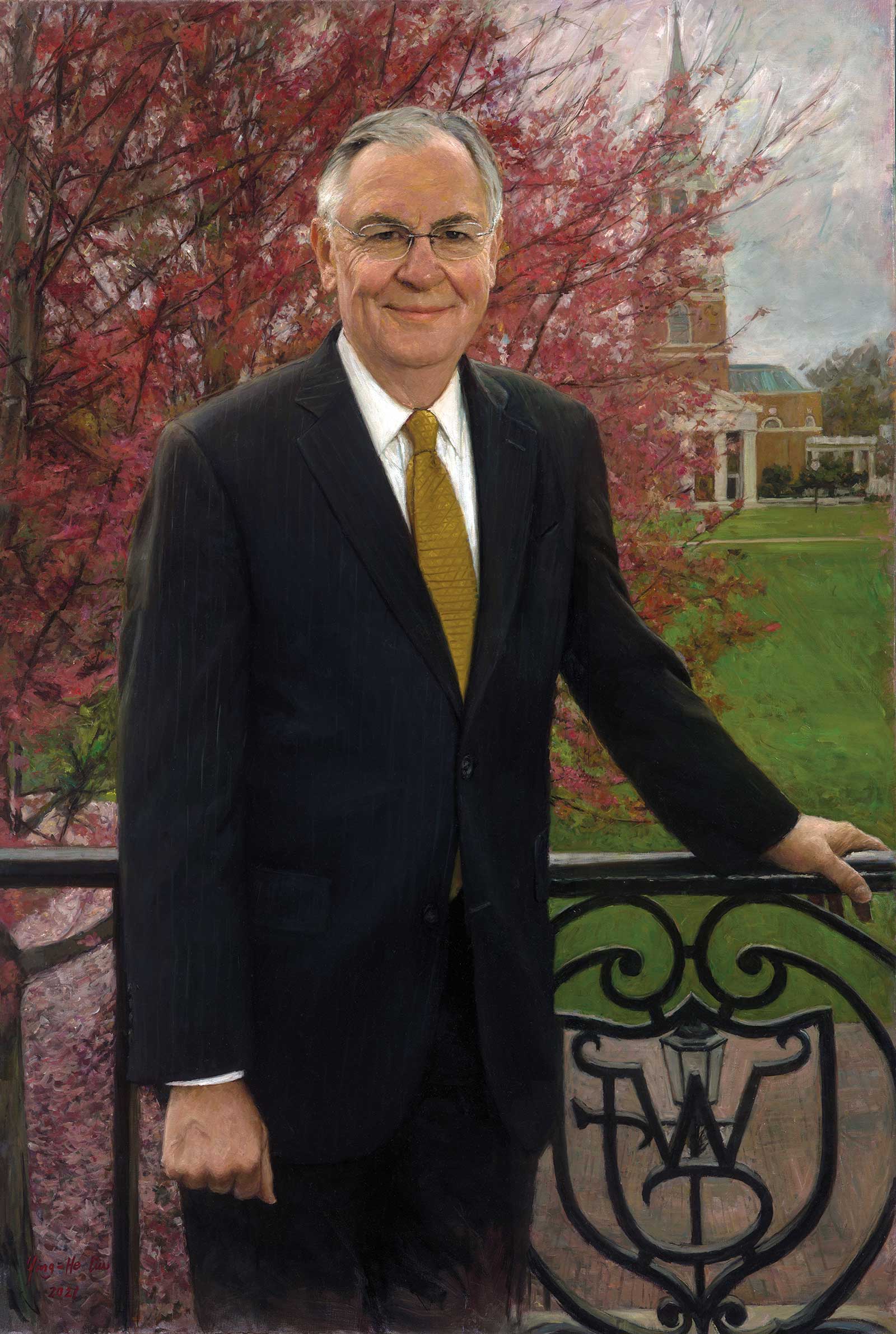 Nathan Hatch, President of Wake Forest University, oil on linen, 50 x 34" (127 x 86 cm)
Ying-He Liu
Inspiration
This portrait was a commission from Wake Forest University. President Hatch was a beloved president and had a distinguished and appealing presence. The portrait is now hanging in Reynolda House Museum of American Art, which is affiliated with Wake Forest University.
Process
When I started the sitting, we did not have a concrete idea as to how the portrait should be designed. After checking out several locations, I decided to use the balcony of the main administrative building for the setting of the portrait. It has some important symbols of the university, including the chapel in the distance and the cast iron railing, which has a Wake Forest symbolic design. The red leaf tree in the background presents a rich and beautiful backdrop. I think a lot of elements are fortuitous for this portrait, and I am glad it works to the delight of my client and myself.
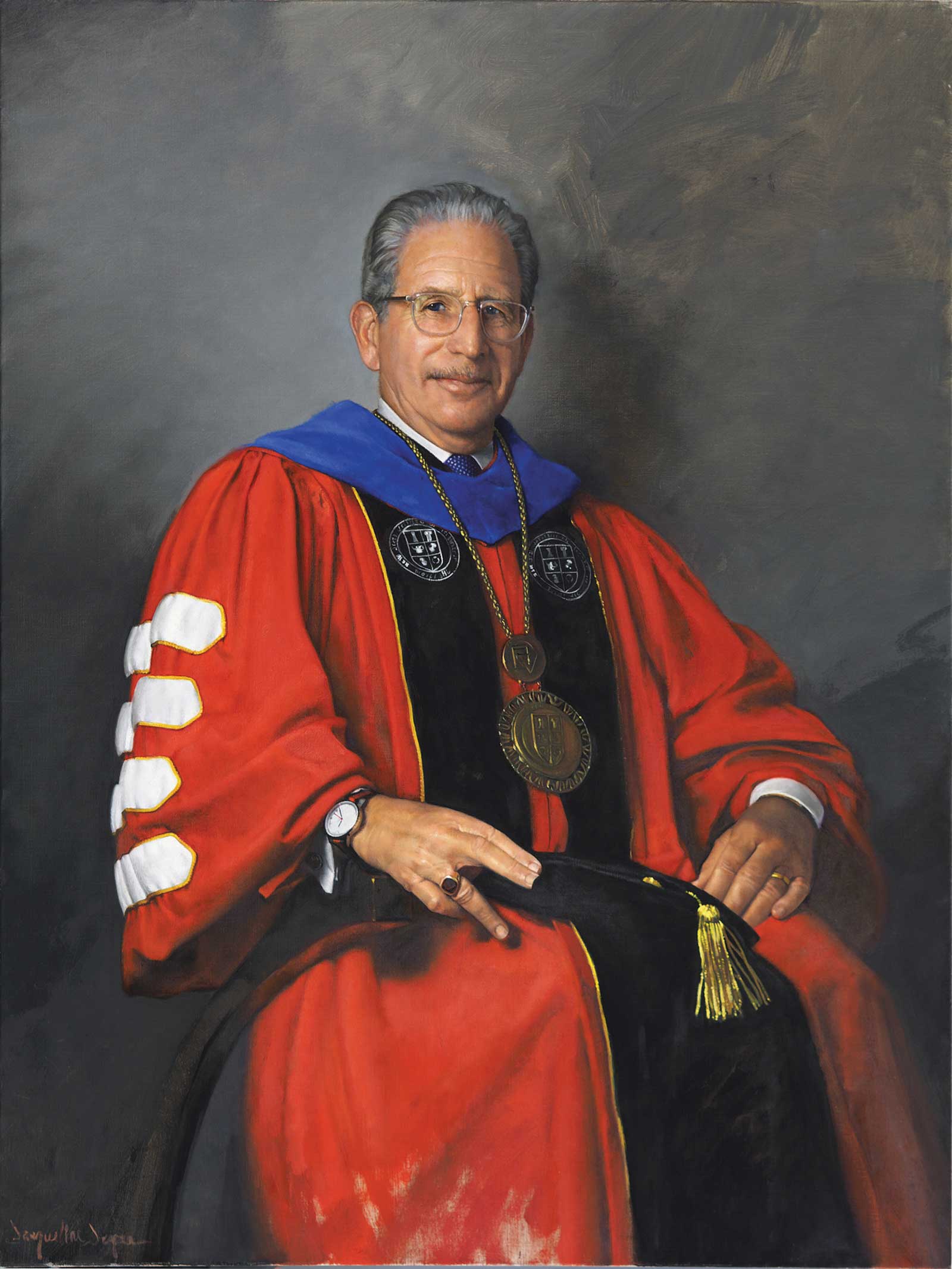 Dr. Joel S. Bloom, oil on canvas, 40 x 30" (101 x 76 cm)
Jacqueline Jasper
Inspiration
One of my early portrait instructors encouraged me to approach each painting with the thought that, “One day this painting may hang in a museum.” As such, I tend to look to the work of the masters for guidance, and my commissions tend to come from clients who seek a classical approach to portraiture. The minute I saw Dr. Bloom in his red regalia, my mind flashed to the iconic Velázquez portrait of Pope Innocent X, which I believe has inspired many artists before me.
Process
Few people these days have the time or inclination to sit for portraits, so I have become comfortable working from reference photography. However, I don’t trust the camera to record color accurately. I need to do a color study in oil to record the subject’s skin tones, in light as well as shadow, hair, eye coloring, clothing, etc., and I rely on this color study throughout the painting process. I prefer to take reference photos myself since lighting for a painting has different needs than lighting for a photograph. I believe it is important to keep my clients involved, so at various stages in the process I email a digital photo to show my progress and to get their feedback.