



Grand Prize
Grand Prize is a four-page editorial feature in American Art Collector magazine
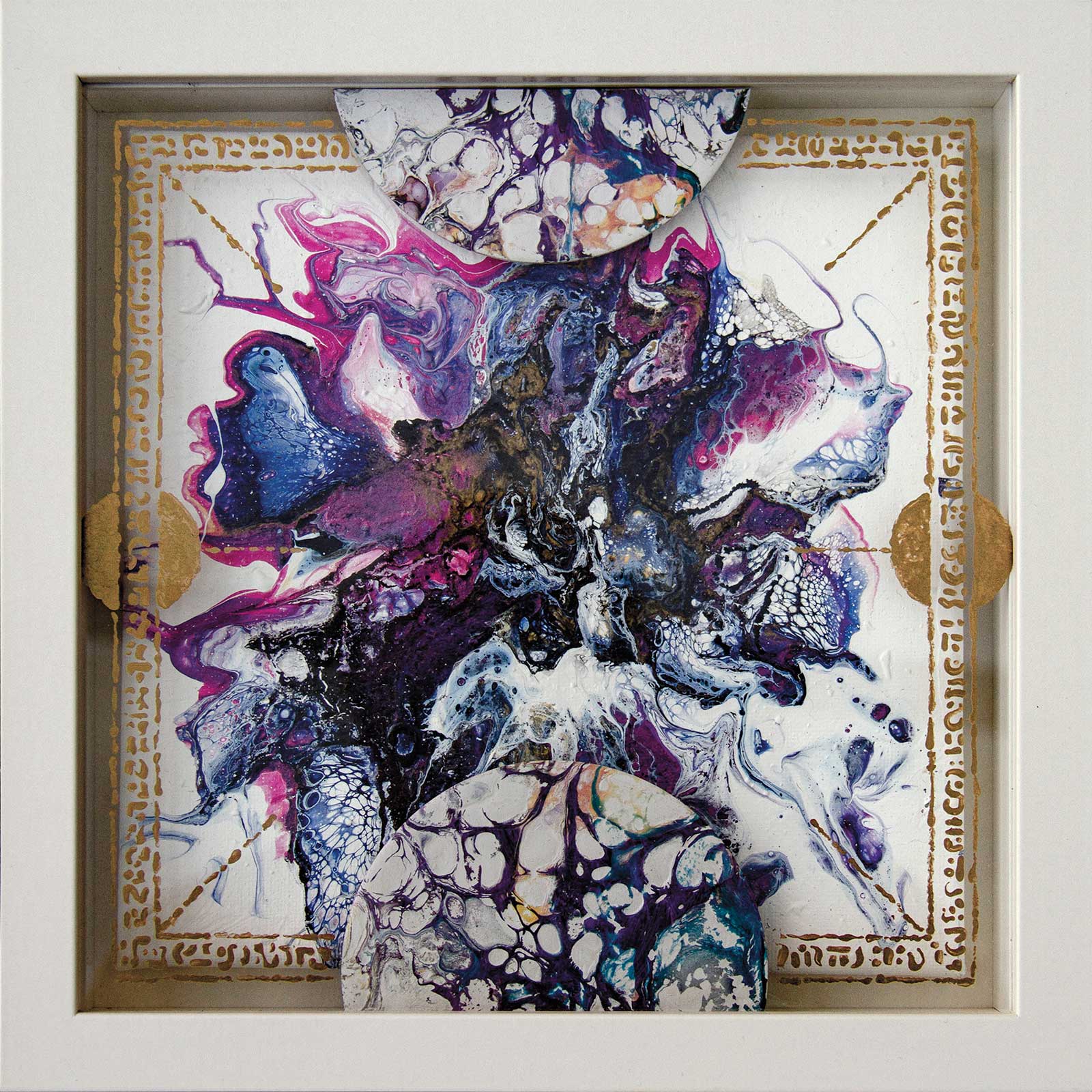 Relics 03, acrylic, 8 x 8" (20 x 20 cm)
Jef De Corte
Wichelen, Belgium
Keeping Them Guessing
Jef De Corte is a man of many talents, working in a variety of mediums and subject matter. From landscapes and seascapes in pastel, to portraits in charcoal, to abstract art in acrylic, the artist enjoys exploring the world around him.
“A large portion of my work is realistic painting and drawing, mostly landscapes and commissioned portraits,” says De Corte. “In my abstract work I aim for a style that looks intricate and detailed, like the old manuscripts that inspired me. When you look at one page of the Book of Kells it takes a long time before you have discovered everything. This is what I want for both my realistic and abstract work, to offer a journey to the viewer, to be able to wander through the artwork.”
De Corte’s inspiration comes primarily from his direct surroundings, with many of his paintings depicting the river and nature reserve right near his home in Belgium. “Also, when I travel through inspiring landscapes, painting is always on my mind. Wherever I go, I take many reference photos to support my memories,” he says. “I like to work on recurring themes. I have my abstract Relics theme, and Ripples, a series based on water reflections, of which most viewers tell me they also experience an abstract quality.”
He also has a series with a recurring theme of “tree portraits,” and another series on “street lights.” The artist says, “Being able to switch between subjects and media keeps it fresh and interesting for me.”
My Inspiration
My first Relics painting series goes back 30 years, with a successful exhibition in the beautiful old cellars of a 15th-century Belfry, in my birth town Aalst. These paintings were done on hand-marbled paper and were made to look old, like remnants from a distant age or lost civilization, a perfect match for the old cellar walls. I was also inspired by the Eastern European icon paintings and old manuscripts like the Book of Kells, with their use of gold and intricate details. My intention was never to copy these but to capture the mystic quality they radiate. When I learned more about the acrylic pouring technique, I felt this could be a means to give my Relics paintings a new twist.
My Design Strategy
Just like the marbling technique, acrylic pouring is a combination of experimentation and know-how. In my landscape paintings I am completely in control, therefore I enjoy this side-step into abstract art, in which I have to give up part of this control. Of course it helps a lot to experiment and get to know how the different products react and create cells in the paint. But still coincidence remains an essential part of the process. I also wanted a real 3D look for this series, so I had to figure out how I would build the different layers for the artwork. I decided on a painted background layer, a second painted layer floating above and design elements painted in gold on the inside of the glass.
My Working Process
I select the color combinations and mix the paint and pouring medium. As a cell activator, I add some drops of silicon oil. My aim is to create an intricate web of little cells that look like a very detailed painting. Even in the smaller paintings I still want people to be able to wander through them.
I pour the backgrounds on wooden panels or canvas, and with the same batch of paint also some smaller wooden disks. I now have matching elements to combine and try different compositions. I use the disks as a whole, or just a piece. With foam board and glue I mount the disks so that they seem to float above the background. From the final composition I make an exact position drawing of the different elements. I also include markings for the zones where I want to paint on the glass. I put the glass on top of this drawing and paint design elements in acrylic gold.
When this has dried I assemble the frame so that everything lines up.
Contact Details
Email: jdecorte58@gmail.com
Website: www.jefdecorte.art
Second Prize
Second Prize is a two-page editorial feature in American Art Collector magazine
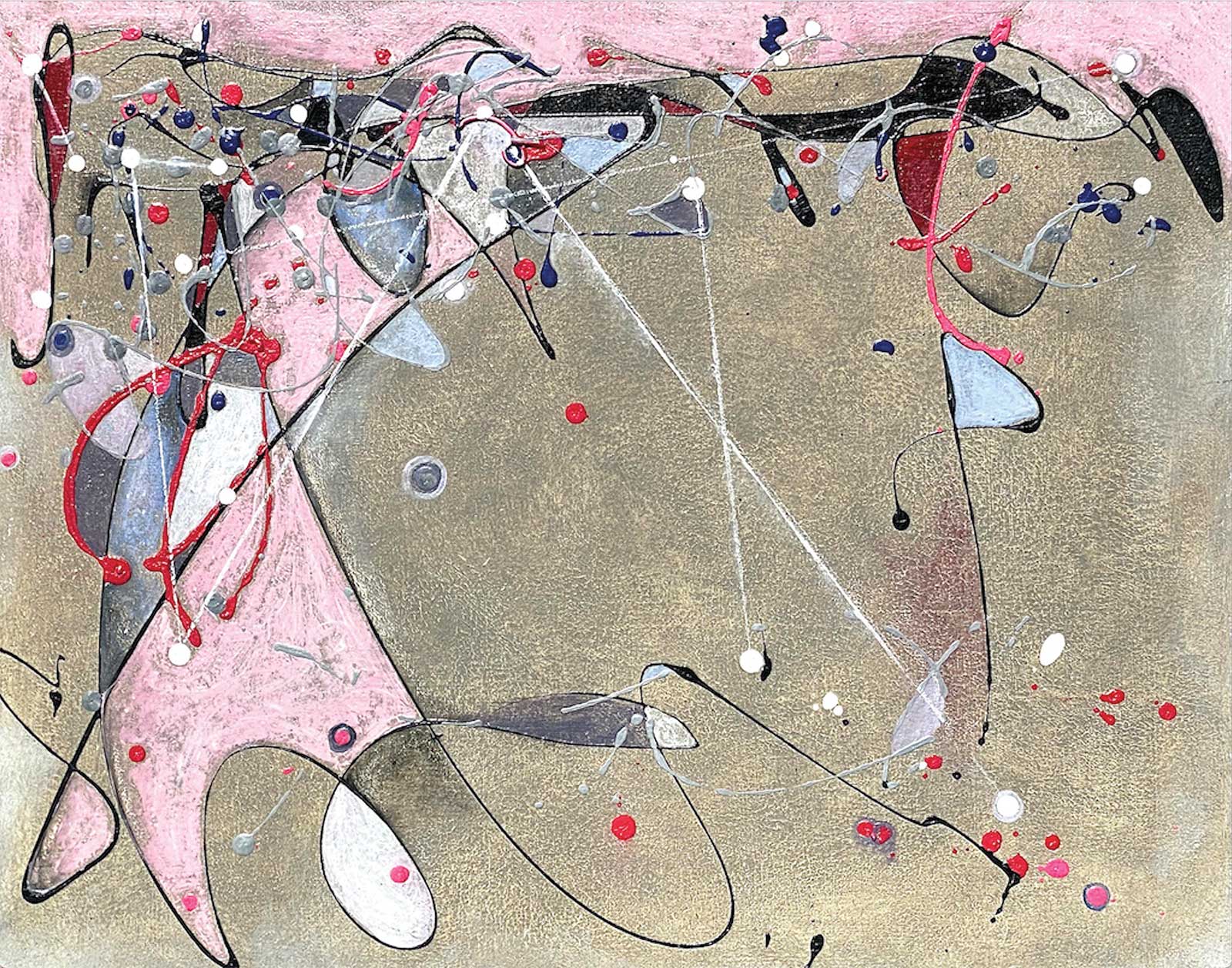 Trying to Sort It All Out, mixed media, 19 x 23" (48 x 58 cm)
Tanya Roland
Virginia, USA,
My Inspiration
For this piece I was inspired by a method I’d been playing with—that of pouring paint. I’d been experimenting with it for a while. I knew in my mind how I wanted it to behave but only through lots of trial and error did I find the right consistency. Once I had the ground of a neutral mud color that I love, the rest basically created itself. A sense of trust that has developed within me is what I allow to guide me into unexpected choices. I rarely know how things will turn out as was the case here.
My Design Strategy
As I’ve mentioned, the strategy was to basically allow the method and intuition to guide me. I had a general sense of where I was going, but I’m always open to changing directions, shifting gears given new information or understanding along the way. So the plan was basically to listen and see within—to continually trust what is being revealed inside as I gave it expression outside. I stayed open to the surprises that showed themselves, and then I responded in a way that felt right.
My Working Process
I’ve trained my eye over a lifetime of looking and seeing things manifest in the world. I guess the older I get I tend to rely far more on inner vision. When I sit still with the intention of having images arise, they often do. And sometimes they even come in dreams. With this piece I started with a commitment to the pouring and the colors I was interested in at the moment. Connecting the random, organic shapes with the straight lines came at the end. Once that happened I understood what the title would be.
Contact Details
Email: tanya@tanyaroland.com
Website: www.tanyaroland.com
Third Prize
Third Prize is a one-page editorial feature in American Art Collector magazine
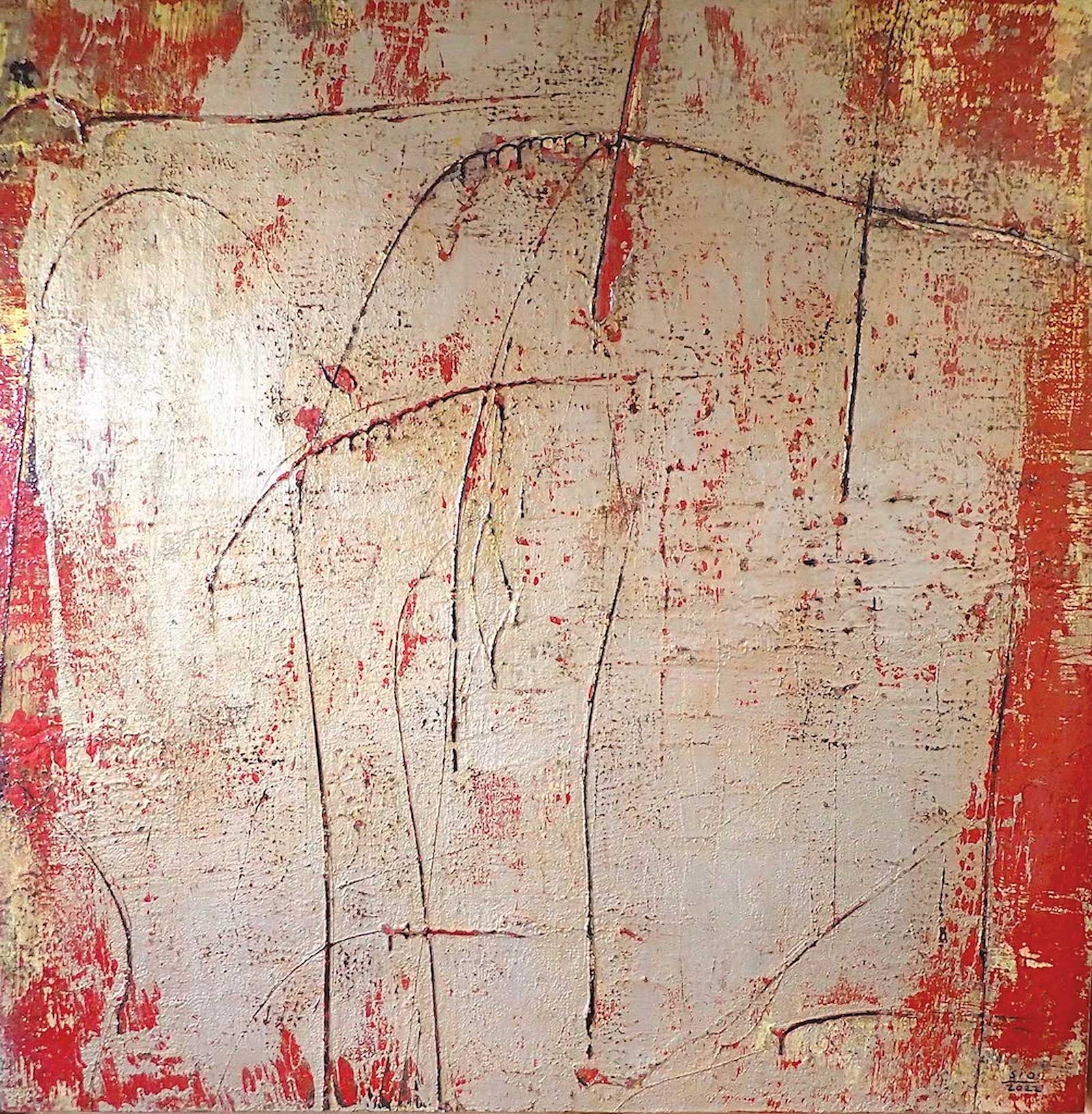 Passage to Red Rock (Pulang-Bato), acrylic, 48 x 48" (122 x 122 cm)
Dennis Montera
Cebu, Philippines,
My Inspiration
As an artist for over three decades, painting as artistic expression remains a primary source at my disposal for seeking solace and strength. By and large, the basis of my abstract painting is an intense, unpremeditated search for the images of my creative experiences and life’s journey. Each work is treated with a high degree of integrity that is aligned with personal life philosophies and artistic values. I get the inspiration to create artworks from the mundane to the more dramatic daily experiences of life. Sometimes, the idea can come from a weather-beaten concrete wall or the textures of an old house, and sometimes, the inspiration can come from grieving the memory of one’s mother. In other words, the inspiration can come from anywhere or anything. In practice, I would always rely on my instincts to know if something is worth developing because it will speak to you the moment you first see or feel it.
My Design Strategy
By design, my artmaking always starts with a confrontation with the materials and surface. In principle, my art production is connected to the abstract expressionist concept that what must occur on the canvas is not just the creation of an image, but an event. A canvas as an arena in which to act. Thus, it is critical for my strategy to separate the image-making process from any preconceived notion and allow form to emerge from the intuitive activity itself. The composition and design are generally worked to create sparse non-figurative abstraction using negative space as a dynamic support to color, texture and lines. These elements also extend beyond the framing edges, as if the pictorial area were a random selection and are painted with equal intensity where no particular object or shape stands out from the whole energy impact in the mass image. Thus, the resulting compositions are a collection of painterly and unintentional marks that are mostly impulsive and energetic.
My Working Process
The artistic process begins by wrestling with the pure, blank space of the canvas in consideration with the prevalent state of my personal emotions and being. A process-oriented method follows utilizing acrylic and non-traditional media such as tar, stains, and modeling paste to build up excoriated layers and leaving out patches of the painting’s histories after another layer is overlapped. The additive/reductive technique in the layering application produces swathes of lines and color grids, which often hints of an accelerated pace of weathering. The process is repeated a number of times until a desirable result is achieved. A period of curing and varnish applications completes the process.
Contact Details
Email: siomontera@gmail.com
Website: www.siomontera.com
Finalists
Each receives an Award Certificate and a one-year subscription to International Artist magazine PLUS having their work seen worldwide by international galleries looking for new talent.
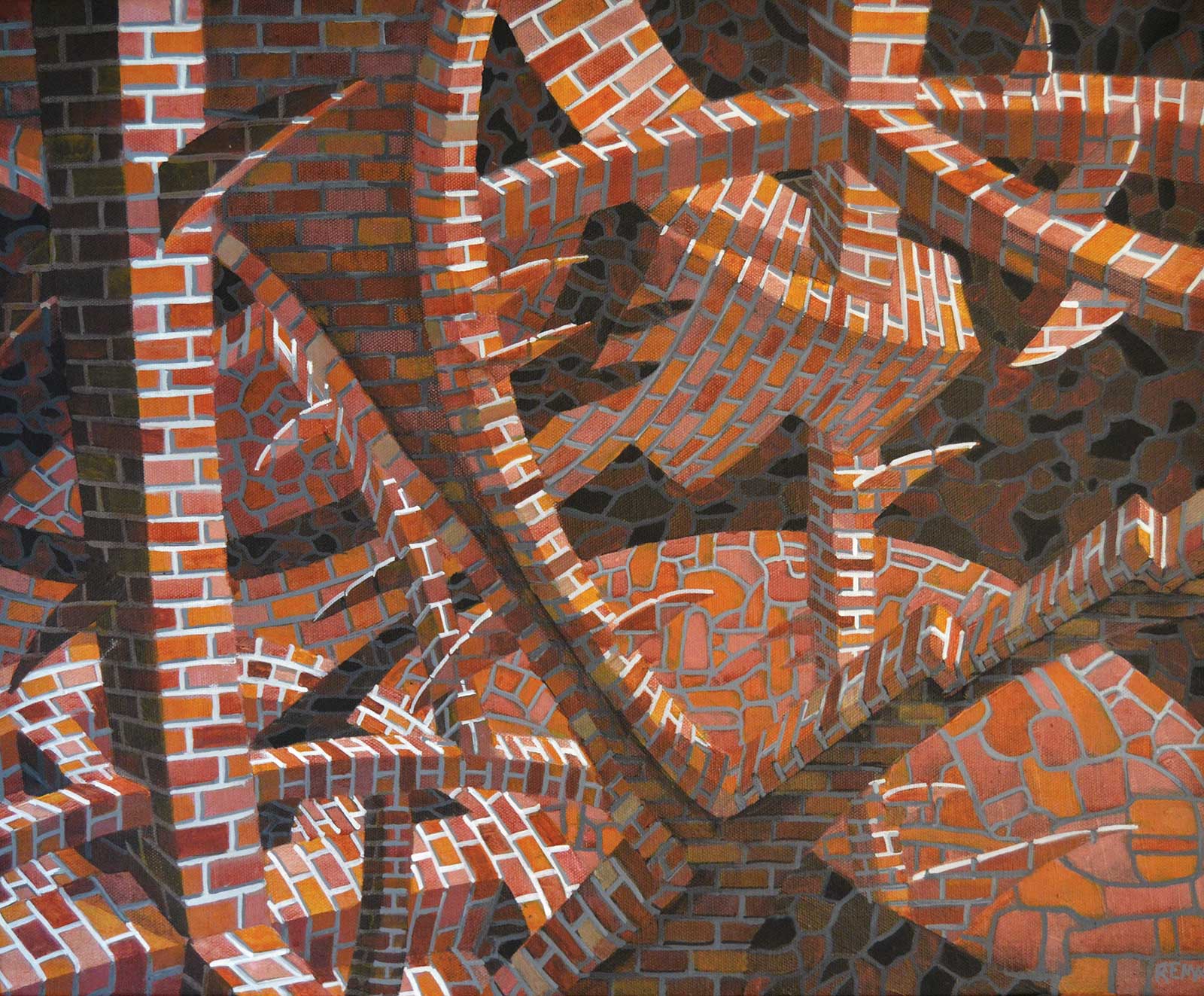 The Brick Playground, acrylic, 16 x 20" (40 x 50 cm)
Dan Remmel
Florida, USA,
My Inspiration
This image is part of a series of paintings based on abstract doodles/thumbnail sketches, each drawn in under 15 minutes. The bricks that everything is constructed from are derived from memories of my elementary school playground and a large brick storm drain that my friends and I recklessly followed underground for over a mile. Rain and flooding were always a possibility. I tried to reflect that danger in an abstract way with this painting.
My Design Strategy
The imagery contained here is based purely on a random stream of consciousness. At times I follow the rules of perspective, light and shade; other times I ignore those rules in favor of what I deem to be better abstract design. I tried to design this so the image works upside down as well as sideways. I wanted to convey a sense of vertigo along with a physical space that one could theoretically venture through.
My Working Process
I begin by painting the entire canvas dark red. I then sketch the basic design in with vine charcoal and begin roughing in the shapes monochromatically with mixtures of red, black and white. I keep an imaginary light source in mind, but don’t follow it slavishly. Once it takes on a semi-finished, three-dimensional appearance, I begin painting in the grout between the bricks. I finish by glazing bricks in various colors and highlighting them.
Contact Details
Email: danremmel@gmail.com
Website: www.dan-remmel.pixels.com
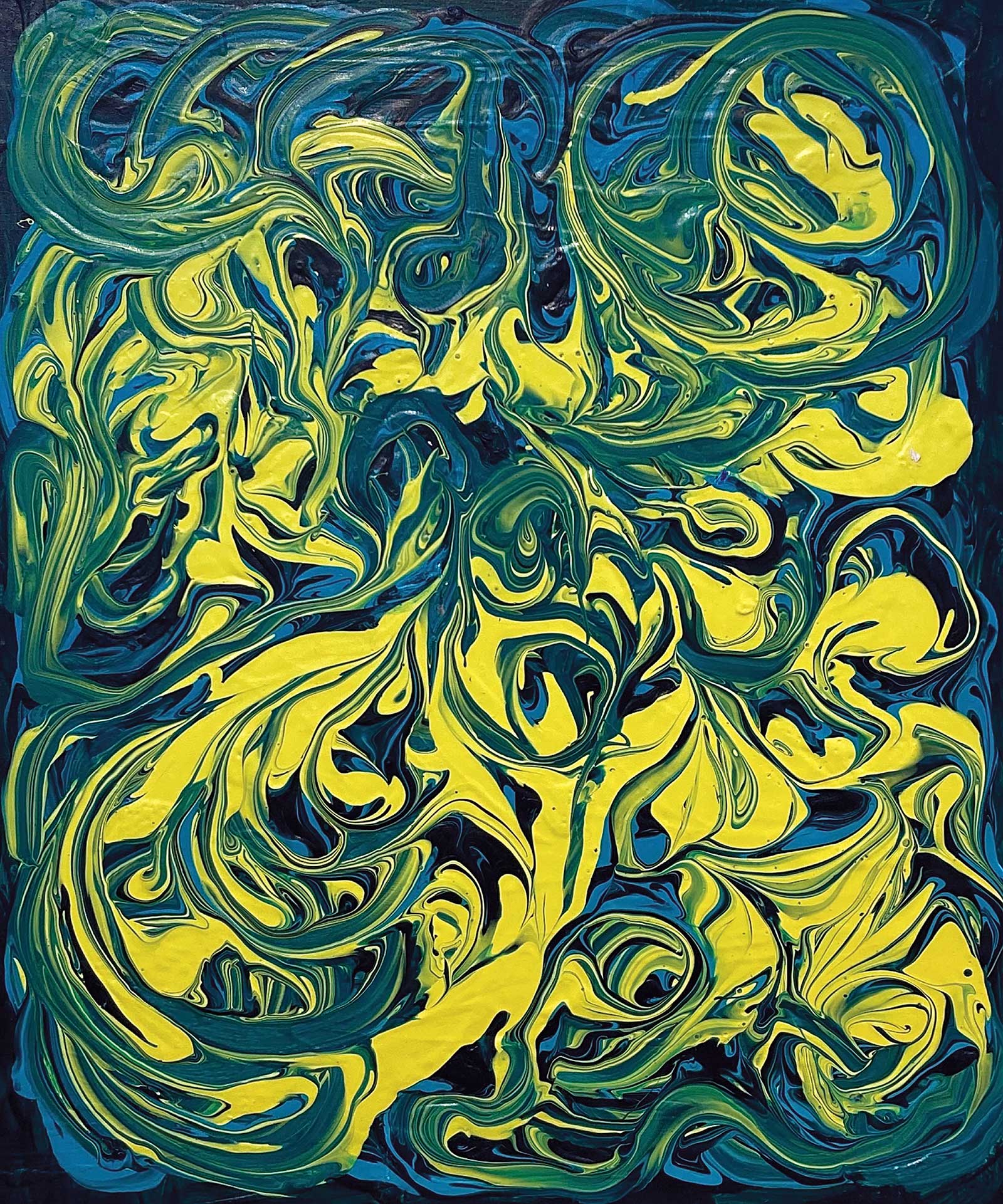 Let’s Sing in the Green, acrylic, 18 x 15" (45½ x 38 cm)
Akiko Yada
Kyoto, Japan
My Inspiration
I wanted to paint a picture of the sound of singing coming from the field in the green of early summer, which became a wave and spread wide.
My Design Strategy
I designed the spread of the singing voice as an abstract, undulating wave.
My Working Process
I put a lot of acrylic paint on the surface and painted with a brush, turning the brush in a circular motion without too much force.
Contact Details
Email: yadamaniart@gmail.com
Website: www.ydart.exout.net
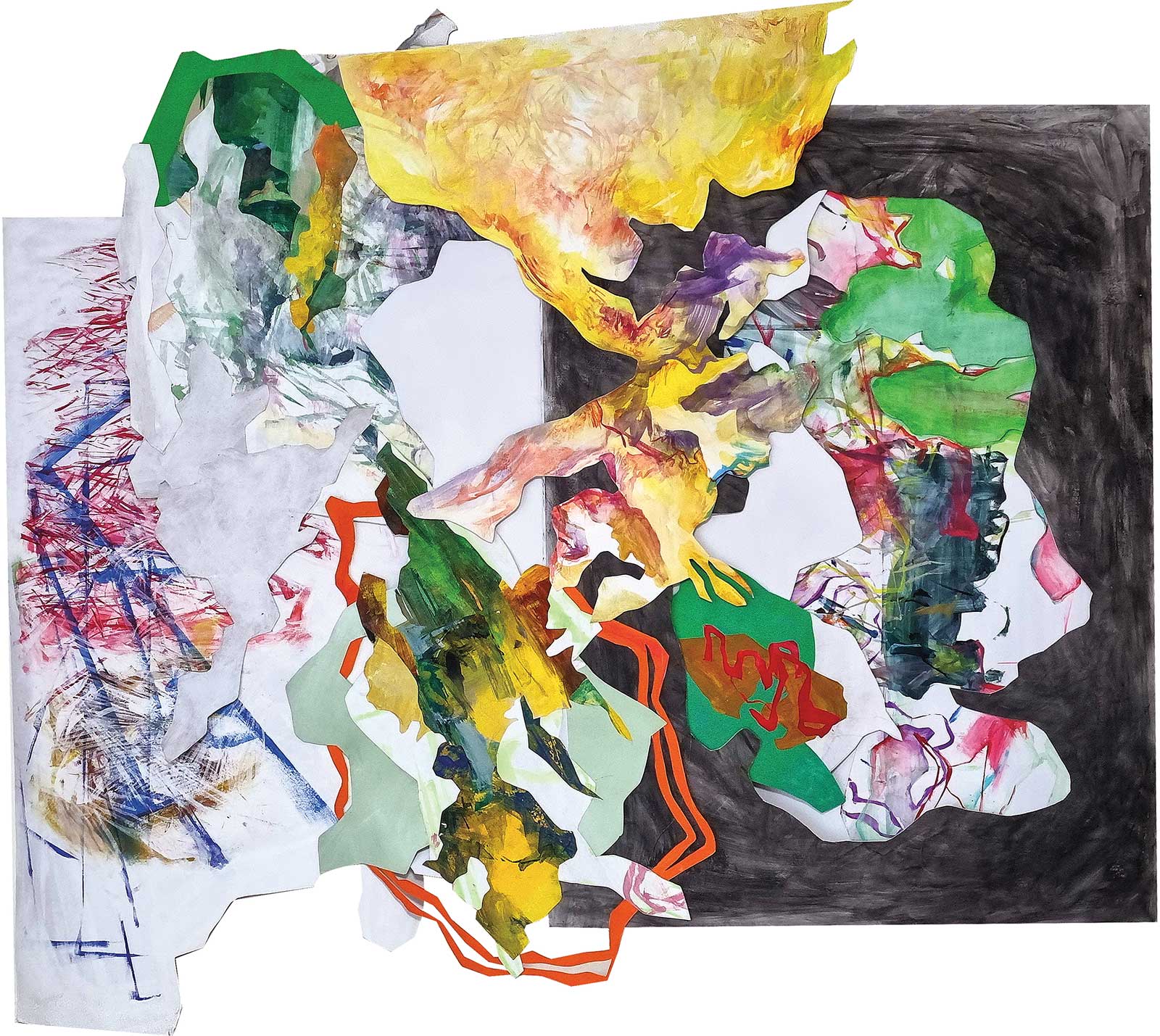 Plis 012, mixed media on paper, 54 x 59" (137 x 150 cm)
Hee Jung Han
Gyeonggi-do, South Korea,
My Inspiration
My series is a process of exploring the “multiplicity” inherent in humans living in the hyper-connected era where real and fake are mixed, as well as a journey of discovering myself who “knows nothing,” as Socrates once said. To this, my work begins from the concept of wrinkles (hereinafter referred to as “Pli”) often mentioned by Gilles Deleuze, a post-structuralism philosopher who explored the metaphysical relationship between identity and difference.
My Design Strategy
Driven by the desire to contextualize this, I use the fragments obtained from deconstructing my figurative paintings to create art that reinvents narrative and redefines meaning. For this, the collage technique was used dynamically and the fragments of various shapes extracted from the original are placed in reverse front and back, the inside and outside are flipped, and the visible becomes invisible for making a new scene. But they don’t come together to create a single narrative.
My Working Process
Through this approach, I want to show a journey in which images of multiplicity are connected to others and repeat explications and implications, creating difference—and then recreating themselves as something new. Above all, allowing for multiple interpretations as fluid as water and inviting viewers to peel back the many layers, they will hopefully discover the wisdom of Socrates in the end: “I know that I know nothing.”
Contact Details
Email: pinkasam2@gmail.com
Website: www.saatchiart.com/pinkasam
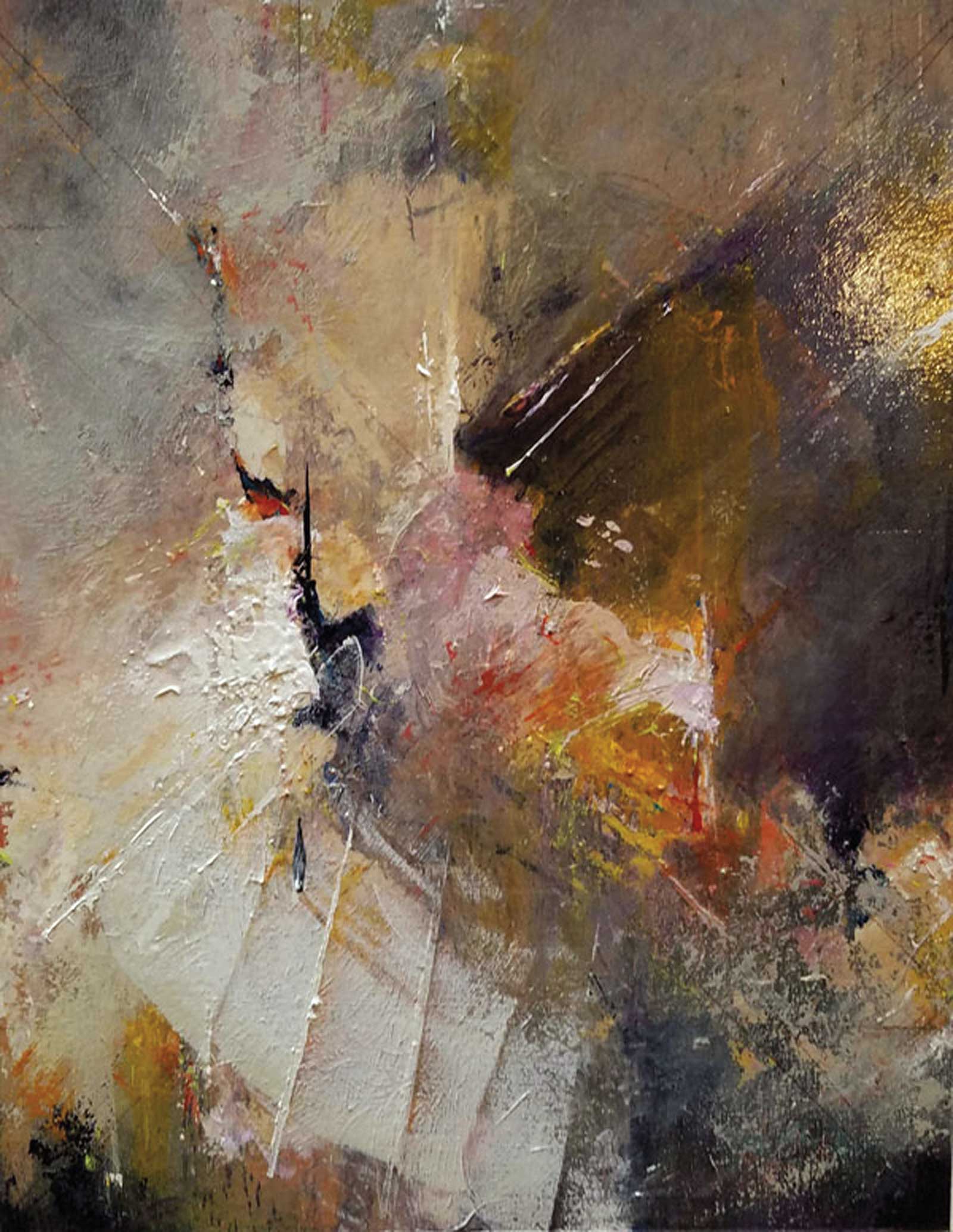 Beauty Walks a Razor’s Edge, acrylic, 20 x 16" (50 x 40 cm)
Timothy Pittenger
Illinois, USA
My Inspiration
All my artworks are inspired and enabled by music. I listen to classical music for my realistic works and rock and roll or jazz for the abstract pieces. The title for this painting came from a line in Bob Dylan’s “Shelter from the Storm.” “Beauty walks a razor’s edge, someday I’ll make it mine” represents to me the struggle and ultimate challenge in creating abstract pieces with a sense of excitement, drama and joy.
My Design Strategy
My abstract paintings are really about improvisation. They are not paintings of a subject—they are the subject. I use line, form, value, texture and of course, color, along with a lot of contemplation. I try to create something exciting and fresh. I want to make every inch of the painting interesting. My hope is that it will be unique and beautiful; a pleasure to look at.
My Working Process
The first step is to lay down an underlying gridwork. Although it will become hidden, it helps me establish balance, emphasis and continuity. Next comes intense gestural painting with brushes, sponges, palette knives, etc. Every area of the painting must sing its own part, but keep in harmony with the whole. The final crystallizing work is to adjust values, texture and color to create a balance in often asymmetrical paintings. Everything must work together.
Contact Details
Email: tjpbusiness@aol.com
Website: www.tpittengerstudios.com
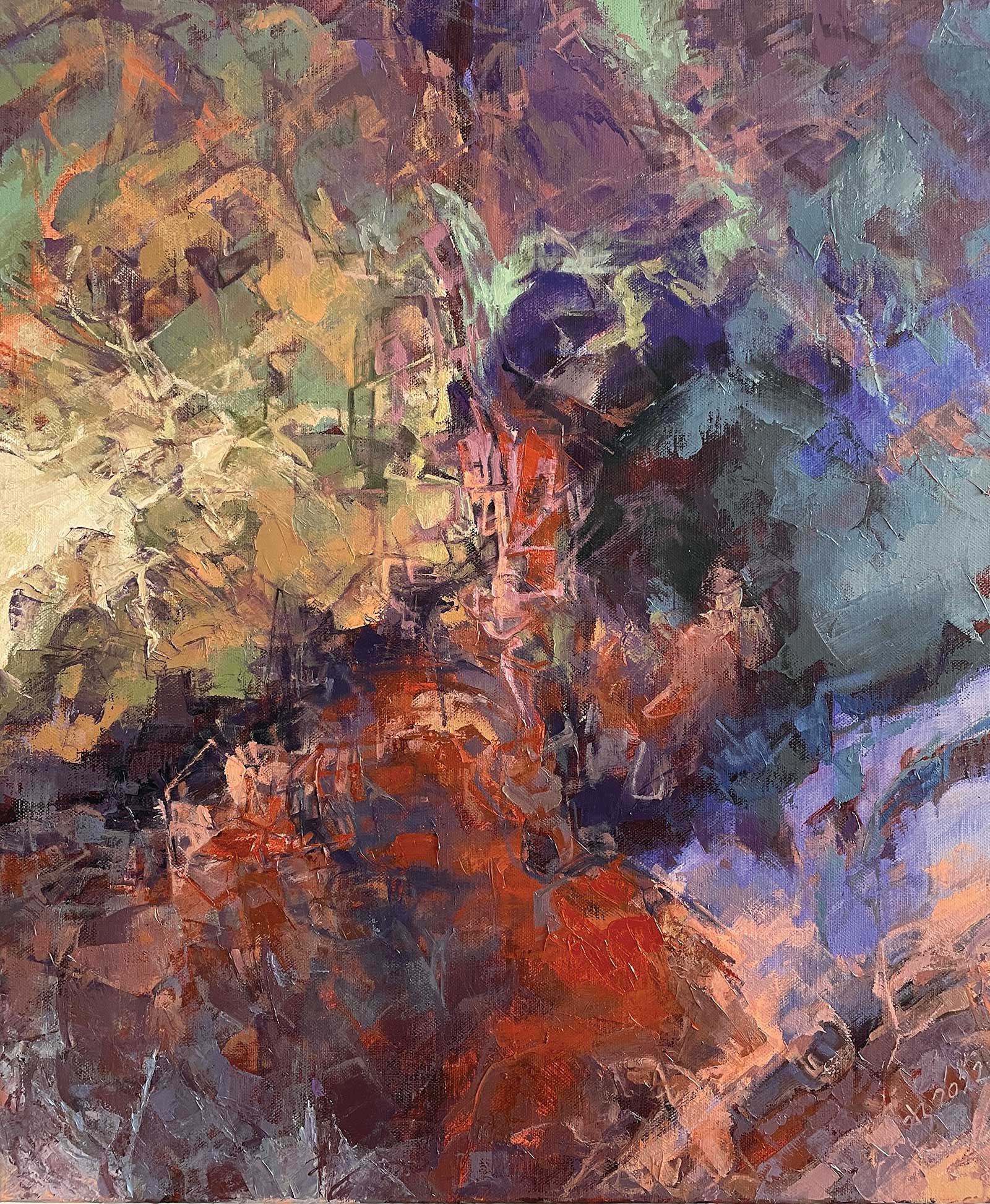 The Map of A Myth VI, oil, 20 x 24" (51 x 61 cm)
Kwong Kwok Wai
Hong Kong
My Inspiration
A map is a collection of symbols—green curves for forests, gray lines for roads, with the legend explaining the meanings. In another dimension, the map itself is also a symbol constituted of geometric lines and shapes. Through these beautiful lines, stories are told—narratives of a place, of a community in visual form, of its past and present. This inspires me to do portraits of maps.
My Design Strategy
My idea is to portray a symbol in a symbolic approach. In the visual dimension, a map provides evocative imagery for contemplation. At the community level, a map represents the physical layout of a city, a way of living. To add another layer of meaning, I employed a topographical map of Southern China by the War Office of the British government in 1949 as reference. This aims at connecting the artwork with history.
My Working Process
For the bottom layer, I worked with brushes and acrylic paint. I collaged the back view of the upper part of a human body with the map. This step set the basic color tone and composition of the painting. Then spatula by spatula, I developed the street patterns with oil paint on the top. Heavily textured, the figure is intertwined and engulfed in the map patterns of the surroundings.
Contact Details
Email: kwongkwokwai@yahoo.com
Website: www.walterkwong.hk