I use an intuitive approach to art making and rely on my instincts to create ambiguous narratives that explore the female experience. I examine a collection of both contemporary and historical images as resource material and let a story unfold from there. Although the women I render do not represent any one person in particular, there is always a part of me described in each character I create. I invent women that I hope will teach me about what it means to be a woman. I intuitively tell the stories that are not just my own, but that of my mother, my grandmother and the women that have permeated my life. These women are my friends and family members, but they are also women I identify with from both history and contemporary society. The stories I’ve encountered of uniquely female experiences throughout different time periods and political, cultural and social milieus trickle into my allegories.
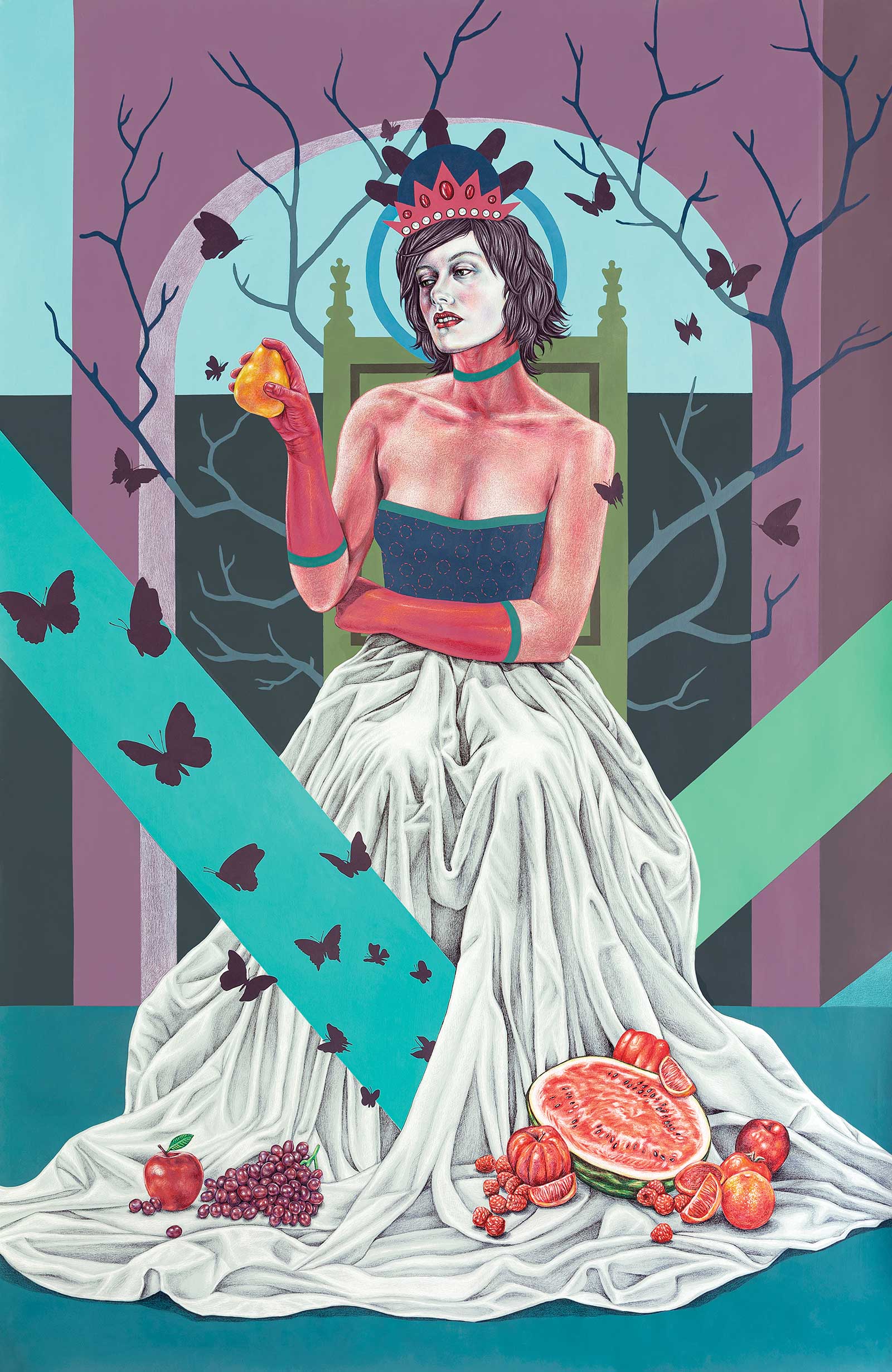
Fecundity, mixed media on panel, 72 x 48" (182 x 121 cm)
Through my image making process I look for ways to show a uniquely female perspective and imagine what history would be like if seen through the eyes of women. My subjects appear to me to be a composite picture of the female past. I hope to assemble their experiences into a narrative that delves into the concerns, fears and hopes of women across cultures. Making these images of women is not only a way for me to understand the woman that I am, but the woman that I want to become. When I draw women, what I am most interested in is cross-examining societal expectations that try to categorize women and prevent them from being the complicated and complex individuals that they are today and always have been.
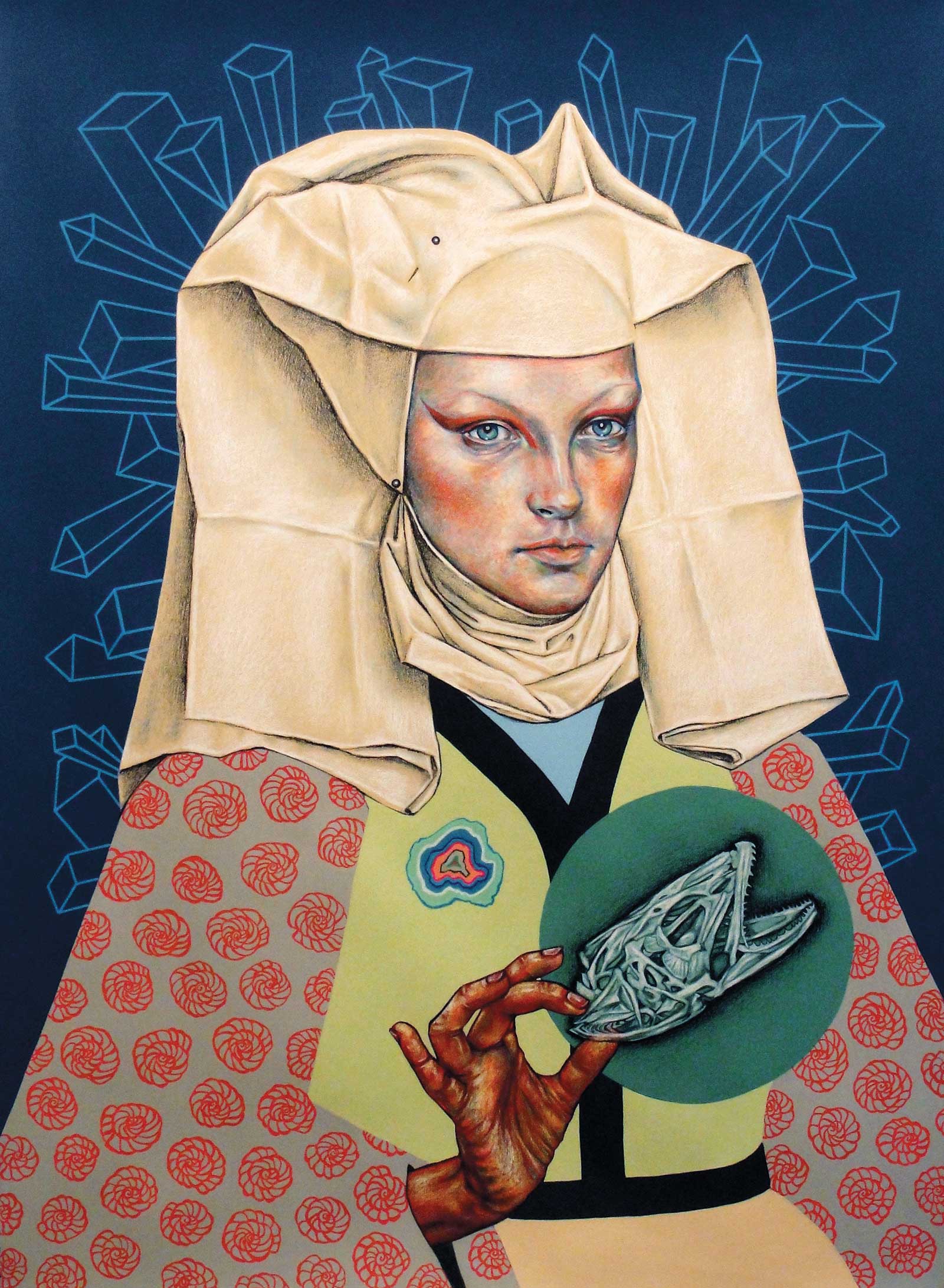
Temperance, mixed media on panel, 30 x 22" (76 x 55 cm)
To begin, I collect my source material from books and magazines, and take photographs of the things around me. I make instinctual choices regarding what images and symbols to collect. A visual catalog is built to inform my work. I compose the objects impulsively, letting them speak to one another and gain autonomy. There is a necessity to spend time with these images, combine them in different ways and understand them on many levels. The female protagonist is often surrounded by animals and inanimate objects that activate the environment she is in. The woman is sometimes in a domestic space and other times she inhabits a landscape. My drawings often contain a vast array of symbols and patterns elaborately layered in space. Because symbols are transient, there can be numerous interpretations. The power that the symbols in my drawings hold is due to their ability to change and transform with both time and analysis, allowing them to be related to on many levels. I strive to cultivate an open dialog where my viewers can communicate freely about my art in meaningful ways.
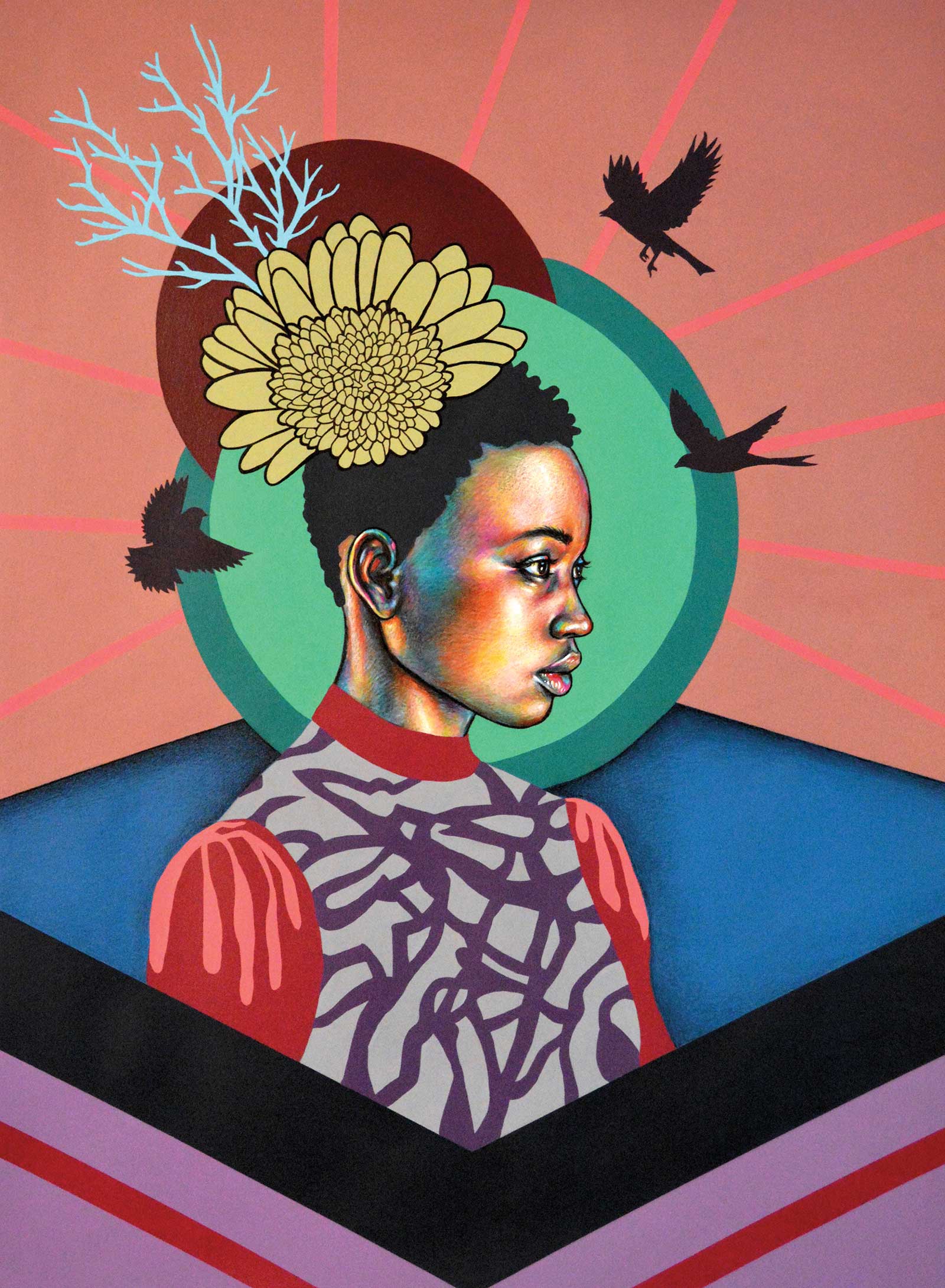
Vesna, mixed media on panel, 30 x 22" (76 x 55 cm)
My artwork involves both drawing and painting techniques. I combine flat color with areas that are more highly rendered to describe the imagery. I use a wide range of media as well as mark making techniques to create a collage aesthetic. Prismacolor pencil renderings and patterns executed with paint pens are layered on a ground of brightly colored acrylic paint. With this method I am able to create focal points as well as a hierarchy of importance within the imagery. It is also a way to play with perception of the space and draw viewers in. Not being tied down to any one specific way of working or a single medium keeps me engaged with my story. This method allows me to juxtapose contradictory images and embrace stylistic differences. If I try to control this process too much, it loses the excitement and mystery for me and I stop learning from it.
Through my search for meaning I feel that I present a coded mystery into which my viewers can insert themselves, requiring them to ask questions about their own visual history and identity, as well as their understanding of the female experience. The narratives in my artwork are transient and have multiple meanings for multiple viewers. I believe a continuous challenge of the notions of self is what we need to understand who we are and how we fit into this world with each other.
My Art in the Making Inception
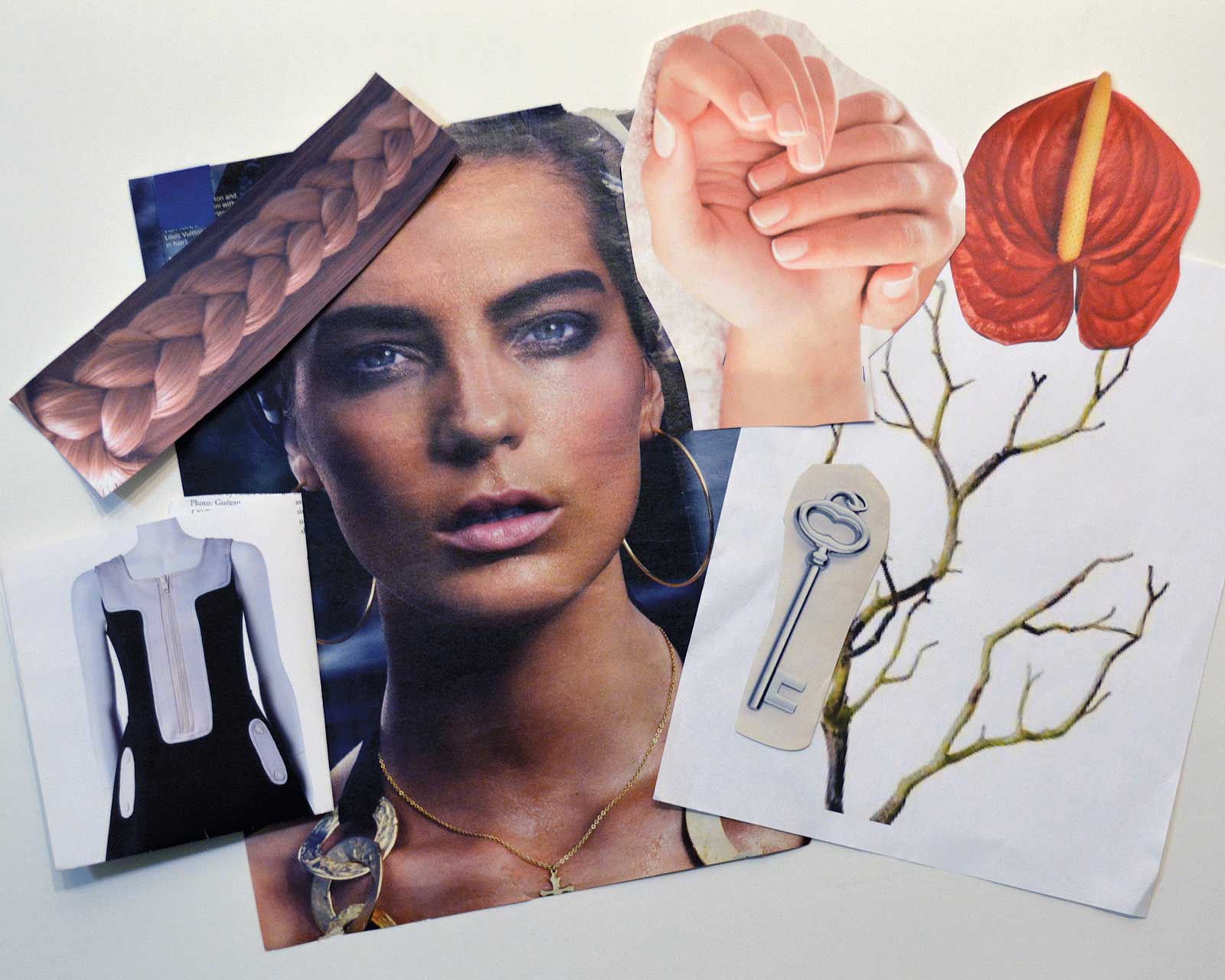 Resource Materials
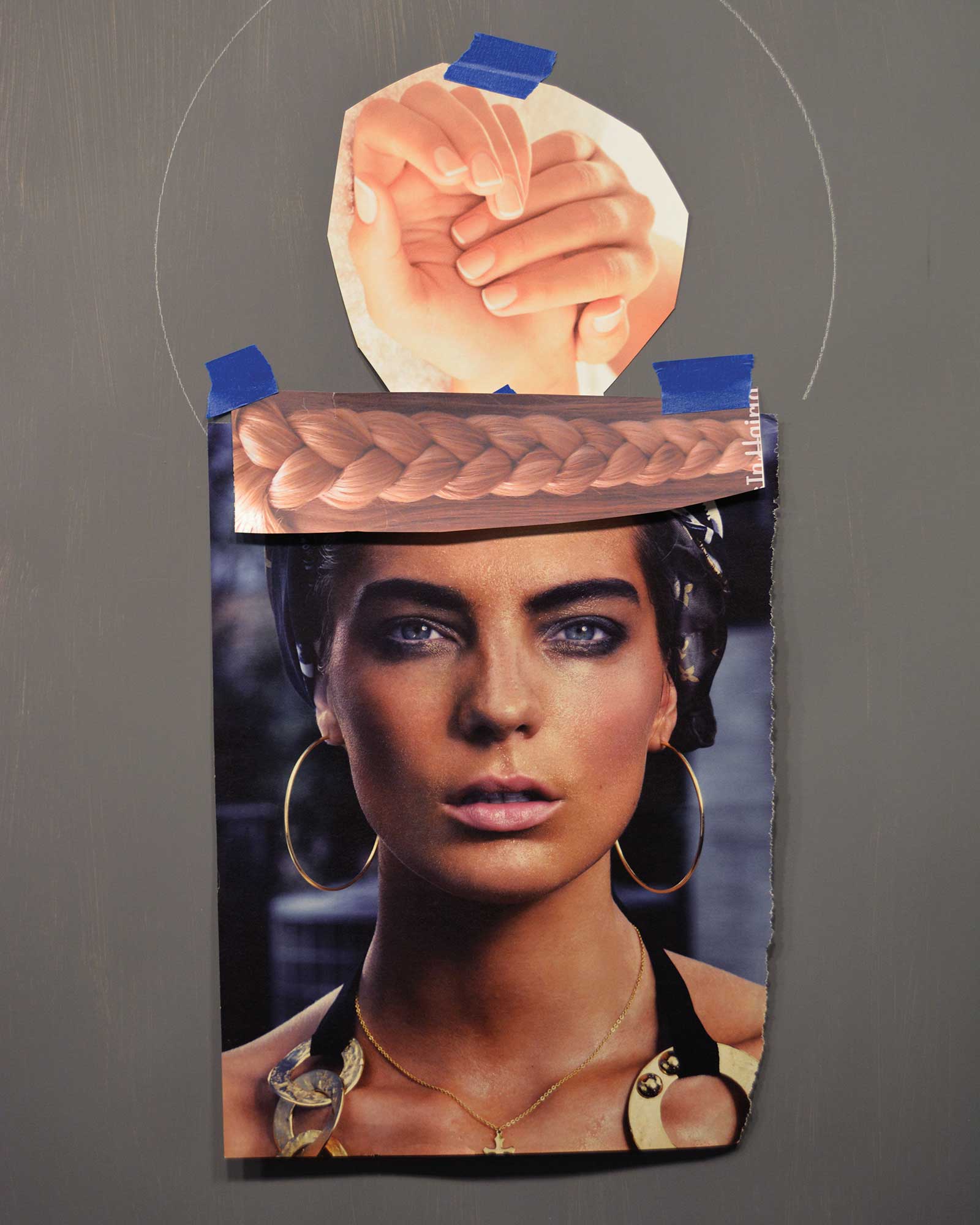 Stage 1
Stage 1 Arranging Resource Materials
To begin this piece, I pinned my paper to the wall in my studio and prepared it with gray gesso. I then took my chosen resource material and arranged it on the substrate as a template.
WHAT THE ARTIST USED
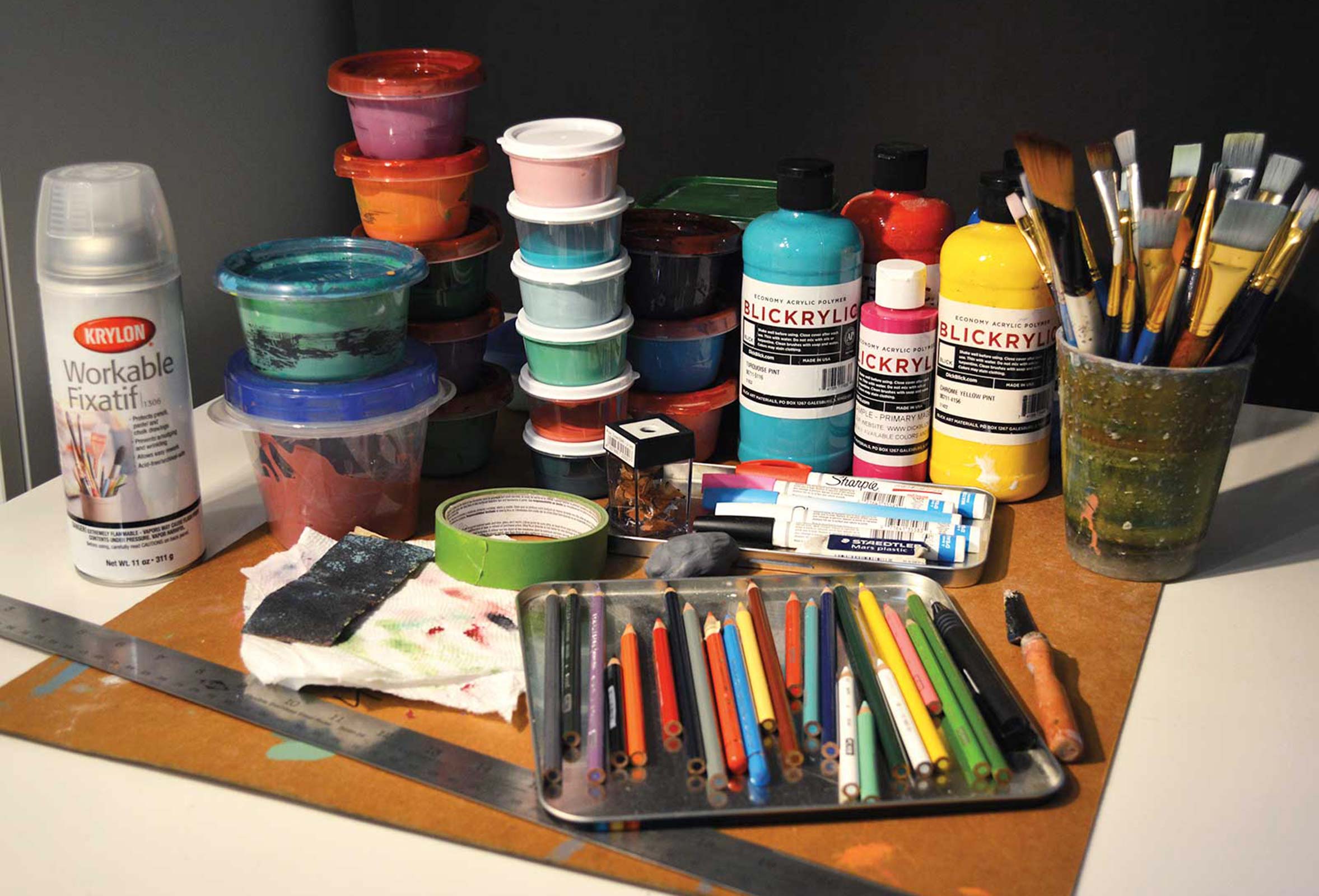
Blickrylic Paints (water-based acrylics)
Chrome yellow, Fluor blue, Fire red, Turquoise, Magenta, Mars black
Prismacolor Premier Pencils
White, Black, Spanish orange, Poppy red, Scarlet lake, Rose, Canary yellow, Grass green, Spring green, Cobalt turquoise, Light aqua, Cool gray
Sharpie Paint Pens/
Water-based/Fine Point
White, Black, Red, Fluorescent blue, Fluorescent pink
Brushes
Princeton Art and Brush Co. (synthetic hair): Round, size 2, Shader, size 4, Shader, size 8, Wash, ¾"
Additional Supplies
Rising Stonehenge 90-lb mixed media paper, 30 x 22", Gesso, HB graphite pencil, Factis BM2 mechanical eraser, Kneaded eraser, Pencil sharpener, Palette knife, 24" metal ruler, FrogTape, Sand paper, Tracing paper, Paper towel, Water cup, Ziploc containers
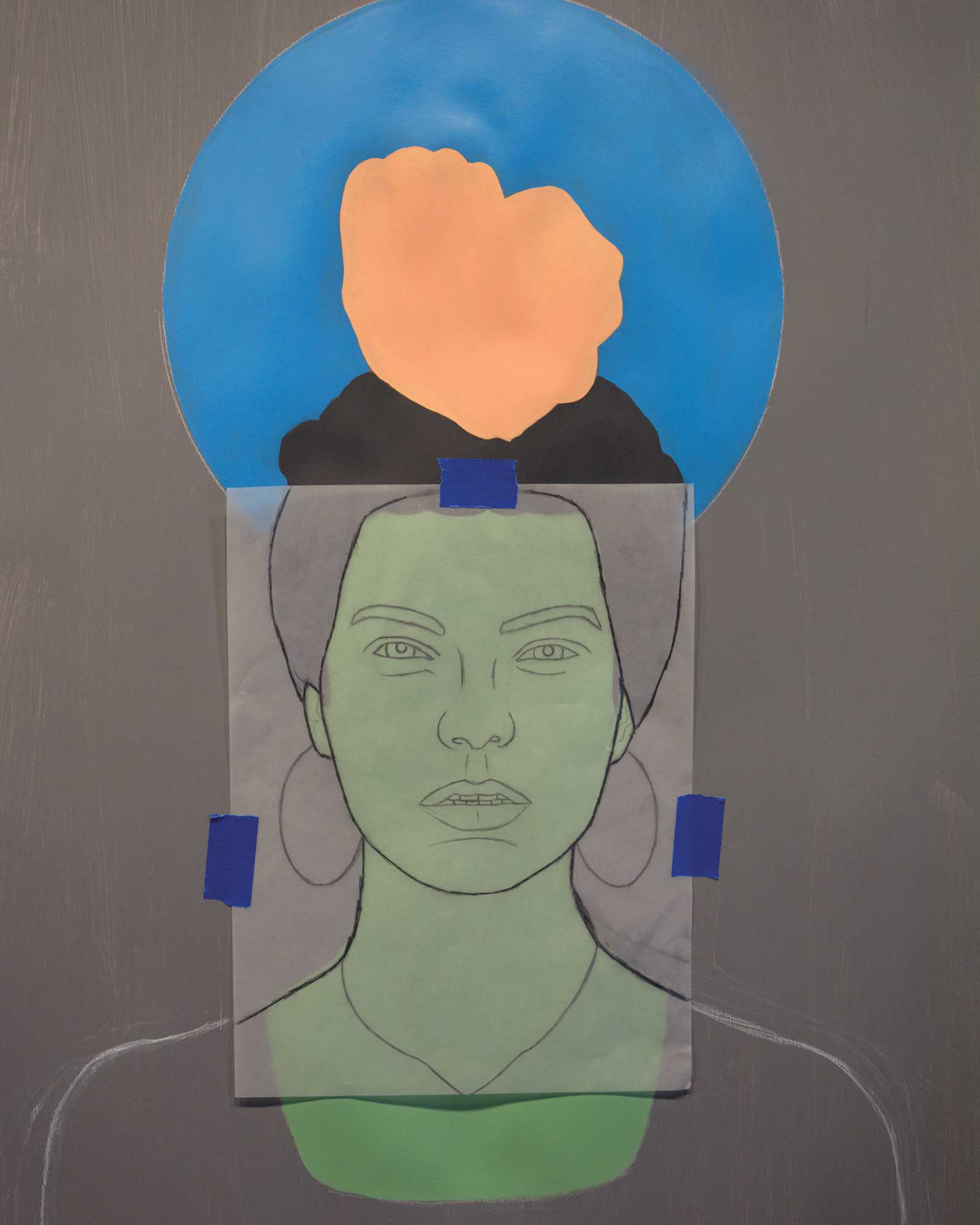 Stage 2
Stage 2 Laying the Foundation
Next, I blocked in areas of acrylic paint and started to create my foundation to render on. I used tracing paper to lay down a guide for some of the details, such as facial features.
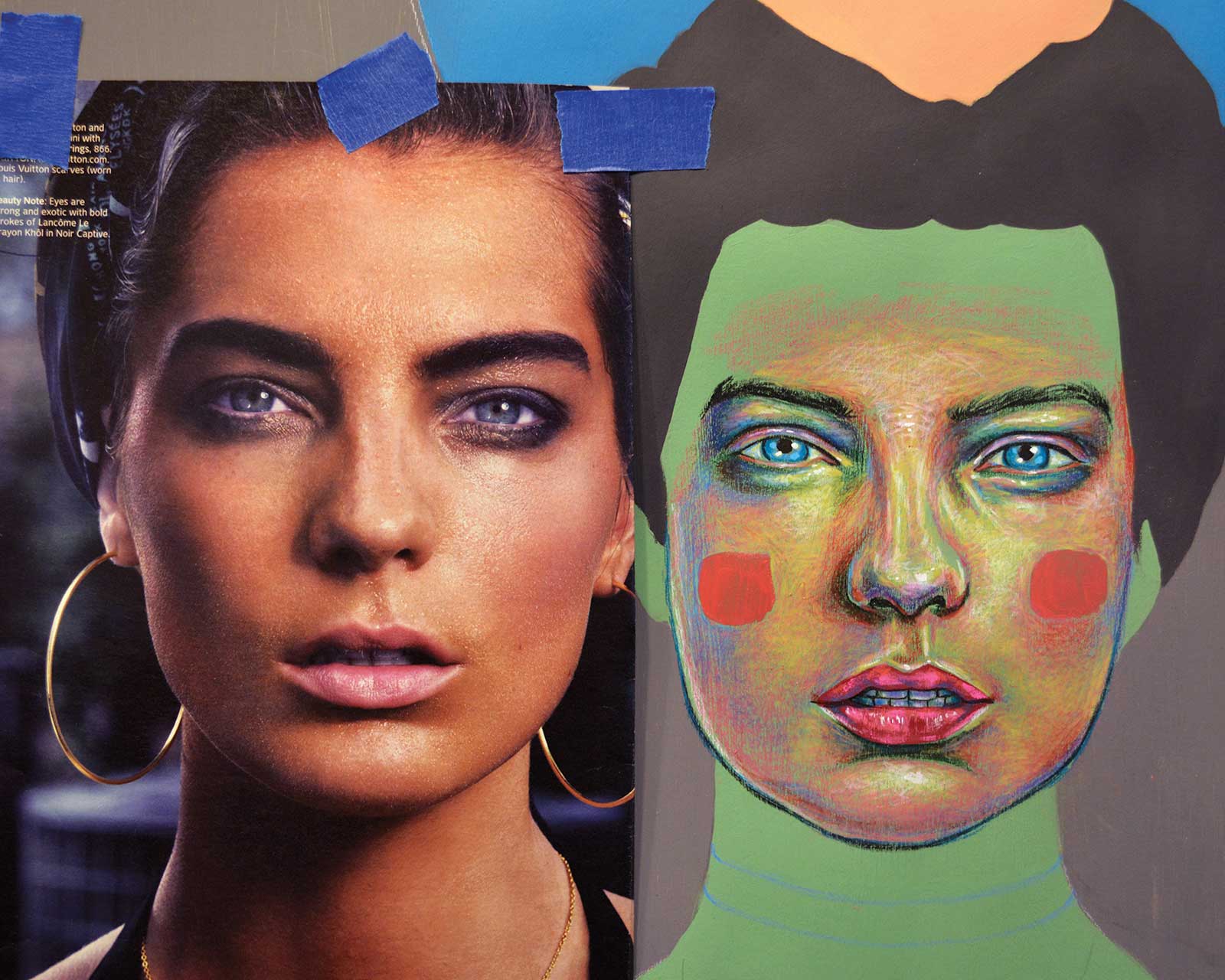 Stage 3
Stage 3 Colored Pencils for Face
I used Prismacolor pencils to render the face. I often start with a base color as an undertone to make the skin look more luminous and vibrant. I usually take creative liberties and do not make an exact copy of my photo reference.
 Stage 4
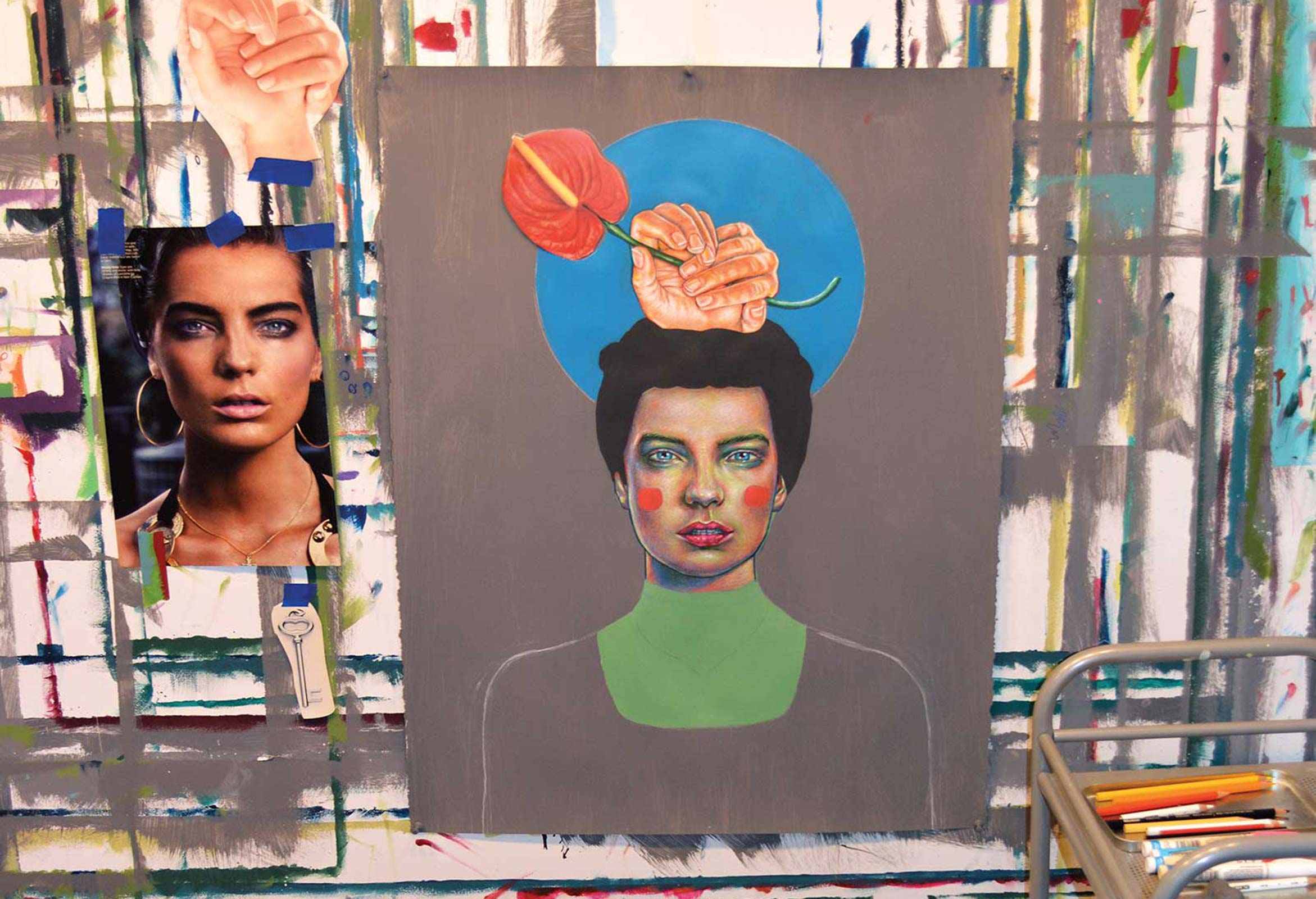
Stage 4 Hands and Flower
I then rendered more of the important storytelling symbols, such as the hands and the flower. You can see my home studio set-up in this image.
 Stage 5
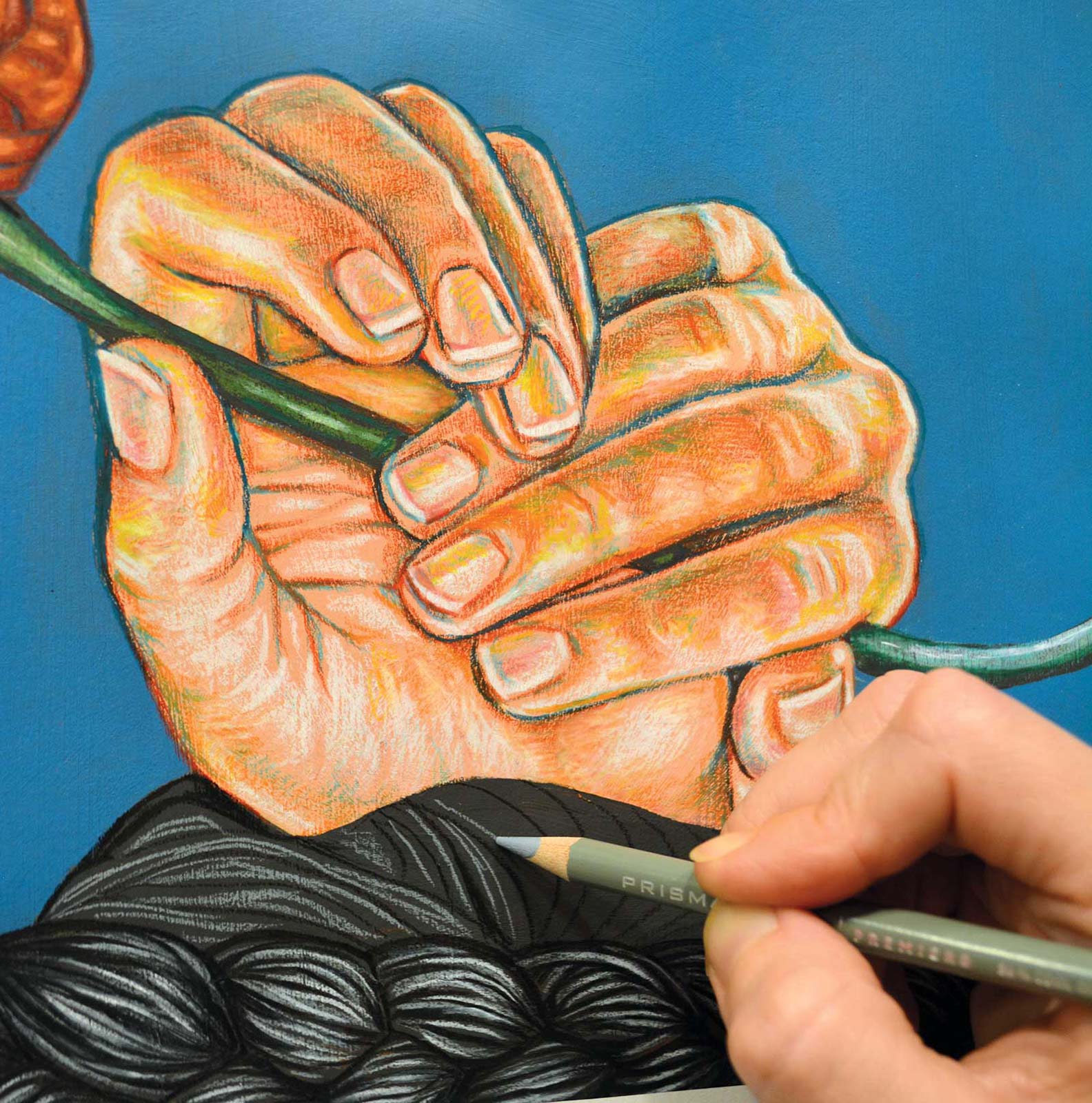
Stage 5 Rendering Process
This photo demonstrates the rendering process. I drew individual marks with the Prismacolor pencils to create strands of hair. I used a scrap piece of paper to cover the face so that I didn’t rest my hand on what I’ve already drawn.
 Stage 6
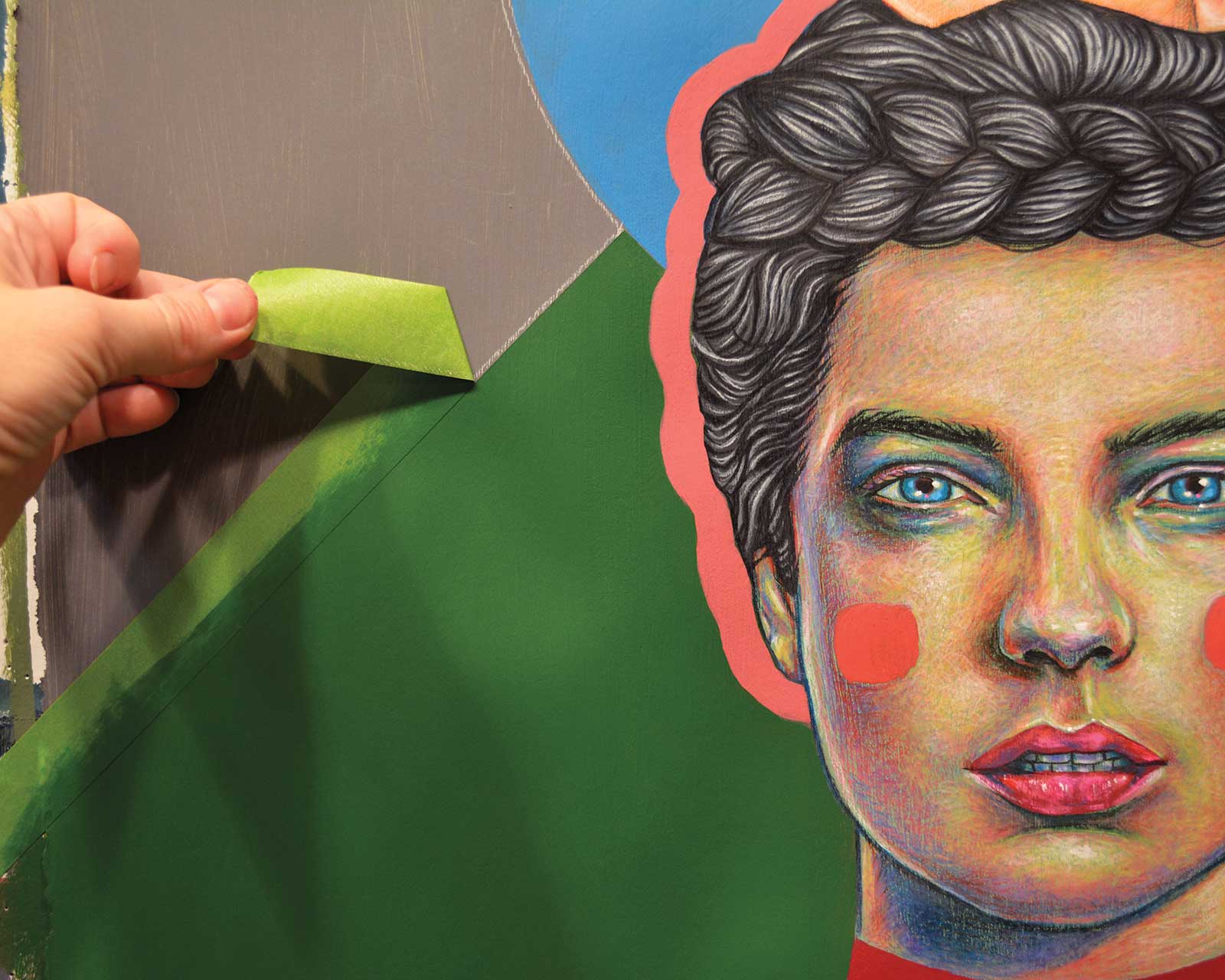
Stage 6 Crisp Edges
I used FrogTape to create a nice crisp edge for the background color. I applied two coats of paint and let it dry completely before removing the tape.
 Stage 7
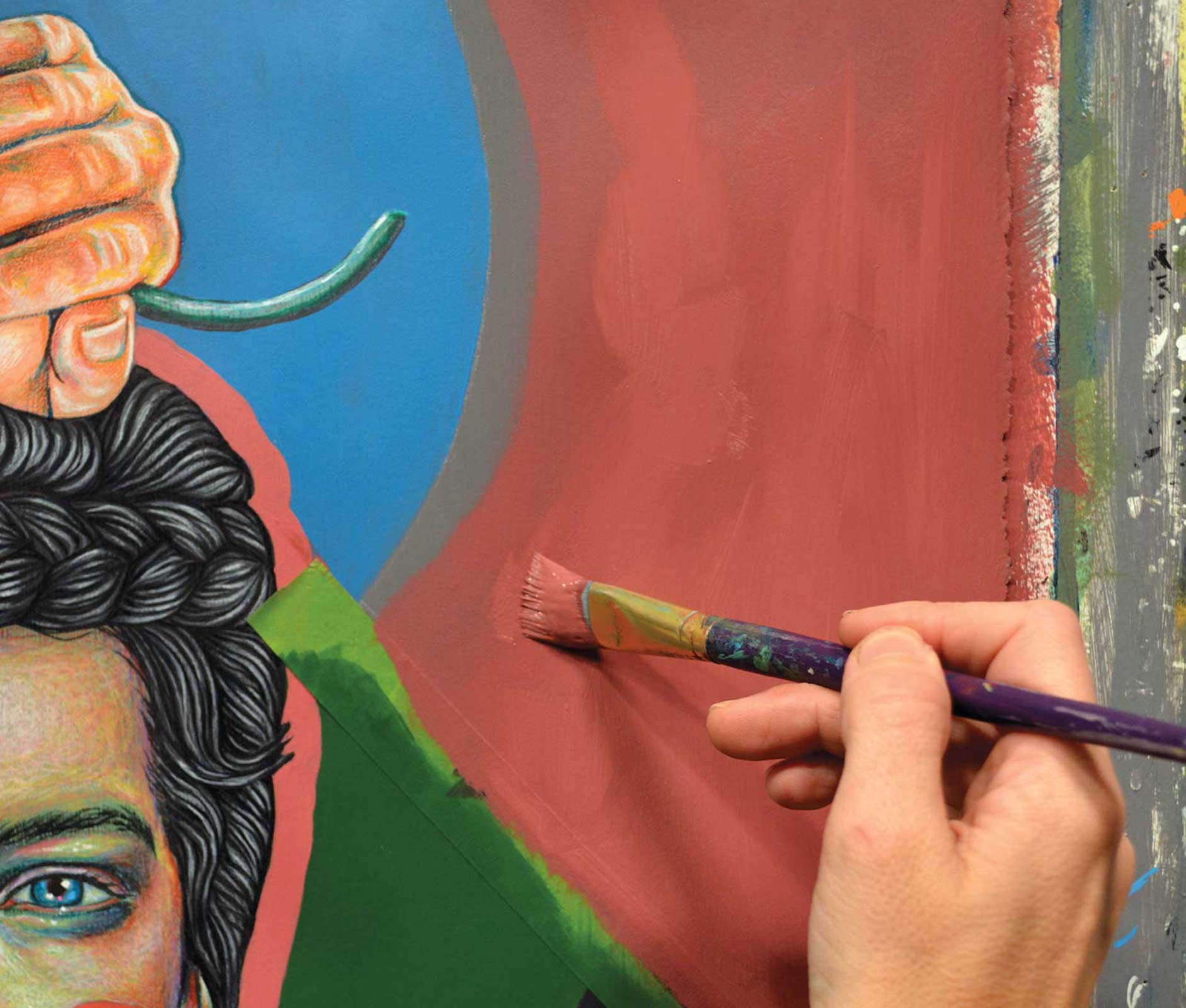
Stage 7 Additional Coat of Paint
Here I am adding another coat of paint to the background and reusing the FrogTape I had used in an earlier stage of the work. I try to conserve my materials.
 Stage 8
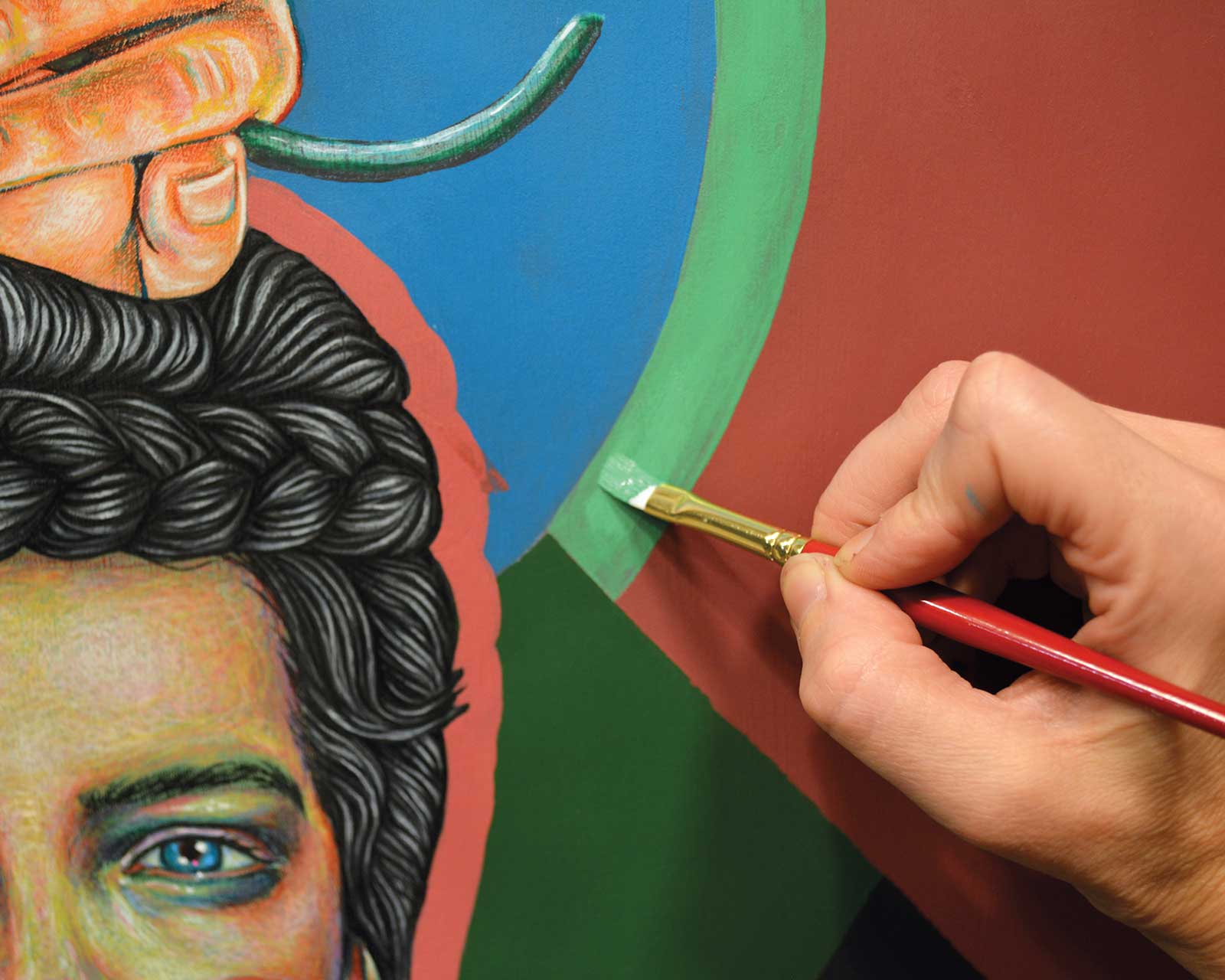
Stage 8 Border and Halo Around Head
I used a large mixing bowl to trace the halo around the head with a pencil, and then I freehanded the border with a small flat brush, which takes a very steady hand.
 Stage 9
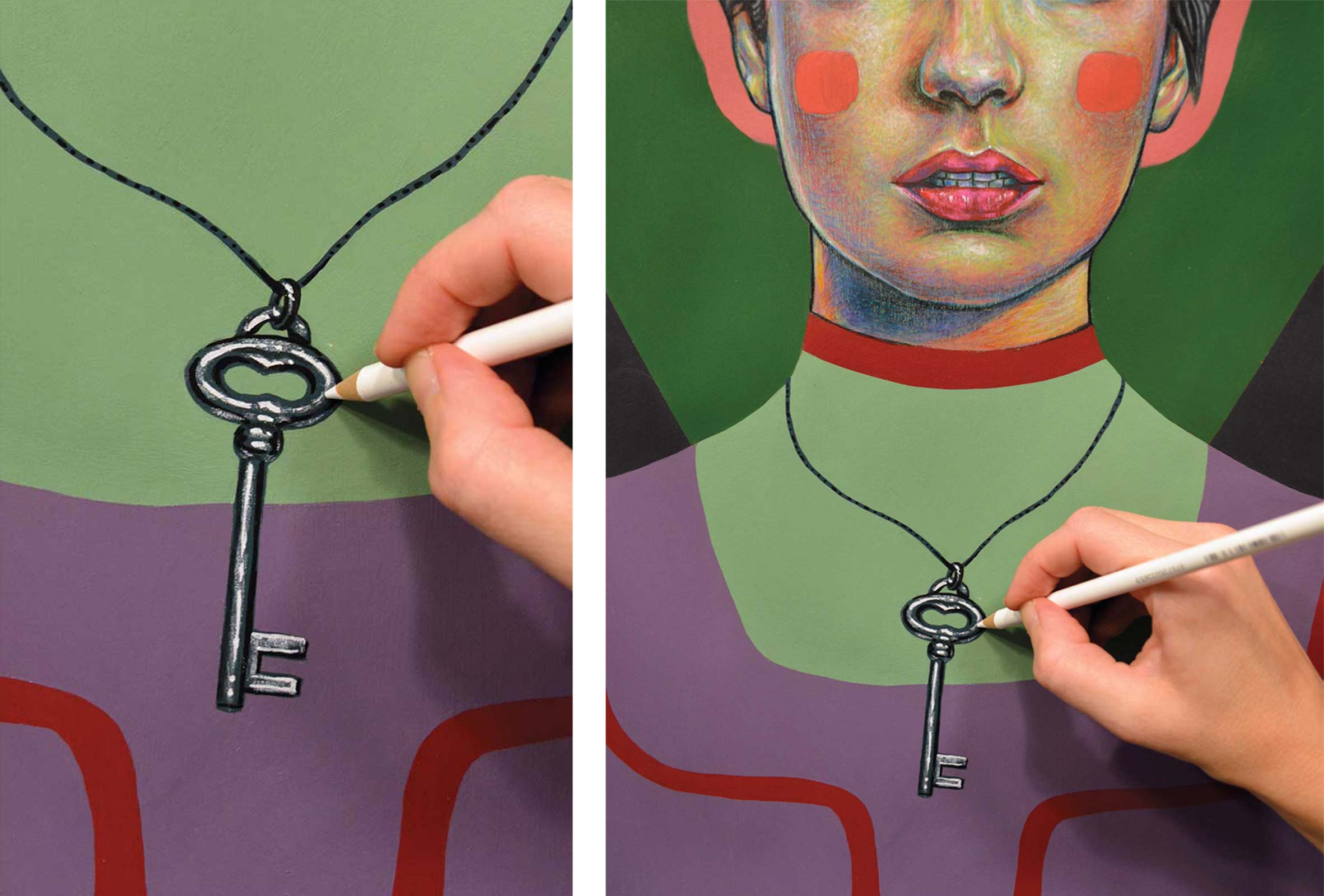
Stage 9 Clothing
In this stage I have blocked in the woman’s clothing. I have also added the key necklace and rendered it to make it look three-dimensional and make it stand out against the flat color beneath.
 Stage 10
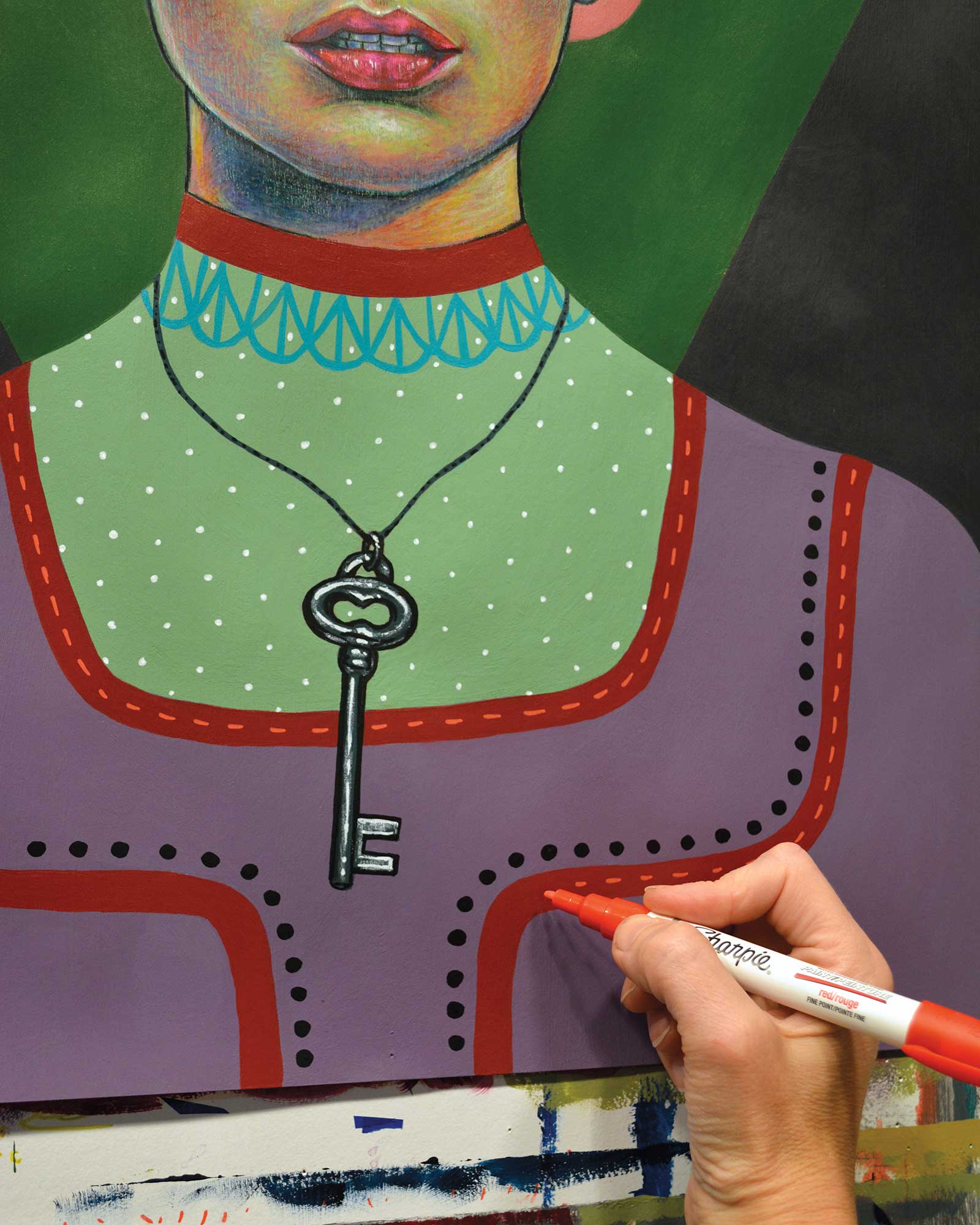
Stage 10 Details in Clothing
I used fine tip Sharpie paint pens to add more details to the clothing, such as patterns, lace and stitching. Most of these things are improvised and not from resource material.
 Stage 11
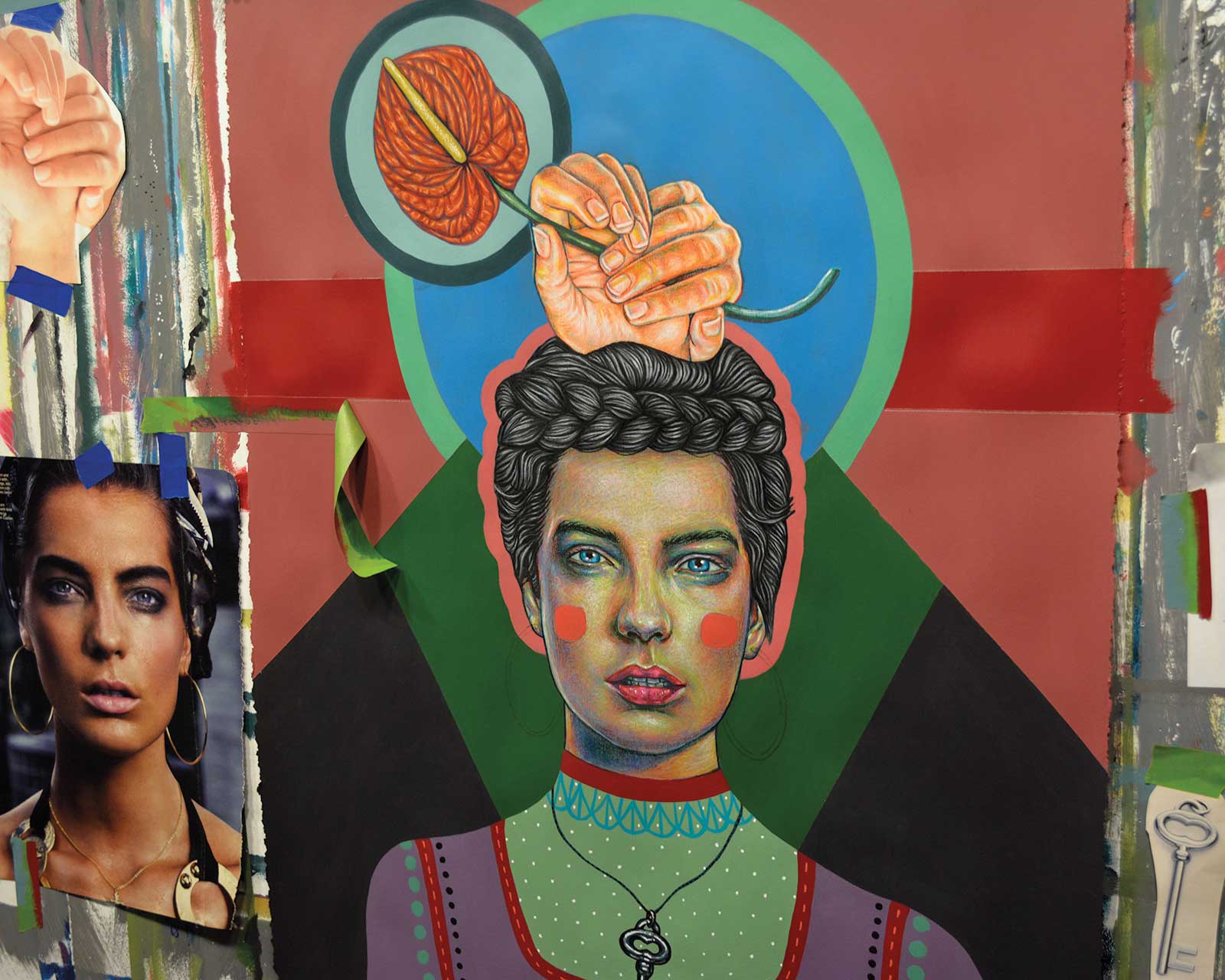
Stage 11 Removing the Tape
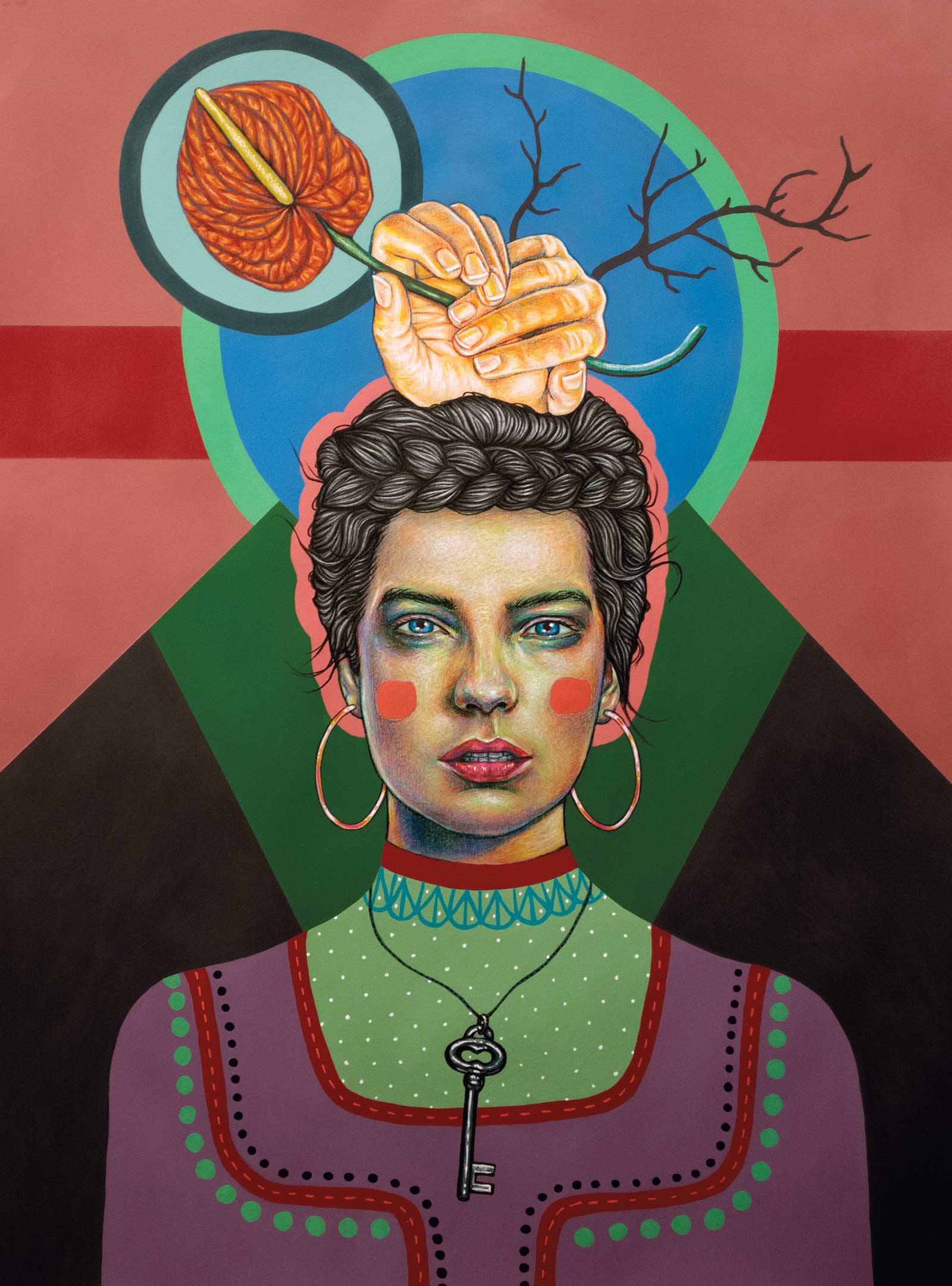
I painted a red stripe in the background, and then I carefully removed the tape to reveal the nice clean lines underneath. I prefer the FrogTape to the blue painter’s tape because it’s much higher quality and creates a better seal.
 Stage 12
Stage 12 Finished Artwork
Inception, mixed media, 30 x 22" (76 x 55 cm)
Here is the finished piece. I added a few more symbols such as the branches and hoop earrings, and I also drew some extra wisps of hair around her temples. When a piece is completed, I spray it with Krylon Fixatif and then I usually dry mount or adhere it with Yes Paste to a Dibond panel for presentation.
About the Artist
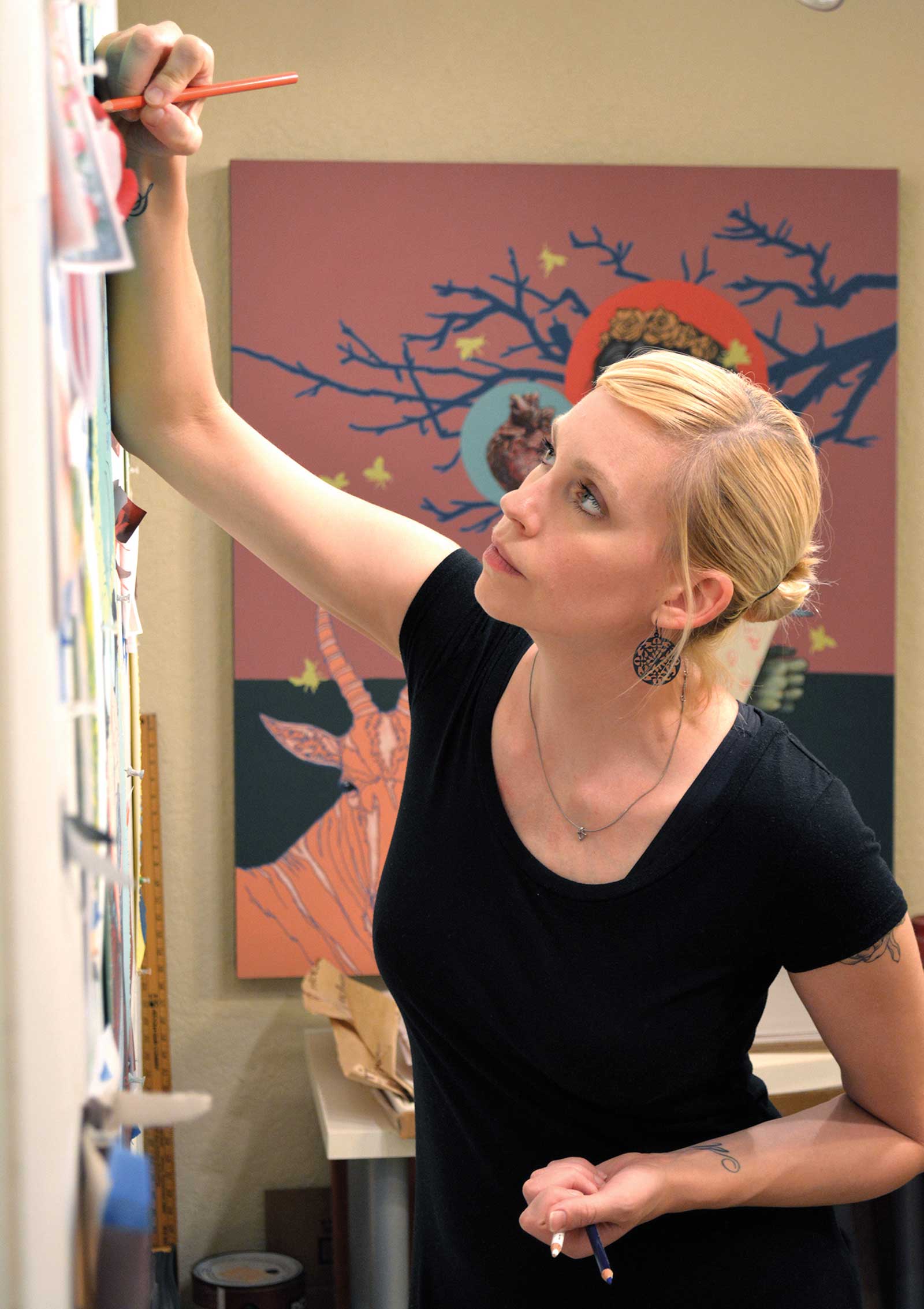 Aneka Ingold
Aneka Ingold has two degrees in visual arts. She received her BFA in painting from Grand Valley State University where she was the recipient of the Alexander Calder Honors Scholarship. She received her MFA in drawing from Kendall College of Art and Design where she was awarded the Kendall Scholarship of Merit Award. Ingold has an award-winning professional art practice and has exhibited her artwork extensively across the United States. In 2019, she was the inaugural winner of The Bennett Prize for women working in figurative realism. Also in 2019, she was one of ten finalists for the 9th Annual Manifest Prize-One Award, presented by Manifest Creative Research and Drawing Center. In 2016, Ingold was awarded first place at the Valdosta National All-Media Juried Competition at Dedo Maranville Fine Arts Gallery in Valdosta State University, Georgia. Her work was also selected for the Surreal Salon 8, at Baton Rouge Center for Contemporary Art. During the 2015 Art Basel, Ingold was the Grand Prize Winner of the show Vying at Viophilia Gallery in Wynwood. Her work has been featured in many publications including International Artist sister publication, American Art Collector. Ingold resides in Tampa, Florida, where she teaches drawing and design at Hillsborough Community College.
Represented by
RJD Gallery, Michigan, USA, www.rjdgallery.com
Contact at
avanderhill@gmail.com
www.anekaingold.com