During my time teaching in art workshops, every individual I worked with had something special within their art that could be brought out. For years, life’s images and thoughts continue sweeping through our minds, waiting to be realized on paper or canvas or clay. What is needed is on the technical and creative side with especially good mentor guidance; much like the images and words in International Artist. It can happen to anyone who has a powerful desire in art. I’ll repeat two serious words: “powerful desire.”
My Art Circle
I began my life fairly “low key.” Then starting at age 20, I went through an eccentric artist/fantasy period for nearly two decades. After that, I entered into the second half of my life in art. I slowly became confidently settled, relatively “low key,” always with my passion for art. What happened during those periods of my life was quite unbelievable. And here we are, continuing art in a circle of life. Dear reader, do you have a “circle” in your personal world that you can describe? Consider it. And remember: a circle has no end.
If You Allow
I need some comprehension. I do not quite understand contemporary/abstract art. To me, it is mostly strokes and shapes, often with colors, and laid onto importantly large canvases. I am by no means slamming contemporary art: I have many close friends who are very involved with modern. I just plain don’t comprehend what it’s about. Now, let’s go meet at the Cedar Tavern, have a cup of green tea, relax and discuss our favorite works of art.
I truly bless all artists, no matter what style—realism, abstract, whatever their approach. In the arts, we all eventually gravitate towards our personal needs and wants. Being totally honest with ourselves.
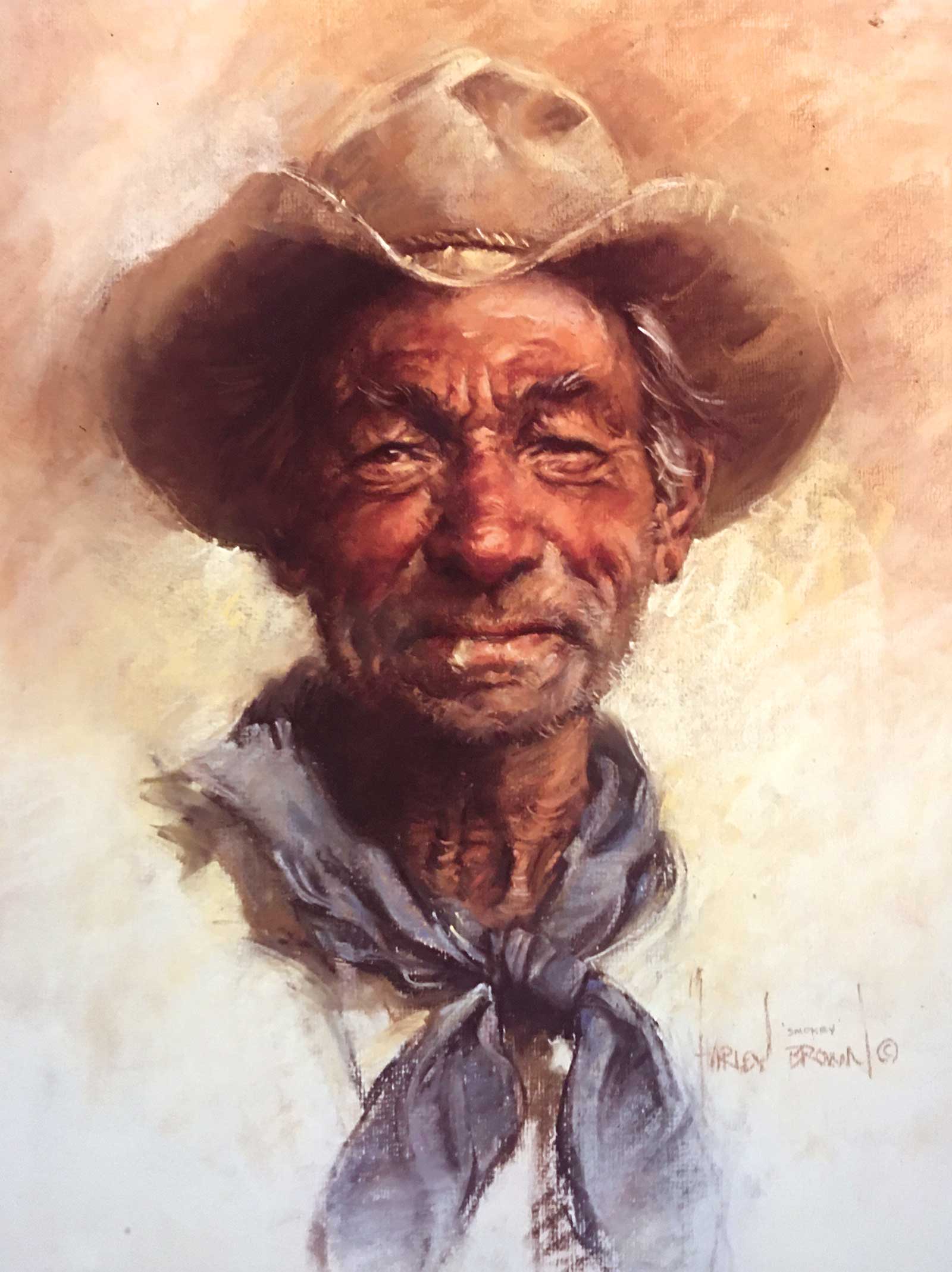 Smokey
SMOKEY
This is another example of the artist (me) revealing as much of himself as the subject. I had not seen this pastel for quite a while and right away, I sensed another Harley behind it. It’s good, yes, but done with a somewhat different mind and approach. I do remember those days and as some of you might know, I was rather a different person. My mind was eccentrically buzzing every minute of the day. It buzzes now, but only when I want it to. Look at artists over their lifetime. You can see the periods they evolve through.
With SMOKEY:
- You observe much of the design is from cast and form shadows. A few lost edges causing interesting dark shapes.
- Overall warm hue with the dash of blue scarf (complementary color).
- Time taken for accuracy but certainly no feeling of photograph. Two active humans here: Artist and subject.
- A hundred years from now, people will still see Smokey smiling with that cigarette.
- As you and I can imagine he’s probably lived quite a life which will never be known. As long as we observe him, he’ll be with us. When we leave him, we know he’ll be moving on.
The Mystery That is Woman
I do not—cannot—portray a woman’s inner feelings in a portrait. I can portray only what she allows at any moment. Her expression might change but yes, I concentrate on the one she holds. That’s the one she is offering me and to whoever eventually observes the portrait. The look Mona Lisa gives us is that very personal, momentary expression. Even though that painting took Leonardo da Vinci four years to paint. Four years!
What we sometimes see in a portrait is the artist’s incompetence. That artist might explain, “Hey, I’m not a camera, my painting of Jack here is revealing beneath the surface of him, not an exact copy like a photo of him.” I say, “Goodness, if that is true, Jack should take that particular portrait done of him, (and the insightful artist who did it,) to Jack’s personal psychiatrist to help the doctor more understand Jack.”
Also, neither can we discover the “inner soul” of an artist any more than finding the “inner soul” of an actor. There is no one on planet Earth who knows what kind of person Balinofski is through his art.
Interpreting with Accuracy
Never let it out of your mind: get the measuring, angles, forms, lines, shapes and values right from the start. Whether from life or photographs. Anything wrong that isn’t fixed can spread to other areas. And then “fixing” can be a challenge. Accuracy is a strange word to throw into art, but it is actually used in all the arts. Accuracy with feeling: melodies with lyrics, jazz piano, writing a novel, sculpting. Yes, we do put ourselves into our art—our interpretations. But we interpret it with a “solid base.”
I look quite intently at my subject. My pastels and paper are all set up and ready. What actually happens is that my hand grabs a seemingly random pastel and starts to make marks on the paper. After a few moments, those marks begin to take the form of a face or tree or old log cabin. It happens with a clear desire to get the strokes quite accurate. Too many corrections take away the subject’s and my “character.” Meaning my determined mind is intent on getting what I visually want and being true to my subject.
Again I use the word “accurate,” realizing it’s an anathema to a part of the art world: those who feel the artist needs more emotion towards a subject and not try for a “photographic resemblance.” I’ll have to butt in here and say: the artist doesn’t need so much emotion that the resemblance is in shambles. Something I see too often.
Let me explain with the great artist Degas: when you see his ballerinas, you see their form and artistry, and at the same time you see Degas himself within his works. He was true to his subjects as well as himself. He combined their contours accurately with his own aesthetic vision and approach. I could continue this for hours, but you get my meaning.
A Bonus
Artists have a special bonus. We can fix problems or mistakes in our paintings within our studio. No one needs to know about it. Unlike playing the piano at a concert, or a ballet performance. Singing an opera aria. A dramatic scene in a stage play. No mistakes allowed in those performances. Lucky us artists.
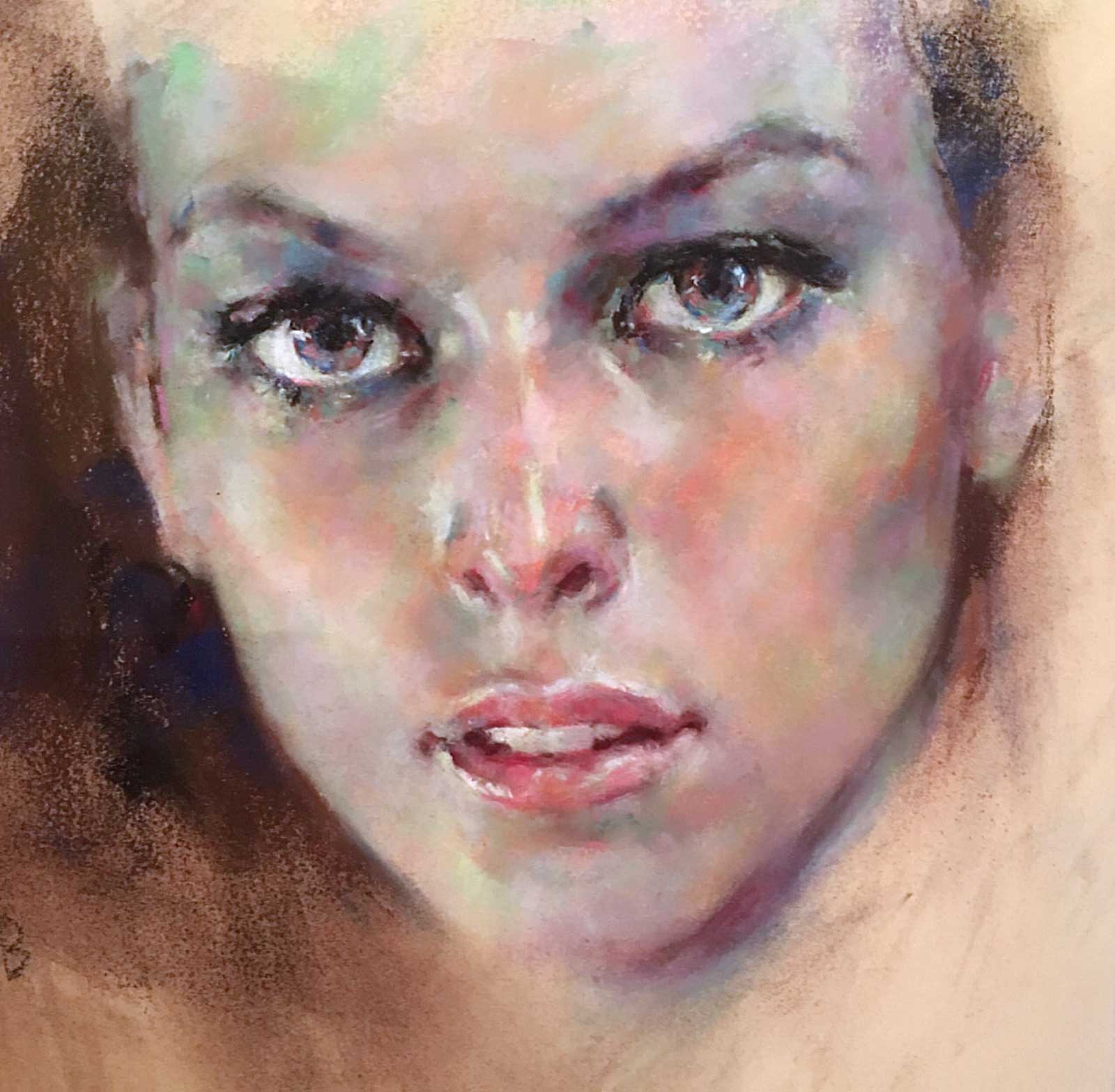 She
She
SHE
SHE looks at us, curious and at the same time knowing. We look back, smiling. As you look at SHE, you also see the joy I had creating throughout with bold and small, fussed strokes. Reality is art and not simply duplicating. Her face is developed with delicate form shadows. Much work was done around her expressive eyes and eyebrows. I took tender care with all her features—eyes, lips, nose. The very softness of her cheeks. Her teeth, finely shaped with the light gently touching them. Lost edges in the chin area. Accuracy with forms as well as subtle light values to dark values. My rendering of this pastel was inspiring and captivates me each time I visit with her image.
Art Reasons
It’s one thing to make a mistake when painting a picture. It’s another thing making a mistake when climbing up a cliff. So, considering this, it’s one of the 773 reasons I chose art.
Solo Trips
I care not what people might think of my art pieces while I’m working on them. At that time, I care what I think. At the easel, myself with my subject: a person, an old barn or perhaps a photo. Music in the background, not people. I’ve no doubt many of you artists feel the same. Ah yes, what people think when our works are displayed on an art gallery wall—then we care.
Such Great Memories
I’ll mention my art workshops here. They were important and uplifting experiences. Artists meeting in a large studio, with me being watched and me watching everyone. Total back and forth, creating and showing and talking art, as we joyfully went at it day and night. I could go on here but wanted to mention those positively inspiring times when we artists gathered together for art’s sake.
All the Arts are Here Forever
Forever, through cinema and television, original art, limited editions, written words, cameras, recordings, filmed performances. With today’s electronics and more, we can see and listen to anything at any time. A certain magic has arrived in our lives. At this moment I can listen to any piece of music, take a look at any artist’s paintings. See every film or TV show, read most all the written words. Our new world can arouse within moments. Let’s imagine 20 years from now.
Golden Times
What did people do before television, computers, social media? How did people spend their days? What did they do? Some of us happen to know. For so many, those times were joyfully memorable and absolutely inspiring. It comes down to what we do with each day.
Values
We use colors in our work, but what is most important are the values of those colors. Our art is based on values; light areas to darkest areas. We can put in whatever colors we want as long as they’re the right values. Try this out and go wild with the colors, but keep the values right on, and you’ll amaze yourself.
“Reflected light” on a subject within a work of art must be deftly handled. If not, it can ruin an otherwise beautiful art piece. We have to be careful knowing the reflected light might go dull or brighten on what it touches. Whether a portrait, figure, or any subject. Just know the basics: reflected lighting can vary dramatically throughout all the areas it touches upon. Be rather finicky with it.
We Become Artists
When asked what I do for a living, I say, “I’m an artist.” No matter how many times I say it, there’s an elated feeling within. It takes me back to my very early days when I dreamed of being an artist. But it seemed like a fantasy because most people were in the business world, and that’s what I’d better prepare for. Artists were only in books and movies. In real life, I kept hearing about “starving artists.” So when I say “I’m an artist,” it never fails to hearten me. I did it! You and I both do it!
Subject Matter
There is no such thing as a bad subject. It’s us, the artists that make what we paint “breathe with life.” It’s how we see and how we paint/interpret our subject. So I say to you dear reader, try this out: look for the most “mundane subject” in your house and see what you can do with it in a sketch. You’ll find that project much more than interesting. You’ll understand when completed.
I’ve never been bored. Maybe agitated, daydreaming, joyful, reflecting, doubting, loving, hoping, creating, questioning, searching and more. Never, ever bored. I think that’s part of being an artist.
Photos can be deceptive and some of it depends on the angle of the camera. For example, if we want to photograph a standing figure and the camera is at the level of the head, then the rest of the body, in the photo, shrinks going down to the floor. I always step back and lower the camera to the mid figure area when doing a full standing person. That’s one example with a camera. There are many more using visual common sense.
I spend as much time working on a child’s portrait as I do working on a wrinkled old man’s portrayal. The child’s face, in many ways, has to be flawless.
All my artist friends, no matter how old, are young at heart. Minds keep going, creating art, traveling, observing, doing and enjoying life. Often we get together and talk about what’s happening in the world around us. So many of my art friends from the past lived well into their late 90s, with minds and hearts so much younger. Oh, what I’ve observed, learned and so deeply, wholeheartedly appreciated in my spirited life with artists.
BALINOFSKI
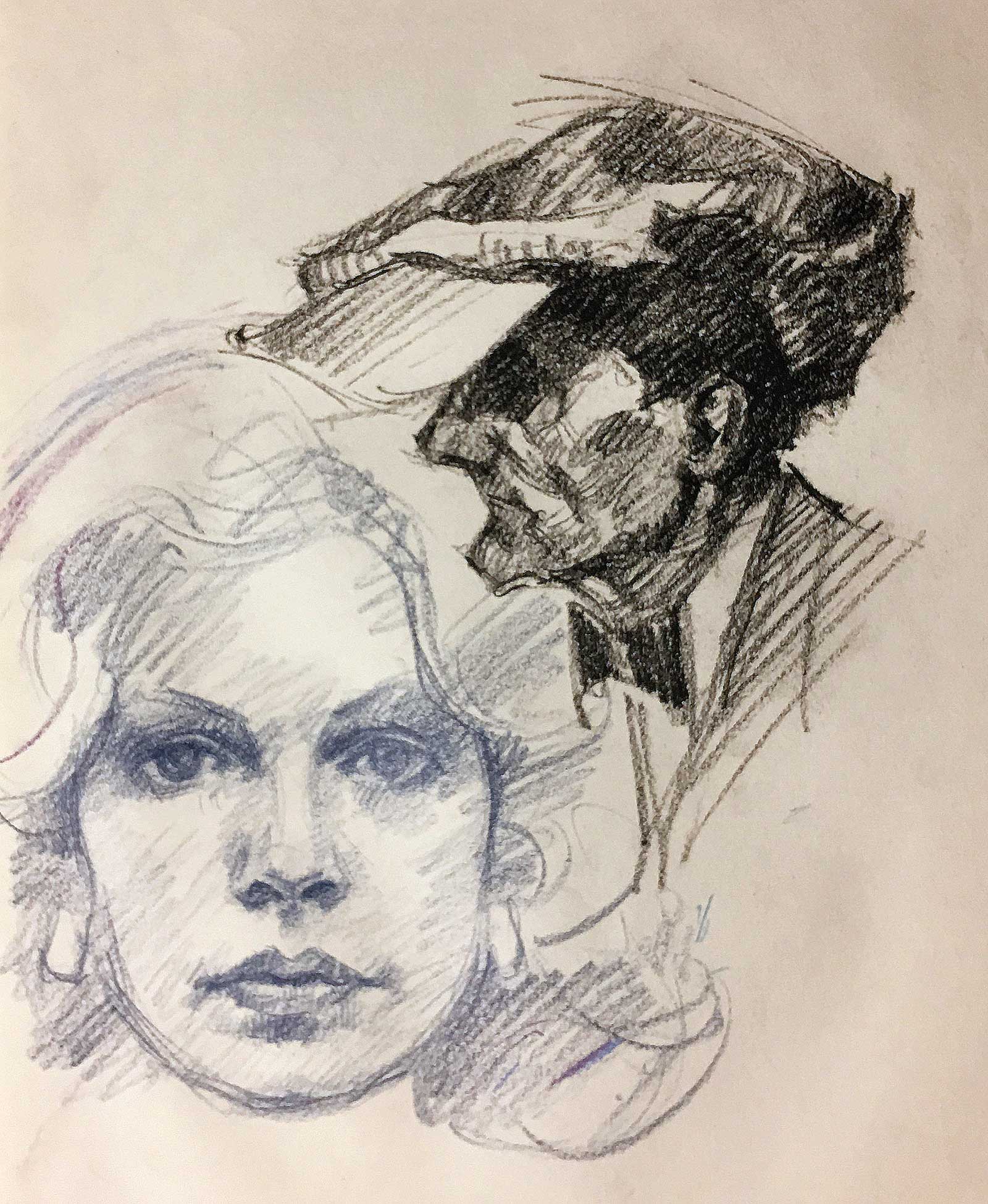 The Page
THE PAGE
My art life has been wonderfully filled with unforeseen moments. I was in a location I would soon have to leave. I love to draw wherever I am, and started sketching that fellow. I liked the shape of his cap and facial shadows; there was a mystery about him. Then, all of a sudden I saw this woman’s mesmerizing face. I needed to draw her, and there was very little time.
Here was the problem: All I had was this one page left in my drawing pad. Without further ado, I started drawing her. The pencil strokes as you see them makes her face relatively larger. Not a bunch of room, but under those circumstances, you do what you can and how you feel. I was excited as her facial expression developed before my eyes, as if she was appearing out of a mist. Alive!
I’m very happy with the way things turned out. Two people who are quite different, but in my eyes, artistically work well together. The fellow is into his own world. The lady seems to understand me, and I’ve wondered what she might have said if given the time. Like much in art, unusual happenings bring out the unexpected. The moment was right: two individuals, one page. There they are, connected forever.