There is something magical in the process of taking a delicate flower and painting it large and bold, as if it will last forever. Working in an oversized scale offers a sense of solidity and allows me to create natural images that feel reliable and permanent, almost monumental, like a sculpture. The paradox here, of course, is that nature is entirely impermanent. The subtle iterations of a flower blooming last only a few days, but I want to capture those moments as if they are sculpted in stone.
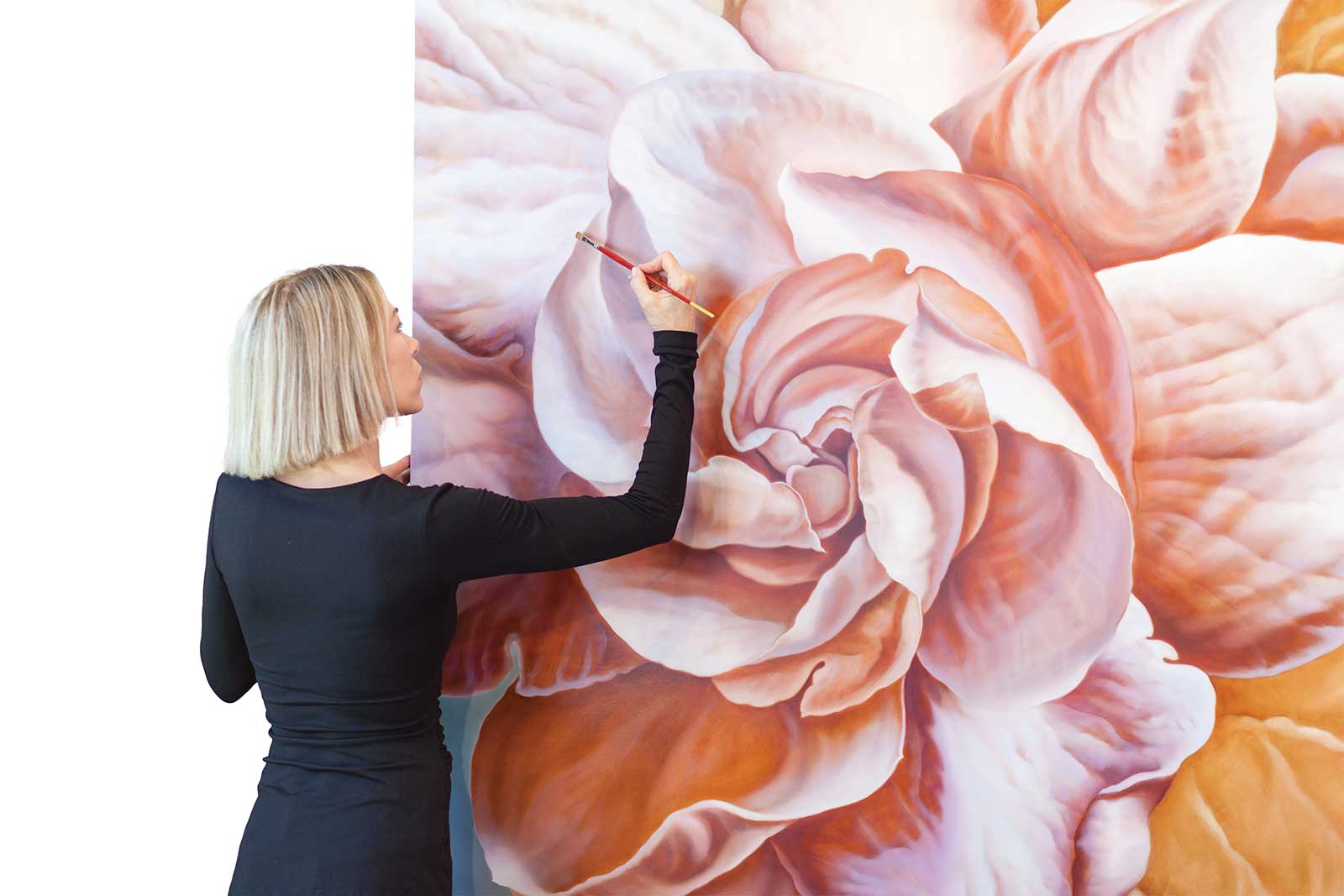
Carin Gerard
My passion for painting natural imagery comes from a desire to turn my classical training into a contemporary vision of the beauty in nature. Painting objects like flowers, butterflies and skyscapes felt almost predestined because of my need to create a life that was serene and calm, unlike my childhood. I remember as a young girl watching my mother paint; she often encouraged me to draw alongside her. I always had a sketchbook in hand, and she said I would be an artist when I grew up. Yet, at the tender age of 9 or 10, I didn’t want to follow in her footsteps because life as an artist seemed unpredictable and unstable. She passed away when I was 11 due to substance abuse, and my sister, brother and I were separated and put into foster care. Without family, I turned to drawing to keep my mind occupied and feel connected to my mother.
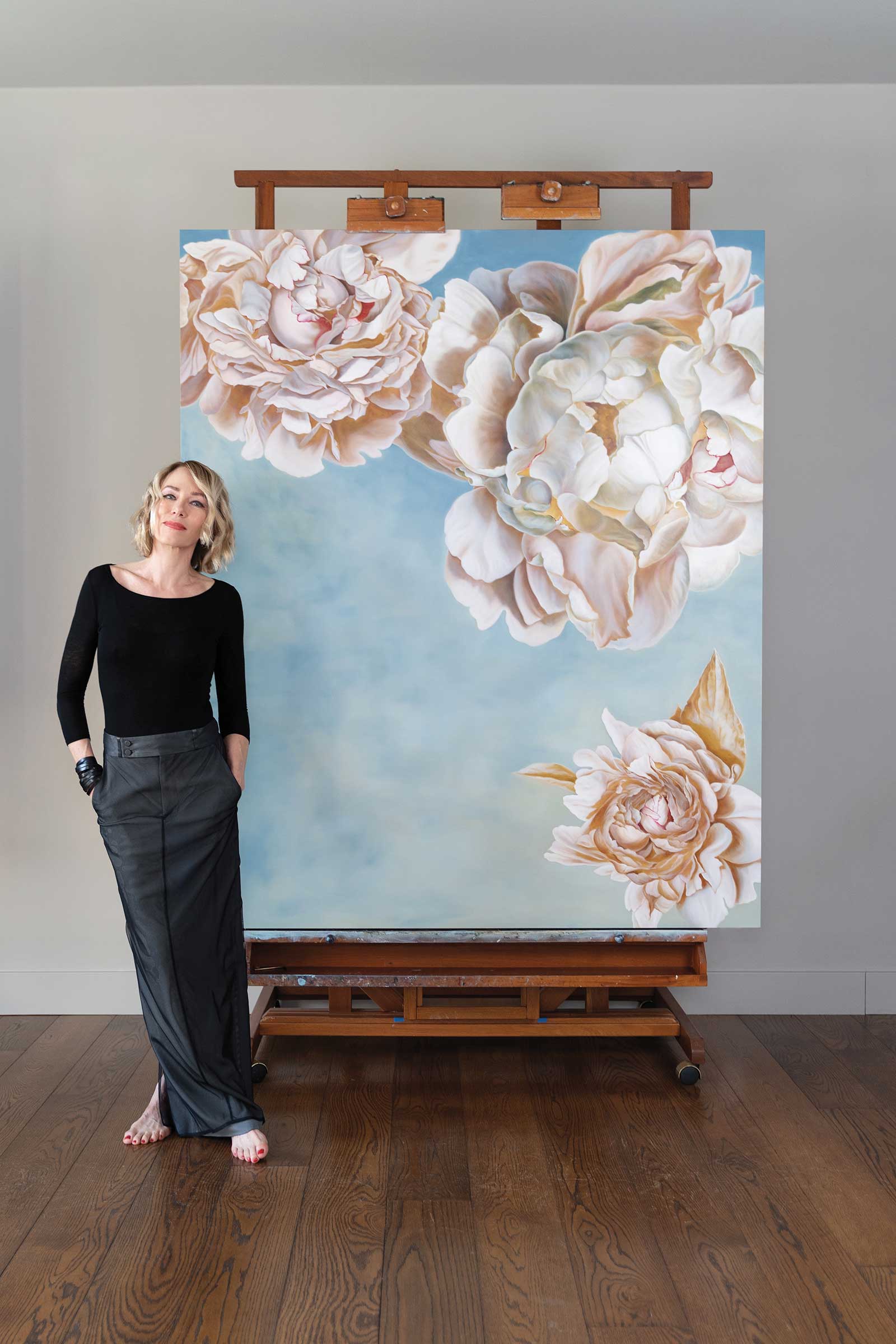
Carin Gerard
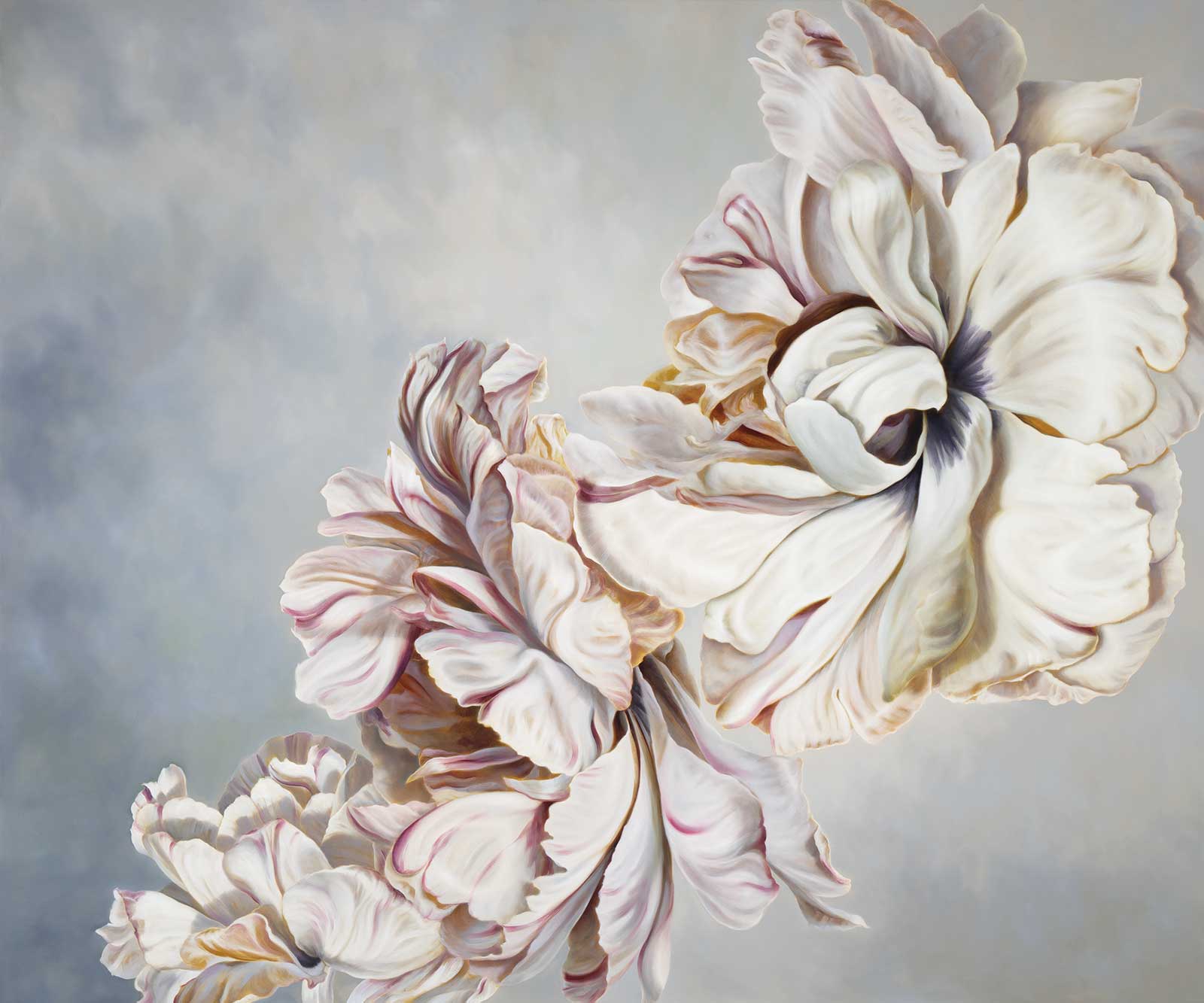
Jonquieres Tulips, oil on linen, 50 x 60" (127 x 152 cm)
For these reasons and more, order and stability are incredibly important in my life, and my large-scale paintings offer a necessary balance of vulnerability and solidity. I want my pieces to arouse a sense of the tangible and the magical, so viewers feel entwined and engaged, like they can step into a piece and become part of it. I appreciate the interplay of what is real and present versus what is inspired and dreamlike. I’ve always been interested in exploring how art contributes to feelings of hopefulness, and in that way, I want my work to translate seamlessly from reality to fantasy. I’m not interested in creating art that is photorealistic, but rather endless in its possibility. I think we all need a renewed sense of hope, more often than not.I began my formal artistic training at Bowling Green State University in Ohio, where I graduated Magna Cum Laude with a Bachelor of Fine Arts degree. I then traveled to Europe and found inspiration in the museums of Rome, Venice, Florence, London, Paris and Amsterdam, through the timeless beauty of the Old Masters. I was determined to keep expanding my artistic horizons and paint in a style of significant meaning and depth, so I moved to the Chianti region of Tuscany, just south of Florence, Italy. For two years, I studied classical realism with Charles H. Cecil, whose art academy is one of the most highly acclaimed Florentine ateliers. While studying with Cecil and living in a 19th-century Chianti farmhouse, I created a series of 18 paintings titled Quattro Stagioni. The series incorporated the four seasons, capturing the landscape of the surrounding countryside and the charm of the Tuscan villages.
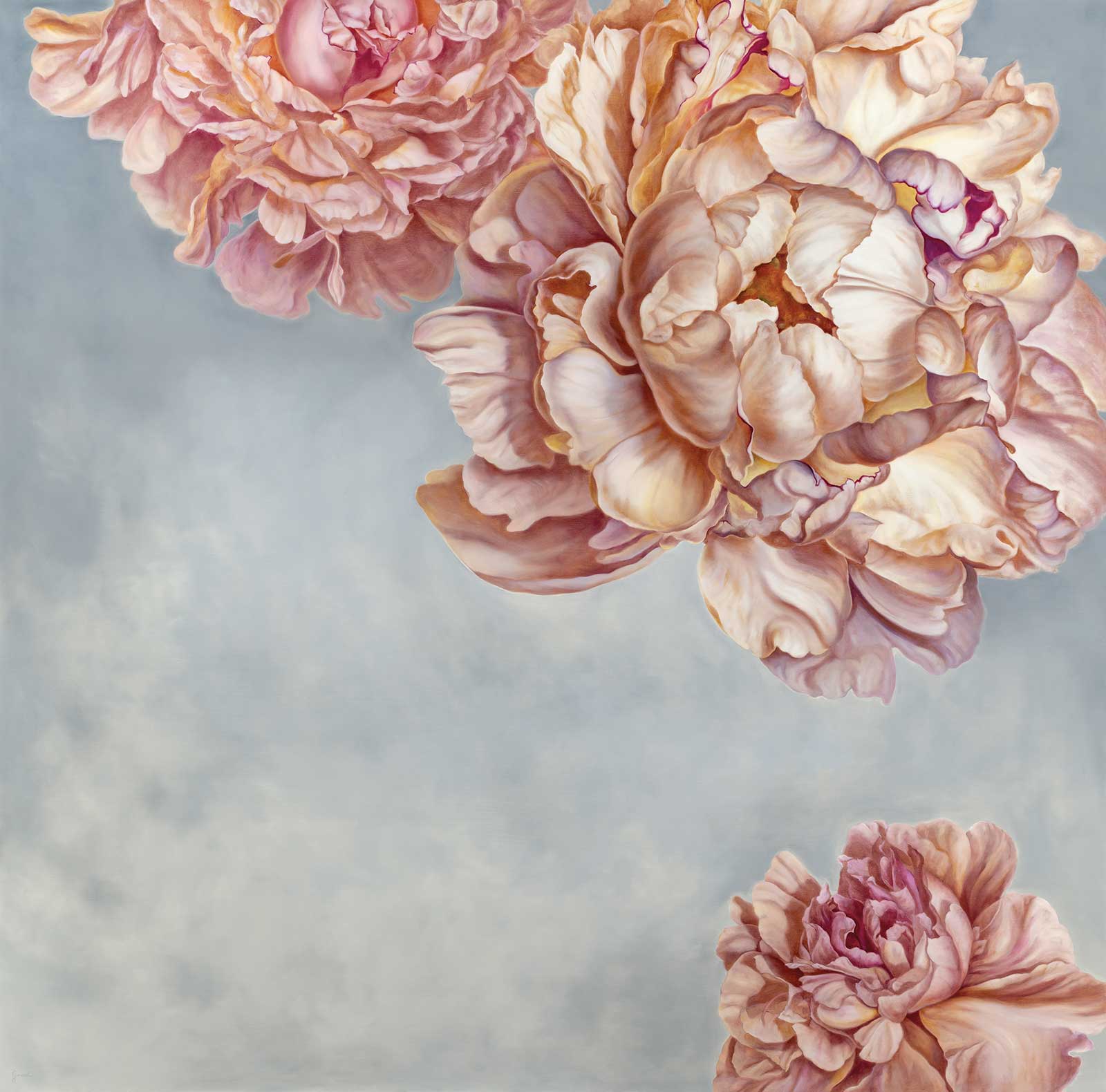
Poetic Peonies, oil on linen, 70 x 70" (177 x 177 cm)
In Florence, I was trained in the “sight size method” where everything is fairly true to size, but I quickly felt a pull away from reality and into fantasy and spirituality. Digging deeper into the inner beauty of a flower, for example, allowed me to reimagine the form in size and color. I feel as if I could step into it and lose myself for a moment in time. For me, it’s important to be able to escape into my studio and paint a luscious flower with my own modern interpretation in order to feel connected to something that is bigger than what I can see right in front of me. “Larger than life” feels like the perfect way to describe it.
My exaggerated compositions create a modern interpretation of a classic theme, or rather, a classic technique. I focus on the innermost qualities of my subject and build out, which allows me to emphasize its ever-shifting objective and physical beauty without an expectation of perfection or exacting realism. My most recent pieces are looser and more ethereal, and my hope is that they convey a sense of resilience and purpose. Using grisaille, my paintings are executed entirely in monochrome or near monochrome. This artistic style creates a relief effect and sculptural quality that makes the objects on canvas feel tangible. Working with such a limited palette requires me to focus on the intricate, subtle beauty of contrast. Highlights and shadows on the organic objects become dramatic, volumetric forms. There is a story behind every shape and a feeling behind every shade. Painting in this way has forced me to return to the fundamentals of my training. I read color values to create the dynamic interplay of dark and light—it is the essence of the Italian chiaroscuro, the drama of darkness and lightness. My paintings have twists, turns and textures that feel sensual if not categorically sexy. Painting something that is pretty is never my goal; I strive for an image that is powerful and unexpected. I invariably find more information in my images than I initially expected, where the inspiration is right in front of me—I don’t have to make anything up. My hope is that people will first see the pop of the image, and then slow down to interpret its drama. When we do this, it becomes effortless to feel the subtle depth, movement and life in each piece.
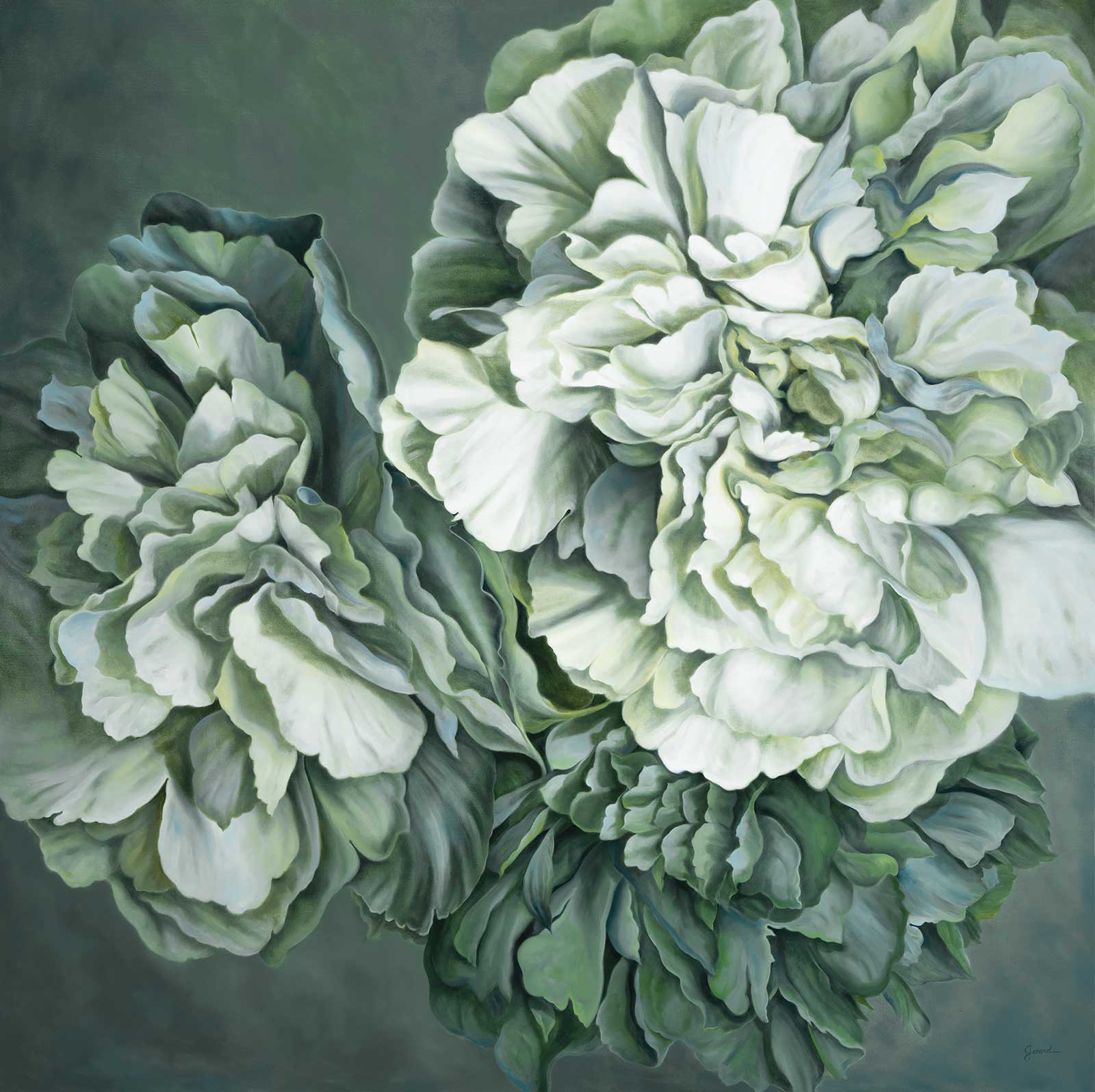
Misty Floral, oil on linen, 50 x 50" (127 x 127 cm)
My process begins with sourcing my subject matter, taking hundreds of reference photos and finding one that is powerful. I sketch it in my journal to find a composition that resonates with me. I’ll be spending up to three months with this image on a canvas, so I want to love every stage! From there, I draw it out full scale on vellum to transfer to my canvas. I then determine the size and order my structure. I say “structure” because what I paint on—the fabric I choose—is an essential choice. I have tried numerous linens from various companies, and they all react differently depending on the texture of the linen and how many coats of gesso are applied. I used linen from a company in France for many years, but their gesso formula changed, and it does not accept my oil paint the same way any longer. I have run into issues with certain fabrics because of adhesion problems, which can be due to many factors including the actual medium in the oil paint. For example, one company puts damar varnish in their pigment and it is not listed on the label—this was causing an adhesion problem for me. Also, determining the medium and the process of fat over lean can make a difference too. I work with Oleogel (ground silica and linseed oil) from Natural Pigments and also use their linseed oil, and my high-quality mineral spirits are by Vasari or Natural Pigments.
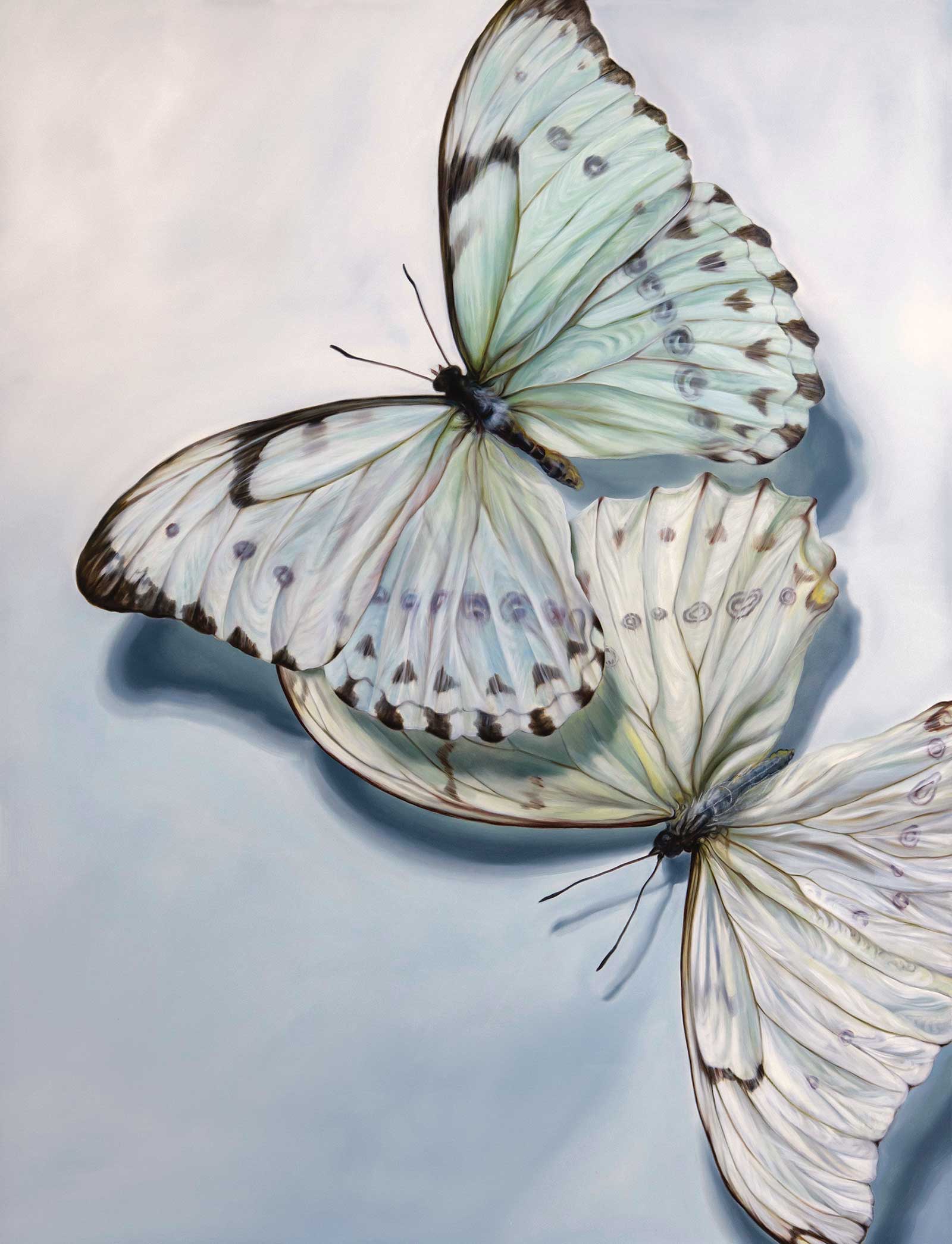
Connectivity, oil on linen, 60 x 46" (152 x 116 cm)
All my structures are made by hand, and right now I am utilizing Simon Liu in New York. He uses beautiful maple wood for my stretcher bars, and I choose either a full wood panel with linen stretched over the panel or his mechanical stretcher bars with linen. The reason I prefer the panels, even though they are heavier, is because they are more archival and safer from damage or puncture. As far as my paints are concerned, I use mostly hand ground pigments from companies in the United States. Vasari, Rublev Colors, Michael Harding and Williamsburg are my favorites. My brushes all come from either Zecchi’s in Florence or Willow Wolfe in Canada, and my journals come from Parione in Florence.
When I am ready to begin a new piece, the first thing I do is tint my canvas. This is called the imprimatura, and it will affect all subsequent layers of color, so I use different colors to stain my canvas depending on the color palette. After the imprimatura is dry, I transfer the drawing onto the canvas. I start using what is called a wipe-out process to create my grisaille, brunaille and verdaille. This is a part of the process that I truly enjoy because I start to see my composition come to life, as if it is emerging from the canvas. It is another reason why I love painting flowers. Their three-dimensional qualities are compelling, especially on floral varieties including peonies, gardenias and magnolias. My pieces find their foundation, quite literally, in the grisaille or underpainting, which is typically underdeveloped, monochromatic and hazy. I’ve realized this is my favorite stage. I have typically pushed myself to develop it and move toward perfection, but right now it feels important to recognize what is inherently beautiful. Why not stop when I feel the most joy in it?
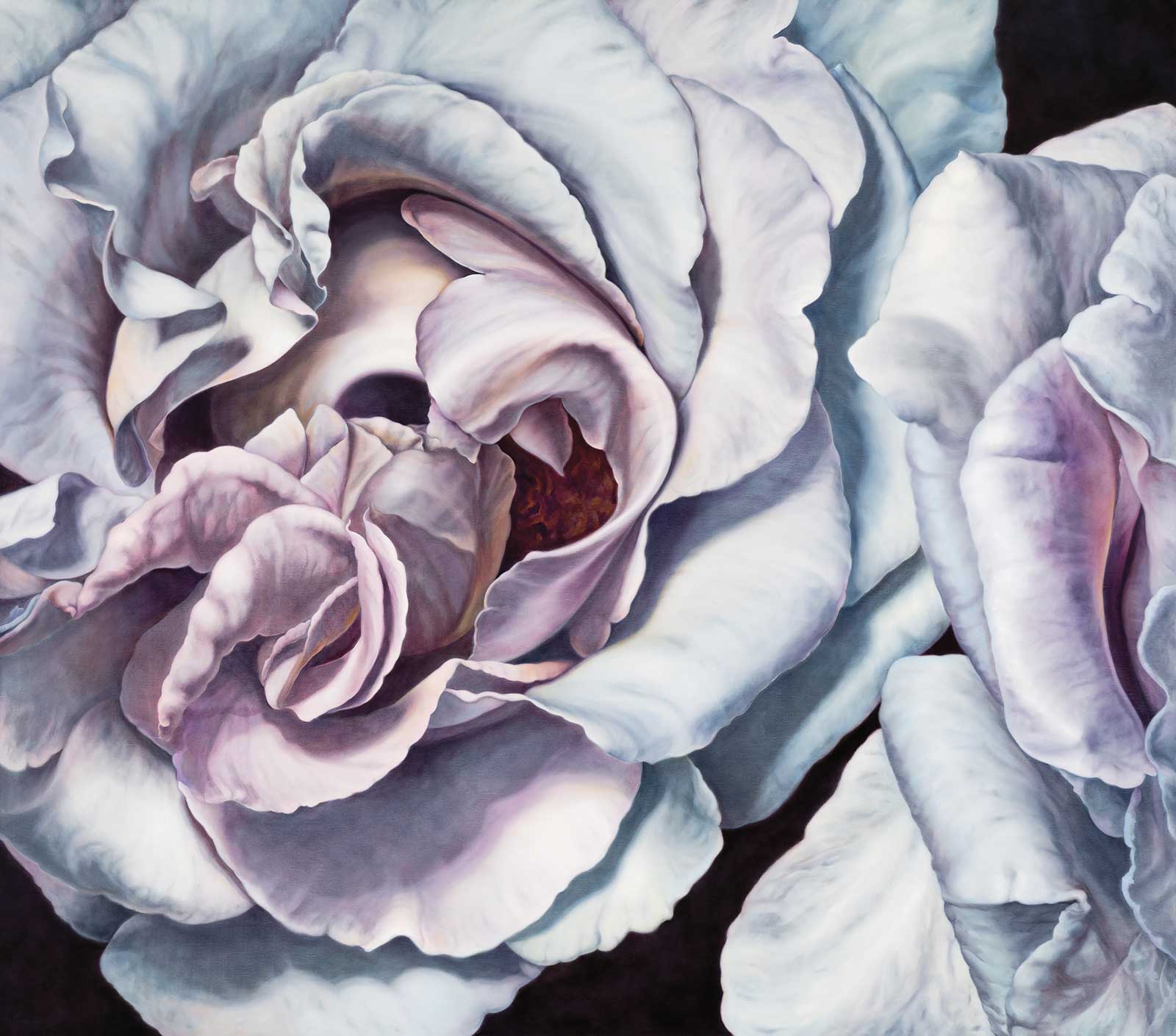
Two Tone Rose, oil on linen, 60 x 68" (152 x 172 cm)
My perception of the world is rejuvenated through painting, when I can take seemingly simple, natural objects and bring them to life. In addition to flowers, butterflies have been a consistent theme in my work, and these pieces delve more into an array of colors to showcase the soft, fluttering fragility of each subject. Butterflies represent hope and new life, yet I deeply feel how brief and fragile that life is. Trying to express this transient beauty is always a welcome challenge; they are living, dying or changing in the same breath, and hold beauty at every stage. I enjoy conveying a story beyond the external paint strokes that portrays the everlasting quality of nature’s innermost beauty.
I am also experiencing and expressing the power of renewal in my new exhibition titled Awakening. It explores the evolution in my work in parallel process with the evolution in our world. I’ve been emboldened by recent societal and professional evolutions, and am eager to contribute art that invokes both purpose and power. We are emerging in such unexpected yet intentional ways. My hope is that my work consistently offers an element of timely, provocative surprise that highlights the beauty of the real world with a modern twist. —