The evolution of an artist’s style and technique is always the story of an interesting journey. Often, there is an early commonality among artists; a childhood love of drawing and reinforcement by a parent or teacher. Later, a network of experiences and opportunities forge a unique path. Art always makes sense in retrospect, a culmination of many unique proclivities and influences.
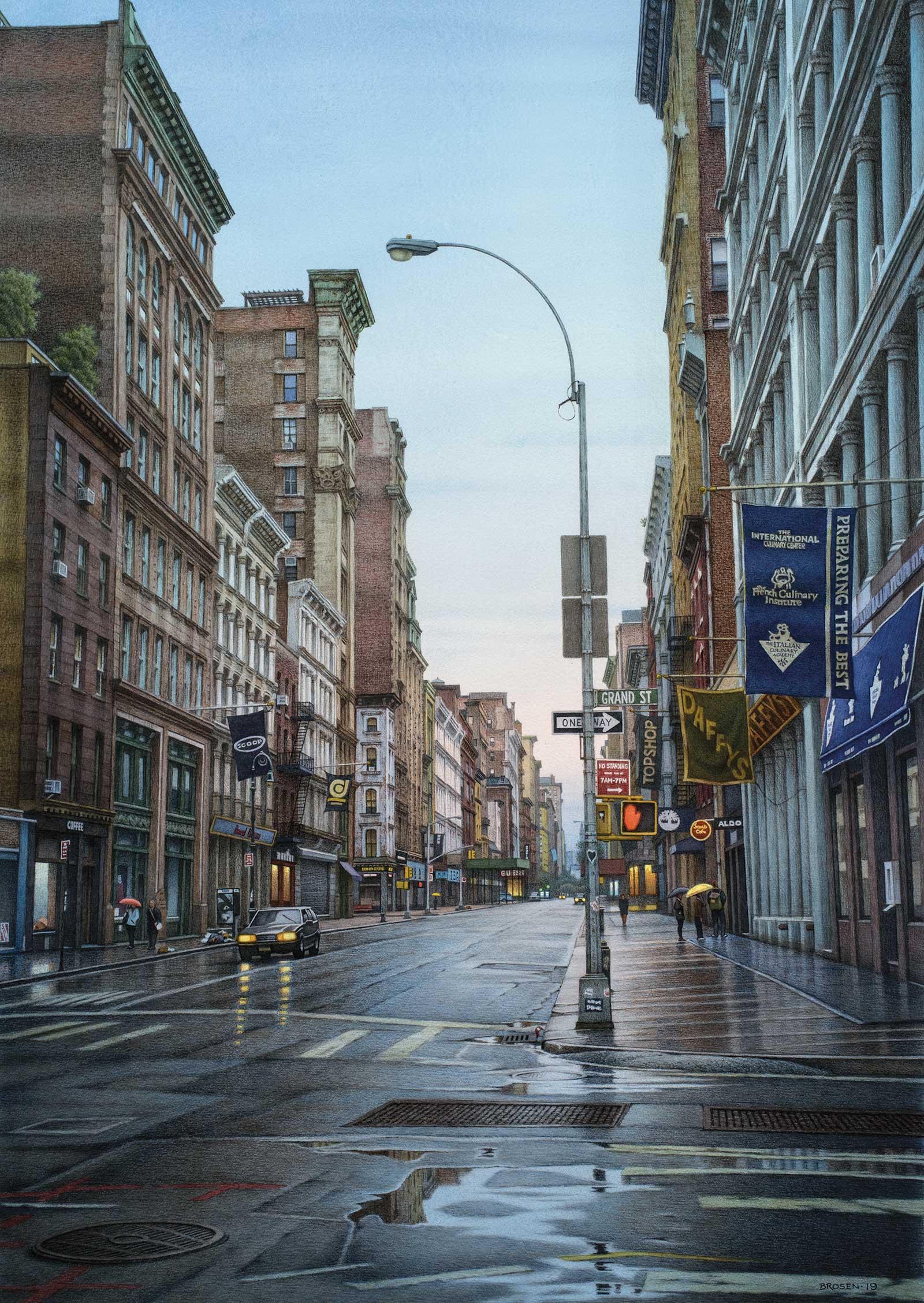
Grand Street and Broadway, watercolor, 48 x 32" (121 x 81 cm) This large work captures the empty wide expanse of lower Broadway on a rainswept dawn. The high horizon line creates a broad take into the distance of the reflective ground, a main focus of the painting. The central lampost bisects the composition and acts as a spatial barometer against the receding space. One of my favorite lamposts of the many I’ve painted! Creating the overall glow and movement of light was created with several initial wet-in-wet washes before any local colors were applied.
Upon first viewing my work, people often ask, “Why this approach to watercolor? Why architecture?” Simply put, my mother took genuine pride in my childhood drawings, and my father had a love for architecture. He knew the anecdotal stories behind the buildings we saw in our New York City neighborhood, and his stories engendered a sense of mystery, of hidden secrets behind the facades. This romantic sense of wonder instilled by a unique feeling of place is what transported me as a child, and is ultimately what I seek to recapture in my paintings.
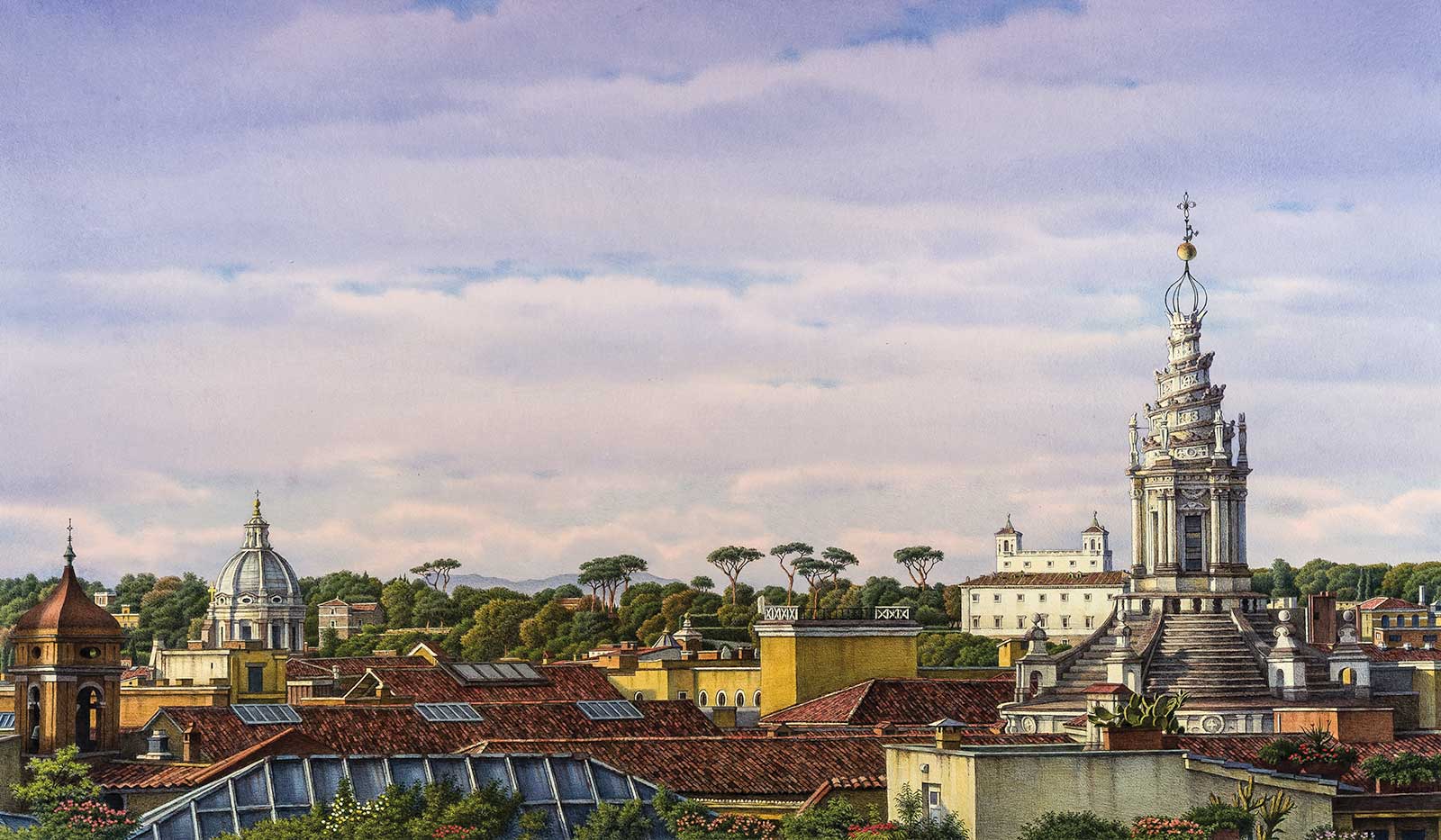
Roman Rooftops, watercolor, 30 x 52" (76 x 132 cm) This panoramic view from the Campo de' Fiori captures the beauty and variety of Roman churches and towers. The piece also features the multitude of the hidden rooftop gardens nestled among the old structures. La Dolce Vita! This large cloud filled sky presented a real challenge, and required over a dozen wettings and rewetting to develop the complex layering and soft edges of the cloud forms.
As a student, I had the serendipitous benefit of two influential teachers at the City College of New York—Dr. Jacob Rothenberg in art history and Prof. Bill Behnken in drawing. They instilled in me a love of the Old Masters through their passion and depth of knowledge. In the same period, I went to Amsterdam for the first of many visits. Besides the thrill of being there as an 18-year-old, and the attendant pleasures, I became enthralled by the Rijksmuseum, and by Dutch 17th-century art in general. It was the combination of the great beauty and technique of Baroque painting with the remarkable accessibility of Dutch art that captured me. The cityscapes and tavern scenes never looked down at the viewer, but invited them in. We are one of you, they seemed to say. Then, upon leaving the museum, you would walk into the cityscapes you had just encountered on the walls. It seemed a magical confluence of art and life, and I was hooked! Over the following several years I was fortunate to have the opportunity to travel frequently and to study the art of past masters of landscape and cityscape in depth.
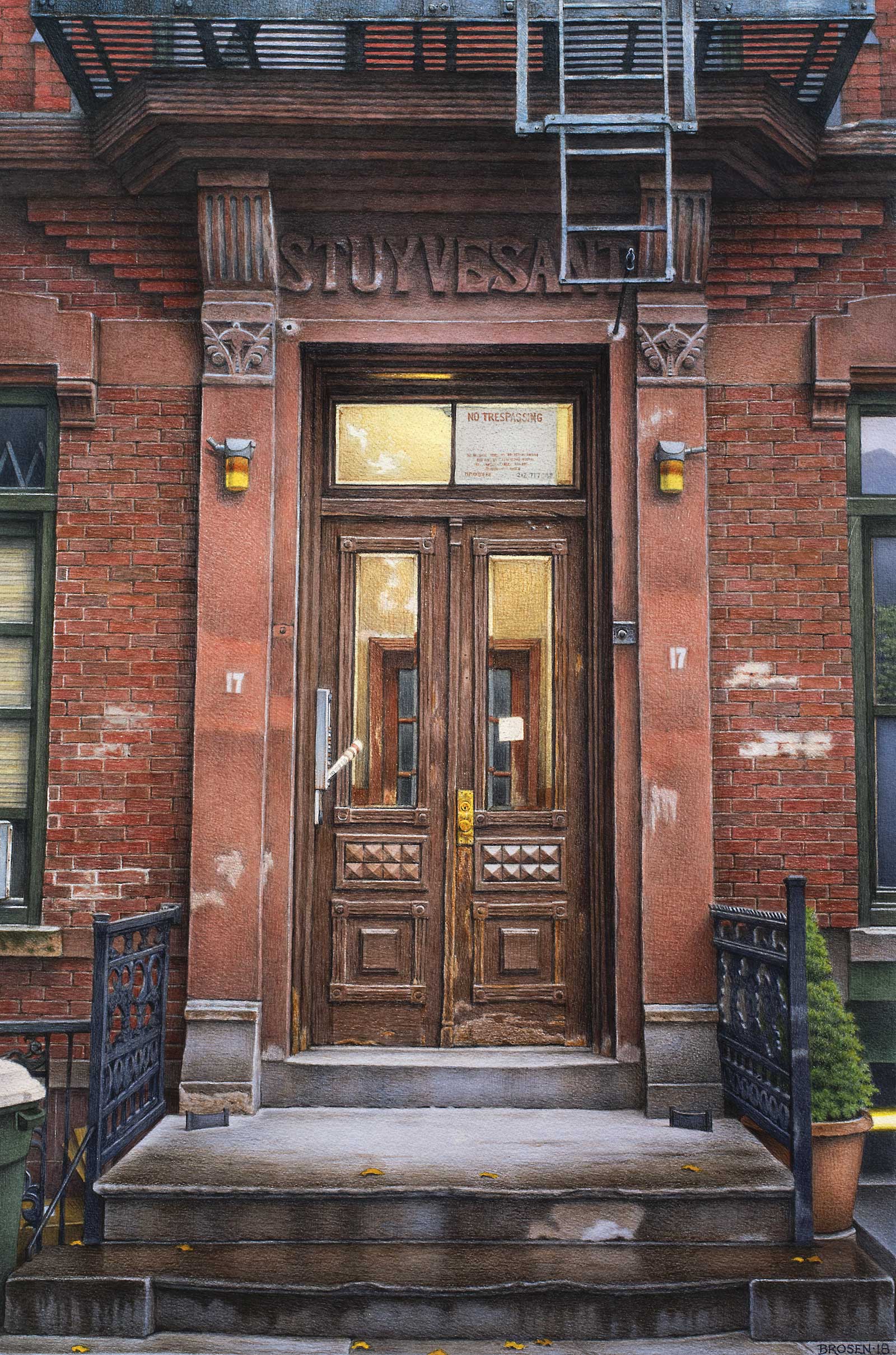
Stuyvesant Street, watercolor, 35 x 23" (88 x 58 cm) This East Village working class facade on one of Manhattan’s oldest streets is redolent with expressiveness. The unrenovated, or “benign neglect,” creates a multitude of suggested stories. From the Boot Scrapes on the left and right, the worn stairs and door and the interior glow, it speaks of a sense of condensed experience. The wear and tear of the many who have moved within.
I am somewhat of a purist as relates to transparent watercolor. I use no gouache or opaque paint, all my highlights are created by the white of the paper, and so are painted around using darker colors. I do a finished drawing in hard graphite, 4H and 6H most commonly, over which I glaze as many as 20 layers of wash to build my darks. The hard graphite, once treated with an overall initial wetting, bonds to the fiber of the paper and so does not lift or smear when color washes are applied over it.
The art of cityscapes is essentially one of spatial construction. My painting process is an attempt to create a convincing sense of depth using color transitions, movement of light and shadow, linear and atmospheric perspective and built up textures to achieve a tangible sense of space and place.
My Art in the Making East End Cottage
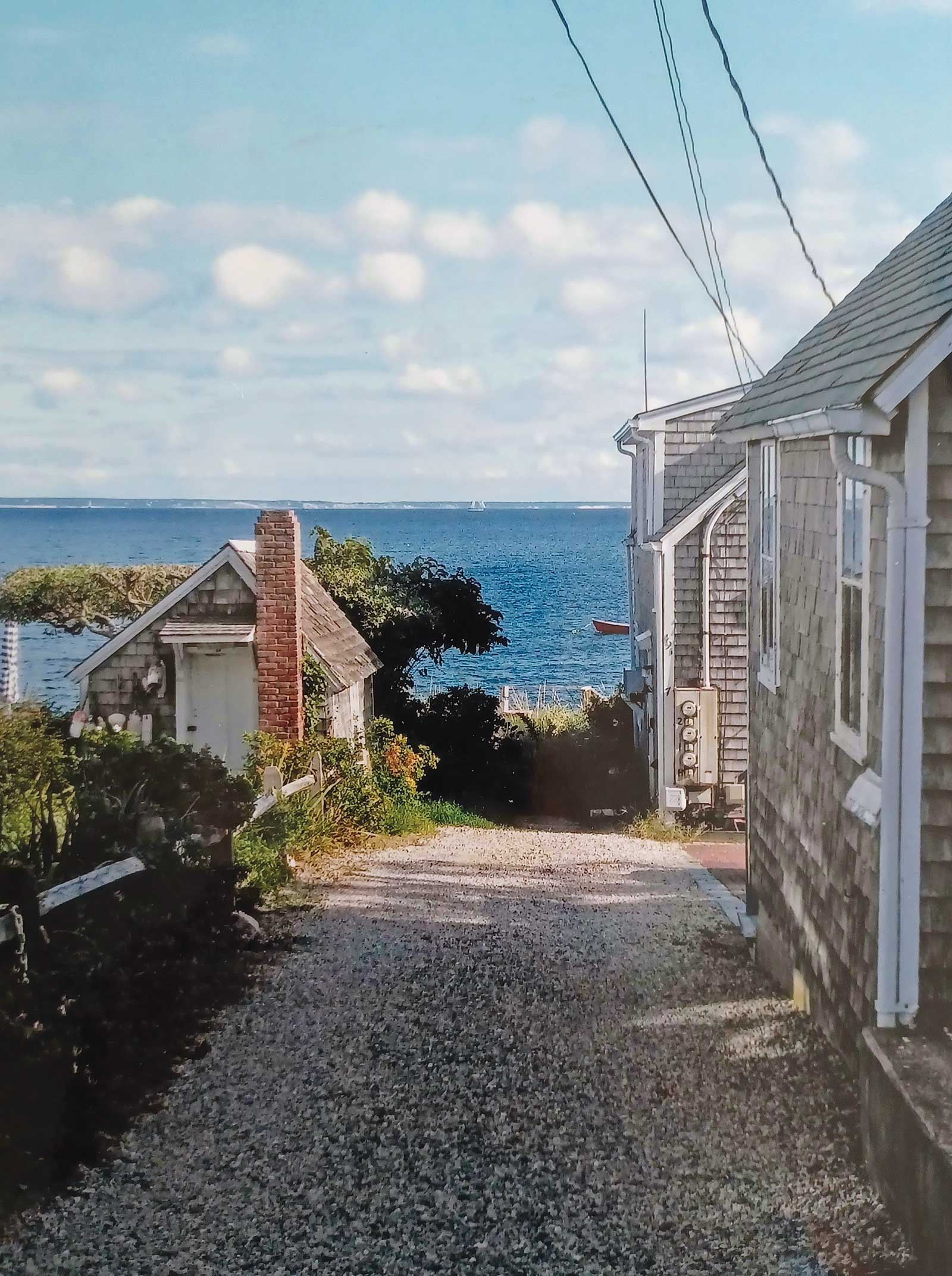
Reference Photo
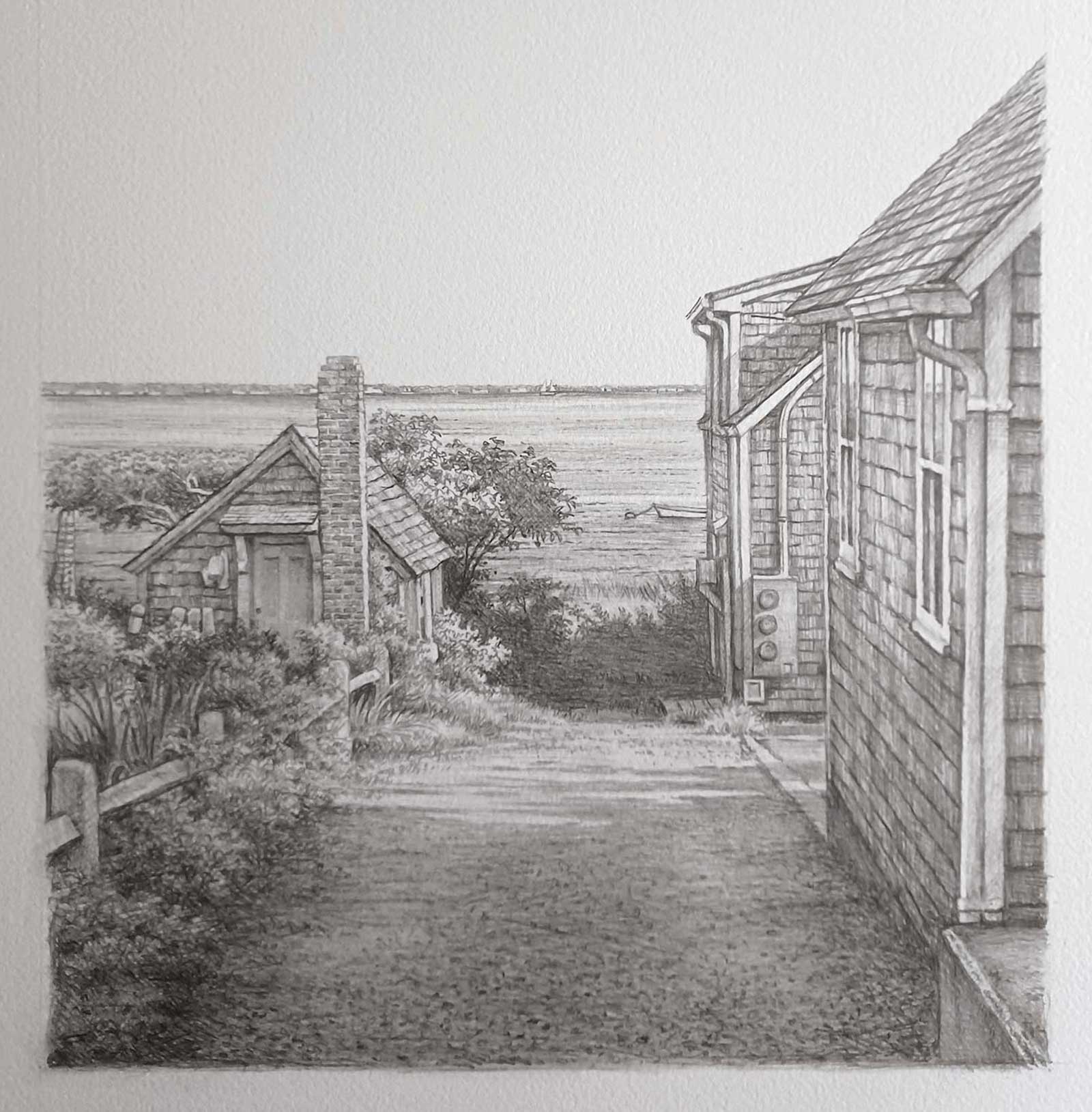
Stage 1
Stage 1 Pencil Drawing
A complete 6H graphite drawing is done in preparation for painting. The hard graphite and initial wet washes fix the drawing to the fiber of the Arches paper and so the washes of color do not lift the pencil work.
WHAT THE ARTIST USED
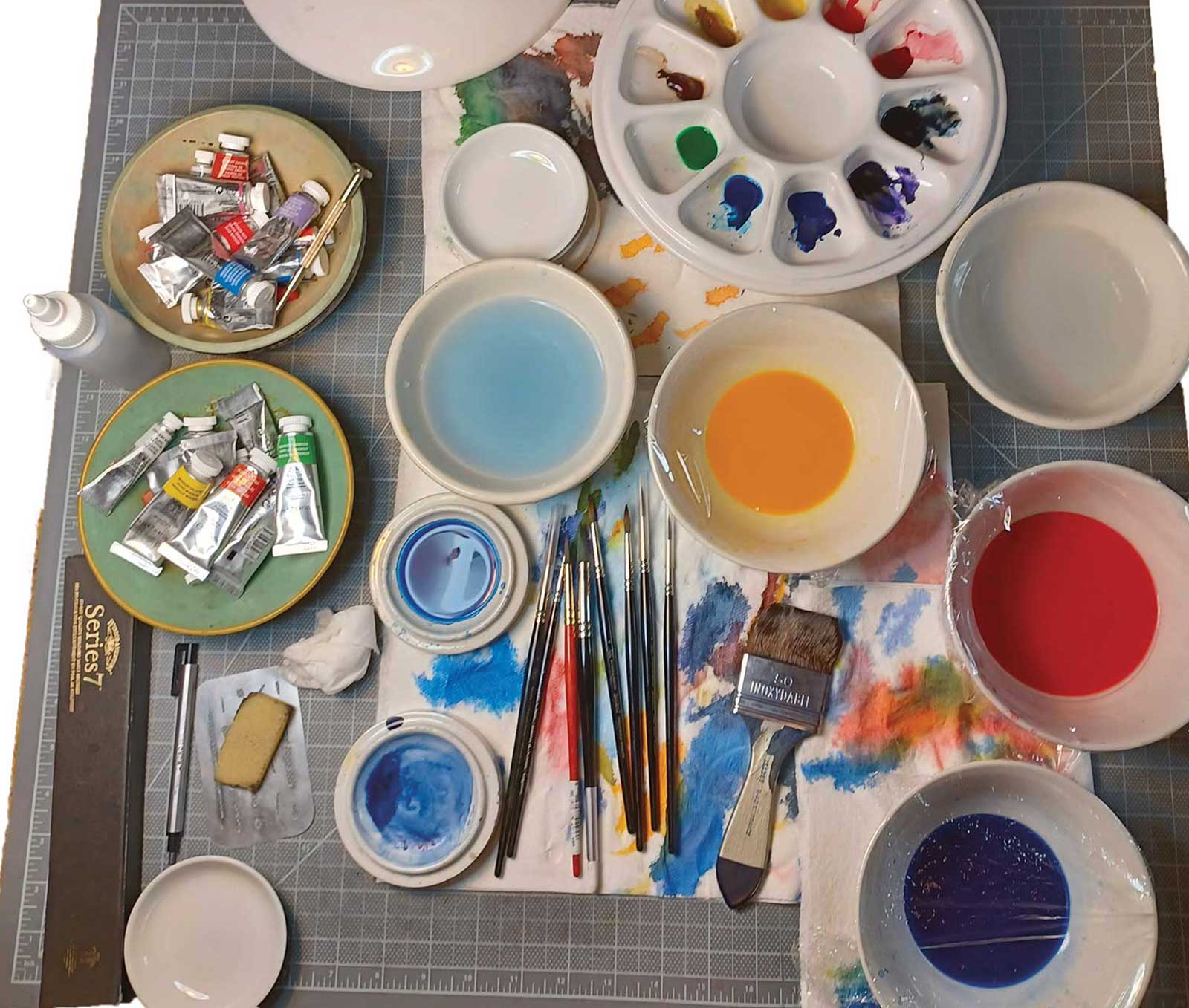
Winsor & Newton Watercolors
Winsor yellow, Winsor red, Winsor violet, Permanent rose, Burnt sienna, Raw sienna, Payne’s gray, Hooker’s green, Winsor blue red shade, Winsor blue green shade
Brushes
Winsor & Newton, series 7: rounds #2, 4, 8 and 12, Isabey Squirrel flats, 2 and 4" (listed as 50 and 100)
Paper
Arches cold-pressed watercolor paper in sheets
Additional Supplies
White ceramic flower palette, Small individual mixing dishes (sometimes called a “China Nest”), Nichiban Tape, 2" wide, Liquid frisket, Paper towels (I recommend Viva, no embossing on the sheets)
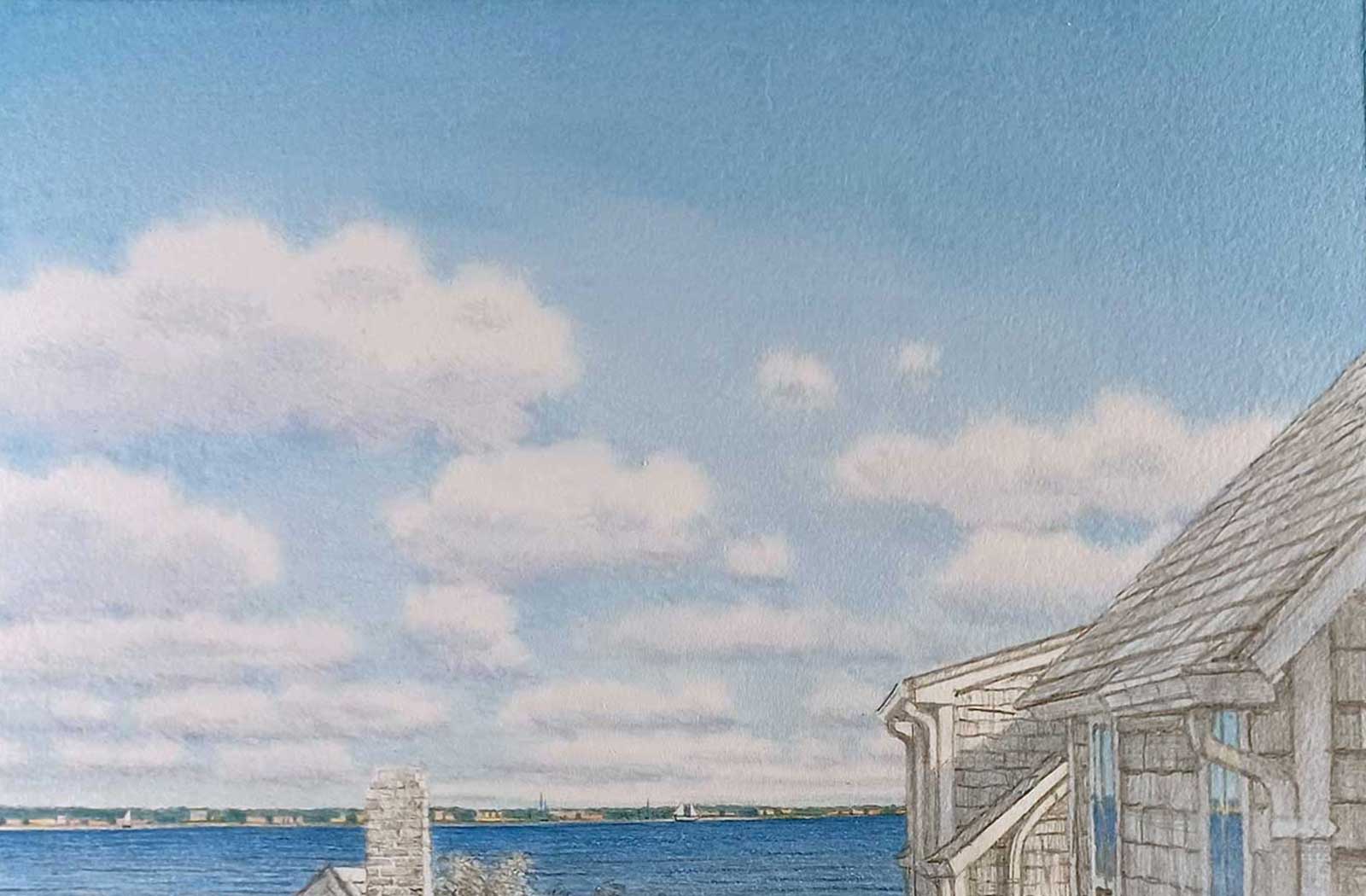
Stage 2
Stage 2 Creating the Sky
The sky has been laid in using a wet-in-wet application to achieve the soft edges of the clouds. The sliver of the background bay has also been painted using wet-on-dry washes.
My Approach and Techniques
My technique emphasizes simple materials and a limited palette, employing five warm and five cool colors for a total palette of the 10 colors listed in my materials list. I think of color simply as warm and cool; cool colors tend to visually recede, while warm colors tend to come forward. I have tried to develop a simple approach to painting complex subjects. Pure transparent watercolor can be (overly) simplified as an understanding of four applications, in this order:
- Wet-on-wet: Pre-wetting the paper and bleeding large washes of color over the work.
- Wet-on-dry: Applying local colors in washes on dry paper to achieve clean edges on specific elements; i.e., the red of a car.
- Dry brush or scumbling: The modeling of texture and details over the initial washes.
- Point-of-brush: Using a fine point round brush to crisp up edges and reinforce details.
Successful watercolor painting, from my approach, requires solid drawing skills over which those four applications are applied. Understanding the sequences of this technique, how the various layers will combine to complement one another, is achieved through years of continual painting.
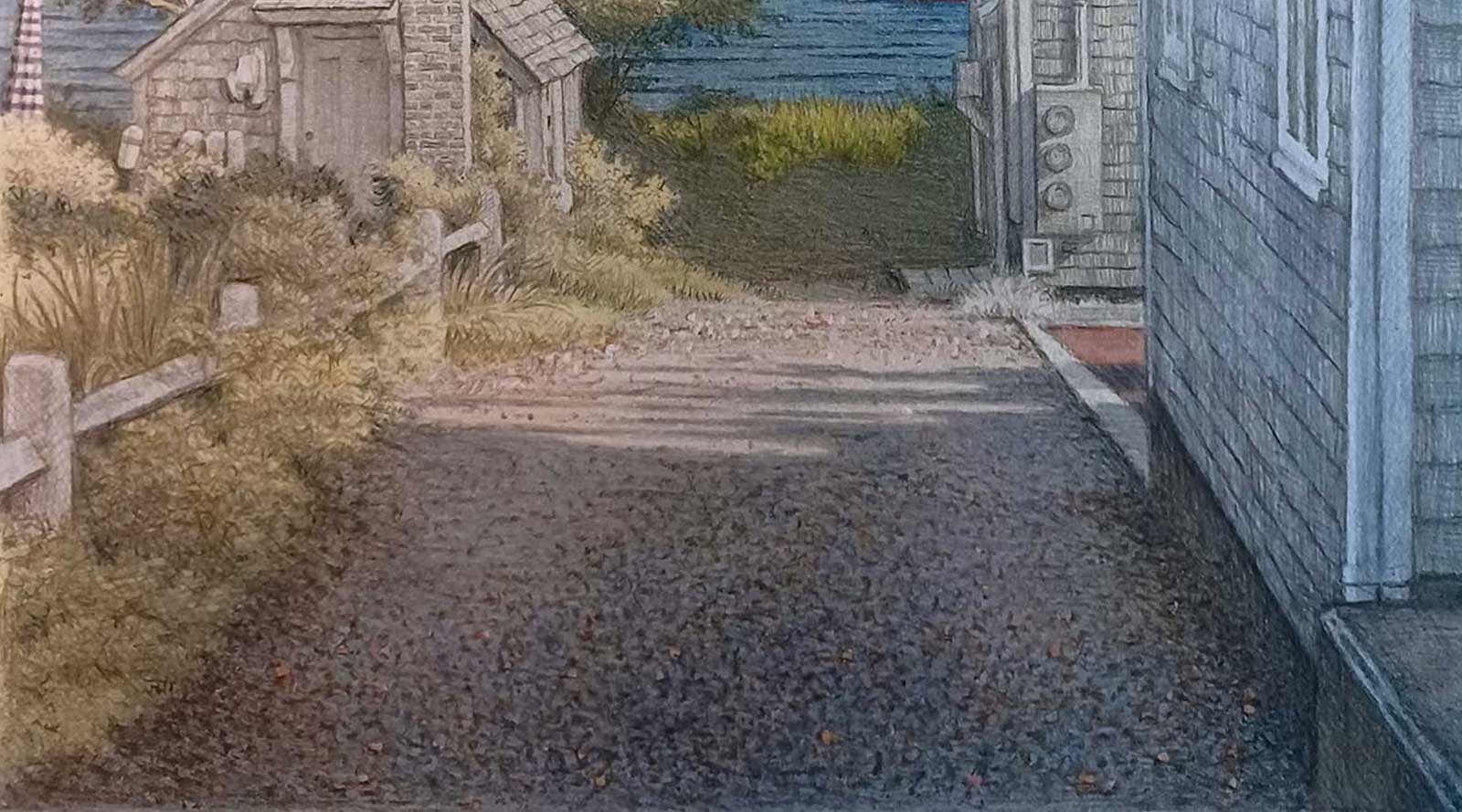
Stage 3
Stage 3 Shadows and Textures
A blue/violet light wash to reinforce the shadows has been painted, and the ground plane has been laid in using warm and cool speckled or dotted brushwork to capture the pebbled textures.
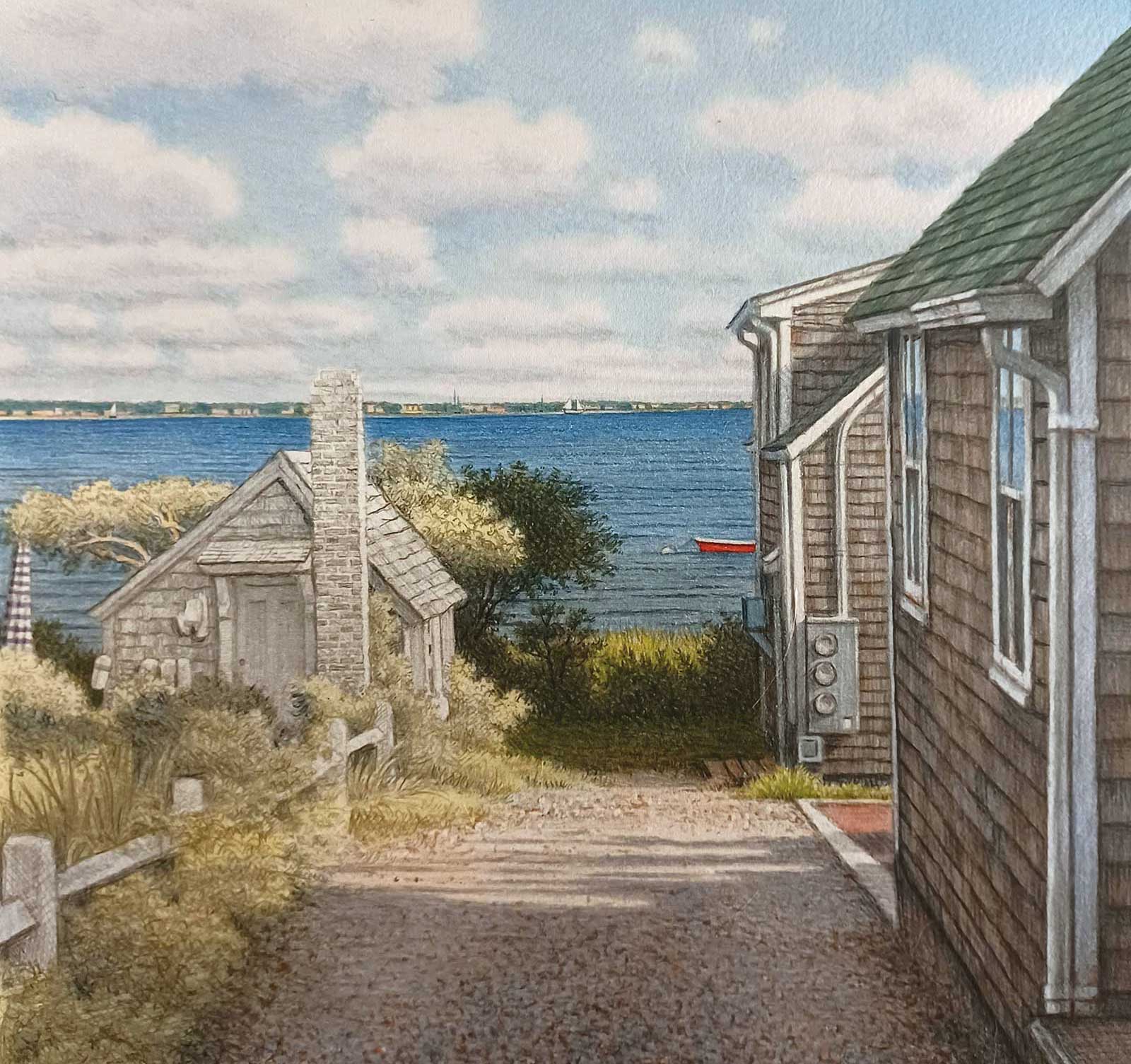
Stage 4
Stage 4 Finishing Right-Side Buildings
The right-hand buildings are completed, and the deep greens of the middle bushes laid in, establishing the dark funnel of shadow opening onto the bay.
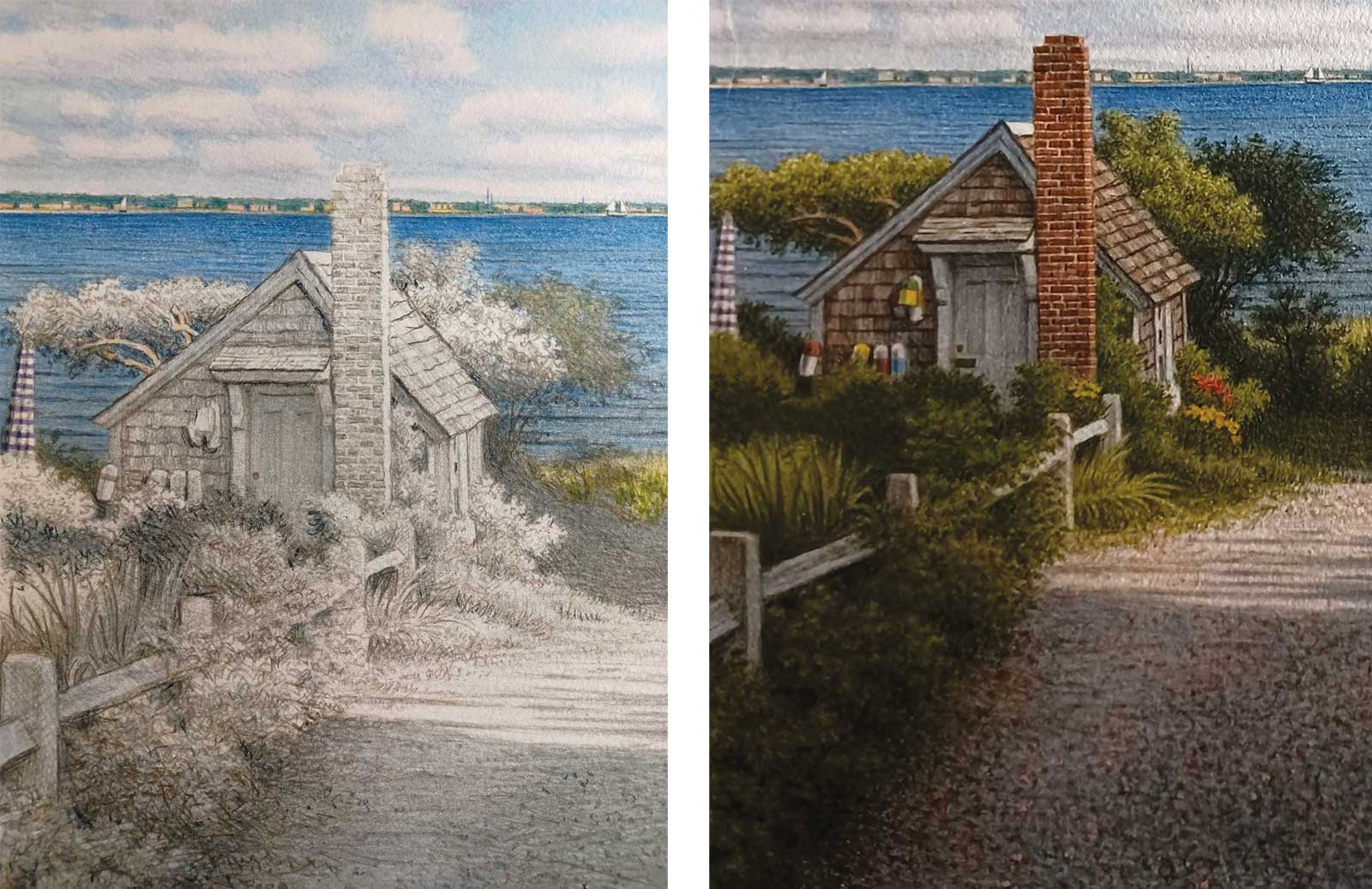
Stage 5
Stage 5 Cottage
Here are detail photos of the cottage on the left-hand side in both the pencil and painted phases.
Stage 6
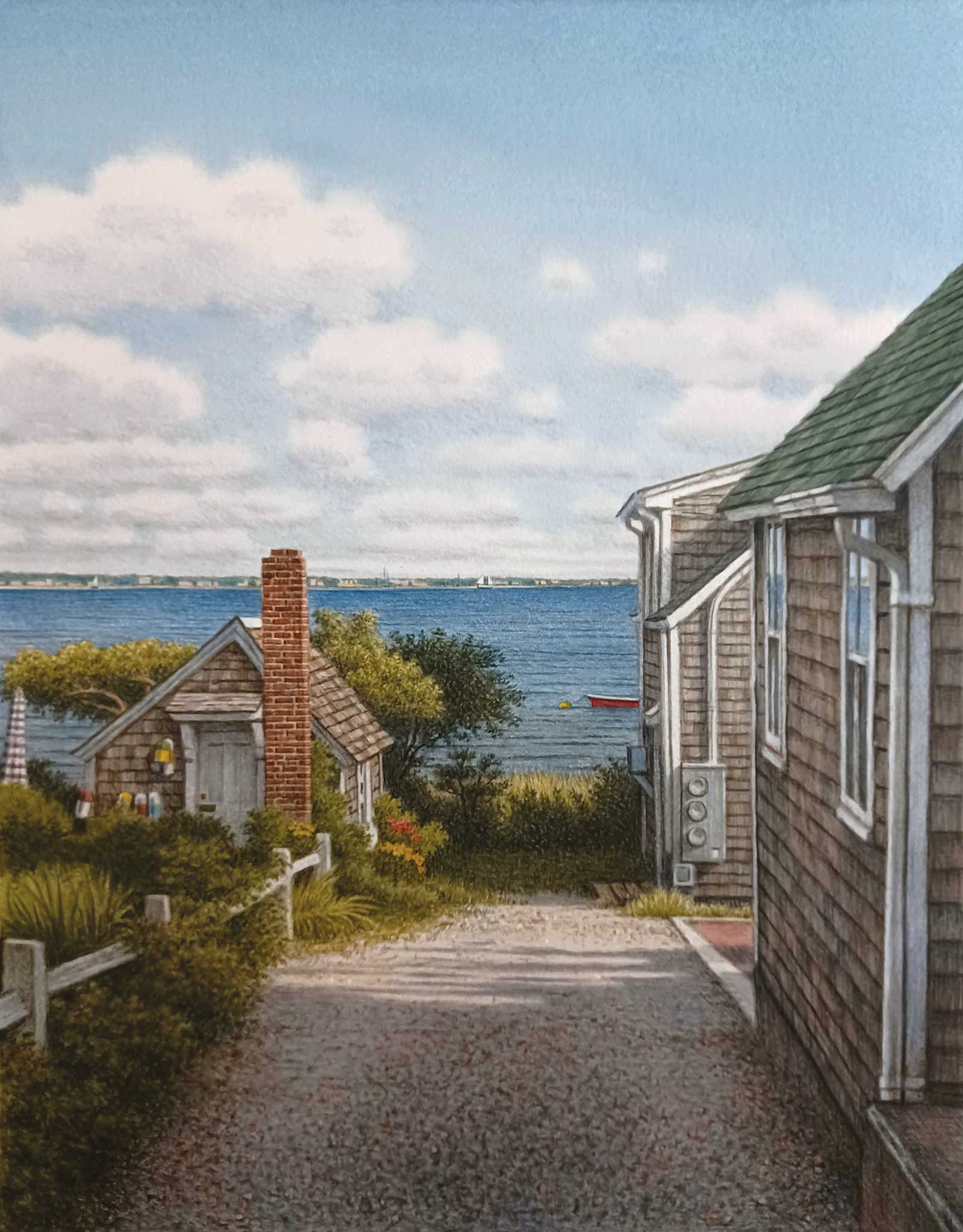
Stage 6 Finished Artwork
East End Cottages, watercolor, 14 x 11" (35 x 27 cm)
Note that the sky is different, the chimney on the left is raised and the phone wires have been eliminated from the reference photo—subtle design changes.
About the artist
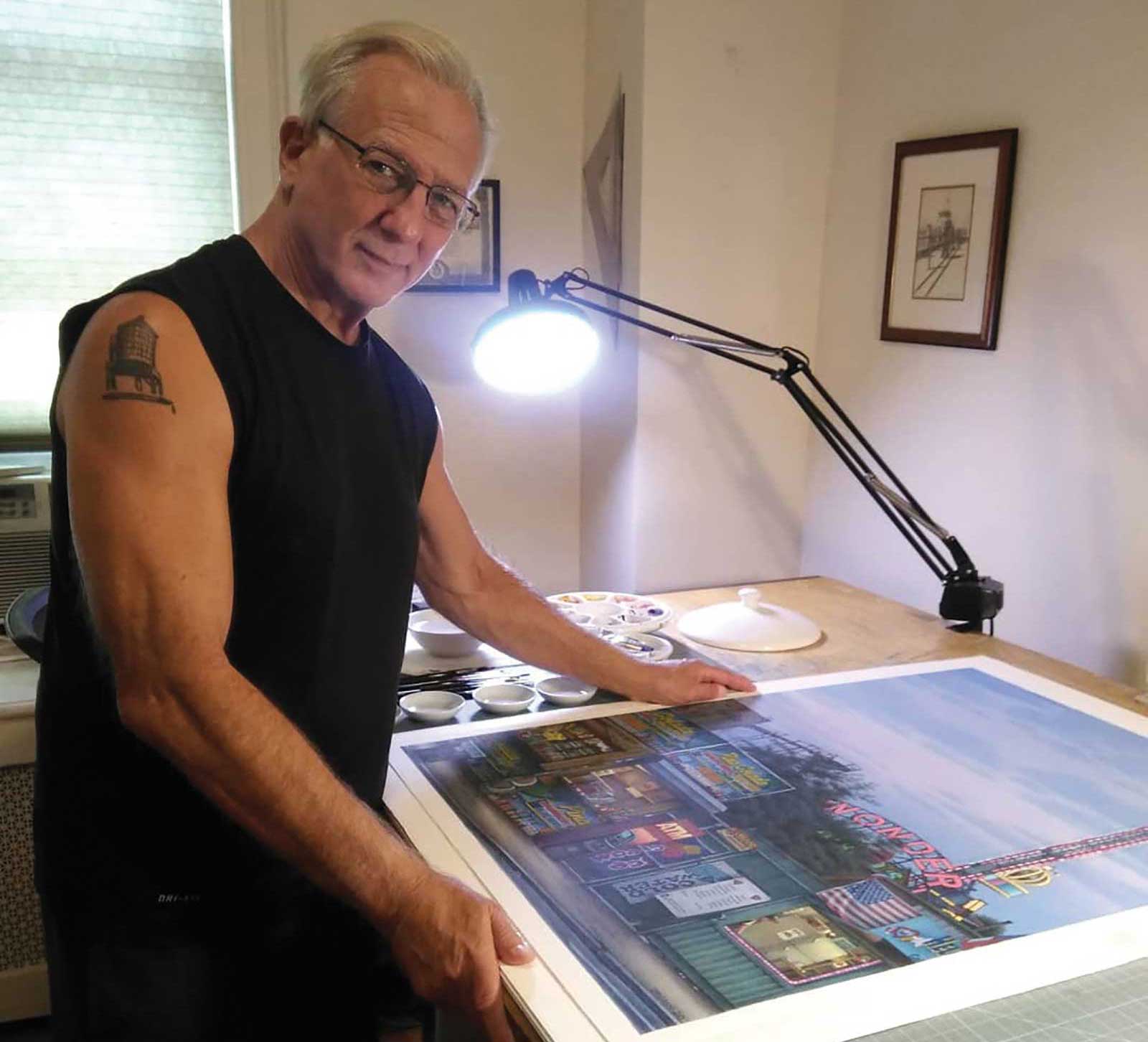 Frederick Brosen
Frederick Brosen’s watercolors have been featured in over 30 solo museum and gallery exhibitions across the country, most recently at Hirschl & Adler Modern in New York City in February 2020, his sixth solo show with the gallery. In spring 2024, the Museum of the City of New York will exhibit a series of large watercolors depicting the four seasons in Central Park. His watercolors have also been the subject of numerous solo museum exhibitions, in 2012 at the South Street Seaport Museum in NYC, in 2006 at the Museum of the City of New York and in 2002 at the Frye Museum in Seattle, Washington. The exhibition American Dreamland: Coney Island featured two of his large works and traveled to several museums across the country, ending in 2016 at the Brooklyn Museum.
In 2006 a monograph on his NYC watercolors, Still New York, with an introduction by Ric Burns, was published by Vendome Press, and in 2012 he was awarded the Lifetime Achievement Award by his alma mater, The City College of New York. Brosen is the recipient of numerous grants and awards, including two Pollack-Krasner Grants. His work is in the permanent collection of over 20 museums, including the Metropolitan Museum of Art, the New York Historical Society, the Museum of the City of New York and the Frye Museum. His work has been represented by Hirschl & Adler Modern since 2005.
His teaching credits over the last 35 years include the National Academy of Design, Pratt Institute, Lehman College and for the last several years at the Art Students League of New York, where he continues to conduct workshops throughout the year. He conducts yearly travel workshops, including a planned May 2023 Amsterdam adventure. Private individual lessons are also available via Zoom or in person.
Brosen is proud to have been designated an ARC Associate Living Master last year.
In August this year a group of his Provincetown watercolors will be shown at the William-Scott Gallery there.
Represented by
Hirschl & Adler Galleries, New York, USA, www.hirschlandadler.com